wheel PORSCHE 911 GT3 2010 5.G User Guide
[x] Cancel search | Manufacturer: PORSCHE, Model Year: 2010, Model line: 911 GT3, Model: PORSCHE 911 GT3 2010 5.GPages: 251, PDF Size: 14.33 MB
Page 38 of 251
Operation, Safety
37
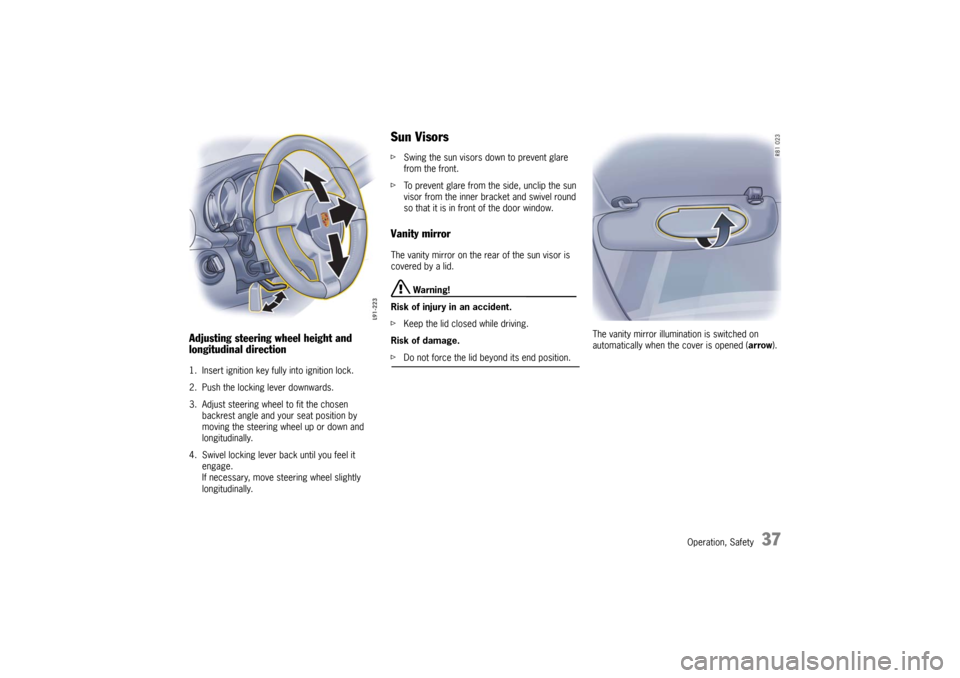
Adjusting steering wheel height and
longitudinal direction1. Insert ignition key fully into ignition lock.
2. Push the locking lever downwards.
3. Adjust steering wheel to fit the chosen
backrest angle and your seat position by
moving the steering wheel up or down and
longitudinally.
4. Swivel locking lever back until you feel it
engage.
If necessary, move steering wheel slightly
longitudinally.
Sun VisorsfSwing the sun visors down to prevent glare
from the front.
fTo prevent glare from the side, unclip the sun
visor from the inner bracket and swivel round
so that it is in front of the door window. Vanity mirror The vanity mirror on the rear of the sun visor is
covered by a lid.
Warning!
Risk of injury in an accident.
fKeep the lid closed while driving.
Risk of damage.
fDo not force the lid beyond its end position.The vanity mirror illumination is switched on
automatically when the cover is opened (arrow).
10_GT3_21.book Seite 37 Donnerstag, 4. Juni 2009 12:48 12
Page 42 of 251

Operation, Safety
41
Airbag SystemsThe airbags in combination with the safety belts
make up a safety system which offers the driver
and the passenger the greatest known protection
from injuries in case of accident.
Your vehicle is equipped with a weight sensing
system for the passenger's seat in accordance
with U.S. Federal Motor Vehicle Safety Standard
208.
Even if your vehicle is equipped with airbags, the
safety belts must be worn at all times,
because the front airbag system is only deployed
by frontal collisions with an impact of sufficient
severity.
Below the deployment threshold of the airbag
system, and during types of collisions which do
not cause the actuation of the system, the safety
belts provide the primary protection to the occup-
ants when correctly worn.
Therefore, all persons within the vehicle
must wear safety belts at all times (in many
states, state law requires the use of safety belts).
fPlease see the chapter “SAFETY BELTS” on
Page 38.
The front airbags are located under the padded
steering wheel panel on the driver’s side and, on
the passenger's side, in the dashboard.
The side airbags for the front seats are installed
on the side in the seat backrests.
The head airbags are installed in the door linings.
Danger!
To provide optimal occupant protection,
airbags must inflate at very high speed. If
you are not wearing your safety belt or are
too close to the airbag when it is deployed,
inflating airbags can result in serious
personal injury or death.
fMake sure there are no people, animals or
objects between the driver or passenger and
the area into which the airbag inflates.
fSit back as far from the dashboard or steering
wheel as is practical, while still maintaining full
vehicle control.
fAlways hold the steering wheel by the outer
rim. Never rest your hands on the airbag panel.
fAlways fasten seat belts because triggering
of the airbag system depends on the force and
angle of impact.
fDo not transport heavy objects on or in front of
the passenger’s seat. These could impair the
function of the airbag, the seat belts, and
weight sensing.
fDo not hang objects (e.g. jackets, coats, coat
hangers) over the backrest.fAlways keep the lid of the door storage
compartment closed. Objects must not
protrude out of the door storage compart-
ment.
fDo not add any additional coverings or stickers
to the steering wheel or in the area of the
passenger’s airbag, side airbags and head
airbags. Doing so may adversely affect the
functioning of the airbag system or cause
harm to the occupants if the airbag system
should deploy.
Do not use protective seat covers.
fDo not modify the seat coverings. Do not
attach additional cushions, protective cover-
ings, or pillows to the passenger's seat. Do not
affix things to the passenger's seat or cover it
with other materials. Do not cover the back of
the backrest. Do not make changes to the
passenger's seat and to the seat base frame.
fNo changes may be made to the wiring or
components of the airbag system.
fDo not install any wiring for electrical acces-
sory equipment in the vicinity of the airbag
wiring harnesses. Doing so may disable the
airbag system or cause inadvertent inflation.
fIf the warning light comes on, the airbag
system should be repaired immediately by
your authorized Porsche dealer.
10_GT3_21.book Seite 41 Donnerstag, 4. Juni 2009 12:48 12
Page 43 of 251
42
Operation, Safety fAlways keep feet in the footwell while driving.
Do not put feet on the dashboard or the seat
area. Do not lean against the inside of the door
or outside the window while the vehicle is
moving.
fUsing accessories not approved by Porsche
can cause the weight sensing system to be
impaired.
fDo not squeeze objects, such as the fire extin-
guisher, or first aid kit under the seat.
fOnly have seats removed and installed by an
authorized Porsche dealer so that weight
sensing components will not be damaged.
fGive your passenger all of the information in
this chapter.
Note
Airbag components (e.g. steering wheel, door
lining, seats) may be disassembled only by an
authorized Porsche dealer.
When disposing of a used airbag unit, our safety
instructions must be followed. These instructions
can be obtained at any authorized Porsche dealer.
Function of the airbag systemAirbags are a supplemental safety system. Your
primary protection comes from your safety belts.
The front airbags are triggered during a frontal
collision of sufficient force and direction.
In the event of a side impact of corresponding force, the side airbag on the impact side is
triggered.
The inflation process generates the amount of gas
required to fill the airbags at the necessary
pressure in fractions of a second.
Airbags help to protect the head and upper body,
while simultaneously damping the motion of the
driver and passenger in the impact direction in the
event of a frontal impact or side impact.
In order to help provide protection in severe colli-
sions which can cause death and serious injury,
airbags must inflate extremely rapidly. Such high
speed inflation has a negative but unavoidable
side effect, which is that it can and does cause
injuries, including facial and arm abrasions,
bruising and broken bones. You can help minimize
such injuries by always wearing your safety belts.
There are many types of accidents in which
airbags are not expected to deploy. These include
accidents where the airbags whould provide no
benefit, such as a rear impact against your
vehicle. Other accidents where the airbags are
designed not to deploy are those where the risk of
injury from the airbag deployment could exeed any
protective benefits, such as in low speed
accidents or higher speed accidents where the
vehicle decelerates over a longer time. Since
airbag deployment does not occur in all accidents,
this further emphasizes the need for you and your
passenger to always wear safety belts.Your vehicle is equipped with a crash sensing and
diagnostic module. This module will record the
use of the seat belt restraint system by the driver
and passenger when the airbags and/or belt tensi-
oner work.
Advanced AirbagYour vehicle is equipped with a weight sensing
system for the passenger's seat in accordance
with U.S. Federal Motor Vehicle Safety Standard
208.
Depending on the weight acting on the
passenger's seat, the passenger's airbag will
automatically be switched on and off.
Depending on the angle and force of impact, the
passenger's airbag which is activated will be
triggered during a collision.
Precondition for switching the passenger's airbag
on and off, depending on weight:
– Vehicles equipped with key-operated airbag
deactivation device:
Switch position AUTO.
– Ignition key is inserted.
Improper handling of the weight sensing
system can unintentionally impair switching
the passenger’s airbag off and on.
10_GT3_21.book Seite 42 Donnerstag, 4. Juni 2009 12:48 12
Page 54 of 251
Operation, Safety
53
Clutch Pedal The clutch pedal must be depressed fully
before the starter will engage.
Warning!
Risk of an accident, resulting in serious
personal injury or death.
fAlways check the movement of the clutch
pedal before driving and make sure that it is
not obstructed by a floor mat or any other
object.
fSecure the floor mat to prevent it from sliding
into positions that could interfere with the safe
operation of your vehicle.
Your Porsche dealer will be glad to offer you
nonskid floor mats of the correct size.
To avoid damage to the clutch and transmis-
sion:
fAlways depress the clutch pedal fully when
changing gears.
fDo not hold the car on a steep grade with the clutch pedal partially depressed.
Should the free travel of the clutch pedal suddenly
become larger, it could mean a malfunction of the
clutch.
fSee your Porsche dealer for correction.
Parking Brake Parking brake force is mechanically transferred to
the rear wheels by means of cables.
fUse the parking brake only after the vehicle
has come to a full stop.
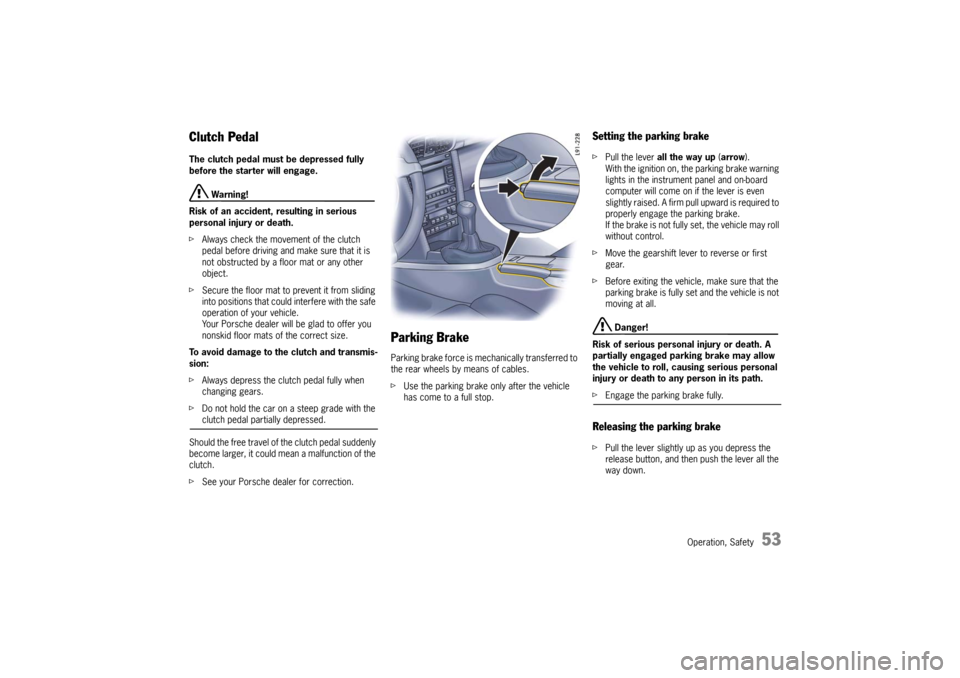
Setting the parking brake fPull the lever all the way up (arrow).
With the ignition on, the parking brake warning
lights in the instrument panel and on-board
computer will come on if the lever is even
slightly raised. A firm pull upward is required to
properly engage the parking brake.
If the brake is not fully set, the vehicle may roll
without control.
fMove the gearshift lever to reverse or first
gear.
fBefore exiting the vehicle, make sure that the
parking brake is fully set and the vehicle is not
moving at all.
Danger!
Risk of serious personal injury or death. A
partially engaged parking brake may allow
the vehicle to roll, causing serious personal
injury or death to any person in its path.
fEngage the parking brake fully.Releasing the parking brakefPull the lever slightly up as you depress the
release button, and then push the lever all the
way down.
10_GT3_21.book Seite 53 Donnerstag, 4. Juni 2009 12:48 12
Page 55 of 251
54
Operation, Safety The warning lights in the instrument panel and on-
board computer will go out after the parking brake
is fully released.
The warning lights are not an indicator that the
parking brake is fully set; it is only intended to be
a warning to release the parking brake before
driving the car. Caution!
A partially engaged brake will overheat the
rear brakes, reduce their effectiveness and
cause excessive wear.
fRelease the parking brake fully.
fWhen parking your car, always set the parking
brake by pulling all the way up on the lever.
fMove the gearshift lever to reverse or first
gear.
fOn hills also turn the front wheels towards the
curb.
Brakes fMake it a habit to check the operation of your
brakes before driving.
Keep in mind that the braking distance increases
very rapidly as the speed increases. At 60 mph or
100 km/h, for example, it is not twice but four
times longer than 30 mph or 50 km/h. Tire
traction is also less effective when the roads are
wet or slippery.
fTherefore, always maintain a safe distance
from the car in front of you.
Vehicles without Porsche Ceramic Compo-
site Brake (PCCB)
Even though the brake discs consist of alloyed
grey cast iron, they will unavoidably start to
corrode if your car is parked for an extended
period. The brakes will tend to “rub” as a result.
The nature, extent and effects of corrosion
depend on the amount of time the vehicle was
parked, whether granular or liquid road salt was
spread and whether grease-dissolving agents
were used in car washes.
If the braking comfort is noticeably impaired, we
recommend having the brake system checked by
experts at an authorized Porsche dealer.
Brake system function Your Porsche is equipped with a power assisted
hydraulic dual circuit brake system with disc
brakes at the front and rear.
Both circuits function independently. One brake
circuit operates the front and the other operates
the rear.
If one brake circuit has failed, the other will still
operate. However, you will notice an increased
pedal travel when you apply the brakes.
Failure of one brake circuit will cause the stopping
distance to increase.
Warning!
Risk of an accident, resulting in serious
personal injury or death.
In the unlikely event of hydraulic failure of
one brake circuit:
fPush the brake pedal down firmly and hold it in
that position.
A mechanical linkage activates the second
circuit, and you will be able to bring the vehicle
to a stop.
fAfter bringing your vehicle to a complete stop,
avoid driving the vehicle and instead have it
towed to the nearest authorized Porsche dealer for repair.
Parking brake warning light USA
Parking brake warning light
Canada
10_GT3_21.book Seite 54 Donnerstag, 4. Juni 2009 12:48 12
Page 58 of 251
Operation, Safety
57
ABS Brake System
(Antilock Brake System)The ABS system represents a major contribution
to the enhancement of active safety in your
vehicle. This system prevents the wheels from
locking in a panic stop on almost all road
surfaces. With the ABS system in your vehicle, the
following areas are enhanced: Steering, vehicle remains steerable under all
braking forces when ABS is engaged.
Good directional control, no swerving caused
by locking of wheels under braking conditions.
Shorter stopping distance, stopping distances
are usually reduced because controlled braking is
maximized.
Prevention of wheel lock up, no brake-induced
sliding and thus no localized tire wear from
emergency braking.
The crucial advantage of the ABS system over a
conventional brake system is in the area of
maintaining directional control and maneuverabi-
lity of the car in emergency situations.
Warning!
The increased control that is provided should
not induce you to take greater risks with your
safety. The limits dictated by the laws of
physics cannot be overcome, even with ABS.
The risk of accidents due to inappropriate
speed cannot be reduced, even by the ABS.
The driver bears the responsibility for all
driving maneuvers.
fAdapt your driving style to the prevailing road
and weather conditions.
fObey all traffic laws.
Other vehicles not equipped with the ABS
system may not be able to maintain control,
especially on wet or poor road surfaces and
thus may be more likely to impact you from
behind.
fTo minimize that risk, use your ABS system to
increase your ability to maneuver to avoid
dangerous situations and not merely to try to stop in the shortest distance possible.
Operation of the ABS systemA wheel speed sensor is mounted to each of the
four wheels. If wheel lock-up of either of the front
wheels or the rear wheels is sensed during
braking, the brake pressure is adjusted automati-
cally until the wheel no longer slips.
If braking forces approach the wheel lock-up point
for all wheels (panic braking) the ABS system will
intervene to provide a rapid rythmic braking. The
proper operation of ABS is perceived by the driver
as a pulsating brake pedal in conjunction with
audible noise and perhaps some vibration.
fIf you experience these sensations while
driving or a road surface with questionable
traction, reduce vehicle speed appropriate for
the prevailing road conditions.
fIf full braking should be necessary, press the
brake pedal all the way down throughout the
entire braking procedure, regardless of the
pulsating pedal. Do not ease up on pressure
applied to the pedal.
The functional readiness of all the main electrical
components of the ABS is checked by an
electronic monitoring system both before and
while you drive.
10_GT3_21.book Seite 57 Donnerstag, 4. Juni 2009 12:48 12
Page 60 of 251
Operation, Safety
59
Porsche Stability Management
(PSM)PSM is an active control system for stabilization of
the vehicle during extreme driving maneuvers.
Warning!
Risk of an accident, resulting in serious
personal injury or death.
The increased control that is provided should
not induce you to take greater risks with your
safety. The limits dictated by the laws of
physics cannot be overcome, even with PSM.
The risk of accidents due to inappropriate
speed cannot be reduced, even by PSM.
The driver bears the responsibility for all
driving maneuvers.
fAdapt your driving style to the prevailing road
and weather conditions.
fObey all traffic laws.
Sensors at the wheels, brakes, steering system
and engine continuously measure:
–Speed
– Direction of travel (steering angle)
– Lateral acceleration
– Rate of turn about the vertical axis
– Longitudinal accelerationPSM uses these values to determine the direction
of travel indicated by the driver.
PSM intervenes and helps to correct the course if
the actual direction of motion deviates from the
chosen course (steering-wheel position):
It brakes individual wheels as needed. In addition,
the engine power may be manipulated in order to
stabilize the vehicle.
The events below inform the driver of PSM control
operations and warn him/her to adapt his/her
driving style to the road conditions:
– The multifunctional information light on the
instrument panel flashes.
– Hydraulic noises can be heard.
– The vehicle decelerates and steering-wheel
forces are altered as PSM controls the brakes.
– Reduced engine power.
– The brake pedal pulsates and its position is
changed during braking.
In order to achieve full vehicle deceleration,
foot pressure must be increased after the
brake pedal has begun vibrating.
Advantages of PSM– Improved traction and lane-holding ability in all
driving situations – even on road surfaces with
varying friction.
– The system compensates for undesired lateral
vehicle reactions when the driver releases the
accelerator pedal or brakes when cornering.
This compensation functions up to the
maximum lateral acceleration.
– PSM actively helps stabilize the vehicle as
required during dynamic driving maneuvers
(e.g. rapid steering movements, during lane
changes or on alternating bends).
– Improved braking stability in curves and on
different or varying road surfaces.
10_GT3_21.book Seite 59 Donnerstag, 4. Juni 2009 12:48 12
Page 64 of 251
Operation, Safety
63
The previously selected PASM mode is always
activated after the engine is started.
There is no automatic return to Normal mode after
the ignition is switched off.
PASM makes two running-gear setups available to
the driver: “Normal” and “Sport”.
The selection is made via a button on the center
console.
When in Normal mode the running gear is in a
basic setup for roads and circuits with “irregular”
surfaces.
Sport mode provides a shock-absorber setting
for particularly high driving dynamics (e.g. on level
circuits).
The variable suspension system selects the appro-
priate damping level for each wheel according to
the situation and conditions of driving.
Example:
If the vehicle is driven in a very sporty manner in
Normal mode, PASM automatically adapts the
shock-absorber behavior to the driving situation
accordingly.
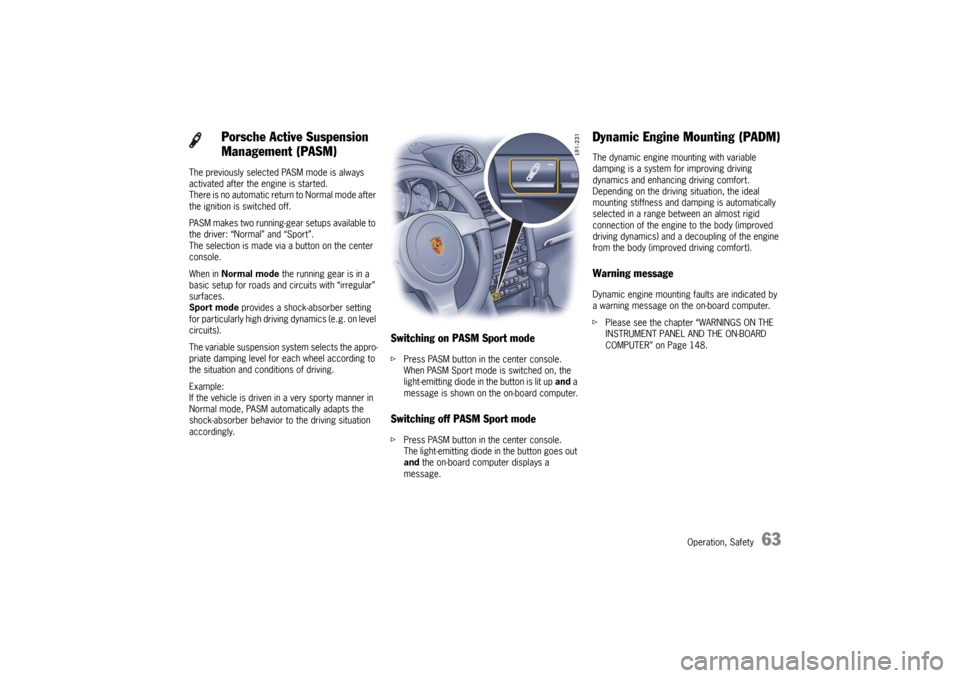
Switching on PASM Sport modefPress PASM button in the center console.
When PASM Sport mode is switched on, the
light-emitting diode in the button is lit up and a
message is shown on the on-board computer.Switching off PASM Sport modefPress PASM button in the center console.
The light-emitting diode in the button goes out
and the on-board computer displays a
message.
Dynamic Engine Mounting (PADM)The dynamic engine mounting with variable
damping is a system for improving driving
dynamics and enhancing driving comfort.
Depending on the driving situation, the ideal
mounting stiffness and damping is automatically
selected in a range between an almost rigid
connection of the engine to the body (improved
driving dynamics) and a decoupling of the engine
from the body (improved driving comfort).Warning messageDynamic engine mounting faults are indicated by
a warning message on the on-board computer.
fPlease see the chapter “WARNINGS ON THE
INSTRUMENT PANEL AND THE ON-BOARD
COMPUTER” on Page 148.
Porsche Active Suspension
Management (PASM)
10_GT3_21.book Seite 63 Donnerstag, 4. Juni 2009 12:48 12
Page 69 of 251
68
Operation, Safety
Switch position 2Start engine
fTurn ignition key to ignition lock position 2.
fPlease see the chapter “STARTING PROCE-
DURES” on Page 70.Switch position 3Ignition off
fTurn ignition key to ignition lock position 3.
Note on operation
The vehicle battery discharges if the ignition key is
left inserted.
If the vehicle battery is dead, the key can only be
pulled out of the ignition lock if the emergency
operation is performed:
fPlease see the chapter “EMERGENCY OPERA-
TION – PULLING OUT THE IGNITION KEY” on
Page 69.
Locking the steering columnAutomatic locking
The steering column is automatically locked when
the ignition key is withdrawn from the ignition lock.
Warning!
Risk of an accident, resulting in serious
personal injury or death.
The steering wheel will lock and will cause
loss of steering.
fNever remove key from the ignition lock or turn
the key off while the vehicle is moving.
fAlways withdraw the ignition key when leaving the vehicle.Automatic unlocking
The steering column is unlocked when the vehicle
is unlocked with the radio remote control.
Note
fTo avoid discharging the battery, always
remove the ignition key from the ignition lock.
Please see the chapter “BATTERY” on
Page 211.
Gong If you leave the key in the ignition/steering lock, a
gong will sound when the driver’s door is opened.
This is a reminder to remove the key.
10_GT3_21.book Seite 68 Donnerstag, 4. Juni 2009 12:48 12
Page 72 of 251
Operation, Safety
71
Stopping Engine fTurn key back to position 3.
fDo not stop engine immediately after hard or
extended driving.
Keep engine running at increased idle for
about two minutes to prevent excessive heat
build-up before turning off engine.
fTo avoid discharging the battery, always
remove the ignition key from the ignition lock.
fWhen leaving the vehicle always remove the
ignition key, apply the parking brake and
engage the 1st gear or reverse gear.
fEngage the steering lock by moving the
steering wheel to the left or right.
Turn the steering wheel to the locking position
before you switch off the engine so that you
don’t have to exert yourself when locking or
unlocking the steering.
Warning!
Danger of injury. Hot engine compartment
components can burn skin on contact.
fBefore working on any part in the engine
compartment, turn the engine off and let it cool down sufficiently.
Engine-compartment blower,
radiator fan The radiator and radiator fan are in the front of the
car.
The engine-compartment blower is mounted on
the engine compartment lid.
Warning!
Risk of injury.
After the engine is switched off, the engine-
compartment temperature is monitored for
approx. 30 minutes.
During this period, and depending on tempe-
rature, the engine-compartment blower may
continue to run or start to run.
fCarry out work in these areas only with the
engine off, the ignition off, and exercise
extreme caution.
Risk of injury. The radiator fan in the front
end of the car may be operating or unexpec-
tedly start operating when the engine is
switched on.
fCarry out work in these areas only with the engine switched off.
Automatic garage door The ignition system in your Porsche may interfere
with your electronically operated garage door.
fTo check this, drive your Porsche close to the
garage door. Make sure not to interfere with
the operating range of the door.
fRun the engine at different speeds.
fIf the garage door opens or closes without you
operating the garage door unit in your car,
contact the dealer who installed the automatic
garage door to have the frequency and/or
coding of the garage door signal changed or
modified.
10_GT3_21.book Seite 71 Donnerstag, 4. Juni 2009 12:48 12