ECU PORSCHE 911 GT3 2010 5.G Owner's Manual
[x] Cancel search | Manufacturer: PORSCHE, Model Year: 2010, Model line: 911 GT3, Model: PORSCHE 911 GT3 2010 5.GPages: 251, PDF Size: 14.33 MB
Page 203 of 251
202
Practical Tips, Emergency Service
Caution!
Using wheel cleaning agents:
Wheel cleaning agents can bleach the
anodised surface of the central bolt.
fOnly use wheel cleaning agents approved
by Porsche and use these sparingly and in accordance with instructions for use.
Emergency procedure for securing
central boltIf, in the event of a breakdown, no suitable torque
wrench is available for tightening the central bolt
to the high tightening torque, the emergency
procedure for securing the central bolt must be
performed.
fThe central bolt must always be fitted using
the original tool (stored in the luggage
compartment).
1.Tighten the central bolt with great force
using a long lever and loosen again
slightly (by approx. 1/4 turn).
Tighten the central bolt to precisely 74 ftlb.
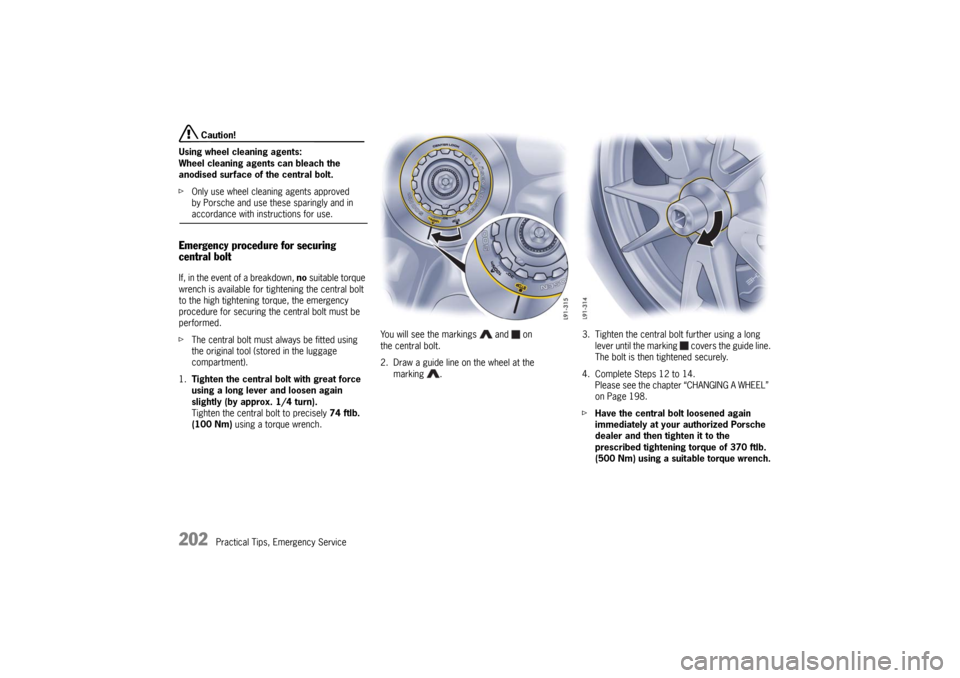
(100 Nm) using a torque wrench.You will see the markings and on
the central bolt.
2. Draw a guide line on the wheel at the
marking .3. Tighten the central bolt further using a long
lever until the marking covers the guide line.
The bolt is then tightened securely.
4. Complete Steps 12 to 14.
Please see the chapter “CHANGING A WHEEL”
on Page 198.
fHave the central bolt loosened again
immediately at your authorized Porsche
dealer and then tighten it to the
prescribed tightening torque of 370 ftlb.
(500 Nm) using a suitable torque wrench.10_GT3_21.book Seite 202 Donnerstag, 4. Juni 2009 12:48 12
Page 213 of 251

212
Practical Tips, Emergency Service
Battery care fEnsure that battery is securely mounted.
fKeep terminals and connections clean and
properly tightened.
Corrosion can be prevented by coating the
terminals and connections with petroleum jelly
or silicone spray.
fEnsure that vent caps are securely tightened to
prevent spillage.
Checking the electrolyte fluid level
Generally, the electrolyte level must be checked
more often in summer than in the winter, and more
often when driving long distances.
fWhen adding water, use only clean containers.
In no case may alcohol (e.g. window cleaner
residues) be permitted to enter the battery.
fUnscrew and open the filler vent caps of each
cell.
With the car on a level surface, the fluid level
should meet the indicator mark in each cell.
fIf necessary, top up with distilled water.
Do not use acid.
Only fill up to the mark, otherwise the electro-
lyte will overflow when the battery is being
charged and cause damage. Battery charging
Automotive batteries loose their efficiency when
not in use.
The charge available in your battery can be
measured with a battery hydrometer.
We recommend that the battery voltage be tested
by your authorized Porsche dealer who has the
appropriate equipment.
If the car is not driven for prolonged periods, the
battery must be charged at least every 6 weeks.
A discharged battery allows rapid formation of
sulfates, leading to premature deterioration of the
plates.
Warning!
Hydrogen gas generated by the battery
could cause an explosion, resulting in
serious personal injury or death.
fCharge battery in a well ventilated area.
fNever charge a frozen battery. It may explode
because of gas trapped in the ice. Allow a
frozen battery to thaw out first.
fIf you get electrolyte, which is an acid, in your
eyes or on your skin, immediately rinse with
cold water for several minutes and call a doctor. Slow battery charging
1. Pay attention to all warnings and follow instruc-
tions that come with your battery charger.
2. When charging, ensure adequate ventilation.
3. Remove battery.
Please see the chapter “REMOVING THE
BATTERY” on Page 214.
4. All vent caps should be open.
The fluid level should meet the indicator mark
in each cell.
5. Ensure that charger is switched off – danger of
short circuit!
6. Connect charger cables.
Charger cables must be connected
POSITIVE (+) to POSITIVE (+) and
NEGATIVE (–) to NEGATIVE (–).
7. Switch on charger.
Normally, a battery should be charged at no
more than 10 percent of its rated capacity.
Rated capacity of the battery in your vehicle is
listed on the battery housing.
8. After charging, turn off charger and disconnect
charger cables.
9. Tighten the vent caps and reinstall battery.
Please see the chapter “INSTALLING THE
BATTERY” on Page 215.
10_GT3_21.book Seite 212 Donnerstag, 4. Juni 2009 12:48 12
Page 222 of 251
Practical Tips, Emergency Service
221
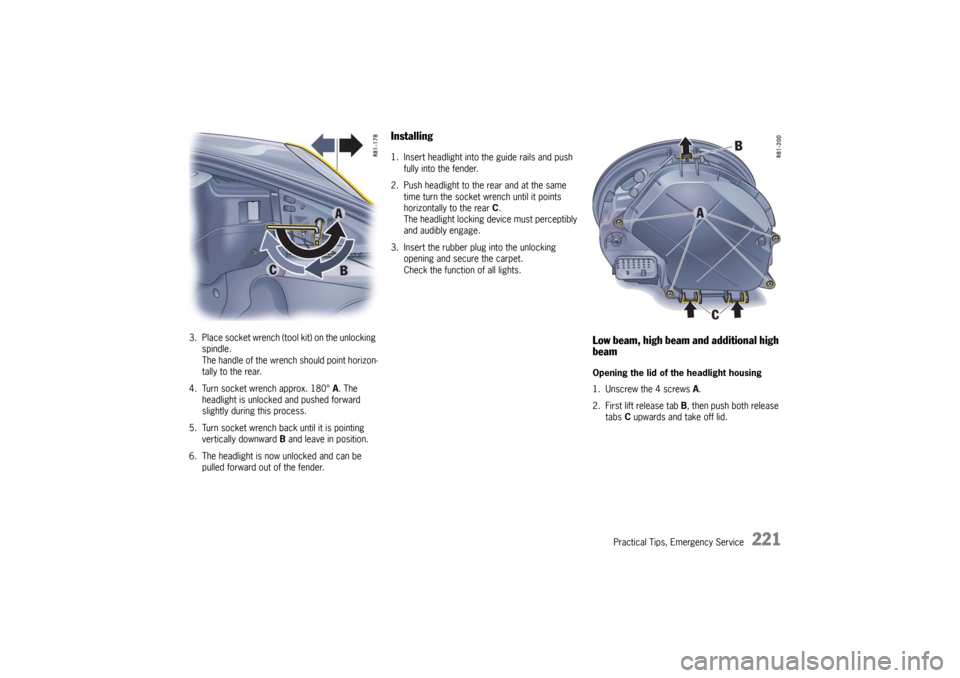
3. Place socket wrench (tool kit) on the unlocking
spindle.
The handle of the wrench should point horizon-
tally to the rear.
4. Turn socket wrench approx. 180° A. The
headlight is unlocked and pushed forward
slightly during this process.
5. Turn socket wrench back until it is pointing
vertically downward B and leave in position.
6. The headlight is now unlocked and can be
pulled forward out of the fender.
Installing1. Insert headlight into the guide rails and push
fully into the fender.
2. Push headlight to the rear and at the same
time turn the socket wrench until it points
horizontally to the rear C.
The headlight locking device must perceptibly
and audibly engage.
3. Insert the rubber plug into the unlocking
opening and secure the carpet.
Check the function of all lights.
Low beam, high beam and additional high
beamOpening the lid of the headlight housing
1. Unscrew the 4 screws A.
2. First lift release tab B, then push both release
tabs C upwards and take off lid.
10_GT3_21.book Seite 221 Donnerstag, 4. Juni 2009 12:48 12
Page 227 of 251
226
Practical Tips, Emergency Service
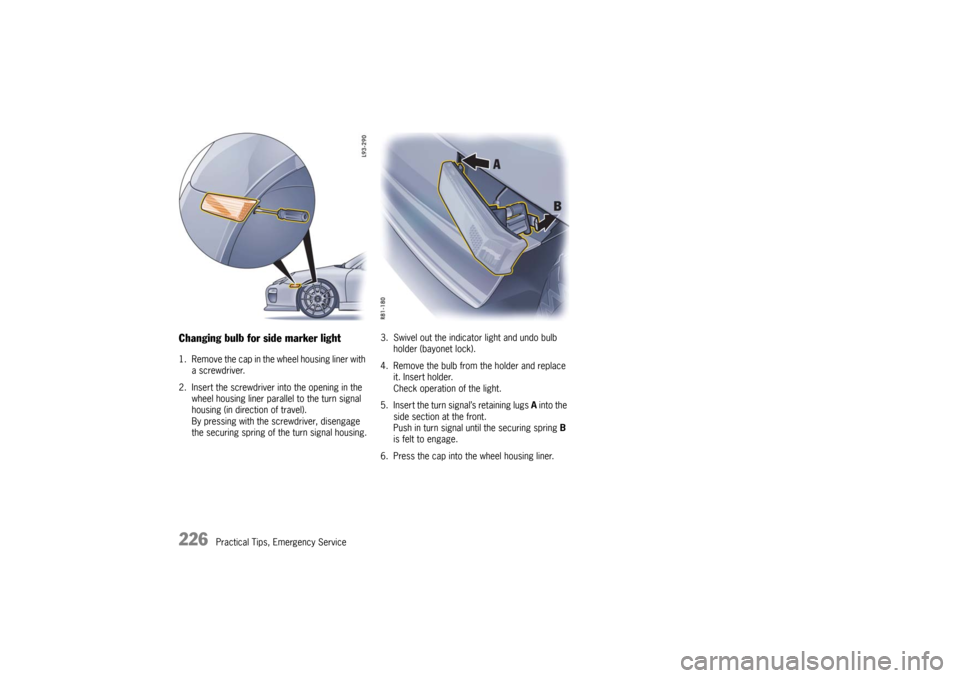
Changing bulb for side marker light1. Remove the cap in the wheel housing liner with
a screwdriver.
2. Insert the screwdriver into the opening in the
wheel housing liner parallel to the turn signal
housing (in direction of travel).
By pressing with the screwdriver, disengage
the securing spring of the turn signal housing.3. Swivel out the indicator light and undo bulb
holder (bayonet lock).
4. Remove the bulb from the holder and replace
it. Insert holder.
Check operation of the light.
5. Insert the turn signal’s retaining lugs A into the
side section at the front.
Push in turn signal until the securing spring B
is felt to engage.
6. Press the cap into the wheel housing liner.10_GT3_21.book Seite 226 Donnerstag, 4. Juni 2009 12:48 12
Page 231 of 251
230
Practical Tips, Emergency Service
Towing Certain state statutes and local ordinances
prohibit towing with a chain, rope or even a tow
bar.
In addition, damage to your vehicle may result
from improper procedures.
Consult your authorized Porsche dealer for
details. Vehicle towing Flat bed towing is the preferred type of towing to
be used on Porsche vehicles.
Under certain circumstances, wheel lifts may be
used when the vehicle will not roll.
The vehicle must be towed with all four
wheels off the ground, otherwise damage to
the vehicle may result.
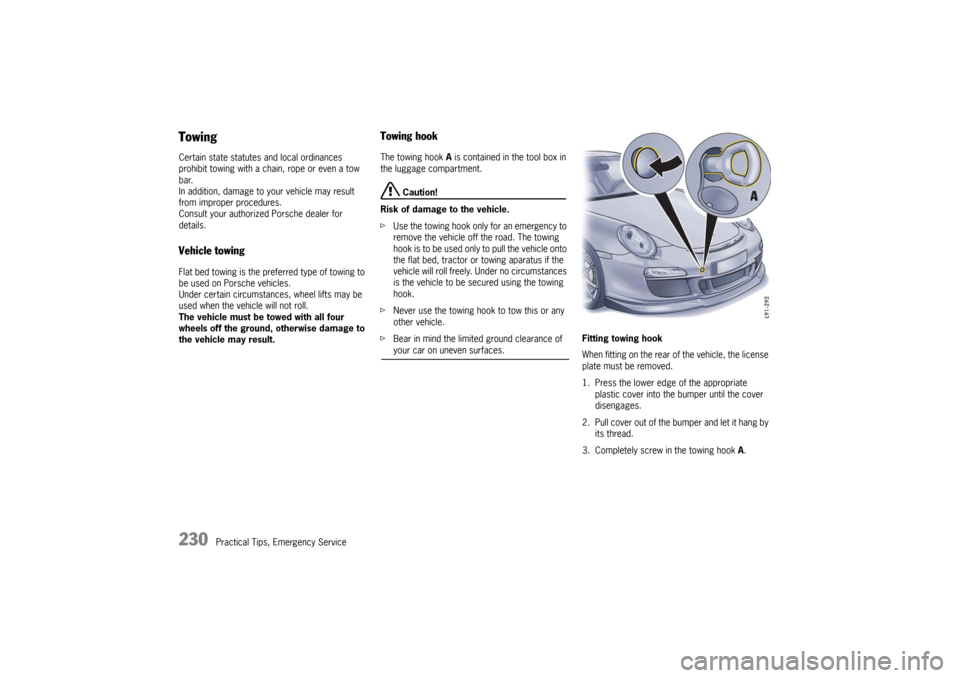
Towing hook The towing hook A is contained in the tool box in
the luggage compartment.
Caution!
Risk of damage to the vehicle.
fUse the towing hook only for an emergency to
remove the vehicle off the road. The towing
hook is to be used only to pull the vehicle onto
the flat bed, tractor or towing aparatus if the
vehicle will roll freely. Under no circumstances
is the vehicle to be secured using the towing
hook.
fNever use the towing hook to tow this or any
other vehicle.
fBear in mind the limited ground clearance of your car on uneven surfaces.Fitting towing hook
When fitting on the rear of the vehicle, the license
plate must be removed.
1. Press the lower edge of the appropriate
plastic cover into the bumper until the cover
disengages.
2. Pull cover out of the bumper and let it hang by
its thread.
3. Completely screw in the towing hook A.
10_GT3_21.book Seite 230 Donnerstag, 4. Juni 2009 12:48 12
Page 232 of 251
Practical Tips, Emergency Service
231
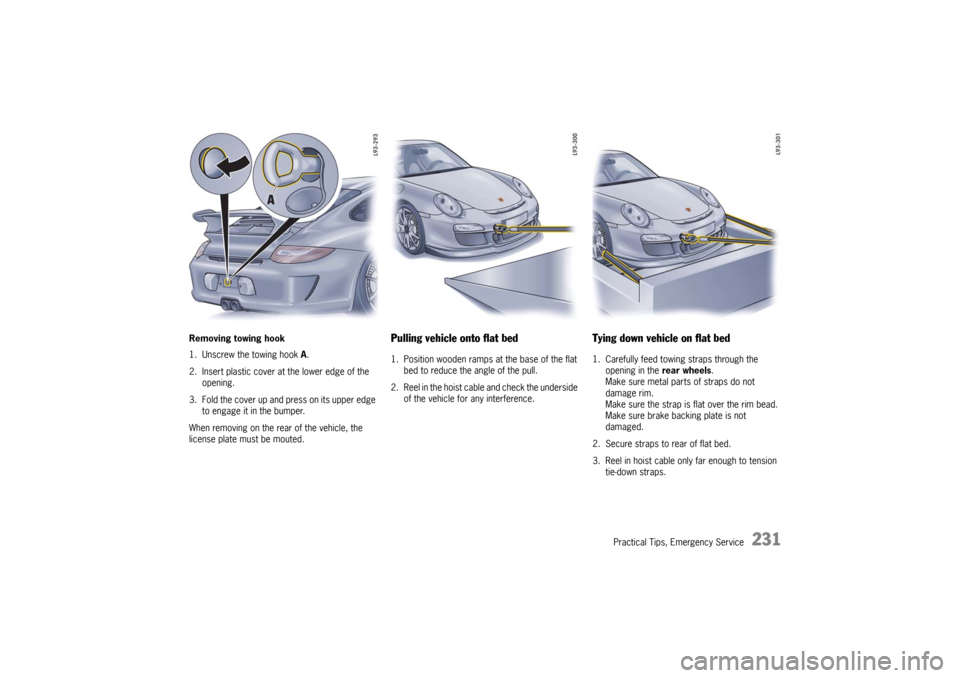
Removing towing hook
1. Unscrew the towing hook A.
2. Insert plastic cover at the lower edge of the
opening.
3. Fold the cover up and press on its upper edge
to engage it in the bumper.
When removing on the rear of the vehicle, the
license plate must be mouted.
Pulling vehicle onto flat bed 1. Position wooden ramps at the base of the flat
bed to reduce the angle of the pull.
2. Reel in the hoist cable and check the underside
of the vehicle for any interference.
Tying down vehicle on flat bed 1. Carefully feed towing straps through the
opening in the rear wheels.
Make sure metal parts of straps do not
damage rim.
Make sure the strap is flat over the rim bead.
Make sure brake backing plate is not
damaged.
2. Secure straps to rear of flat bed.
3. Reel in hoist cable only far enough to tension
tie-down straps.
10_GT3_21.book Seite 231 Donnerstag, 4. Juni 2009 12:48 12
Page 233 of 251

232
Practical Tips, Emergency Service 4. Carefully feed towing straps through the
opening in the front wheels.
Make sure metal parts of straps do not
damage rim.
Make sure the strap is flat over the rim bead.
Make sure brake backing plate is not
damaged.
5. Secure straps to front of flat bed.
6. Release tension on hoist cable, but do not
disconnect.
Use hoist cable as a safety cable.
10_GT3_21.book Seite 232 Donnerstag, 4. Juni 2009 12:48 12
Page 250 of 251
Index
249
Towing lug ................................................... 87
TPM Tire pressure monitoring ...................... 134
Tracks ....................................................... 238
Traction Control (TC)..................................... 61
Transmission .............................................. 237
Drive-Off Assistant............................... 155
Fluid........................................... 172, 239
Manual transmission............................ 155
Porsche Doppelkupplung (PDK) ............ 155
Trip Odometer ............................................ 109
Trunk entrapment ......................................... 88
Turn signal
Indicator light...................................... 111
Turn signals ......................................... 75, 111
Turn signals, front....................................... 227UUndercoating...................................... 168, 178
Upshift indicator ................................. 111, 155
USB interface ............................................... 93
VValves ........................................................189
Vanity mirror.................................................37
Vehicle
Care...................................................174
Engine number....................................235
Identification .......................................234
Identification label ...............................234
Identification number ...........................234
Lifting.................................................206
Load capacity .....................................196
Putting into operation ..........................213
Safety compliance sticker ....................234
Washing .............................................175
Vehicle identification number ........................234
Ventilation ....................................................98
Vents ...................................................98, 101
Viscosity, engine oil.....................................160
Voice control, button ...................................117
Voice control, PCM .....................................117
WWarning lights and messages ...................... 148
Washer
Fluid .......................................... 170, 239
Fluid warning light............................... 170
Lever................................................... 76
Washing .................................................... 175
Weights ..................................................... 240
Welcome Home Function .............................. 74
Wheel .......................................... 13, 184, 238
Alignment .......................................... 190
Balancing........................................... 190
Care .................................................. 184
Central bolts ...................................... 197
Changing ................................... 198, 203
Checking pressure............................. 203
Inscription .......................................... 193
Loading information ............................ 195
Security wheel bolts ............................. 87
Sidewall ............................................. 193
Size .................................................. 193
Tire pressure ............................. 185, 237
Tire pressure plate ............................. 235
Tire sealant ................................ 203, 204
Wheels
Care .................................................. 178
Central bolts ...................................... 197
Tightening torque ............................... 197
TPM sensors...................................... 190
10_GT3_21.book Seite 249 Donnerstag, 4. Juni 2009 12:48 12