light PORSCHE 911 GT3 2010 5.G Owners Manual
[x] Cancel search | Manufacturer: PORSCHE, Model Year: 2010, Model line: 911 GT3, Model: PORSCHE 911 GT3 2010 5.GPages: 251, PDF Size: 14.33 MB
Page 2 of 251

1
© Dr. Ing. h.c. F. Porsche AG
Porsche, the Porsche crest, 911, Carrera, PCCB,
PCM, PSM and Tequipment are registered trade-
marks and the distinctive shapes of Porsche
automobiles are trademarks of
Dr. Ing. h.c. F. Porsche AG.
All rights reserved.
Printed in Germany
Orientation guides in the
Owner’s ManualThe orientation guides in the Owner’s Manual are
highlighted in yellow.
Overall Table of Contents
At the start of the Owner’s Manual you will find an
overview of the overall contents of the Owner’s
Manual.
Section Contents
There is a summary of topics with the corre-
sponding page numbers at the beginning of each
main chapter.
Index
There is a detailed, alphabetical index at the end
of this Owner’s Manual. WKD 997 521 10 05/09
10_GT3_21.book Seite 1 Donnerstag, 4. Juni 2009 12:48 12
Page 3 of 251

2Dear Owner, We would like to thank you for your purchase of a
Porsche Sports car.
Judging by the car you have chosen, you are a
motorist of a special breed, and you are probably
no novice when it comes to automobiles.
Remember however, as with any vehicle, you
should take time to familiarize yourself with your
Porsche and its performance characteristics.
Always drive within your own unique capabilities as
a driver and your level of experience with your
Porsche. Ensure that anyone else driving your
Porsche does the same. To prevent or minimize
injury, always use your safety belts. Never
consume alcohol or drugs before or during the
operation of your vehicle.
This Owner’s Manual contains a host of useful
information. Please take the time to read this
manual before you drive your new Porsche.
Become familiar with the operation of your
Porsche car for maximum safety and operating
pleasure. The better you know your Porsche, the
more pleasure you will experience driving your
new car.
Always keep your Owner’s Manual in the car, and
give it to the new owner if you ever sell your
Porsche. A separate Maintenance Booklet explains how
you can keep your Porsche in top driving condition
by having it serviced regularly.
A separate Warranty and Customer Informa-
tion Booklet contains detailed information about
the warranties covering your Porsche.
For U.S. only:
If you believe that your vehicle has a fault which
could cause a crash, injury or death, you should
immediately inform the National Highway Traffic
Safety Administration (NHTSA) in addition to
notifying Porsche Cars North America, Inc.
(Porsche Cars N.A.).
If NHTSA receives similar complaints, it may open
an investigation, and if it finds that a safety
problem exists in a group of vehicles, it may order
a recall and remedy campaign. However, NHTSA
cannot become involved in individual problems
between you and your dealer, or
Porsche Cars N.A.
To contact NHTSA, you may call the Vehicle Safety
Hotline toll-free at 1-888-327-4236 (TTY: 1-800-
424-9153); go to http://www.safercar.gov; or
write to: Administrator,
NHTSA, 400 Seventh
Street, SW., Washington, DC 20590.
You can also obtain other information about motor
vehicle safety from http://www.savercar.gov.
Your car has thousands of parts and components
which have been designed and manufactured in
accordance with Porsche’s high standards of
engineering quality and safety.
Warning!
Any alteration or misuse of the vehicle can
lead to accidents and severe or fatal
personal injuries.
Any alteration of the vehicle may negate or
interfere with those safety features built into
the vehicle. Modifications may be carried out
on your vehicle only if approved by Porsche.
Your Porsche is intended to be used in a safe
manner obeying the local laws and in the
light of driving conditions faced by you, and
in accordance with the instructions provided
in this Owner’s Manual.
fDo not misuse your Porsche by ignoring those
laws and driving conditions, or by ignoring the instructions in this manual.
10_GT3_21.book Seite 2 Donnerstag, 4. Juni 2009 12:48 12
Page 5 of 251

4
Safety notes!
Your vehicle warranty does not cover use in
competition, racing or track use or other events.
Components and/or parts that fail during racing
or driving events (including Porsche sponsored
events) will not be covered by the manufacturer
new car limited warranty or the pre-owned vehicle
warranty.
Your new 911 GT3 has been developed with
experience gained from the development, testing,
and driving of countless GT vehicles. While
drivable on public roads, the GT3 is specially
equipped for racing on racetracks and is set up at
the factory for the adjustments required for
racing.
The GT3 can be adapted to either the racing or the
street environment. In each case, take into
account that a modern high-performance sports
car is a complex system whose individual compo-
nents are carefully adjusted to work well together.
Interfering in this system is only an option if it can
be guaranteed that all of the components will
continue to work together according to the actual
running conditions. Well-founded Porsche
technical specialist knowledge is necessary for
this. You should seek advice from your authorized
Porsche dealer.
Here, you will receive information about sports
parts available from Porsche, their reliability on
public roads and important maintenance notes.Please bear in mind that use on race tracks
subjects all vehicle components to considerably
more wear than normal use, making professional
inspection and maintenance after each use a vital
precondition for functioning and safety.
Please use only Original Porsche Parts for your
car. These parts are available from your autho-
rized Porsche dealer, who has expert knowledge
concerning the range of approved parts and will
be pleased to advise you further.
The use of other parts or accessories which are
neither Genuine Porsche Parts nor approved by
Porsche may adversely affect the safety of your
car, and Porsche can take no responsibility for any
loss or damage caused by their use.
Even if the supplier of other accessories or parts
is a recognized supplier, the safety of your car
may still be affected if such items are installed.
Due to the large variety of products offered in the
accessory market it is not possible for Porsche to
inspect and approve every one.
When your Porsche is driven in normal driving
situations on public roads, away from the
racetrack, please note that the use of replace-
ment parts which are not Genuine Porsche Parts,
or approved parts, or the use of accessories not
approved by Porsche may also detrimentally
affect the Warranties relating to your car.
Note again that in no case will Porsche warrant
any parts damaged while racing your vehicle, on
or off the track.
Motor racingFor reasons of safety, the braking system,
steering, running gear, wheels and tires of your
car should be checked after every use on a race
track.
On public highways, the running gear and rear
wing must be in the standard position.Power transmissionThe differential lock, which was designed for use
on race tracks, may make a slight noise when
maneuvering and on tight corners.Porsche Stability Management (PSM)PSM should always be switched on during
”normal“ driving. This is particularly the case when
the road is wet.
10_GT3_21.book Seite 4 Donnerstag, 4. Juni 2009 12:48 12
Page 6 of 251

5
Development philosophyPorsche 911 GT3 stands for a sports car with
exceptional performance, both on the road and on
the race track. This objective means that, in the
event of any compromise being required between
sportiness and comfort during the development
process, the tendency will be geared more
towards sportiness. This can result in the following
restrictions in comfort:
– Brake squeal when light pressure applied to
the pedal shortly before stopping.
– Rough engine operation in speed range around
3000 rpm.
– Cracking noise in area of front-axle coil
springs.
– Greater operating force for clutch and gear
shifting.
– Aerodynamic-related extremely low vehicle
position with restrictions in terms of ground
clearance.Sport tiresYour vehicle is equipped with special sport tires
(ultra high performance tires).
This type of tire is approved for use on public
highways and complies with all statutory require-
ments and safety criteria.The design of the tire is also geared towards use
on racing circuits (driver safety training courses,
sports driving schools, Club Sport events) and
provides distinct advantages here in terms of dry
grip and wear compared to conventional road
tires.
The major features are a reduced tread depth and
a special tread pattern and carcass.
Due to ultra high performance design and the
particular manufacturing process of these tires,
they must always be replaced in axle sets (2)
regardless of wear or mileage. Failure to do so
may have a negative affect on the handling charac-
teristics of the vehicle.
The design features of this sports tire result
in the following effects compared with other
summer tires when used under normal
driving conditions:
– Sport tires have a smaller tread depth, and
thus can reach their wear limit sooner.
As with all tires, the attainable mileage
depends on the individual driving style and the
conditions of use.
– Exercise caution when driving on wet roads,
paying special attention to hydroplaning situa-
tions (stagnant water, puddles, lane grooves).
Sport tires have a lower tread depth than
normal tires and you must therefore adapt
speed accordingly when driving on wet
surfaces.– The driver’s skill level must be commensurate
with the vehicle performance levels in the
upper range limits, due to increased safety
risks in the upper range limits.
fAt oudside temperatures below 45 °F (7 °C)
change to winter tires.
fNotify anyone using your car of these charac-
teristics and possible effects.
Danger!
Risk of accident through loss of road surface
contact, control over the vehicle and braking
ability, leading to serious personal injury or
death.
The reduced tire tread depth means that
there is an increased risk of hydroplaning on
wet roads.
fWhen driving on wet or mud-covered roads reduce speed significantly. Danger!
Risk of accident from worn tires.
Sport tires have a smaller tread depth, and
thus can reach their wear limit sooner.
It is important to check tire wear frequently
to avoid risk of serious personal injury or
death from worn tires.
fCheck tire wear frequently.
10_GT3_21.book Seite 5 Donnerstag, 4. Juni 2009 12:48 12
Page 8 of 251

7
Technical modificationsModifications may be carried out on your vehicle
only if approved by Porsche. This ensures that
your Porsche will remain reliable and safe to drive,
and that it will not be damaged as a result of the
modifications.
Your authorized Porsche dealer will be pleased to
advise you.CoveringsfDo not affix any coverings (e.g. films or „stone
guards“) in the area of the headlights and air
intakes.
Damage due to excessive temperatures and
abrasion could result.
The headlights can mist up depending on the tem-
perature and humidity.
fTo ensure optimum ventilation, do not cover
the gap between headlight and body.
Setting and operating vehicle
components when driving
Warning!
There is a danger of accident if you set or
operate the on-board computer, radio,
navigation system, telephone or other equip-
ment while driving.
This could distract you from the traffic and
cause you to lose control of the vehicle resul-
ting in serious personal injury or death.
fOperate the components while driving only if
the traffic situation allows you to do so safely.
fCarry out any complicated operating or setting procedures only with the vehicle stationary.
Portable Fuel Containers
Danger!
Portable fuel containers may leak, whether
they are full or partially empty. Fuel leaking
from a portable container carried in your
vehicle could, in case of an accident, cause
a fire or explosion, resulting in serious
personal injury or death.
fNever carry additional fuel in portable contai-ners in your vehicle.
10_GT3_21.book Seite 7 Donnerstag, 4. Juni 2009 12:48 12
Page 10 of 251
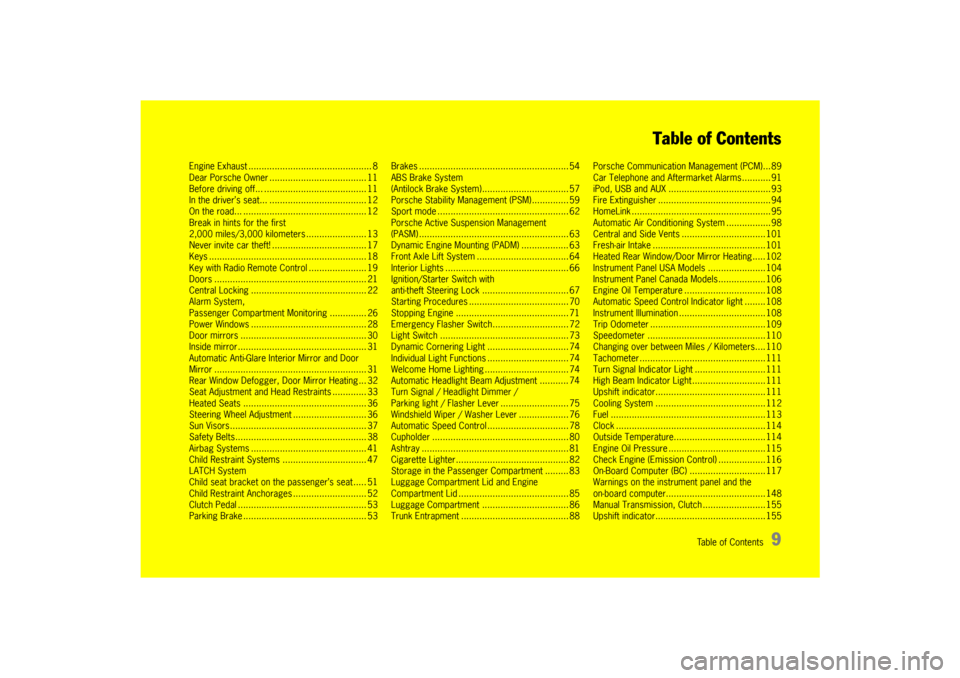
Table of Contents
9 Table of Contents
Engine Exhaust ............................................... 8
Dear Porsche Owner ..................................... 11
Before driving off... ....................................... 11
In the driver’s seat... ..................................... 12
On the road... ............................................... 12
Break in hints for the first
2,000 miles/3,000 kilometers ....................... 13
Never invite car theft! .................................... 17
Keys ............................................................ 18
Key with Radio Remote Control ...................... 19
Doors .......................................................... 21
Central Locking ............................................ 22
Alarm System,
Passenger Compartment Monitoring .............. 26
Power Windows ............................................ 28
Door mirrors ................................................ 30
Inside mirror ................................................. 31
Automatic Anti-Glare Interior Mirror and Door
Mirror .......................................................... 31
Rear Window Defogger, Door Mirror Heating ... 32
Seat Adjustment and Head Restraints ............. 33
Heated Seats ............................................... 36
Steering Wheel Adjustment ............................ 36
Sun Visors.................................................... 37
Safety Belts.................................................. 38
Airbag Systems ............................................ 41
Child Restraint Systems ................................ 47
LATCH System
Child seat bracket on the passenger’s seat ..... 51
Child Restraint Anchorages ............................ 52
Clutch Pedal ................................................. 53
Parking Brake ............................................... 53Brakes ......................................................... 54
ABS Brake System
(Antilock Brake System)................................. 57
Porsche Stability Management (PSM).............. 59
Sport mode .................................................. 62
Porsche Active Suspension Management
(PASM) ......................................................... 63
Dynamic Engine Mounting (PADM) .................. 63
Front Axle Lift System ................................... 64
Interior Lights ............................................... 66
Ignition/Starter Switch with
anti-theft Steering Lock ................................. 67
Starting Procedures ...................................... 70
Stopping Engine ........................................... 71
Emergency Flasher Switch............................. 72
Light Switch ................................................. 73
Dynamic Cornering Light ............................... 74
Individual Light Functions ............................... 74
Welcome Home Lighting ................................ 74
Automatic Headlight Beam Adjustment ........... 74
Turn Signal / Headlight Dimmer /
Parking light / Flasher Lever .......................... 75
Windshield Wiper / Washer Lever ................... 76
Automatic Speed Control ............................... 78
Cupholder .................................................... 80
Ashtray ........................................................ 81
Cigarette Lighter........................................... 82
Storage in the Passenger Compartment ......... 83
Luggage Compartment Lid and Engine
Compartment Lid .......................................... 85
Luggage Compartment ................................. 86
Trunk Entrapment ......................................... 88Porsche Communication Management (PCM)... 89
Car Telephone and Aftermarket Alarms........... 91
iPod, USB and AUX ....................................... 93
Fire Extinguisher ........................................... 94
HomeLink ..................................................... 95
Automatic Air Conditioning System .................98
Central and Side Vents ................................ 101
Fresh-air Intake ........................................... 101
Heated Rear Window/Door Mirror Heating..... 102
Instrument Panel USA Models ...................... 104
Instrument Panel Canada Models.................. 106
Engine Oil Temperature ............................... 108
Automatic Speed Control Indicator light ........ 108
Instrument Illumination................................. 108
Trip Odometer ............................................ 109
Speedometer ............................................. 110
Changing over between Miles / Kilometers.... 110
Tachometer ................................................ 111
Turn Signal Indicator Light ........................... 111
High Beam Indicator Light ............................ 111
Upshift indicator.......................................... 111
Cooling System .......................................... 112
Fuel ........................................................... 113
Clock .........................................................114
Outside Temperature................................... 114
Engine Oil Pressure ..................................... 115
Check Engine (Emission Control) .................. 116
On-Board Computer (BC)............................. 117
Warnings on the instrument panel and the
on-board computer...................................... 148
Manual Transmission, Clutch ........................ 155
Upshift indicator.......................................... 155
10_GT3_21.book Seite 9 Donnerstag, 4. Juni 2009 12:48 12
Page 11 of 251
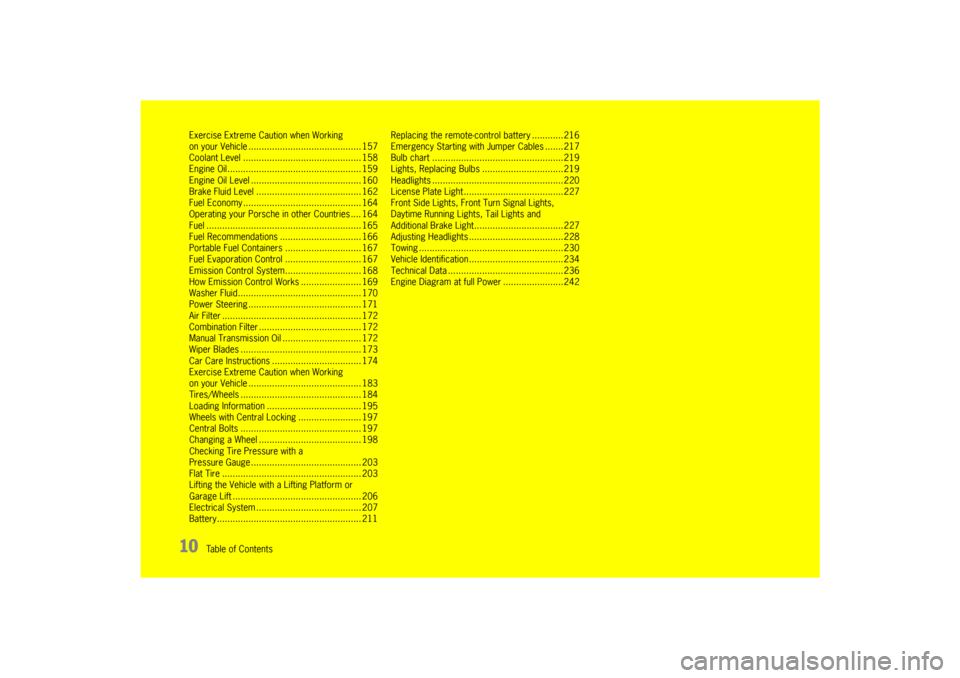
10
Table of Contents Exercise Extreme Caution when Working
on your Vehicle ........................................... 157
Coolant Level ............................................. 158
Engine Oil................................................... 159
Engine Oil Level .......................................... 160
Brake Fluid Level ........................................ 162
Fuel Economy ............................................. 164
Operating your Porsche in other Countries .... 164
Fuel ........................................................... 165
Fuel Recommendations............................... 166
Portable Fuel Containers ............................. 167
Fuel Evaporation Control ............................. 167
Emission Control System............................. 168
How Emission Control Works ....................... 169
Washer Fluid............................................... 170
Power Steering ........................................... 171
Air Filter ..................................................... 172
Combination Filter ....................................... 172
Manual Transmission Oil .............................. 172
Wiper Blades .............................................. 173
Car Care Instructions.................................. 174
Exercise Extreme Caution when Working
on your Vehicle ........................................... 183
Tires/Wheels .............................................. 184
Loading Information .................................... 195
Wheels with Central Locking ........................ 197
Central Bolts .............................................. 197
Changing a Wheel ....................................... 198
Checking Tire Pressure with a
Pressure Gauge .......................................... 203
Flat Tire ..................................................... 203
Lifting the Vehicle with a Lifting Platform or
Garage Lift ................................................. 206
Electrical System ........................................ 207
Battery....................................................... 211Replacing the remote-control battery ............216
Emergency Starting with Jumper Cables .......217
Bulb chart ..................................................219
Lights, Replacing Bulbs ...............................219
Headlights ..................................................220
License Plate Light ......................................227
Front Side Lights, Front Turn Signal Lights,
Daytime Running Lights, Tail Lights and
Additional Brake Light..................................227
Adjusting Headlights ....................................228
Towing .......................................................230
Vehicle Identification....................................234
Technical Data ............................................236
Engine Diagram at full Power .......................242
10_GT3_21.book Seite 10 Donnerstag, 4. Juni 2009 12:48 12
Page 12 of 251

Before driving off...
11
Dear Porsche Owner A lot has gone into the manufacture of your
Porsche, including advanced engineering, rigid
quality control and demanding inspections.
These engineering and safety features will be
enhanced by you... the safe driver... – who knows his/her car and all controls,
– who maintains the vehicle properly,
– who uses driving skills wisely and always
drives within her/his own capabilities and the
level of familiarity with the vehicle.
You will find helpful hints in this manual on how to
perform most of the checks listed on the following
pages.
If in doubt, have these checks performed by your
authorized Porsche dealer.
Before driving off... Check the following items first fTurn the engine off before you attempt any
checks or repairs on the vehicle.
fBe sure the tires are inflated correctly.
Check tires for damage and tire wear.
fSee that wheel bolts are properly tightened
and not loose or missing.
fCheck engine oil level, add if necessary.
Make it a habit to have engine oil checked with
every refueling.
fCheck all fluid levels such as windshield
washer and brake fluid levels.
fBe sure the vehicle battery is well charged and
cranks the engine properly.
fCheck all doors and lids for proper operation
and latch them properly.
fCheck, and if necessary replace worn or
cracked wiper blades.
fSee that all windows are clear and
unobstructed.
fCheck air intake slots and area between
luggage compartment lid and windshield.
Ensure that these areas are free of snow and
ice, so the heater and the windshield wipers
work properly. fIf a child will be riding in the vehicle, check
child seat/child seat restraint system to ensure
that restraints are properly adjusted.
fChild restraint systems will not fit into the
Sports bucket seat.
Do not install a child restraint system in the
Sports bucket seat.
The Sports bucket seat cannot be equipped
with the LATCH system and thus the airbag
system cannot be manually deactivated.
fCheck all exterior and interior lights for opera-
tion and that the lenses are clean.
fCheck the headlights for proper aim, and if
necessary, have them adjusted.
fCheck under the vehicle for leaks.
fBe sure all luggage is stowed securely.
Emergency equipment It is good practice to carry emergency equipment
in your vehicle.
Some of the items you should have are:
window scraper, snow brush, container or bag of
sand or salt, emergency light, small shovel, first-
aid kit, etc.
10_GT3_21.book Seite 11 Donnerstag, 4. Juni 2009 12:48 12
Page 13 of 251

12
Before driving off...
In the driver’s seat... fCheck operation of the horn.
fPosition seat for easy reach of foot pedals and
controls.
To reduce the possibility of injury from the
airbag deployment, you should always sit back
as far from the steering wheel as is practical,
while still maintaining full vehicle control.
fAdjust the inside and outside rear view mirrors.
fBuckle your safety belts.
fCheck operation of the foot and parking brake.
fCheck all warning and indicator lights with
ignition on and engine not running.
fStart engine and check all warning displays for
warning symbols.
fNever leave an idling car unattended.
fLock doors from inside, especially with
children in the car to prevent inadvertent
opening of doors from inside or outside.
Drive with doors locked.
On the road... fNever drive after you have consumed alcohol
or drugs.
fAlways have your safety belt fastened.
fAlways drive defensively.
Expect the unexpected.
fUse signals to indicate turns and lane changes.
fTurn on headlights at dusk or when the driving
conditions warrant it.
fAlways keep a safe distance from the vehicle in
front of you, depending on traffic, road and
weather conditions.
fReduce speed at night and during inclement
weather.
Driving in wet weather requires caution and
reduced speeds, particularly on roads with
standing water, as the handling characteristics
of the vehicle may be impaired due to hydropla-
ning of the tires.
fAlways observe speed limits and obey road
signs and traffic laws.
fWhen tired, get well off the road, stop and take
a rest. Turn the engine off. Do not sit in the
vehicle with engine idling.
Please see the chapter “ENGINE EXHAUST” on
Page 8.fWhen parked, always set the parking brake.
Move the gearshift lever to reverse or first
gear.
On hills also turn the front wheels toward the
curb.
fWhen emergency repairs become necessary,
move the vehicle well off the road. Turn on the
emergency flasher and use other warning
devices to alert other motorists. Do not park
or operate the vehicle in areas where the hot
exhaust system may come in contact with dry
grass, brush, fuel spill or other flammable
material.
fMake it a habit to have the engine oil checked
after every refueling.
10_GT3_21.book Seite 12 Donnerstag, 4. Juni 2009 12:48 12
Page 14 of 251

Before driving off...
13
Break in hints for the first
2,000 miles/3,000 kilometers The following tips will be helpful in obtaining
optimum performance from your new Porsche.
Despite the most modern, high-precision manufac-
turing methods, the moving parts must still wear
in with each other. This wearing-in occurs mainly in
the first 2,000 miles/3,000 kilometers.Therefore: fPreferably take longer trips.
fAvoid frequent cold starts with short-distance
driving whenever possible.
fAvoid full throttle starts and abrupt stops.
fDo not exceed maximum engine speed of
4,200 rpm (revolutions per minute).
fDo not run a cold engine at high rpm either in
Neutral or in gear.
fDo not let the engine labor, especially when
driving uphill. Shift to the next lower gear in
time (use the most favorable rpm range).
fNever lug the engine in high gear at low
speeds. This rule applies at all times, not just
during the break-in period.fDo not participate in motor racing events,
sports driving schools, etc. during the first
2,000 miles/3,000 kilometers.
There may be a slight stiffness in the steering,
gear-shifting or other controls during the break-in
period which will gradually disappear.
Break in brake pads and brake discsNew brake pads and discs have to be “broken in”,
and therefore only attain optimal friction when the
car has covered several hundred miles or km.
The slightly reduced braking ability must be
compensated for by pressing the brake pedal
harder. This also applies whenever the brake pads
and brake discs are replaced.
A significant amount of brake noise may be heard
during the break-in period.New tires New tires do not have maximum traction. They
tend to be slippery.
fBreak in new tires by driving at moderate
speeds during the first 60 to 120 miles/100 to
200 km. Longer braking distances must be
anticipated.
Engine oil and fuel consumption During the break-in period oil and fuel consump-
tion may be higher than normal.
fPlease see the chapter “TECHNICAL DATA” on
Page 236.
As always, the rate of oil consumption depends on
the quality and viscosity of oil, the speed at which
the engine is operated, the climate and road
conditions, as well as the amount of dilution and
oxidation of the lubricant.
fMake a habit of checking engine oil with every
refueling, add if necessary.
10_GT3_21.book Seite 13 Donnerstag, 4. Juni 2009 12:48 12