fuel consumption PORSCHE 911 GT3 2013 6.G Information Manual
[x] Cancel search | Manufacturer: PORSCHE, Model Year: 2013, Model line: 911 GT3, Model: PORSCHE 911 GT3 2013 6.GPages: 49, PDF Size: 22.75 MB
Page 5 of 49
8 I The new 911 GT3
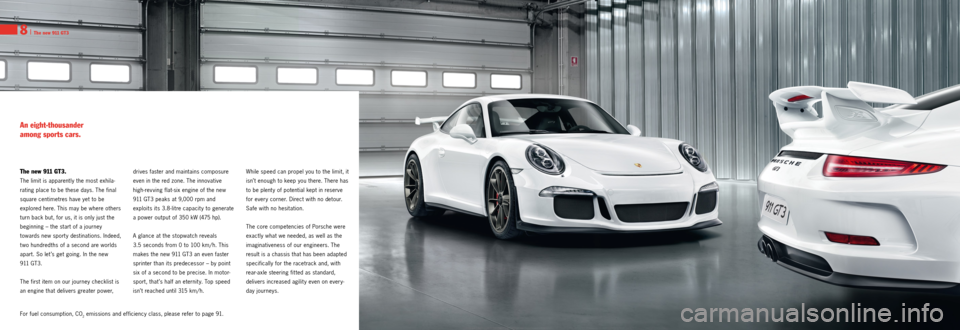
The new 911 GT3.
The limit is apparently the most exhila
rating place to be these days. The final
square centimetres have yet to be
explored here. This may be where others
turn back but, for us, it is only just the
beginning – the start of a journey
towards new sport y destinations. Indeed,
t wo hundredths of a second are worlds
apart. So let ’s get going. In the new
9 11 G T 3 .
The first item on our journey checklist is
an engine that delivers greater power,
An eight-thousander
among sports cars.
drives faster and maintains composure
even in the red zone. The innovative
high revving flat six engine of the new
911 GT3 peaks at 9,000 rpm and
exploits its 3.8 litre capacit y to generate
a power output of 350 kW (475 hp).
A glance at the stopwatch reveals
3.5 seconds from 0 to 100 km/ h. This
makes the new 911 GT3 an even faster
sprinter than its predecessor – by point
six of a second to be precise. In motor
sport, that ’s half an eternit y. Top speed
isn’t reached until 315 km/ h. While speed can propel you to the limit, it
isn’t enough to keep you there. There has
to be plent y of potential kept in reserve
for every corner. Direct with no detour.
Safe with no hesitation.
The core competencies of Porsche were
exactly what we needed, as well as the
imaginativeness of our engineers. The
result is a chassis that has been adapted
specifically for the racetrack and, with
rear
axle steering fit ted as standard,
delivers increased agilit y even on every
day journeys.
For fuel consumption, CO
2 emissions and efficiency class, please refer to page 91.
Page 6 of 49
The new 911 GT3 I 11
For the first time, 7speed Porsche Dop
pelkupplung (PDK) is fit ted as standard,
with short ratios designed exclusively for
the 911 GT3. The shift throws of the
gearshift paddles on the steering wheel
are even shorter and gear changes are
even more dynamic so as to provide
even better acceleration.
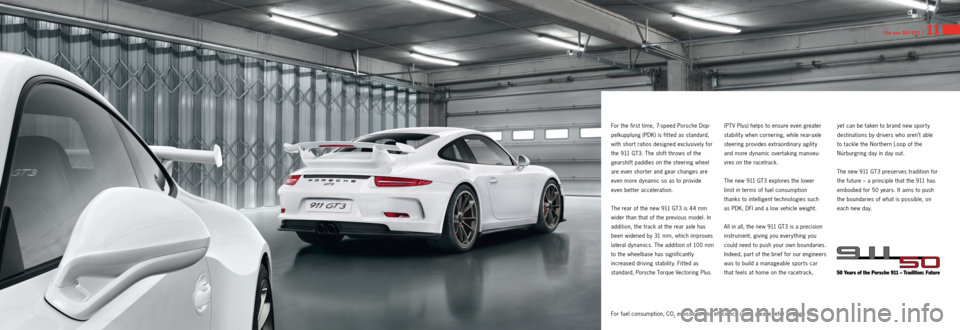
The rear of the new 911 GT3 is 44 mm
wider than that of the previous model. In
addition, the track at the rear axle has
been widened by 31 mm, which improves
lateral dynamics. The addition of 100 mm
to the wheelbase has significantly
increased driving stabilit y. Fit ted as
standard, Porsche Torque Vectoring Plus (PT V Plus) helps to ensure even greater
stability when cornering, while rear
axle
steering provides extraordinar y agilit y
and more dynamic overtaking manoeu
vres on the racetrack.
The new 911 GT3 explores the lower
limit in terms of fuel consumption
thanks to intelligent technologies such
as PDK, DFI and a low vehicle weight.
All in all, the new 911 GT3 is a precision
instrument, giving you everything you
could need to push your own boundaries.
Indeed, part of the brief for our engineers
was to build a manageable sports car
that feels at home on the racetrack, yet can be taken to brand new sport y
destinations by drivers who aren’t able
to tackle the Northern Loop of the
Nürburgring day in day out.
The new 911 GT3 preserves tradition for
the future – a principle that the 911 has
embodied for 50 years. It aims to push
the boundaries of what is possible, on
each new day.
For fuel consumption, CO
2 emissions and efficiency class, please refer to page 91.
Page 10 of 49
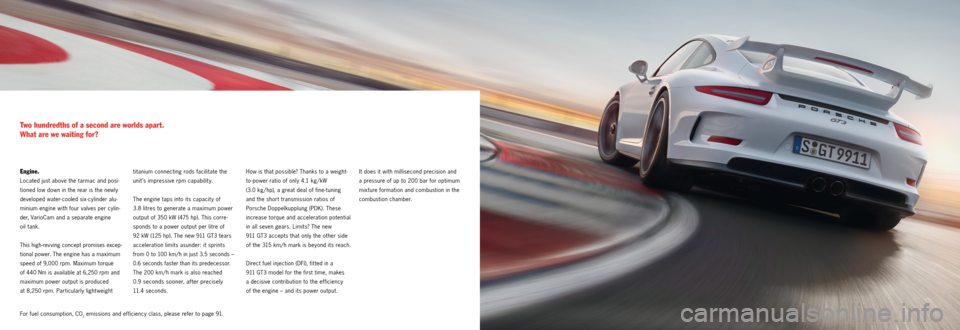
Engine.
Located just above the tarmac and posi
tioned low down in the rear is the newly
developed water cooled six cylinder alu
minium engine with four valves per cylin
der, VarioCam and a separate engine
oil tank.
This high revving concept promises excep
tional
power. The engine has a maximum
speed of 9,000 rpm.
Maximum torque
of 440
Nm is available at 6,250 rpm and
maximum power output is
produced
at 8,250 rpm. Particularly light weight
Two hundredths of a second are worlds apart.
What are we waiting for?
titanium connecting rods facilitate the
unit’s impressive rpm capability.
The engine taps into its capacit y of
3.8 litres to generate a maximum power
output of 350 kW (475 hp). This corre
sponds to a power output per litre of
92 kW (125 hp). The new 911 GT3 tears
acceleration limits asunder: it sprints
from 0 to 100 km/ h in just 3.5 seconds –
0.6 seconds faster than its predecessor.
The 200 km/ h mark is also reached
0.9 seconds sooner, after precisely
11. 4 s e c o n d s .
How is that possible? Thanks to a weight
to power ratio of only 4.1 kg / kW
(3.0 kg / hp), a great deal of fine tuning
and the short transmission ratios of
Porsche Doppelkupplung (PDK). These
increase torque and acceleration potential
in all seven gears. Limits? The new
911 GT3 accepts that only the other side
of the 315 km/ h mark is beyond its reach.
Direct fuel injection (DFI), fitted in a
911 GT3 model for the first time, makes
a decisive contribution to the efficiency
of the engine – and its power output. It does it with millisecond precision and
a pressure of up to 200 bar for optimum
mixture formation and combustion in the
combustion chamber.
For fuel consumption, CO
2 emissions and efficiency class, please refer to page 91.
Page 11 of 49
1
2
3
3
4
5
6
7
8
9
10
11
12
13
1415
15
16
17
18
19
20
1
2
3
3
4
5
6
7
8
9
10
11
12
13
1415
15
16
17
18
19
20
VarioCam.
The upgraded VarioCam system is an
engine timing concept that distinguishes
bet ween various engine speeds and
load states so that timing can be adapted
to suit the current power demand. It
regulates not only the adjustment of the
intake camshafts but also the exhaust
camshafts in order to deliver increased
power and torque.
Adjustments are controlled imperceptibly
by the new electronic engine manage
ment. The results are extremely smooth
running, better fuel economy, low emis
sions and, above all, high power and
torque across the entire engine speed
range.
Dry-sump lubrication.
The engine oil supply is vital at the limits
of sporty performance, especially
in the presence of the powerful lateral
and longitudinal forces that can be
experienced on the racetrack.
Two oil scavenge pumps per cylinder
head and t wo scavenge pumps in the
crankcase return the engine oil quickly
and efficiently to the external tank.
In conjunction with the electronically
controlled oil pressure pump, this means
that the engine has a reliable supply
of oil to the crankshaft drive and both
cylinder banks. The new 911
GT3 is factory filled with
Mobil 1 fully synthetic high performance
oil. The excellent lubrication properties of this oil ensure a reliable cold start, even
at ver y low temperatures, and contribute
not least to the durabilit y of the engine.
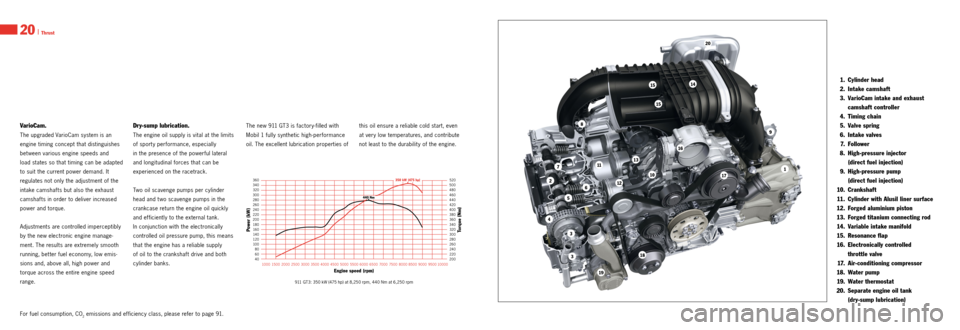
1. Cylinder head
2. Intake camshaft
3. VarioCam intake and exhaust
camshaft controller
4. Timing chain
5. Valve spring
6. Intake valves
7. Follower
8. High-pressure injector
(direct fuel injection)
9. High-pressure pump
(direct fuel injection)
10. Crankshaft
11. Cylinder with Alusil liner surface
12. Forged aluminium piston
13. Forged titanium connecting rod
14. Variable intake manifold
15. Resonance flap
16. Electronically controlled
throttle valve
17. Air-conditioning compressor
18. Water pump
19. Water thermostat
20. Separate engine oil tank
(dry-sump lubrication)
For fuel consumption, CO2 emissions and efficiency class, please refer to page 91.
911 GT3: 350 kW (475 hp) at 8,250 rpm, 440 Nm at 6,250 rpm
360
340 320
300 280260 240
220
200 18 016 0
14 0
120 10 0 8060
40
1000 15 0 02000 25003000 35004000 45005000 55006000 65007000 7500 80008500 9000 950010000 520
500
480 460
440 420
400 380360
340 320
300 280260 240
220
200
Torque (Nm) Power (kW)
Engine speed (rpm)
440 Nm
350 kW (475 hp)
20 I Thrust
Page 12 of 49
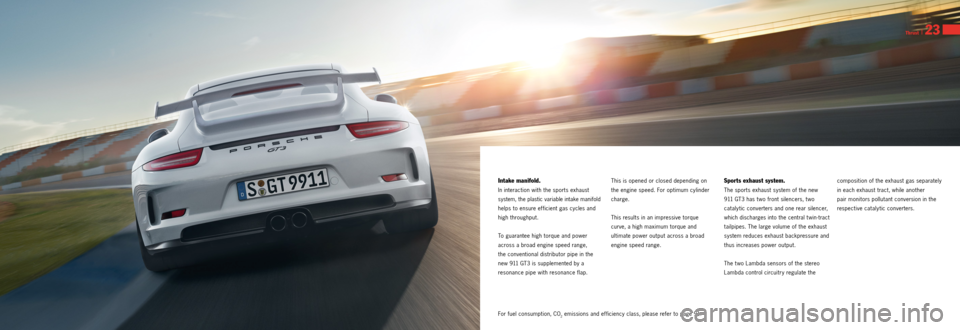
Intake manifold.
In interaction with the sports exhaust
system, the plastic variable intake manifold
helps to ensure efficient gas cycles and
high throughput.
To guarantee high torque and power
across a broad engine speed range,
the conventional distributor pipe in the
new 911 GT3 is supplemented by a
resonance pipe with resonance flap. This is opened or closed depending on
the engine speed. For optimum cylinder
charge.
This results in an impressive torque
curve, a high maximum torque and
ultimate power output across a broad
engine speed range.
Sports exhaust system.
The sports exhaust system of the new
911
GT3 has t wo front silencers, t wo
catalytic converters and one rear silencer,
which discharges into the central twin tract
tailpipes. The large volume of the exhaust
system reduces exhaust backpressure and
thus increases power output.
The t wo Lambda sensors of the stereo
Lambda control circuitry regulate the composition of the exhaust gas separately
in each exhaust tract, while another
pair monitors pollutant conversion in the
respective cataly tic converters.
Thrust I 23
For fuel consumption, CO2 emissions and efficiency class, please refer to page 91.
Page 14 of 49
Thrust I 27
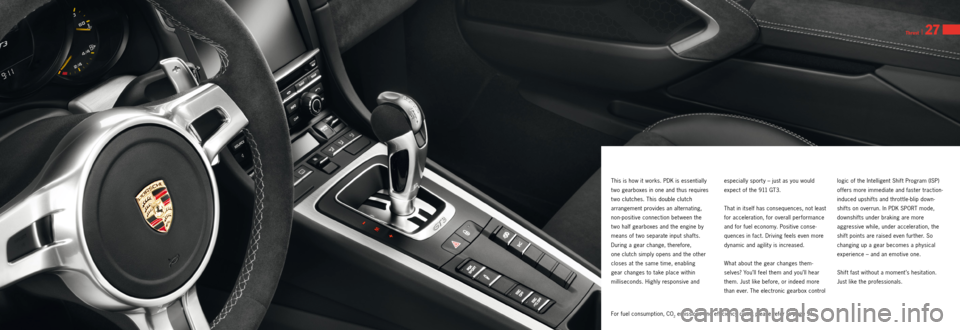
This is how it works. PDK is essentially
t wo gearboxes in one and thus requires
t wo clutches. This double clutch
arrangement provides an alternating,
nonpositive connection between the
t wo half gearboxes and the engine by
means of t wo separate input shafts.
During a gear change, therefore,
one clutch simply opens and the other
closes at the same time, enabling
gear changes to take place within
milliseconds. Highly responsive and especially sport y – just as you would
expect of the 911
GT3.
That in itself has consequences, not least
for acceleration, for overall performance
and for fuel economy. Positive conse
quences in fact. Driving feels even more
dynamic and agilit y is increased.
What about the gear changes them
selves? You’ll feel them and you’ll hear
them. Just like before, or indeed more
than ever. The electronic gearbox control logic of the Intelligent Shift Program (ISP)
offers more immediate and faster traction
induced upshifts and throttle blip down
shifts on overrun. In PDK SPORT mode,
downshifts under braking are more
aggressive while, under acceleration, the
shift points are raised even further. So
changing up a gear becomes a physical
experience – and an emotive one.
Shift fast without a moment ’s hesitation.
Just like the professionals.
For fuel consumption, CO
2 emissions and efficiency class, please refer to page 91.
Page 26 of 49

Interior.
The sports car environment in the new
911 GT3 is perfectly adapted to the
driver. Man and machine are as one.
Which is just as well because, on the
racetrack, there is usually only a fraction
of a second in which to make the right
decision. Accelerate or brake. Pass lef t
or right. Refuel or chance another lap.
Speed is critical in the cockpit, too.
The driver needs information that can
be accessed quickly and an interior ergonomics concept that enables even
faster use of it.
The requirement is fulfilled by an ascend
ing centre console that places the gear
selector within direct reach of the steer
ing wheel, by ergonomic gearshift pad
dles on the steering wheel itself and by
conveniently positioned controls that
dispense with unnecessary gadgetry but
do open up new possibilities on the
racetrack. 30,000 racing victories were
not achieved by engine power alone.
Instruments.
Precise not fanciful, minimalist not kitsch.
True to Porsche st yle, the five circular
instruments integrated in the cockpit lead
the way. In the middle is the rev counter.
Its dial face is titaniumcoloured and
bears the ‘GT3’ logo. The gear and
upshift indicator helps you to achieve
optimum acceleration.
For the first time in a 911 GT3, the instru
ment cluster is equipped with a high
resolution 4.6 inch TFT colour display. It provides you with data from the on
board
computer, including average speed and
fuel consumption, fuel range and outside
temperature, and allows you to view Tyre
Pressure Monitoring (TPM) information
as well as data from the stopwatch of the
optional Sport Chrono Package. It also
reminds you of your selected communica
tion and audio set tings or displays the
map of the optional navigation system –
but only for the rare occasion you aren’t
on the racetrack.
Designed for high speeds.
Speed of travel and speed of thought.
Cockpit I 51
Page 36 of 49
Environment.
We’ve already spoken about our contribu
tion to motorsport. To be more precise,
about our responsibility for the future of
motorsport. We meet this responsibility
with intelligent technology, unconven
tional ideas and optimum performance.
Our approach to environmental protec
tion is no different. In an era of intensify
ing debate about global climate change
and CO
2 emissions, every automotive
manufacturer is asking what it has to
offer right now. Our answer has long
been the same: high power output
combined with high efficiency.
Porsche has managed to reduce fuel
consumption significantly across all
model ranges compared with the respec
tive previous model even though perfor
mance has been increased. This is made
possible by an efficient drive concept,
lightweight construction, optimised
aerodynamics and low rolling resistance.
The environmental management team
at the Porsche Development Centre in
Weissach aims to demonstrate a high
level of environmental responsibility. Here, technological developments are
carried out with environmental protection
in mind. The goal is to enhance perfor
mance – but preferably not at the expense
of the environment.
Fuel economy and recycling.
Intelligent lightweight construction has
been part of Porsche DNA since 1948 –
for both technological and ecological
reasons. And, of course, with competitive
advantages in mind. In motorsport, weight
is increasingly the number one factor
of success. Lightweight construction is
therefore the basis for low consumption
The true challenge:
not merely getting faster, but better.
values combined with outstanding
performance.
On the technical side, various compo
nents are made with a high proportion
of aluminium, magnesium, plastics and
super high strength sheet steel. The
materials used have been selected for
their abilit y to withstand load, yet they
are considerably lighter overall than
conventional steel.
Pit stop I 71
Page 37 of 49
On the ecological side, all materials used
are meticulously selected. Each light
weight material is easily recyclable
and all plastic components are labelled
to facilitate separation for recycling.
The
reduction in the number of plastic
variants helps to ensure more efficient
recycling. Recycled plastics are used
where they meet our exacting technical
requirements.
In short, the new 911 GT3 is around 95 %
recoverable. In addition, Porsche uses a
high proportion of environmentally friendly
water based paints. For us, environmental protection does not begin at the end of
a vehicle’s life. It starts at the planning
and development stage.
Emission control.
The new 911 GT3 meets the strict Euro 5
emission standard in the EU and LEV II
in the USA. Vehicles manufactured by
Porsche demonstrate that even high
performance sports cars can achieve
moderate emission values in their
respective category. This puts the new
911 GT3 among not only the most powerful sports cars of the future, but
also the cleanest.
This has been accomplished not least by
the t wo cataly tic converters and stereo
Lambda control circuits, which monitor
each cylinder bank separately. For each
exhaust tract, t wo Lambda sensors regu
late the composition of the exhaust gas.
Another Lambda sensor for each cylinder
bank monitors pollutant conversion in the
respective cataly tic converter.
Fuel.
All Porsche models – including the new
911 GT3 – are designed to operate on
fuels with an ethanol content of up to
10 %, e.g. ‘E10’. Ethanol has a positive
impact on the CO2 balance since the
plants grown for the production of
this biofuel also absorb CO
2 from the
atmosphere.
The release of hydrocarbons from the
fuel system has been minimised thanks
to the active carbon filter and the
multi layered material from which the
fuel tank is made. All fuel lines are
made from multi layered plastic, steel
or aluminium.
For fuel consumption, CO2 emissions and efficiency class, please refer to page 91.
72 I Pit stop
Page 46 of 49
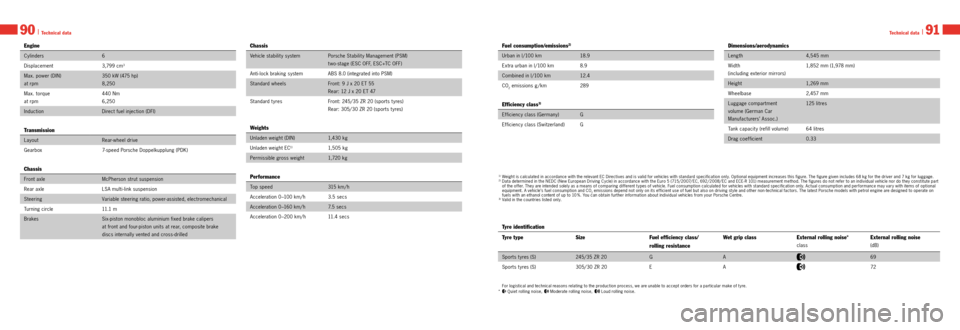
Technical data I 9190 I Technical data
Engine
C y linders6
Displacement 3,79 9 c m
3
Max. power (DIN)
at rpm 350 kW (475 hp)
8,250
Max. torque
at rpm 440 Nm
6,250
Induction Direct fuel injection (DFI)
Transmission
LayoutRearwheel drive
Gearbox 7speed Porsche Doppelkupplung (PDK)
Chassis
Front axle McPherson strut suspension
Rear axle LSA multilink suspension
Steering Variable steering ratio, powerassisted, electromechanical
Turning circle 11.1 m
Brakes Sixpiston monobloc aluminium fixed brake calipers
at front and four piston units at rear, composite brake
discs internally vented and cross drilled
Chassis
Vehicle stabilit y system Porsche Stability Management (PSM)
t wostage (ESC OFF, ESC+TC OFF)
Anti lock braking system ABS 8.0 (integrated into PSM)
Standard wheels Front: 9 J x 20 ET 55
Rear: 12 J x 20 ET 47
Standard tyres Front: 245/35 ZR 20 (sports t yres)
Rear: 305/30 ZR 20 (sports t yres)
Weights
Unladen weight (DIN) 1,4 3 0 k g
Unladen weight EC
1)1,5 05 k g
Permissible gross weight 1,720 k g
Performance
Top speed 315 k m / h
Acceleration 0 –100 km/ h 3.5 secs
Acceleration 0 –160 km/ h 7.5 secs
Acceleration 0 –200 km/ h 11.4 secs
Fuel consumption/emissions2)
Urban in l/100 km 18.9
Extra urban in l/100 km 8.9
Combined in l/100 km 12.4
CO
2 emissions g/km 289
Efficiency class3)
Efficiency class (Germany) G
Ef ficiency class (Switzerland) G
1) Weight is calculated in accordance with the relevant EC Directives and is valid for vehicles with standard specification only. Optional equipment increases this figure. The figure given includes 68 kg for the driver and 7 kg for luggage.2) Data determined in the NEDC (New European Driving Cycle) in accordance with the Euro 5 (715/2007/ EC, 692/2008/ EC and ECE R 101) measurement method. The figures do not refer to an individual vehicle nor do they constitute part
of the of fer. They are intended solely as a means of comparing dif ferent t ypes of vehicle. Fuel consumption calculated for vehicles with standard specification only. Actual consumption and per formance may var y with items of optional
equipment. A vehicle’s fuel consumption and CO
2 emissions depend not only on its ef ficient use of fuel but also on driving st yle and other non technical factors. The latest Porsche models with petrol engine are designed to operate on
fuels with an ethanol content of up to 10 %. You can obtain further information about individual vehicles from your Porsche Centre.
3) Valid in the countries listed only.
Tyre identification
Ty r e t yp e SizeFuel efficiency class/
rolling resistanceWet grip class
External rolling noise*
class
External rolling noise
(dB)
Sports t yres (S) 245/35 ZR 20GA 69
Sports t yres (S) 305/30 ZR 20EA 72
Dimensions/aerodynamics
Length 4,545 mm
Width
(including exterior mirrors) 1,852 mm (1,978 mm)
Height 1, 269 m m
Wheelbase 2,457 m m
Luggage compartment
volume (German Car
Manufacturers’ Assoc.) 125 l i t re s
Tank capacity (refill volume) 64 litres
Drag coef ficient 0.33
For logistical and technical reasons relating to the production process, we are unable to accept orders for a particular make of t yre.
* Quiet rolling noise, Moderate rolling noise,
Loud rolling noise.