fuel consumption PORSCHE 911 TARGA4 2013 6.G Information Manual
[x] Cancel search | Manufacturer: PORSCHE, Model Year: 2013, Model line: 911 TARGA4, Model: PORSCHE 911 TARGA4 2013 6.GPages: 54, PDF Size: 8.37 MB
Page 10 of 54
2120
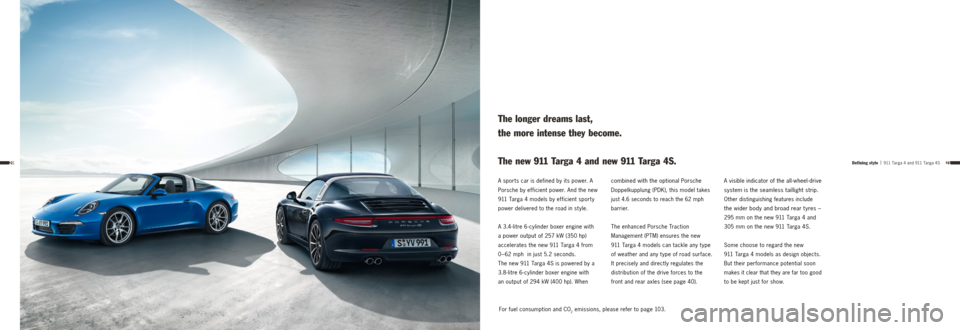
A sports car is defined by its power. A
Porsche by efficient power. And the new
911 Targa 4 models by efficient sport y
power delivered to the road in st yle.
A 3.4-litre 6- cylinder boxer engine with
a power output of 257 kW (350 hp)
accelerates the new 911 Targa 4 from
0 – 62 mph in just 5.2 seconds.
The new 911 Targa 4S is powered by a
3.8-litre 6-cylinder boxer engine with
an output of 294 kW (400 hp). When
combined with the optional Porsche
Doppel kupplung (PDK), this model takes
just 4.6 seconds to reach the 62 mph
barrier.
The enhanced Porsche Traction
Manage ment (PTM) ensures the new
911 Targa 4 models can tackle any t ype
of weather and any t ype of road surface.
It precisely and directly regulates the
distribution of the drive forces to the
front and rear axles (see page 40). A
visible indicator of the all-wheel-drive
system is the seamless taillight strip.
Other distinguishing features include
the wider body and broad rear t yres –
295 mm on the new 911 Targa 4 and
305 mm on the new 911 Targa 4S.
Some choose to regard the new
911 Targa 4 models as design objects.
But their performance potential soon
makes it clear that they are far too good
to be kept just for show.
For fuel consumption and CO
2 emissions, please refer to page 103.
Defining style | 911 Targa 4 and 911 Targa 4S
The longer dreams last,
the more intense they become.
The new 911 Targa 4 and new 911 Targa 4S.
Page 16 of 54
3332Authentic style | Drive
For fuel consumption and CO2 emissions, please refer to page 103.
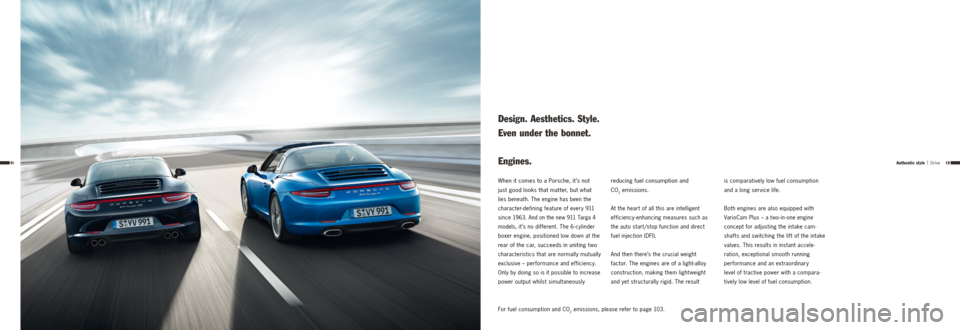
When it comes to a Porsche, it ’s not
just good looks that mat ter, but what
lies beneath. The engine has been the
character-defining feature of every 911
since
1963. And on the new 9 11 Targa 4
models, it ’s no different. The 6- cylinder
boxer engine, positioned low down at the
rear
of the car, succeeds in uniting t wo
characteristics that are normally mutually
exclusive – performance and efficiency.
Only by doing so is it possible to increase
power output whilst simultaneously
reducing fuel consumption and
CO
2 emissions.
At the heart of all this are intelligent
efficiency-enhancing measures such as
the auto start/stop function and direct
fuel injection (DFI).
And then there’s the crucial weight
factor. The engines are of a light-alloy
construction, making them lightweight
and yet structurally rigid. The result
Design. Aesthetics. Style.
Even under the bonnet.
Engines.
is comparatively low fuel consumption
and a long service life.
Both engines are also equipped with
VarioCam Plus – a two-in-one engine
concept for adjusting the intake cam -
shafts and switching the lift of the intake
valves. This results in instant accele -
ration, exceptional smooth running
performance and an extraordinary
level of tractive power with a compara -
tively low level of fuel consumption.
Page 17 of 54
3534
For fuel consumption and CO2 emissions, please refer to page 103.
The 3.4-litre engine of the
911 Targa 4.
The engine of the new 911 Targa 4
develops 257 kW (350 hp) at 7,400 rpm
and a maximum torque of 390 Nm at
5,600 rpm. When combined with the
7-speed manual gearbox, it accelerates
from 0 – 62 mph in just 5.2 seconds and
reaches a top speed of 175 mph.
The 3.8-litre engine of the
911 Targa 4S.
On the S model, the figures speak for
themselves: the 3.8-litre boxer engine
develops 294 kW (400 hp) at 7,400 rpm
and a maximum torque of 440 Nm at
5,600 rpm. When equipped with the
optional Porsche Doppelkupplung (PDK),
the new 911 Targa 4S completes the
0 – 62 mph sprint in just 4.6 seconds
and can continue on to a top speed of
182 mph.
Efficiency technologies.
At Porsche, reducing fuel consumption is
part and parcel of performance. It goes
without saying, therefore, that efficiency
technologies are standard features on
the 9 11 Targa 4 models and form an
integral part of the vehicle concept.
Whenever the car comes to a stop, the
auto start/stop function automatically
switches off the engine – and restarts it
swiftly and smoothly as soon as you
operate the clutch or, on models with
Porsche Doppelkupplung (PDK), as soon
as you release the brake.
The thermal management system
regulates the temperature in the engine
and gearbox through the intelligent
manipulation of heat flow. The resulting
improvement in combustion efficiency has
a beneficial effect on fuel consumption. A further fuel-saving feature is electrical
system recuperation. This function
ensures that the bat tery is recharged
predominantly by the alternator under
braking conditions.
Direct fuel injection (DFI).
DFI delivers fuel directly into the combus
-
tion chamber with millisecond precision.
The spray and cone angles of the multi-
hole injectors have been optimised for
torque, power output, fuel consumption,
emissions and efficient combustion.
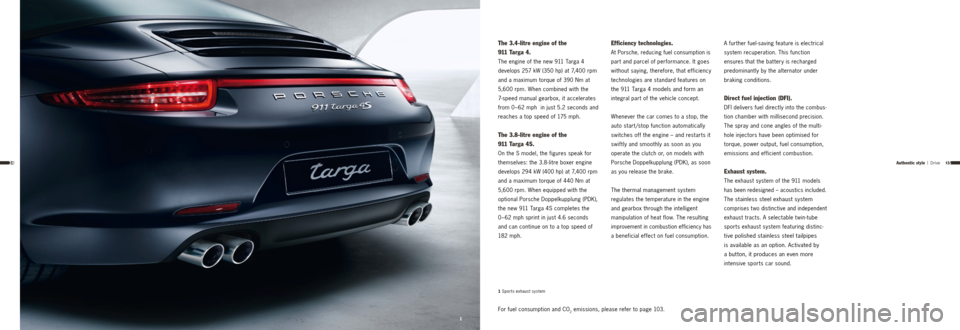
Exhaust system.
The exhaust system of the 911 models
has been redesigned – acoustics included.
The stainless steel exhaust system
comprises two distinctive and independent
exhaust tracts. A selectable t win-tube
sports exhaust system featuring distinc -
tive polished stainless steel tailpipes
is available as an option. Activated by
a but ton, it produces an even more
intensive sports car sound.
1 Spor ts exhaust system
Authentic style | Drive
1
Page 18 of 54
3736
For fuel consumption and CO2 emissions, please refer to page 103.
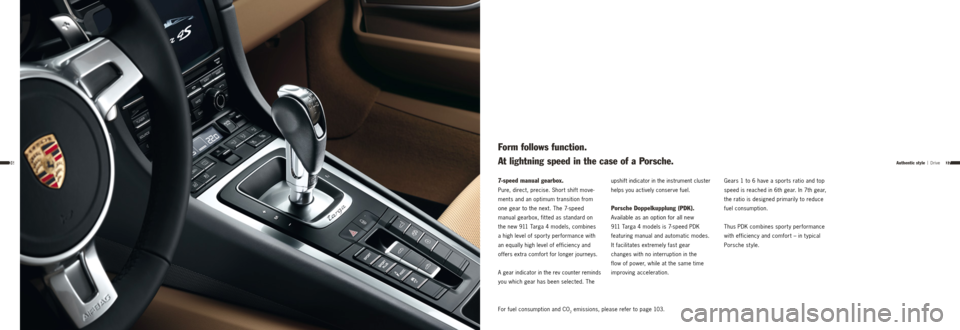
7-speed manual gearbox.
Pure, direct, precise. Short shift move-
ments and an optimum transition from
one gear to the next. The 7-speed
manual gearbox, fit ted as standard on
the new 911 Targa 4 models, combines
a high level of sport y performance with
an equally high level of efficiency and
offers extra comfort for longer journeys.
A gear indicator in the rev counter reminds
you which gear has been selected. The
upshift indicator in the instrument cluster
helps you actively conserve fuel.
Porsche Doppelkupplung (PDK).
Available as an option for all new
911 Targa 4 models is 7-speed PDK
featuring manual and automatic modes.
It facilitates extremely fast gear
changes with no interruption in the
flow of power, while at the same time
improving acceleration.
Form follows function.
At lightning speed in the case of a Porsche.
Gears 1 to 6 have a sports ratio and top
speed is reached in 6th gear. In 7th gear,
the ratio is designed primarily to reduce
fuel consumption.
Thus PDK combines sporty performance
with efficiency and comfort – in t ypical
Porsche st yle.
Authentic style | Drive
Page 19 of 54
3938
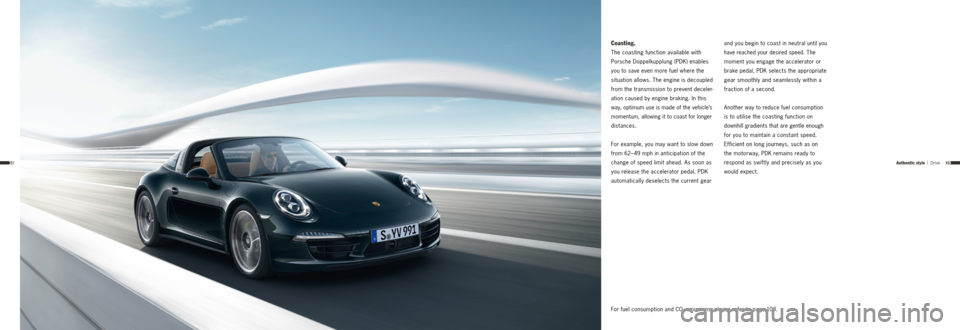
Coasting.
The coasting function available with
Porsche Doppelkupplung (PDK) enables
you to save even more fuel where the
situation allows. The engine is decoupled
from the transmission to prevent deceler -
ation caused by engine braking. In this
way, optimum use is made of the vehicle’s
momentum, allowing it to coast for longer
distances.
For example, you may want to slow down
from 62–49 mph in anticipation of the
change of speed limit ahead. As soon as
you release the accelerator pedal, PDK
automatically deselects the current gear and you begin to coast in neutral
until you
have reached your desired speed.
The
moment you engage the accelerator or
brake pedal, PDK selects the appro
priate
gear smoothly and seamlessly
within a
fraction of a second.
Another way to reduce fuel consumption
is to utilise the coasting function on
downhill gradients that are gentle enough
for you to maintain a constant speed.
Efficient on long journeys, such as on
the motorway, PDK remains ready to
respond as swiftly and precisely as you
would expect.
Authentic style | Drive
For fuel consumption and CO2 emissions, please refer to page 103.
Page 24 of 54
4948
Dynamic engine mounts.
The dynamic engine mounts are included
as part of the Sport Chrono Package. The
electronically controlled system minimises
the oscillations and vibrations of the entire
drivetrain, especially the engine, and
combines the benefits of a hard or soft
engine mounting arrangement.
The stiffness and damping properties
of the engine mounts are adapted to
changes in driving st yle and road surface
conditions. Handling is noticeably more
stable under load change conditions and
in fast corners. Whenever a less asser -
tive driving st yle is adopted, the dynamic
engine mounts provide a greater level
of comfort.
Wheels.
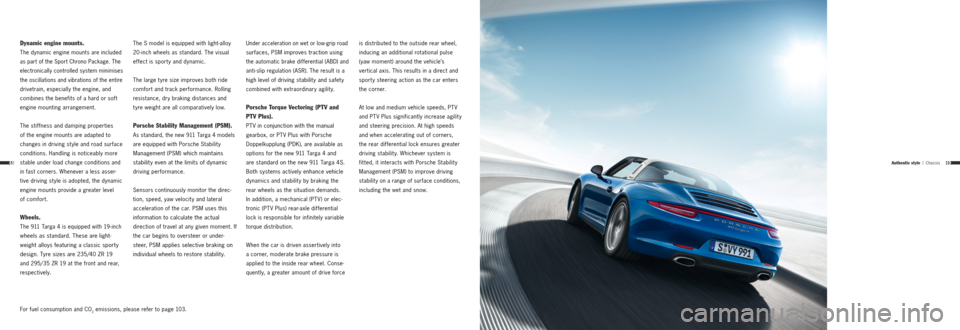
The 9 11 Targa 4 is equipped with 19-inch
wheels as standard. These are light-
weight alloys featuring a classic sport y
design. Tyre sizes are 235/40 ZR 19
and 295/35 ZR 19 at the front and rear,
respectively.
For fuel consumption and CO
2 emissions, please refer to page 103. The S model is equipped with light-alloy
20-inch wheels as standard. The visual
effect is sport y and dynamic.
The large t yre size improves both ride
comfort and track performance. Rolling
resistance, dry braking distances and
t yre weight are all comparatively low.
Porsche Stability Management (PSM).
As standard, the new 9 11 Targa 4 models
are equipped with
Porsche Stability
Management (PSM) which maintains
stabilit y even at the limits of dynamic
driving performance.
Sensors continuously monitor the direc -
tion, speed, yaw velocit y and lateral
acceleration of the car. PSM uses this
information to calculate the actual
direction of travel at any given moment. If
the car begins to oversteer or under -
steer, PSM applies selective braking on
individual wheels to restore stability.
Under acceleration on wet or low-grip road
surfaces, PSM improves traction using
the automatic brake differential (ABD) and
anti-slip regulation (ASR). The result is a
high level of driving stabilit y and safet y
combined with extraordinary agility.
Porsche Torque Vectoring (PTV and
PTV Plus).
PTV in conjunction with the manual
gearbox, or PT V Plus with Porsche
Doppelkupplung (PDK), are available as
options for the new 911 Targa 4 and
are standard on the new 9 11 Targa 4S.
Both systems actively enhance vehicle
dynamics and stabilit y by braking the
rear wheels as the situation demands.
In addition, a mechanical (PT V) or elec -
tronic (PT V Plus) rear-axle differential
lock is responsible for infinitely variable
torque distribution.
When the car is driven assertively into
a corner, moderate brake pressure is
applied to the inside rear wheel. Conse -
quently, a greater amount of drive force is distributed to the outside rear wheel,
inducing an additional rotational pulse
(yaw moment) around the vehicle’s
vertical axis. This results in a direct and
sport y steering action as the car enters
the corner.
At low and medium vehicle speeds, PT V
and PT V Plus significantly increase agilit y
and steering precision. At high speeds
and when accelerating out of corners,
the rear differential lock ensures greater
driving stability. Whichever system is
fitted, it interacts with Porsche Stability
Management (PSM) to improve driving stabilit y on a range of surface conditions,
including the wet and snow.
Authentic style | Chassis
Page 28 of 54
5756
In an era of intensifying debate about
global
climate change and CO2 emissions,
every automotive manufacturer is asking
what it has to offer right now. Our answer
is ‘high performance must be accom panied
by high efficiency’.
Exhaust emission control.
Vehicles manufactured by Porsche
demonstrate that even high-performance
sports cars can achieve moderate
fuel consumption and exhaust emission
values in their respective category. This is enabled, on the one hand, by the
use of fuel-efficient technologies such
as auto start /stop, thermal management,
electrical system recuperation, direct
fuel injection or coasting mode. On the
other hand, new cataly tic converters
developed for the 911 provide efficient
emission control through the use of
stereo Lambda control circuitry.
Sustainable driving pleasure
is ultimately a question of good style too.
Porsche and the environment.
Fuel economy and recycling.
Intelligent lightweight construction is
fundamental to the Porsche identit y. It
is expressed through the use of a high
proportion of aluminium, magnesium,
plastics, super-high-strength sheet steel
and environmentally friendly water-based
paints. All materials are meticulously
and purposefully selected. All lightweight
materials are easily recyclable and
all plastic components are labelled to
facilitate their separation for subsequent
recycling. In short, the 911 is now around
95 % recoverable.
Fuel.
All Porsche models – including the 911 –
are designed to operate using fuels with
an ethanol content of up to 10 %, e. g.
‘E10’. Ethanol has a positive impact on
the CO
2 balance since the plants grown
for the production of this biofuel also
absorb CO
2 from the atmosphere.
Authentic style | Environment
For fuel consumption and CO2 emissions, please refer to page 103.
Page 30 of 54
6160
Comfort.
You could say that designing a sports car
is all about creating a unique st yle. But
it’s also about reconciling performance
with everyday practicalit y. To achieve this
seemingly contradictory goal, all elements,
particularly those in the interior, must be
perfectly coordinated with each other.
Specifically, this means combining sport y
ergonomics, high-quality materials and
signature Porsche st yling to create one harmonious overall concept. One that’s
timeless. And, perhaps precisely because
of this, one that ’s also a lit tle ahead of
its time.Instruments.
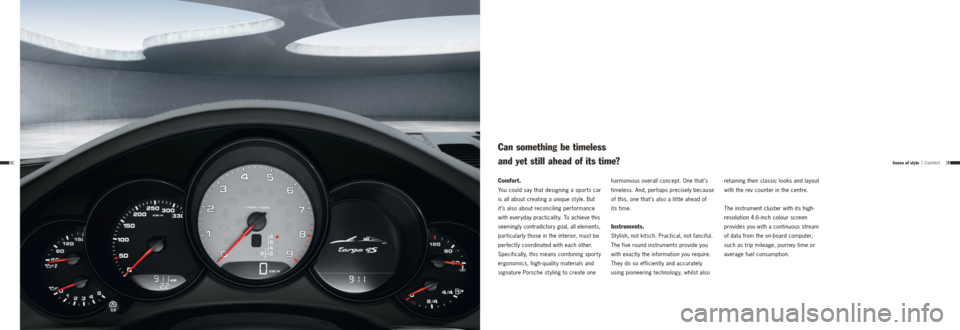
St ylish, not kitsch. Practical, not fanciful.
The five round instruments provide you
with exactly the information you require.
They do so efficiently and accurately
using pioneering technology, whilst also
Can something be timeless
and yet still ahead of its time?
retaining their classic looks and layout
with the rev counter in the centre.
The instrument cluster with its high-
resolution 4.6-inch colour screen
provides you with a continuous stream
of data from the on-board computer,
such as trip mileage, journey time or
average fuel consumption.
Sense of style | Comfort
Page 51 of 54
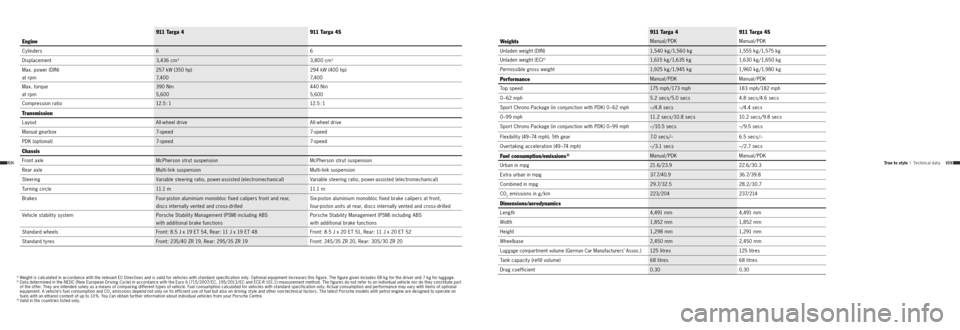
103102True to style | Technical data
911 Targa 4911 Targa 4S
Weights
Manual/PDK Manual/PDK
Unladen weight (DIN) 1,5 4 0 k g / 1,5 6 0 k g1,555 kg /1,575 kg
Unladen weight (EC)
1)1,615 k g / 1,6 35 k g 1,6 3 0 k g / 1,65 0 k g
Permissible gross weight 1,925 k g / 1,9 45 k g1,9 6 0 k g / 1,9 8 0 k g
PerformanceManual/PDKManual/PDK
Top speed 175 mph/173 mph183 mph/182 mph
0 – 62 mph 5.2 secs/5.0 secs4.8 secs/4.6 secs
Sport Chrono Package (in conjunction with PDK) 0 – 62 mph –/4.8 secs–/4.4 secs
0 –99 mph 11.2 secs/10.8 secs10.2 secs/9.8 secs
Sport Chrono Package (in conjunction with PDK) 0 –99 mph –/10.5 secs–/9.5 secs
Flexibilit y (49 –74 mph). 5th gear 7.0 secs/–6.5 secs/–
Overtaking acceleration (49–74 mph) –/3.1 secs–/2.7 secs
Fuel consumption/emissions 2)Manual/PDKManual/PDK
Urban in mpg 21.6/ 23.922.6/30.3
Extra urban in mpg 3 7. 7/ 4 0 . 936.7/39.8
Combined in mpg 2 9 . 7/ 3 2 . 528.2 / 3 0.7
CO
2 emissions in g / km 223/2042 3 7/ 2 14
Dimensions/aerodynamics
Length 4,491 m m4,491 m m
Width 1,8 52 m m1,8 52 m m
Height 1, 2 9 8 m m1, 2 91 m m
Wheelbase 2,450 mm2,450 mm
Luggage compartment volume (German Car Manufacturers’ Assoc.) 125 l i t re s125 l i t re s
Tank capacity (refill volume) 68 litres68 litres
Drag coefficient 0.300.30
911 Targa 4 911 Targa 4S
Engine
Cylinders 6 6
Displacement 3,436 cm
33,800 cm3
Max. power (DIN)
at rpm257 kW (350 hp)
7, 4 0 0 294 kW (400 hp)
7, 4 0 0
Max. torque
at rpm 390 Nm
5,600 440 Nm
5,600
Compression ratio 12.5 : 1 12.5 : 1
Transmission
LayoutAll-wheel drive All-wheel drive
Manual gearbox 7-speed 7-speed
PDK (optional) 7-speed 7-speed
Chassis
Front a xleMcPherson strut suspension McPherson strut suspension
Rear axle Multi-link suspension Multi-link suspension
Steering Variable steering ratio, power-assisted (electromechanical) Variable steering ratio, power-assisted (electromechanical)
Turning circle 11.1 m 11.1 m
Brakes Four-piston aluminium monobloc fixed calipers front and rear,
discs internally vented and cross-drilled Six-piston aluminium monobloc fixed brake calipers at front,
four-piston units at rear, discs internally vented and cross- drilled
Vehicle stability system Porsche Stability Management (PSM) including ABS
with additional brake functions
Porsche Stability Management (PSM) including ABS
with additional brake functions
Standard wheels Front: 8.5 J x 19 ET 54, Rear: 11 J x 19 ET 48 Front: 8.5 J x 20 ET 51, Rear: 11 J x 20 ET 52
Standard tyres Front: 235/40 ZR 19, Rear: 295/35 ZR 19 Front: 245/35 ZR 20, Rear: 305/30 ZR 20
1) Weight is calculated in accordance with the relevant EC Directives and is valid for vehicles with standard specification only. Optional equipment increases this figure. The figure given includes 68 kg for the driver and 7 kg for luggage.2) Data determined in the NEDC (New European Driving Cycle) in accordance with the Euro 6 (715/2007/ EC, 195/2013/ EC and ECE- R 101.1) measurement method. The figures do not refer to an individual vehicle nor do they constitute par t
of the of fer. They are intended solely as a means of comparing dif ferent t ypes of vehicle. Fuel consumption calculated for vehicles with standard specification only. Actual consumption and per formance may var y with items of optional
equipment. A vehicle’s fuel consumption and CO
2 emissions depend not only on its ef ficient use of fuel but also on driving st yle and other non -technical factors. The latest Porsche models with petrol engine are designed to operate on
fuels with an ethanol content of up to 10 %. You can obtain fur ther information about individual vehicles from your Porsche Centre.
3) Valid in the countries listed only.
Page 52 of 54
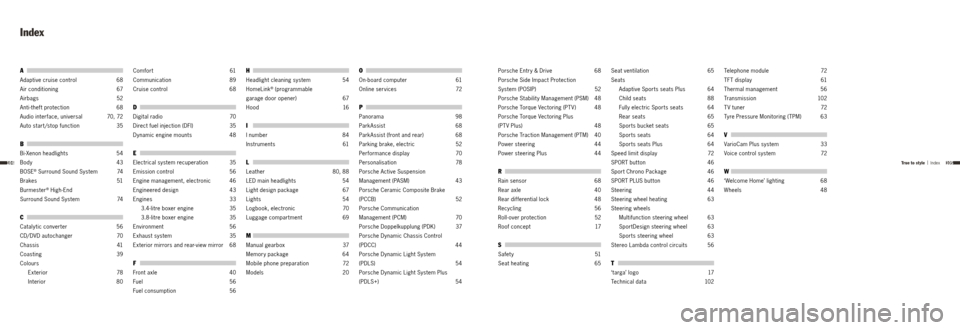
105104
Index
A
Adaptive cruise control 68
Air conditioning 67
Airbags 52
Anti-theft protection 68
Audio interface, universal 70, 72
Auto start/stop function 35
B
Bi-Xenon headlights 54
Body 43
BOSE
® Surround Sound System 74
B r a ke s 51
Burmester
® High - End
Surround Sound System 74
C
Catalytic converter 56
CD/ DVD autochanger 70
Chassis 41
Coasting 39
Colours Exterior 78
Interior 80 Co m fo r t
61
Communication 89
Cruise control 68
D
Digital radio 70
Direct fuel injection (DFI) 35
Dynamic engine mounts 48
E
Electrical system recuperation 35
Emission control 56
Engine management, electronic 46
Engineered design 43
Engines 33
3.4-litre boxer engine 35
3.8-litre boxer engine 35
Environment 56
Exhaust system 35
Exterior mirrors and rear-view mirror 68
F
Front axle 40
Fuel 56
Fuel consumption 56
H
Headlight cleaning system 54
HomeLink
® (programmable
garage door opener) 67
Hood 16
I
I number 84
Instruments 61
L
Leather 80, 88
LED main headlights 54
Light design package 67
Lights 54
Logbook, electronic 70
Luggage compartment 69
M
Manual gearbox 37
Memory package 64
Mobile phone preparation 72
Models 20
O
On-board computer 61
Online services 72
P
Panorama 98
Park Assist 68
Park Assist (front and rear) 68
Parking brake, electric 52
Performance display 70
Personalisation 78
Porsche Active Suspension
Management (PASM) 43
Porsche Ceramic Composite Brake
(PCCB) 52
Porsche Communication
Management (PCM) 70
Porsche Doppelkupplung (PDK) 37
Porsche Dynamic Chassis Control
(PDCC) 44
Porsche Dynamic Light System
(PDLS) 54
Porsche Dynamic Light System Plus
(PDLS +
) 54 Porsche Entry & Drive
68
Porsche Side Impact Protection
System (POSIP) 52
Porsche Stabilit y Management (PSM) 48
Porsche Torque Vectoring (PT V) 48
Porsche Torque Vectoring Plus
(PT V Plus) 48
Porsche Traction Management (PTM) 40
Power steering 44
Power steering Plus 44
R
Rain sensor 68
Rear axle 40
Rear differential lock 48
Recycling 56
Roll-over protection 52
Roof concept 17
S
S a f e t y 51
Seat heating 65 Seat ventilation
65
Seats Adaptive Sports seats Plus 64
Child seats 88
Fully electric Sports seats 64
Rear seats 65
Sports bucket seats 65
Sports seats 64
Sports seats Plus 64
Speed limit display 72
SPORT but ton 46
Sport Chrono Package 46
SPORT PLUS but ton 46
Steering 44
Steering wheel heating 63
Steering wheels Multifunction steering wheel 63
SportDesign steering wheel 63
Sports steering wheel 63
Stereo Lambda control circuits 56
T
‘ targa’ logo 17
Technical data 102Telephone module
72
TFT display 61
Thermal management 56
Transmission 102
T V tuner 72
Tyre Pressure Monitoring (TPM) 63
V
VarioCam Plus system 33
Voice control system 72
W
‘Welcome Home’ lighting 68
Wheels 48
True to style | Index