Fuel PORSCHE 911 TURBO 2004 4.G Information Manual
[x] Cancel search | Manufacturer: PORSCHE, Model Year: 2004, Model line: 911 TURBO, Model: PORSCHE 911 TURBO 2004 4.GPages: 61, PDF Size: 2.14 MB
Page 17 of 61
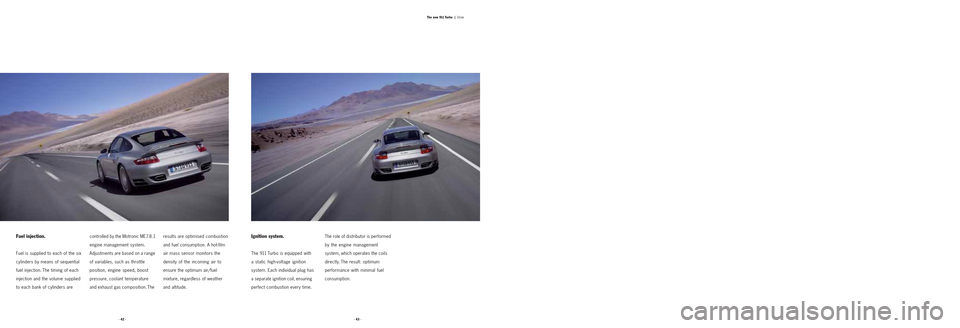
Fuel injection.
Fuel is supplied to each of the six
cylinders by means of sequential
fuel injection. The timing of each
injection and the volume supplied
to each bank of cylinders are
controlled by the Motronic ME7.8.1
engine management system.
Adjustments are based on a range
of variables, such as throttle
position, engine speed, boost
pressure, coolant temperature
and exhaust gas composition. Theresults are optimised combustion
and fuel consumption. A hot-film
air mass sensor monitors the
density of the incoming air to
ensure the optimum air/fuel
mixture, regardless of weather
and altitude.
Ignition system.
The 911 Turbo is equipped with
a static high-voltage ignition
system. Each individual plug has
a separate ignition coil, ensuring
perfect combustion every time.
The role of distributor is performed
by the engine management
system, which operates the coils
directly. The result: optimum
performance with minimal fuel
consumption.
· 42 ·· 43 ·The new 911 Turbo |
Drive
Page 18 of 61
are reduced thanks to lengthy
replacement intervals for both
the engine oil (18,000 miles) and
air filter unit (36,000 miles). The
spark plugs require changing after
36,000 miles or a maximum of
every four years. The generator,
power-steering pump and air-
conditioning compressor are all
driven by a single self-adjusting
belt with a service life of 54,000
miles. The hydraulic tappets
provide automatic adjustment of
all valve clearances, while the
drive chains on the camshafts
and auxiliary shafts will also last
the life of the car.
Basic servicing is required after
18,000 miles or a maximum of
two years on the road. The first
major service is due at 36,000
miles or every four years at the
latest. The results: lower running
costs and virtually uninterrupted
enjoyment from your Porsche.
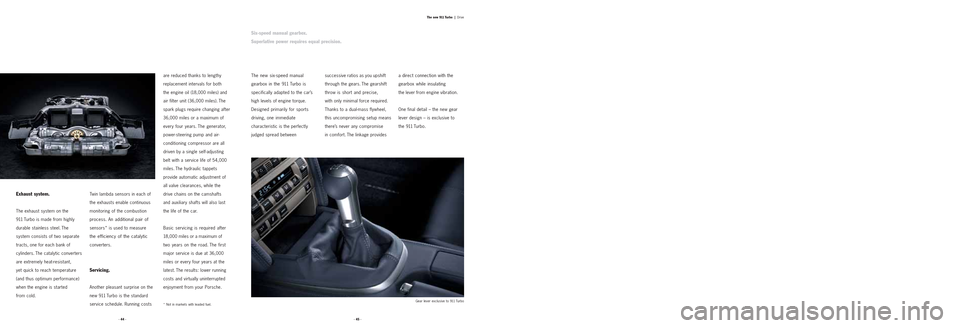
Exhaust system.
The exhaust system on the
911 Turbo is made from highly
durable stainless steel. The
system consists of two separate
tracts, one for each bank of
cylinders. The catalytic converters
are extremely heat-resistant,
yet quick to reach temperature
(and thus optimum performance)
when the engine is started
from cold.Twin lambda sensors in each of
the exhausts enable continuous
monitoring of the combustion
process. An additional pair of
sensors* is used to measure
the efficiency of the catalytic
converters.
Servicing.
Another pleasant surprise on the
new 911 Turbo is the standard
service schedule. Running costs
The new six-speed manual
gearbox in the 911 Turbo is
specifically adapted to the car’s
high levels of engine torque.
Designed primarily for sports
driving, one immediate
characteristic is the perfectly
judged spread betweensuccessive ratios as you upshift
through the gears. The gearshift
throw is short and precise,
with only minimal force required.
Thanks to a dual-mass flywheel,
this uncompromising setup means
there’s never any compromise
in comfort. The linkage provides
a direct connection with the
gearbox while insulating
the lever from engine vibration.
One final detail – the new gear
lever design – is exclusive to
the 911 Turbo.
· 44 ·· 45 ·The new 911 Turbo |
Drive
Six-speed manual gearbox.
Superlative power requires equal precision.
Gear lever exclusive to 911 Turbo* Not in markets with leaded fuel.
Page 19 of 61
Tiptronic S also includes a warm-
up function designed to minimise
exhaust emissions. When the
car is started, the engine speed is
increased so that the catalytic
converters reach their optimum
operating temperature within the
shortest possible time. braking on descent. This, of
course, helps to reduce the
load on the braking system. If
traction is lost under braking
in the wet or on snow, the system
automatically changes up to
restore lateral grip and bring the
car back into line. there is no need to use a kick-
down function. Unlike conventional
automatic systems, Tiptronic S
does not shift up when the throttle
is released, thus enabling
optimum acceleration when exiting
a corner with no loss of stability
due to changes in load. Mid-corner
gearshifts are also prevented,
thereby enhancing stability and
safety. Under heavy braking, the
system shifts down, using engine
braking to slow the car. The
function is enabled during high-
performance use when the driver
releases the throttle to apply
the brake within a period of
1.5 seconds. These active
downshifts enhance the car’s
performance, particularly when
braking for a corner. Under
prolonged braking, additional
downshifts are performed based
on the amount of brake force
applied. An incline sensor
improves uphill acceleration and
makes better use of engine
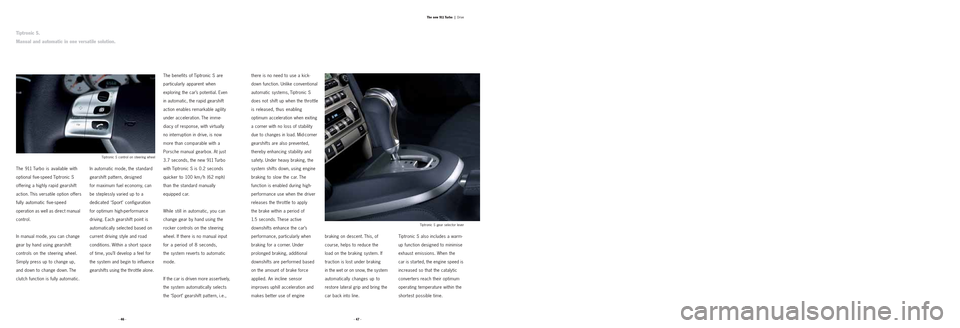
The 911 Turbo is available with
optional five-speed Tiptronic S
offering a highly rapid gearshift
action. This versatile option offers
fully automatic five-speed
operation as well as direct manual
control.
In manual mode, you can change
gear by hand using gearshift
controls on the steering wheel.
Simply press up to change up,
and down to change down. The
clutch function is fully automatic.In automatic mode, the standard
gearshift pattern, designed
for maximum fuel economy, can
be steplessly varied up to a
dedicated ‘Sport’ configuration
for optimum high-performance
driving. Each gearshift point is
automatically selected based on
current driving style and road
conditions. Within a short space
of time, you’ll develop a feel for
the system and begin to influence
gearshifts using the throttle alone.
The benefits of Tiptronic S are
particularly apparent when
exploring the car’s potential. Even
in automatic, the rapid gearshift
action enables remarkable agility
under acceleration. The imme-
diacy of response, with virtually
no interruption in drive, is now
more than comparable with a
Porsche manual gearbox. At just
3.7 seconds, the new 911 Turbo
with Tiptronic S is 0.2 seconds
quicker to 100 km / h (62 mph)
than the standard manually
equipped car.
While still in automatic, you can
change gear by hand using the
rocker controls on the steering
wheel. If there is no manual input
for a period of 8 seconds,
the system reverts to automatic
mode.
If the car is driven more assertively,
the system automatically selects
the ‘Sport’ gearshift pattern, i.e.,
· 46 ·· 47 ·The new 911 Turbo |
Drive
Tiptronic S gear selector lever Tiptronic S control on steering wheel
Tiptronic S.
Manual and automatic in one versatile solution.
Page 31 of 61
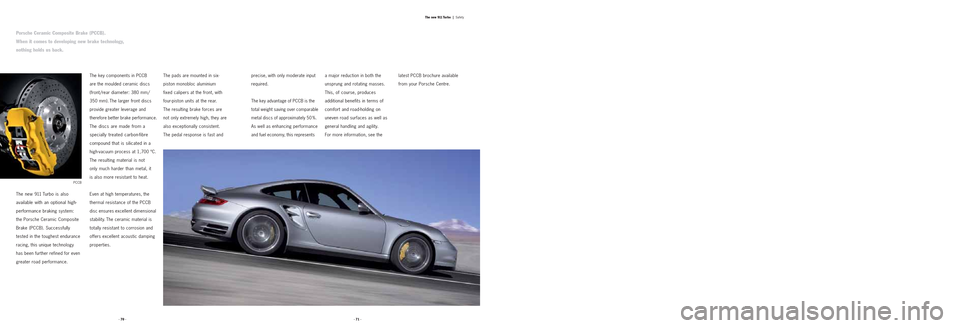
The new 911 Turbo is also
available with an optional high-
performance braking system:
the Porsche Ceramic Composite
Brake (PCCB). Successfully
tested in the toughest endurance
racing, this unique technology
has been further refined for even
greater road performance.The key components in PCCB
are the moulded ceramic discs
(front/rear diameter: 380 mm/
350 mm). The larger front discs
provide greater leverage and
therefore better brake performance.
Thediscsaremadefrom a
specially treated carbon-fibre
compound that is silicated in a
high-vacuum process at 1,700 ºC.
The resulting material is not
only much harder than metal, it
is also more resistant to heat.
Even at high temperatures, the
thermal resistance of the PCCB
disc ensures excellent dimensional
stability. The ceramic material is
totally resistant to corrosion and
offers excellent acoustic damping
properties.The pads are mounted in six-
piston monobloc aluminium
fixed calipers at the front, with
four-piston units at the rear.
The resulting brake forces are
not only extremely high, they are
also exceptionally consistent.
The pedal response is fast andprecise, with only moderate input
required.
The key advantage of PCCB is the
total weight saving over comparable
metal discs of approximately 50 %.
As well as enhancing performance
and fuel economy, this represents
a major reduction in both the
unsprung and rotating masses.
This, of course, produces
additional benefits in terms of
comfort and road-holding on
uneven road surfaces as well as
general handling and agility.
For more information, see thelatest PCCB brochure available
from your Porsche Centre.
· 70 ·· 71 ·The new 911 Turbo |
Safety
PCCB
Porsche Ceramic Composite Brake (PCCB).
When it comes to developing new brake technology,
nothing holds us back.
Page 35 of 61
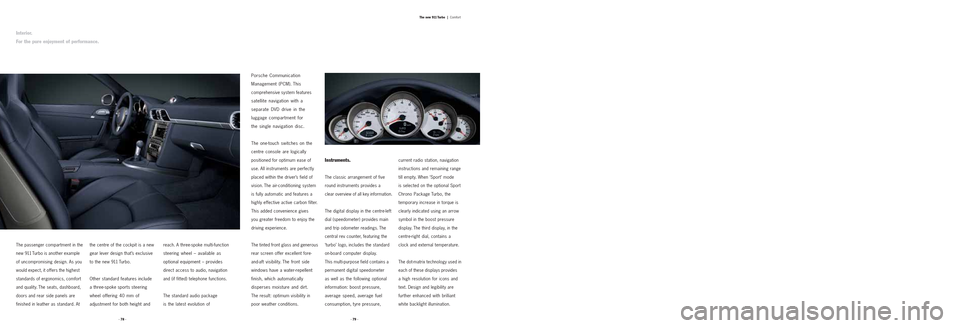
Porsche Communication
Management (PCM). This
comprehensive system features
satellite navigation with a
separate DVD drive in the
luggage compartment for
the single navigation disc.
The one-touch switches on the
centre console are logically
positioned for optimum ease of
use. All instruments are perfectly
placed within the driver’s field of
vision. The air-conditioning system
is fully automatic and features a
highly effective active carbon filter.
This added convenience gives
you greater freedom to enjoy the
driving experience.
The tinted front glass and generous
rear screen offer excellent fore-
and-aft visibility. The front side
windows have a water-repellent
finish, which automatically
disperses moisture and dirt.
The result: optimum visibility in
poor weather conditions.
Instruments.
The classic arrangement of five
round instruments provides a
clear overview of all key information.
The digital display in the centre-left
dial (speedometer) provides main
and trip odometer readings. The
central rev counter, featuring the
‘turbo’ logo, includes the standard
on-board computer display.
This multi-purpose field contains a
permanent digital speedometer
as well as the following optional
information: boost pressure,
average speed, average fuel
consumption, tyre pressure,
current radio station, navigation
instructions and remaining range
till empty. When ‘Sport’ mode
is selected on the optional Sport
Chrono Package Turbo, the
temporary increase in torque is
clearly indicated using an arrow
symbol in the boost pressure
display. The third display, in the
centre-right dial, contains a
clock and external temperature.
The dot-matrix technology used in
each of these displays provides
a high resolution for icons and
text. Design and legibility are
further enhanced with brilliant
white backlight illumination.
· 78 ·· 79 ·The new 911 Turbo |
Comfort
Interior.
For the pure enjoyment of performance.
The passenger compartment in the
new 911 Turbo is another example
of uncompromising design. As you
would expect, it offers the highest
standards of ergonomics, comfort
and quality. The seats, dashboard,
doors and rear side panels are
finished in leather as standard. Atthe centre of the cockpit is a new
gear lever design that’s exclusive
to the new 911 Turbo.
Other standard features include
a three-spoke sports steering
wheel offering 40 mm of
adjustment for both height and
reach. A three-spoke multi-function
steering wheel – available as
optional equipment – provides
direct access to audio, navigation
and (if fitted) telephone functions.
The standard audio package
is the latest evolution of
Page 40 of 61
Antenna diversity.
The PCM package includes four
separate antennae which are
discreetly incorporated within the
windscreen glass. This simple
solution enables the twin-tuner
radio system to find the strongest
possible signal, thereby enhancing
FM reception.
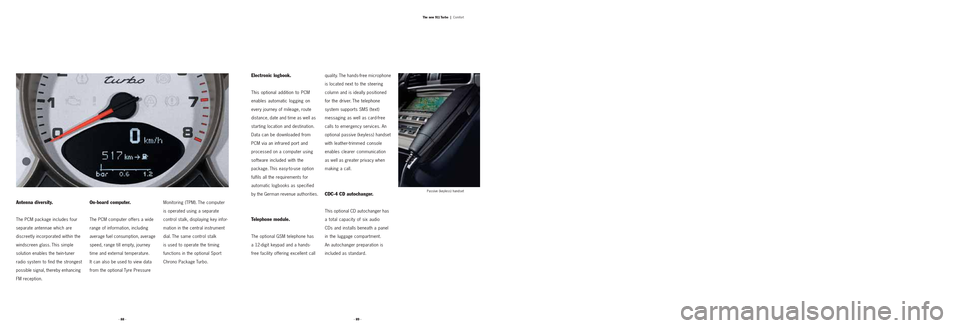
On-board computer.
The PCM computer offers a wide
range of information, including
average fuel consumption, average
speed, range till empty, journey
time and external temperature.
It can also be used to view data
from the optional Tyre PressureMonitoring (TPM). The computer
is operated using a separate
control stalk, displaying key infor-
mation in the central instrument
dial. The same control stalk
is used to operate the timing
functions in the optional Sport
Chrono Package Turbo.
Electronic logbook.
This optional addition to PCM
enables automatic logging on
every journey of mileage, route
distance, date and time as well as
starting location and destination.
Data can be downloaded from
PCM via an infrared port and
processed on a computer using
software included with the
package. This easy-to-use option
fulfils all the requirements for
automatic logbooks as specified
by the German revenue authorities.
Telephone module.
The optional GSM telephone has
a 12-digit keypad and a hands-
free facility offering excellent callquality. The hands-free microphone
is located next to the steering
column and is ideally positioned
for the driver. The telephone
system supports SMS (text)
messaging as well as card-free
calls to emergency services. An
optional passive (keyless) handset
with leather-trimmed console
enables clearer communication
as well as greater privacy when
making a call.
CDC-4 CD autochanger.
This optional CD autochanger has
a total capacity of six audio
CDs and installs beneath a panel
in the luggage compartment.
An autochanger preparation is
included as standard.
· 88 ·· 89 ·The new 911 Turbo |
Comfort
Passive (keyless) handset
Page 43 of 61
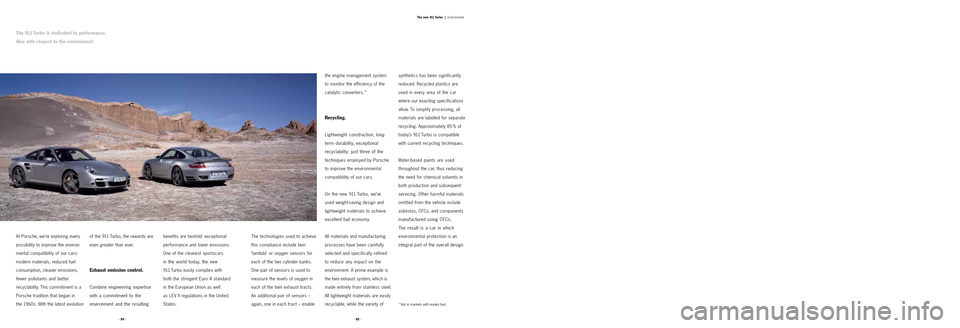
At Porsche, we’re exploring every
possibility to improve the environ-
mental compatibility of our cars:
modern materials, reduced fuel
consumption, cleaner emissions,
fewer pollutants and better
recyclability. This commitment is a
Porsche tradition that began in
the 1960s. With the latest evolutionof the 911 Turbo, the rewards are
even greater than ever.
Exhaust emission control.
Combine engineering expertise
with a commitment to the
environment and the resulting
benefits are twofold: exceptional
performance and lower emissions.
One of the cleanest sportscars
in the world today, the new
911 Turbo easily complies with
both the stringent Euro 4 standard
in the European Union as well
as LEV II regulations in the United
States.The technologies used to achieve
this compliance include twin
‘lambda’ or oxygen sensors for
each of the two cylinder banks.
One pair of sensors is used to
measure the levels of oxygen in
each of the twin exhaust tracts.
An additional pair of sensors –
again, one in each tract – enablethe engine management system
to monitor the efficiency of the
catalytic converters.*
Recycling.
Lightweight construction, long-
term durability, exceptional
recyclability: just three of the
techniques employed by Porsche
to improve the environmental
compatibility of our cars.
On the new 911 Turbo, we’ve
used weight-saving design and
lightweight materials to achieve
excellent fuel economy.
All materials and manufacturing
processes have been carefully
selected and specifically refined
to reduce any impact on the
environment. A prime example is
the twin exhaust system, which is
made entirely from stainless steel.
All lightweight materials are easily
recyclable, while the variety ofsynthetics has been significantly
reduced. Recycled plastics are
used in every area of the car
where our exacting specifications
allow. To simplify processing, all
materials are labelled for separate
recycling. Approximately 85 % of
today’s 911 Turbo is compatible
with current recycling techniques.
Water-based paints are used
throughout the car, thus reducing
the need for chemical solvents in
both production and subsequent
servicing. Other harmful materials
omitted from the vehicle include
asbestos, CFCs, and components
manufactured using CFCs.
The result is a car in which
environmental protection is an
integral part of the overall design.
· 94 ·· 95 ·The new 911 Turbo |
Environment
* Not in markets with leaded fuel.
The 911 Turbo is dedicated to performance.
Also with respect to the environment.
Page 44 of 61
Servicing.
Longer service intervals are not
only easier on resources, they
also reduce ownership costs. The
new 911 Turbo has very modest
servicing requirements of 18,000
miles or every two years (standard
service) and 36,000 miles or
every four years (major service).
The replacement intervals for
parts and fluids have also been
significantly extended: engine
oil and filter every 18,000 miles,
air filter every 36,000 miles,
spark plugs every 36,000 miles
or four years, and fuel filter every
56,000 miles.
Noise.
The new 911 Turbo complies with
all noise regulations worldwide.
Instead of resorting to engineencapsulation, we’ve eliminated
noise at source: engine com-
ponents are more rigid, moving
parts are lighter, and tolerances
have been reduced to a minimum.
High-efficiency silencers in durable
stainless steel help to minimise
noise throughout the life of the
car. All that remains, both inside
and out, is the famous Porsche
sound.
Fuel system.
Key developments in the fuel
supply system include a further
reduction in the evaporation of
hydrocarbons. This is achieved
through a combination of active
carbon filter and specially coated
fuel tank. All fuel lines are made
from robust aluminium, while
those carrying vapours use multi-
layer plastic.
· 96 ·· 97 ·The new 911 Turbo |
Environment
Page 58 of 61
· 126 ·· 127 ·
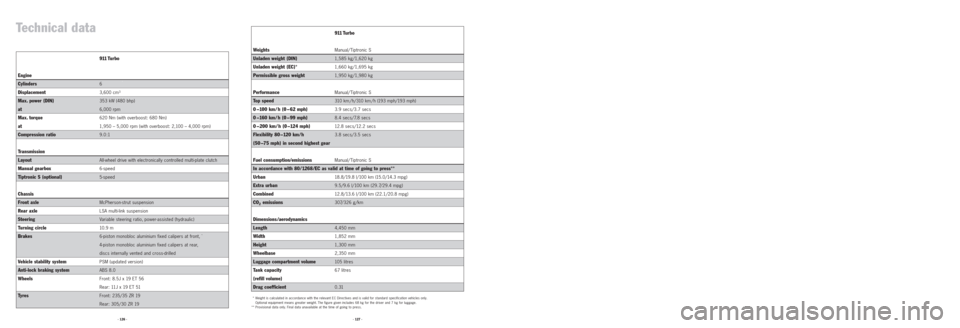
Technical data911 Turbo
WeightsManual/ Tiptronic S
Unladen weight (DIN)1,585 kg/1,620 kg
Unladen weight (EC)*1,660 kg/1,695 kg
Permissible gross weight1,950 kg/1,980 kg
PerformanceManual/ Tiptronic S
Top speed310 km / h/310 km / h (193 mph/193 mph)
0 –100 km / h (0 – 62 mph)3.9 secs/3.7 secs
0 –160 km / h (0 – 99 mph)8.4 secs/7.8 secs
0 – 200 km / h (0 –124 mph)12.8 secs/12.2 secs
Flexibility 80 –120 km / h 3.8 secs/3.5 secs
(50 –75 mph) in second highest gear
Fuel consumption/emissionsManual/ Tiptronic S
In accordance with 80 / 1268 /EC as valid at time of going to press**
Urban18.8/19.8 l/100 km (15.0/14.3 mpg)
Extra urban9.5/9.6 l/100 km (29.7/29.4 mpg)
Combined12.8/13.6 l/100 km (22.1/20.8 mpg)
CO2emissions307/326 g/km
Dimensions /aerodynamics
Length4,450 mm
Width1,852 mm
Height1,300 mm
Wheelbase2,350 mm
Luggage compartment volume105 litres
Tank capacity 67 litres
(refill volume)
Drag coefficient
0.31
911 Turbo
Engine
Cylinders6
Displacement3,600 cm3
Max. power (DIN)353 kW (480 bhp)
at6,000 rpm
Max. torque620 Nm (with overboost: 680 Nm)
at1,950 – 5,000 rpm (with overboost: 2,100 – 4,000 rpm)
Compression ratio9.0 :1
Transmission
LayoutAll-wheel drive with electronically controlled multi-plate clutch
Manual gearbox6-speed
Tiptronic S (optional)5-speed
Chassis
Front axleMcPherson-strut suspension
Rear axleLSA multi-link suspension
SteeringVariable steering ratio, power-assisted (hydraulic)
Turning circle10.9 m
Brakes6-piston monobloc aluminium fixed calipers at front, `
4-piston monobloc aluminium fixed calipers at rear,
discs internally vented and cross-drilled
Vehicle stability systemPSM (updated version)
Anti-lock braking systemABS 8.0
WheelsFront: 8.5J x 19 ET 56
Rear: 11J x 19 ET 51
Ty r e sFront: 235/35 ZR 19
Rear: 305/30 ZR 19* Weight is calculated in accordance with the relevant EC Directives and is valid for standard specification vehicles only.
Optional equipment means greater weight. The figure given includes 68 kg for the driver and 7 kg for luggage.
** Provisional data only. Final data unavailable at the time of going to press.
Page 59 of 61
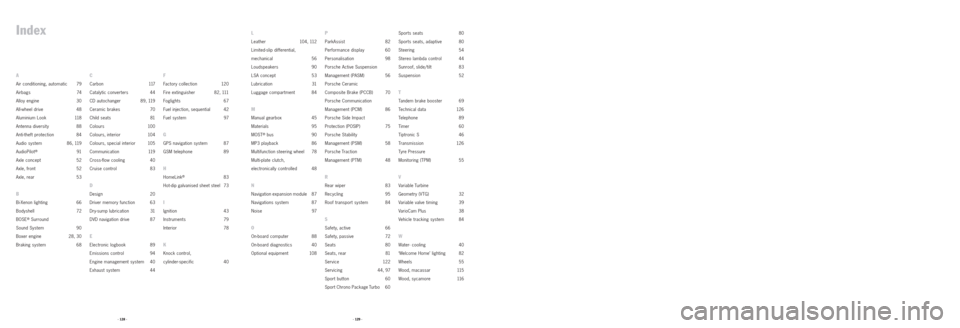
L
Leather 104, 112
Limited-slip differential,
mechanical 56
Loudspeakers 90
LSA concept 53
Lubrication 31
Luggage compartment 84
M
Manual gearbox 45
Materials 95
MOST
®bus 90
MP3 playback 86
Multifunction steering wheel 78
Multi-plate clutch,
electronically controlled 48
N
Navigation expansion module 87
Navigations system 87
Noise 97
O
On-board computer 88
On-board diagnostics 40
Optional equipment 108
P
ParkAssist 82
Performance display 60
Personalisation 98
Porsche Active Suspension
Management (PASM) 56
Porsche Ceramic
Composite Brake (PCCB) 70
Porsche Communication
Management (PCM) 86
Porsche Side Impact
Protection (POSIP) 75
Porsche Stability
Management (PSM) 58
Porsche Traction
Management (PTM) 48
R
Rear wiper 83
Recycling 95
Roof transport system 84
S
Safety, active 66
Safety, passive 72
Seats 80
Seats, rear 81
Service 122
Servicing 44, 97
Sport button 60
Sport Chrono Package Turbo 60Sports seats 80
Sports seats, adaptive 80
Steering 54
Stereo lambda control 44
Sunroof, slide/tilt 83
Suspension 52
T
Tandem brake booster 69
Technical data 126
Telephone 89
Timer 60
Tiptronic S 46
Transmission 126
Tyre Pressure
Monitoring (TPM) 55
V
Variable Turbine
Geometry (VTG) 32
Variable valve timing 39
VarioCam Plus 38
Vehicle tracking system 84
W
Water- cooling 40
‘Welcome Home’ lighting 82
Wheels 55
Wood, macassar 115
Wood, sycamore 116
· 129 ·
A
Air conditioning, automatic 79
Airbags 74
Alloy engine 30
All-wheel drive 48
Aluminium Look 118
Antenna diversity 88
Anti-theft protection 84
Audio system 86, 119
AudioPilot
®91
Axle concept 52
Axle, front 52
Axle, rear 53
B
Bi-Xenon lighting 66
Bodyshell 72
BOSE
®Surround
Sound System 90
Boxer engine 28, 30
Braking system 68
C
Carbon 117
Catalytic converters 44
CD autochanger 89, 119
Ceramic brakes 70
Child seats 81
Colours 100
Colours, interior 104
Colours, special interior 105
Communication 119
Cross-flow cooling 40
Cruise control 83
D
Design 20
Driver memory function 63
Dry-sump lubrication 31
DVD navigation drive 87
E
Electronic logbook 89
Emissions control 94
Engine management system 40
Exhaust system 44
F
Factory collection 120
Fire extinguisher 82, 111
Foglights 67
Fuel injection, sequential 42
Fuel system 97
G
GPS navigation system 87
GSM telephone 89
H
HomeLink®83
Hot-dip galvanised sheet steel 73
I
Ignition 43
Instruments 79
Interior 78
K
Knock control,
cylinder-specific 40
· 128 ·
Index