TPMS PORSCHE 911 TURBO 2014 6.G User Guide
[x] Cancel search | Manufacturer: PORSCHE, Model Year: 2014, Model line: 911 TURBO, Model: PORSCHE 911 TURBO 2014 6.GPages: 300, PDF Size: 10.61 MB
Page 129 of 300
Instrument Panel and Multi-Function Display 127
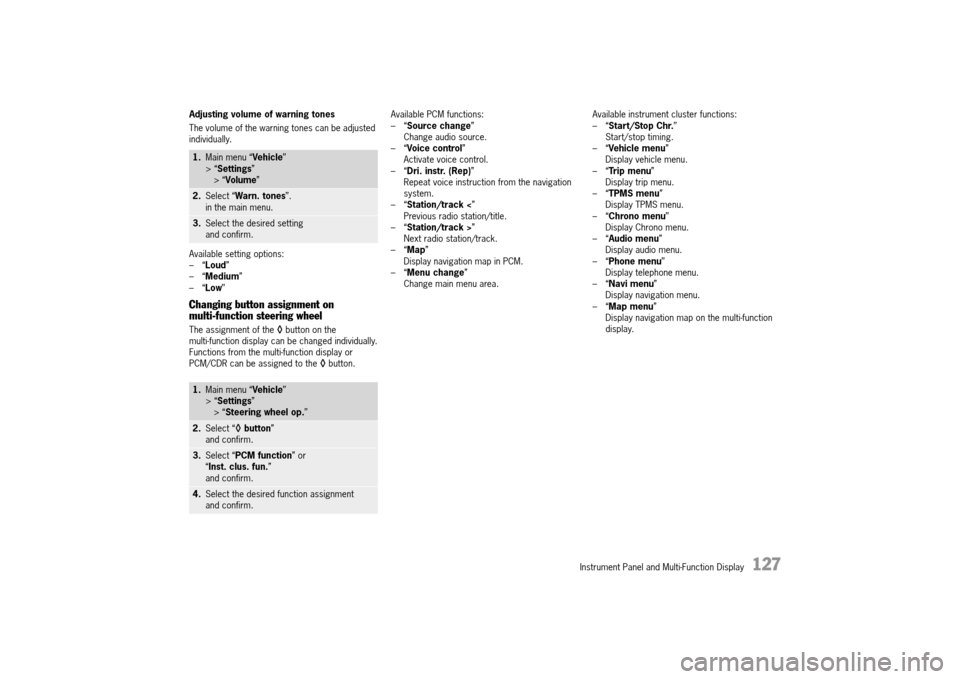
Adjusting volume of warning tones
The volume of the warning tones can be adjusted individually.
Available setting options: –“ Loud” –“ Medium” –“ Low”
Changing button assignment on multi-function steering wheel
The assignment of the ◊ button on the multi-function display can be changed individually.Functions from the multi-function display or PCM/CDR can be assigned to the ◊ button.
Available PCM functions: –“ Source change” Change audio source.–“ Voice control” Activate voice control.–“ Dri. instr. (Rep)” Repeat voice instruction from the navigation system.–“ Station/track <” Previous radio station/title.–“ Station/track >” Next radio station/track.–“ Map” Display navigation map in PCM.–“ Menu change” Change main menu area.
Available instrument cluster functions: –“ Start/Stop Chr.” Start/stop timing.–“ Vehicle menu” Display vehicle menu.–“ Trip menu” Display trip menu.–“ TPMS menu” Display TPMS menu.–“ Chrono menu” Display Chrono menu.–“ Audio menu” Display audio menu.–“ Phone menu” Display telephone menu.–“ Navi menu” Display navigation menu.–“ Map menu” Display navigation map on the multi-function display.
1. Main menu “Vehicle” > “ Settings” > “ Volume”
2.Select “Warn. tones”. in the main menu.
3. Select the desired setting and confirm.
1. Main menu “Vehicle” > “ Settings” > “ Steering wheel op.”
2.Select “◊ button” and confirm.
3. Select “PCM function” or “ Inst. clus. fun.” and confirm.
4. Select the desired function assignment and confirm.
14_991_Turbo_21.book Seite 127 Mittwoch, 9. April 2014 2:19 14
Page 248 of 300
246 Minor Repairs
The temperature grade for this tire is established for a tire that is properly inflated and not overloaded. Excessive speed, underinflation, or excessive loading, either separately or in combination, can cause heat buildup and possible tire failure.fDo not exceed the permitted maximum speed for the tires fitted to the vehicle.fEnsure that the tires are set to the correct inflation pressure.fObserve the maximum load for the vehicle.
Tire pressures
Driving the vehicle with low tire pressure increases risk of a tire failure and resulting loss of control. Furthermore, low tire pressure increases rate of wear of the affected tires and causes damage. fAlways use an accurate tire pressure gauge when checking inflation pressures.fDo not exceed the maximum tire pressure listed on the tire sidewall. (Also refer to “Technical data”).fPlease see the chapter “TIRE PRESSURE PLATE” on page 247.fCold tire inflation pressure means: all tires must be cold, ambient temperature maximum 68 °F (20 °C), when adjusting the inflation pressure. Avoid sunlight striking the tires before measuring cold pressures, since the pressures would rise from temperature influence.fValve caps protect the valve from dust and dirt, and thus from leakage. Always screw caps tightly down. Replace missing caps immediately.
fUse only plastic valve caps.fFor safety reasons, don't use tire inflating bottles.
fPlease see the chapter “TIRE PRESSURE FOR COLD TIRES (68 °F/ 20 °C)” on page 287.
Each tire, including the spare (if provided), should be checked monthly when cold and inflated to the
inflation pressure recommended by the vehicle manufacturer on the vehicle placard or tire inflation pressure label. (If your vehicle has tires of
a different size than the size indicated on the vehicle placard or tire inflation pressure label, you
should determine the proper tire inflation pressure
for those tires.)
As an added safety feature, your vehicle has been equipped with a Tire Pressure Monitoring System (TPMS) that illuminates a low tire pressure telltale when one or more of your tires is significantly under-inflated. Accordingly, when the low tire pressure telltale illuminates, you should stop and check your tires as soon as possible, and inflate them to the proper pressure. Driving on a significantly under-inflated tire causes the tire to overheat and can lead to tire failure. Under-inflation also reduces fuel efficiency and tire tread life, and may affect the vehicle’s handling and stopping ability.
Please note that the TPMS is not a substitute for proper tire maintenance, and it is the driver’s responsibility to maintain correct tire pressure, even if under-inflation has not reached the level to trigger illumination of the TPMS low tire pressure tell-tale.
For further information on the tire pressure monitoring:fPlease see the chapter “TIRE PRESSURE MENU (TIRE PRESSURE MONITORING SYSTEM, TPMS)” on page 105.
When tires are warm, the tire pressure is increased.fNever let air out of hot tires. This could cause the tire pressure to fall below the prescribed value.
Insufficient tire pressure can cause tires to over- heat and thus be damaged – even invisibly. Hidden tire damage is not eliminated by subsequently correcting the tire pressure.
Overloading
Overloading can lead to dangerous vehicle reactions and long braking distances.fDo not overload your vehicle. Be careful about the roof load. fIf you plan to load the vehicle, first correct the tire pressure. Tire pressure for loaded vehicle can be found on the tire pressure plate and in the chapter technical data.fNever exceed the specified axle load.
Tire Abuse
Low Tire Pressure
WARNINGh
DANGERhOverloading TiresDANGERh
14_991_Turbo_21.book Seite 246 Mittwoch, 9. April 2014 2:19 14
Page 252 of 300
250 Minor Repairs
Wheel alignment, wheel balancing
As a precaution, have wheels with summer tires balanced in the spring, and those with mud and snow tires before winter. Unbalanced wheels may affect car handling and tire life.Only the specified weights may be used for wheel balancing.
Self-adhesive weights must not come into contact with cleaning agents, since they could drop off.Uneven tread wear indicates wheel imbalance. In this event, the vehicle should be checked at an authorized Porsche dealer.
If, during a trip, uneven running or vibrations occur that could be caused by damage to tires or the car, the speed must be reduced immediately, but without braking sharply. If you continue your trip without having the cause of the fault remedied, you might lose control of your vehicle.fStop the vehicle and check the tires.fIf no cause for the fault can be found, drive carefully to the nearest authorized Porsche dealer.
The summer tires of your Sports Car have been specially developed and adapted for high performance. At low outside temperatures (<15°C (60°F)), the tire characteristics change. This can result in noises occurring when parking or maneuvering at low outside temperatures.
Wheels with Tire Pressure Monitoring System (TPMS) sensors
Before changing wheels, make sure that the wheels are compatible with your vehicle’s TPMS.fCheck this with your authorized Porsche dealer.
Removing and storing tires
fAfter changing, adjust tire pressure and torque wheel bolts diagonally. Please see the chapter “CHANGING WHEELS” on page 254.fStore tires in a cool and dry place. Rotate periodically to avoid flat spots.fDo not store summer tires or park vehicles fitted with summer tires at ambient temperatures below 5 °F (-15 °C).fAvoid contact with fuel, oil and grease.
Tires must always remain on the same side of the vehicle.When wheels are removed, the direction of rotation and position of each wheel should be marked.
Example
FR (front right), FL, RR and RL.
Wheels must always be fitted in accordance with their marking.
The perception that tire durability and performance are not affected by storage and age is unfounded. Chemical additives, which make the rubber elastic, lose their effectiveness over the course of time and the rubber becomes brittle and cracks.
Therefore, the tires should be inspected from time to time.
Information
Under no circumstances should tires older than 6 years be used on your Porsche.
The age of the tire can be obtained from the “DOT” code number. If, for example, the last four numbers read 1213, then the tire was produced in the 12th week of 2013.
Snow tires
The installation of Porsche approved snow tires is recommended.
Use Porsche approved snow tires for grip on snow and ice. Summer performance tires are not suitable for usage in cold, snowy, or icy conditions.Check with your local Motor Vehicle Bureau for possible restrictions.
High-Speed tire Vibration
DANGERh
14_991_Turbo_21.book Seite 250 Mittwoch, 9. April 2014 2:19 14
Page 258 of 300
256 Minor Repairs
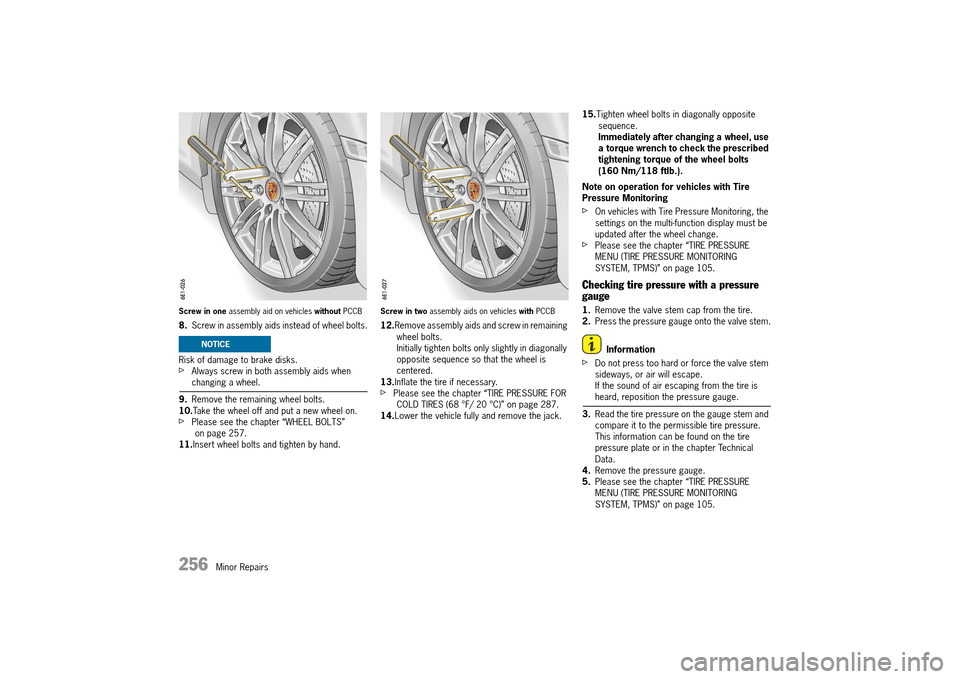
Screw in one assembly aid on vehicles without PCCB
8.Screw in assembly aids instead of wheel bolts.
Risk of damage to brake disks.fAlways screw in both assembly aids when changing a wheel.
9. Remove the remaining wheel bolts. 10. Take the wheel off and put a new wheel on.fPlease see the chapter “WHEEL BOLTS” on page 257.11. Insert wheel bolts and tighten by hand.
Screw in two assembly aids on vehicles with PCCB
12.Remove assembly aids and screw in remaining wheel bolts.Initially tighten bolts only slightly in diagonally opposite sequence so that the wheel is centered.13. Inflate the tire if necessary.fPlease see the chapter “TIRE PRESSURE FOR COLD TIRES (68 °F/ 20 °C)” on page 287.14. Lower the vehicle fully and remove the jack.
15. Tighten wheel bolts in diagonally opposite sequence.Immediately after changing a wheel, use a torque wrench to check the prescribed tightening torque of the wheel bolts (160 Nm/118 ftlb.).
Note on operation for vehicles with Tire Pressure Monitoring
fOn vehicles with Tire Pressure Monitoring, the settings on the multi-function display must be updated after the wheel change.fPlease see the chapter “TIRE PRESSURE MENU (TIRE PRESSURE MONITORING SYSTEM, TPMS)” on page 105.
Checking tire pressure with a pressure gauge
1. Remove the valve stem cap from the tire. 2. Press the pressure gauge onto the valve stem.
Information
fDo not press too hard or force the valve stem sideways, or air will escape.If the sound of air escaping from the tire is heard, reposition the pressure gauge.
3. Read the tire pressure on the gauge stem and compare it to the permissible tire pressure.This information can be found on the tire pressure plate or in the chapter Technical Data.4. Remove the pressure gauge. 5. Please see the chapter “TIRE PRESSURE MENU (TIRE PRESSURE MONITORING SYSTEM, TPMS)” on page 105.
NOTICE
14_991_Turbo_21.book Seite 256 Mittwoch, 9. April 2014 2:19 14
Page 271 of 300
Minor Repairs 269
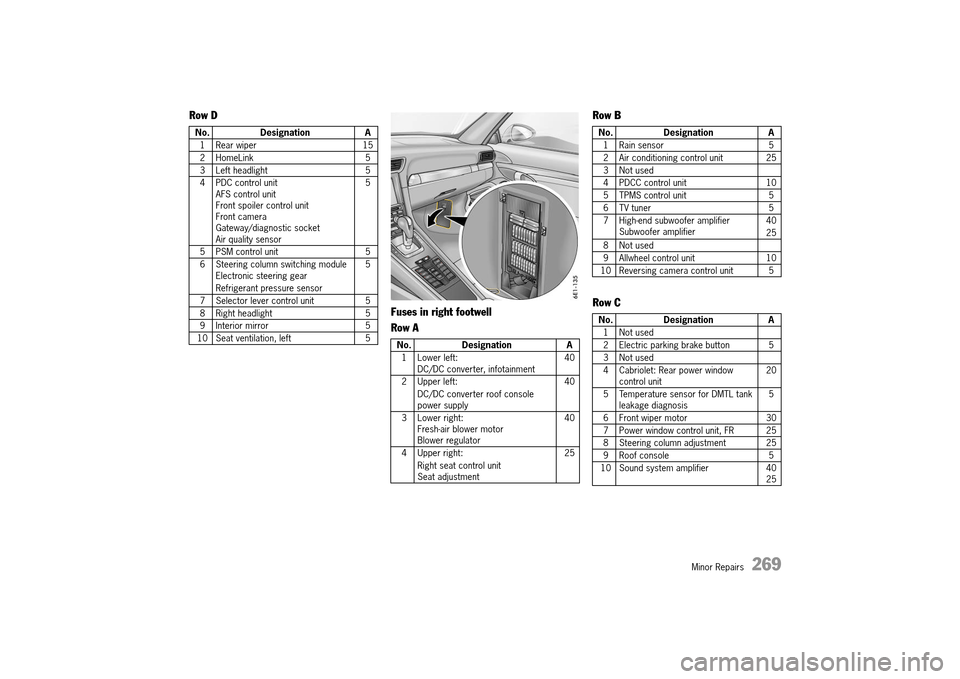
Row D
Fuses in right footwell
Row A
Row B
Row C
No. Designation A
1 Rear wiper 15
2 HomeLink 5
3 Left headlight 5
4 PDC control unit AFS control unitFront spoiler control unitFront cameraGateway/diagnostic socketAir quality sensor
5
5 PSM control unit 5
6 Steering column switching module Electronic steering gear
Refrigerant pressure sensor
5
7 Selector lever control unit 5
8 Right headlight 5
9 Interior mirror 5
10 Seat ventilation, left 5No. Designation A
1 Lower left: DC/DC converter, infotainment 40
2 Upper left:
DC/DC converter roof console power supply
40
3 Lower right: Fresh-air blower motorBlower regulator
40
4 Upper right:
Right seat control unit Seat adjustment
25
No. Designation A
1 Rain sensor 5
2 Air conditioning control unit 25
3 Not used
4 PDCC control unit 10
5 TPMS control unit 5
6 TV tuner 5
7 High-end subwoofer amplifier Subwoofer amplifier 40
25
8 Not used
9 Allwheel control unit 10
10 Reversing camera control unit 5
No. Designation A
1 Not used
2 Electric parking brake button 5
3 Not used
4 Cabriolet: Rear power window control unit 20
5 Temperature sensor for DMTL tank leakage diagnosis 5
6 Front wiper motor 30
7 Power window control unit, FR 25
8 Steering column adjustment 25
9 Roof console 5
10 Sound system amplifier 40 25
14_991_Turbo_21.book Seite 269 Mittwoch, 9. April 2014 2:19 14
Page 275 of 300
Minor Repairs 273
fAfter you install a new battery, it must be initialized in the control unit.Please contact your authorized Porsche dealer.fPlease observe the disposal instructions for batteries.
Putting vehicle into operation
After the battery is connected or after a fully discharged battery is charged, the PSM warning light lights up on the instrument panel and a message appears on the multi-function display in the instrument panel to indicate a fault.
This fault can be corrected with a few simple steps: 1. Start the engine. To do this, turn the ignition key or the control unit (on vehicles with Porsche Entry & Drive) to ignition lock position 2 twice. 2. With the vehicle stationary, perform a few steering movements to the left and right and then drive a short distance in a straight line until the PSM warning light goes out and the message is erased from the multi-function display in the instrument panel.3. If the warnings do not disappear, then: Drive carefully to the nearest authorized Porsche dealer.Have the fault corrected.4. After the warnings go out: Stop the vehicle in a suitable place.5. Store the end position for the power windows.
For information on storing the end positions for the power windows: fPlease see the chapter “STORING END POSITION OF THE WINDOWS AFTER CONNECTING THE VEHICLE BATTERY” on page 63.6. Teach tires on vehicles with Tire Pressure Monitoring.
For information on teaching the Tire Pressure Monitoring System (TPMS): fPlease see the chapter “TIRE PRESSURE MENU (TIRE PRESSURE MONITORING SYSTEM, TPMS)” on page 105.7. Store end position on vehicles with a sunroof.
For information on storing the end position for the sunroof: fPlease see the chapter “STORING END POSITION OF THE SUNROOF” on page 66.fPlease see the chapter “STORING END POSITION OF THE ROLL-UP SUNBLIND” on page 67.
External Power Supply, Emergency
starting with jumper cables
If the battery is flat, the battery of another vehicle can be used for starting or as an external power supply with the help of jump leads.
Both batteries must be 12 V batteries. The capacity (Ah) of the donor battery must not be substantially less than that of the flat battery.
The flat battery must be connected correctly to the vehicle’s electrical system.
A short circuit may be caused if unsuitable jumper cables are used or if jumper cable starting is not performed properly. Such short circuits can cause a fire.fUse only standard jumper cables with sufficient cross section and completely insulated alligator clips. Follow the instructions provided by the jumper cable manufacturer.fRoute the jumper cables so that they cannot be caught by moving parts in the engine compartment.The jumper cables must be long enough so that neither vehicles nor cables touch another.fThe vehicles must not touch, otherwise current might flow as soon as the positive terminals are connected.fEnsure that tools or conductive jewelry (rings, chains, watch straps) do not come into contact with the positive jumper cable, the positive battery post or live parts of the vehicle.fImproper hook-up of jumper cables can ruin the alternator.
Jumper Cable HazardsWARNINGh
14_991_Turbo_21.book Seite 273 Mittwoch, 9. April 2014 2:19 14
Page 289 of 300
Tire Pressure and Technical Data 287
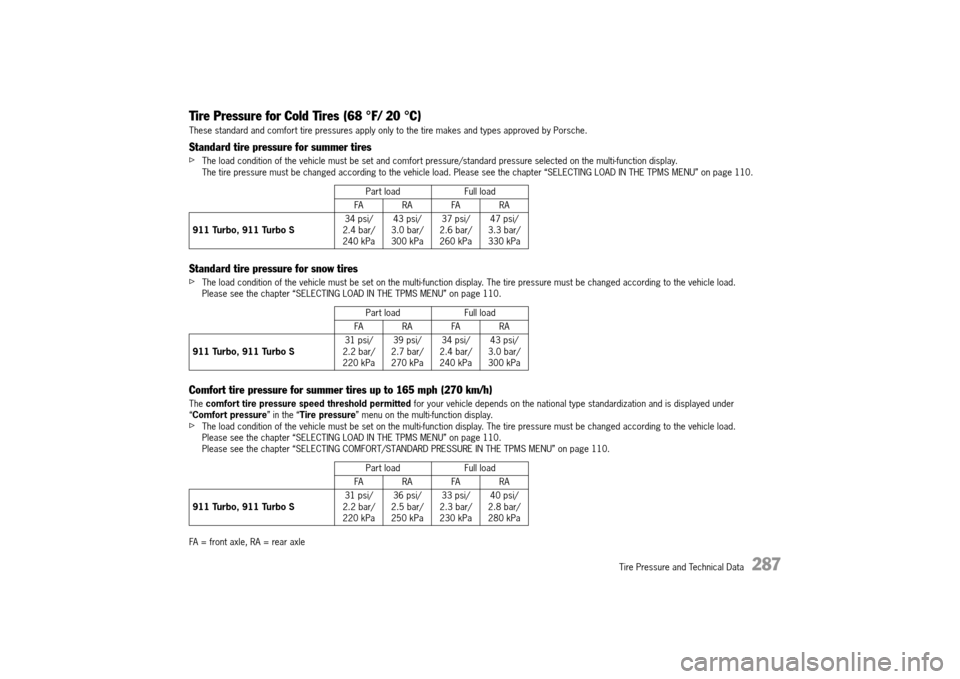
Tire Pressure for Cold Tires (68 °F/ 20 °C)
These standard and comfort tire pressures apply only to the tire makes and types approved by Porsche.
Standard tire pressure for summer tires
fThe load condition of the vehicle must be set and comfort pressure/standard pressure selected on the multi-function display. The tire pressure must be changed according to the vehicle load. Please see the chapter “SELECTING LOAD IN THE TPMS MENU” on page 110.
Standard tire pressure for snow tires
fThe load condition of the vehicle must be set on the multi-function display. The tire pressure must be changed according to the vehicle load. Please see the chapter “SELECTING LOAD IN THE TPMS MENU” on page 110.
Comfort tire pressure for summer tires up to 165 mph (270 km/h)
The comfort tire pressure speed threshold permitted for your vehicle depends on the national type standardization and is displayed under “Comfort pressure” in the “Tire pressure” menu on the multi-function display.fThe load condition of the vehicle must be set on the multi-function display. The tire pressure must be changed according to the vehicle load. Please see the chapter “SELECTING LOAD IN THE TPMS MENU” on page 110.Please see the chapter “SELECTING COMFORT/STANDARD PRESSURE IN THE TPMS MENU” on page 110.
FA = front axle, RA = rear axle
Part load Full load
FA R A FA R A
911 Turbo, 911 Turbo S34 psi/2.4 bar/240 kPa
43 psi/3.0 bar/300 kPa
37 psi/2.6 bar/260 kPa
47 psi/3.3 bar/330 kPa
Part loadFull load
FA R A FA R A
911 Turbo, 911 Turbo S31 psi/2.2 bar/220 kPa
39 psi/2.7 bar/270 kPa
34 psi/2.4 bar/240 kPa
43 psi/3.0 bar/300 kPa
Part loadFull load
FA R A FA R A
911 Turbo, 911 Turbo S31 psi/2.2 bar/220 kPa
36 psi/2.5 bar/250 kPa
33 psi/2.3 bar/230 kPa
40 psi/2.8 bar/280 kPa
Reifendruck_TechnischeDaten.fm Seite 287 Mittwoch, 9. April 2014 3:12 15
Page 299 of 300
Index 297
Storing vehicle settings ......................................34 Why have the settings changed? ........................144Shifting gearsPorsche Doppelkupplung (PDK) .........................172Shift prompt ......................................................93Side lightsSwitching on ......................................................79Slicks .............................................................................1Snow chainsGeneral information ..........................................251 Snow tires...................................................................250Socket (12 V) ..............................................................196Speed code letter on tire .............................................252Speed control (cruise control) Accelerating ....................................................156Decelerating ....................................................156Functional description .......................................155Interrupting operation .......................................156Storing speed ..................................................156Switching off....................................................157Switching on ....................................................156Speed limit..................................................................252Speedometer ..........................................................92, 93Spoiler, operating principle ...........................................190Sport Chrono ..............................................................114Sport mode ....................................................................3 Porsche Doppelkupplung ..................................175Switching on/off...............................................188 Sport tires ......................................................................2Stainless steel tailpipesCare instructions ..............................................236Standstill management Functional description .......................................184 Start/Stop function ......................................................149StartingEngine .............................................................148Steam-jet cleaners, instructions for use .........................232Steering......................................................................244 Countersteering assistance ...............................182 Steering torque pulse...................................................182Steering wheel Adjustment ........................................................51Multi-function steering wheel withtelephone function ..............................................53Multi-function steering wheel, functional description ........................................................52Switching Easy Entry function on/off ....................34Switching heating on/off .....................................51 StoppingEngine .............................................................148
Stopping engine automatically (Auto Start Stop function).......................................................... 149Stopwatch .................................................................. 114StorageGlove box........................................................ 193Opening storage compartment in front armrest .. 194Storage options............................................... 193Storage compartmentGlove box........................................................ 193In front armrest, opening .................................. 194Storage .......................................................... 193StoringPersonal settings ............................................. 143 Storing end position of the sunroof ................................. 66Storing the end position for the power windows............... 63Summer tiresChanging tires ................................................. 256Storage .......................................................... 250 Sun visor ...................................................................... 53Sunblind ....................................................................... 65SunroofCleaning the air deflector ................................... 67Emergency operation ......................................... 65Functional description ........................................ 63Malfunctions ...................................................... 65Storing end position ........................................... 66 Switching automatic anti-dazzle function on and off .......... 50Switching emergency flasher on/off................................ 83Switching on air-recirculation modeAir-conditioning system ...................................... 57 Switching on parking light .............................................. 83
TTachometerDisplay.............................................................. 92 Tailpipes Stainless steel, care instructions ....................... 236TankVentilation system ............................................ 231Technical dataDriving performance ........................................ 285Engine ............................................................ 285Tire pressure (bar/psi) ..................................... 287Tires, wheels ................................................... 286Weights........................................................... 288Technical modifications to the vehicle, information ......... 220Telephone ................................................................... 169Using via multi-function display .......................... 103Test standsBrake test ............................................... 221, 241Performance test..................................... 221, 241
Theft protection .....................................................16, 217 TireCare................................................................248Life .................................................................248Traction ...........................................................247Wear ...............................................................248Tire filling compressor .................................................198Tire pressureAir pressure (bar/psi)........................................287Comfort pressure .............................................110Comfort pressure speed warning.......................111Current settings ...............................................108Data (bar/psi) ..................................................287Fill info ............................................................108Speed warning .................................................112System learning ...............................................111Tire pressure plate ...........................................284Warnings .........................................................111Tire pressure monitoringWarning light ....................................................106Tire Pressure Monitoring System (TPMS) .......................105Tire pressure plate.......................................................284Tire sealing compound/sealing set for defective tires .....265TiresBreaking in new tires ............................................6Changing .........................................................256Checking pressure ...........................................256Damage ..........................................................248Fixing a flat tire ................................................265General information ..........................................244Inscription on radial tire ....................................252Replacing ........................................................249Sealant ............................................................265Setting type and size ........................................109Sidewall...........................................................252Snow chains (general information) .....................251Snow tires (general information) ........................250Sport ..................................................................2Storage ...........................................................250Tire pressure plate ...........................................284Tire pressure, data (bar/psi)..............................287Valves .............................................................249Tool kit........................................................................198Tools ..........................................................................198Torque ........................................................................116Torque display .............................................................116Torque, Technical data .................................................285TowingScrewing in towing lug ......................................280Towing lugIn the tool kit....................................................198
14_991_Turbo_21.book Seite 297 Mittwoch, 9. April 2014 2:19 14
Page 300 of 300
298 Index
TPMS (Tire Pressure Monitoring System) ....................... 105 TransmissionPorsche Doppelkupplung (PDK) ......................... 172Transmission and chassis control systemsOverview (PSM, PASM, PDCC, PTV Plus) ............ 179Transport (on car trains, ferries, etc.)Securing the vehicle ......................................... 282Switching off inclination sensor ......................... 216Trip counterDisplay .............................................................. 93Resetting........................................................... 93Trip information ........................................................... 105Trunk entrapment .......................................................... 30Turn signal, stalk ........................................................... 82
UUltrasound sensor, ParkAssist ...................................... 207Underbody protection, care instructions ........................ 235Universal audio interface, installation position ................ 171Unlocking Opening vehicle door from inside......................... 23Retrieving personal settings from the key........... 143The vehicle cannot be unlocked........................... 26Unlocking and opening tailgate ............................ 25Unlocking vehicle door from inside ...................... 23Unlocking vehicle door with car key(remote control) ................................................. 21Unlocking vehicle door with Porsche Entry & Drive (keyless)........................... 21Upshift prompt .............................................................. 93USB interface, installation position ................................ 171
VVanity mirror ................................................................. 53Vehicle Keys ................................................................. 16Vehicle data ................................................................ 284Vehicle doorLocking from inside ............................................ 23Locking with car key (remote control) .................. 22Locking with Porsche Entry & Drive (keyless)........ 22Malfunctions when opening and closing................ 26Unlocking with car key (remote control) ............... 21Unlocking with Porsche Entry & Drive (keyless) ..... 21Vehicle informationRetrieving on multi-function display .................... 100Vehicle settingsAdapting multi-function display .......................... 118Adjusting on multi-function display ..................... 117
Adjusting volume of warning and information tones ............................................ 126Air-conditioning settings ................................... 123Changing button assignment on multi-function steering wheel ................................................. 127Changing the language .................................... 126Light and visibility settings................................ 120Locking settings .............................................. 122Porsche Active Safe settings ............................ 128Resetting to factory settings............................. 117Selecting settings menu ................................... 117Setting date and time....................................... 124Setting units .................................................... 125Storing on person buttons .......................... 34, 143Storing on the key ..................................... 34, 143Vents Adjusting........................................................... 59Opening/closing ................................................ 59 Voice control .............................................................. 171
WWarning messagesTire pressure................................................... 112 Washer fluid Antifreeze ....................................................... 224Topping up ...................................................... 224 Washer jets Heating ............................................................. 86Washing the vehicle, instructions .................................. 232WeightsDefinitions ....................................................... 204Weights, Technical data ............................................... 288Welcome Home functionSwitching on ..................................................... 80Wheel Attachment faces ............................................ 257Central Bolts ................................................... 258Central locking ................................................ 258Changing ........................................................ 258Checking pressure ........................................... 256Security wheel bolts......................................... 198 Wheel alignment ......................................................... 250Wheel attachment faces .............................................. 257Wheel change ............................................................. 251WheelsAdjusting......................................................... 250Central Bolts ................................................... 258Central locking ................................................ 258Changing ........................................................ 254Fixing a flat tire................................................ 265General information ......................................... 244
Inscription on alloy wheels ................................ 253 Inscription on radial tire .................................... 252Overview ......................................................... 286Replacing tires (general information) .................. 249Rim offset ....................................................... 286Security wheel bolt (wrench socket) ................... 257Size ................................................................ 286Snow chains (general information) ..................... 251Snow tires (general information) ........................ 250Storage ........................................................... 250Tightening torque ............................................. 258Tire pressure plate ........................................... 284Tire pressure, data (bar/psi) ............................. 287Tire sealant ..................................................... 265Wheel attachment faces ................................... 257Wheel balancing ............................................... 250Wheel bolts (care instructions)........................... 257WindowsAdjusting after connecting battery ....................... 63Care instructions .............................................. 234Heated washer jets ............................................ 86Opening/closing with rocker switch ..................... 62Storing end position ........................................... 63Windshield washer systemAdding washer fluid .......................................... 224Windshield wiper/washer stalk Adjusting the rain sensor sensitivity ..................... 85Windshield wiper/washer system......................... 86Windshield, fast wiping ....................................... 86Windshield, slow wiping ...................................... 86Wiping windshield once (one-touch operation) ....... 86 Windshield wipers Care instructions .............................................. 234Stalk ................................................................. 86 WindstopClosing.............................................................. 69Lowering ........................................................... 69Opening ............................................................ 69Raising .............................................................. 69Winter driving .............................................................. 272Winter tires Changing tires ................................................. 256General information .......................................... 250Storage ........................................................... 250 Wiper bladesCare instructions .............................................. 234Replacing ........................................................ 224Wrench socket for security wheel boltUsing .............................................................. 257
14_991_Turbo_21.book Seite 298 Mittwoch, 9. April 2014 2:19 14