check engine PORSCHE 911 TURBO 2014 6.G Owner's Manual
[x] Cancel search | Manufacturer: PORSCHE, Model Year: 2014, Model line: 911 TURBO, Model: PORSCHE 911 TURBO 2014 6.GPages: 300, PDF Size: 10.61 MB
Page 153 of 300
Driving and Driving Safety 151
Auto Start Stop function display
If the engine was stopped automatically by the Auto Start Stop function, the indicator light on the multi-function display in the instrument panel will light up green.
If the Auto Stop function is not available or if no driver is detected in the vehicle after the engine has stopped automatically (driver’s seat belt not fastened or driver’s door open), the indicator light on the multi-function display in the instrument panel will light up yellow when the vehicle is stationary.
The Auto Start Stop system has detected that: – At least one precondition for stopping the engine automatically is not met.
or – There is at least one exception for the Auto Start Stop function.fPlease see the chapter “PRECONDITIONS FOR STOPPING THE ENGINE AUTOMATICALLY” on page 149.fPlease see the chapter “EXCEPTIONS FOR THE AUTO START STOP FUNCTION” on page 150.
Information
If the indicator light in the multi-function display continuously lights up yellow when the vehicle is stopped and if the engine does not stop regularly when the vehicle is stopped despite the fact that the preconditions for stopping the engine automatically are met, have the Auto Start Stop system checked the next time you visit the workshop.
Fault reporting
If there is a fault, the warning message “ Start/ Stop operation deactivated ” will appear on the multi-function display in the instrument panel.fHave the fault corrected at an authorized Porsche dealer.
Electric Parking Brake
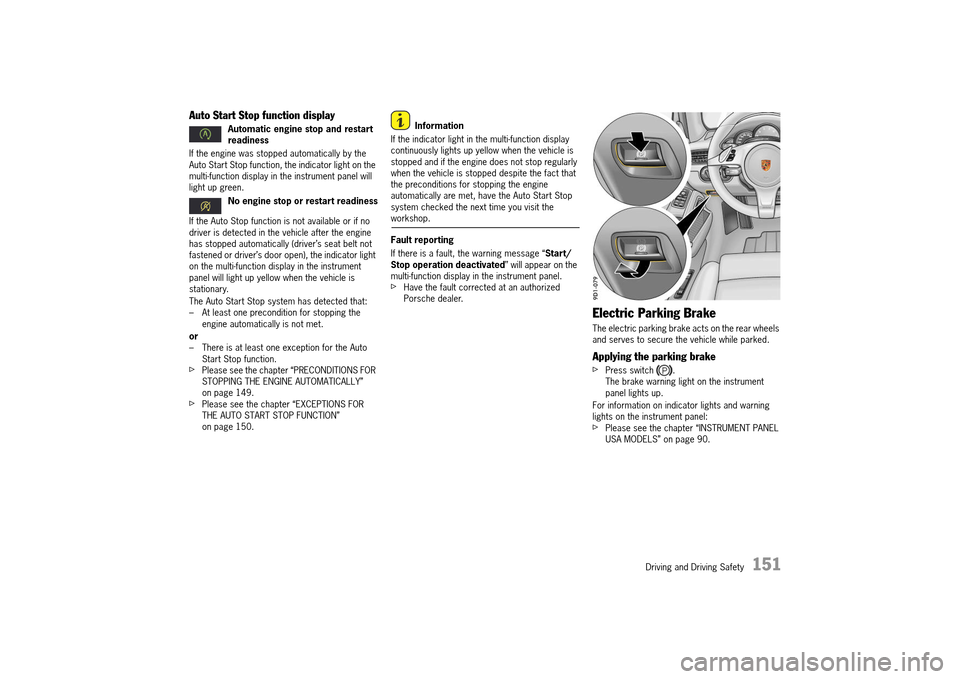
The electric parking brake acts on the rear wheels and serves to secure the vehicle while parked.
Applying the parking brake
fPress switch .The brake warning light on the instrument panel lights up.
For information on indicator lights and warning lights on the instrument panel: fPlease see the chapter “INSTRUMENT PANEL USA MODELS” on page 90.
Automatic engine stop and restart readiness
No engine stop or restart readiness
14_991_Turbo_21.book Seite 151 Mittwoch, 9. April 2014 2:19 14
Page 154 of 300
152 Driving and Driving Safety
Releasing the parking brake
The electric parking brake can only be released when the ignition is switched on.1. Press the brake pedal. 2. Pull switch . The brake warning light on the instrument panel goes out.
Automatic electric parking brake release when driver’s intention to drive off is detected
If the engine is running, the driver’s door is closed and the driver’s safety belt is fastened, it is still possible to drive off normally even though the parking brake is on.The electric parking brake detects the driver’s intention to drive off and releases automatically.The warning light on the instrument panel goes out.
If the driver’s door is not closed or the driver’s safety belt is not fastened, the electric parking brake will not be released automatically when the driver attempts to drive off.The message “ Release parking brake” appears on the multi-function display in the instrument panel. The brake warning light on the instrument panel and the indicator light on the switch start to flash.
For information on warning messages on the multi-function display: fPlease see the chapter “OVERVIEW OF WARNING AND INFORMATION MESSAGES” on page 129.
Engaging the electric parking brake automatically
The electric parking brake engages if PDK selector-lever position D, R or M is selected when the vehicle is stationary and the driver’s door is opened. The brake warning light on the instrument panel and the indicator light on the switch light up. For information on warning messages on the multi-function display: fPlease see the chapter “OVERVIEW OF WARNING AND INFORMATION MESSAGES” on page 129.
Emergency braking function
If the vehicle cannot be stopped by conventional braking, you can decelerate sharply and stop the vehicle using the electric parking brake.fPress switch and keep it pressed.The message “ Emergency braking” appears on the multi-function display in the instrument panel. The brake warning light on the instrument panel and the indicator light on the switch start to flash.The emergency braking function is deactivated when you release the switch.
Emergency braking takes place with very high braking power. The following traffic may be endangered.fOnly use the emergency braking function in an emergency situation.fDo not use the emergency braking function to stop the vehicle when driving normally.
Brake warning light USA
Brake warning light Canada
If the electric parking brake could not be applied fully when the vehicle is stopped, the brake warning light on the instrument panel starts to flash.
For information on warning messages on the multi- function display: fPlease see the chapter “OVERVIEW OF WARNING AND INFORMATION MESSAGES” on page 129.
Brakes
fMake it a habit to check the operation of your brakes before driving.
Keep in mind that the braking distance increases very rapidly as the speed increases. At 60 mph (100 km/h), for example, it is not twice but four times longer than 30 mph (50 km/h). Tire traction is also less effective when the roads are wet or slippery.fTherefore, always maintain a safe distance from the car in front of you.
Severe decelerationWARNINGh
14_991_Turbo_21.book Seite 152 Mittwoch, 9. April 2014 2:19 14
Page 156 of 300
154 Driving and Driving Safety
fBefore descending a steep grade, reduce speed and shift the transmission into a lower gear to control speed. fDo not “ride the brakes” by resting your foot on the pedal when not intending to apply brake pressure.fDo not hold the pedal down too long or too often. This could cause the brakes to overheat and lose braking power.
Brake booster
The brake booster assists braking only when the engine is running.
When the car is moving while the engine is not running, or if the brake booster is defective, more pressure on the brake pedal is required to bring the car to a stop.
Moisture, road salt or grit on brakes affects braking. Brakes will dry after a few cautious brake applications.
Driving through water may reduce the traction. Moisture on brakes from road water, car wash, or a coating of road salt or grit may affect braking efficiency.fCautiously apply brakes to test and dry the brakes after exposure to road water, etc.
The brake booster is ready for operation only while the engine is running. If the engine is switched off or there is a defect in the brake booster, much greater force has to be applied to the pedal when braking. fVehicles with defective brakes must not be towed and must be transported on a flat bed.
For information on towing:fPlease see the chapter “TOWING” on page 278.
Brake wear
Your car has excellent brakes, but they are still subject to wear. The rate at which they wear depends on how the brakes are used.fHave the brake system inspected at the intervals recommended in your Maintenance Booklet.
Brake system warning light
You can check the functionality of the brake system warning light by switching the ignition to the “On” position (position 1) and verifying that the warning light illuminates.
A warning message will be displayed on the multi- purpose display of the instrument panel if the brake pads are worn, excessively.fDo not continue to operate the vehicle.Have your authorized Porsche dealer inspect or replace the brake pads.
For information on warning messages on the multi-purpose display:fPlease see the chapter “OVERVIEW OF WARNING AND INFORMATION MESSAGES” on page 129.
Brake pads and brake disks
Wear on the brake pads and brake disks depends to a great extent on the driving style and the conditions of use and therefore cannot be expressed in actual miles on the road.
The high-performance brake system is designed for optimal braking effect at all speeds and temperatures.
Certain speeds, braking forces and ambient conditions (e.g. temperature and humidity) can therefore cause the brakes to “squeal”.
Unsuitable or incorrectly installed floor mats or objects can obstruct the movement of the brake pedal or prevent application of the brake pedal.fDo not obstruct the pedal travel with floor mats or other objects.
Riding the Brakes
Wet Brakes
WARNINGh
WARNINGh
Loss of Braking PowerWARNINGhBrake wear warning message USA
Brake wear warning message Canada
Obstructed Brake PedalWARNINGh
14_991_Turbo_21.book Seite 154 Mittwoch, 9. April 2014 2:19 14
Page 157 of 300
Driving and Driving Safety 155
In heavy rain, while driving through water or after leaving a car wash, the braking action may be delayed and increased pressure may be required.fFor this reason, keep further back from the vehicle in front and “dry” the brakes by applying them at intervals. Make sure that the traffic behind you is not affected.
After a long drive over salted or gritted roads, a coating may form on the brake disks and pads that significantly reduces friction and therefore also braking effect.fEven though the brake disks consist of alloyed gray cast iron, they will unavoidably start to corrode if your vehicle is parked for an extended period. The brakes will tend to “rub” as a result.The nature, extent and effects of corrosion depend on the amount of time the vehicle was parked, whether road salt or grit was spread and whether grease-dissolving agents were used in car washes (not on vehicles with Porsche Ceramic Composite Brake).To prevent corrosion of the brake disks, “brake them dry” before parking the vehicle (not on vehicles with Porsche Ceramic Composite Brake).If braking comfort is noticeably impaired, we recommend that you have the brake system checked by experts at an authorized Porsche dealer.
fTo relieve the brake system on downhill stretches, change down to a lower gear in good time (engine braking).If engine braking is insufficient on steep stretches, operate the footbrake at intervals. Avoid continuous braking as it overheats the brakes and reduces the braking effect.
For information on brake fluid and checking the brake fluid level:fPlease see the chapter “BRAKE FLUID” on page 243.
New brake pads or linings
New brake pads have to be “broken in”, and therefore only attain optimal friction when the car has covered several hundred miles or km.The slightly reduced braking ability must be compensated for by pressing the brake pedal harder. This applies whenever the brake pads and/or brake disks are replaced.
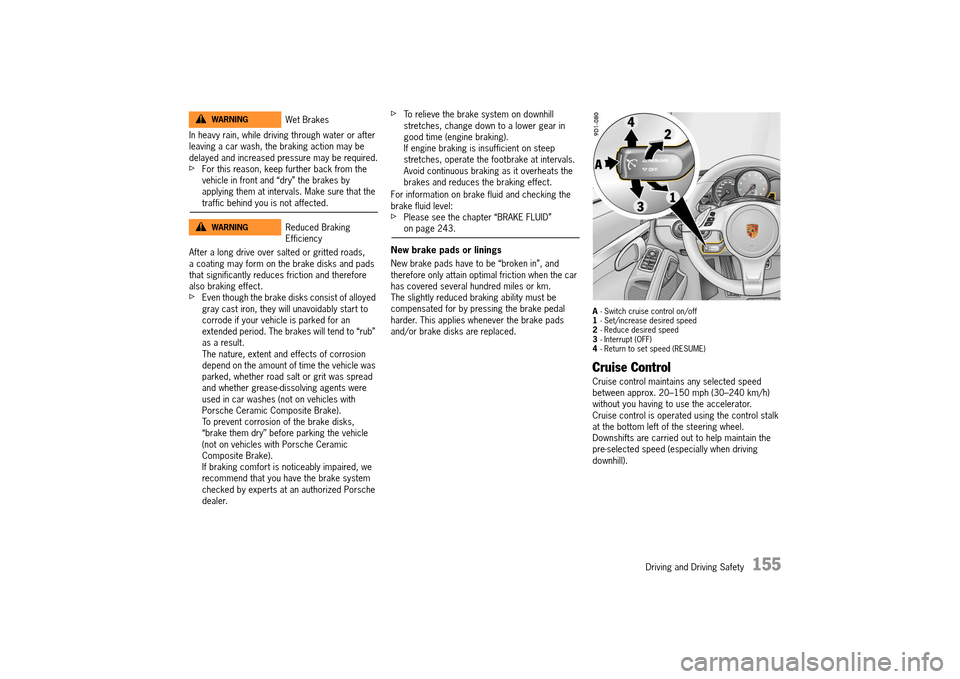
A - Switch cruise control on/off 1 - Set/increase desired speed 2 - Reduce desired speed 3 - Interrupt (OFF) 4 - Return to set speed (RESUME)
Cruise Control
Cruise control maintains any selected speed between approx. 20–150 mph (30–240 km/h) without you having to use the accelerator.Cruise control is operated using the control stalk at the bottom left of the steering wheel.Downshifts are carried out to help maintain the pre-selected speed (especially when driving downhill).
Wet Brakes
Reduced Braking Efficiency
WARNINGh
WARNINGh
14_991_Turbo_21.book Seite 155 Mittwoch, 9. April 2014 2:19 14
Page 187 of 300

Driving and Driving Safety 185
Function
The decisive advantage of ABS lies in the driving stability and maneuverability of the vehicle in hazardous situations.
ABS prevents locking of the wheels during full braking, on almost all road surfaces, until just before the vehicle stops.
ABS begins to control the braking process as soon as a wheel shows a tendency to lock.This controlled braking process is comparable with extremely rapid cadence braking.The pulsating brake pedal and a “juddering noise” warn the driver to adapt his driving speed to the road conditions.fIf full braking is necessary, press the brake pedal fully during the whole braking operation, even though the pedal is pulsating. Do not reduce brake pressure.
Warning light USA
Warning light Canada
If the ABS warning light lights up on the instrument panel while the engine is running, the ABS has switched off because of a fault.The warning message “ ABS/PSM failure Adapted driving permitted ” appears on the multi-function display in the instrument panel.
For information on warning messages on the multi- function display: fPlease see the chapter “OVERVIEW OF WARNING AND INFORMATION MESSAGES” on page 129.
In this case, the braking system will operate without lock prevention , as in vehicles without ABS.fAdapt your driving style to the changed braking behavior.The ABS must be checked by your authorized Porsche dealer in order to prevent the occurrence of further faults with unpredictable consequences.Please contact an authorized Porsche dealer.
The ABS control unit is adjusted for the approved tire dimensions.The use of tires with non-approved dimensions can lead to different wheel speeds, causing ABS to switch off.
Porsche Active Suspension
Management (PASM)
The PASM system actively adjusts the shock absorbers. The adjustable damper system selects the appropriate damping level for each wheel according to the driving situation and driving conditions. Driving safety, agility and comfort are optimized.
Two different chassis setups can be selected at the push of a button:–“ Chassis Normal” –“ Chassis Sport”
In Normal mode the vehicle is in a sporty and comfortable setup.Sport mode offers very sporty shock absorber tuning (e.g. for driving on the race circuit).
In addition to manual mode selection, PASM also adjusts shock absorber tuning for either sporty or comfort driving, depending on the driving situation.
14_991_Turbo_21.book Seite 185 Mittwoch, 9. April 2014 2:19 14
Page 219 of 300
Alarm System and Theft Protection 217
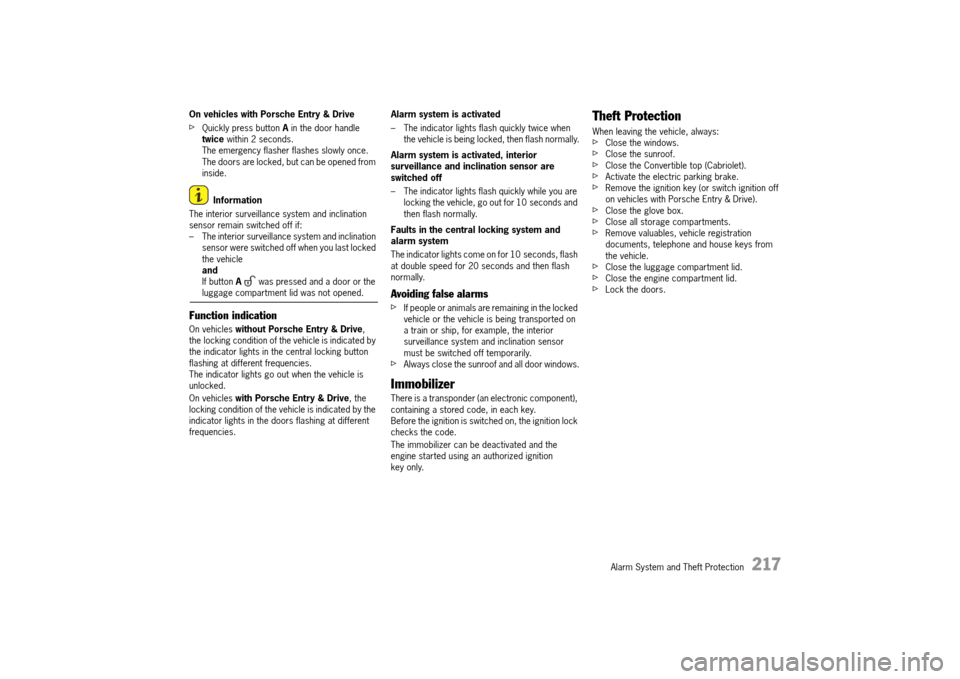
On vehicles with Porsche Entry & Drive
fQuickly press button A in the door handle twice within 2 seconds. The emergency flasher flashes slowly once.The doors are locked, but can be opened from inside.
Information
The interior surveillance system and inclination sensor remain switched off if:– The interior surveillance system and inclination sensor were switched off when you last locked the vehicleandIf button A was pressed and a door or the luggage compartment lid was not opened.
Function indication
On vehicles without Porsche Entry & Drive, the locking condition of the vehicle is indicated by the indicator lights in the central locking button flashing at different frequencies.The indicator lights go out when the vehicle is unlocked.
On vehicles with Porsche Entry & Drive, the locking condition of the vehicle is indicated by the indicator lights in the doors flashing at different frequencies.
Alarm system is activated
– The indicator lights flash quickly twice when the vehicle is being locked, then flash normally.
Alarm system is activated, interior surveillance and inclination sensor are switched off
– The indicator lights flash quickly while you are locking the vehicle, go out for 10 seconds and then flash normally.
Faults in the central locking system and alarm system
The indicator lights come on for 10 seconds, flash at double speed for 20 seconds and then flash normally.
Avoiding false alarms
fIf people or animals are remaining in the locked vehicle or the vehicle is being transported on a train or ship, for example, the interior surveillance system and inclination sensor must be switched off temporarily.fAlways close the sunroof and all door windows.
Immobilizer
There is a transponder (an electronic component), containing a stored code, in each key. Before the ignition is switched on, the ignition lock checks the code.
The immobilizer can be deactivated and the engine started using an authorized ignition key only.
Theft Protection
When leaving the vehicle, always:fClose the windows.fClose the sunroof.fClose the Convertible top (Cabriolet).fActivate the electric parking brake.fRemove the ignition key (or switch ignition off on vehicles with Porsche Entry & Drive).fClose the glove box.fClose all storage compartments.fRemove valuables, vehicle registration documents, telephone and house keys from the vehicle.fClose the luggage compartment lid.fClose the engine compartment lid.fLock the doors.
14_991_Turbo_21.book Seite 217 Mittwoch, 9. April 2014 2:19 14
Page 220 of 300
218 Maintenance and Car Care
Maintenance and Car Care
Exercise Extreme Caution when Working on your vehicle .............................. 219Engine Oil................................................... 221Checking Engine Oil Level ............................ 222Topping Up Engine Oil ................................. 222Washer Fluid windshield ............................... 224Wiper Blades .............................................. 224Emission Control System............................. 225How Emission Control Works ....................... 226Fuel Economy ............................................. 226Operating Your Porsche in other Countries ... 227Fuel ........................................................... 227Portable Fuel Container ............................... 229Fuel Recommendations ............................... 230Fuel Evaporation Control ............................ 231Car Care Instructions .................................. 231
14_991_Turbo_21.book Seite 218 Mittwoch, 9. April 2014 2:19 14
Page 222 of 300
220 Maintenance and Car Care
If the vehicle is not secured, or incorrectly secured, during repair work, it could move unexpectedly or fall from the car jack or car lift.fBe alert and cautious around the engine at all times while it is running. If you have to work on the engine while it is running, always apply the electric parking brake and put the PDK selector lever in position P or N.fAlways support your car with safety stands if it is necessary to work under the car. The jack supplied with the car is not adequate for this purpose.Switch off level control of air suspension and height adjustment.Please see the chapter “RAISING THE VEHICLE WITH A LIFTING PLATFORM, TROLLEY JACK OR STANDARD JACK” on page 254.fJack up the vehicle only at the specified jacking points on the underside of the vehicle.fNever start the engine when the vehicle is jacked or lifted up. Vibration from the engine could cause the vehicle to fall.fWhen working under the car without safety stands but with the wheels on the ground, make sure the car is on level ground, the wheels are blocked, and that the engine cannot be started.Withdraw ignition keys (switch ignition off in vehicles that have Porsche Entry & Drive).
Information
fIncomplete or improper servicing may cause problems in the operation of the car. If in doubt about any servicing, have it done by your authorized Porsche dealer.Improper maintenance during the warranty period may affect your Porsche warranty coverage.fSome countries require additional tools and special spare parts to be carried in your vehicle. Please make enquiries before driving abroad.
Technical Modifications
fModifications may be carried out on your vehicle only if approved by Porsche.This ensures that your Porsche will remain reliable and safe to drive, and that it will not be damaged as a result of the modifications.Your authorized Porsche dealer will be pleased to advise you.
Information
fOnly use genuine Porsche spare parts for your vehicle or spare parts of similar quality which have been manufactured according to the specifications and production requirements of Porsche. These parts are available from your authorized Porsche dealer. Safety-related accessories should only be used if they are from the Porsche Tequipment range or are tested and approved by Porsche. Your authorized Porsche dealer will be pleased to advise you and answer any questions you may have.However, the use of other parts or accessories may adversely affect the safety of your vehicle, and Porsche can take no responsibility for any loss or damage caused by their use.Even if the supplier of other accessories or parts is a recognized supplier, the safety of your vehicle may still be affected if such items are installed.Due to the large variety of products offered in the accessory market, it is not possible for Porsche to inspect and approve every one.fIn addition, please note that the use of replacement parts that are not genuine Porsche parts or approved parts, or the use of accessories not approved by Porsche may also detrimentally affect your vehicle warranty.fCheck your vehicle regularly for signs of damage. Damaged or missing aerodynamic components, such as spoilers or underbody panels, impair vehicle handling and must therefore be replaced immediately.
Failure to Secure VehicleWARNINGh
14_991_Turbo_21.book Seite 220 Mittwoch, 9. April 2014 2:19 14
Page 223 of 300
Maintenance and Car Care 221
Radiator fan, engine compartment blowers
The engine-compartment blowers are mounted under the engine compartment lid.After the engine is switched off, the engine compartment temperature is monitored for approx. 30 minutes.During this period, and depending on temperature, the engine-compartment blowers may continue to run or start to run.fCarry out work in this area only with the engine off and exercise extreme caution.
The radiators and radiator fans are in the front of the vehicle.The radiator fans in the front of the vehicle may be operating or unexpectedly start operating when the engine is switched on.fCarry out work in these areas only with the engine switched off.fTake great care to ensure that parts of the body, items of clothing or jewelery cannot be drawn in by the radiator fan, engine-compartment blower, drive belt or other moving parts.
Measurements on test stands
Performance test
Performance tests on roller-type test stands are not approved by Porsche.
Brake tests
Brake tests must be performed only on roller-type test stands.
The following limit values must not be exceeded on roller-type test stands: – Test speed 4.7 mph (7.5 km/h)– Test duration 20 seconds
Testing the electric parking brake
Electric parking brake tests on the brake test stand must only be performed with the ignition switched on and with the Porsche Doppelkupplung selector lever in position N. The vehicle switches automatically to brake test stand mode, in which the electric parking brake can be tested.The message “ Electric parking brake in service mode ” appears on the multi-function display in the instrument panel.
Balancing wheels on the vehicle
During finish balancing of the wheels, the entire vehicle must be lifted and the wheels must be free to turn.
Engine Oil
It is important to perform oil changes regularly in accordance with the intervals specified in your Maintenance Schedule .
Engine oil consumption
It is normal for your engine to consume oil. The rate of oil consumption depends on the quality and viscosity of oil, the speed at which the engine is operated, the climate, road conditions as well
as the amount of dilution and oxidation of the lubricant.
If the vehicle is used for repeated short trips, and consumes a normal amount of oil, the engine oil measurement may not show any drop in the oil level at all, even after 600 miles (1000 km) or more. This is because the oil is gradually becoming diluted with fuel or moisture, making it appear that the oil level has not changed. The diluting ingredients evaporate out when the vehicle is driven at high speeds, as on an expressway, making it then appear that oil is excessively consumed after driving at high speeds.
If the conditions you drive your vehicle in are dusty, humid, or hot, the frequency of the oil change intervals should be greater.
If the vehicle is driven at a high rate of speed, climatic conditions are warm, and the load is high, the oil should be checked more frequently, as driving conditions will determine the rate of oil consumption.– The engine in your vehicle depends on oil to lubricate and cool all of its moving parts. Therefore, the engine oil should be checked regularly and kept at the required level.– Make it a habit to have the engine oil level checked with every refueling.– The oil pressure warning light is not an oil level indicator. The oil pressure warning light indicates serious engine damage may be occurring when lit, if engine rpm is above idle speed.
Radiator Fans, Engine Compartment Blowers
WARNINGh
14_991_Turbo_21.book Seite 221 Mittwoch, 9. April 2014 2:19 14
Page 224 of 300
222 Maintenance and Car Care
Checking Engine Oil Level
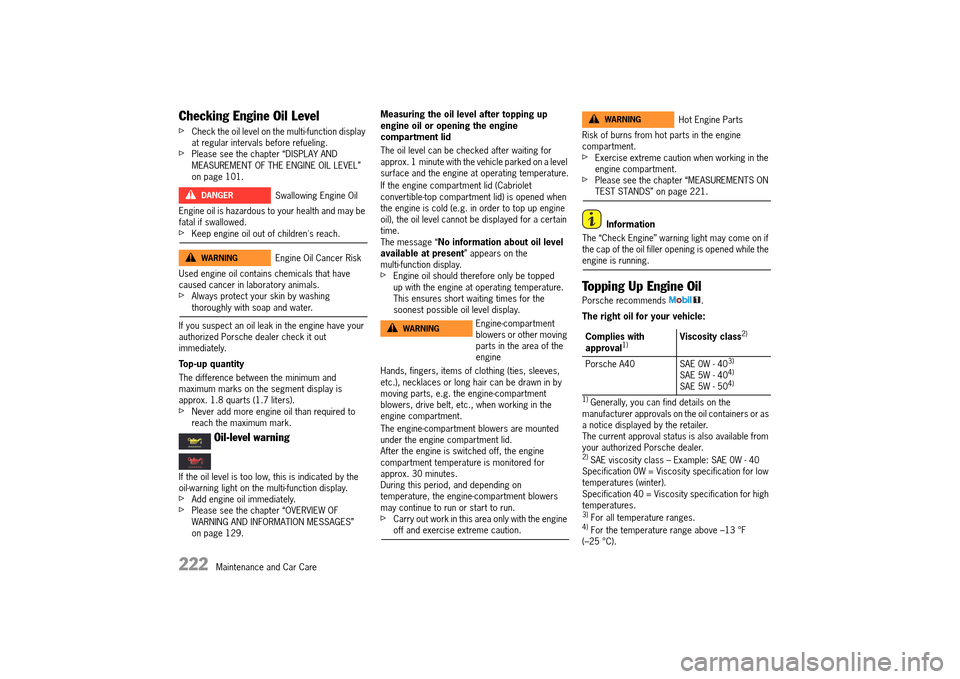
fCheck the oil level on the multi-function display at regular intervals before refueling.fPlease see the chapter “DISPLAY AND MEASUREMENT OF THE ENGINE OIL LEVEL” on page 101.
Engine oil is hazardous to your health and may be fatal if swallowed.fKeep engine oil out of children's reach.
Used engine oil contains chemicals that have caused cancer in laboratory animals.fAlways protect your skin by washing thoroughly with soap and water.
If you suspect an oil leak in the engine have your authorized Porsche dealer check it out immediately.
Top-up quantity
The difference between the minimum and maximum marks on the segment display is approx. 1.8 quarts (1.7 liters).fNever add more engine oil than required to reach the maximum mark.
If the oil level is too low, this is indicated by the oil-warning light on the multi-function display.fAdd engine oil immediately.fPlease see the chapter “OVERVIEW OF WARNING AND INFORMATION MESSAGES” on page 129.
Measuring the oil level after topping up engine oil or opening the engine compartment lid
The oil level can be checked after waiting for approx. 1 minute with the vehicle parked on a level surface and the engine at operating temperature.
If the engine compartment lid (Cabriolet convertible-top compartment lid) is opened when the engine is cold (e.g. in order to top up engine oil), the oil level cannot be displayed for a certain time.The message “ No information about oil level available at present ” appears on the multi-function display.fEngine oil should therefore only be topped up with the engine at operating temperature. This ensures short waiting times for the soonest possible oil level display.
Hands, fingers, items of clothing (ties, sleeves, etc.), necklaces or long hair can be drawn in by moving parts, e.g. the engine-compartment blowers, drive belt, etc., when working in the engine compartment.
The engine-compartment blowers are mounted under the engine compartment lid.After the engine is switched off, the engine compartment temperature is monitored for approx. 30 minutes.During this period, and depending on temperature, the engine-compartment blowers may continue to run or start to run.fCarry out work in this area only with the engine off and exercise extreme caution.
Risk of burns from hot parts in the engine compartment.fExercise extreme caution when working in the engine compartment.fPlease see the chapter “MEASUREMENTS ON TEST STANDS” on page 221.
Information
The “Check Engine” warning light may come on if the cap of the oil filler opening is opened while the engine is running.
Topping Up Engine Oil
Porsche recommends .
The right oil for your vehicle:
1) Generally, you can find details on the manufacturer approvals on the oil containers or as a notice displayed by the retailer.The current approval status is also available from your authorized Porsche dealer.2) SAE viscosity class – Example: SAE 0W - 40 Specification 0W = Viscosity specification for low temperatures (winter).Specification 40 = Viscosity specification for high temperatures.3) For all temperature ranges.4) For the temperature range above –13 °F(–25 °C).
Swallowing Engine Oil
Engine Oil Cancer Risk
Oil-level warning
DANGERh
WARNINGh
Engine-compartment blowers or other moving parts in the area of the engine
WARNINGh
Hot Engine Parts
Complies with approval1)Viscosity class2)
Porsche A40 SAE 0W - 403)
SAE 5W - 404)
SAE 5W - 504)
WARNINGh
14_991_Turbo_21.book Seite 222 Mittwoch, 9. April 2014 2:19 14