parking brake PORSCHE 911 TURBO 2014 6.G Owner's Manual
[x] Cancel search | Manufacturer: PORSCHE, Model Year: 2014, Model line: 911 TURBO, Model: PORSCHE 911 TURBO 2014 6.GPages: 300, PDF Size: 10.61 MB
Page 174 of 300
172 Driving and Driving Safety
Porsche Doppelkupplung (PDK)
Porsche Doppelkupplung (PDK) is a seven-speed transmission with an automatic and a manual selection mode.
In automatic selection mode (selector-lever position D), gear changing is automatic. You can change temporarily from automatic to manual mode using the shift buttons on the steering wheel.
In manual selection mode (selector-lever position M), you change gear using the shift buttons or shift paddles on the steering wheel or with the PDK selector lever.
You can change between selector-lever positions D and M as you wish while driving.
Information
fTake care not to operate the shift buttons on the steering wheel inadvertently in either automatic or manual mode, thereby triggering undesired gear changes.
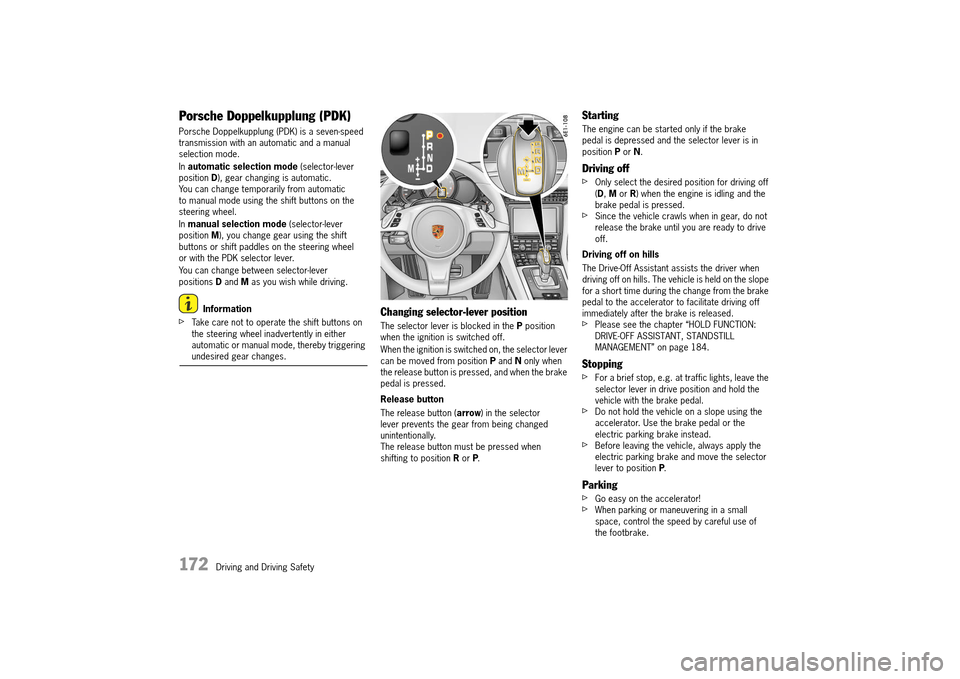
Changing selector-lever position
The selector lever is blocked in the P position when the ignition is switched off.
When the ignition is switched on, the selector lever can be moved from position P and N only when the release button is pressed, and when the brake pedal is pressed.
Release button
The release button ( arrow) in the selector lever prevents the gear from being changed unintentionally.The release button must be pressed when shifting to position R or P.
Starting
The engine can be started only if the brake pedal is depressed and the selector lever is in position P or N.
Driving off
fOnly select the desired position for driving off ( D, M or R) when the engine is idling and the brake pedal is pressed.fSince the vehicle crawls when in gear, do not release the brake until you are ready to drive off.
Driving off on hills
The Drive-Off Assistant assists the driver when driving off on hills. The vehicle is held on the slope for a short time during the change from the brake pedal to the accelerator to facilitate driving off immediately after the brake is released.fPlease see the chapter “HOLD FUNCTION: DRIVE-OFF ASSISTANT, STANDSTILL MANAGEMENT” on page 184.
Stopping
fFor a brief stop, e.g. at traffic lights, leave the selector lever in drive position and hold the vehicle with the brake pedal.fDo not hold the vehicle on a slope using the accelerator. Use the brake pedal or the electric parking brake instead.fBefore leaving the vehicle, always apply the electric parking brake and move the selector lever to position P.
Parking
fGo easy on the accelerator!fWhen parking or maneuvering in a small space, control the speed by careful use of the footbrake.
14_991_Turbo_21.book Seite 172 Mittwoch, 9. April 2014 2:19 14
Page 176 of 300
174 Driving and Driving Safety
Selector-lever Positions
P – Parking lock
fEngage parking lock only when the vehicle is stationary.If selector-lever position P is flashing in the instrument panel, the parking lock is not engaged. The vehicle can roll away.Shift again from selector-lever position R to P.fActivate the electric parking brake and then engage the parking lock.If selector-lever position P is flashing in the instrument panel, the parking lock is not engaged. The vehicle can roll away.Shift again from selector-lever position R to P.
Vehicles without Porsche Entry & Drive: The ignition key can only be removed in selector- lever position P.
R – Reverse gear
fSelect only if the vehicle is stationary and the brake is applied.
N – Neutral
Selector-lever position N must be selected for towing or in car washes, for example.fOnly select the desired position for driving off ( D, M or R) when the engine is idling and the brake pedal is pressed.
D – Automatic selection mode
Select position D for “normal” driving. The gears are shifted automatically according to the accelerator position and speed.
Depending on the way the vehicle is driven (economical, comfortable or sporty driving style) and on the resistance (e.g. uphill), the gear-changing points are shifted towards higher or lower engine-speed ranges.The accelerator position, driving speed, engine speed, longitudinal and lateral acceleration and the road profile all have an influence on the gear-changing characteristic.
Unwanted upshifts, e.g. when entering bends, are prevented by swiftly releasing the accelerator pedal.
Depending on lateral acceleration, upshifts on bends are not made until the engine-speed limit is reached.
When you brake, and depending on the amount of deceleration, the PDK transmission changes down earlier.For subsequent cornering, the correct gear is engaged when pressure is applied to the brakes before the bend. The bend is taken in the right gear, and when you accelerate out of the bend you do not have to change down.
With a sporty driving style, downshifts are already initiated when the brake pedal is touched lightly. This further enhances a dynamic driving style.
The PDK transmission temporarily changes to the sportiest gear-changing map, i.e. to the highest possible gear-changing points, if the accelerator pedal is pressed quickly. The transmission accordingly shifts down immediately by one or two gears (temporary downshift).
The transmission no longer selects 7th gear at very high driving speeds.
However, if necessary, the gear can be selected manually.
Upshifts and downshifts are avoided as far as possible when PSM is active. In the case of high wheel slip when PSM is switched off, upshifts are prevented until slip is no longer detected.
Driving in coasting mode
Through attentive driving, fuel can be saved in coasting mode. The vehicle rolls with the engine disengaged and at idle speed without engine braking effect.
Preconditions for automatic coasting mode – Driving in selector lever position D – Coasting mode is switched on.Indicator light on the button is off.– Sport and Sport Plus modes are switched off– PSM is active– Cruise control is not active– Engine, transmission and battery are at operating temperature– Calm/economic driving style– Slight uphill or slight downhill gradientsfSlowly take your foot off the accelerator.
The engine is disengaged and runs at idle speed. The vehicle rolls with no engine braking effect. Coasting mode is recognizable by the idle speed indicated on the tachometer.
Information
In the case of a sporty driving or when swiftly releasing the accelerator pedal, coasting mode is suppressed to allow targeted use of the engine braking effect. On more pronounced uphill gradients, “coasting” is also prevented as the coasting phases are very short due to the gradient and no significant fuel savings can be achieved. On more pronounced downhill gradients, coasting
14_991_Turbo_21.book Seite 174 Mittwoch, 9. April 2014 2:19 14
Page 186 of 300
184 Driving and Driving Safety
HOLD function: Drive-Off
Assistant, Standstill Management
The HOLD function, as an assistance function, assists the driver when stopping and driving off on upward slopes.The vehicle is automatically prevented from rolling back away from the desired direction of travel.When the HOLD function is active, the indicator light on the instrument panel comes on.
The vehicle is stopped and prevented from rolling back away from the desired direction of travel even without pressing the brake.
Information
The HOLD function is not available if the PDK selector lever is in position P and N.
If the PDK selector lever is moved while the HOLD function is active, the HOLD function is deactivated.
If the driver’s safety belt is unfastened and the driver’s door is opened while the HOLD function is active, the electric parking brake is activated automatically.
For information on the electric parking brake:fPlease see the chapter “ELECTRIC PARKING BRAKE” on page 151.
The limits set by the physics of driving cannot be overcome, even with the HOLD function. Responsibility for driving off on upward slopes is still the driver’s, despite the HOLD function.Assistance by the HOLD function is not always guaranteed when stopping and driving off on a slippery surface (e.g. on icy or loose surfaces). In this case, the vehicle can slip.fAlways adjust your driving style to the driving conditions and vehicle load. Use the footbrake if necessary.
If the Drive-Off Assistant is not functioning, the driver cannot be assisted when driving off on hills.fHold the vehicle with the footbrake.
If the vehicle comes to a standstill on a steep uphill gradient without operation of the footbrake by the driver, this may result in a certain roll-back before the vehicle is held by the HOLD function. In this situation, the roll-back can be reduced by pressing the footbrake.fAssist holding of the vehicle by increasing the braking force with the footbrake.
Information
When the HOLD function is active, the brake pedal may feel different and you may hear hydraulic noises.
This behavior is normal for the system. It is not a fault.
ABS Brake System
(Anti-lock Brake System)
In spite of the advantages of ABS, it is still the driver’s responsibility to adapt his driving style and maneuvers in line with road and weather conditions, as well as the traffic situation.
The increased safety that is provided should not induce you to take greater risks with your safety. The limits set by the physics of driving cannot be overcome, even with ABS.Risk of accidents due to inappropriate speed cannot be reduced by ABS.
ABS helps provide:
– Full steering control The vehicle remains steerable– Good driving stability No skidding due to locked wheels– Optimum braking distance Shorter stopping distance in most cases– Prevention of wheel locking No flat spots on the tires
Limits of HOLD Function
Drive-Off Assistant Not Working
Vehicle Roll-back
WARNINGh
CAUTIONh
CAUTIONh
Loss of control over the vehicleWARNINGh
14_991_Turbo_21.book Seite 184 Mittwoch, 9. April 2014 2:19 14
Page 209 of 300
Parking 207
ParkAssist
When the driver is parking and maneuvering the vehicle, ParkAssist indicates the distance between the vehicle and a large obstacle by means of signal tones.fOn vehicles with front and rear sensors:For information on the ParkAssist visual display, please refer also to the section “PARKASSIST” in the operating instructions for the Porsche Communication Systems PCM/CDR.
ParkAssist is activated automatically when reverse gear is selected and the ignition is on.
If the vehicle has front ParkAssist, this also issues an automatic warning when the distance between the vehicle and an obstacle in front is less – than approx. 40 in./100 cm (acoustically) and approx. 32 in./80 cm (visually).
A warning signal sounds when – the distance between the vehicle and an obstacle at the rear is less than approx. 71 in./180 cm.The ParkAssist visual display appears on the central screen of the Porsche communication system.
Front and rear ParkAssist is not activated: – At a speed of more than approx. 9 mph (15 km/h).– When the electric parking brake is activated.– When the ParkAssist has been switched off with button A in the overhead console with the ignition switched on. The indicator light in button A lights up.
Responsibility for parking and for assessing the risk to persons, children, pets, and small objects around the vehicle lies completely with the driver. fMake sure that no persons (especially small children), animals or obstacles are within the maneuvering area. fIf the continuous tone sounds, stop and do not move your vehicle further in that direction.
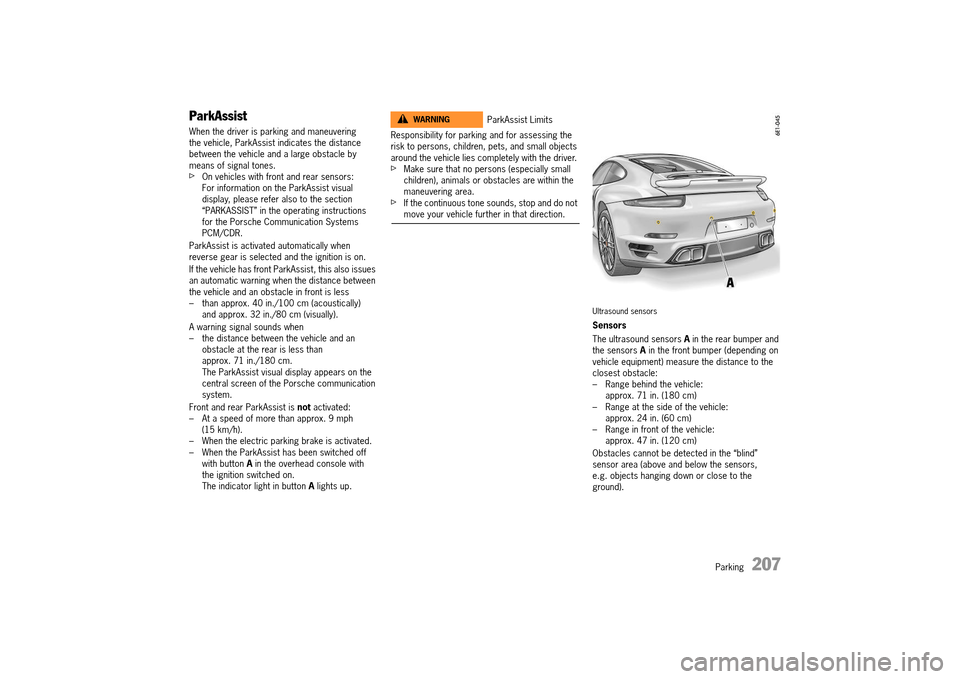
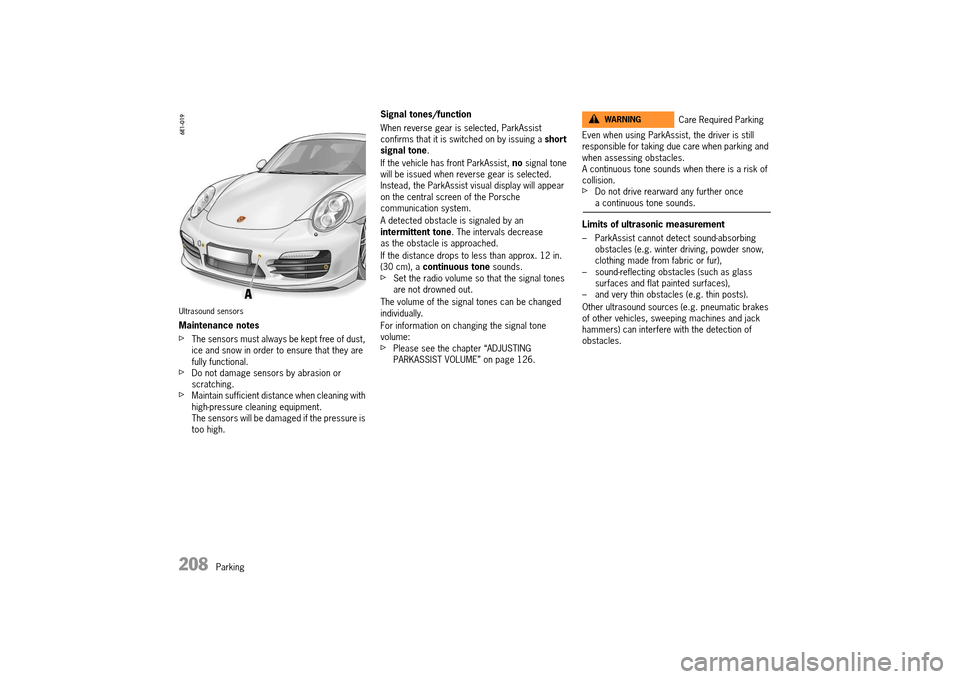
Ultrasound sensors
Sensors
The ultrasound sensors A in the rear bumper and the sensors A in the front bumper (depending on vehicle equipment) measure the distance to the closest obstacle:– Range behind the vehicle: approx. 71 in. (180 cm)– Range at the side of the vehicle: approx. 24 in. (60 cm)– Range in front of the vehicle: approx. 47 in. (120 cm)
Obstacles cannot be detected in the “blind” sensor area (above and below the sensors, e.g. objects hanging down or close to the ground).
ParkAssist LimitsWARNINGh
14_991_Turbo_21.book Seite 207 Mittwoch, 9. April 2014 2:19 14
Page 210 of 300
208 Parking
Ultrasound sensors
Maintenance notes
fThe sensors must always be kept free of dust, ice and snow in order to ensure that they are fully functional.fDo not damage sensors by abrasion or scratching.fMaintain sufficient distance when cleaning with high-pressure cleaning equipment.The sensors will be damaged if the pressure is too high.
Signal tones/function
When reverse gear is selected, ParkAssist confirms that it is switched on by issuing a short signal tone .
If the vehicle has front ParkAssist, no signal tone will be issued when reverse gear is selected.Instead, the ParkAssist visual display will appear on the central screen of the Porsche communication system.
A detected obstacle is signaled by an intermittent tone . The intervals decrease as the obstacle is approached.
If the distance drops to less than approx. 12 in. (30 cm), a continuous tone sounds.fSet the radio volume so that the signal tones are not drowned out.
The volume of the signal tones can be changed individually.
For information on changing the signal tone volume:fPlease see the chapter “ADJUSTING PARKASSIST VOLUME” on page 126.
Even when using ParkAssist, the driver is still responsible for taking due care when parking and when assessing obstacles.A continuous tone sounds when there is a risk of collision.fDo not drive rearward any further once a continuous tone sounds.
Limits of ultrasonic measurement
– ParkAssist cannot detect sound-absorbing obstacles (e.g. winter driving, powder snow, clothing made from fabric or fur),– sound-reflecting obstacles (such as glass surfaces and flat painted surfaces),– and very thin obstacles (e.g. thin posts).
Other ultrasound sources (e.g. pneumatic brakes of other vehicles, sweeping machines and jack hammers) can interfere with the detection of obstacles.
Care Required ParkingWARNINGh
14_991_Turbo_21.book Seite 208 Mittwoch, 9. April 2014 2:19 14
Page 219 of 300
Alarm System and Theft Protection 217
On vehicles with Porsche Entry & Drive
fQuickly press button A in the door handle twice within 2 seconds. The emergency flasher flashes slowly once.The doors are locked, but can be opened from inside.
Information
The interior surveillance system and inclination sensor remain switched off if:– The interior surveillance system and inclination sensor were switched off when you last locked the vehicleandIf button A was pressed and a door or the luggage compartment lid was not opened.
Function indication
On vehicles without Porsche Entry & Drive, the locking condition of the vehicle is indicated by the indicator lights in the central locking button flashing at different frequencies.The indicator lights go out when the vehicle is unlocked.
On vehicles with Porsche Entry & Drive, the locking condition of the vehicle is indicated by the indicator lights in the doors flashing at different frequencies.
Alarm system is activated
– The indicator lights flash quickly twice when the vehicle is being locked, then flash normally.
Alarm system is activated, interior surveillance and inclination sensor are switched off
– The indicator lights flash quickly while you are locking the vehicle, go out for 10 seconds and then flash normally.
Faults in the central locking system and alarm system
The indicator lights come on for 10 seconds, flash at double speed for 20 seconds and then flash normally.
Avoiding false alarms
fIf people or animals are remaining in the locked vehicle or the vehicle is being transported on a train or ship, for example, the interior surveillance system and inclination sensor must be switched off temporarily.fAlways close the sunroof and all door windows.
Immobilizer
There is a transponder (an electronic component), containing a stored code, in each key. Before the ignition is switched on, the ignition lock checks the code.
The immobilizer can be deactivated and the engine started using an authorized ignition key only.
Theft Protection
When leaving the vehicle, always:fClose the windows.fClose the sunroof.fClose the Convertible top (Cabriolet).fActivate the electric parking brake.fRemove the ignition key (or switch ignition off on vehicles with Porsche Entry & Drive).fClose the glove box.fClose all storage compartments.fRemove valuables, vehicle registration documents, telephone and house keys from the vehicle.fClose the luggage compartment lid.fClose the engine compartment lid.fLock the doors.
14_991_Turbo_21.book Seite 217 Mittwoch, 9. April 2014 2:19 14
Page 222 of 300
220 Maintenance and Car Care
If the vehicle is not secured, or incorrectly secured, during repair work, it could move unexpectedly or fall from the car jack or car lift.fBe alert and cautious around the engine at all times while it is running. If you have to work on the engine while it is running, always apply the electric parking brake and put the PDK selector lever in position P or N.fAlways support your car with safety stands if it is necessary to work under the car. The jack supplied with the car is not adequate for this purpose.Switch off level control of air suspension and height adjustment.Please see the chapter “RAISING THE VEHICLE WITH A LIFTING PLATFORM, TROLLEY JACK OR STANDARD JACK” on page 254.fJack up the vehicle only at the specified jacking points on the underside of the vehicle.fNever start the engine when the vehicle is jacked or lifted up. Vibration from the engine could cause the vehicle to fall.fWhen working under the car without safety stands but with the wheels on the ground, make sure the car is on level ground, the wheels are blocked, and that the engine cannot be started.Withdraw ignition keys (switch ignition off in vehicles that have Porsche Entry & Drive).
Information
fIncomplete or improper servicing may cause problems in the operation of the car. If in doubt about any servicing, have it done by your authorized Porsche dealer.Improper maintenance during the warranty period may affect your Porsche warranty coverage.fSome countries require additional tools and special spare parts to be carried in your vehicle. Please make enquiries before driving abroad.
Technical Modifications
fModifications may be carried out on your vehicle only if approved by Porsche.This ensures that your Porsche will remain reliable and safe to drive, and that it will not be damaged as a result of the modifications.Your authorized Porsche dealer will be pleased to advise you.
Information
fOnly use genuine Porsche spare parts for your vehicle or spare parts of similar quality which have been manufactured according to the specifications and production requirements of Porsche. These parts are available from your authorized Porsche dealer. Safety-related accessories should only be used if they are from the Porsche Tequipment range or are tested and approved by Porsche. Your authorized Porsche dealer will be pleased to advise you and answer any questions you may have.However, the use of other parts or accessories may adversely affect the safety of your vehicle, and Porsche can take no responsibility for any loss or damage caused by their use.Even if the supplier of other accessories or parts is a recognized supplier, the safety of your vehicle may still be affected if such items are installed.Due to the large variety of products offered in the accessory market, it is not possible for Porsche to inspect and approve every one.fIn addition, please note that the use of replacement parts that are not genuine Porsche parts or approved parts, or the use of accessories not approved by Porsche may also detrimentally affect your vehicle warranty.fCheck your vehicle regularly for signs of damage. Damaged or missing aerodynamic components, such as spoilers or underbody panels, impair vehicle handling and must therefore be replaced immediately.
Failure to Secure VehicleWARNINGh
14_991_Turbo_21.book Seite 220 Mittwoch, 9. April 2014 2:19 14
Page 223 of 300
Maintenance and Car Care 221
Radiator fan, engine compartment blowers
The engine-compartment blowers are mounted under the engine compartment lid.After the engine is switched off, the engine compartment temperature is monitored for approx. 30 minutes.During this period, and depending on temperature, the engine-compartment blowers may continue to run or start to run.fCarry out work in this area only with the engine off and exercise extreme caution.
The radiators and radiator fans are in the front of the vehicle.The radiator fans in the front of the vehicle may be operating or unexpectedly start operating when the engine is switched on.fCarry out work in these areas only with the engine switched off.fTake great care to ensure that parts of the body, items of clothing or jewelery cannot be drawn in by the radiator fan, engine-compartment blower, drive belt or other moving parts.
Measurements on test stands
Performance test
Performance tests on roller-type test stands are not approved by Porsche.
Brake tests
Brake tests must be performed only on roller-type test stands.
The following limit values must not be exceeded on roller-type test stands: – Test speed 4.7 mph (7.5 km/h)– Test duration 20 seconds
Testing the electric parking brake
Electric parking brake tests on the brake test stand must only be performed with the ignition switched on and with the Porsche Doppelkupplung selector lever in position N. The vehicle switches automatically to brake test stand mode, in which the electric parking brake can be tested.The message “ Electric parking brake in service mode ” appears on the multi-function display in the instrument panel.
Balancing wheels on the vehicle
During finish balancing of the wheels, the entire vehicle must be lifted and the wheels must be free to turn.
Engine Oil
It is important to perform oil changes regularly in accordance with the intervals specified in your Maintenance Schedule .
Engine oil consumption
It is normal for your engine to consume oil. The rate of oil consumption depends on the quality and viscosity of oil, the speed at which the engine is operated, the climate, road conditions as well
as the amount of dilution and oxidation of the lubricant.
If the vehicle is used for repeated short trips, and consumes a normal amount of oil, the engine oil measurement may not show any drop in the oil level at all, even after 600 miles (1000 km) or more. This is because the oil is gradually becoming diluted with fuel or moisture, making it appear that the oil level has not changed. The diluting ingredients evaporate out when the vehicle is driven at high speeds, as on an expressway, making it then appear that oil is excessively consumed after driving at high speeds.
If the conditions you drive your vehicle in are dusty, humid, or hot, the frequency of the oil change intervals should be greater.
If the vehicle is driven at a high rate of speed, climatic conditions are warm, and the load is high, the oil should be checked more frequently, as driving conditions will determine the rate of oil consumption.– The engine in your vehicle depends on oil to lubricate and cool all of its moving parts. Therefore, the engine oil should be checked regularly and kept at the required level.– Make it a habit to have the engine oil level checked with every refueling.– The oil pressure warning light is not an oil level indicator. The oil pressure warning light indicates serious engine damage may be occurring when lit, if engine rpm is above idle speed.
Radiator Fans, Engine Compartment Blowers
WARNINGh
14_991_Turbo_21.book Seite 221 Mittwoch, 9. April 2014 2:19 14
Page 243 of 300
Minor Repairs 241
If the vehicle is not secured, or incorrectly secured, during repair work, it could move unexpectedly or fall from the car jack or car lift.fBe alert and cautious around the engine at all times while it is running. If you have to work on the engine while it is running, always apply the electric parking brake and put the PDK selector lever in position P or N.fAlways support your car with safety stands if it is necessary to work under the car. The jack supplied with the car is not adequate for this purpose.Switch off level control of air suspension and height adjustment.Please see the chapter “RAISING THE VEHICLE WITH A LIFTING PLATFORM, TROLLEY JACK OR STANDARD JACK” on page 254.fJack up the vehicle only at the specified jacking points on the underside of the vehicle.fNever start the engine when the vehicle is jacked or lifted up. Vibration from the engine could cause the vehicle to fall.fWhen working under the car without safety stands but with the wheels on the ground, make sure the car is on level ground, the wheels are blocked, and that the engine cannot be started.Withdraw ignition keys (switch ignition off in vehicles that have Porsche Entry & Drive).
Information
fIncomplete or improper servicing may cause problems in the operation of the car. If in doubt about any servicing, have it done by your authorized Porsche dealer.Improper maintenance during the warranty period may affect your Porsche warranty coverage.fSome countries require additional tools and special spare parts to be carried in your vehicle. Please make enquiries before driving abroad.
T
The engine-compartment blowers are mounted under the engine compartment lid.After the engine is switched off, the engine compartment temperature is monitored for approx. 30 minutes.During this period, and depending on temperature, the engine-compartment blowers may continue to run or start to run.fCarry out work in this area only with the engine off and exercise extreme caution.
The radiators and radiator fans are in the front of the vehicle.The radiator fans in the front of the vehicle may be operating or unexpectedly start operating when the engine is switched on.fCarry out work in these areas only with the engine switched off.fTake great care to ensure that parts of the body, items of clothing or jewelery cannot be drawn in by the radiator fan, engine-compartment blower, drive belt or other moving parts.
Measurements on test stands
Performance test
Performance tests on roller-type test stands are not approved by Porsche.
Brake tests
Brake tests must be performed only on roller-type test stands.
The following limit values must not be exceeded on roller-type test stands: – Test speed 4.7 mph (7.5 km/h)– Test duration 20 seconds
Testing the electric parking brake
Electric parking brake tests on the brake test stand must only be performed with the ignition switched on and the Porsche Doppelkupplung selector lever in position N. The vehicle switches automatically to brake test stand mode, in which the electric parking brake can be tested.The message “ Electric parking brake in service mode ” appears on the multi-function display in the instrument panel.
Balancing wheels on the vehicle
During finish balancing of the wheels, the entire vehicle must be lifted and the wheels must be free to turn.
Information
The tools required for changing a wheel (e.g. jack, wheel bolt wrench, assembly aids) are not supplied as standard with the vehicle. Your authorized Porsche dealer will be pleased to advise you.
Failure to Secure VehicleWARNINGh
Radiator Fans, Engine Compartment Blowers
WARNINGh
14_991_Turbo_21.book Seite 241 Mittwoch, 9. April 2014 2:19 14
Page 257 of 300
Minor Repairs 255
fBefore you change a wheel, be sure the ground is level and firm. If necessary, use a board under the jack to ensure that the jack does not sink into the ground.fSet the electric parking brake and block the wheels opposite the flat tire on the other side of the vehicle.fThe jack is only to be used for changing a wheel. Do not use it as a support to work under the car.fThe car must be jacked up only at the illustrated jacking points. Lifting at any other place may result in personal injury.
Risk of damage to the engine or vehicle if you lift the vehicle improperly.fThe car must be jacked up only at the illustrated jacking points. Lifting at any other place may result in damage to the vehicle.fNever jack up the car by the body, bumpers, engine, transmission or at the axles.fDo not damage any sensitive components in the vicinity of the jacking points.fFor safety reasons do not use tire inflating bot-tles. Do not use commercially available sealant bottles. Use only the tire inflating bottle located in the luggage compartment.
Information
The tools required for changing a wheel (e.g. jack, wheel bolt wrench, assembly aids) are not supplied as standard with the vehicle. Your authorized Porsche dealer will be pleased to advise you.
Information
The tire and wheel sizes on both axles are different.fDo not fit the wrong wheels on the wrong axle.fOnly use wheels/tires with approved dimensions for the relevant axle.
Sequence of operation
The jack must be used only to raise the car for wheel changing. The jack must never be used as a support to work underneath the vehicle. If the jack is accidentally dislodged, you or bystanders could suffer severe personal injury.fNever jack up other vehicles or other loads with the jack.fAlways place the car on stable supports if you have to work under it. When working under the vehicle, always use safety stands specifically designed for this purpose.
fPlease use a suitable knee rest to protect your clothing against soiling.1. Activate the electric parking brake and move the PDK selector lever to position P. Remove the ignition key or control unit on vehicles with Porsche Entry & Drive.2. Switch on the emergency flasher if necessary.
3. Secure the vehicle to prevent it from rolling away, e.g. by means of wedges under the wheels on the opposite side.This is particularly important on slopes.4. Slightly loosen the wheel bolts on the wheel to be changed.5. Lift the vehicle only at the specified jacking points.6. Raise the vehicle until the wheel lifts off the ground. fPlease see the chapter “RAISING THE VEHICLE WITH A LIFTING PLATFORM, TROLLEY JACK OR STANDARD JACK” on page 254.7. Remove 1 or 2 wheel bolts (see corresponding figure).NOTICE
Working Under VehicleWARNINGh
14_991_Turbo_21.book Seite 255 Mittwoch, 9. April 2014 2:19 14