PSI PORSCHE 911 TURBO 2014 6.G Owners Manual
[x] Cancel search | Manufacturer: PORSCHE, Model Year: 2014, Model line: 911 TURBO, Model: PORSCHE 911 TURBO 2014 6.GPages: 300, PDF Size: 10.61 MB
Page 95 of 300
Instrument Panel and Multi-Function Display 93
F – Engine oil pressure gauge
The oil pressure is controlled as required and should be at least 51 psi (3.5 bar) at an engine speed of 5000 rpm.
The engine oil pressure varies depending on the engine speed, oil temperature and engine load.
If oil pressure drops abruptly and a message is displayed on the multi-function display when the engine is running or while driving:fStop immediately in a suitable place.fSwitch off the engine.fCheck whether there is an obvious oil leak on or under the car.fSelect “ Oil measurement” on the multi- function display.fPlease see the chapter “DISPLAY AND MEASUREMENT OF THE ENGINE OIL LEVEL” on page 101.fAdd engine oil if necessary.
Risk of engine damage.fDo not continue driving if there is an obvious oil leak.fDo not continue driving if the warning message appears even when the oil level is correct.fHave the fault corrected at an authorized Porsche dealer.
G – Reset button for trip counter display/ brightness setting for instrument lighting
Resetting trip counter display
fPress rotary switch G for approx. 1 second. The trip counter display is reset to “0”.
Adjusting brightness of instrument lighting
For information on adjusting the brightness of the instrument lighting:fPlease see the chapter “INTERIOR/READING LIGHTS” on page 84.
H – Odometer
The displays for the total mileage and individual trips are integrated in the speedometer on the instrument panel.
The upper display counts the total mileage, the lower display shows individual trips.
After exceeding 6,213 miles or 9,999 kilometers, the trip counter returns to 0.
I – Digital speedometer
The digital speedometer I is integrated in the tachometer on the instrument panel.
J – Upshift prompt indicator
The consumption-oriented shift indicator to the right of the digital speed display on the tachometer helps you to develop a fuel-saving driving style. The upshift indicator lights up – prompting you to shift up to the next-higher gear – depending on the selected gear, engine speed and accelerator pedal position.fChange to the next-higher gear when the upshift indicator lights up.
NOTICE
14_991_Turbo_21.book Seite 93 Mittwoch, 9. April 2014 2:19 14
Page 110 of 300
108 Instrument Panel and Multi-Function Display
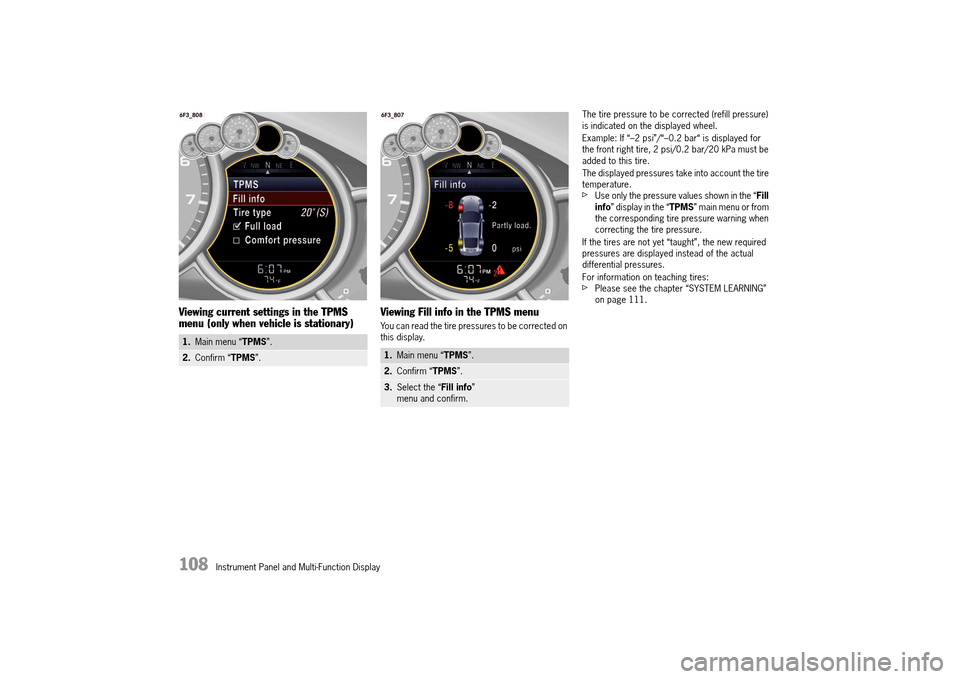
Viewing current settings in the TPMS menu (only when vehicle is stationary) Viewing Fill info in the TPMS menu
You can read the tire pressures to be corrected on this display.
The tire pressure to be corrected (refill pressure) is indicated on the displayed wheel.
Example: If “–2 psi”/“–0.2 bar“ is displayed for the front right tire, 2 psi/0.2 bar/20 kPa must be added to this tire.
The displayed pressures take into account the tire temperature.fUse only the pressure values shown in the “ Fill info ” display in the “TPMS” main menu or from the corresponding tire pressure warning when correcting the tire pressure.
If the tires are not yet “taught”, the new required pressures are displayed instead of the actual differential pressures.
For information on teaching tires:fPlease see the chapter “SYSTEM LEARNING” on page 111.
1. Main menu “TPMS”.
2.Confirm “TPMS”.1.Main menu “TPMS”.
2.Confirm “TPMS”.
3.Select the “Fill info” menu and confirm.
14_991_Turbo_21.book Seite 108 Mittwoch, 9. April 2014 2:19 14
Page 114 of 300
112 Instrument Panel and Multi-Function Display
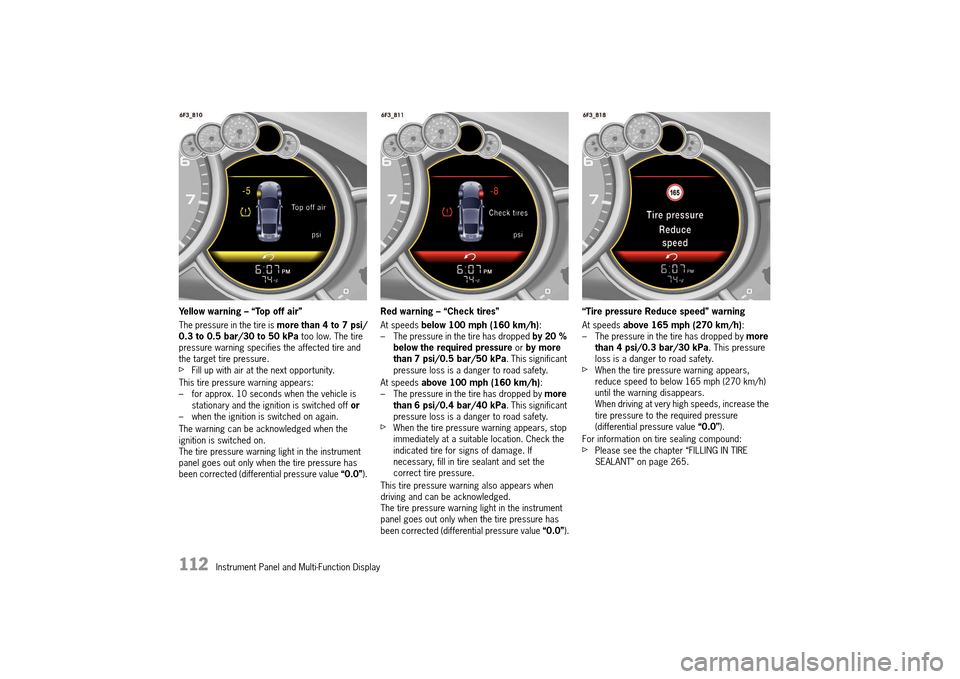
Yellow warning – “Top off air”
The pressure in the tire is more than 4 to 7 psi/ 0.3 to 0.5 bar/30 to 50 kPa too low. The tire pressure warning specifies the affected tire and the target tire pressure. fFill up with air at the next opportunity.
This tire pressure warning appears: – for approx. 10 seconds when the vehicle is stationary and the ignition is switched off or – when the ignition is switched on again.
The warning can be acknowledged when the ignition is switched on.The tire pressure warning light in the instrument panel goes out only when the tire pressure has been corrected (differential pressure value “0.0”).
Red warning – “Check tires”
At speeds below 100 mph (160 km/h): – The pressure in the tire has dropped by 20 % below the required pressure or by more than 7 psi/0.5 bar/50 kPa . This significant pressure loss is a danger to road safety.
At speeds above 100 mph (160 km/h): – The pressure in the tire has dropped by more than 6 psi/0.4 bar/40 kPa . This significant pressure loss is a danger to road safety.fWhen the tire pressure warning appears, stop immediately at a suitable location. Check the indicated tire for signs of damage. If necessary, fill in tire sealant and set the correct tire pressure.
This tire pressure warning also appears when driving and can be acknowledged. The tire pressure warning light in the instrument panel goes out only when the tire pressure has been corrected (differential pressure value “0.0”).
“Tire pressure Reduce speed” warning
At speeds above 165 mph (270 km/h): – The pressure in the tire has dropped by more than 4 psi/0.3 bar/30 kPa . This pressure loss is a danger to road safety.fWhen the tire pressure warning appears, reduce speed to below 165 mph (270 km/h) until the warning disappears.When driving at very high speeds, increase the tire pressure to the required pressure (differential pressure value “0.0”).
For information on tire sealing compound:fPlease see the chapter “FILLING IN TIRE SEALANT” on page 265.
14_991_Turbo_21.book Seite 112 Mittwoch, 9. April 2014 2:19 14
Page 115 of 300
Instrument Panel and Multi-Function Display 113
Warning light
The warning light in the instrument panel lights up: – When a loss in pressure has been detected (warning light: lights up continuously).– In the event of a defect in TPMS or a temporary fault (warning light: flashes for 60 seconds, then lights up continuously).– When learning new fitted wheels/wheel transmitters, as long as the vehicle’s own wheels have not yet been recognized (warning light: flashes for 60 seconds, then lights up continuously).
A warning message also appears on the multi- function display in the instrument panel.fPlease see the chapter “OVERVIEW OF WARNING AND INFORMATION MESSAGES” on page 129.
The tire pressure warning light on the instrument panel goes out only when the cause of the fault has been rectified.
Changing a wheel and replacing tires
fNew wheels must be fitted with radio transmitters for Tire Pressure Monitoring System. Before tires are changed, the battery charge condition of the wheel transmitters should be checked.fPlease contact an authorized Porsche dealer.fSwitch off the ignition when changing a wheel.
The tire settings on the multi-function display must be updated after changing a wheel.If the tire settings are not updated, the message “Tire change? Update settings” is displayed on the multi-function display.fUpdate the multi-function display settings the next time the vehicle is stationary.
Pressure increase as the result of temperature increase
In accordance with physical principles, the tire pressure changes as the temperature changes.For every 18 °F (10 °C) change in temperature, the tire pressure increases or decreases by around 1.5 psi/0.1 bar/10 kPa.
Partial monitoring
Monitoring of the other wheels is continued if there is a fault in one or two wheel transmitters.– The tire pressure warning light lights up.– The message “Restricted monitoring” appears on the multi-function display.– No tire pressures are displayed on the multi-function display for wheels with faulty wheel transmitters.
No monitoring
In the event of faults, Tire Pressure Monitoring System cannot monitor the tire pressure. The warning light on the instrument panel lights up and a corresponding message appears on the multi-function display.
Monitoring is not active: – In the event of a defect in TPMS or if more than 2 wheel transmitters are defective.– If wheel transmitters for Tire Pressure Monitoring System are missing.– During the learning phase after the tire settings have been updated.– After a wheel change without updating the tire settings.– If more than four wheel transmitters are recognized.– If there is external interference by other radio sources, e.g. wireless headphones.– If tire temperatures are too high.fPlease see the chapter “OVERVIEW OF WARNING AND INFORMATION MESSAGES” on page 129.
14_991_Turbo_21.book Seite 113 Mittwoch, 9. April 2014 2:19 14
Page 128 of 300
126 Instrument Panel and Multi-Function Display
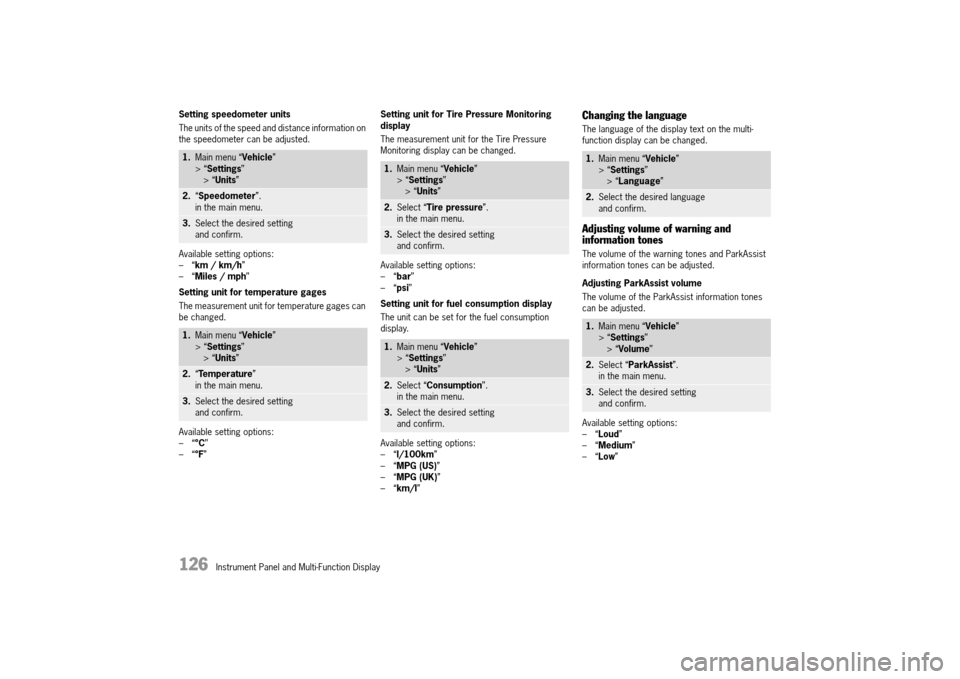
Setting speedometer units
The units of the speed and distance information on the speedometer can be adjusted.
Available setting options: –“ km / km/h” –“ Miles / mph”
Setting unit for temperature gages
The measurement unit for temperature gages can be changed.
Available setting options: –“ °C” –“ °F”
Setting unit for Tire Pressure Monitoring display
The measurement unit for the Tire Pressure Monitoring display can be changed.
Available setting options: –“ bar” –“ psi”
Setting unit for fuel consumption display
The unit can be set for the fuel consumption display.
Available setting options: –“ l/100km” –“ MPG (US)” –“ MPG (UK)” –“ km/l”
Changing the language
The language of the display text on the multi- function display can be changed.
Adjusting volume of warning and information tones
The volume of the warning tones and ParkAssist information tones can be adjusted.
Adjusting ParkAssist volume
The volume of the ParkAssist information tones can be adjusted.
Available setting options: –“ Loud” –“ Medium” –“ Low”
1.Main menu “Vehicle” > “ Settings” > “ Units”
2.“Speedometer”. in the main menu.
3. Select the desired setting and confirm.
1. Main menu “Vehicle” > “ Settings” > “ Units”
2.“Temperature” in the main menu.
3. Select the desired setting and confirm.
1. Main menu “Vehicle” > “ Settings” > “ Units”
2.Select “Tire pressure”. in the main menu.
3. Select the desired setting and confirm.
1. Main menu “Vehicle” > “ Settings” > “ Units”
2.Select “Consumption”. in the main menu.
3. Select the desired setting and confirm.
1. Main menu “Vehicle” > “ Settings” > “ Language”
2.Select the desired language and confirm.
1. Main menu “Vehicle” > “ Settings” > “ Volume”
2.Select “ParkAssist”. in the main menu.
3. Select the desired setting and confirm.
14_991_Turbo_21.book Seite 126 Mittwoch, 9. April 2014 2:19 14
Page 138 of 300
136 Instrument Panel and Multi-Function Display
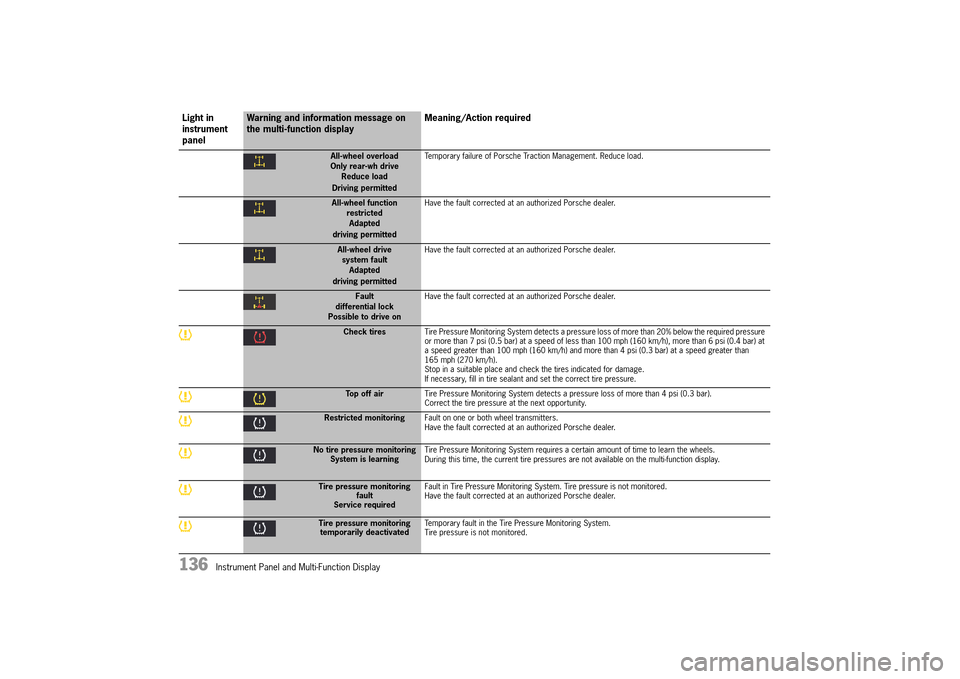
All-wheel overload Only rear-wh driveReduce load Driving permitted
Temporary failure of Porsche Traction Management. Reduce load.
All-wheel function restrictedAdapted driving permitted
Have the fault corrected at an authorized Porsche dealer.
All-wheel drive system faultAdapted driving permitted
Have the fault corrected at an authorized Porsche dealer.
Fault differential lockPossible to drive on
Have the fault corrected at an authorized Porsche dealer.
Check tires Tire Pressure Monitoring System detects a pressure loss of more than 20% below the required pressure or more than 7 psi (0.5 bar) at a speed of less than 100 mph (160 km/h), more than 6 psi (0.4 bar) at a speed greater than 100 mph (160 km/h) and more than 4 psi (0.3 bar) at a speed greater than 165 mph (270 km/h).Stop in a suitable place and check the tires indicated for damage.If necessary, fill in tire sealant and set the correct tire pressure.
Top off air Tire Pressure Monitoring System detects a pressure loss of more than 4 psi (0.3 bar). Correct the tire pressure at the next opportunity.
Restricted monitoring Fault on one or both wheel transmitters. Have the fault corrected at an authorized Porsche dealer.
No tire pressure monitoring System is learning Tire Pressure Monitoring System requires a certain amount of time to learn the wheels. During this time, the current tire pressures are not available on the multi-function display.
Tire pressure monitoring faultService required
Fault in Tire Pressure Monitoring System. Tire pressure is not monitored. Have the fault corrected at an authorized Porsche dealer.
Tire pressure monitoring temporarily deactivated Temporary fault in the Tire Pressure Monitoring System. Tire pressure is not monitored.
Light in instrument panel
Warning and information message on the multi-function display Meaning/Action required
14_991_Turbo_21.book Seite 136 Mittwoch, 9. April 2014 2:19 14
Page 190 of 300
188 Driving and Driving Safety
Dynamic Engine Mounting (PADM)
On vehicles with Sport Chrono package
Dynamic Engine Mounting with variable damping is a system designed to enhance both driving dynamics and driving comfort. Depending on the driving situation, the ideal mounting rigidity and damping is automatically set in the range between an rigid engine-to-body connection (increase in driving dynamics) and decoupling of the engine from the body (increase in driving comfort).
“Sport” mode
When “ Sport” mode is switched on, a more rigid engine-to-body connection is achieved for a sporty driving style.
“Sport Plus” mode
When “ Sport Plus” mode is switched on, an optimal engine-to-body connection is achieved for driving on race circuits.
Warning message
Dynamic engine mounting faults are indicated by a warning message on the multi-function display.fPlease see the chapter “OVERVIEW OF WARNING AND INFORMATION MESSAGES” on page 129.
“Sport” and “Sport Plus” mode
The selectable chassis settings mean that the vehicle can offer various modes for a sportier overall setup.The “ Sport” mode pushes the control systems more in the direction of greater emotionality and performance during every day driving.
In “ Sport Plus” mode, maximum performance is set for race-circuit-like driving:– In “ Sport Plus” mode: PASM (Porsche Active Suspension Management) is automatically changed to “ Chassis Normal” or “Chassis Sport” mode. – In “ Sport Plus” mode: Like PASM, PDCC is switched to the corresponding “ Sport” mode, whereby the rolling movements of the vehicle are reduced further, depending on the selected mode.– The PDK transmission switches to a sporty gear-changing map and shortens the gear shifting times when Sport mode is activated. Gear changes take place faster.– The electronic accelerator pedal reacts sooner, and the engine is more responsive to throttle inputs. When Sport mode is switched on and the vehicle is traveling at a speed of less than 40 km/h (25 mph), this function is activated only after the driver has floored the accelerator pedal or released it briefly.– The rpm limiter characteristic is “harder”. In other words: the engine is immediately throttled when the performance limits are reached (only in manual selection mode on vehicles with PDK).
– PSM (Porsche Stability Management) control is more sporty in “ Sport Plus” mode. PSM interventions are later than in Normal mode. The driver can maneuver the vehicle with greater agility at its performance limits, without having to dispense with the assistance of PSM in emergency situations. This helps to achieve optimal lap times, particularly on race circuits with a dry road surface.– PADM changes to more sporty maps for the dynamic engine mountings to achieve a stiffer engine-to-body connection.In “ Sport” for a sporty driving style, in “ Sport Plus” mode for race-circuit-like driving. – PTV Plus changes to a more dynamic map when “ Sport Plus” is switched on. – The dynamic cornering light reacts more spontaneously to steering angle changes.– The sports exhaust system is be switched to a sound-optimized mode, but can be switched off separately via the button.The Auto Start Stop function and coasting mode are deactivated.fPlease read the relevant chapters.
Overboost function
On vehicles with Sport Chrono package
When “ Sport” or “Sport Plus” mode is switched on and the accelerator is fully pressed, the boost pressure is temporarily increased by approx. 2 psi (0.15 bar) in the medium engine-speed range and the maximum torque increases.
For information on the torque display:fPlease see the chapter “PERFORMANCE MENU” on page 116.
14_991_Turbo_21.book Seite 188 Mittwoch, 9. April 2014 2:19 14
Page 239 of 300
Maintenance and Car Care 237
Improperly secured floor mats can obstruct pedal travel.fAlways check the movement of the pedals before driving and make sure that they are not obstructed by a floor mat or any other object.fSecure the floor mat to prevent it from sliding into positions that could interfere with the safe operation of your vehicle – do not lay them loosely in the vehicle.Your authorized Porsche dealer will be glad to offer you floor mats of correct size including a securing possibility.
Cleaning airbag covers
Incorrect modifications may damage the airbag system. The airbag may not deploy properly in the event of an accident.fDo not make any modifications whatsoever to individual components, such as the padded covers on the steering wheel, the instrument panel, the underside of the instrument panel, front seats and door panels.fHave your authorized Porsche dealer to clean these components.
Cleaning fabric linings
fFabric linings on pillars, roofliner and sun blinds, etc. must be cleaned only using suitable cleaning agents or a suitable dry foam and a soft brush.
Alcantara® care
Do not use leather care products to clean Alcantara®. Alcantara® is a manufactured product. It is not genuine leather or suede.
For regular care, it is sufficient to clean the cover with a soft brush.
Strong abrasion or rubbing when cleaning will produce a lasting change to the surface.
Cleaning when lightly soiled
fWet a soft cloth with water or a neutral soap solution and wipe off the dirt.
Cleaning when heavily soiled
fWet a soft cloth with lukewarm water or thinned white spirit and dab the dirt from the outside in.
Cleaning the safety belts
fUse mild detergent to clean soiled belts.fWhen drying, avoid direct sunlight.fOnly use suitable cleaning agents.fDo not tint or bleach the belts.The belt fabric could be weakened, thus affecting safety.
Storing your Porsche
If you intend to store your Porsche for a prolonged period, please consult your authorized Porsche dealer. The staff will be glad to advise you on the most suitable and necessary methods. fClean your vehicle thoroughly inside and outside. The under carriage and chassis components should be free of dirt and salt deposits. fFill up the fuel tank. fChange the oil and oil filter, and run the engine for several minutes. fIncrease the tire pressure to 50 psi/3.5 bar/350 kPa.It is not recommended to lift the vehicle, due to the possibility of corrosion on shock absorber piston shafts.The vehicle should be moved slightly, approximately every four weeks, to prevent flat spot on the tires.
Climate control
The air conditioning system should be in good working condition and fully charged.
Windshield/Headlight washer
fCheck and correct antifreeze/cleaning solution level as necessary.
Obstructed Pedals
Vehicle Interior Modifications
WARNINGh
DANGERh
14_991_Turbo_21.book Seite 237 Mittwoch, 9. April 2014 2:19 14
Page 268 of 300
266 Minor Repairs
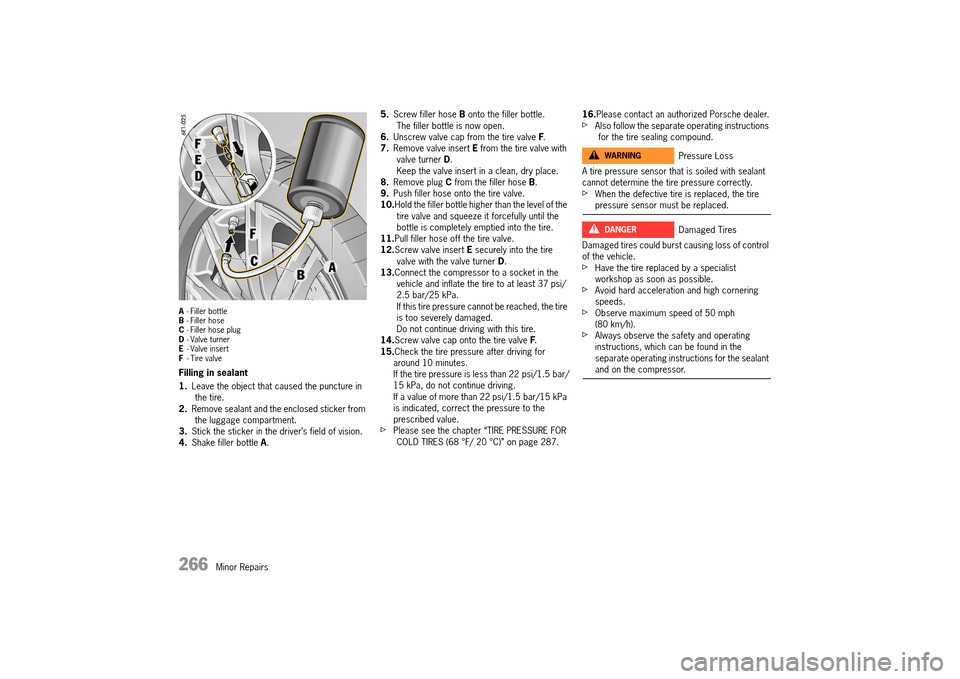
A- Filler bottle B - Filler hose C - Filler hose plug D - Valve turner E - Valve insert F - Tire valve
Filling in sealant
1. Leave the object that caused the puncture in the tire.2. Remove sealant and the enclosed sticker from the luggage compartment.3. Stick the sticker in the driver’s field of vision. 4. Shake filler bottle A.
5. Screw filler hose B onto the filler bottle. The filler bottle is now open.6. Unscrew valve cap from the tire valve F. 7. Remove valve insert E from the tire valve with valve turner D. Keep the valve insert in a clean, dry place.8. Remove plug C from the filler hose B. 9. Push filler hose onto the tire valve. 10. Hold the filler bottle higher than the level of the tire valve and squeeze it forcefully until the bottle is completely emptied into the tire.11. Pull filler hose off the tire valve. 12. Screw valve insert E securely into the tire valve with the valve turner D. 13. Connect the compressor to a socket in the vehicle and inflate the tire to at least 37 psi/2.5 bar/25 kPa.If this tire pressure cannot be reached, the tire is too severely damaged.Do not continue driving with this tire.14. Screw valve cap onto the tire valve F. 15. Check the tire pressure after driving for around 10 minutes.If the tire pressure is less than 22 psi/1.5 bar/15 kPa, do not continue driving.If a value of more than 22 psi/1.5 bar/15 kPa is indicated, correct the pressure to the prescribed value.fPlease see the chapter “TIRE PRESSURE FOR COLD TIRES (68 °F/ 20 °C)” on page 287.
16. Please contact an authorized Porsche dealer.fAlso follow the separate operating instructions for the tire sealing compound.
A tire pressure sensor that is soiled with sealant cannot determine the tire pressure correctly.fWhen the defective tire is replaced, the tire pressure sensor must be replaced.
Damaged tires could burst causing loss of control of the vehicle.fHave the tire replaced by a specialist workshop as soon as possible.fAvoid hard acceleration and high cornering speeds.fObserve maximum speed of 50 mph (80 km/h).fAlways observe the safety and operating instructions, which can be found in the separate operating instructions for the sealant and on the compressor.
Pressure Loss
Damaged Tires
WARNINGh
DANGERh
14_991_Turbo_21.book Seite 266 Mittwoch, 9. April 2014 2:19 14
Page 289 of 300
Tire Pressure and Technical Data 287
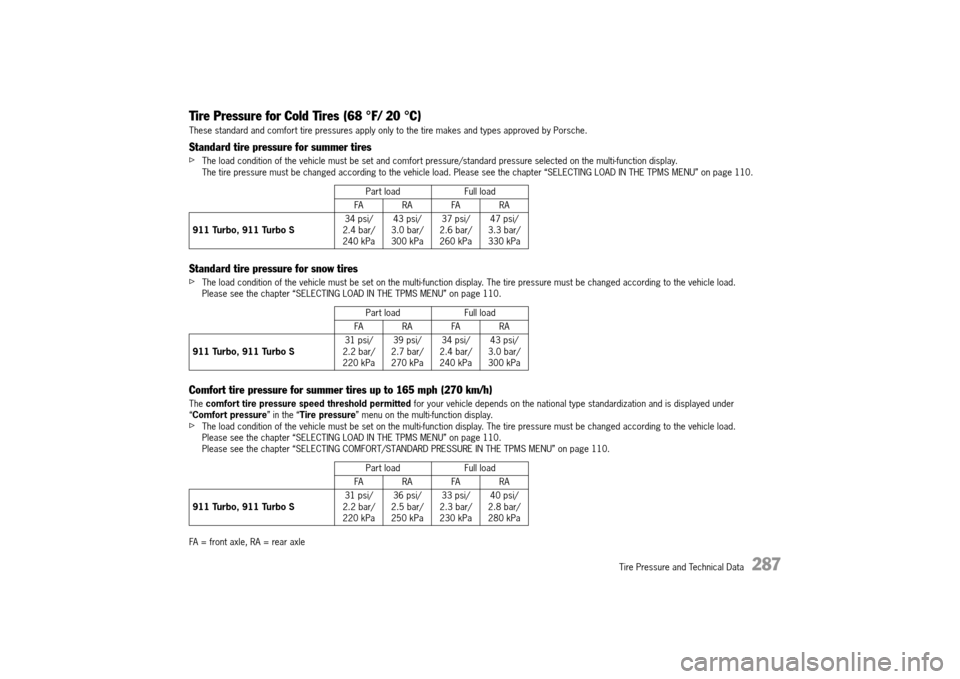
Tire Pressure for Cold Tires (68 °F/ 20 °C)
These standard and comfort tire pressures apply only to the tire makes and types approved by Porsche.
Standard tire pressure for summer tires
fThe load condition of the vehicle must be set and comfort pressure/standard pressure selected on the multi-function display. The tire pressure must be changed according to the vehicle load. Please see the chapter “SELECTING LOAD IN THE TPMS MENU” on page 110.
Standard tire pressure for snow tires
fThe load condition of the vehicle must be set on the multi-function display. The tire pressure must be changed according to the vehicle load. Please see the chapter “SELECTING LOAD IN THE TPMS MENU” on page 110.
Comfort tire pressure for summer tires up to 165 mph (270 km/h)
The comfort tire pressure speed threshold permitted for your vehicle depends on the national type standardization and is displayed under “Comfort pressure” in the “Tire pressure” menu on the multi-function display.fThe load condition of the vehicle must be set on the multi-function display. The tire pressure must be changed according to the vehicle load. Please see the chapter “SELECTING LOAD IN THE TPMS MENU” on page 110.Please see the chapter “SELECTING COMFORT/STANDARD PRESSURE IN THE TPMS MENU” on page 110.
FA = front axle, RA = rear axle
Part load Full load
FA R A FA R A
911 Turbo, 911 Turbo S34 psi/2.4 bar/240 kPa
43 psi/3.0 bar/300 kPa
37 psi/2.6 bar/260 kPa
47 psi/3.3 bar/330 kPa
Part loadFull load
FA R A FA R A
911 Turbo, 911 Turbo S31 psi/2.2 bar/220 kPa
39 psi/2.7 bar/270 kPa
34 psi/2.4 bar/240 kPa
43 psi/3.0 bar/300 kPa
Part loadFull load
FA R A FA R A
911 Turbo, 911 Turbo S31 psi/2.2 bar/220 kPa
36 psi/2.5 bar/250 kPa
33 psi/2.3 bar/230 kPa
40 psi/2.8 bar/280 kPa
Reifendruck_TechnischeDaten.fm Seite 287 Mittwoch, 9. April 2014 3:12 15