brake pads PORSCHE 911 TURBO 2014 6.G Owners Manual
[x] Cancel search | Manufacturer: PORSCHE, Model Year: 2014, Model line: 911 TURBO, Model: PORSCHE 911 TURBO 2014 6.GPages: 300, PDF Size: 10.61 MB
Page 5 of 300
3
The reduced tire tread depth means that there is an increased risk of aquaplaning on wet roads. fWhen driving on wet or mud-covered roads reduce speed significantly.
Sport tires have a smaller tread depth, and thus can reach their wear limit sooner.It is important to check tire wear frequently to avoid risk of serious personal injury or death from worn tires.fCheck tire wear frequently.
Driving on Race Circuit
(e.g. Sports Driving Schools, Club
Sport Events)
Brake fluid, brake pads and brake disks
Brake fluid absorbs moisture from the air over time. This accumulation of water lowers the boiling point and can impair braking action if the brakes are subjected to high temperatures, such as can occur on race circuits (sports driving school, Club Sport events).
The brake fluid should therefore not be more than 12 months old if the vehicle is driven on race circuits (sports driving school, Club Sport events).fFor more information, see the “ Maintenance” booklet.
Wear on the brake pads and brake disks depends to a great extent on the driving style and driving conditions. Wear on the brake components is increased as a result of high temperatures, such as can occur on race circuits (sports driving school, Club Sport events). fBefore and after driving on race circuits (e.g. sports driving school, Club Sport events), it is important therefore to carry out a professional inspection of the brake pads and brake disks for wear.
Racing tires
The fitting of racing tires (e.g. slicks) for sporting events is not approved by Porsche.Very high cornering speeds can be achieved with racing tires. The resulting transverse acceleration values would jeopardize the adequate supply of oil to the engine.Porsche therefore refuses to accept any guarantee or liability for damage occurring as a result of non-compliance with this provision.
Setting and operating vehicle
components when driving
Setting or operating the multi-function display, radio, navigation system, telephone or other equipment when driving could distract you from the traffic. You could lose control of the vehicle resulting in serious personal injury or death.fOperate the components while driving only if the traffic situation allows you to do so safely.fCarry out any complicated operating or setting procedures only with the vehicle stationary.
Loss of Road Surface Contact, Control over the Vehicle and Braking Ability
Worn Tires
DANGERh
DANGERh
Operating Components While Driving
WARNINGh
14_991_Turbo_21.book Seite 3 Mittwoch, 9. April 2014 2:19 14
Page 6 of 300
4
Engine Exhaust
Engine exhaust is dangerous if inhaled. Engine exhaust fumes have many components which you can smell. They also contain carbon monoxide (CO), which is a colorless and odorless gas.Carbon monoxide can cause unconsciousness and even death if inhaled.fNever start or let the engine run in an en-closed, unventilated area.It is not recommended to sit in your car for prolonged periods with the engine on and the car not moving.
Engine exhaust, some of its constituents, and certain vehicle components contain or emit chemicals known to the State of California to cause cancer and birth defects or other reproductive harm.In addition, certain fluids contained in vehicles and certain products of component wear contain or emit chemicals known to the State of California to cause cancer and birth defects or other reproductive harm.
Hot Exhaust Pipes
The exhaust pipe is hot when the vehicle is running and remains hot for some time after the vehicle is turned off.fTo prevent injury, make a point of noting where your vehicle’s exhaust pipe is, avoid placing your legs near the exhaust pipe, and closely supervise children around the vehicle during time when the exhaust pipe could be hot.A hot exhaust pipe can cause serious burns.
Portable Fuel Containers
Portable fuel containers may leak, whether they are full or partially empty. Fuel leaking from a portable container carried in your vehicle could, in case of an accident, cause a fire or explosion.fNever carry additional fuel in portable containers in your vehicle.
Ground Clearance
Risk of damage to the vehicle due to lower ground clearance.
The vehicle may touch the ground as a result of reduced ground clearance.fDrive carefully and slowly on steep slopes (e. g. parking lots, curbs, uneven roads, lifting platforms etc.).fAvoid steep ramps.
Porsche Ceramic Composite Brake
(PCCB)
fPlease see the chapter “BRAKES” on page 152.
The high-performance brake system is designed for optimal braking effect at all speeds and temperatures.Certain speeds, braking forces and ambient conditions (such as temperature and humidity) therefore might cause brake noises.
Wear on the different components and braking system, such as brake pads and brake disks, depends to a great extent on the individual driving style and the conditions of use and therefore cannot be expressed in actual miles on the road.
The values communicated by Porsche are based on normal operation adapted to traffic. Wear increases considerably when the vehicle is driven on race tracks or through an aggressive driving style.fPlease consult an authorized Porsche dealer about the current guidelines in effect before such use of your vehicle.
Engine Exhaust Inhalation
California Proposition 65
DANGERh
WARNINGh
Hot Exhaust Pipes
Portable Fuel Container Leaks
WARNINGh
DANGERh
NOTICE
14_991_Turbo_21.book Seite 4 Mittwoch, 9. April 2014 2:19 14
Page 8 of 300
6
On the road…
fNever drive after you have consumed alcohol or drugs.fAlways have your safety belt fastened.fAlways drive defensively. Expect the unexpected.fUse signals to indicate turns and lane changes.fTurn on headlights at dusk or when the driving conditions warrant it.fAlways keep a safe distance from the vehicle in front of you, depending on traffic, road and weather conditions.fReduce speed at night and during inclement weather.Driving in wet weather requires caution and reduced speeds, particularly on roads with standing water, as the handling characteristics of the vehicle may be impaired due to hydro-planing of the tires.fAlways observe speed limits and obey road signs and traffic laws.fWhen tired, get well off the road, stop and take a rest. Turn the engine off. Do not sit in the vehicle with engine idling. Please see the chapter “ENGINE EXHAUST” on page 4.fWhen parked, always put the electric parking brake on and put the PDK selector lever in position P. On hills also turn the front wheels toward the curb.fWhen emergency repairs become necessary, move the vehicle well off the road. Turn on the emergency flasher and use other warning devices to alert other motorists. Do not park or operate the vehicle in areas where the hot exhaust system may come in contact with dry
grass, brush, spilled fuel or other flammable material.fMake it a habit to check the engine oil with every refueling.
Break in hints for the first
2,000 miles (3,000 kilometers)
The following tips will be helpful in obtaining optimum performance from your new Porsche.
Despite the most modern, high-precision manufacturing methods, the moving parts must still wear in with each other. This wearing-in occurs mainly in the first 2,000 miles (3,000 km).
Therefore:
fPreferably take longer trips.fAvoid frequent cold starts with short-distance driving whenever possible.fAvoid full throttle starts and abrupt stops.fDo not exceed maximum engine speed of 4,200 rpm (revolutions per minute).fDo not run a cold engine at high rpm either in Neutral or in gear.fDo not let the engine labor, especially when driving uphill. Shift to the next lower gear in time (use the most favorable rpm range).fNever lug the engine in high gear at low speeds. This rule applies at all times, not just during the break-in period.fDo not participate in motor racing events, sports driving schools, etc. during the first 2,000 miles (3,000 kilometers).
There may be a slight stiffness in the steering, gear-shifting or other controls during the break-in period which will gradually disappear.
Break in brake pads and brake disks
New brake pads and disks have to be ”broken in“, and therefore only attain optimal friction when the car has covered several hundred miles or km.The slightly reduced braking ability must be compensated for by pressing the brake pedal harder. This also applies whenever the brake pads and brake disks are replaced.
New tires
New tires do not have maximum traction. They tend to be slippery.fBreak in new tires by driving at moderate speeds during the first 60 to 120 miles (100 to 200 km). Longer braking distances must be anticipated.
Engine oil and fuel consumption
During the break-in period oil and fuel consump-tion may be higher than normal.
As always, the rate of oil consumption depends on the quality and viscosity of oil, the speed at which the engine is operated, the climate and road conditions, as well as the amount of dilution and oxidation of the lubricant.fMake a habit of checking engine oil with every refueling, add if necessary.
14_991_Turbo_21.book Seite 6 Mittwoch, 9. April 2014 2:19 14
Page 134 of 300
132 Instrument Panel and Multi-Function Display
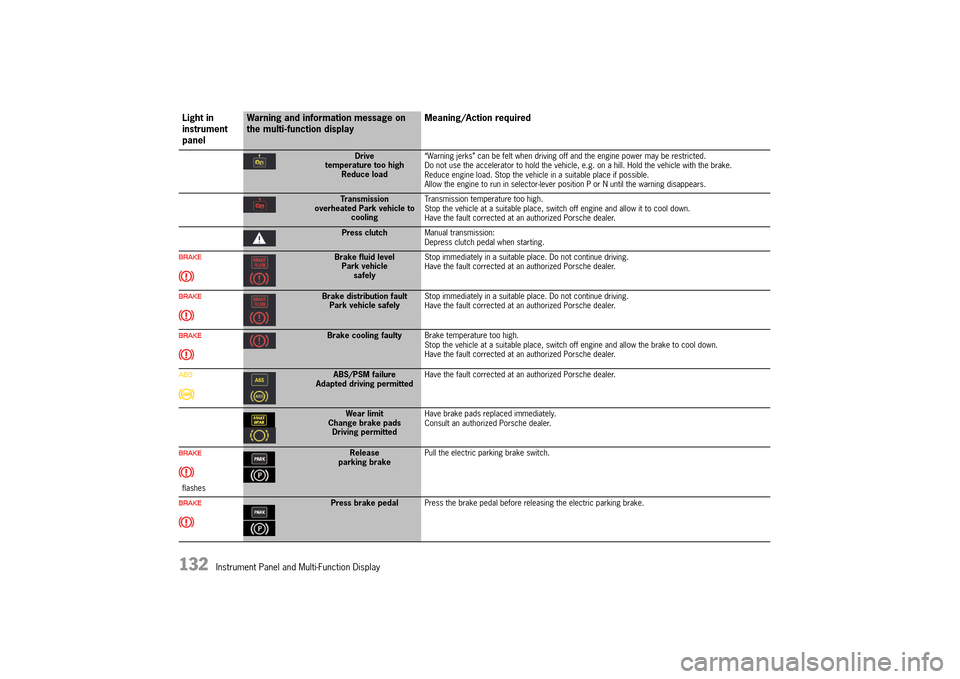
Drive temperature too highReduce load
“Warning jerks” can be felt when driving off and the engine power may be restricted. Do not use the accelerator to hold the vehicle, e.g. on a hill. Hold the vehicle with the brake.Reduce engine load. Stop the vehicle in a suitable place if possible.Allow the engine to run in selector-lever position P or N until the warning disappears.
Transmission overheated Park vehicle to cooling
Transmission temperature too high. Stop the vehicle at a suitable place, switch off engine and allow it to cool down.Have the fault corrected at an authorized Porsche dealer.
Press clutch Manual transmission: Depress clutch pedal when starting.
Brake fluid level Park vehiclesafely
Stop immediately in a suitable place. Do not continue driving. Have the fault corrected at an authorized Porsche dealer.
Brake distribution fault Park vehicle safely Stop immediately in a suitable place. Do not continue driving. Have the fault corrected at an authorized Porsche dealer.
Brake cooling faulty Brake temperature too high. Stop the vehicle at a suitable place, switch off engine and allow the brake to cool down.Have the fault corrected at an authorized Porsche dealer.
ABS/PSM failure Adapted driving permitted Have the fault corrected at an authorized Porsche dealer.
Wear limit Change brake padsDriving permitted
Have brake pads replaced immediately. Consult an authorized Porsche dealer.
flashes
Release parking brake Pull the electric parking brake switch.
Press brake pedal Press the brake pedal before releasing the electric parking brake.
Light in instrument panel
Warning and information message on the multi-function display Meaning/Action required
14_991_Turbo_21.book Seite 132 Mittwoch, 9. April 2014 2:19 14
Page 156 of 300
154 Driving and Driving Safety
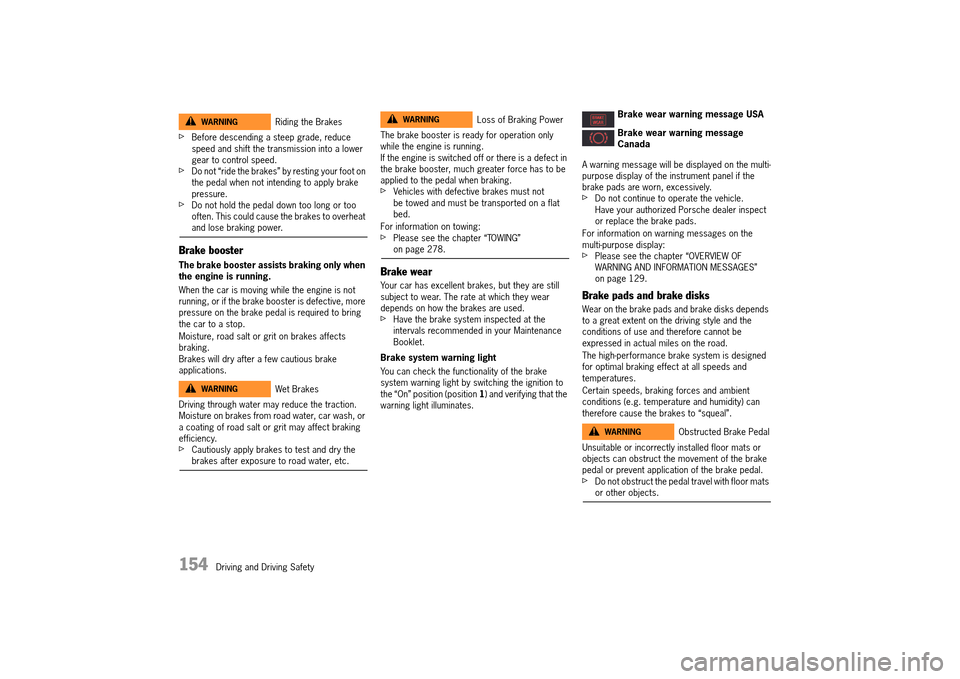
fBefore descending a steep grade, reduce speed and shift the transmission into a lower gear to control speed. fDo not “ride the brakes” by resting your foot on the pedal when not intending to apply brake pressure.fDo not hold the pedal down too long or too often. This could cause the brakes to overheat and lose braking power.
Brake booster
The brake booster assists braking only when the engine is running.
When the car is moving while the engine is not running, or if the brake booster is defective, more pressure on the brake pedal is required to bring the car to a stop.
Moisture, road salt or grit on brakes affects braking. Brakes will dry after a few cautious brake applications.
Driving through water may reduce the traction. Moisture on brakes from road water, car wash, or a coating of road salt or grit may affect braking efficiency.fCautiously apply brakes to test and dry the brakes after exposure to road water, etc.
The brake booster is ready for operation only while the engine is running. If the engine is switched off or there is a defect in the brake booster, much greater force has to be applied to the pedal when braking. fVehicles with defective brakes must not be towed and must be transported on a flat bed.
For information on towing:fPlease see the chapter “TOWING” on page 278.
Brake wear
Your car has excellent brakes, but they are still subject to wear. The rate at which they wear depends on how the brakes are used.fHave the brake system inspected at the intervals recommended in your Maintenance Booklet.
Brake system warning light
You can check the functionality of the brake system warning light by switching the ignition to the “On” position (position 1) and verifying that the warning light illuminates.
A warning message will be displayed on the multi- purpose display of the instrument panel if the brake pads are worn, excessively.fDo not continue to operate the vehicle.Have your authorized Porsche dealer inspect or replace the brake pads.
For information on warning messages on the multi-purpose display:fPlease see the chapter “OVERVIEW OF WARNING AND INFORMATION MESSAGES” on page 129.
Brake pads and brake disks
Wear on the brake pads and brake disks depends to a great extent on the driving style and the conditions of use and therefore cannot be expressed in actual miles on the road.
The high-performance brake system is designed for optimal braking effect at all speeds and temperatures.
Certain speeds, braking forces and ambient conditions (e.g. temperature and humidity) can therefore cause the brakes to “squeal”.
Unsuitable or incorrectly installed floor mats or objects can obstruct the movement of the brake pedal or prevent application of the brake pedal.fDo not obstruct the pedal travel with floor mats or other objects.
Riding the Brakes
Wet Brakes
WARNINGh
WARNINGh
Loss of Braking PowerWARNINGhBrake wear warning message USA
Brake wear warning message Canada
Obstructed Brake PedalWARNINGh
14_991_Turbo_21.book Seite 154 Mittwoch, 9. April 2014 2:19 14
Page 157 of 300
Driving and Driving Safety 155
In heavy rain, while driving through water or after leaving a car wash, the braking action may be delayed and increased pressure may be required.fFor this reason, keep further back from the vehicle in front and “dry” the brakes by applying them at intervals. Make sure that the traffic behind you is not affected.
After a long drive over salted or gritted roads, a coating may form on the brake disks and pads that significantly reduces friction and therefore also braking effect.fEven though the brake disks consist of alloyed gray cast iron, they will unavoidably start to corrode if your vehicle is parked for an extended period. The brakes will tend to “rub” as a result.The nature, extent and effects of corrosion depend on the amount of time the vehicle was parked, whether road salt or grit was spread and whether grease-dissolving agents were used in car washes (not on vehicles with Porsche Ceramic Composite Brake).To prevent corrosion of the brake disks, “brake them dry” before parking the vehicle (not on vehicles with Porsche Ceramic Composite Brake).If braking comfort is noticeably impaired, we recommend that you have the brake system checked by experts at an authorized Porsche dealer.
fTo relieve the brake system on downhill stretches, change down to a lower gear in good time (engine braking).If engine braking is insufficient on steep stretches, operate the footbrake at intervals. Avoid continuous braking as it overheats the brakes and reduces the braking effect.
For information on brake fluid and checking the brake fluid level:fPlease see the chapter “BRAKE FLUID” on page 243.
New brake pads or linings
New brake pads have to be “broken in”, and therefore only attain optimal friction when the car has covered several hundred miles or km.The slightly reduced braking ability must be compensated for by pressing the brake pedal harder. This applies whenever the brake pads and/or brake disks are replaced.
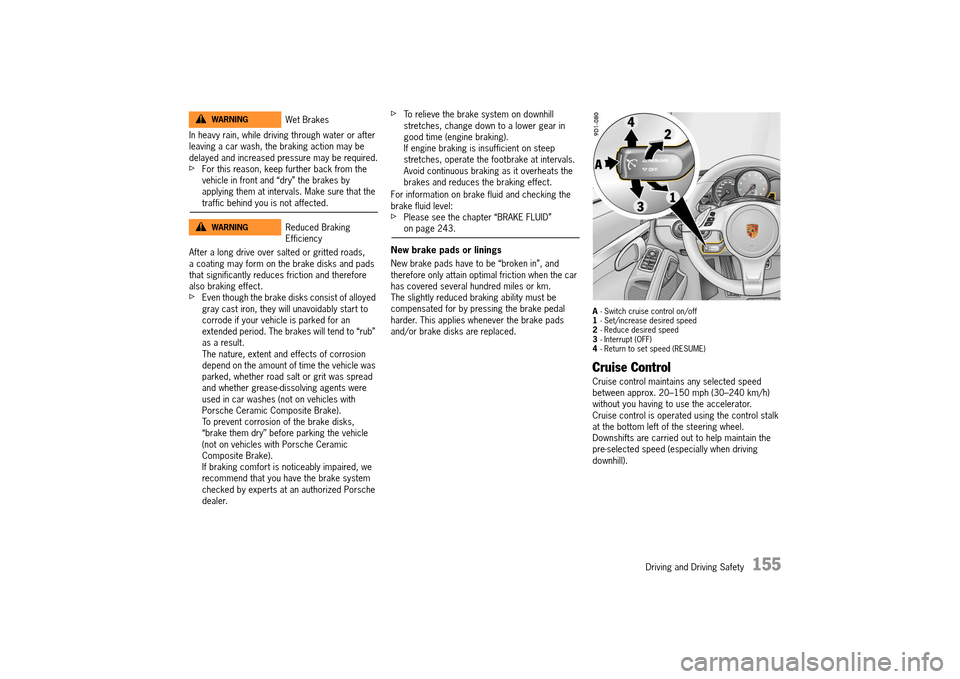
A - Switch cruise control on/off 1 - Set/increase desired speed 2 - Reduce desired speed 3 - Interrupt (OFF) 4 - Return to set speed (RESUME)
Cruise Control
Cruise control maintains any selected speed between approx. 20–150 mph (30–240 km/h) without you having to use the accelerator.Cruise control is operated using the control stalk at the bottom left of the steering wheel.Downshifts are carried out to help maintain the pre-selected speed (especially when driving downhill).
Wet Brakes
Reduced Braking Efficiency
WARNINGh
WARNINGh
14_991_Turbo_21.book Seite 155 Mittwoch, 9. April 2014 2:19 14
Page 183 of 300
Driving and Driving Safety 181
Porsche Stability Management
(PSM)
PSM is an active control system for stabilization of the vehicle during extreme driving maneuvers.
PSM makes use of both the automatic brake differential (ABD) and anti-slip regulation (ASR) systems, as well as the functions of the anti-lock brake system (ABS) and engine drag torque control system (MSR).
In spite of the advantages of PSM, it is still the driver’s responsibility to adapt his driving style and maneuvers in line with road and weather conditions, as well as the traffic situation.
The increased safety that is provided should not induce you to take greater risks with your safety. The limits set by the physics of driving cannot be overcome, even with PSM.Risk of accidents due to inappropriate speed cannot be reduced by PSM.
Advantages of PSM
– Best possible traction and lane-holding ability in all driving situations – even on road surfaces with varying friction.– The system compensates for undesired vehicle reactions (Ferraria effect) when the driver releases the accelerator pedal or brakes on bends. This compensation functions up to the maximum lateral acceleration.– PSM actively helps to stabilize the vehicle if necessary during dynamic driving maneuvers (e.g. rapid steering movements, during lane changes, or on alternating bends).
– Improved braking stability on bends and on different or varying road surfaces.– Improved brake function and shorter stopping distance in the event of emergency braking.
Readiness for operation
PSM is switched on automatically every time you start the engine.
Function
Sensors at the wheels, brakes, steering system and engine continuously measure:– Speed– Direction of travel (steering angle)– Lateral acceleration– Axial acceleration– Rate of turn about the vertical axis
PSM uses these values to determine the direction of travel desired by the driver.PSM intervenes and corrects the course if the actual direction of motion deviates from the desired course (steering-wheel position):It brakes individual wheels as required. If necessary, PSM also influences the engine power or the gear-changing characteristic of Porsche Doppelkupplung (PDK) in order to stabilize the vehicle.
The events below inform the driver of PSM control operations and warn him to adapt his driving style to the road conditions:– PSM warning light on the instrument panel flashes.– Hydraulic noises can be heard.– The vehicle decelerates and steering-wheel forces are altered as PSM controls the brakes.– Reduced engine power.– The brake pedal pulsates and its position is changed during braking.In order to achieve full vehicle deceleration, foot pressure must be increased after the brake pedal has begun vibrating.
Examples of PSM control operations
– If the “front wheels of the vehicle drift” on a bend, the engine power is reduced and the rear wheel on the inside of the bend is braked if necessary.– If the rear of the vehicle swings out on a bend, the front wheel on the outside of the bend is braked.– Brake system prefilling:The brake system is prepared for possible subsequent emergency braking if the accelerator pedal is released suddenly and quickly. The brake system is prefilled and the brake pads are already applied gently to the brake disks.– Brake booster (Hydraulic Brake Assist):In the event of an emergency braking operation where the pedal force is insufficient, a brake booster provides the braking pressure necessary for maximum deceleration at all 4 wheels.
Loss of control over the vehicleWARNINGh
14_991_Turbo_21.book Seite 181 Mittwoch, 9. April 2014 2:19 14
Page 293 of 300
Index 291
Changing in car key ..........................................275 Charging..........................................................274Emergency starting with jumper cables ..............273General information ..........................................271Installation position ...........................................271Procedure after connection ...............................273Replacing ........................................................272Vehicle electrical system warning ........................95Winter driving...................................................272Before driving off .............................................................5BeltsCare instructions ..............................................237Fastening ..........................................................37Opening belt buckle ............................................38Safety-belt pretensioners, functional description ...37Warning light on the tachometer ..........................37 Brake booster .............................................................154Brake disks .....................................................................3Brake fluid ......................................................................3 Changing .........................................................243Warning light on speedometer ...........................243Brake pads .....................................................................3Breaking in new brake pads ..................................6Warning message, brakes.................................154Brake pedal ................................................................153Brake wear Warning message.............................................154 BrakesApplying/releasing parking brake.......................151Brake pad warning message .............................154Brake pedal .....................................................153Brake wear warning message ...........................154Break in new brake pads.......................................6Footbrake ........................................................152Test stand ...............................................221, 241Break in hints ..................................................................6Breaking inEngine .................................................................6Engine oil and fuel consumption during break-in period .....................................................6Hints ...................................................................6New brake pads and brake disks ...........................6New tires .............................................................6Brief overviewOpening and locking the vehicle from outside .......19
CCabrioletClosing convertible top .......................................69Convertible top care .........................................233Emergency operation .........................................70
Engine compartment lid ..................................... 26 Opening convertible top ..................................... 68Roll-over protection ............................................ 48Car careAirbags ........................................................... 237Alcantara ........................................................ 237Alloy wheels .................................................... 235Fabric linings ................................................... 237Headlights, plastic components, adhesive foils... 235Leather ........................................................... 236Leather care for seats with seat ventilation ........ 236Paint ............................................................... 234Safety belts ..................................................... 237Seals .............................................................. 236Underbody protection ...................................... 235Use of high-pressure cleaning equipment ........... 232Washing the vehicle, instructions....................... 232Wheel attachment faces ................................... 257Wheel bolts ..................................................... 257Windows ......................................................... 234Car key (remote control)Changing battery ............................................. 275Emergency operation of key/control unit in ignition lock....................................................... 28Locking vehicle door .......................................... 22Unlocking vehicle door ....................................... 21 Car Telephone............................................................. 169Care instructions Airbags ........................................................... 237Alcantara ........................................................ 237Alloy wheels .................................................... 235Car washing .................................................... 232Carpet ............................................................ 236Fabric linings ................................................... 237Headlights, plastic components, adhesive foils... 235Leather ........................................................... 236Leather care for seats with seat ventilation ........ 236Mats ............................................................... 236Paint ............................................................... 234Radar sensor................................................... 235Safety belts ..................................................... 237Seals .............................................................. 236Ultrasound sensors, ParkAssist......................... 235Underbody protection ...................................... 235Use of high-pressure cleaning equipment ........... 232Wheel attachment faces ................................... 257Wheel bolts ..................................................... 257Windows ......................................................... 234Carpet, care instructions ............................................. 236Catalytic converter ...................................................... 226Emission control (Check Engine) ......................... 95
Center armrest Opening front oddments tray .............................194Central bolt tightening torque (wheels) ...........................262Central locking ......................................................23, 258Emergency operation in the event of a fault ..........29Locking vehicle door with car key (remote control) .................................................22Locking vehicle door with Porsche Entry & Drive...22Opening and locking vehicle door from inside .......23Unlocking vehicle door with car key(remote control) .................................................21Unlocking vehicle door with Porsche Entry & Drive ........................................21 Central locking system Functional description .........................................18Changing button assignment on multi-function steering wheel..........................................................................127Changing car key (remote control) battery .....................275Changing wheels .........................................................254Chassis control systemsOverview (PTM, PSM, PASM, PDCC, PTV Plus) ....179Chassis number, position .............................................284Chassis setupFunctional description .......................................185Selecting .........................................................186Check Engine (emission control) Functional description .........................................95Warning light ......................................................95 Checking pressure .......................................................256Child restraint anchorages..............................................47Child restraint systemInstalling with LATCH system ...............................46LATCH restraint system ......................................46Child seatInstalling with LATCH system ...............................46LATCH restraint system ......................................46Prescribed installation direction (depending onweight of child)...................................................43 Child seat bracket .........................................................46Chrono .......................................................................114Cigarette Lighter .........................................................196Cleaning the air deflector ...............................................67Clock ..................................................................114, 124Closing Locking vehicle door from inside .........................23Persons/animals remaining in the vehicle .............22Vehicle door with car key (remote control) ............22Vehicle door with Porsche Entry & Drive (keyless) .22Closing convertible top ..................................................69Coasting .....................................................................150Coasting mode ................................................174
14_991_Turbo_21.book Seite 291 Mittwoch, 9. April 2014 2:19 14