differential PORSCHE 911 TURBO 2014 6.G Owners Manual
[x] Cancel search | Manufacturer: PORSCHE, Model Year: 2014, Model line: 911 TURBO, Model: PORSCHE 911 TURBO 2014 6.GPages: 300, PDF Size: 10.61 MB
Page 110 of 300
108 Instrument Panel and Multi-Function Display
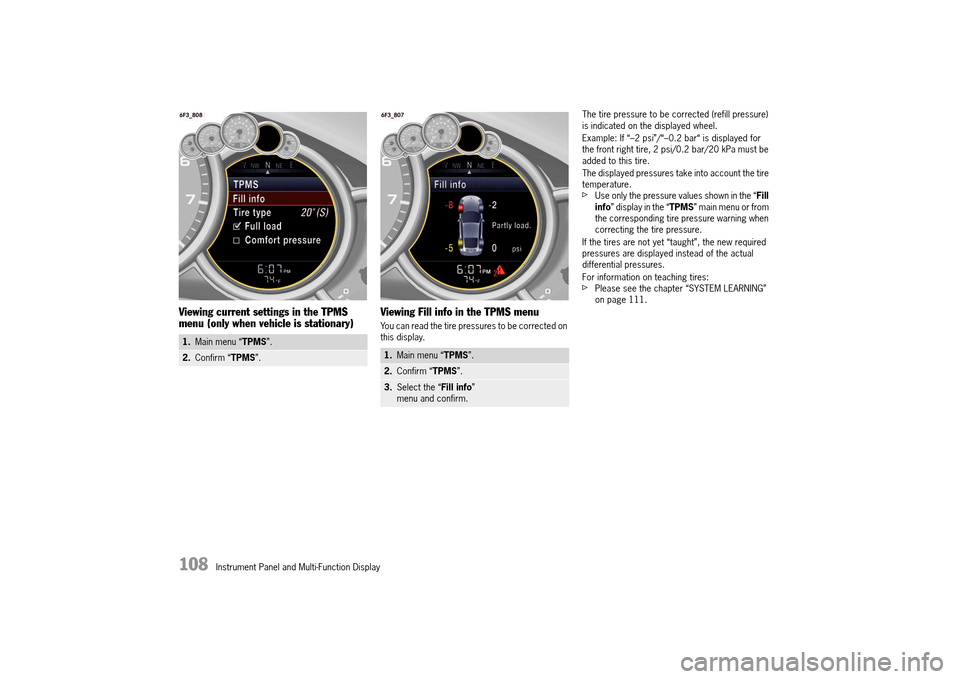
Viewing current settings in the TPMS menu (only when vehicle is stationary) Viewing Fill info in the TPMS menu
You can read the tire pressures to be corrected on this display.
The tire pressure to be corrected (refill pressure) is indicated on the displayed wheel.
Example: If “–2 psi”/“–0.2 bar“ is displayed for the front right tire, 2 psi/0.2 bar/20 kPa must be added to this tire.
The displayed pressures take into account the tire temperature.fUse only the pressure values shown in the “ Fill info ” display in the “TPMS” main menu or from the corresponding tire pressure warning when correcting the tire pressure.
If the tires are not yet “taught”, the new required pressures are displayed instead of the actual differential pressures.
For information on teaching tires:fPlease see the chapter “SYSTEM LEARNING” on page 111.
1. Main menu “TPMS”.
2.Confirm “TPMS”.1.Main menu “TPMS”.
2.Confirm “TPMS”.
3.Select the “Fill info” menu and confirm.
14_991_Turbo_21.book Seite 108 Mittwoch, 9. April 2014 2:19 14
Page 113 of 300
Instrument Panel and Multi-Function Display 111
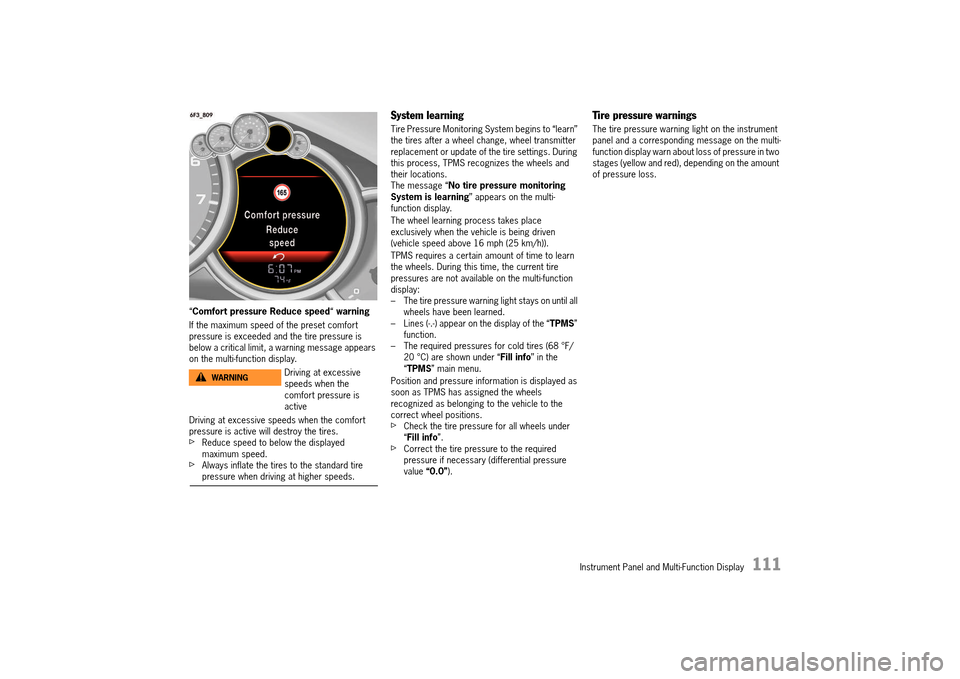
“Comfort pressure Reduce speed“ warning
If the maximum speed of the preset comfort pressure is exceeded and the tire pressure is below a critical limit, a warning message appears on the multi-function display.
Driving at excessive speeds when the comfort pressure is active will destroy the tires.fReduce speed to below the displayed maximum speed.fAlways inflate the tires to the standard tire pressure when driving at higher speeds.
System learning
Tire Pressure Monitoring System begins to “learn” the tires after a wheel change, wheel transmitter replacement or update of the tire settings. During this process, TPMS recognizes the wheels and their locations.The message “ No tire pressure monitoring System is learning ” appears on the multi- function display.
The wheel learning process takes place exclusively when the vehicle is being driven (vehicle speed above 16 mph (25 km/h)).
TPMS requires a certain amount of time to learn the wheels. During this time, the current tire pressures are not available on the multi-function display:– The tire pressure warning light stays on until all wheels have been learned.– Lines (-.-) appear on the display of the “ TPMS” function.– The required pressures for cold tires (68 °F/20 °C) are shown under “ Fill info” in the “ TPMS” main menu.
Position and pressure information is displayed as soon as TPMS has assigned the wheels recognized as belonging to the vehicle to the correct wheel positions.fCheck the tire pressure for all wheels under “ Fill info”.fCorrect the tire pressure to the required pressure if necessary (differential pressure value “0.0”).
Tire pressure warnings
The tire pressure warning light on the instrument panel and a corresponding message on the multi-function display warn about loss of pressure in two stages (yellow and red), depending on the amount of pressure loss.
Driving at excessive speeds when the comfort pressure is active
WARNINGh
14_991_Turbo_21.book Seite 111 Mittwoch, 9. April 2014 2:19 14
Page 114 of 300
112 Instrument Panel and Multi-Function Display
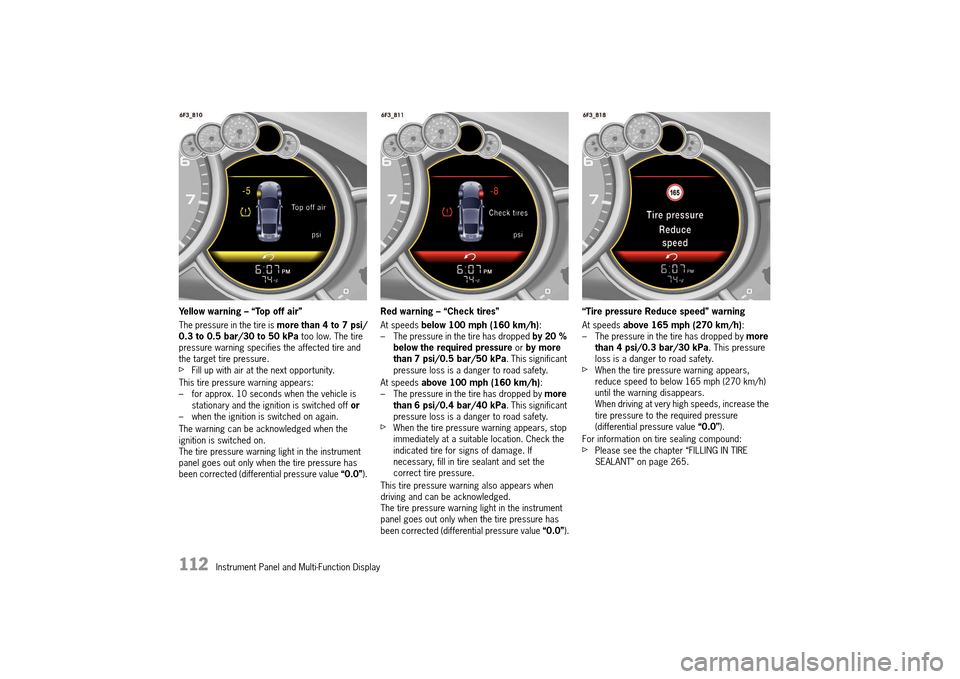
Yellow warning – “Top off air”
The pressure in the tire is more than 4 to 7 psi/ 0.3 to 0.5 bar/30 to 50 kPa too low. The tire pressure warning specifies the affected tire and the target tire pressure. fFill up with air at the next opportunity.
This tire pressure warning appears: – for approx. 10 seconds when the vehicle is stationary and the ignition is switched off or – when the ignition is switched on again.
The warning can be acknowledged when the ignition is switched on.The tire pressure warning light in the instrument panel goes out only when the tire pressure has been corrected (differential pressure value “0.0”).
Red warning – “Check tires”
At speeds below 100 mph (160 km/h): – The pressure in the tire has dropped by 20 % below the required pressure or by more than 7 psi/0.5 bar/50 kPa . This significant pressure loss is a danger to road safety.
At speeds above 100 mph (160 km/h): – The pressure in the tire has dropped by more than 6 psi/0.4 bar/40 kPa . This significant pressure loss is a danger to road safety.fWhen the tire pressure warning appears, stop immediately at a suitable location. Check the indicated tire for signs of damage. If necessary, fill in tire sealant and set the correct tire pressure.
This tire pressure warning also appears when driving and can be acknowledged. The tire pressure warning light in the instrument panel goes out only when the tire pressure has been corrected (differential pressure value “0.0”).
“Tire pressure Reduce speed” warning
At speeds above 165 mph (270 km/h): – The pressure in the tire has dropped by more than 4 psi/0.3 bar/30 kPa . This pressure loss is a danger to road safety.fWhen the tire pressure warning appears, reduce speed to below 165 mph (270 km/h) until the warning disappears.When driving at very high speeds, increase the tire pressure to the required pressure (differential pressure value “0.0”).
For information on tire sealing compound:fPlease see the chapter “FILLING IN TIRE SEALANT” on page 265.
14_991_Turbo_21.book Seite 112 Mittwoch, 9. April 2014 2:19 14
Page 138 of 300
136 Instrument Panel and Multi-Function Display
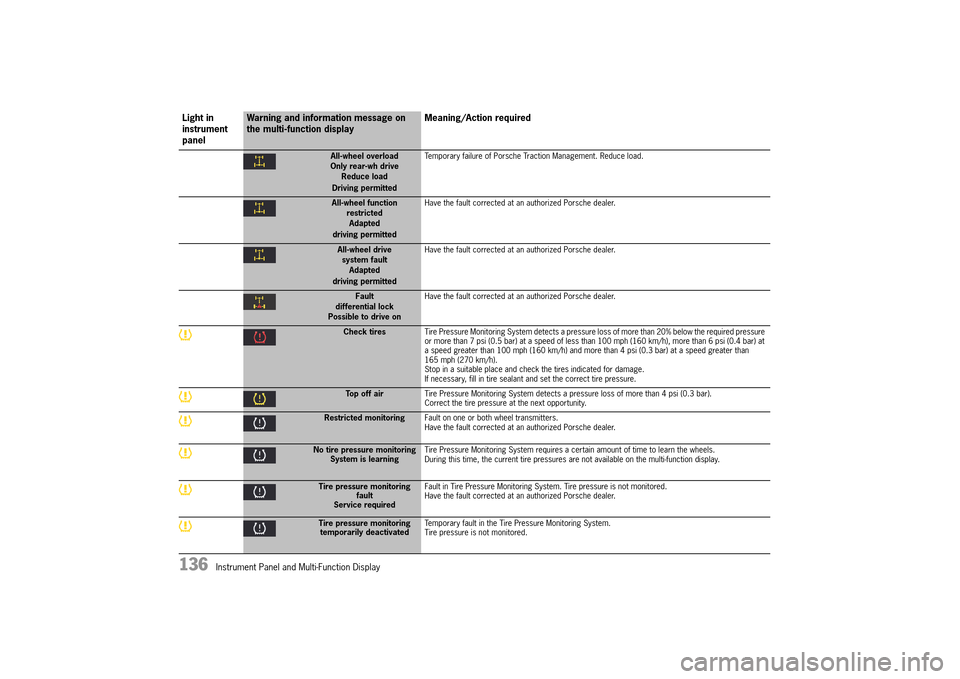
All-wheel overload Only rear-wh driveReduce load Driving permitted
Temporary failure of Porsche Traction Management. Reduce load.
All-wheel function restrictedAdapted driving permitted
Have the fault corrected at an authorized Porsche dealer.
All-wheel drive system faultAdapted driving permitted
Have the fault corrected at an authorized Porsche dealer.
Fault differential lockPossible to drive on
Have the fault corrected at an authorized Porsche dealer.
Check tires Tire Pressure Monitoring System detects a pressure loss of more than 20% below the required pressure or more than 7 psi (0.5 bar) at a speed of less than 100 mph (160 km/h), more than 6 psi (0.4 bar) at a speed greater than 100 mph (160 km/h) and more than 4 psi (0.3 bar) at a speed greater than 165 mph (270 km/h).Stop in a suitable place and check the tires indicated for damage.If necessary, fill in tire sealant and set the correct tire pressure.
Top off air Tire Pressure Monitoring System detects a pressure loss of more than 4 psi (0.3 bar). Correct the tire pressure at the next opportunity.
Restricted monitoring Fault on one or both wheel transmitters. Have the fault corrected at an authorized Porsche dealer.
No tire pressure monitoring System is learning Tire Pressure Monitoring System requires a certain amount of time to learn the wheels. During this time, the current tire pressures are not available on the multi-function display.
Tire pressure monitoring faultService required
Fault in Tire Pressure Monitoring System. Tire pressure is not monitored. Have the fault corrected at an authorized Porsche dealer.
Tire pressure monitoring temporarily deactivated Temporary fault in the Tire Pressure Monitoring System. Tire pressure is not monitored.
Light in instrument panel
Warning and information message on the multi-function display Meaning/Action required
14_991_Turbo_21.book Seite 136 Mittwoch, 9. April 2014 2:19 14
Page 181 of 300
Driving and Driving Safety 179
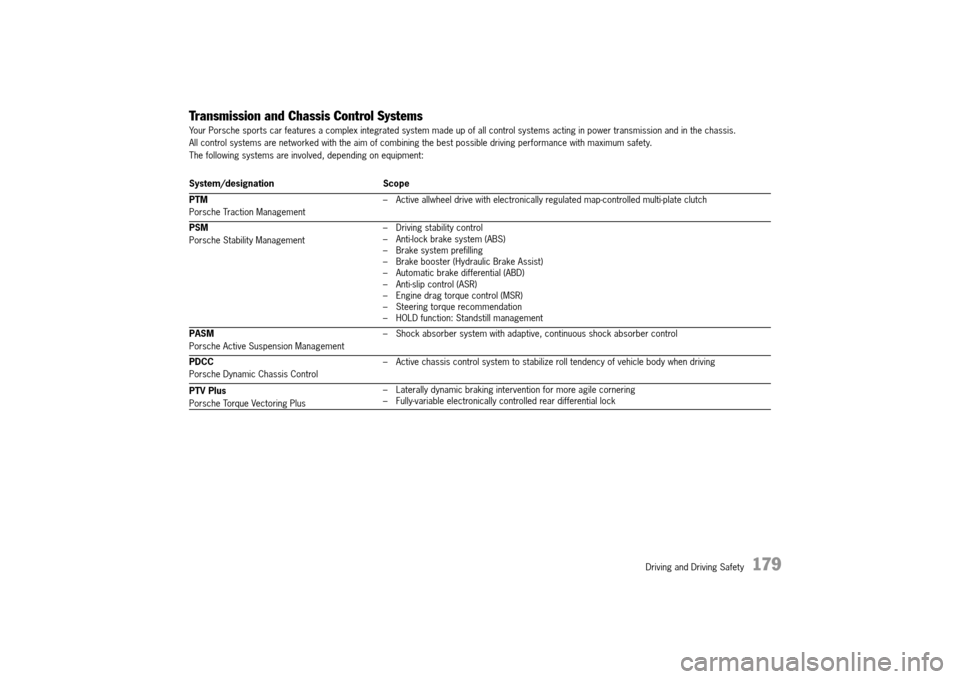
Transmission and Chassis Control Systems
Your Porsche sports car features a complex integrated system made up of all control systems acting in power transmission and in the chassis.
All control systems are networked with the aim of combining the best possible driving performance with maximum safety.
The following systems are involved, depending on equipment:
System/designation Scope
PTM
Porsche Traction Management
– Active allwheel drive with electronically regulated map-controlled multi-plate clutch
PSM
Porsche Stability Management
– Driving stability control – Anti-lock brake system (ABS)– Brake system prefilling– Brake booster (Hydraulic Brake Assist)– Automatic brake differential (ABD)– Anti-slip control (ASR)– Engine drag torque control (MSR)– Steering torque recommendation– HOLD function: Standstill management
PASM
Porsche Active Suspension Management
– Shock absorber system with adaptive, continuous shock absorber control
PDCC
Porsche Dynamic Chassis Control
– Active chassis control system to stabilize roll tendency of vehicle body when driving
PTV Plus
Porsche Torque Vectoring Plus
– Laterally dynamic braking intervention for more agile cornering – Fully-variable electronically controlled rear differential lock
14_991_Turbo_21.book Seite 179 Mittwoch, 9. April 2014 2:19 14
Page 183 of 300
Driving and Driving Safety 181
Porsche Stability Management
(PSM)
PSM is an active control system for stabilization of the vehicle during extreme driving maneuvers.
PSM makes use of both the automatic brake differential (ABD) and anti-slip regulation (ASR) systems, as well as the functions of the anti-lock brake system (ABS) and engine drag torque control system (MSR).
In spite of the advantages of PSM, it is still the driver’s responsibility to adapt his driving style and maneuvers in line with road and weather conditions, as well as the traffic situation.
The increased safety that is provided should not induce you to take greater risks with your safety. The limits set by the physics of driving cannot be overcome, even with PSM.Risk of accidents due to inappropriate speed cannot be reduced by PSM.
Advantages of PSM
– Best possible traction and lane-holding ability in all driving situations – even on road surfaces with varying friction.– The system compensates for undesired vehicle reactions (Ferraria effect) when the driver releases the accelerator pedal or brakes on bends. This compensation functions up to the maximum lateral acceleration.– PSM actively helps to stabilize the vehicle if necessary during dynamic driving maneuvers (e.g. rapid steering movements, during lane changes, or on alternating bends).
– Improved braking stability on bends and on different or varying road surfaces.– Improved brake function and shorter stopping distance in the event of emergency braking.
Readiness for operation
PSM is switched on automatically every time you start the engine.
Function
Sensors at the wheels, brakes, steering system and engine continuously measure:– Speed– Direction of travel (steering angle)– Lateral acceleration– Axial acceleration– Rate of turn about the vertical axis
PSM uses these values to determine the direction of travel desired by the driver.PSM intervenes and corrects the course if the actual direction of motion deviates from the desired course (steering-wheel position):It brakes individual wheels as required. If necessary, PSM also influences the engine power or the gear-changing characteristic of Porsche Doppelkupplung (PDK) in order to stabilize the vehicle.
The events below inform the driver of PSM control operations and warn him to adapt his driving style to the road conditions:– PSM warning light on the instrument panel flashes.– Hydraulic noises can be heard.– The vehicle decelerates and steering-wheel forces are altered as PSM controls the brakes.– Reduced engine power.– The brake pedal pulsates and its position is changed during braking.In order to achieve full vehicle deceleration, foot pressure must be increased after the brake pedal has begun vibrating.
Examples of PSM control operations
– If the “front wheels of the vehicle drift” on a bend, the engine power is reduced and the rear wheel on the inside of the bend is braked if necessary.– If the rear of the vehicle swings out on a bend, the front wheel on the outside of the bend is braked.– Brake system prefilling:The brake system is prepared for possible subsequent emergency braking if the accelerator pedal is released suddenly and quickly. The brake system is prefilled and the brake pads are already applied gently to the brake disks.– Brake booster (Hydraulic Brake Assist):In the event of an emergency braking operation where the pedal force is insufficient, a brake booster provides the braking pressure necessary for maximum deceleration at all 4 wheels.
Loss of control over the vehicleWARNINGh
14_991_Turbo_21.book Seite 181 Mittwoch, 9. April 2014 2:19 14
Page 184 of 300
182 Driving and Driving Safety
Combined operation of PSM and PTV Plus
In order to ensure optimum stabilization of the vehicle, the center differential lock is influenced when PSM interventions occur on vehicles with PTV Plus.
Combined operation of PSM and PTM
In order to ensure optimum stabilization of the vehicle, torque distribution between the front and rear wheels is adapted and the differential lock is influenced when PSM interventions occur on vehicles with PTV Plus.
In the event of a PTM fault, PSM cannot be switched off.If PSM is switched off, it is switched on again automatically.
Automatic brake differential (ABD)
The ABD system controls the front and rear axles separately. If one wheel of an axle starts to spin, it is braked so that the other wheel on the same axle can be driven.
ABD recognizes different driving states, and it features control strategies adapted to these states. In situations in which little propulsive power is required, such as when the vehicle moves off on a level gravel surface, traction control already becomes active at low engine speeds. If a large amount of propulsive power is required, e.g. when driving off on an uphill slope or for rapid acceleration, the ABD system is adapted accordingly.
Anti-slip control (ASR)
The anti-slip control system prevents the wheels from spinning by adjusting the engine power, thereby ensuring good lane-holding ability and stable handling.
Engine drag torque control (MSR)
In conditions of excessive slip, the engine drag torque control system prevents all driven wheels from locking up when the vehicle is overrunning. This is also the case for downshifts on a slippery road.
Steering torque pulse
The steering torque pulse provides the driver with steering assistance when braking on road surfaces with differing friction values.Additional steering forces also assist the driver during counter steering.
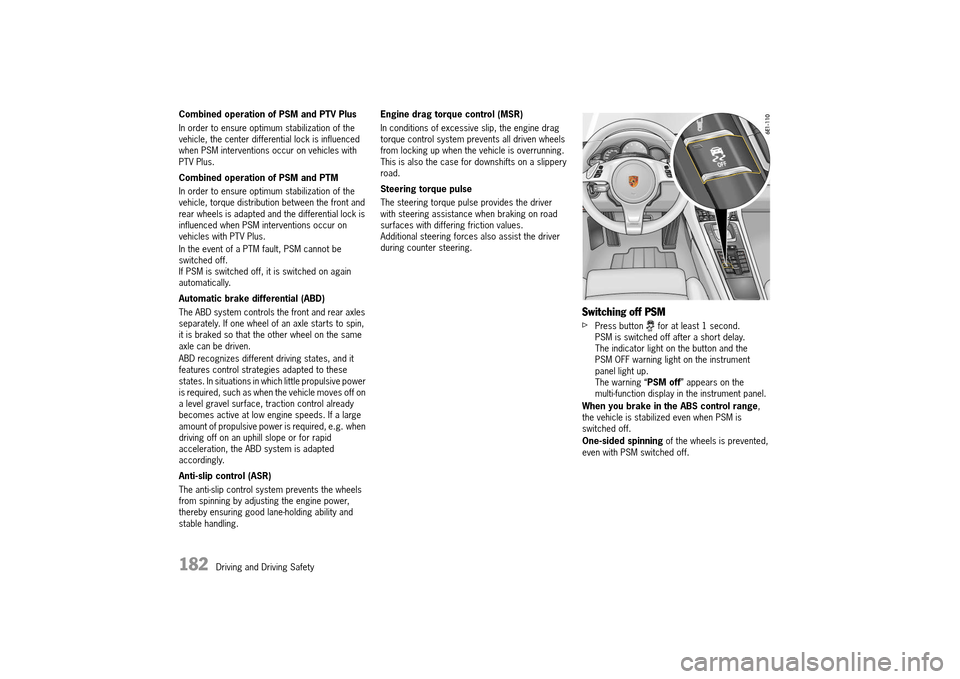
Switching off PSM
fPress button for at least 1 second.PSM is switched off after a short delay.The indicator light on the button and the PSM OFF warning light on the instrument panel light up.The warning “ PSM off” appears on the multi-function display in the instrument panel.
When you brake in the ABS control range , the vehicle is stabilized even when PSM is switched off.
One-sided spinning of the wheels is prevented, even with PSM switched off.
14_991_Turbo_21.book Seite 182 Mittwoch, 9. April 2014 2:19 14
Page 185 of 300
Driving and Driving Safety 183
When PSM is switched off, PSM support is no longer provided in critical driving situations outside the ABS control range. fPSM should always be switched on during “normal” driving.
However, it may be a good idea to switch off PSM temporarily in exceptional situations:– On a loose surface and in deep snow.– When “rocking the vehicle free”.
Information
The vehicle retains its enhanced braking readiness through prefilling of the brake system even when PSM is switched off.
When PSM is switched off, wheel-specific brake interventions and the anti-slip control system (ASR) are also switched off.The automatic brake differential (ABD) remains on.
Switching PSM back on
fPress button . PSM is active immediately.The indicator light on the button and the PSM OFF warning light on the instrument panel go out.The message “ PSM on” appears on the multi-function display in the instrument panel.
“Sport Plus” mode
A sportier setup is obtained when “ Sport Plus” mode is switched on.PSM interventions occur later than in Normal mode. The vehicle can be maneuvered with greater agility at its performance limits, without having to dispense with the assistance of PSM in emergency situations. This helps to achieve optimal lap times, particularly on race circuits and on a dry road surface.
PSM warning light
– The PSM warning light on the instrument panel lights up for a lamp check when the ignition is switched on.– The light indicates a control operation, even when PSM is switched off, e.g. brake control in the event of one-sided wheel spin.– The light – in conjunction with the multi-function display – indicates a fault.The warning message “ PSM failure Consult a workshop Adapted driving permitted ” appears on the multi-function display in the instrument panel.
For information on warning messages on the multi-function display:fPlease see the chapter “OVERVIEW OF WARNING AND INFORMATION MESSAGES” on page 129.fAdapt your driving style according to the changed conditions.fContact an authorized Porsche dealer.
Towing
For information on towing:fPlease see the chapter “TOWING” on page 278.
No PSM assistanceWARNINGh
14_991_Turbo_21.book Seite 183 Mittwoch, 9. April 2014 2:19 14
Page 188 of 300
186 Driving and Driving Safety
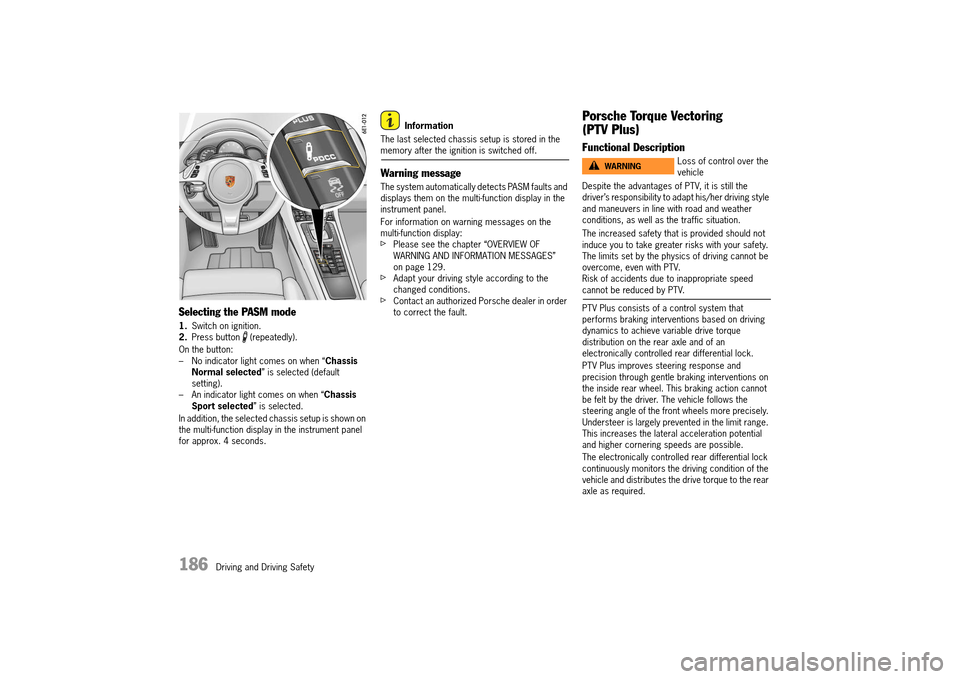
Selecting the PASM mode
1.Switch on ignition. 2. Press button (repeatedly).
On the button: – No indicator light comes on when “ Chassis Normal selected ” is selected (default setting).– An indicator light comes on when “ Chassis Sport selected ” is selected.
In addition, the selected chassis setup is shown on the multi-function display in the instrument panel for approx. 4 seconds.
Information
The last selected chassis setup is stored in the memory after the ignition is switched off.
Warning message
The system automatically detects PASM faults and displays them on the multi-function display in the instrument panel.
For information on warning messages on the multi-function display:fPlease see the chapter “OVERVIEW OF WARNING AND INFORMATION MESSAGES” on page 129.fAdapt your driving style according to the changed conditions.fContact an authorized Porsche dealer in order to correct the fault.
Porsche Torque Vectoring
(PTV Plus)
Functional Description
Despite the advantages of PTV, it is still the driver’s responsibility to adapt his/her driving style and maneuvers in line with road and weather conditions, as well as the traffic situation.
The increased safety that is provided should not induce you to take greater risks with your safety. The limits set by the physics of driving cannot be overcome, even with PTV.Risk of accidents due to inappropriate speed cannot be reduced by PTV.
PTV Plus consists of a control system that performs braking interventions based on driving dynamics to achieve variable drive torque distribution on the rear axle and of an electronically controlled rear differential lock.
PTV Plus improves steering response and precision through gentle braking interventions on the inside rear wheel. This braking action cannot be felt by the driver. The vehicle follows the steering angle of the front wheels more precisely. Understeer is largely prevented in the limit range. This increases the lateral acceleration potential and higher cornering speeds are possible.
The electronically controlled rear differential lock continuously monitors the driving condition of the vehicle and distributes the drive torque to the rear axle as required.
Loss of control over the vehicleWARNINGh
14_991_Turbo_21.book Seite 186 Mittwoch, 9. April 2014 2:19 14
Page 292 of 300
290 Index
Index
AA/C button Air-conditioning system .......................................56A/C MAX buttonAir-conditioning system .......................................56ABD (automatic brake differential)Functional description .......................................182ABS (anti-lock brake system)Functional description .......................................184Warning light on instrument panel ......................185ACCAdaptive cruise control .....................................157Active Safe (PAS)Settings in multi-purpose display........................128Adaptive cruise control ................................................157Display principle ...............................................160Exceptions.......................................................165Functional description .......................................157Interrupting/resuming control ............................164Operating principle ...........................................159Operating states ..............................................161Porsche Active Safe .........................................167Radar sensor ...................................................158Setting the desired distance ..............................162Setting/changing desired speed ........................161Switching on/off...............................................161 Adaptive light system, driving light assistant ....................79Adhesive foils, care instructions ....................................235Adjusting seat position ...................................................32Aftermarket Alarms......................................................169Air cleaner, maintenance instructions ............................244Air distribution ...............................................................58Air vents Adjusting ...........................................................59Opening/closing .................................................59AirbagAirbag warning light on the tachometer ................42Automatic deactivation of the passenger airbag....41Care instructions ..............................................237Disposal ............................................................39Function ............................................................39Functional description .........................................38Installation location .............................................38Passenger airbag warning light............................42Air-conditioning compressorInformation on air-conditioning compressor ..........55
Air-conditioning system Automatic load switch-off ................................... 55Extended ventilation panel .................................. 59Information on air-conditioning compressor.......... 55Setting air distribution ........................................ 58Setting air quantity............................................. 58Setting automatic air-recirculation mode .............. 57Setting temperature ........................................... 58Switching A/C MAX mode on/off ......................... 56Switching A/C mode on/off ................................ 56Switching air-conditioning compressor on/off....... 56Switching air-recirculation mode on and off .......... 57Temperature sensor ........................................... 55 Air-recirculation button Air-conditioning system ...................................... 57 Alarm button................................................................. 17Alarm system Avoiding false alarms ....................................... 217Functional description ...................................... 216Persons/animals remaining in the locked vehicle 216Switching off ................................................... 216Switching off interior surveillance and inclination sensor............................................. 216Switching on ................................................... 216 Alcantara, care instructions ......................................... 237Alloy wheels Care instructions ............................................. 235Inscription ....................................................... 253Allwheel driveFunctional description ...................................... 180Torque distribution ................................... 114, 116AlternatorVehicle electrical system warning ........................ 95 Aluminum rims Care instructions ............................................. 235Inscription ....................................................... 253 Ambient lighting ............................................................ 84Antifreeze in coolant ........................................................ 242In washer fluid ................................................. 224Anti-lock brake system (ABS)Functional description ...................................... 184Anti-slip control (ASR)Functional description ...................................... 182ArmrestOpening front oddments tray ............................ 194AshtrayEmptying ........................................................ 195
Opening .......................................................... 195 ASR (Anti-slip control) Functional description....................................... 182 Assigning MFS button (◊ )............................................. 127 Assistance systemsActive Safe (PAS) ............................................. 128Assistance when driving uphill Functional description....................................... 184 AudioTips ................................................................ 168 Audio interface, installation position .............................. 171AUTO (light switch) ........................................................ 79 Driving light assistant ......................................... 79 Auto Start Stop function Display ............................................................ 151Exceptions ...................................................... 149Operating principle ........................................... 149Preconditions................................................... 149Starting engine automatically ............................ 149Stopping engine automatically........................... 149Switching on and off................................. 150, 175 Automatic brake differential (ABD) Functional description....................................... 182Automatic Coming Home lights, courtesy lighting Entry function .................................................... 80Welcome Home function ..................................... 80 Automatic driving light assistant High Beam Assistant .......................................... 81 Automatic speed control (cruise control)Accelerating .................................................... 156Decelerating .................................................... 156Functional description....................................... 155Interrupting operation ....................................... 156Storing speed .................................................. 156Switching off ................................................... 157Switching on .................................................... 156 Automatic transmission................................................ 172AUX interface, installation position ................................ 171
BBaby seat Installing with LATCH system............................... 46LATCH restraint system ...................................... 46Prescribed installation direction (depending onweight of child) .................................................. 43BatteryCare ............................................................... 272
14_991_Turbo_21.book Seite 290 Mittwoch, 9. April 2014 2:19 14