transmission PORSCHE 911 TURBO 2014 6.G Owners Manual
[x] Cancel search | Manufacturer: PORSCHE, Model Year: 2014, Model line: 911 TURBO, Model: PORSCHE 911 TURBO 2014 6.GPages: 300, PDF Size: 10.61 MB
Page 10 of 300
8 Contents
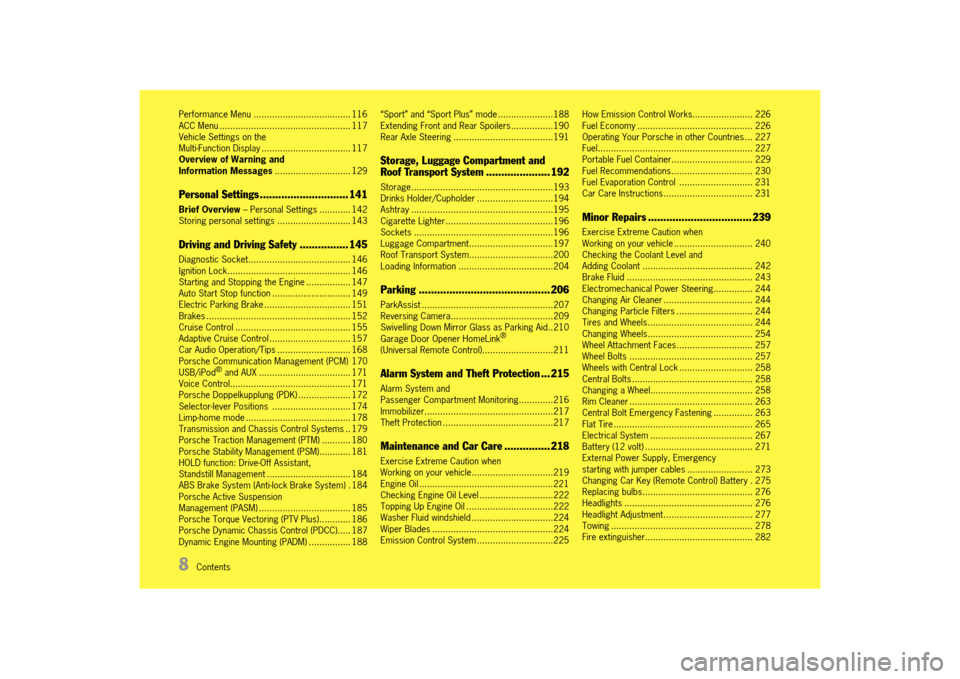
Performance Menu ..................................... 116 ACC Menu .................................................. 117Vehicle Settings on theMulti-Function Display .................................. 117Overview of Warning and Information Messages ............................. 129
Personal Settings ............................. 141
Brief Overview – Personal Settings ............ 142 Storing personal settings ............................ 143
Driving and Driving Safety ................ 145
Diagnostic Socket....................................... 146Ignition Lock............................................... 146Starting and Stopping the Engine ................. 147Auto Start Stop function .............................. 149Electric Parking Brake ................................. 151Brakes ....................................................... 152Cruise Control ............................................ 155Adaptive Cruise Control ............................... 157Car Audio Operation/Tips ............................ 168Porsche Communication Management (PCM) 170USB/iPod® and AUX ................................... 171Voice Control.............................................. 171Porsche Doppelkupplung (PDK) .................... 172Selector-lever Positions .............................. 174Limp-home mode ........................................ 178Transmission and Chassis Control Systems .. 179Porsche Traction Management (PTM) ........... 180Porsche Stability Management (PSM)............ 181HOLD function: Drive-Off Assistant, Standstill Management ................................ 184ABS Brake System (Anti-lock Brake System) . 184Porsche Active Suspension Management (PASM) ................................... 185Porsche Torque Vectoring (PTV Plus)............ 186Porsche Dynamic Chassis Control (PDCC)..... 187Dynamic Engine Mounting (PADM) ................ 188
“Sport” and “Sport Plus” mode .....................188 Extending Front and Rear Spoilers ................190Rear Axle Steering ......................................191
Storage, Luggage Compartment and Roof Transport System ..................... 192
Storage......................................................193 Drinks Holder/Cupholder .............................194Ashtray ......................................................195Cigarette Lighter .........................................196Sockets .....................................................196Luggage Compartment................................197Roof Transport System................................200Loading Information ....................................204
Parking ........................................... 206
ParkAssist ..................................................207Reversing Camera.......................................209Swivelling Down Mirror Glass as Parking Aid..210Garage Door Opener HomeLink®
(Universal Remote Control)...........................211
Alarm System and Theft Protection ... 215
Alarm System and Passenger Compartment Monitoring.............216Immobilizer.................................................217Theft Protection ..........................................217
Maintenance and Car Care ............... 218
Exercise Extreme Caution when Working on your vehicle...............................219Engine Oil ...................................................221Checking Engine Oil Level ............................222Topping Up Engine Oil .................................222Washer Fluid windshield ...............................224Wiper Blades ..............................................224Emission Control System .............................225
How Emission Control Works....................... 226 Fuel Economy ............................................ 226Operating Your Porsche in other Countries ... 227Fuel........................................................... 227Portable Fuel Container............................... 229Fuel Recommendations............................... 230Fuel Evaporation Control ............................ 231Car Care Instructions.................................. 231
Minor Repairs .................................. 239
Exercise Extreme Caution when Working on your vehicle .............................. 240Checking the Coolant Level and Adding Coolant .......................................... 242Brake Fluid ................................................ 243Electromechanical Power Steering............... 244Changing Air Cleaner .................................. 244Changing Particle Filters ............................. 244Tires and Wheels........................................ 244Changing Wheels........................................ 254Wheel Attachment Faces............................. 257Wheel Bolts ............................................... 257Wheels with Central Lock ............................ 258Central Bolts .............................................. 258Changing a Wheel....................................... 258Rim Cleaner ............................................... 263Central Bolt Emergency Fastening ............... 263Flat Tire ..................................................... 265Electrical System ....................................... 267Battery (12 volt) ......................................... 271External Power Supply, Emergency starting with jumper cables ......................... 273Changing Car Key (Remote Control) Battery . 275Replacing bulbs.......................................... 276Headlights ................................................. 276Headlight Adjustment.................................. 277Towing ...................................................... 278Fire extinguisher......................................... 282
14_991_Turbo_21.book Seite 8 Mittwoch, 9. April 2014 2:19 14
Page 96 of 300
94 Instrument Panel and Multi-Function Display
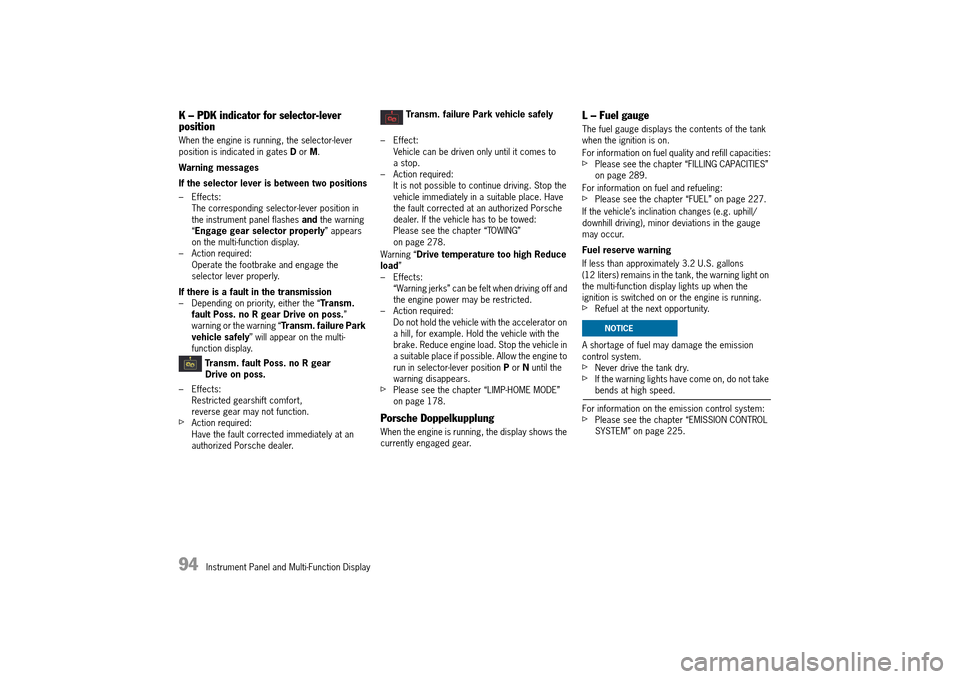
K – PDK indicator for selector-lever position
When the engine is running, the selector-lever position is indicated in gates D or M.
Warning messages
If the selector lever is between two positions
– Effects: The corresponding selector-lever position in the instrument panel flashes and the warning “ Engage gear selector properly” appears on the multi-function display.– Action required:Operate the footbrake and engage the selector lever properly.
If there is a fault in the transmission – Depending on priority, either the “ Transm. fault Poss. no R gear Drive on poss. ” warning or the warning “ Transm. failure Park vehicle safely ” will appear on the multi- function display.
Transm. fault Poss. no R gear Drive on poss.
– Effects: Restricted gearshift comfort,reverse gear may not function.fAction required:Have the fault corrected immediately at an authorized Porsche dealer.
Transm. failure Park vehicle safely
– Effect: Vehicle can be driven only until it comes to a stop. – Action required:It is not possible to continue driving. Stop the vehicle immediately in a suitable place. Have the fault corrected at an authorized Porsche dealer. If the vehicle has to be towed:Please see the chapter “TOWING” on page 278.
Warning “ Drive temperature too high Reduce load ” – Effects:“Warning jerks” can be felt when driving off and the engine power may be restricted.– Action required:Do not hold the vehicle with the accelerator on a hill, for example. Hold the vehicle with the brake. Reduce engine load. Stop the vehicle in a suitable place if possible. Allow the engine to run in selector-lever position P or N until the warning disappears.fPlease see the chapter “LIMP-HOME MODE” on page 178.
Porsche Doppelkupplung
When the engine is running, the display shows the currently engaged gear.
L – Fuel gauge
The fuel gauge displays the contents of the tank when the ignition is on.
For information on fuel quality and refill capacities:fPlease see the chapter “FILLING CAPACITIES” on page 289.
For information on fuel and refueling:fPlease see the chapter “FUEL” on page 227.
If the vehicle’s inclination changes (e.g. uphill/ downhill driving), minor deviations in the gauge may occur.
Fuel reserve warning
If less than approximately 3.2 U.S. gallons (12 liters) remains in the tank, the warning light on the multi-function display lights up when the ignition is switched on or the engine is running. fRefuel at the next opportunity.
A shortage of fuel may damage the emission control system. fNever drive the tank dry.fIf the warning lights have come on, do not take bends at high speed.
For information on the emission control system:fPlease see the chapter “EMISSION CONTROL SYSTEM” on page 225.
NOTICE
14_991_Turbo_21.book Seite 94 Mittwoch, 9. April 2014 2:19 14
Page 133 of 300
Instrument Panel and Multi-Function Display 131
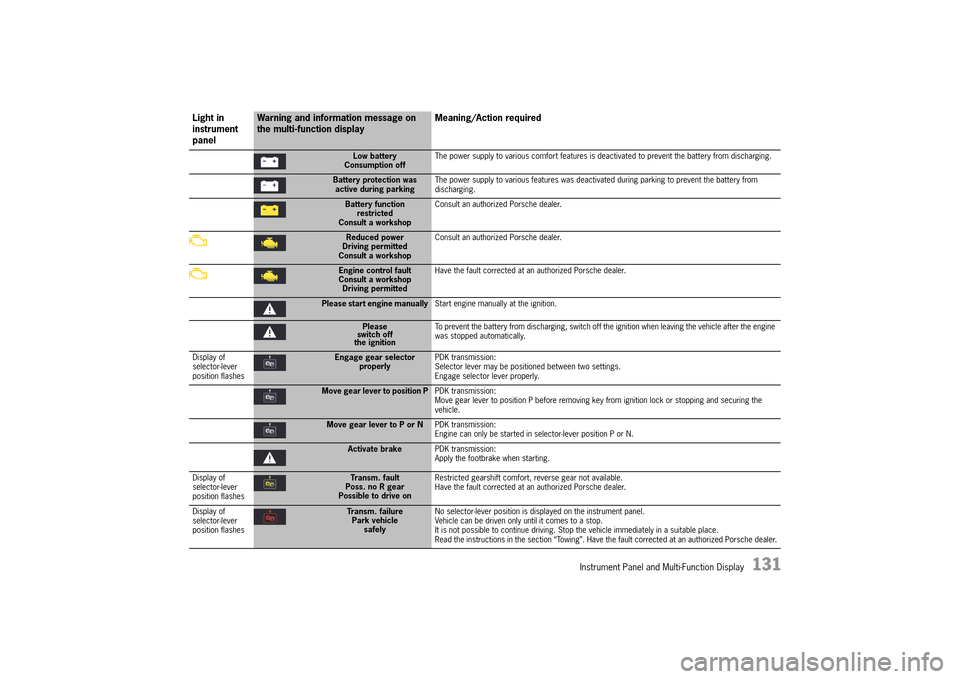
Low battery Consumption off The power supply to various comfort features is deactivated to prevent the battery from discharging.
Battery protection was active during parking The power supply to various features was deactivated during parking to prevent the battery from discharging.
Battery function restrictedConsult a workshop
Consult an authorized Porsche dealer.
Reduced power Driving permittedConsult a workshop
Consult an authorized Porsche dealer.
Engine control fault Consult a workshopDriving permitted
Have the fault corrected at an authorized Porsche dealer.
Please start engine manually Start engine manually at the ignition.
Please switch offthe ignition
To prevent the battery from discharging, switch off the ignition when leaving the vehicle after the engine was stopped automatically.
Display of selector-lever position flashes
Engage gear selector properly PDK transmission: Selector lever may be positioned between two settings. Engage selector lever properly.
Move gear lever to position P PDK transmission: Move gear lever to position P before removing key from ignition lock or stopping and securing the vehicle.
Move gear lever to P or N PDK transmission: Engine can only be started in selector-lever position P or N.
Activate brake PDK transmission: Apply the footbrake when starting.
Display of selector-lever position flashes
Transm. fault Poss. no R gearPossible to drive on
Restricted gearshift comfort, reverse gear not available. Have the fault corrected at an authorized Porsche dealer.
Display of selector-lever position flashes
Transm. failure Park vehiclesafely
No selector-lever position is displayed on the instrument panel. Vehicle can be driven only until it comes to a stop.It is not possible to continue driving. Stop the vehicle immediately in a suitable place. Read the instructions in the section “Towing”. Have the fault corrected at an authorized Porsche dealer.
Light in instrument panel
Warning and information message on the multi-function display Meaning/Action required
14_991_Turbo_21.book Seite 131 Mittwoch, 9. April 2014 2:19 14
Page 134 of 300
132 Instrument Panel and Multi-Function Display
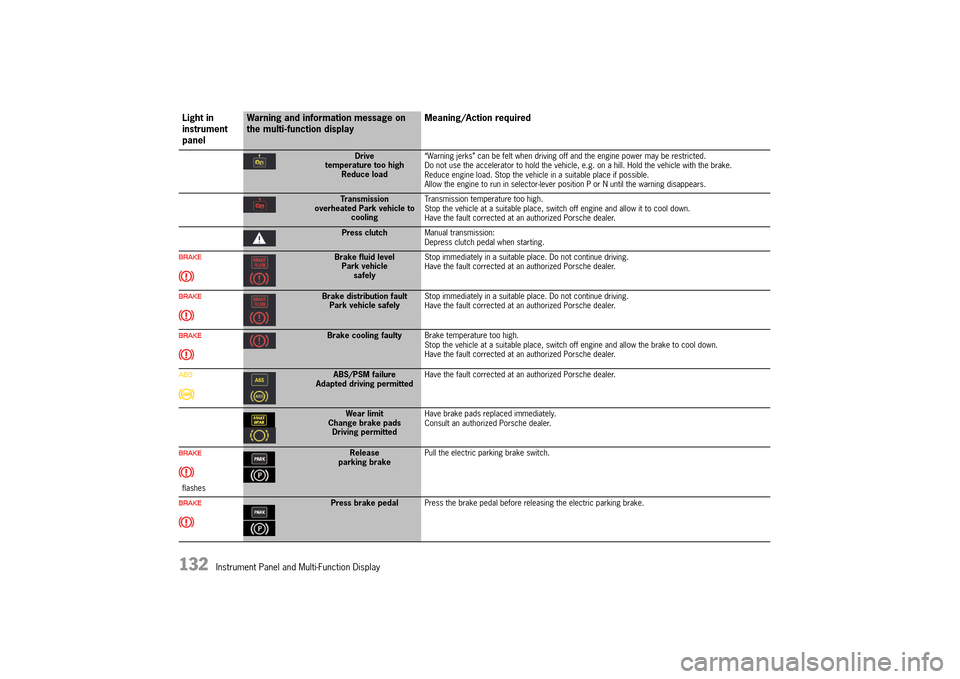
Drive temperature too highReduce load
“Warning jerks” can be felt when driving off and the engine power may be restricted. Do not use the accelerator to hold the vehicle, e.g. on a hill. Hold the vehicle with the brake.Reduce engine load. Stop the vehicle in a suitable place if possible.Allow the engine to run in selector-lever position P or N until the warning disappears.
Transmission overheated Park vehicle to cooling
Transmission temperature too high. Stop the vehicle at a suitable place, switch off engine and allow it to cool down.Have the fault corrected at an authorized Porsche dealer.
Press clutch Manual transmission: Depress clutch pedal when starting.
Brake fluid level Park vehiclesafely
Stop immediately in a suitable place. Do not continue driving. Have the fault corrected at an authorized Porsche dealer.
Brake distribution fault Park vehicle safely Stop immediately in a suitable place. Do not continue driving. Have the fault corrected at an authorized Porsche dealer.
Brake cooling faulty Brake temperature too high. Stop the vehicle at a suitable place, switch off engine and allow the brake to cool down.Have the fault corrected at an authorized Porsche dealer.
ABS/PSM failure Adapted driving permitted Have the fault corrected at an authorized Porsche dealer.
Wear limit Change brake padsDriving permitted
Have brake pads replaced immediately. Consult an authorized Porsche dealer.
flashes
Release parking brake Pull the electric parking brake switch.
Press brake pedal Press the brake pedal before releasing the electric parking brake.
Light in instrument panel
Warning and information message on the multi-function display Meaning/Action required
14_991_Turbo_21.book Seite 132 Mittwoch, 9. April 2014 2:19 14
Page 147 of 300
Driving and Driving Safety 145
Driving and Driving Safety
Diagnostic Socket .......................................146 Ignition Lock ...............................................146Starting and Stopping the Engine .................147Auto Start Stop function ..............................149Electric Parking Brake .................................151Brakes .......................................................152Cruise Control.............................................155Adaptive Cruise Control ...............................157Car Audio Operation/Tips ............................168Porsche Communication Management (PCM) .170USB/iPod® and AUX....................................171Voice Control ..............................................171Porsche Doppelkupplung (PDK) ....................172Selector-lever Positions ..............................174Limp-home mode ........................................178Transmission and Chassis Control Systems ..179Porsche Traction Management (PTM)............180Porsche Stability Management (PSM) ............181HOLD function: Drive-Off Assistant, Standstill Management ................................184ABS Brake System (Anti-lock Brake System) ..184Porsche Active Suspension Management (PASM) ...................................185Porsche Torque Vectoring (PTV Plus) ............186Porsche Dynamic Chassis Control (PDCC) .....187Dynamic Engine Mounting (PADM) ................188“Sport” and “Sport Plus” mode .....................188Extending Front and Rear Spoilers ................190Rear Axle Steering ......................................191
14_991_Turbo_21.book Seite 145 Mittwoch, 9. April 2014 2:19 14
Page 149 of 300
Driving and Driving Safety 147
Ignition lock position 0 – Ignition off (initial position)
The engine and ignition are off in ignition lock position 0. The ignition key can be removed in this position.
Ignition lock position 1 – Ignition on
fTurn ignition key to position 1.
All electrical equipment can be switched on. The warning lights on the instrument panel light up for a lamp check.fPlease see the chapter “INSTRUMENT PANEL USA MODELS” on page 90.
If a load is not switched on for 10 minutes after switching on the ignition, the ignition must be switched on again. Turn the ignition key to ignition lock position 0 (initial position) first.
The ignition key cannot be removed when the ignition is switched on or when the engine has been started.
To remove the ignition key: fStop the vehicle.fMove PDK selector lever to position P.fSwitch ignition off.fRemove the ignition key.
Ignition lock position 2 – Start engine
fTurn ignition key to ignition lock position 2.
The key is reset automatically from position 2 to position 1 when you start the engine.
Emergency operation with Porsche Entry & Drive
Interference in radio transmission between the vehicle and ignition lock or a discharged ignition lock battery can disable the Porsche Entry & Drive comfort function.
If this happens, the control unit can be removed from the ignition lock and the vehicle can be started using the ignition key.
For information on removing the control unit from the ignition lock: fPlease see the chapter “EMERGENCY OPERATION – UNLOCKING THE IGNITION KEY/CONTROL UNIT” on page 28.
Starting and Stopping the Engine
The immobilizer can be deactivated and the engine started only using an authorized ignition key.fPlease see the chapter “IMMOBILIZER” on page 217.
Exhaust gas contains colorless and odorless carbon monoxide (CO), which is toxic even in low concentrations. Carbon monoxide can cause unconsciousness and even death if inhaled.fNever start or let the engine running in an enclosed, unventilated area. It is not recommended to sit in your car for prolonged periods with the engine on and the car not moving.
Exhaust fumes and the exhaust system are very hot when the engine is running. The exhaust system remains hot for some time after the engine is turned off.fDo not park or drive your vehicle where combustible materials, such as dry grass or leaves, can come into contact with the hot exhaust system.fIf your car catches on fire for any reason, call the fire department. Do not endanger your life by attempting to put out the fire.
Exhaust Gas
Exhaust System Fire Hazard
WARNINGh
WARNINGh
14_991_Turbo_21.book Seite 147 Mittwoch, 9. April 2014 2:19 14
Page 151 of 300
Driving and Driving Safety 149
Auto Start Stop function
The engine stops automatically when the vehicle is
stopped, e.g. at traffic lights or in a traffic jam, if all the preconditions for stopping the engine automatically are met. The engine can also stop automatically
during a stop at walking pace. The Auto Start Stop function thus helps to save fuel.
The ignition stays on even when the engine switches off automatically. All safety functions are still available.
Preconditions for stopping the engine automatically
– Auto Start Stop function switched on. – Engine compartment lid closed.– Brake pedal pressed– Move PDK selector lever to the D, N or P position, or to a manually selected transmission range 1 or 2. – Engine, transmission and air conditioning are at operating temperature.– Battery has reached its target voltage.– Vehicle was driven at a speed of more than approx. 1 mph (2 km/h) for at least 1.5 seconds since the engine last stopped automatically.
Information
When the ignition is on, the battery is discharged. If the vehicle is parked for an extended period, the battery can discharge fully and be damaged (exhaustive discharge).
Stopping the engine
The Auto Start Stop function stops the engine once the vehicle stops moving or during the stopping process.1. Use the footbrake to stop the vehicle. 2. Keep the footbrake pressed. orMove PDK selector lever to position P.
Information
– The engine can also be stopped subsequently (not immediately after the vehicle comes to a stop) if the exceptions are set aside and the preconditions for stopping the engine automatically continue to be met.fPlease see the chapter “EXCEPTIONS FOR THE AUTO START STOP FUNCTION” on page 150.– When adaptive cruise control is switched on, the engine stops automatically when the vehicle is stationary if the vehicle in front also comes to a stop.
Starting the engine
The Auto Start Stop function starts the engine:fIn PDK selector-lever position D, N or manually selected transmission range 1 or 2: Release the footbrake.orPress the accelerator.orMove the steering wheel.orMove PDK selector lever to position R.
You can drive off normally.
Information
When adaptive cruise control is switched on, the engine starts automatically if the following preconditions are met:– The vehicle in front drives off.orThe accelerator is pressed.orSpeed and distance control is resumed using the control stalk (position 4, RESUME).fPlease see the chapter “INTERRUPTING AND RESUMING CRUISE CONTROL AND DISTANCE CONTROL” on page 164.– Switching off adaptive cruise control starts the engine automatically and the vehicle moves (crawls) when in gear.
14_991_Turbo_21.book Seite 149 Mittwoch, 9. April 2014 2:19 14
Page 156 of 300
154 Driving and Driving Safety
fBefore descending a steep grade, reduce speed and shift the transmission into a lower gear to control speed. fDo not “ride the brakes” by resting your foot on the pedal when not intending to apply brake pressure.fDo not hold the pedal down too long or too often. This could cause the brakes to overheat and lose braking power.
Brake booster
The brake booster assists braking only when the engine is running.
When the car is moving while the engine is not running, or if the brake booster is defective, more pressure on the brake pedal is required to bring the car to a stop.
Moisture, road salt or grit on brakes affects braking. Brakes will dry after a few cautious brake applications.
Driving through water may reduce the traction. Moisture on brakes from road water, car wash, or a coating of road salt or grit may affect braking efficiency.fCautiously apply brakes to test and dry the brakes after exposure to road water, etc.
The brake booster is ready for operation only while the engine is running. If the engine is switched off or there is a defect in the brake booster, much greater force has to be applied to the pedal when braking. fVehicles with defective brakes must not be towed and must be transported on a flat bed.
For information on towing:fPlease see the chapter “TOWING” on page 278.
Brake wear
Your car has excellent brakes, but they are still subject to wear. The rate at which they wear depends on how the brakes are used.fHave the brake system inspected at the intervals recommended in your Maintenance Booklet.
Brake system warning light
You can check the functionality of the brake system warning light by switching the ignition to the “On” position (position 1) and verifying that the warning light illuminates.
A warning message will be displayed on the multi- purpose display of the instrument panel if the brake pads are worn, excessively.fDo not continue to operate the vehicle.Have your authorized Porsche dealer inspect or replace the brake pads.
For information on warning messages on the multi-purpose display:fPlease see the chapter “OVERVIEW OF WARNING AND INFORMATION MESSAGES” on page 129.
Brake pads and brake disks
Wear on the brake pads and brake disks depends to a great extent on the driving style and the conditions of use and therefore cannot be expressed in actual miles on the road.
The high-performance brake system is designed for optimal braking effect at all speeds and temperatures.
Certain speeds, braking forces and ambient conditions (e.g. temperature and humidity) can therefore cause the brakes to “squeal”.
Unsuitable or incorrectly installed floor mats or objects can obstruct the movement of the brake pedal or prevent application of the brake pedal.fDo not obstruct the pedal travel with floor mats or other objects.
Riding the Brakes
Wet Brakes
WARNINGh
WARNINGh
Loss of Braking PowerWARNINGhBrake wear warning message USA
Brake wear warning message Canada
Obstructed Brake PedalWARNINGh
14_991_Turbo_21.book Seite 154 Mittwoch, 9. April 2014 2:19 14
Page 171 of 300
Driving and Driving Safety 169
Static and fluttering
When the line-of-sight link between a transmitter and vehicle is blocked by large buildings or mountains, the radio sound may be accompanied with static or fluttering because of the characteristic of FM.
In a similar effect, a fluttering noise is sometimes heard when driving along a tree-lined road.
This static and fluttering can be reduced by adjusting the tone control for greater bass response until the disturbance has passed.
Multipath
Because of the reflecting characteristics of FM, direct and reflected signals may reach the antenna at the same time (multipath) and cancel each other out. As a vehicle moves through these electronic dead spots, the listener may hear a momentary flutter or loss of reception.
Station swapping
When two FM stations are close to each other, and an electronic dead spot, such as static or multipath area, interrupts the original signal, sometimes the stronger second signal will be selected automatically until the original one returns. This swapping can also occur as you drive away from the selected station and approach another station of a stronger signal.
Compact disk player
To avoid damage to compact disk player and disks.fUse only compact disks labeled as shown, having no dirt, damage or warpage.
fNever attempt to disassemble or oil any part of the player unit. Do not insert any object other than a disk into the slot. Remember there are no user-serviceable parts inside the compact disk player.fDo not allow the disk to sustain any fingerprints, scrapes or stickers on the surfaces. This may cause poor sound quality.Hold the disk only on the edge or center hole.fWhen not in use, take the disk out of the player, put the disk back into its case and store it away from dust, heat, damp and direct sunlight.Leaving the disk on the dashboard in the sun can damage the disk.fIf the disk gets dirty, clean the disk by wiping the surfaces from the center to the outside in a radial direction with a soft cloth. Do not use a conventional record cleaner or anti-static record preservative. Disk cleaners are available in audio stores.
Car Telephone and Aftermarket Alarms
Important legal and safety information regarding the use of cellular telephones
Some jurisdictions may prohibit the use of cellular telephones while driving a vehicle. Check the laws and regulations on the use of cellular telephones in the areas where you drive.
Looking away from the road or turning your attention away from your driving to operate a cell phone will sooner or later cause an accident. fDo not attempt to operate a hand-held cell phone while you are driving. Safety is more important than a phone call.
fLearn to operate the hands-free phone, if it is available, before you start driving. Then make use of the hands-free phone at all times.
It is essential to observe the telephone manufacturer’s instructions before operating the telephone.
Any portable telephone or radio transmitter which is used in a Porsche must be properly installed in accordance with the technical requirements of Porsche.
The transmission power must not exceed 10 W.
The devices must possess a type approval for your vehicle and have an “e” symbol.
If you should require equipment with transmission power values greater than 10 W, please consult your authorized Porsche dealer for this purpose. They are familiar with the technical requirements for installing devices of this kind.
The antennas for all radios and telephones with a transmitting antenna must be externally mounted.
The improper installation of radios or telephones or use of a radio or telephone with a transmitting antenna inside the car may cause the warning lights to come on.
Improper installation of such equipment can create a discharged battery or excessive current draw from added equipment.
NOTICE
Cell Phone UseDANGERh
14_991_Turbo_21.book Seite 169 Mittwoch, 9. April 2014 2:19 14
Page 174 of 300
172 Driving and Driving Safety
Porsche Doppelkupplung (PDK)
Porsche Doppelkupplung (PDK) is a seven-speed transmission with an automatic and a manual selection mode.
In automatic selection mode (selector-lever position D), gear changing is automatic. You can change temporarily from automatic to manual mode using the shift buttons on the steering wheel.
In manual selection mode (selector-lever position M), you change gear using the shift buttons or shift paddles on the steering wheel or with the PDK selector lever.
You can change between selector-lever positions D and M as you wish while driving.
Information
fTake care not to operate the shift buttons on the steering wheel inadvertently in either automatic or manual mode, thereby triggering undesired gear changes.
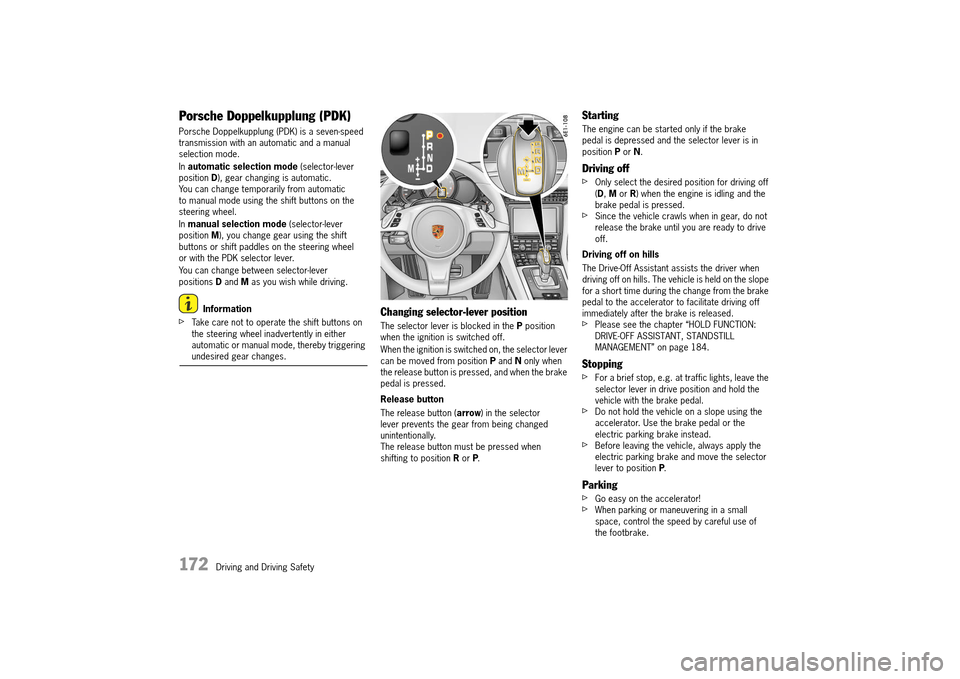
Changing selector-lever position
The selector lever is blocked in the P position when the ignition is switched off.
When the ignition is switched on, the selector lever can be moved from position P and N only when the release button is pressed, and when the brake pedal is pressed.
Release button
The release button ( arrow) in the selector lever prevents the gear from being changed unintentionally.The release button must be pressed when shifting to position R or P.
Starting
The engine can be started only if the brake pedal is depressed and the selector lever is in position P or N.
Driving off
fOnly select the desired position for driving off ( D, M or R) when the engine is idling and the brake pedal is pressed.fSince the vehicle crawls when in gear, do not release the brake until you are ready to drive off.
Driving off on hills
The Drive-Off Assistant assists the driver when driving off on hills. The vehicle is held on the slope for a short time during the change from the brake pedal to the accelerator to facilitate driving off immediately after the brake is released.fPlease see the chapter “HOLD FUNCTION: DRIVE-OFF ASSISTANT, STANDSTILL MANAGEMENT” on page 184.
Stopping
fFor a brief stop, e.g. at traffic lights, leave the selector lever in drive position and hold the vehicle with the brake pedal.fDo not hold the vehicle on a slope using the accelerator. Use the brake pedal or the electric parking brake instead.fBefore leaving the vehicle, always apply the electric parking brake and move the selector lever to position P.
Parking
fGo easy on the accelerator!fWhen parking or maneuvering in a small space, control the speed by careful use of the footbrake.
14_991_Turbo_21.book Seite 172 Mittwoch, 9. April 2014 2:19 14