warm PORSCHE 911 TURBO 2014 6.G Owners Manual
[x] Cancel search | Manufacturer: PORSCHE, Model Year: 2014, Model line: 911 TURBO, Model: PORSCHE 911 TURBO 2014 6.GPages: 300, PDF Size: 10.61 MB
Page 61 of 300
Air Conditioning 59
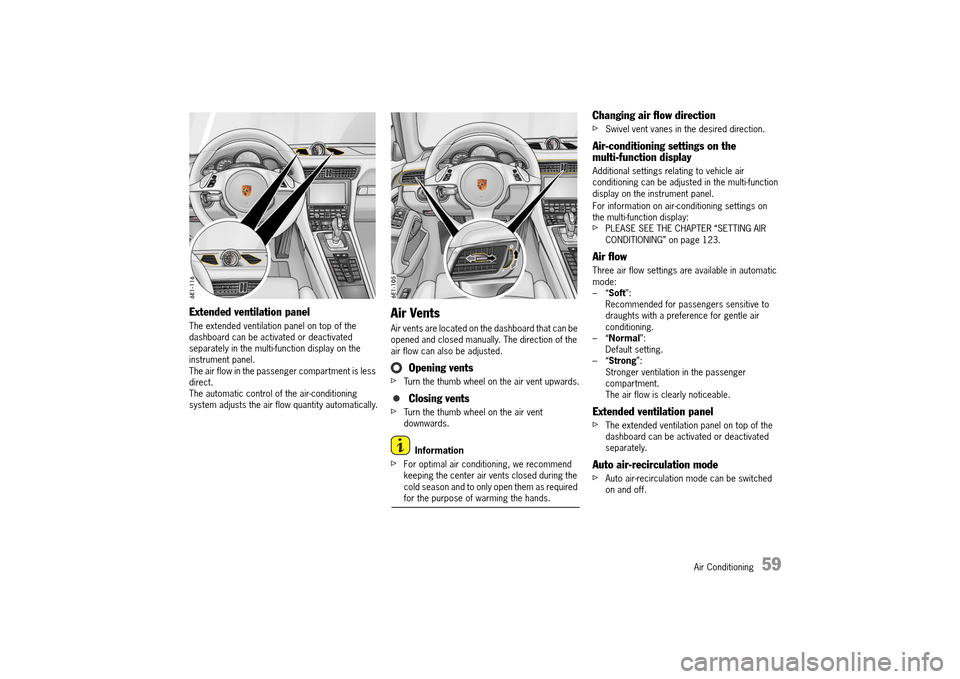
Extended ventilation panel
The extended ventilation panel on top of the dashboard can be activated or deactivated separately in the multi-function display on the instrument panel.The air flow in the passenger compartment is less direct.The automatic control of the air-conditioning system adjusts the air flow quantity automatically.
Air Vents
Air vents are located on the dashboard that can be opened and closed manually. The direction of the air flow can also be adjusted.
Opening vents
fTurn the thumb wheel on the air vent upwards.
Closing vents
fTurn the thumb wheel on the air vent downwards.
Information
fFor optimal air conditioning, we recommend keeping the center air vents closed during the cold season and to only open them as required for the purpose of warming the hands.
Changing air flow direction
fSwivel vent vanes in the desired direction.
Air-conditioning settings on the multi-function display
Additional settings relating to vehicle air conditioning can be adjusted in the multi-function display on the instrument panel.
For information on air-conditioning settings on the multi-function display:fPLEASE SEE THE CHAPTER “SETTING AIR CONDITIONING” on page 123.
Air flow
Three air flow settings are available in automatic mode:–“ Soft”: Recommended for passengers sensitive to draughts with a preference for gentle air conditioning.–“ Normal”: Default setting.–“ Strong”: Stronger ventilation in the passenger compartment.The air flow is clearly noticeable.
Extended ventilation panel
fThe extended ventilation panel on top of the dashboard can be activated or deactivated separately.
Auto air-recirculation mode
fAuto air-recirculation mode can be switched on and off.
14_991_Turbo_21.book Seite 59 Mittwoch, 9. April 2014 2:19 14
Page 150 of 300
148 Driving and Driving Safety
An unattended vehicle with a running engine is potentially hazardous. If warning lights come on to indicate improper operation, no one would be present to observe the light and turn off the engine.fNever leave the engine idling unattended.
Starting the vehicle
fOperate the footbrake.fMove PDK selector lever to the P or N position.fDo not press the accelerator pedal.The engine control unit will provide the correct starting mixture.fTurn the ignition key or control unit (Porsche Entry & Drive) to ignition lock position 2. The starting process is carried out and completed automatically as soon as ignition lock position 2 (start engine) is reached. The ignition key or control unit is reset automatically to ignition lock position 1 (ignition on).fDo not operate the starter for more than approx. 10 seconds. If necessary, repeat the starting procedure after a pause of approx. 10 seconds. Turn the ignition key back to ignition lock position 0 (initial position) first. The first operation of the starter is ended automatically when the engine starts.If the engine does not start, subsequent starter operations will not be ended automatically.fDo not warm up the engine when stationary. Drive off immediately. Avoid high revs and full throttle until the engine has reached operating temperature.
fIf the vehicle battery power is too weak, the engine can be started with jump leads.
For information on jump-lead starting: fPlease see the chapter “EXTERNAL POWER SUPPLY, EMERGENCY STARTING WITH JUMPER CABLES” on page 273.
Information
To ensure a good battery charge condition, thereby ensuring that the battery will start the engine, all electrical loads that are not required should be switched off when the ignition is switched on and when engine revs are low (in traffic jams, in city traffic or in lines).
Stopping
fOnly remove the ignition key when the vehicle is stationary.fOnly switch the ignition off when the vehicle is stationary, as there is no power steering and brake booster assistance when the engine is switched off.fWhen leaving the vehicle, always remove the ignition key, apply the electric parking brake and engage selector-lever position P. The control unit always remains in the ignition lock on vehicles with Porsche Entry & Drive.
Engine components become very hot when the engine is running.fBefore working on any part in the engine compartment, turn the engine off and let it cool down sufficiently.
The exhaust pipe is hot when the engine is running and remains hot for some time after the vehicle is turned off. fTo prevent injury, make a point of noting where your vehicle’s exhaust pipe is, avoid placing your legs near the exhaust pipe when loading and unloading cargo in the rear, and closely supervise children around the vehicle during time when the exhaust pipe could be hot. A hot exhaust pipe can cause painful skin burns.
Radiator fan
The fan can start running depending on the temperature, even with the engine switched off.fExercise extreme care that parts of the body, articles of clothing or jewelry do not get caught in the radiator fan. fExercise extreme caution when working in the area of the radiator fans.
For information on radiator fans:fPlease see the chapter “RADIATOR FAN, ENGINE COMPARTMENT BLOWERS” on page 221.
NOTICE
Hot Engine PartsWARNINGh
Hot Exhaust Tailpipe
Radiator Fan
WARNINGh
WARNINGh
14_991_Turbo_21.book Seite 148 Mittwoch, 9. April 2014 2:19 14
Page 223 of 300
Maintenance and Car Care 221
Radiator fan, engine compartment blowers
The engine-compartment blowers are mounted under the engine compartment lid.After the engine is switched off, the engine compartment temperature is monitored for approx. 30 minutes.During this period, and depending on temperature, the engine-compartment blowers may continue to run or start to run.fCarry out work in this area only with the engine off and exercise extreme caution.
The radiators and radiator fans are in the front of the vehicle.The radiator fans in the front of the vehicle may be operating or unexpectedly start operating when the engine is switched on.fCarry out work in these areas only with the engine switched off.fTake great care to ensure that parts of the body, items of clothing or jewelery cannot be drawn in by the radiator fan, engine-compartment blower, drive belt or other moving parts.
Measurements on test stands
Performance test
Performance tests on roller-type test stands are not approved by Porsche.
Brake tests
Brake tests must be performed only on roller-type test stands.
The following limit values must not be exceeded on roller-type test stands: – Test speed 4.7 mph (7.5 km/h)– Test duration 20 seconds
Testing the electric parking brake
Electric parking brake tests on the brake test stand must only be performed with the ignition switched on and with the Porsche Doppelkupplung selector lever in position N. The vehicle switches automatically to brake test stand mode, in which the electric parking brake can be tested.The message “ Electric parking brake in service mode ” appears on the multi-function display in the instrument panel.
Balancing wheels on the vehicle
During finish balancing of the wheels, the entire vehicle must be lifted and the wheels must be free to turn.
Engine Oil
It is important to perform oil changes regularly in accordance with the intervals specified in your Maintenance Schedule .
Engine oil consumption
It is normal for your engine to consume oil. The rate of oil consumption depends on the quality and viscosity of oil, the speed at which the engine is operated, the climate, road conditions as well
as the amount of dilution and oxidation of the lubricant.
If the vehicle is used for repeated short trips, and consumes a normal amount of oil, the engine oil measurement may not show any drop in the oil level at all, even after 600 miles (1000 km) or more. This is because the oil is gradually becoming diluted with fuel or moisture, making it appear that the oil level has not changed. The diluting ingredients evaporate out when the vehicle is driven at high speeds, as on an expressway, making it then appear that oil is excessively consumed after driving at high speeds.
If the conditions you drive your vehicle in are dusty, humid, or hot, the frequency of the oil change intervals should be greater.
If the vehicle is driven at a high rate of speed, climatic conditions are warm, and the load is high, the oil should be checked more frequently, as driving conditions will determine the rate of oil consumption.– The engine in your vehicle depends on oil to lubricate and cool all of its moving parts. Therefore, the engine oil should be checked regularly and kept at the required level.– Make it a habit to have the engine oil level checked with every refueling.– The oil pressure warning light is not an oil level indicator. The oil pressure warning light indicates serious engine damage may be occurring when lit, if engine rpm is above idle speed.
Radiator Fans, Engine Compartment Blowers
WARNINGh
14_991_Turbo_21.book Seite 221 Mittwoch, 9. April 2014 2:19 14
Page 229 of 300
Maintenance and Car Care 227
fAlways monitor your fuel consumption.fDrive smoothly, avoid abrupt changes in speed as much as possible.fAvoid jack rabbit starts and sudden stops.fDo not drive longer than necessary in the lower gears. Shifting into a higher gear early without lugging the engine will help save fuel.fProlonged “warm up” idling wastes gas. Start the vehicle just before you are ready to drive. Accelerate slowly and smoothly.fSwitch off the engine if stationary for longer periods.fAny additional weight carried in the vehicle reduces fuel economy. Always keep cargo to a minimum and remove all unnecessary items.fOrganize your trips to take in several errands in one trip.fAll electrical accessories contribute to increased fuel consumption.fOnly switch on the air conditioning when necessary.fDo not drive with the Roof Transport System mounted unless you need it.
The EPA estimated miles per gallon (mpg) is to be used for comparison purposes, actual mileage may be different from the estimated mpg, depending on your driving speed, weather conditions and trip length. Your actual highway mileage may be less than the estimated mpg.fPlease observe all local and national speed limits.
Operating Your Porsche in other
Countries
Government regulations in the United States and Canada require that automobiles meet specific emission regulations and safety standards. Therefore, cars built for the U.S. and Canada differ from vehicles sold in other countries.
If you plan to take your Porsche outside the continental limits of the United States or Canada, there is the possibility that:– Unleaded fuel may not be available,– Unleaded fuel may have a considerably lower octane rating. Excessive engine knock and serious damage to both engine and catalytic converters could result,– Service may be inadequate due to lack of proper service facilities, tools or diagnostic equipment,– Replacement parts may not be available or very difficult to get.
Porsche cannot be responsible for the mechanical damage that could result because of inadequate fuel, service or parts availability.
If you purchased your Porsche abroad and want to bring it back home, be sure to find out about shipping and forwarding requirements, as well as current import and customs regulations.
Fuel
When the ignition is on, the fuel level is displayed on the instrument panel.fPlease see the chapter “FUEL GAUGE” on page 90.
fFire, open flame and smoking are prohibited when handling fuel.
Fuel and fuel vapors are hazardous to health.fAvoid contact with skin or clothing, since injury to your skin may occur.fDo not inhale fuel vapors, since they may make you ill and possibly cause death if inhalation is prolonged and occurs in a closed space.
To prevent damage to the emission control system and engine:fNever drive the tank dry.fAvoid high cornering speeds after the warning lights have come on.
fPlease see the chapter “FUEL ECONOMY” on page 226.
Check engine warning light
If the warning lights in the instrument panel come on and remain on while driving, it suggests: – a potential engine control problem and the need for system service or – an improperly fastened tank cap or
refueling with engine running.
Refueling Fire Risk
Fuel Vapors and Skin Contact
DANGERh
WARNINGh
NOTICE
14_991_Turbo_21.book Seite 227 Mittwoch, 9. April 2014 2:19 14
Page 234 of 300
232 Maintenance and Car Care
High-pressure cleaning equipment, steam cleaners
Risk of damage as a result of using high-pressure cleaning equipment, steam cleaners or similar.
High-pressure cleaning equipment, steam cleaners or similar can damage the following components:– Convertible top– Tires– Logos, emblems– Painted surfaces– Alternator– Electrical components and plug connections in the engine compartment– ParkAssist sensors– Radar sensor for adaptive cruise control– Reversing camerafAlways read the operating instructions provided by the equipment manufacturer.fAlways cover the lid of the brake fluid reservoir prior to cleaning. Never point the cleaning jet directly at the lid.fWhen cleaning with a flat-jet nozzle or a so-called “dirt blaster”, maintain a minimum distance of 20 in. (50 cm).fNever use high-pressure cleaning equipment or steam cleaners with a round-jet nozzle.A high-pressure cleaning device or steam cleaner fitted with a round nozzle will damage your vehicle. The tires are particularly susceptible to damage.fDo not point the cleaning jet directly at any of the aforementioned components.
Decorative film
Risk of damage due to separation of the decorative film when using high-pressure cleaning equipment, steam cleaners or similar cleaning equipment.fDo not use high-pressure cleaning equipment, steam cleaners, etc. to clean decorative films.
Care of door lock
fTo prevent the door lock from freezing during the cold season, cover the lock barrel with suitable adhesive tape while washing the vehicle.
If the lock still freezes, use an ordinary de-icer. In many cases, a well warmed key can help.fNever use excessive force.
Car washing
The best protection for the vehicle from the damaging effects of the environment is frequent washing and preservation.
The longer road salt, road dust, industrial dust, insect remains, bird excrement, and tree exudations (e.g. resin, pollen), etc. are allowed to remain on the bodywork, the more harmful their effect.
Observe the following points in order to ensure that the vehicle is washed thoroughly without damaging the paintwork: fThe underside of the vehicle should also be thoroughly washed at the end of the gritting season at the latest.fWash your vehicle only at sites provided for this purpose to prevent soot, grease, oil and heavy metals from entering the environment.
fNew cars should be washed carefully with plenty of clear water to protect the new paint work. Dark paint finishes show up the smallest of surface damage (e.g., scratches) more readily than lighter colors. Dark colors are slightly more susceptible to scratching and require particularly careful paint care.Dark paints make even the smallest surface blemishes (scratches) more conspicuous than lighter colors.fDo not wash your Porsche in direct sunlight or when its body is hot.fWhen washing by hand, use a car shampoo, plenty of water, and a soft sponge or washing brush.We recommend Porsche car shampoo.fStart washing the vehicle by thoroughly wetting the paintwork and rinsing the heavy dirt off.fAfter washing the vehicle, rinse it thoroughly with water and rub it dry with chamois-leather.Do not use the same chamois for rubbing dry as you use for cleaning the windshield and windows.
Reduced or uneven braking action may be caused by wet brakes.fAfter washing the vehicle, test the brakes and steering and briefly brake the disks dry.When doing so, make sure that vehicles traveling behind you are not affected.
NOTICENOTICE
Wet BrakesWARNINGh
14_991_Turbo_21.book Seite 232 Mittwoch, 9. April 2014 2:19 14
Page 235 of 300

Maintenance and Car Care 233
Cleaning in car washes
Optional add-on parts or parts that project beyond the contours of the vehicle may be damaged by design features of car washes.
The following parts are particularly at risk: – Convertible top (hot wax treatment must not be used, as the wax attacks the convertible top material),– Windshield wipers and rear wiper (always switch them off – wiper stalk in position 0 – to prevent them wiping unintentionally in intermittent or sensor operation).– Exterior mirrors (always fold in).– External antenna (always unscrew).– Roof transport system (always remove completely).– Spoilers.– Wheels (the wider the rim and the lower the tire height, the greater the risk of damage).– High-gloss or silk-gloss wheels (to prevent these from getting scratched, do not clean with the wheel-cleaning brushes of the car wash). fPlease consult the operator before using automatic car washes.fAll parts not reached by a car wash, such as door and lid seams or door sills, must be washed and polished by hand.
Information
Automatic car washes spray water at odd angles and high pressures, which are not seen in normal driving. Therefore, water can sometimes find its way into the passengers compartment during or shortly after the car wash.
Convertible top
The service life and appearance of the convertible top depend largely on expert care and operation.
Incorrect care and operation can damage the convertible top or cause it to leak.
Never remove snow and ice with sharp-edged objects.
Cleaning the convertible top
Risk of damage to the convertible top due to the cleaning jet of the high-pressure cleaning equipment or hot wax treatment. fDo not clean the convertible top with high-pressure cleaning equipment. fDo not use hot wax treatment.
Do not wash the convertible top every time you wash the vehicle.
Normally, rinsing the convertible top with clean water is sufficient.fBrush dust off the convertible top in the direction of the weave using a soft brush. fOnly in the case of heavy soiling, wet the convertible top with lukewarm water and a wash-shampoo & convertible-top cleaner and rub gently using a sponge or soft brush.Rinse off wash-shampoo & convertible-top cleaner thoroughly from the convertible top with clean water.We recommend Porsche wash-shampoo.fAfter washing, treat the convertible top at least once a year with a convertible-top care product.Do not allow the convertible-top care product to come into contact with paint or glass. If it does, remove immediately.
fIn the case of leakage in the convertible-top covering or at its seams and folds, use a convertible-top care product.fPlease observe the information on the containers.We recommend Porsche convertible-top care product.fRemove bird excrement immediately. The acid this contains makes the rubber swell and the convertible top will leak.fOpen the convertible top only when completely dry, otherwise damp stains and abrasion marks may occur which cannot be removed.fAttempt to remove spots from the convertible-top covering by rubbing carefully with a soft rubber sponge.
NOTICE
14_991_Turbo_21.book Seite 233 Mittwoch, 9. April 2014 2:19 14
Page 238 of 300
236 Maintenance and Car Care
If cleaning agents (e.g. wheel cleaning agents) come into contact with the brake disks, the resulting film on the brake disks can impair braking performance.fMake sure that no cleaning agent comes into contact with the brake disks.fIf cleaning agent has come into contact with the brake disks, clean the brake disks thoroughly with a strong jet of water.fPaying attention to any road users behind you, dry the brake disks by applying the brakes.
Stainless steel tailpipes
Stainless steel tailpipes can discolor due to soiling, strong heat and combustion residues.
The original shine can be achieved again using commercially available metal luster paste or metal polish.
Cleaning door, roof, lid and window seals
The lubricant coating on the inner door seals may be damaged by unsuitable cleaning and care agents.fDo not use any chemical cleaning agents or solvents.fDo not use any preservative agents.
fWash dirt (e.g. abrasion, dust, road salts) from all seals regularly using warm soapy water.fIf there is a risk of frost, protect the outer door seals and the lid and flap seals against freezing into place with a suitable care product.
Leather care
The natural surface markings of leather, e.g. creases, healed scars, insect sting marks, structural differences and slight variations in shade and grain add to the attractiveness of the high-quality natural leather product.
Observe the following care instructions:
The leather will be damaged by the use of unsuitable cleaning and care agents and by inappropriate treatment.fDo not use caustic cleaners or hard cleaning objects!fMake sure that perforated leather does not get wet on its reverse side.fRemove water drops from the leather without delay.
fClean all types of leather regularly to remove fine dust using a soft, damp, white woolen cloth or a commercially available microfiber cloth.fRemove heavy contamination (not water or moisture stains) with a leather cleaner.Always read the instructions for use given on the containers.We recommend Porsche leather care liquid.fTreat cleaned leather only with a leather care product.We recommend Porsche leather care liquid.
Seats with seat ventilation
Care instructions for water or moisture stains.
Rain water or moisture can stain the perforated leather.
Removing water and moisture stains
Preconditions: – Seat heating and seat ventilation must be switched off.– No direct sunlight.– Do not use leather cleaners or care products to remove water and moisture stains.fBlot the entire seat or backrest surface using a clean, absorbent sponge and distilled water.Make sure that the perforated leather does not get wet on its reverse side.fAllow the seat covering to dry completely at room temperature out of direct sunlight.Do not dry the seat covering by switching on the seat heating and seat ventilation.fOnce dry, wipe the seat covering with a dry, lint-free cloth.
Cleaning carpet, floor mats
fUse a vacuum cleaner or a brush (not too soft) for cleaning.fHeavy dirt and stains can be removed with a stain remover.We recommend Porsche stain remover.
To protect carpets, the Porsche range of accessories includes mats of the correct size and with the appropriate fastening.
Cleaning Agents on Brake Disks
WARNINGh
NOTICE
NOTICE
14_991_Turbo_21.book Seite 236 Mittwoch, 9. April 2014 2:19 14
Page 239 of 300
Maintenance and Car Care 237
Improperly secured floor mats can obstruct pedal travel.fAlways check the movement of the pedals before driving and make sure that they are not obstructed by a floor mat or any other object.fSecure the floor mat to prevent it from sliding into positions that could interfere with the safe operation of your vehicle – do not lay them loosely in the vehicle.Your authorized Porsche dealer will be glad to offer you floor mats of correct size including a securing possibility.
Cleaning airbag covers
Incorrect modifications may damage the airbag system. The airbag may not deploy properly in the event of an accident.fDo not make any modifications whatsoever to individual components, such as the padded covers on the steering wheel, the instrument panel, the underside of the instrument panel, front seats and door panels.fHave your authorized Porsche dealer to clean these components.
Cleaning fabric linings
fFabric linings on pillars, roofliner and sun blinds, etc. must be cleaned only using suitable cleaning agents or a suitable dry foam and a soft brush.
Alcantara® care
Do not use leather care products to clean Alcantara®. Alcantara® is a manufactured product. It is not genuine leather or suede.
For regular care, it is sufficient to clean the cover with a soft brush.
Strong abrasion or rubbing when cleaning will produce a lasting change to the surface.
Cleaning when lightly soiled
fWet a soft cloth with water or a neutral soap solution and wipe off the dirt.
Cleaning when heavily soiled
fWet a soft cloth with lukewarm water or thinned white spirit and dab the dirt from the outside in.
Cleaning the safety belts
fUse mild detergent to clean soiled belts.fWhen drying, avoid direct sunlight.fOnly use suitable cleaning agents.fDo not tint or bleach the belts.The belt fabric could be weakened, thus affecting safety.
Storing your Porsche
If you intend to store your Porsche for a prolonged period, please consult your authorized Porsche dealer. The staff will be glad to advise you on the most suitable and necessary methods. fClean your vehicle thoroughly inside and outside. The under carriage and chassis components should be free of dirt and salt deposits. fFill up the fuel tank. fChange the oil and oil filter, and run the engine for several minutes. fIncrease the tire pressure to 50 psi/3.5 bar/350 kPa.It is not recommended to lift the vehicle, due to the possibility of corrosion on shock absorber piston shafts.The vehicle should be moved slightly, approximately every four weeks, to prevent flat spot on the tires.
Climate control
The air conditioning system should be in good working condition and fully charged.
Windshield/Headlight washer
fCheck and correct antifreeze/cleaning solution level as necessary.
Obstructed Pedals
Vehicle Interior Modifications
WARNINGh
DANGERh
14_991_Turbo_21.book Seite 237 Mittwoch, 9. April 2014 2:19 14
Page 248 of 300
246 Minor Repairs
The temperature grade for this tire is established for a tire that is properly inflated and not overloaded. Excessive speed, underinflation, or excessive loading, either separately or in combination, can cause heat buildup and possible tire failure.fDo not exceed the permitted maximum speed for the tires fitted to the vehicle.fEnsure that the tires are set to the correct inflation pressure.fObserve the maximum load for the vehicle.
Tire pressures
Driving the vehicle with low tire pressure increases risk of a tire failure and resulting loss of control. Furthermore, low tire pressure increases rate of wear of the affected tires and causes damage. fAlways use an accurate tire pressure gauge when checking inflation pressures.fDo not exceed the maximum tire pressure listed on the tire sidewall. (Also refer to “Technical data”).fPlease see the chapter “TIRE PRESSURE PLATE” on page 247.fCold tire inflation pressure means: all tires must be cold, ambient temperature maximum 68 °F (20 °C), when adjusting the inflation pressure. Avoid sunlight striking the tires before measuring cold pressures, since the pressures would rise from temperature influence.fValve caps protect the valve from dust and dirt, and thus from leakage. Always screw caps tightly down. Replace missing caps immediately.
fUse only plastic valve caps.fFor safety reasons, don't use tire inflating bottles.
fPlease see the chapter “TIRE PRESSURE FOR COLD TIRES (68 °F/ 20 °C)” on page 287.
Each tire, including the spare (if provided), should be checked monthly when cold and inflated to the
inflation pressure recommended by the vehicle manufacturer on the vehicle placard or tire inflation pressure label. (If your vehicle has tires of
a different size than the size indicated on the vehicle placard or tire inflation pressure label, you
should determine the proper tire inflation pressure
for those tires.)
As an added safety feature, your vehicle has been equipped with a Tire Pressure Monitoring System (TPMS) that illuminates a low tire pressure telltale when one or more of your tires is significantly under-inflated. Accordingly, when the low tire pressure telltale illuminates, you should stop and check your tires as soon as possible, and inflate them to the proper pressure. Driving on a significantly under-inflated tire causes the tire to overheat and can lead to tire failure. Under-inflation also reduces fuel efficiency and tire tread life, and may affect the vehicle’s handling and stopping ability.
Please note that the TPMS is not a substitute for proper tire maintenance, and it is the driver’s responsibility to maintain correct tire pressure, even if under-inflation has not reached the level to trigger illumination of the TPMS low tire pressure tell-tale.
For further information on the tire pressure monitoring:fPlease see the chapter “TIRE PRESSURE MENU (TIRE PRESSURE MONITORING SYSTEM, TPMS)” on page 105.
When tires are warm, the tire pressure is increased.fNever let air out of hot tires. This could cause the tire pressure to fall below the prescribed value.
Insufficient tire pressure can cause tires to over- heat and thus be damaged – even invisibly. Hidden tire damage is not eliminated by subsequently correcting the tire pressure.
Overloading
Overloading can lead to dangerous vehicle reactions and long braking distances.fDo not overload your vehicle. Be careful about the roof load. fIf you plan to load the vehicle, first correct the tire pressure. Tire pressure for loaded vehicle can be found on the tire pressure plate and in the chapter technical data.fNever exceed the specified axle load.
Tire Abuse
Low Tire Pressure
WARNINGh
DANGERhOverloading TiresDANGERh
14_991_Turbo_21.book Seite 246 Mittwoch, 9. April 2014 2:19 14