lights PORSCHE 944 1987 1.G User Guide
[x] Cancel search | Manufacturer: PORSCHE, Model Year: 1987, Model line: 944, Model: PORSCHE 944 1987 1.GPages: 66, PDF Size: 3.3 MB
Page 19 of 66
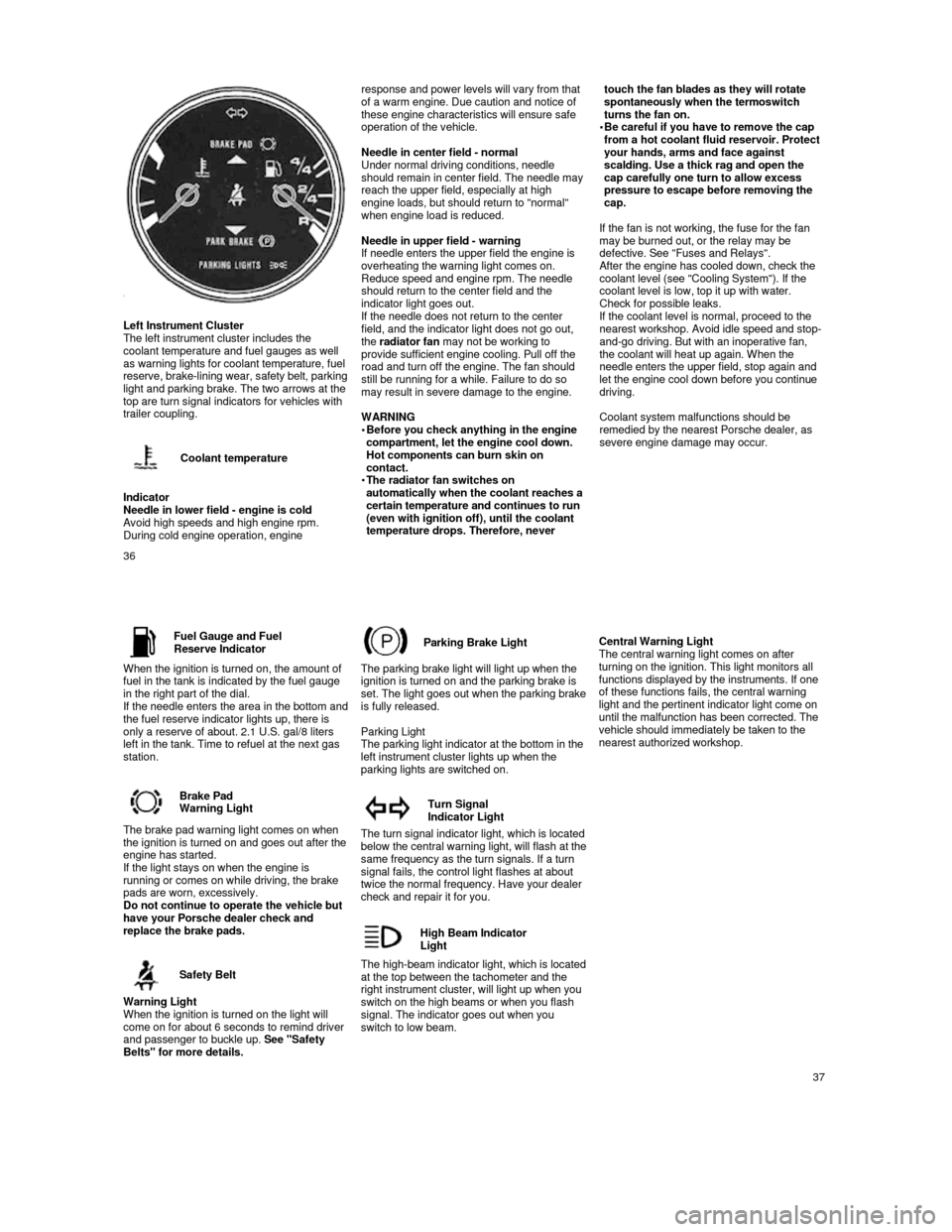
Left Instrument Cluster
The left instrument cluster includes the
coolant temperature and fuel gauges as well
as warning lights for coolant temperature, fuel
reserve, brake-
lining wear, safety belt, parking light and parking brake. The two arrows at the
top are turn signal indicators for vehicles with
trailer coupling.
Coolant temperature
Indicator
Needle in lower field - engine is cold
Avoid high speeds and high engine rpm. During cold engine operation, engine
response and power levels will vary from that
of a warm engine. Due caution and notice of
these engine characteristics will ensure safe
operation of the vehicle.
Needle in center field - normal
Under normal driving conditions, needle
should remain in center field. The needle may
reach the upper field, especially at high
engine loads, but should return to "normal"
when engine load is reduced.
Needle in upper field - warning
If needle enters the upper field the engine is
overheating the warning light comes on.
Reduce speed and engine rpm. The needle
should return to the center field and the
indicator light goes out.
If the needle does not return to the center
field, and the indicator light does not go out,
the radiator fan may not be working to
provide sufficient engine cooling. Pull off the
road and turn off the engine. The fan should
still be running for a while. Failure to do so
may result in severe damage to the engine.
WARNING
Before you check anything in the engine compartment, let the engine cool down.
Hot components can burn skin on
contact. The radiator fan switches on automatically when the coolant reaches a
certain temperature and continues to run
(even with ignition off), until the coolant
temperature drops. Therefore, never
touch the fan blades as they will rotate spontaneously when the termoswitch
turns the fan on.
Be careful if you have to remove the cap from a hot coolant fluid reservoir. Protect
your hands, arms and face against
scalding. Use a thick rag and open the
cap carefully one turn to allow excess
pressure to escape before removing the
cap.
If the fan is not working, the fuse for the fan
may be burned out, or the relay may be
defective. See "Fuses and Relays".
After the engine has cooled down, check the coolant level (see "Cooling System"). If the
coolant level is low, top it up with water.
Check for possible leaks.
If the coolant level is normal, proceed to the
nearest workshop. Avoid idle speed and stop-
and-go driving. But with an inoperative fan,
the coolant will heat up again. When the
needle enters the upper field, stop again and
let the engine cool down before you continue
driving.
Coolant system malfunctions should be
remedied by the nearest Porsche dealer, as
severe engine damage may occur.
36
Fuel Gauge and FuelReserve Indicator
When the ignition is turned on, the amount of
fuel in the tank is indicated by the fuel gauge
in the right part of the dial.
If the needle enters the area in the bottom and the fuel reserve indicator lights up, there is
only a reserve of about. 2.1 U.S. gal/8 liters
left in the tank. Time to refuel at the next gas
station.
Brake Pad
Warning Light
The brake pad warning light comes on when the ignition is turned on and goes out after the engine has started.
If the light stays on when the engine is
running or comes on while driving, the brake
pads are worn, excessively.
Do not continue to operate the vehicle but
have your Porsche dealer check and
replace the brake pads.
Safety Belt
Warning Light
When the ignition is turned on the light will
come on for about 6 seconds to remind driver
and passenger to buckle up. See "Safety
Belts" for more details.
Parking Brake Light
The parking brake light will light up when the
ignition is turned on and the parking brake is
set.
The light goes out when the parking brake is fully released.
Parking Light
The parking light indicator at the bottom in the
left instrument cluster lights up when the
parking lights are switched on.
Turn Signal
Indicator Light
The turn signal indicator light, which is located below the central warning light, will flash at the same frequency as the turn signals. If a turn
signal fails, the control light flashes at about
twice the normal frequency. Have your dealer
check and repair it for you.
High Beam Indicator
Light
The high-beam indicator light, which is located at the top between the tachometer and the
right instrument cluster, will light up when you
switch on the high beams or when you flash
signal. The indicator goes out when you
switch to low beam.
Central Warning Light
The central warning light comes on after
turning on the ignition. This light monitors all
functions displayed by the instruments. If one
of these functions fails, the central warning
light and the pertinent indicator light come on
until the malfunction has been corrected. The
vehicle should immediately be taken to the
nearest authorized workshop.
37
Page 20 of 66
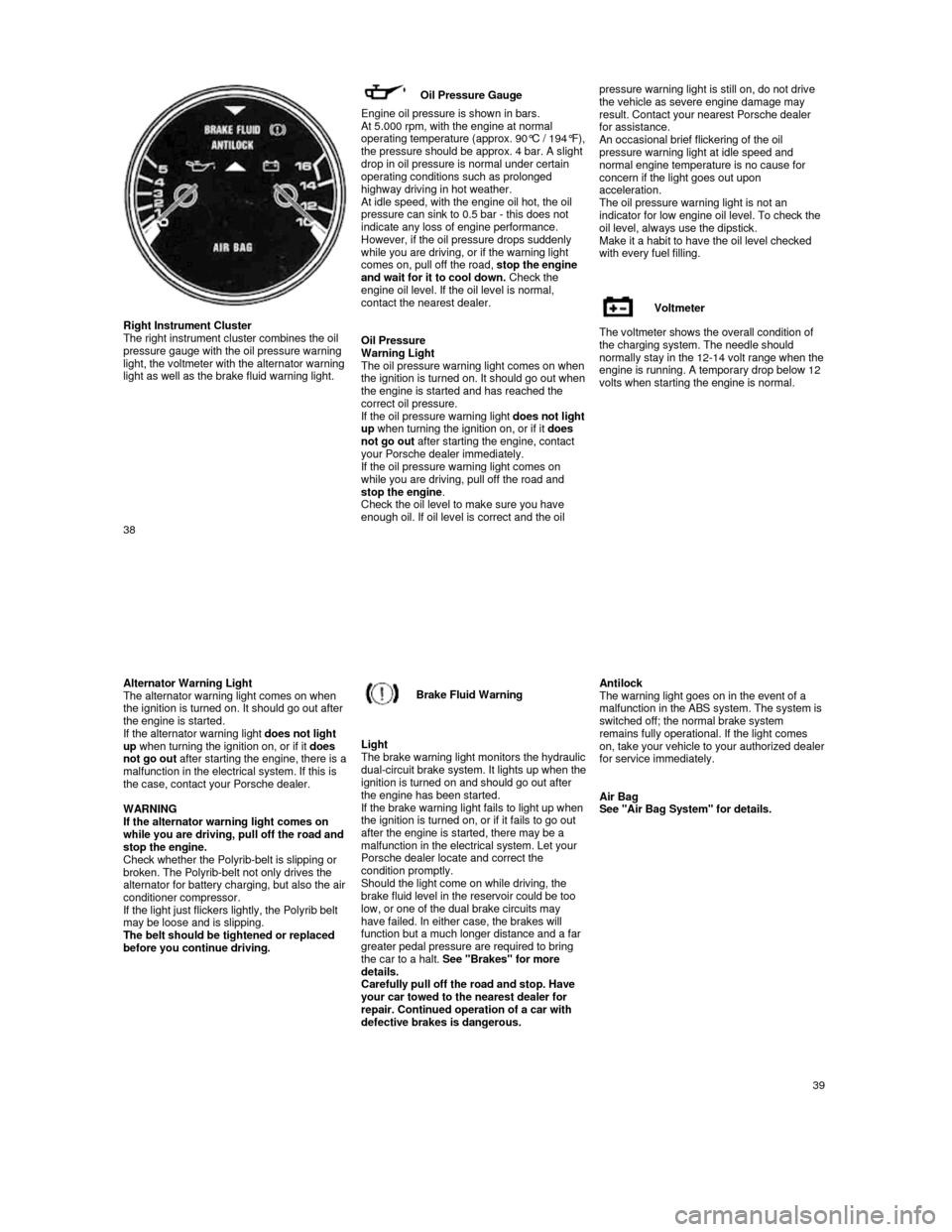
Right Instrument Cluster
The right instrument cluster combines the oil
pressure gauge with the oil pressure warning
light, the voltmeter with the alternator warning
light as well as the brake fluid warning light.
Oil Pressure Gauge
Engine oil pressure is shown in bars. At 5.000 rpm, with the engine at normal operating temperature (approx. 90°C / 194°F), the pressure should be approx. 4 bar. A slight
drop in oil pressure is normal under certain
operating conditions such as prolonged
highway driving in hot weather.
At idle speed, with the engine oil hot, the oil pressure can sink to 0.5 bar - this does not
indicate any loss of engine performance.
However, if the oil pressure drops suddenly
while you are driving, or if the warning light comes on, pull off the road,
stop the engine
and wait for it to cool down. Check the
engine oil level. If the oil level is normal,
contact the nearest dealer.
Oil Pressure
Warning Light
The oil pressure warning light comes on when the ignition is turned on. It should go out when the engine is started and has reached the
correct oil pressure.
If the oil pressure warning light
does not light up when turning the ignition on, or if it does
not go out after starting the engine, contact
your Porsche dealer immediately.
If the oil pressure warning light comes on
while you are driving, pull off the road and stop the engine .
Check the oil level to make sure you have
enough oil. If oil level is correct and the oil pressure warning light is still on, do not driv
e
the vehicle as severe engine damage may
result. Contact your nearest Porsche dealer
for assistance.
An occasional brief flickering of the oil pressure warning light at idle speed and
normal engine temperature is no cause for
concern if the light goes out upon
acceleration.
The oil pressure warning light is not an
indicator for low engine oil level. To check the
oil level, always use the dipstick.
Make it a habit to have the oil level checked
with every fuel filling.
Voltmeter
The voltmeter shows the overall condition of
the charging system. The needle should
normally stay in the 12-
14 volt range when the engine is running. A temporary drop below 12
volts when starting the engine is normal.
38
Alternator Warning Light
The alternator warning light comes on when
the ignition is turned on. It should go out after
the engine is started.
If the alternator warning light does not light
up when turning the ignition on, or if it does
not go out
after starting the engine, there is a malfunction in the electrical system. If this is
the case, contact your Porsche dealer.
WARNING
If the alternator warning light comes on
while you are driving, pull off the road and
stop the engine.
Check whether the Polyrib-belt is slipping or
broken. The Polyrib-belt not only drives the
alternator for battery charging, but also the air
conditioner compressor.
If the light just flickers lightly, the Polyrib bel t
may be loose and is slipping.
The belt should be tightened or replaced
before you continue driving.
Brake Fluid Warning
Light
The brake warning light monitors the hydraulic dual-circuit brake system. It lights up when the ignition is turned on and should go out after
the engine has been started.
If the brake warning light fails to light up when
the ignition is turned on, or if it fails to go out
after the engine is started, there may be a
malfunction in the electrical system. Let your
Porsche dealer locate and correct the
condition promptly.
Should the light come on while driving, the
brake fluid level in the reservoir could be too
low, or one of the dual brake circuits may
have failed. In either case, the brakes will
function but a much longer distance and a far
greater pedal pressure are required to bring
the car to a halt. See "Brakes" for more
details.
Carefully pull off the road and stop. Have
your car towed to the nearest dealer for
repair. Continued operation of a car with
defective brakes is dangerous.
Antilock
The warning light goes on in the event of a
malfunction in the ABS system. The system is
switched off; the normal brake system
remains fully operational. If the light comes
on, take your vehicle to your authorized dealer for service immediately.
Air Bag
See "Air Bag System" for details.
39
Page 22 of 66
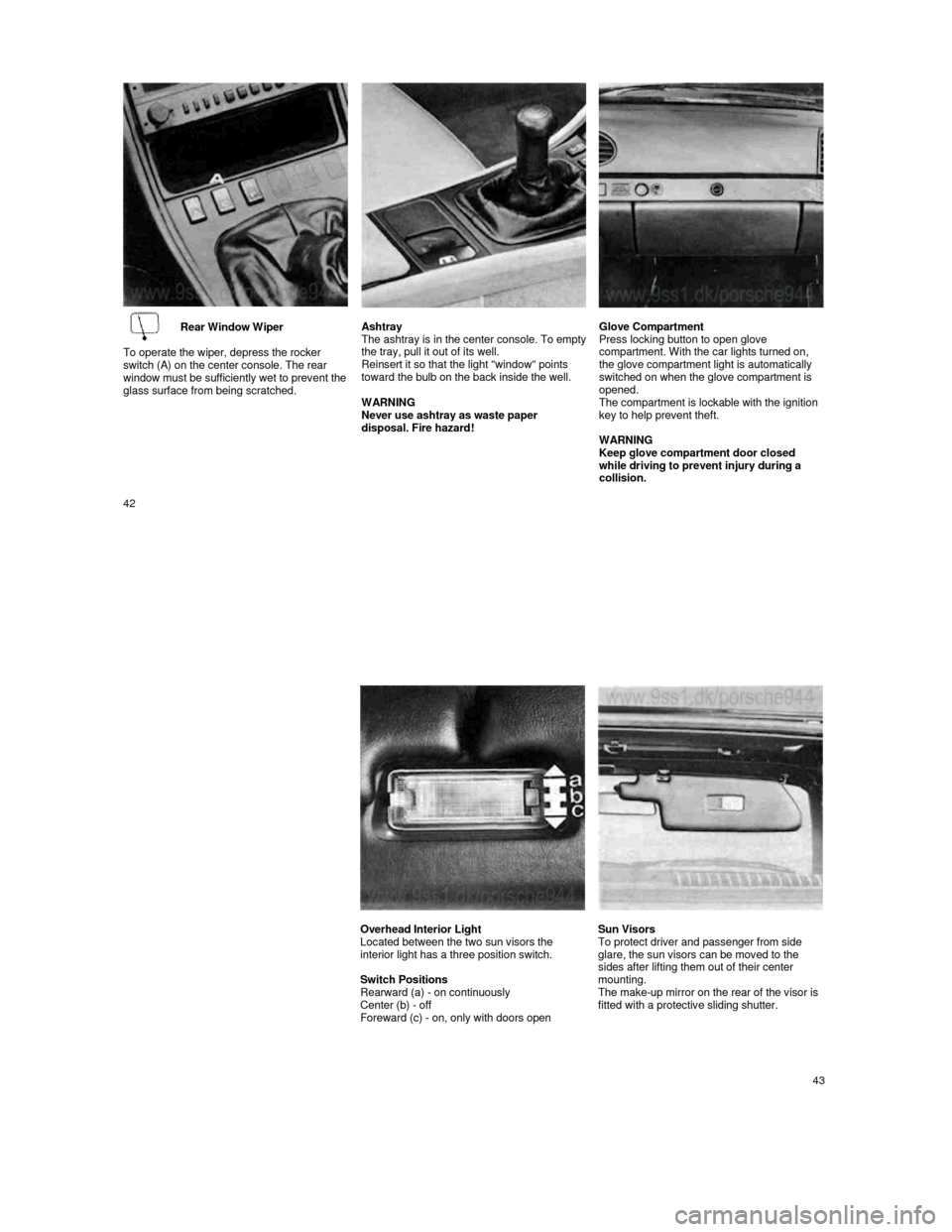
Rear Window Wiper
To operate the wiper, depress the rocker
switch (A) on the center console. The rear
window must be sufficiently wet to prevent the glass surface from being scratched.
Ashtray
The ashtray is in the center console. To empty the tray, pull it out of its well.
Reinsert it so that the light "window" points
toward the bulb on the back inside the well.
WARNING
Never use ashtray as waste paper
disposal. Fire hazard!
Glove Compartment
Press locking button to open glove
compartment. With the car lights turned on,
the glove compartment light is automatically
switched on when the glove compartment is
opened.
The compartment is lockable with the ignition
key to help prevent theft.
WARNING
Keep glove compartment door closed
while driving to prevent injury during a
collision.
42
Overhead Interior Light
Located between the two sun visors the
interior light has a three position switch.
Switch Positions
Rearward (a) - on continuously
Center (b) - off
Foreward (c) - on, only with doors open Sun Visors
To protect driver and passenger from side
glare, the sun visors can be moved to the
sides after lifting them out of their center
mounting.
The make-up mirror on the rear of the visor is
fitted with a protective sliding shutter.
43
Page 27 of 66
WARNING
Never carry additional fuel in portable containers in your car. Such containers,
full or partially empty, may leak, cause an
explosion, or result in fire in case of a
collision.
Porsche does not recommend the use of
fuel additives.
Do not use any fuel with octane ratings
lower than 91 RON or 87 CLC or AKI,
944S/944 Turbo 95 RON or 90 CLC or AKI.
Gasolines containing alcohol
Gasoline containing alcohol is available at gas
stations in some areas. The gas pump may not
be labeled to identify that alcohol is present in
the gasoline. If it is labeled, it may not identify
what amount and type(s) of alcohol
are used. We recommend you DO NOT use
fuels where the alcohol content cannot be
identified.
Gasolines containing methanol
DO NOT
use fuels containing methanol (methyl alcohol, wood alcohol). The use of fuel
containing this type of alcohol can result in
vehicle drivability and performance problems
and may damage critical parts of your vehicle's
fuel and emission control systems.
Gasolines containing ethanol
A mixture of unleaded gasoline and ethanol (ethyl alcohol, grain alcohol) is sold in some
areas. This mixture is sometimes called
"Gasohol".
You may use gasohol in your
Porsche, provided it contains no more than
10% ethanol, and the octane requirements for
your vehicle are met. However, we strongly
recommend to switch back to gasoline without
ethanol, if you experience any of the following
problems with your vehicle:
Deterioration of drivability and performance.
Substantially reduced fuel economy. Vapor lock and non-start problems, especially
at high altitude or at high temperatures.
Engine malfunction or stalling.
Continued use of gasohol under these
conditions may cause costly damage to the fuel system and the emission control system of your vehicle.
51
Gearshifting Manual Transmission
Maximum downshift points
5th to 4th gear
944 115 mph/1 80 km/h or 4300 rpm
944 S 123 mph/1 98 km/h or 5400 rpm
Turbo 130 mph/210 km/h or 5000 rpm
4th to 3rd gear
944 85 mph/1 36 km/h or 4750 rpm
944 S 91 mph/1 46 km/h or 5000 rpm
Turbo 96 mph/1 55 km/h or 4500 rpm
3rd to 2nd gear
944 58 mph/ 94 km/h or 4500 rpm
944 S 61 mph/ 98 km/h or 4600 rpm
Turbo 65 mph/1 05 km/h or 4250 rpm
2nd to 1st gear
944 34 mph/ 55 km/h or 3850 rpm
944 S 36 mph/ 58 km/h or 4000 rpm
Turbo 38 mph/ 62 km/h or 3700 rpm
Minimum upshifting points
1st to 2nd gear at 15 mph/24 km/h or
944 2850 rpm
944 S 2800 rpm
Turbo 2850 rpm
2nd to 3rd gear at 25 mph/40 km/h or
944 2800 rpm
944 S 2750 rpm
Turbo 2400 rpm
3rd to 4th gear at 40 mph/64 km/h or
944 3050 rpm
944 S 3000 rpm
Turbo 2750 rpm
4th to 5th gear at 48 mph/77 km/h or
944 2700 rpm
944 S 2650 rpm
Turbo 2300 rpm
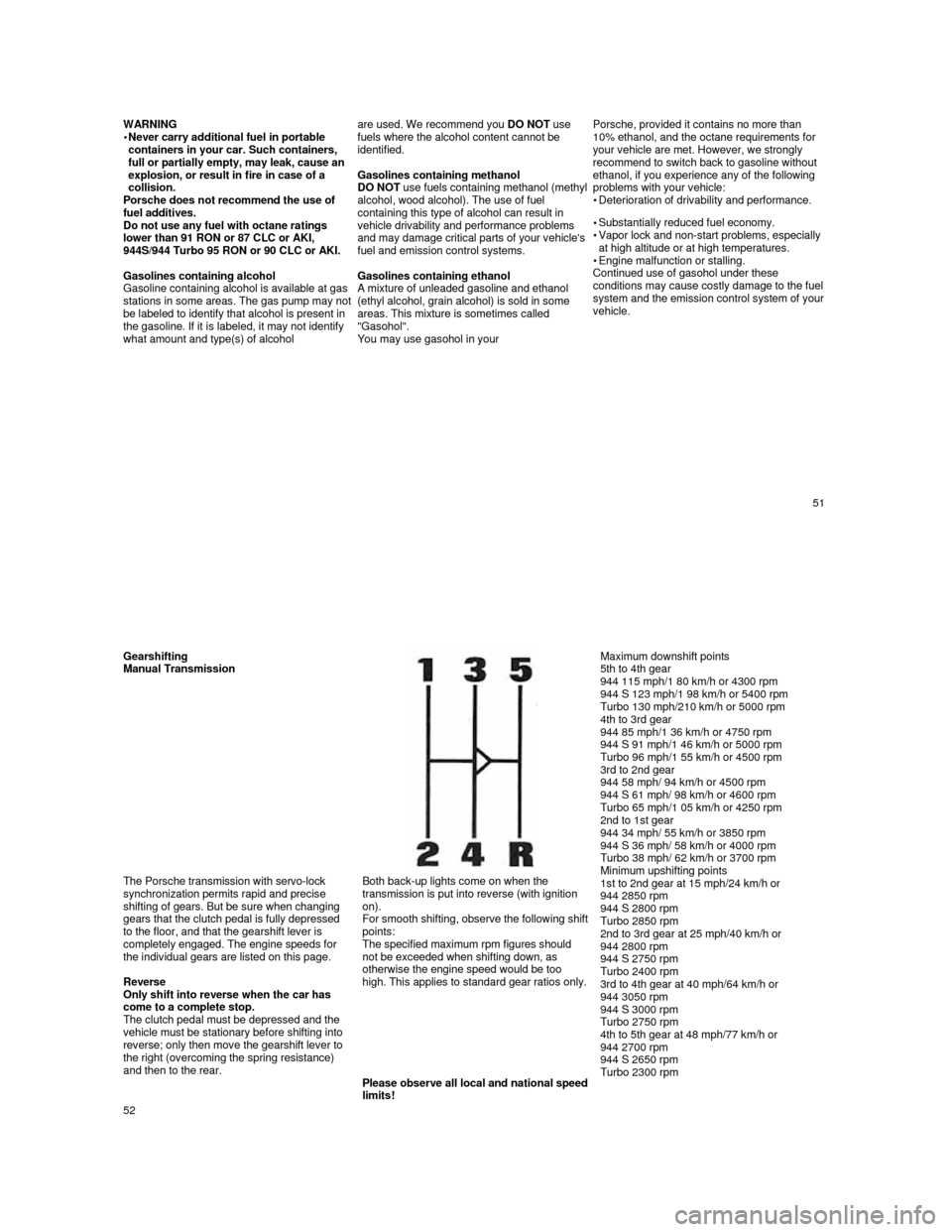
The Porsche transmission with servo-lock
synchronization permits rapid and precise
shifting of gears. But be sure when changing
gears that the clutch pedal is fully depressed
to the floor, and that the gearshift lever is
completely engaged. The engine speeds for
the individual gears are listed on this page.
Reverse
Only shift into reverse when the car has
come to a complete stop.
The clutch pedal must be depressed and the
vehicle must be stationary before shifting into
reverse; only then move the gearshift lever to
the right (overcoming the spring resistance)
and then to the rear. Both back-up lights come on when the
transmission is put into reverse (with ignition
on).
For smooth shifting, observe the following shift points:
The specified maximum rpm figures should
not be exceeded when shifting down, as
otherwise the engine speed would be too
high. This applies to standard gear ratios only.
Please observe all local and national speed limits!
52
Page 28 of 66
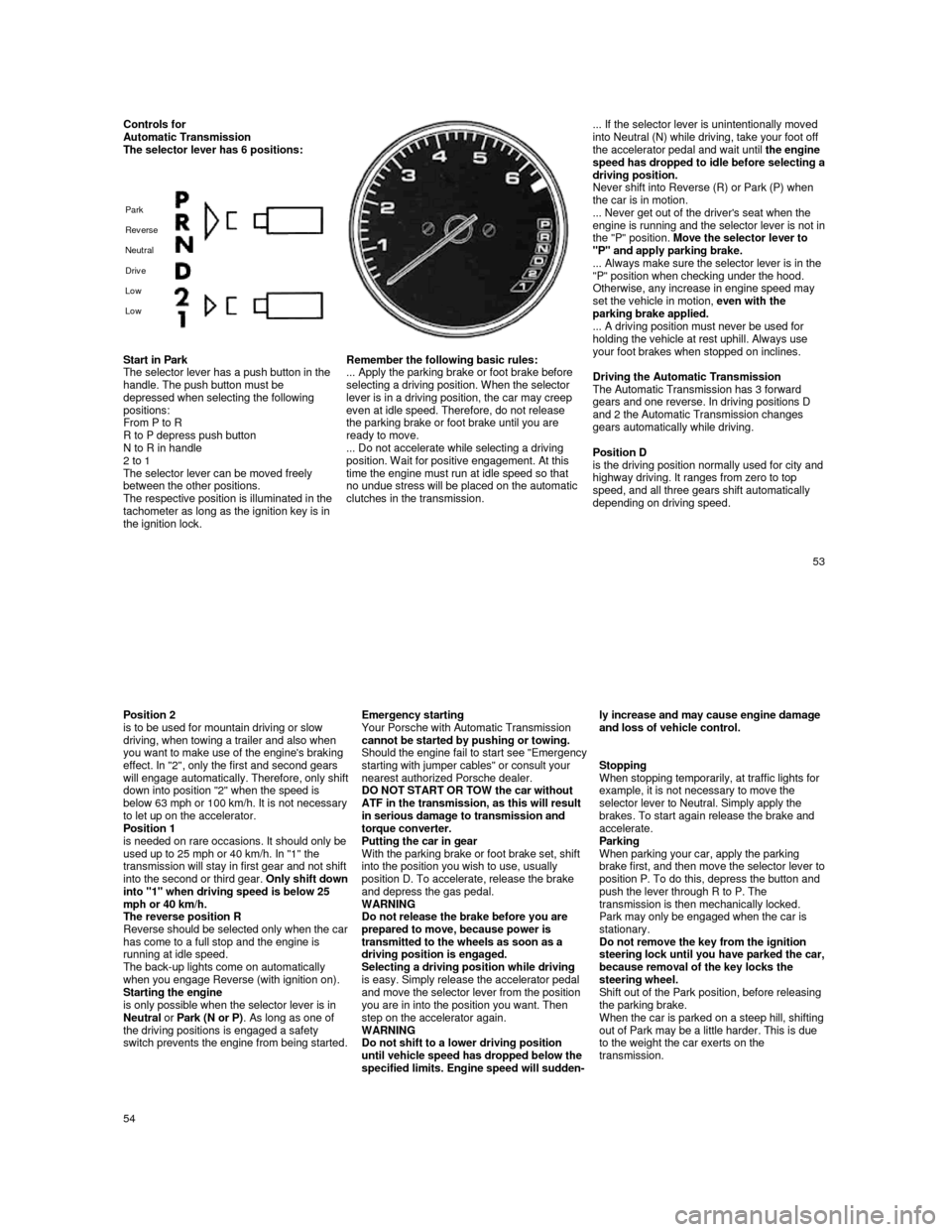
Controls for Automatic Transmission
The selector lever has 6 positions:
Park
Rev erse
Neutral
Driv e
Low
Low
... If the selector lever is unintentionally mo ved
into Neutral (N) while driving, take your foot off
the accelerator pedal and wait until the engine
speed has dropped to idle before selecting a driving position.
Never shift into Reverse (R) or Park (P) when
the car is in motion.
... Never get out of the driver's seat when the
engine is running and the selector lever is not in the "P" position. Move the selector lever to
"P" and apply parking brake.
... Always make sure the selector lever is in the
"P" position when checking under the hood.
Otherwise, any increase in engine speed may
set the vehicle in motion, even with the
parking brake applied.
... A driving position must never be used for
holding the vehicle at rest uphill. Always use
your foot brakes when stopped on inclines.
Driving the Automatic Transmission
The Automatic Transmission has 3 forward
gears and one reverse. In driving positions D
and 2 the Automatic Transmission changes
gears automatically while driving.
Position D
is the driving position normally used for city and highway driving. It ranges from zero to top
speed, and all three gears shift automatically
depending on driving speed.
Start in Park
The selector lever has a push button in the
handle. The push button must be
depressed when selecting the following
positions:
From P to R
R to P depress push button
N to R in handle
2 to 1
The selector lever can be moved freely
between the other positions.
The respective position is illuminated in the tachometer as long as the ignition key is in
the ignition lock.
Remember the following basic rules:
... Apply the parking brake or foot brake before
selecting a driving position. When the selector
lever is in a driving position, the car may creep
even at idle speed. Therefore, do not release
the parking brake or foot brake until you are
ready to move.
... Do not accelerate while selecting a driving
position. Wait for positive engagement. At this
time the engine must run at idle speed so that
no undue stress will be placed on the automatic
clutches in the transmission.
53
Position 2
is to be used for mountain driving or slow
driving, when towing a trailer and also when
you want to make use of the engine's braking
effect. In "2", only the first and second gears
will engage automatically. Therefore, only shift down into position "2" when the speed is below 63 mph or 100 km/h. It is not necessary to let up on the accelerator.
Position 1
is needed on rare occasions. It should only be
used up to 25 mph or 40 km/h. In "1" the
transmission will stay in first gear and not shift
into the second or third gear.
Only shift down into "1" when driving speed is below 25
mph or 40 km/h.
The reverse position R
Reverse should be selected only when the car has come to a full stop and the engine is
running at idle speed.
The back-up lights come on automatically
when you engage Reverse (with ignition on). Starting the engine
is only possible when the selector lever is in
Neutral or Park (N or P) . As long as one of
the driving positions is engaged a safety
switch prevents the engine from being started.
Emergency starting
Your Porsche with Automatic Transmission
cannot be started by pushing or towing.
Should the engine fail to start see "Emergency starting with jumper cables" or consult your
nearest authorized Porsche dealer.
DO NOT START OR TOW the car without
ATF in the transmission, as this will result
in serious damage to transmission and
torque converter.
Putting the car in gear
With the parking brake or foot brake set, shift
into the position you wish to use, usually
position D. To accelerate, release the brake
and depress the gas pedal.
WARNING
Do not release the brake before you are
prepared to move, because power is
transmitted to the wheels as soon as a
driving position is engaged.
Selecting a driving position while driving
is easy. Simply release the accelerator pedal
and move the selector lever from the position
you are in into the position you want. Then
step on the accelerator again.
WARNING
Do not shift to a lower driving position
until vehicle speed has dropped below the
specified limits. Engine speed will sudden-
ly increase and may cause engine damage and loss of vehicle control.
Stopping
When stopping temporarily, at traffic lights for
example, it is not necessary to move the
selector lever to Neutral. Simply apply the
brakes. To start again release the brake and
accelerate.
Parking
When parking your car, apply the parking
brake first, and then move the selector lever to position P. To do this, depress the button and
push the lever through R to P. The
transmission is then mechanically locked.
Park may only be engaged when the car is
stationary.
Do not remove the key from the ignition
steering lock until you have parked the car, because removal of the key locks the
steering wheel.
Shift out of the Park position, before releasing
the parking brake.
When the car is parked on a steep hill, shifting
out of Park may be a little harder. This is due
to the weight the car exerts on the
transmission.
54
Page 30 of 66
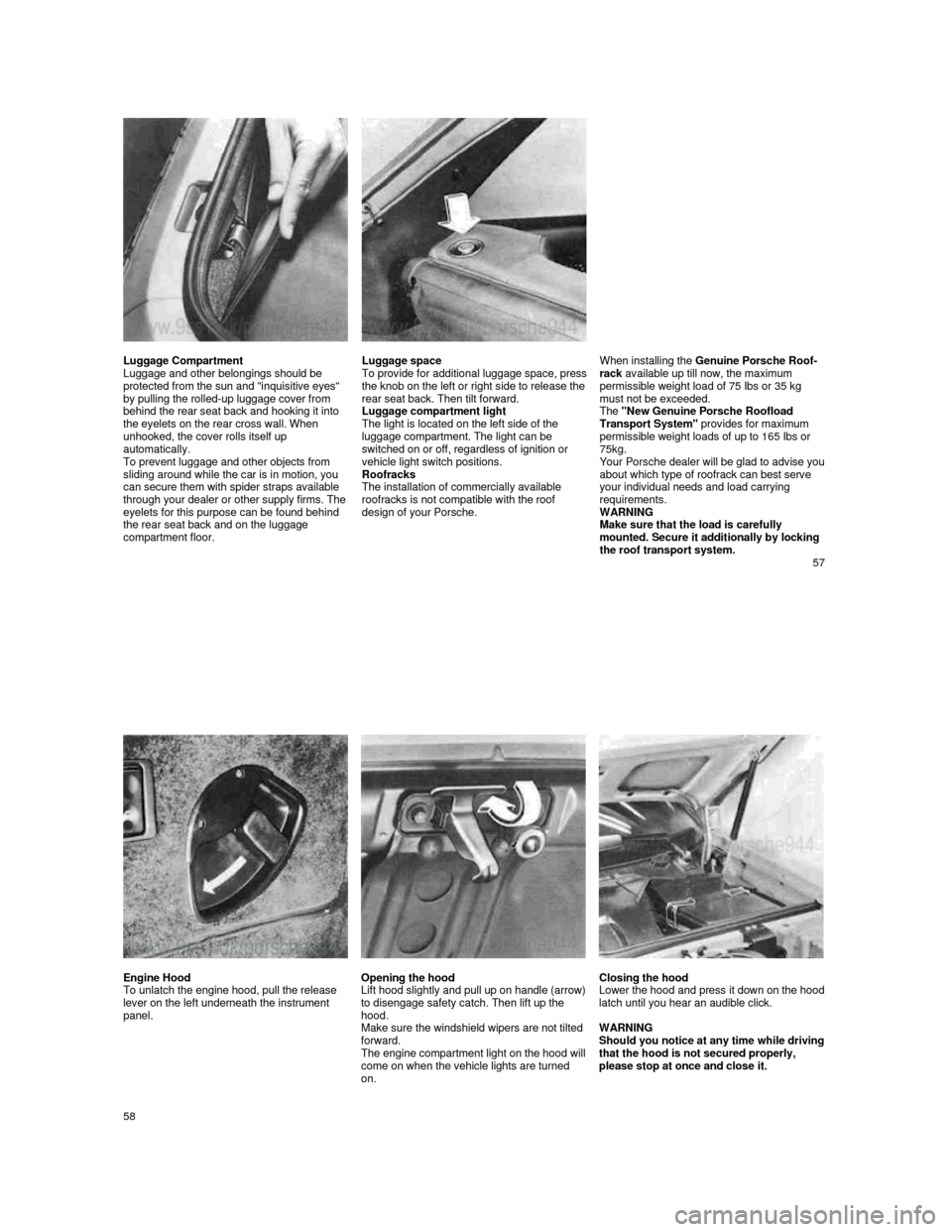
Luggage Compartment
Luggage and other belongings should be
protected from the sun and "inquisitive eyes"
by pulling the rolled-up luggage cover from
behind the rear seat back and hooking it into
the eyelets on the rear cross wall. When
unhooked, the cover rolls itself up
automatically.
To prevent luggage and other objects from
sliding around while the car is in motion, you
can secure them with spider straps available
through your dealer or other supply firms. The
eyelets for this purpose can be found behind
the rear seat back and on the luggage
compartment floor. Luggage space
To provide for additional luggage space, press the knob on the left or right side to release the rear seat back. Then tilt forward.
Luggage compartment light
The light is located on the left side of the
luggage compartment. The light can be
switched on or off, regardless of ignition or
vehicle light switch positions.
Roofracks
The installation of commercially available
roofracks is not compatible with the roof
design of your Porsche.
When installing the Genuine Porsche Roof-
rack available up till now, the maximum
permissible weight load of 75 Ibs or 35 kg
must not be exceeded.
The "New Genuine Porsche Roofload
Transport System" provides for maximum
permissible weight loads of up to 165 Ibs or
75kg.
Your Porsche dealer will be glad to advise you about which type of roofrack can best serve
your individual needs and load carrying
requirements.
WARNING
Make sure that the load is carefully
mounted. Secure it additionally by locking
the roof transport system.
57
Engine Hood
To unlatch the engine hood, pull the release
lever on the left underneath the instrument
panel. Opening the hood
Lift hood slightly and pull up on handle (arrow) to disengage safety catch. Then lift up the
hood.
Make sure the windshield wipers are not tilted
forward.
The engine compartment light on the hood will come on when the vehicle lights are turned
on.
Closing the hood
Lower the hood and press it down on the hood latch until you hear an audible click.
WARNING
Should you notice at any time while driving that the hood is not secured properly,
please stop at once and close it.
58
Page 42 of 66
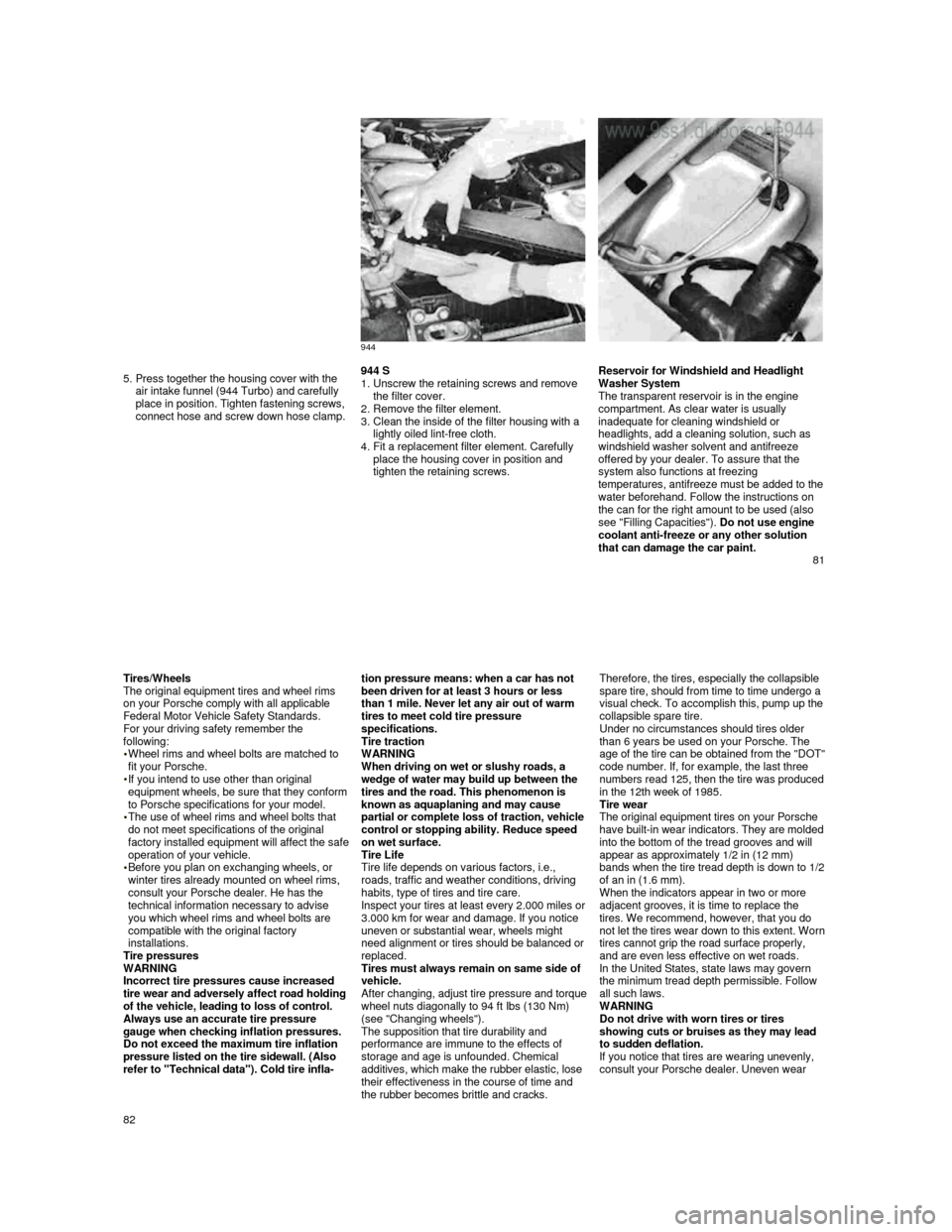
944
5. Press together the housing cover with the air intake funnel (944 Turbo) and carefully
place in position. Tighten fastening screws,
connect hose and screw down hose clamp.
944 S
1. Unscrew the retaining screws and remove
the filter cover.
2.
Remove the filter element.
3. Clean the inside of the filter housing with a
lightly oiled lint-free cloth.
4.
Fit a replacement filter element. Carefully
place the housing cover in position and
tighten the retaining screws.
Reservoir for Windshield and Headlight
Washer System
The transparent reservoir is in the engine
compartment. As clear water is usually
inadequate for cleaning windshield or
headlights, add a cleaning solution, such as
windshield washer solvent and antifreeze offered by your dealer. To assure that the
system also functions at freezing
temperatures, antifreeze must be added to the water beforehand. Follow the instructions on the can for the right amount to be used (also
see "Filling Capacities"). Do not use engine
coolant anti-freeze or any other solution
that can damage the car paint.
81
Tires/Wheels
The original equipment tires and wheel rims
on your Porsche comply with all applicable
Federal Motor Vehicle Safety Standards.
For your driving safety remember the
following:
Wheel rims and wheel bolts are matched to
fit your Porsche.
If you intend to use other than original equipment wheels, be sure that they conform to Porsche specifications for your model. The use of wheel rims and wheel bolts that
do not meet specifications of the original
factory installed equipment will affect the safe operation of your vehicle. Before you plan on exchanging wheels, or winter tires already mounted on wheel rims, consult your Porsche dealer. He has the
technical information necessary to advise
you which wheel rims and wheel bolts are
compatible with the original factory
installations.
Tire pressures
WARNING
Incorrect tire pressures cause increased
tire wear and adversely affect road holding of the vehicle, leading to loss of control.
Always use an accurate tire pressure
gauge when checking inflation pressures.
Do not exceed the maximum tire inflation
pressure listed on the tire sidewall. (Also
refer to "Technical data"). Cold tire infla-
tion pressure means: when a car has not been driven for at least 3 hours or less
than 1 mile. Never let any air out of warm
tires to meet cold tire pressure
specifications.
Tire traction
WARNING
When driving on wet or slushy roads, a
wedge of water may build up between the
tires and the road. This phenomenon is
known as aquaplaning and may cause
partial or com
plete loss of traction, vehicle control or stopping ability. Reduce speed
on wet surface.
Tire Life
Tire life depends on various factors, i.e.,
roads, traffic and weather conditions, driving
habits, type of tires and tire care.
Inspect your tires at least
every 2.000 miles or 3.000 km for wear and damage. If you notice
uneven or substantial wear, wheels might
need alignment or tires should be balanced or
replaced.
Tires must always remain on same side of
vehicle.
After changing, adjust tire pressure and torque wheel nuts diagonally to 94 ft Ibs (130 Nm) (see "Changing wheels").
The supposition that tire durability and
performance are immune to the effects of
storage and age is unfounded. Chemical
additives, which make the rubber elastic, lose
their effectiveness in the course of time and
the rubber becomes brittle and cracks.
Therefore, the tires, especially the collapsible
spare tire, should from time to time undergo a
visual check. To accomplish this,
pump up the collapsible spare tire.
Under no circumstances should tires older
than 6 years be used on your Porsche. The
age of the tire can be obtained from the "DOT" code number. If, for example, the last three
numbers read 125, then the tire was produced in the 12th week of 1985.
Tire wear
The original equipment tires on your Porsche
have built-
in wear indicators. They are molded into the bottom of the tread grooves and will
appear as approximately 1/2 in (12 mm)
bands when the tire tread depth is down to
1/2 of an in (1.6 mm).
When the indicators appear in two or more
adjacent grooves, it is time to replace the
tires. We recommend, however, that you do
not let the tires wear down to this extent. Worn tires cannot grip the road surface properly,
and are even less effective on wet roads.
In the United States, state laws may govern
the minimum tread depth permissible. Follow
all such laws.
WARNING
Do not drive with worn tires or tires
showing cuts or bruises as they may lead
to sudden deflation.
If you notice that tires are wearing unevenly,
consult your Porsche dealer. Uneven wear
82
Page 46 of 66
If it fails to light up, the fuse is defective and
must be replaced. Replace black plastic
cover.
The central electrical system contains plug in
relays for various electrical switching
functions.
Defective relays should be tested and
replaced by an authorized Porsche dealer.
To prevent damage to the electrical system
we recommend having all work - including the
installation of electrical accessories -carried
out by your authorized Porsche dealer. . ,
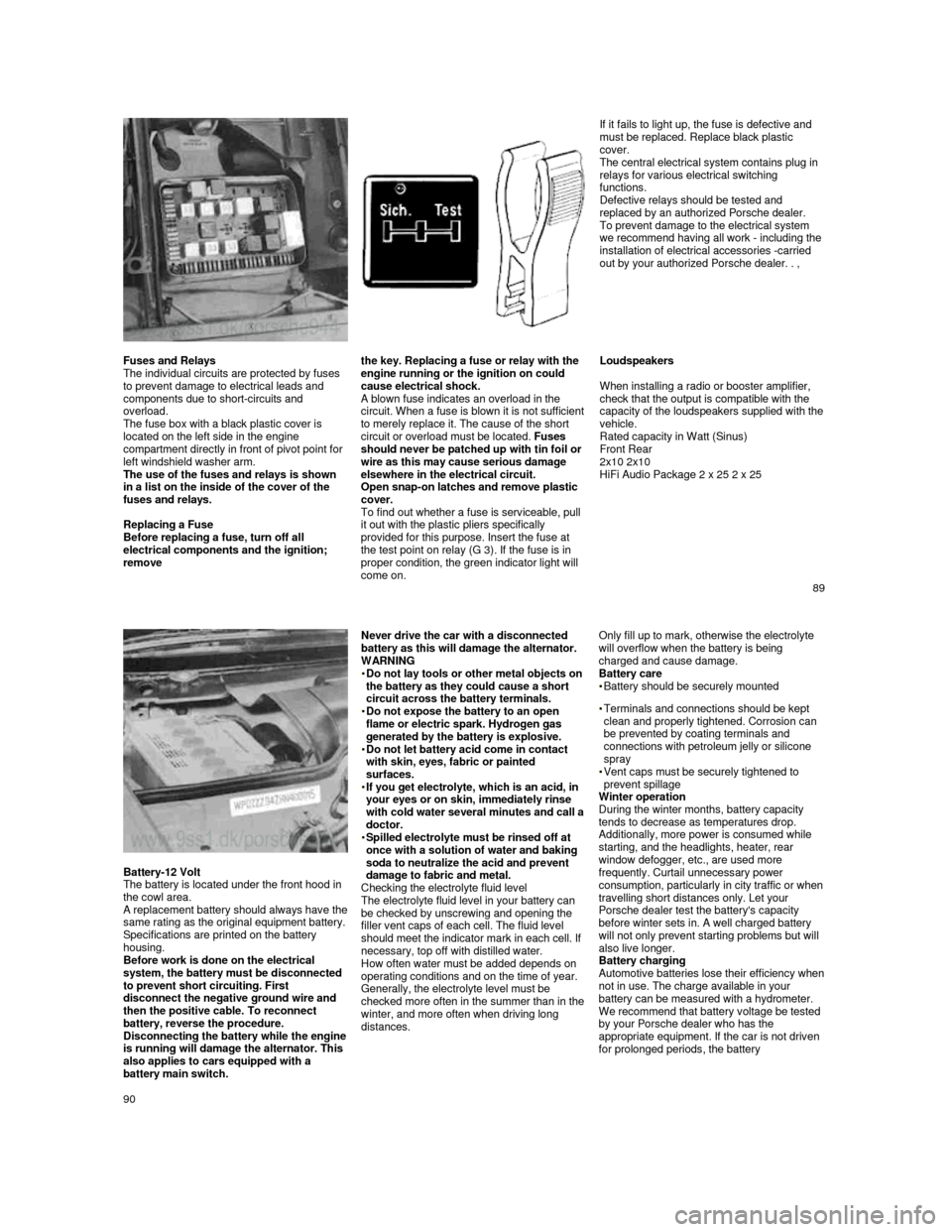
Fuses and Relays
The individual circuits are protected by fuses
to prevent damage to electrical leads and
components due to short-circuits and
overload.
The fuse box with a black plastic cover is
located on the left side in the engine
compartment directly in front of pivot point for
left windshield washer arm.
The use of the fuses and relays is shown
in a list on the inside of the cover of the
fuses and relays.
Replacing a Fuse
Before replacing a fuse, turn off all
electrical components and the ignition;
remove the key. Replacing a fuse or relay with the
engine running or the ignition on could
cause electrical shock.
A blown fuse indicates an overload in the circuit. When a fuse is blown it is not sufficient
to merely replace it. The cause of the short
circuit or overload must be located. Fuses
should never be patched up with tin foil or
wire as this may cause serious damage
elsewhere in the electrical circuit.
Open snap-on latches and remove plastic
cover.
To find out whether a fuse is serviceable, pull
it out with the plastic pliers specifically
provided for this purpose. Insert the fuse at
the test point on relay (G 3). If the fuse is in
proper condition, the green indicator light will
come on.
Loudspeakers
When installing a radio or booster amplifier,
check that the output is compatible with the
capacity of the loudspeakers supplied with the vehicle.
Rated capacity in Watt (Sinus)
Front Rear
2x10 2x10
HiFi Audio Package 2 x 25 2 x 25
89
Battery-12 Volt
The battery is located under the front hood in
the cowl area.
A replacement battery should always have the same rating as the original equipment battery.
Specifications are printed on the battery
housing.
Before work is done on the electrical
system, the battery must be disconnected
to prevent short circuiting. First
disconnect the negative ground wire and
then the positive cable. To reconnect
battery, reverse the procedure.
Disconnecting the battery while the engine is running will damage the alternator. This
also applies to cars equipped with a
battery main switch.
Never drive the car with a disconnected battery as this will damage the alternator. WARNING
Do not lay tools or other metal objects on the battery as they could cause a short
circuit across the battery terminals.
Do not expose the battery to an open flame or electric spark. Hydrogen gas
generated by the battery is explosive.
Do not let battery acid come in contact with skin, eyes, fabric or painted
surfaces.
If you get electrolyte, which is an acid, in your eyes or on skin, immediately rinse
with cold water several minutes and call a doctor. Spilled electrolyte must be rinsed off at once with a solution of water and baking
soda to neutralize the acid and prevent
damage to fabric and metal.
Checking the electrolyte fluid level
The electrolyte fluid level in your battery can
be checked by unscrewing and opening the
filler vent caps of each cell. The fluid level
should meet the indicator mark in each cell. If
necessary, top off with distilled water.
How often water must be added depends on
operating conditions and on the time of year.
Generally, the electrolyte level must be
checked more often in the summer than in the winter, and more often when driving long distances.
Only fill up to mark, otherwise the electrolyte will overflow when the battery is being charged and cause damage.
Battery care
Battery should be securely mounted
Terminals and connections should be kept
clean and properly tightened. Corrosion can
be prevented by coating terminals and
connections with petroleum jelly or silicone
spray
Vent caps must be securely tightened to
prevent spillage
Winter operation
During the winter months, battery capacity
tends to decrease as temperatures drop.
Additionally, more power is consumed while starting, and the headlights, heater, rear window defogger, etc., are used more
frequently. Curtail unnecessary power
consumption, particularly in city traffic or when travelling short distances only. Let your
Porsche dealer test the battery's capacity
before winter sets in. A well charged battery
will not only prevent starting problems but will
also live longer.
Battery charging
Automotive batteries lose their efficiency when not in use. The charge available in your
battery can be measured with a hydrometer.
We recommend that battery voltage be tested
by your Porsche dealer who has the
appropriate equipment. If the car is not driven
for prolonged periods, the battery
90
Page 47 of 66
must be charged at least every 6 weeks. A
discharged battery allows rapid formation of
sulfates, leading to premature deterioration of
the plates.
WARNING
Charge battery in a well ventilated area.
Keep away from open flame or electrical
spark. Do not smoke. Hydrogen gas
generated by the battery is explosive.
Electrolyte fluid that may spill during charging should be washed off with a solution of warm water and baking soda to neutralize the acid. If you get electrolyte in your eyes or on your
skin, immediately rinse with cold water for
several minutes and call a doctor.
Never charge a frozen battery. It may
explode because of gas trapped in the ice.
Allow a frozen battery to thaw out first. Never use a fast charger as a booster to start the engine. This may seriously damage the
vehicle's electrical system and the charger.
Fast charging a battery is dangerous and
should only be attempted by a competent
mechanic with the proper equipment.
Slow battery charging
WARNING
Heed all warnings and follow instructions
that come with your battery charger.
Disconnect battery cables and remove the
battery.
All vent caps should be open. If fluid level is low, it should be topped up to the full mark in
each cell.
Connect charger cables.
Charger cables must be connected
POSITIVE (+) to POSITIVE (+) and
NEGATIVE (-) to NEGATIVE (-).
Do not connect or disconnect charger cables while charger is operating. Switch on charger. Normally, a battery should be charged at no
more than 10 percent of its rated capacity.
Rated capacity of the battery in your vehicle
is listed on the battery housing.
After charging, turn off charger and disconnect charger cables. Tighten the vent caps and reinstall battery.
91
Emergency Starting with Jumper Cables
WARNING
Improper use of booster battery to start a
vehicle may cause an explosion.
Lead-acid batteries generate explosive
gases. Keep sparks, flame and lighted
cigarettes away from batteries.
Do not charge a frozen battery, thaw it out
first. Gas trapped in the ice may cause an
explosion.
No attempt should be made to jump start any vehicle with a low electrolyte level in the
battery.
Check electrolyte level of each cell. If
necessary, fill with distilled water to just
above plates.
Make sure the voltage of both batteries is the same. The capacity (Ah) of the booster battery
should not be lower than that of the
discharged battery.
Vehicle with discharged battery: turn off
lights and accessories, remove key, move
lever to N or P and set parking brake.
Vehicle with booster battery should not be
running. Disconnect ground cable.
Remove vent caps from booster battery and
discharged battery. Preferably lay a cloth
over open vents to reduce explosion hazard.
How to use jumper cables WARNING
To avoid serious personal injury and damage to the vehicle, heed all warnings
and instructions of the jumper cable
manufacturer. The jumper cables must be long enough so that neither vehicles nor cables touch
another.
Improper hook-up of jumper cables can
ruin the alternator.
Always connect POSITIVE (+) to POSITIVE
(+), and NEGATIVE (-) to ground on engine
block.
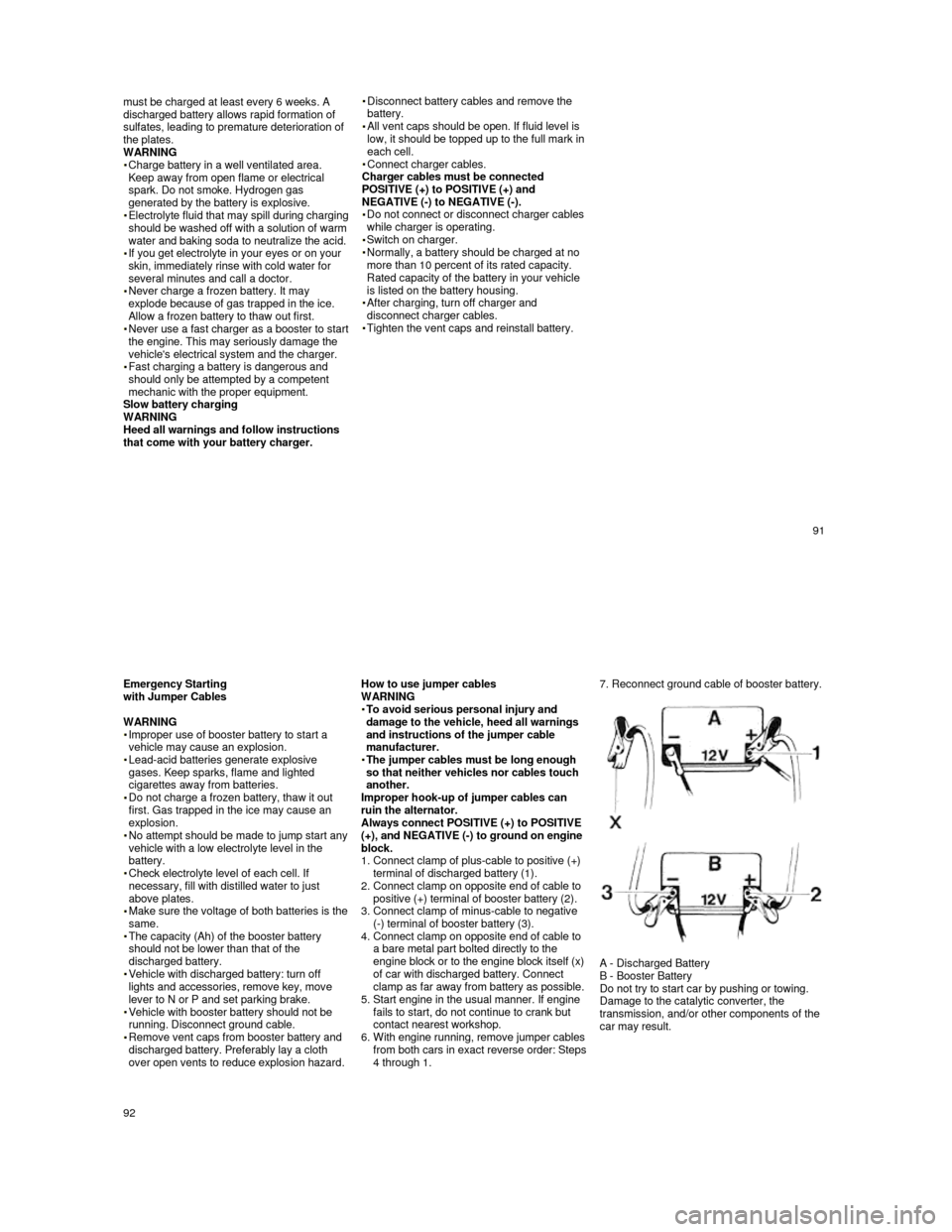
1. Connect clamp of plus-cable to positive (+) terminal of discharged battery (1).
2.
Connect clamp on opposite end of cable to
positive (+) terminal of booster battery (2).
3.
Connect clamp of minus-cable to negative
(-) terminal of booster battery (3).
4.
Connect clamp on opposite end of cable to
a bare metal part bolted directly to the
engine block or to the engine block itself (x)
of car with discharged battery. Connect
clamp as far away from battery as possible.
5. Start engine in the usual manner. If engine
fails to start, do not continue to crank but
contact nearest workshop.
6.
With engine running, remove jumper cables from both cars in exact reverse order: Steps 4 through 1.
7. Reconnect ground cable of booster battery.
A - Discharged Battery
B - Booster Battery
Do not try to start car by pushing or towing.
Damage to the catalytic converter, the
transmission, and/or other components of the
car may result.
92
Page 48 of 66
Replacing Bulbs
944 / 944 S
944 Turbo To avoid short circuits, turn off the respective
electrical components when changing light
bulbs.
Keep bulbs free of grease and dirt. Hold
them only with a clean cloth or soft paper.
Do not use chemical cleaning agents on
the plastic lenses. Plastic lenses should
only be cleaned with water or a mild soap/
water solution.
We recommend that you have an assortment
of spare bulbs in the car.
When traveling abroad don't forget that some
countries require spare bulbs as part of the
safety equipment.
Front - Turn Signal Lights /
Parking Lights
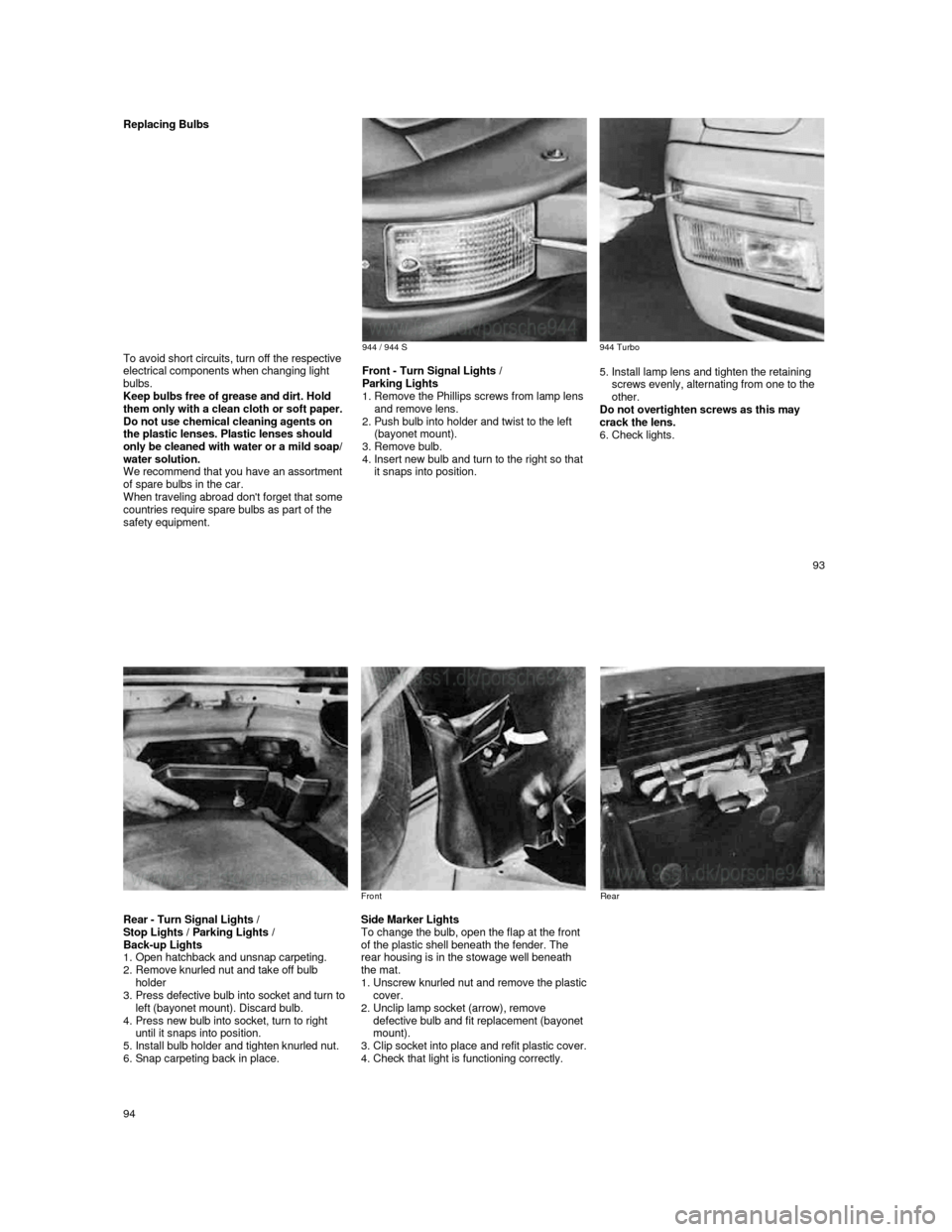
1. Remove the Phillips screws from lamp lens
and remove lens.
2.
Push bulb into holder and twist to the left
(bayonet mount).
3.
Remove bulb.
4. Insert new bulb and turn to the right so that
it snaps into position.
5. Install lamp lens and tighten the retaining screws evenly, alternating from one to the
other.
Do not overtighten screws as this may
crack the lens.
6. Check lights.
93
Front
Rear Rear - Turn Signal Lights /
Stop Lights / Parking Lights /
Back-up Lights
1. Open hatchback and unsnap carpeting.
2.
Remove knurled nut and take off bulb
holder
3.
Press defective bulb into socket and turn to
left (bayonet mount). Discard bulb.
4.
Press new bulb into socket, turn to right
until it snaps into position.
5.
Install bulb holder and tighten knurled nut.
6. Snap carpeting back in place.
Side Marker Lights
To change the bulb, open the flap at the front
of the plastic shell beneath the fender. The
rear housing is in the stowage well beneath
the mat.
1.
Unscrew knurled nut and remove the plastic cover.
2. Unclip lamp socket (arrow), remove
defective bulb and fit replacement (bayonet
mount).
3.
Clip socket into place and refit plastic cover. 4. Check that light is functioning correctly.
94