transmission PORSCHE BOXSTER 2005 2.G User Guide
[x] Cancel search | Manufacturer: PORSCHE, Model Year: 2005, Model line: BOXSTER, Model: PORSCHE BOXSTER 2005 2.GPages: 276, PDF Size: 4.05 MB
Page 145 of 276

Shifting Gear
145 Shifting Gear
Manual Transmission, Clutch ...................... 146
Tiptronic S ................................................ 147
Page 146 of 276

146
Shifting Gear
Manual Transmission, ClutchThe positions of the gears are shown on the shift
diagram on the gearshift lever.
Warning!
Risk of accident.
fDo not obstruct the pedal travel with floor mats
or other objects.
Nonskid floor mats of the correct size are
available at your authorized Porsche dealer.
To avoid damage to the clutch and transmis-
sion:
fAlways depress the clutch pedal fully when
changing gears. Make sure that the gearshift
lever is completely engaged.
fOnly shift into reverse when the car has come to a complete stop.fWhen shifting gears, always ensure that the
clutch pedal is fully depressed and the gear
has fully engaged.
fSelect reverse only when vehicle is stationary.
fSelect an appropriately low gear on upward
and downward slopes.
This will ensure optimum use of engine power
and engine braking.
When reverse gear is selected and the ignition is
on, the backup lights are illuminated.
Permitted engine speedfYou should change into a higher gear before
the needle reaches the red mark on the ta-
chometer, or ease off the accelerator.
If the red zone is reached during acceleration, fuel
feed is interrupted.
Caution!
Risk of engine damage (overrevving) when
shifting down to a lower gear.
fTake care not to exceed the maximum permit-ted engine speed when shifting down.
Page 147 of 276

Shifting Gear
147
Tiptronic SThe Porsche Tiptronic is a five-speed transmission
with an “automatic” and a “manual” selection
mode.
In automatic selection mode (selector lever po-
sition D), gear changing is automatic.
You can change temporarily from automatic to
manual mode using the rocker switches on the
steering wheel.
In manual selection mode (selector lever posi-
tion M), you change gear using the rocker switch-
es on the steering wheel.
You can change between selector lever position D
and M as you wish while driving.
Note
Take care not to operate the rocker switches on
the steering wheel inadvertently in either auto mat-
ic or manual mode, thereby triggering undesired
gear changes.Keylock positionThe ignition key can be withdrawn only in selec-
tor lever position P.
Changing the selector lever positionThe selector lever is locked with the ignition key
withdrawn.
The selector lever can be moved from position P
or N only with:
– the ignition switched on,
– the brake pedal pressed and
– the release button pressed.Release button
The release button (arrow) in the selector lever
prevents unintentional gear changes.
The release button must be pressed when shifting
to position R or P.
StartingThe engine can be started only if the brake pedal
is depressed and the selector lever is in position
P or N.Moving offfOnly select the desired position for moving off
(D, M or R) when the engine is idling and the
brake pedal is depressed.
fSince the vehicle creeps when in gear, do not
release the brake until you want to move off.
fAfter selecting a gear, do not accelerate until
you can feel that the gear is engaged.
Page 148 of 276

148
Shifting Gear
Indicator for selector lever position and
engaged gear When the engine is running, the selector lever po-
sition and engaged gear are indicated. If the selector lever is between two positions:
– The corresponding selector lever position in
the instrument cluster flashes and
– the warning “Selector lever not engaged” ap-
pears in the on-board computer.
fEngage the selector lever correctly.
– The selector lever position is displayed imme-
diately after the correct position has been de-
tected.
– The current gear is shown after a brief detec-
tion period.If there is a fault in the transmission:
– The 4th-gear and the selector lever position se-
lected displays flash in alternation.
– The warning “Tiptronic emergency run” ap-
pears on the on-board computer.
Please observe the chapter “EMERGENCY
PROGRAM” on Page 152.
– Have the fault remedied at an autorized
Porsche dealer.
Page 150 of 276

150
Shifting Gear Shifting gear on the steering wheel
With the toggle switches on the steering wheel,
you can change temporarily from automatic
selection mode D to manual mode M.
Advantages:
– Shifting down before bends and on entering bu-
ilt-up areas.
– Shifting down on downward slopes (engine bra-
king).
– Shifting down for brief spurts of acceleration.
– Selecting 1st gear for moving off.
The manual selection mode remains engaged:
– for cornering (depending on the lateral
acceleration) and overrunning,
– when the vehicle is stationary
(e.g. at a junction).
The system leaves manual selection mode:
– automatically after approx. 8 seconds
(unless cornering or overrunning),
– if you depress the accelerator to kickdown,
– after moving off. Temporary change-down
Conditions:
Speed is higher than approx. 33 mph (54 km/h).
fDepress accelerator quickly.
The Tiptronic changes temporarily to the spor-
tiest gear-changing map, i.e. to the highest
possible gear-changing points. Correspondin-
gly, the transmission shifts down immediately
by one or two gears.
Ending the function:
fRelease the accelerator markedly (by approx.
25%). Kickdown
The kickdown function is active in selector lever
position D, even if you temporarily change to ma-
nual mode M using the toggle switches on the
steering wheel.
fFor optimum acceleration, e.g. when overta-
king, depress the accelerator pedal beyond
the full-throttle point (kickdown).
The transmission shifts down depending on the
speed of travel and engine speed.
Upward shifts occur at the highest possible engine
speeds.
These gear-changing speeds remain active until
the accelerator is released to approx. 80% of the
wide open throttle position.
Page 152 of 276

152
Shifting Gear
Slip monitoring When the speeds of rotation of the front and rear
axles differ by more than the maximum permissib-
le value, integrated slip monitoring shifts up to the
next gear.
This increases driving stability on a slippery sur-
face.
Note
fSlip monitoring is also deactivated when
Porsche Stability Management (PSM) is swit-
ched off. Stopping fFor a brief stop, e.g. at a traffic light, leave the
selector lever in drive position and hold the ve-
hicle with the brake pedal.
fFor a longer stop with the engine running,
select position N (neutral).
fDo not hold the car on a slope using the
accelerator. Use the brake pedal or the hand-
brake instead.
fBefore leaving the vehicle, always apply the
handbrake and move the selector lever to
position P.
Parking fGo easy on the accelerator.
fWhen parking or maneuvring in a small space,
control the speed by careful use of the footbra-
ke. Driving in winter In wintery road conditions it is advisable to take
steep inclines in manual mode. This prevents the
occurrence of gear changes that could cause
wheelspin. Tow-starting, towing fPlease observe the chapter “TOWING” on Page
254.
Emergency program
Warning!
Reverse gear lock monitoring is disabled in
the emergency running program.
Damage to the vehicle may result as well as
loss of control, if the vehicle is moving for-
w a r d f a s t e n o u g h t o c a u s e r e a r w h e e l l o c k u p .
fDo not shift into R while the vehicle is moving forward.
A transmission fault is indicated by the following
symptoms:
–The 4th-gear display flashes.
– The warning “Tiptronic emergency run”
appears in the on-board computer.
– The transmission no longer shifts.
Regardless of selector lever position, 4th is
the only forward gear still available.
fAdapt your driving style to the changed hand-
ling.
fTo remedy the fault, please consult an authori-
zed Porsche dealer.
Page 167 of 276

Maintenance, Car Care
167 Maintenance, Car Care
Exercise Extreme Caution
when Working on your Vehicle .................... 168
Wiper Blades ............................................ 169
Coolant Level ............................................ 170
Engine Oil ................................................. 172
Engine Oil Level ........................................ 173
Engine Oil Recommendation ....................... 174
Brake Fluid Level ....................................... 175
Fuel Economy ........................................... 177
Operating Your Porsche in other Countries .. 177
Fuel.......................................................... 178
Fuel Recommendations.............................. 180
Portable Fuel Containers ............................ 181
Emission Control System ........................... 182
How Emission Control Works ..................... 183
Fuel Evaporation Control ............................ 184
Washer Fluid ............................................. 184
Opening Engine Compartment Lid............... 185
Power Steering ......................................... 189
Air Filter ................................................... 190
Combination filter ...................................... 190
Automatic Transmission Fluid ..................... 190
Manual Transmission Oil ............................ 190
Car Care Instructions................................. 191
Page 190 of 276

190
Maintenance, Car Care
Air Filter The air filter is on the left-hand side of the engine
compartment.
A dirty air filter not only reduces engine perfor-
mance, but can lead to premature engine wear.
Regular filter replacement is part of the routine
maintenance service.
fIn dusty conditions, check the filter element
more frequently and replace if necessary. Combination filterThe fresh air passing through the combination
filter into the passenger compartment is virtually
free of dust, pollen, and unpleasant odours.
fIf the outside air is polluted by exhaust fumes,
press the circulating-air button.
A dirty filter can be the cause of reduced air
throughput:
fHave the filter replaced by an authorized
Porsche dealer.
Regular filter replacement is part of servicing.
Automatic Transmission Fluid The torque converter and the transmission are lu-
bricated with Automatic Transmission Fluid (ATF).
The final drive requires transmission oil.
fPlease observe the chapter “CAPACITIES” on
Page 266.
Do not tow the car or run the engine without ATF
in the transmission. The automatic transmission
may be damaged by even a tiny speck of dirt, only
a clean funnel or spout must be used when adding
AT F.
The ATF and transmission oil has to be checked
and changed at the intervals listed in your Mainte-
nance Schedule.
We recommend that you have the ATF and trans-
mission oil changed at your Porsche dealer, who
has the required lubricants and the necessary fil-
ling equipment.
If you suspect an oil leak in the transmission, have
your authorized Porsche dealer check it out imme-
diately.
Manual Transmission Oil The transmission oil has to be checked and chan-
ged at the intervals listed in your Maintenance
Schedule.
fPlease observe the chapter “CAPACITIES” on
Page 266.
We recommend that you have the transmission oil
changed at your Porsche dealer, who has the re-
quired lubricants and the necessary filling equip-
ment.
If you suspect an oil leak in the transmission, have
your authorized Porsche dealer check it out imme-
diately.
Page 197 of 276

Maintenance, Car Care
197
Warning!
Danger of fire and serious personal injuries.
fDo not apply additional undercoating or rust-
proofing on or near the exhaust manifold, ex-
haust pipes, catalytic converters or heat
shields. During driving the substance used for undercoating could overheat and ignite.
fBefore applying fresh underseal, carefully re-
move deposits or dirt and grease. Once it has
dried, the new undercoating compound forms
a tough protective coating which provides effi-
cient rust-proofing of the floor panels and com-
ponents.
fAlways apply a fresh coating of suitable preser-
vative to unprotected areas after cleaning the
underside of the body, the transmission, the
engine or carrying out repairs to under-body,
engine or transmission components.
Effective rust-proofing is particularly important du-
ring the cold weather season. If your car is driven
frequently in areas where salt has been spread on
the roads, the whole engine compartment should
be cleaned thoroughly after the winter to prevent
salt from causing any lasting damage. A full under-
body wash should also be performed at the same
time.
Door, roof, lid and window seals fWash dirt (e.g. abrasion, dust, road salts) from
all seals regularly using warm soapy water. Do
not use any chemical cleaning agents or sol-
vents.
When there is a frost hazard, the outer door seals
and the front and rear lid seals can be protected
against freezing into place by a suitable care pro-
duct.
In order to prevent damage to the anti-fric-
tion coating, the inner door seals, the con-
vertible top seals and hardtop seals must not
be treated with care products.
Headlights, lights, interior and exterior
plastic parts fUse only clean water and a little dishwashing
detergent to clean light lenses, plastic head-
light lenses, plastic parts and surfaces.
Do not clean when dry.
Use a soft sponge or a soft, lint-free cloth.
Gently wipe the surface without applying too
much pressure.
The Porsche inside window cleaner is also sui-
table for cleaning plastic surfaces. Follow the
cleaning instructions on the container.
Never use other chemical cleaners or
solvents.
fRinse cleaned surfaces with clear water.
Page 258 of 276
258
Vehicle Identification, Technical Data
Vehicle IdentificationWhen ordering spare parts or making inqui-
ries, please always quote the vehicle identifi-
cation number. Vehicle identification label Vehicle identification label is attached to the inner
side of the front luggage compartment hood be-
low the hood lock. It contains all important data
about your car.
This label contains the following information:
1. Vehicle Identification No.
2. Type/Type description
3. Engine code/Transmission code
4. Paint No./Interior
5. Optional equipment
A duplicate of this label is in your Maintenance
Booklet.
Note
This data bank cannot be re-ordered if it is lost or
damaged.
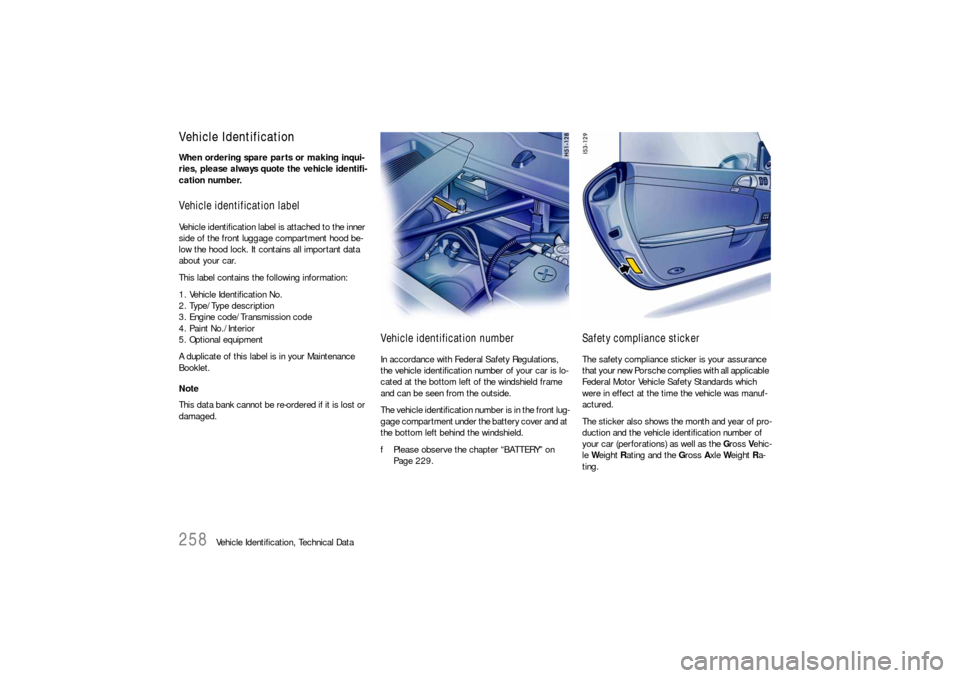
Vehicle identification number In accordance with Federal Safety Regulations,
the vehicle identification number of your car is lo-
cated at the bottom left of the windshield frame
and can be seen from the outside.
The vehicle identification number is in the front lug-
gage compartment under the battery cover and at
the bottom left behind the windshield.
fPlease observe the chapter “BATTERY” on
Page 229.
Safety compliance sticker The safety compliance sticker is your assurance
that your new Porsche complies with all applicable
Federal Motor Vehicle Safety Standards which
were in effect at the time the vehicle was manuf-
actured.
The sticker also shows the month and year of pro-
duction and the vehicle identification number of
your car (perforations) as well as the Gross Vehic-
le Weight Rating and the Gross Axle Weight Ra-
ting.