fuse PORSCHE BOXSTER 2005 2.G Owner's Manual
[x] Cancel search | Manufacturer: PORSCHE, Model Year: 2005, Model line: BOXSTER, Model: PORSCHE BOXSTER 2005 2.GPages: 276, PDF Size: 4.05 MB
Page 231 of 276

Practical Tips, Emergency Service
231
Winter drivingThe capacity and ability of the battery to store
power decreases at low outside temperatures.
Moreover, the battery is more heavily loaded in the
winter months, e.g. by the heated rear window,
the more frequent use of additional lights, the
blower and the windshield wipers, etc.
fHave the battery checked before winter
begins.
Keep the battery well charged to prevent it from
freezing.
A discharged battery can freeze even at
23°F/-5 °
C, but a fully charged one only freezes at
-40°F/-40 °C.
Laying up the vehicleIf the vehicle stands for long periods in the garage
or workshop, the doors and lids should be closed.
fPlease observe the chapter “EMERGENCY
UNLOCKING OF THE FRONT LUGGAGE
COMPARTMENT LID” on Page 228.
fWithdraw the ignition key and, if necessary,
disconnect the battery.
When the battery is disconnected, the
alarm system ceases to function!
Even if you put your vehicle out of operation, the
battery still discharges.
fThe battery must be charged, i.e. connected
to a charger, approximately every 6 weeks in
order to preserve functioning.
Always observe the instructions of the charger
manufacturer.
fStore a battery that has been removed in a
dark, cool place, but not subject to frost.
Replacing the batteryThe battery is subject to normal wear: its service
life depends heavily on the care you give it,
climatic conditions and the conditions of use
(distances, loads).
It is not possible to use the details on the battery
case to determine a comparable battery that
meets all the specific requirements of Porsche.
fUse only a battery that meets the specific
requirements of your vehicle as a replacement.
We recommend that you use an Orignal
Porsche battery.
fPlease observe the disposal instructions for
batteries!
Page 236 of 276

236
Practical Tips, Emergency Service
Jump lead startingfPlease observe the chapter “EMERGENCY
UNLOCKING OF THE FRONT LUGGAGE
COMPARTMENT LID” on Page 228.
fPlease observe the chapter “BATTERY” on
Page 229.
If the battery is flat, the battery of another vehicle
can be used to start the car with the aid of jump
leads.
Both batteries must be 12 volt types. The
capacity (Ampere hours, Ah) of the donor battery
must not be substantially less than that of the
discharged battery.
The discharged battery must be correctly
connected to the vehicle’s electrical system.
Warning!
Risk of damage and injury due to short
circuit.
fUse only standard jump leads with sufficient
cross section and completely insulated
clamps.
Follow the jump lead manufacturer’s instruc-
tions.
fRoute the jump leads so that they cannot be
caught by moving parts in the engine compart-
ment.
The vehicles must not be in contact, otherwise
current might flow as soon as the positive
terminals are connected.
fCarefully ensure that conductive jewellery
(rings, chains, watch straps) do not come into
contact with live parts of the vehicle.
Danger of caustic burns.
fDo not lean over the battery.
Danger of gas explosion.
fKeep sources of ignition, e.g. naked flame,
burning cigarettes or sparks due to cable
contact, away from the battery.
fBefore connecting jump leads, it is essential to thaw out a frozen battery.
Connecting jump leadsAlways observe the sequence below:
1. Connect the red positive lead to the positive
terminal of the discharged battery first, then
connect it to the positive terminal of the donor
battery.
2. First connect the black negative cable to the
negative terminal of the donor battery, then
connect it to a suitable grounding point on the
vehicle with the discharged battery.
This grounding point must lie as far as possible
from the battery.
For example, a solid metal part or the engine
block are suitable grounding points.
If no suitable grounding points are to be found
on either vehicle, the negative cable must
carefully be connected directly to the negative
terminal of the battery.
If a suitable grounding point is to be found only
on the donor vehicle, the negative cable must
first be connected to the terminal of the
discharged battery, then to the grounding point
of the donor vehicle.
Page 238 of 276

238
Practical Tips, Emergency Service
Replacing bulbs
Warning!
Risk of short circuit.
fAlways switch off the relevant load when
changing bulbs.
Risk of injury. The Bi-Xenon headlights are
under high voltage when installed.
fExercise extreme caution when working in the
area of the Bi-Xenon headlights.
Risk of damage. Bulbs of a higher wattage
can damage the lamp housing.
fOnly use the bulbs specified in the bulb chart.
fBulbs must be clean and free from grease.
fNever touch bulbs with your bare hands. Use a
cloth or soft paper when replacing bulbs.
fAlways carry spare bulbs with you.
In certain countries, the carrying of spare
bulbs is mandatory.
Caution!
Risk of damage to headlights due to exces-
sive temperatures and abrasion.
fAttach no coverings (e.g. films, “stone
guards”) in the area of the headlights.
fUse soapy water only to clean light lenses and
plastic headlight lenses.
In no case may chemical cleaners or other vol-
atile cleaning fluids be used.
fTo prevent scratches, do not rub with a dry or merely moist cloth, tissue or insect sponges.
Page 240 of 276

240
Practical Tips, Emergency Service
Warning!
Risk of short circuit.
fAlways switch off the relevant load when
changing bulbs.
Risk of injury. The Bi-Xenon headlights are
under high voltage when installed.
fExercise extreme caution when working in the
area of the Bi-Xenon headlights.
Risk of damage. Bulbs of a higher wattage
can damage the lamp housing.
fOnly use the bulbs specified in the bulb chart.
fBulbs must be clean and free from grease.
fNever touch bulbs with your bare hands. Use a
cloth or soft paper when replacing bulbs.
fAlways carry spare bulbs with you.
In certain countries, the carrying of spare
bulbs is mandatory.
Caution!
Risk of damage to headlights due to exces-
sive temperatures and abrasion.
fAttach no coverings (e.g. films, “stone
guards”) in the area of the headlights.
fUse soapy water only to clean light lenses and
plastic headlight lenses.
In no case may chemical cleaners or other vol-
atile cleaning fluids be used.
fTo prevent scratches, do not rub with a dry or merely moist cloth, tissue or insect sponges.
Page 254 of 276
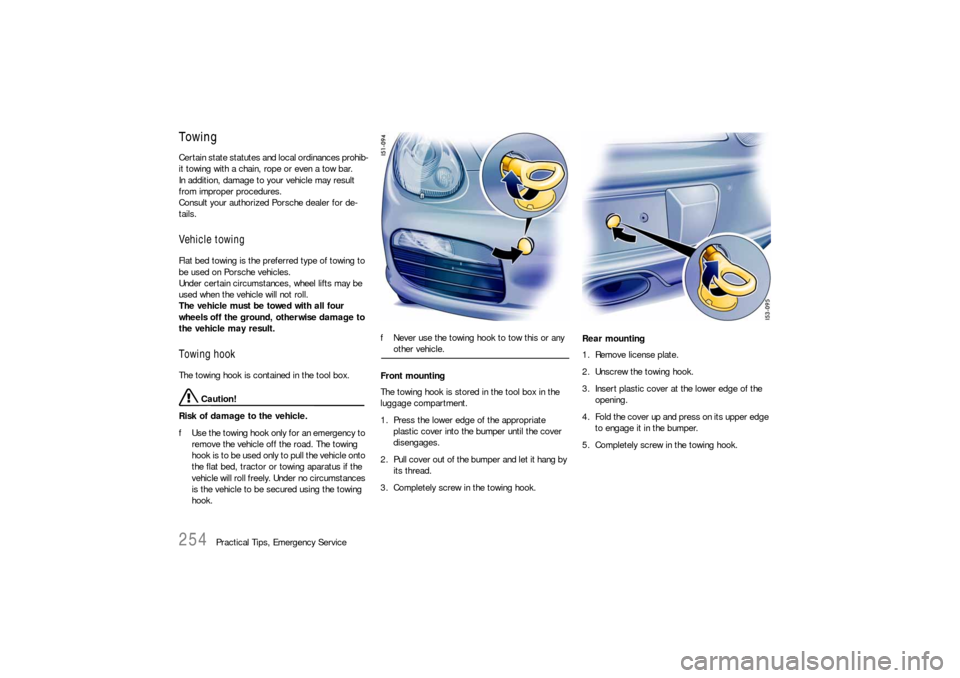
254
Practical Tips, Emergency Service
Towing Certain state statutes and local ordinances prohib-
it towing with a chain, rope or even a tow bar.
In addition, damage to your vehicle may result
from improper procedures.
Consult your authorized Porsche dealer for de-
tails. Vehicle towing Flat bed towing is the preferred type of towing to
be used on Porsche vehicles.
Under certain circumstances, wheel lifts may be
used when the vehicle will not roll.
The vehicle must be towed with all four
wheels off the ground, otherwise damage to
the vehicle may result. Towing hook The towing hook is contained in the tool box.
Caution!
Risk of damage to the vehicle.
fUse the towing hook only for an emergency to
remove the vehicle off the road. The towing
hook is to be used only to pull the vehicle onto
the flat bed, tractor or towing aparatus if the
vehicle will roll freely. Under no circumstances
is the vehicle to be secured using the towing
hook. fNever use the towing hook to tow this or any
other vehicle.
Front mounting
The towing hook is stored in the tool box in the
luggage compartment.
1. Press the lower edge of the appropriate
plastic cover into the bumper until the cover
disengages.
2. Pull cover out of the bumper and let it hang by
its thread.
3. Completely screw in the towing hook.Rear mounting
1. Remove license plate.
2. Unscrew the towing hook.
3. Insert plastic cover at the lower edge of the
opening.
4. Fold the cover up and press on its upper edge
to engage it in the bumper.
5. Completely screw in the towing hook.
Page 273 of 276

Index
273
Level.................................................. 170
Temperature gauge.............................. 80
Warning light ........................................ 80
Cooling system .....................................80
, 170
Cruise control ............................................... 76
Cupholder .................................................. 128
DDashboard ................................................... 65
Data bank .................................................. 258
Defrosting windows .............................114
, 117
Diagnostic socket .................................15, 227
Diagrams ................................................... 268
Dimensions ................................................ 267
Dipped beam .............................................. 241
Door ............................................................ 25
Guard lights ........................................ 251
Handles................................................ 25
Locks...........................................25, 194
Mirror heating ....................................... 33
Windows ....................... 25
, 28, 154
, 196
Driving hints ................................................. 12
Driving in winter .......................................... 152
Driving performance ................................... 265
Drop-center rim .......................................... 215
DVD Navigation........................................... 136
EElectrical system ........................................ 226
Emergency flasher ...................................... 121
Emergency operation
Central locking................................19
, 22
Convertible top ................................... 157Lids ...................................................228
Tank cap ............................................179
Emergency program, Tiptronic .....................152
Emergency service......................................202
Emergency starting with jump leads .............236
Emergenzy operation....................................22
Emission control system ........... 7
, 84, 182
, 183
Engine
Checking the oil level .............................97
Exhaust ..................................................8
Number ..............................................259
Oil consumption ....................................14
Oil level indicator...................................97
Oils ....................................................266
Speeds ................................................14
Starting ................................................67
Switching off.........................................67
Engine compartment
Blower .......................................... 70, 80
Lid ............................................ 135, 185
Lid warning light ..................................134
Environment ...................................................6
FFire extinguisher .........................................131
Flat tire ......................................................219
Floor mats ..................................................199
Fog lights .................................. 108
, 246
, 249
Footwell light ..............................................250
Front lid......................................................135
Fuel ................................................ 4
, 82, 178
Containers ..............................................8
Economy ............................................177
Evaporation ........................................184Level gauge ......................................... 82
Level warning light................................ 82
Portable Containers ............................ 181
Recommendation ....................... 180
, 181
Tank.......................................... 178, 179
Function keys ............................................... 40
Fuses ........................................................ 227
GGarage door opener................................... 142
Garage lift ................................................. 218
Gearchanging ............................................ 145
Glove compartment .................................... 127
Gong .............................. 68
, 69, 88, 107
, 108
Ground clearance ........................................... 8
HHandbrake ................................................... 51
Hardtop ..................................................... 162
Headlights ......................................... 109
, 241
Adjusting ................................... 252, 253
Cleaning system ................. 110
, 184
, 266
Heated rear window...................... 33
, 165
, 166
Heating ............................................. 114, 117
High beam
Indicator light ....................................... 79
Lever......................................... 108, 109
Home mode............................................... 108
HomeLink .................................................. 142
Hoods ............................................... 132, 135
Horn ..................................................... 15, 21