air condition PORSCHE BOXSTER 2006 2.G User Guide
[x] Cancel search | Manufacturer: PORSCHE, Model Year: 2006, Model line: BOXSTER, Model: PORSCHE BOXSTER 2006 2.GPages: 296, PDF Size: 4.12 MB
Page 133 of 296
Controls, Instruments
133
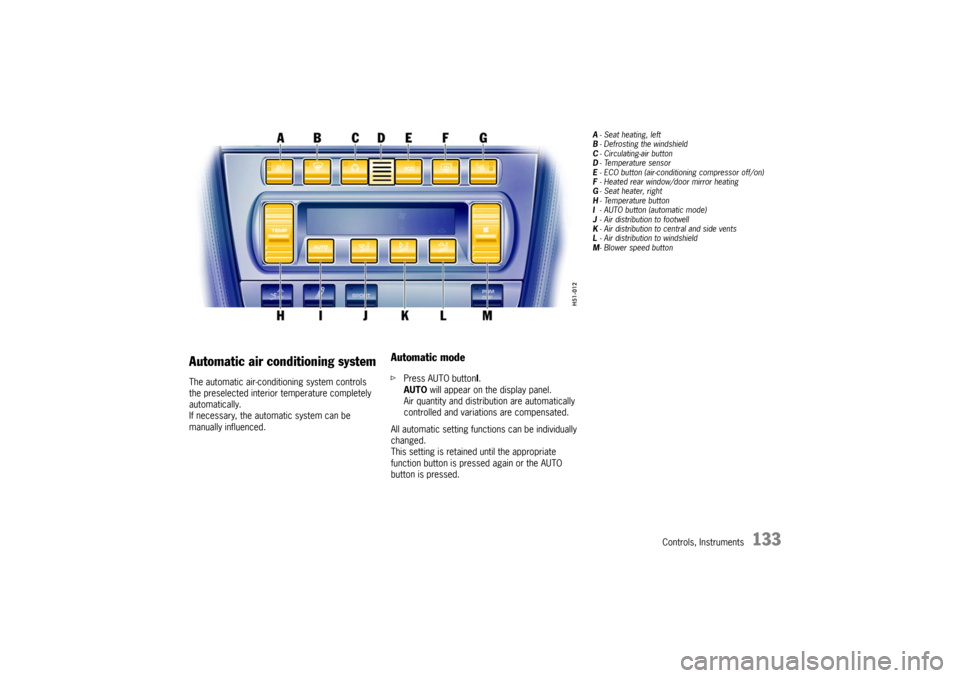
Automatic air conditioning systemThe automatic air-conditioning system controls
the preselected interior temperature completely
automatically.
If necessary, the automatic system can be
manually influenced.
Automatic modefPress AUTO buttonI.
AUTO will appear on the display panel.
Air quantity and distribution are automatically
controlled and variations are compensated.
All automatic setting functions can be individually
changed.
This setting is retained until the appropriate
function button is pressed again or the AUTO
button is pressed.
A- Seat heating, left
B- Defrosting the windshield
C- Circulating-air button
D-Temperature sensor
E- ECO button (air-conditioning compressor off/on)
F- Heated rear window/door mirror heating
G-Seat heater, right
H-Temperature button
I- AUTO button (automatic mode)
J- Air distribution to footwell
K- Air distribution to central and side vents
L- Air distribution to windshield
M-Blower speed button
Page 134 of 296

134
Controls, Instruments
Setting temperaturefPress button H upwards or downwards
respectively.
To suit personal comfort, the interior temperature
can be adjusted between 61°F and 85°F/16°C
and 29.5°C.
Recommendation: 72°F/22 °C.
If “LO” or “HI” appears on the display, the system
is operating at maximum cooling or heating
power.
Automatic control is no longer active.
Note
If the preselected temperature is changed, the
blower speed can increase automatically in
automatic mode.
The desired temperature is reached more quickly
this way.
Sensors
To avoid affecting the performance of the air-
conditioning system:
fDo not cover the sun sensor on the instrument
panel or the temperature sensor D.
Defrost windshieldfPress button B (switch on or off).
The windshield is demisted or defrosted as
quickly as possible.
Air flows to the windshield only.
The light-emitting diode in the button lights up.ECO – switching the air-conditioning
compressor on and offThe air conditioning compressor switches off
automatically at temperatures below approx.
37°F/3°C and cannot be switched on, even
manually.
Whenever outside temperatures exceed approx.
37°F/3°C, the air-conditioning compressor is
always switched on in automatic mode.
The compressor can be switched off manually to
save fuel, but control comfort is then limited:
fPress ECO button E.
The compressor is switched off.
The light-emitting diode in the button lights up.
fIf the interior temperature is too high, switch
compressor back on or press AUTO button.
To dry incoming air in damp weather, do not
switch off the air-conditioning compressor.
This prevents misting of windows.
Adjusting blower speedfPress button M upwards or downwards
respectively.
The preset blower speed is increased or
decreased.
The speeds are indicated by a bar display.
The compressor is switched off at low blower
speeds.
If the button is pressed downwards at the lowest
blower stage, the blower and automatic control
are switched off. “OFF” will appear on the display
field.
Pressing the button upwards or pressing the
AUTO button switches the blower and automatic
control back on again.Circulating-air mode
Warning!
Risk of accident due to hampered vision.
In circulating-air mode, the windows may
mist up.
fOnly select circulating-air mode for short
periods.
fIf the windows mist up, switch air-circulation
mode by pressing the air-circulation button
again and selecting the “Defrost windshield” function.
Page 135 of 296

Controls, Instruments
135
Switching circulating-air mode on or off
fPress button C.
The outside-air supply is interrupted and only
the inside air is circulated.
The light-emitting diode in the button lights up.
Over approx. 37°F/3°C
If the air-conditioning compressor was off, it
switches on automatically. The duration of
circulating-air mode is not limited.
Below approx. 37°F/3°C
The air-conditioning compressor is switched off.
Circulating-air mode is automatically ended after
approx. 3 minutes.Air distributionThe individual air distributions can be combined as
desired.
Recommended setting in Summer –
Air distribution to central and side vents
Recommended setting in Winter –
Air distribution to footwell and windshield
Air distribution to footwell
fPress button J.
The air flows to the footwell.
The selection appears on the display panel.Air distribution to center and side vents
fPress button K.
The air flows from the central and side vents.
Vents must be open.
The selection appears on the display panel.
Air distribution to windshield
fPress button L.
The air flows to the windshield.
The selection appears on the display panel.
Note on operation
fOn vehicles with the Sport Chrono package
Plus, individual air conditioning settings can be
stored on your vehicle key.
Please observe the chapter “Individual
Memory” in the separate PCM operating
instructions.
Information on air-conditioning
compressor– May switch off briefly to ensure sufficient
engine cooling if the engine is operating under
extreme load.
– Operates most effectively with the windows
closed.
If the vehicle has been in the sun for a long
time, it is a good idea to ventilate the interior
briefly with the windows open.
– Depending on the outside temperature and
humidity, condensation can drip from the
evaporator and form a pool under the car.
This is normal and not a sign of leakage.
– If uncooled air flows out when the lowest
temperature has been set, switch off the air
conditioning compressor and have the fault
remedied.
Please contact your authorized Porsche dealer
for further information.
Page 136 of 296
136
Controls, Instruments
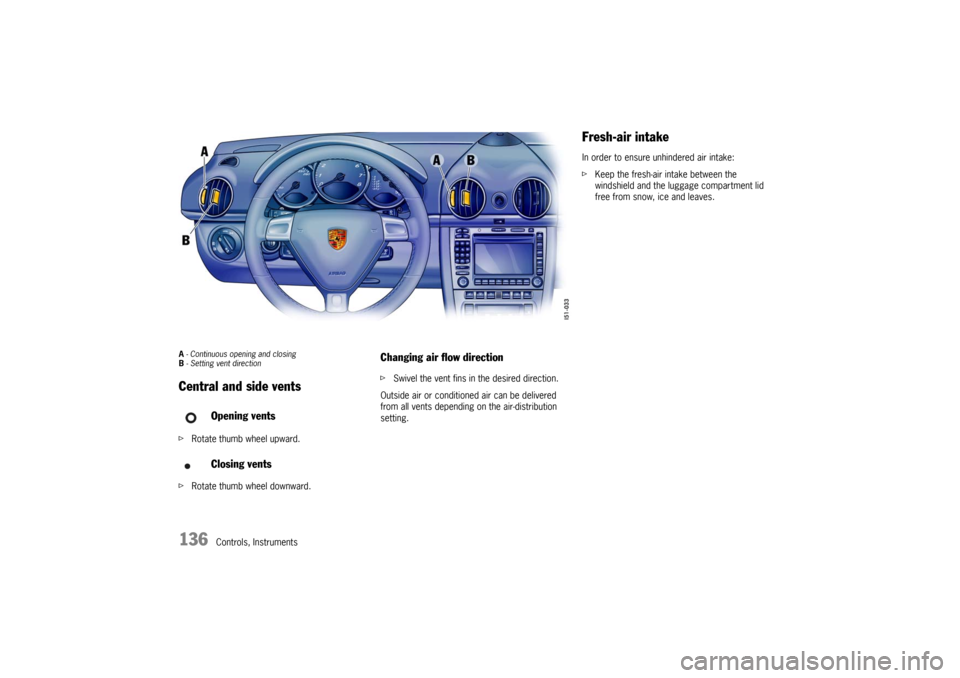
A - Continuous opening and closing
B - Setting vent direction Central and side ventsfRotate thumb wheel upward.
fRotate thumb wheel downward.
Changing air flow directionfSwivel the vent fins in the desired direction.
Outside air or conditioned air can be delivered
from all vents depending on the air-distribution
setting.
Opening vents
Closing vents
Fresh-air intakeIn order to ensure unhindered air intake:
fKeep the fresh-air intake between the
windshield and the luggage compartment lid
free from snow, ice and leaves.
Page 137 of 296
Controls, Instruments
137
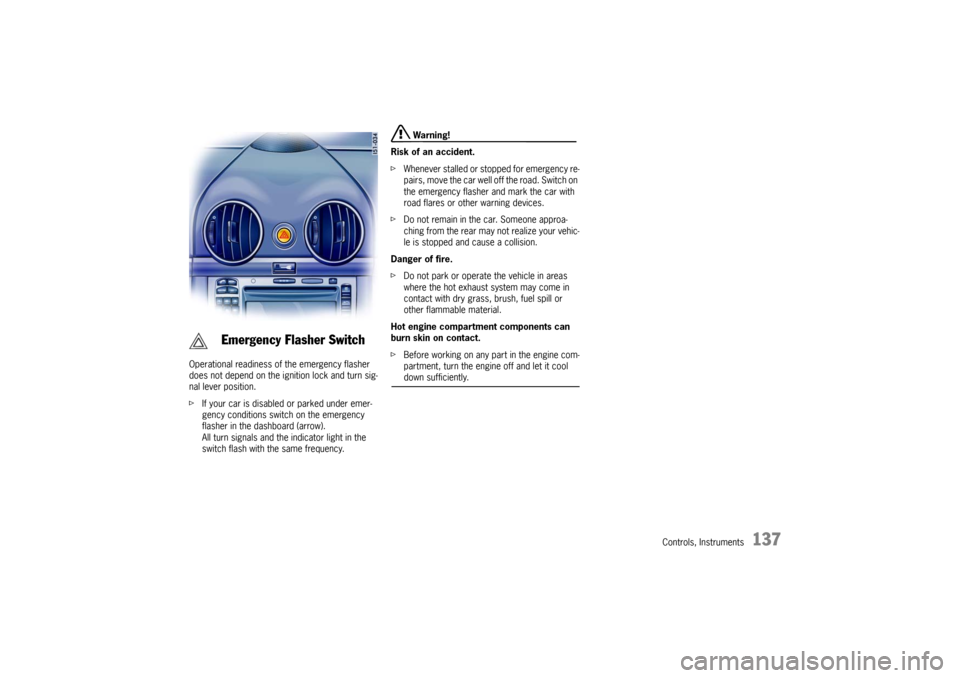
Operational readiness of the emergency flasher
does not depend on the ignition lock and turn sig-
nal lever position.
fIf your car is disabled or parked under emer-
gency conditions switch on the emergency
flasher in the dashboard (arrow).
All turn signals and the indicator light in the
switch flash with the same frequency.
Warning!
Risk of an accident.
fWhenever stalled or stopped for emergency re-
pairs, move the car well off the road. Switch on
the emergency flasher and mark the car with
road flares or other warning devices.
fDo not remain in the car. Someone approa-
ching from the rear may not realize your vehic-
le is stopped and cause a collision.
Danger of fire.
fDo not park or operate the vehicle in areas
where the hot exhaust system may come in
contact with dry grass, brush, fuel spill or
other flammable material.
Hot engine compartment components can
burn skin on contact.
fBefore working on any part in the engine com-
partment, turn the engine off and let it cool down sufficiently.
Emergency Flasher Switch
Page 154 of 296

154
Controls, Instruments
Porsche Communication
Management (PCM) fRefer to the separate operating instructions
before putting the PCM into operation.
fPlease observe the chapter “LOAD SWITCH-
OFF AFTER 2 HOURS OR 7 DAYS” on Page
246.
Warning!
There is a danger of accident if you set or
operate the on-board computer, radio, navi-
gation system, telephone or other equipment
when driving.
This could distract you from the traffic and
cause you to lose control of the vehicle resul-
ting in serious personal injury or death.
fOperate the components while driving only if
the traffic situation allows you to do safely.
fCarry out any complicated operating or setting procedures only with the vehicle stationary.The reception conditions for the radio module inte-
grated in the PCM change continuously as you
drive. Interference from buildings, terrain and the
weather is unavoidable.
FM stereo reception is particularly susceptible to
varying reception conditions.
Electronic accessories should only be retrofitted
by a qualified specialist workshop.
Accessories which have not been tested and
approved by Porsche may impair radio reception.
NavigationWhen put into operation for the first time, a
distance of approx. 31 miles (50 km) must be dri-
ven in order for the navigation system to complete
the process of fine calibration.
The same applies when the tires are changed (e.g.
summer/snow tires) or new tires fitted.
Full location accuracy is not yet achieved during
the fine-calibration process.
If the vehicle has been transported (e.g. ferry, car
train), the system may take a few minutes after
being switched on before it determines the current
location.
Serious tire slip (e.g. spinning wheels on snow)
may result in temporarily inaccurate navigation.
When the battery has been disconnected, it may
take up to 15 minutes before the navigation
system becomes operational again.
Page 155 of 296

Controls, Instruments
155
Car Audio Operation/Tips For radio operation see your radio manual
which is included with your on-board
literature.
fPlease observe the chapter “LOAD SWITCH-
OFF AFTER 2 HOURS OR 7 DAYS” on Page
246. FM reception A vehicle is not an ideal place to listen to a radio.
Because the vehicle moves, reception conditions
are constantly changing.
Buildings, terrain, signal distance and noise from
other vehicles are all working against good recep-
tion.
Some conditions affecting FM may appear to be
problems when they are not.
The following characteristics are completely nor-
mal for a given reception area, and they do not in-
dicate any problem with the radio itself.
Note
Electronic accessories should only be installed by
your authorized Porsche dealer.
Equipment which has not been tested and appro-
ved by Porsche may impair radio reception. Fading and drifting
FM range is limited to about 25 miles (40 km), ex-
cept for some high power stations.
If a vehicle is moving away from the desired stati-
on’s transmitter, the signal will tend to fade and/or
drift. This condition is more prevalent with FM than
AM, and is often accompanied by distortion.
Fading and drifting can be minimized to a certain
degree by careful attention to fine tuning or selec-
tion of a stronger signal.
Static and fluttering
When the line-of-sight link between a transmitter
and vehicle is blocked by large buildings or moun-
tains, the radio sound may be accompanied with
static or fluttering because of the characteristic of
FM.
In a similar effect, a fluttering noise is sometimes
heard when driving along a tree-lined road.
This static and fluttering can be reduced by adjus-
ting the tone control for greater bass response un-
til the disturbance has passed. Multipath
Because of the reflecting characteristics of FM, di-
rect and reflected signals may reach the antenna
at the same time (multipath) and cancel each other
out.
As a vehicle moves through these electronic dead
spots, the listener may hear a momentary flutter
or loss of reception.
Station swapping
When two FM stations are close to each other, and
an electronic dead spot, such as static or multi-
path area, interrupts the original signal, someti-
mes the stronger second signal will be selected
automatically until the original one returns.
This swapping can also occur as you drive away
from the selected station and approach another
station of a stronger signal.
Page 194 of 296

194
Maintenance, Car Care
Fuel Economy Fuel economy will vary depending on where,
when and how you drive, optional equipment
installed, and the general condition of your
car.
A car tuned to specifications and correctly
maintained, will help you to achieve optimal
fuel economy.
fHave your vehicle tuned to specifications.
Air cleaner should be dirt free to allow proper
engine “breathing”.
Battery should be fully charged.
Wheels should be properly aligned.
Tires should be inflated at correct pressure.
fAlways monitor your fuel consumption.
fDrive smoothly, avoid abrupt changes in speed
as much as possible.
fAvoid jack rabbit starts and sudden stops.
fDo not drive longer than necessary in the lower
gears. Shifting into a higher gear early without
lugging the engine will help save fuel.
fProlonged “warm up” idling wastes gas. Start
the vehicle just before you are ready to drive.
Accelerate slowly and smoothly.
fSwitch off the engine if stationary for longer
periods (traffic lights, jams, level crossings). fAny additional weight carried in the vehicle re-
duces fuel economy. Always keep cargo to a
minimum and remove all unnecessary items.
fOrganize your trips to take in several errands
in one trip.
fAll electrical accessories contribute to increa-
sed fuel consumption.
fOnly switch on the air conditioning when neces-
sary.
The EPA estimated m.p.g. is to be used for
comparison purposes, actual mileage may
be different from the estimated m.p.g., de-
pending on your driving speed, weather con-
ditions and trip length. Your actual highway
mileage will probably be less than the esti-
mated m.p.g.
fPlease observe all local and national speed li-
mits.
Page 200 of 296

200
Maintenance, Car Care
Emission Control System In the interest of clean air Pollution of our environment has become a pro-
blem that is of increasing concern to all of us. We
urge you to join us in our efforts for cleaner air in
controlling the pollutants emitted from the auto-
mobile.
Porsche has developed an emission control sys-
tem that controls or reduces those parts of the
emission that can be harmful to our environment.
Your Porsche is equipped with such a system.
Porsche warrants the Emission Control System in
your new car under the terms and conditions set
forth in the Warranty Booklet.
You, as the owner of the vehicle, have the
responsibility to provide regular maintenance ser-
vice for the vehicle and to keep a record of all
maintenance work performed. To facilitate record
keeping, have the service performed by authori-
zed Porsche dealers. They have Porsche trained
technicians and special tools to provide fast and
efficient service.
To assure efficient operation of the
Emission Control System fHave your vehicle maintained properly and in
accordance with the recommendations descri-
bed in your Maintenance Booklet.
Lack of proper maintenance, as well as impro-
per use of the vehicle, will impair the function
of the emission control system and could lead
to damage.
fDo not alter or remove any component of the
emission control system.
fDo not alter or remove any device, such as
heat shields, switches, ignition wires, valves,
etc., which are designed to protect your vehic-
le’s emission control system.
In addition to serious engine damage, this can
result in a fire if excess raw fuel reaches the ex-
haust system.
fDo not continue to operate your vehicle if you
detect engine misfire or other unusual opera-
ting conditions.
Parking
Warning!
Danger of fire.
fDo not park or operate the vehicle in areas
where the hot exhaust system may come in
contact with dry grass, brush, fuel spill or
other flammable material.
fIf your car catches on fire for any reason, call
the fire department.
Do not endanger your life by attempting to put out the fire.
Undercoating
Danger!
Danger of fire and serious personal injuries
or death.
fDo not apply additional undercoating or rust-
proofing on or near the exhaust manifold, ex-
haust pipes, catalytic converters or heat
shields. During driving the substance used for undercoating could overheat and ignite.
Page 201 of 296

Maintenance, Car Care
201
How Emission Control Works When an automobile engine is running, it uses en-
ergy generated through the combustion of a mix-
ture of air and fuel. Depending on whether a car is
driven fast or slowly or whether the engine is cold
or hot, some of the fuel (hydrocarbons) may not
be burned completely, but may be discharged into
the engine crankcase or exhaust system. Addito-
nal hydrocarbons may enter the atmosphere th-
rough evaporation of fuel from the fuel tank. These
hydrocarbons (HC), when released into the air,
contribute to undesirable pollution.
In addition, carbon monoxide (CO) and oxides of
nitrogen (NOx) contribute to engine emissions.
They, too, are formed during the combustion pro-
cess and discharged into the exhaust system.
To reduce these pollutants, your Porsche is equip-
ped with a precisely calibrated fuel injection sys-
tem to assure a finely balanced air/fuel mixture un-
der all operating conditions.
Oxygen sensor The oxygen sensor, installed in the exhaust pipe
continuously senses the oxygen content of the ex-
haust and signals the information to an electronic
control unit. The control unit corrects the air/fuel
ratio, so the engine always receives an accurately
metered air/fuel mixture. Crankcase ventilation Through crankcase ventilation, undesirable emis-
sions from the engine crankcase are not permit-
ted to reach the outside atmosphere. These emis-
sions are recirculated from the crankcase to the
air intake system. From here the emissions mix
with the intake air and are later burned in the engi-
ne. Catalytic converters The catalytic converters are efficient ”clean-up“
devices built into the exhaust system of the vehic-
le. The catalytic converters burn the undesirable
pollutants in the exhaust gas before it is released
into the atmosphere.
The exclusive use of unleaded fuel is critical-
ly important for the life of the catalytic con-
verters. Therefore, only unleaded fuel must
be used. The catalytic converters will be damaged by:
– push or tow starting the vehicle,
– misfiring of the engine,
– turning off the ignition while the vehicle is mo-
ving or
– driving until the fuel tank is completely empty,
– by other unusual operating conditions.
fDo not continue to operate your vehicle under
these conditions, since raw fuel might reach
the catalytic converters. This could result in
overheating of the converters. Federal law pro-
hibits use of leaded fuel in this car.