tires PORSCHE BOXSTER 2006 2.G User Guide
[x] Cancel search | Manufacturer: PORSCHE, Model Year: 2006, Model line: BOXSTER, Model: PORSCHE BOXSTER 2006 2.GPages: 296, PDF Size: 4.12 MB
Page 110 of 296

110
Controls, Instruments In accordance with physical principles, the air
pressure changes as the temperature changes.
The tire pressure increases or decreases by
around 1.5 psi (0.1 bar) for every 50°F (10°C)
change in temperature.
The tire pressure monitoring takes this relation-
ship between tire pressure and temperature into
account.
Tire pressure specificationsInformation on tire pressure for public roads can
be found in this Owner's Manual or on the tire-pres-
sure plate in the left door aperture.
These values apply to cold tires at 68°F (20°C).
Page 121 of 296

Controls, Instruments
121
System fault
Go to workshopSeveral systems may have failed. Adjust your
driving style. Reduce speed.
Have the fault remedied at an authorized
Porsche dealer.
Failure of fuel level indicator
WorkshopHave the fault remedied at an authorized
Porsche dealer.
Service in km/days Service indicator
Bring the vehicle in for service no later than af-
ter the distance/time shown has elapsed.
However, it is the intervals in the “Guarantee
and Maintenance” booklet that are decisive.
Service now Service indicator
Have your vehicle serviced at an authorized
Porsche dealer.
Flat Tire Tire pressure monitoring system has detected a
serious pressure loss.
Stop in a suitable place and check tires for dam-
age. Fill in tyre sealant if necessary.
Add air The tire pressure monitoring system has detect-
ed a gradual pressure loss. Correct tyre pres-
sure at the next opportunity.
TPC inactive
System learningThe tire pressure monitoring system is learning
the wheels on the vehicle. The tire pressure
monitoring system is searching for the tires and
their position. During this period the current
pressure specifications are not available on the
on-board computer.
TPC inactive The tire pressure monitoring system is faulty.
Consult a qualified specialist repairshop.*
Instrument
panelOn-board
computerText display on on-board
computerMeaning/measure
Page 154 of 296

154
Controls, Instruments
Porsche Communication
Management (PCM) fRefer to the separate operating instructions
before putting the PCM into operation.
fPlease observe the chapter “LOAD SWITCH-
OFF AFTER 2 HOURS OR 7 DAYS” on Page
246.
Warning!
There is a danger of accident if you set or
operate the on-board computer, radio, navi-
gation system, telephone or other equipment
when driving.
This could distract you from the traffic and
cause you to lose control of the vehicle resul-
ting in serious personal injury or death.
fOperate the components while driving only if
the traffic situation allows you to do safely.
fCarry out any complicated operating or setting procedures only with the vehicle stationary.The reception conditions for the radio module inte-
grated in the PCM change continuously as you
drive. Interference from buildings, terrain and the
weather is unavoidable.
FM stereo reception is particularly susceptible to
varying reception conditions.
Electronic accessories should only be retrofitted
by a qualified specialist workshop.
Accessories which have not been tested and
approved by Porsche may impair radio reception.
NavigationWhen put into operation for the first time, a
distance of approx. 31 miles (50 km) must be dri-
ven in order for the navigation system to complete
the process of fine calibration.
The same applies when the tires are changed (e.g.
summer/snow tires) or new tires fitted.
Full location accuracy is not yet achieved during
the fine-calibration process.
If the vehicle has been transported (e.g. ferry, car
train), the system may take a few minutes after
being switched on before it determines the current
location.
Serious tire slip (e.g. spinning wheels on snow)
may result in temporarily inaccurate navigation.
When the battery has been disconnected, it may
take up to 15 minutes before the navigation
system becomes operational again.
Page 194 of 296

194
Maintenance, Car Care
Fuel Economy Fuel economy will vary depending on where,
when and how you drive, optional equipment
installed, and the general condition of your
car.
A car tuned to specifications and correctly
maintained, will help you to achieve optimal
fuel economy.
fHave your vehicle tuned to specifications.
Air cleaner should be dirt free to allow proper
engine “breathing”.
Battery should be fully charged.
Wheels should be properly aligned.
Tires should be inflated at correct pressure.
fAlways monitor your fuel consumption.
fDrive smoothly, avoid abrupt changes in speed
as much as possible.
fAvoid jack rabbit starts and sudden stops.
fDo not drive longer than necessary in the lower
gears. Shifting into a higher gear early without
lugging the engine will help save fuel.
fProlonged “warm up” idling wastes gas. Start
the vehicle just before you are ready to drive.
Accelerate slowly and smoothly.
fSwitch off the engine if stationary for longer
periods (traffic lights, jams, level crossings). fAny additional weight carried in the vehicle re-
duces fuel economy. Always keep cargo to a
minimum and remove all unnecessary items.
fOrganize your trips to take in several errands
in one trip.
fAll electrical accessories contribute to increa-
sed fuel consumption.
fOnly switch on the air conditioning when neces-
sary.
The EPA estimated m.p.g. is to be used for
comparison purposes, actual mileage may
be different from the estimated m.p.g., de-
pending on your driving speed, weather con-
ditions and trip length. Your actual highway
mileage will probably be less than the esti-
mated m.p.g.
fPlease observe all local and national speed li-
mits.
Page 218 of 296

218
Maintenance, Car Care
Storing your Porsche If you intend to store your Porsche for a prolonged
period, please consult your authorized Porsche
dealer. The staff will be glad to advise you on the
most suitable and necessary methods.
fClean your vehicle thoroughly inside and out-
side.
Clean the engine compartment.
The under carriage and chassis components
should be free of dirt and salt deposits.
fFill up the fuel tank.
fChange the oil and oil filter, and run the engine
for several minutes.
fIncrease the tire pressure to 58 psi (4 bar).
It is not recommended to lift the vehicle, due to
the possibility of corrosion on shock absorber
piston shafts.
The vehicle should be moved slightly, approxi-
mately every four weeks, to prevent flat spot
on the tires. Climate control
The air conditioning system should be in good wor-
king condition and fully charged.
Windshield/Headlight washer
fCheck and correct antifreeze/cleaning solution
level as necessary.
Electrical system
fRemove the battery from the vehicle and store
it in a cool dry place, not on a cement floor.
When the battery is disconnected, the
alarm system is deactivated.
fRecharge the battery every 3 months. If the
battery remains in the vehicle with the cables
connected, it is necessary to check, remove
and recharge the battery every 2-3 weeks.
Do not fast charge the battery.
fPlease observe the chapter “BULB CHART” on
Page 259. Vehicle interior
The interior must be dry, especially in the area of
the floor carpets. The use of drying agents (Silica-
Gel) is recommended in vehicles with leather inte-
rior and in areas with high humidity. The recom-
mended amount is 3 fabric bags of 1.1 lbs. (500
grams) each placed on the floor carpets.
Windows, doors, lids and top must be closed. The
air vents should be opened.
Page 219 of 296

Practical Tips, Emergency Service
219 Practical Tips, Emergency Service
Exercise Extreme Caution when
Working on your Vehicle ............................. 220
Tires/Wheels ............................................ 221
Loading Information ................................... 235
Lifting the Vehicle with a Lifting Platform
or Garage Lift ........................................... 237
Flat Tire .................................................... 238
Wheel Bolts ............................................. 241
Spacers ................................................... 244
Electrical System ..................................... 246
Battery .................................................... 249
Jump lead starting .................................... 256
Replacing bulbs ......................................... 258
Headlights ................................................ 261
Turn signal light ......................................... 265
Side marker light ....................................... 268
Tail light .................................................... 269
Additional brake light ................................. 270
Luggage compartment/footwell lights ......... 270
Interior light .............................................. 271
Adjusting Headlights .................................. 272
Towing ..................................................... 274
Page 221 of 296

Practical Tips, Emergency Service
221
Tires/Wheels The original equipment tires and wheel rims on
your Porsche comply with all applicable Federal
Motor Vehicle Safety Standards.
For your safety remember the following:
– Wheel rims and wheel bolts are matched to fit
your Porsche.
– If you intend to use other than original equip-
ment wheels, be sure that they conform to
Porsche specifications for your model.
Only tires with the same make and with the
same specification code (e.g. “N0”, “N1”...)
can be mounted.
– The use of wheel rims and wheel bolts that do
not meet specifications of the original factory
installed equipment will affect the safe opera-
tion of your vehicle.
– Before you plan on exchanging wheels, or
snow tires already mounted on the wheel rims,
consult your authorized Porsche dealer. Your
dealer has the technical information necessary
to advise you which wheel rims and wheel bolts
are compatible with the original factory instal-
lations.
Danger!
Risk of loss of control and serious personal
injury or death.
fIf while driving, your vehicle experiences a sud-
den vibration or ride disturbance, and/or you
suspect that possible damage to your tires or
vehicle has occurred, you should immediately
reduce your speed without excessive use of
the brakes.
fStop the vehicle as soon as possible, and in-
spect the tires.
If you cannot determine the cause for the dis-
turbance, have your vehicle towed to the near-
est Porsche or tire dealer to have your vehicle
or tire(s) inspected.
fContinuing to operate the vehicle without cor-
rection could result in a loss of control and se-rious personal injury.
Page 222 of 296
222
Practical Tips, Emergency Service
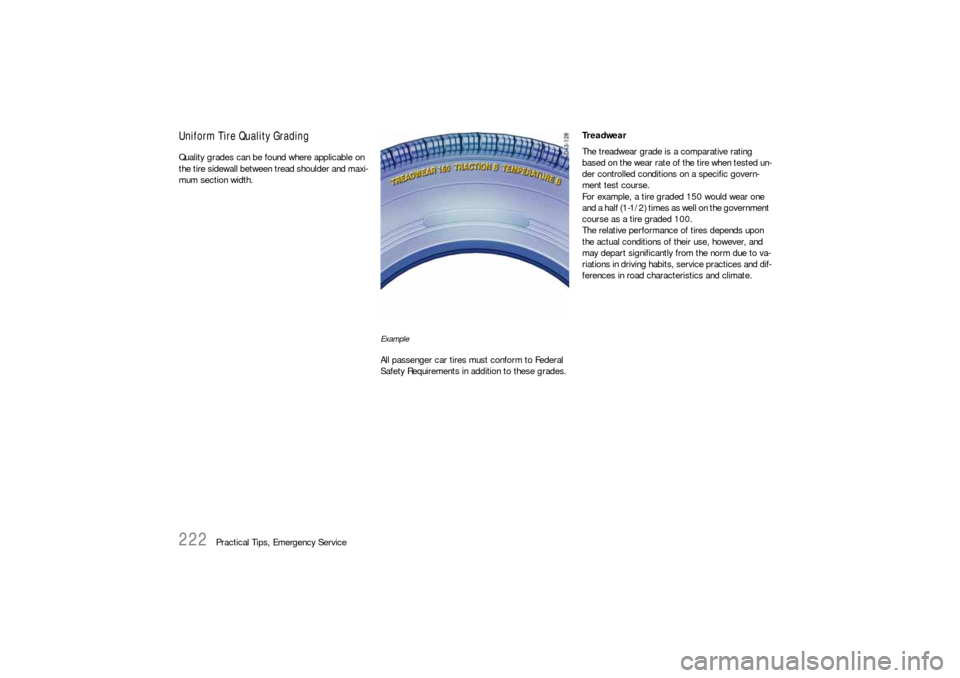
Uniform Tire Quality Grading Quality grades can be found where applicable on
the tire sidewall between tread shoulder and maxi-
mum section width.
Example All passenger car tires must conform to Federal
Safety Requirements in addition to these grades. Treadwear
The treadwear grade is a comparative rating
based on the wear rate of the tire when tested un-
der controlled conditions on a specific govern-
ment test course.
For example, a tire graded 150 would wear one
and a half (1-1/2) times as well on the government
course as a tire graded 100.
The relative performance of tires depends upon
the actual conditions of their use, however, and
may depart significantly from the norm due to va-
riations in driving habits, service practices and dif-
ferences in road characteristics and climate.
Page 223 of 296

Practical Tips, Emergency Service
223
Traction AA, A, B, C
The traction grades, from highest to lowest, are
AA, A, B and C and they represent the tire’s ability
to stop on wet pavement as measured under con-
trolled conditions on specified government test
surfaces of asphalt and concrete.
A tire marked C may have poor traction perfor-
mance.
Warning!
The traction grade assigned to this is based on
braking (straight-ahead) traction tests and does
not include cornering (turned) traction, accelera-
tion, hydroplaning or peak traction characteris-
tics. Temperature A, B, C
The temperature grades are A (the highest), B and
C, representing the tire’s resistance to the genera-
tion of heat and its ability to dissipate heat when
tested under controlled conditions on a specified
indoor laboratory test wheel.
Sustained high temperatures can cause the mate-
rial of the tire to degenerate and reduce tire life,
and excessive temperature can lead to sudden
tire failure.
The grade C corresponds to a level of perfor-
mance which all passenger car tires must meet
under the Federal Motor Vehicle Safety Standard
No. 109.
Grades B and A represent higher levels of perfor-
mance on the laboratory test wheel than the mini-
mum required by law.
Warning!
The temperature grade for this tire is established
for a tire that is properly inflated and not overloa-
ded.
Excessive speed, underinflation, or excessive loa-
ding, either separately or in combination, can cau-
se heat buildup and possible tire failure.
Page 224 of 296

224
Practical Tips, Emergency Service
Tire pressures
Warning!
Incorrect tire pressure causes increased tire
wear and adversely affects road handling.
fAlways use an accurate tire pressure gauge
when checking inflation pressures.
fDo not exceed the maximum tire pressure list-
ed on the tire sidewall.
Please observe the chapter “VEHICLE IDENTI-
FICATION NUMBER” on Page 278.
fCold tire inflation pressure means: all tires
must be cold, ambient temperature maximum
(68°F, (20°C)
, when adjusting the inflation pres-
sure.
Avoid sunlight striking the tires before measur-
ing cold pressures, since the pressures would
rise from temperature influence.
fValve caps protect the valve from dust and dirt,
and thus from leakage.
Always screw caps tightly down.
Replace missing caps immediately.
fUse only plastic valve caps.
fDo not use commercially available sealant or
tire inflating bottles. Only use Porsche approved tire sealant.Each tire, including the spare (if provided), should
be checked every 2 weeks when cold (68°F/20°C)
and inflated to the inflation pressure recommend-
ed in this Owner's Manual or on the tire-pressure
plate.
If your vehicle has tires of a different size than the
size indicated in this Owner's Manual or on the tire-
pressure plate, you should determine the proper
tire inflation pressure for those tires.
As an added safety feature, your vehicle has been
equipped with a tire pressure monitoring (TPC)
that illuminates a low tire pressure message when
one or more of your tires is significantly under-in-
flated. Accordingly, when the low tire pressure
message illuminates, you should stop and check
your tires as soon as possible, and inflate them to
the proper pressure. Driving on a significantly un-
der-inflated tire causes the tire to overheat and
can lead to tire failure. Under-inflation also reduc-
es fuel efficiency and tire tread life, and may affect
the vehicle’s handling and stopping ability.
Please note that the TPC is not a substitute for
proper tire maintenance, and it is the driver’s re-
sponsibility to maintain correct tire pressure, even
if under-inflation has not reached the level to trig-
ger illumination of the TPC low tire pressure mes-
sage.
fOn vehicles with tire pressure monitoring:
Please observe the chapter “TPC TIRE
PRESSURE MONITORING” on Page 103.
When tires are warm, the tire pressure is increa-
sed.fNever let air out of hot tires.
This could cause the tire pressure to fall below
the prescribed value.
Insufficient tire filling pressure can cause tires to
overheat and thus be damaged – even invisibly.
Hidden tire damage is not eliminated by subse-
quently correcting the tire pressure.