wheel PORSCHE BOXSTER 2006 2.G Workshop Manual
[x] Cancel search | Manufacturer: PORSCHE, Model Year: 2006, Model line: BOXSTER, Model: PORSCHE BOXSTER 2006 2.GPages: 296, PDF Size: 4.12 MB
Page 212 of 296

212
Maintenance, Car Care Automatic car washes
Optional add-on parts or parts which project
beyond the contours of the vehicle may be
damaged by design features (e.g. brushes) of au-
tomatic car washes.
The following parts are particularly suscep-
tible to damage:
– Convertible top (hot wax treatment cannot be
used, as the wax attacks the convertible top
material),
– Windshield wipers (always switch them off to
prevent them wiping unintentionally in intermit-
tent or sensor operation)
– External telephone antenna (always unscrew)
– Fixed rear spoiler or extended rear spoiler
– Wheels (the wider the rim and the lower the tire
height, the greater the risk of damage)
– High-gloss wheels (to prevent these from get-
ting scratched, do not clean with the wheel-
cleaning brushes of the car wash).
fPlease consult the operator before using auto-
matic car washes.
fWash and dry by hand all points not reached by
a car wash, such as door and lid seams or
door sills. Note
Automatic car washes spray water at odd angles
and high pressures, which are not seen in normal
driving. Therefore, water can sometimes find its
way into the passengers compartment during or
shortly after the car wash.
Door locks fTo prevent the door locks from freezing during
the cold season, the lock cylinders should be
covered during a wash.
fShould the locks freeze, use an ordinary de-
icer. In many cases, a well warmed key can
help.
Never use excessive force.
Page 216 of 296

216
Maintenance, Car Care
Light alloy wheels fPlease observe the chapter “WASHING” on
Page 210.
Warning!
Danger of accident if cleaning agents (e.g.
wheel cleaning agents) come into contact
with the brake discs. The resulting film on the
brake discs can impair braking perfor-
mance.
fMake sure that no cleaning agent comes into
contact with the brake discs.
fIf cleaning agent has come into contact with
the brake discs, thoroughly clean the brake
discs with a strong jet of water.
fPaying attention to any road users behind you,
dry the brake discs by applying the brakes at short intervals.
Pitting may occur if metallic particles which cause
contact corrosion (e.g. brass or copper in brake
dust) are allowed to remain on the aluminum for
too long.
fIf possible, wash the wheels with a sponge or
wash brush about every two weeks. In areas
where salt is spread on winter roads or there is
a lot of airborne industrial dust, it is best to
clean the wheels weekly.
The Porsche Light Alloy Wheel Cleaner
(ph-value 9.5) can be used for this purpo-
se.If the ph-value of the detergent is incor-
rect, the protective coating on the wheels
will be destroyed.
Polishes which dissolve oxides, such as
those frequently used for other metals, or
abrasive tools or agents are unsuitable
because they break down the oxide film of
the protective coating and will cause dis-
coloration of the wheel.
fEvery three months, after cleaning, coat the
wheels with a car wax or non-corrosive grease
(vaseline).
Using a clean cloth thoroughly rub the grease
into the surface.
Leather Characteristics and special features
The natural surface markings of leather, e.g. cre-
ases, healed scars, insect sting marks, structural
differences and slight variations in shade and
grain add to the attractiveness of the natural lea-
ther product.
A special mention must be made here of natural le-
ather.
For natural leather, carefully selected hides of the
highest quality are used. It is not covered comple-
tely with dye on production.
“Nature’s signature” is therefore easily recogniz-
able.
This fine material is distinguished by an outstan-
ding seating comfort, special suppleness and a ty-
pical patina. Leather care and treatment
fClean all types of leather regularly to remove
fine dust using a soft, damp, white woollen
cloth or a commercially available microfibre
cloth.
fRemove heavy contamination with Porsche le-
ather cleaner.
Please always follow the instructions for use gi-
ven on the containers.
Caustic cleaners and hard cleaning objects
must not be used.
Perforated leather must under no circum-
stances get wet on its reverse side.
Once cleaned, leather (particularly the heavily
stressed leather seats) must be treated only with
Porsche leather care liquid.
Page 219 of 296

Practical Tips, Emergency Service
219 Practical Tips, Emergency Service
Exercise Extreme Caution when
Working on your Vehicle ............................. 220
Tires/Wheels ............................................ 221
Loading Information ................................... 235
Lifting the Vehicle with a Lifting Platform
or Garage Lift ........................................... 237
Flat Tire .................................................... 238
Wheel Bolts ............................................. 241
Spacers ................................................... 244
Electrical System ..................................... 246
Battery .................................................... 249
Jump lead starting .................................... 256
Replacing bulbs ......................................... 258
Headlights ................................................ 261
Turn signal light ......................................... 265
Side marker light ....................................... 268
Tail light .................................................... 269
Additional brake light ................................. 270
Luggage compartment/footwell lights ......... 270
Interior light .............................................. 271
Adjusting Headlights .................................. 272
Towing ..................................................... 274
Page 220 of 296

220
Practical Tips, Emergency Service
Exercise Extreme Caution when
Working on your Vehicle
Danger!
Ignoring the following instructions may cau-
se serious personal injury or death.
fThe engine compartment of any motor vehicle
is a potentially hazardous area. If you are not
fully familiar with proper repair procedures, do
not attempt the adjustments described on the
following pages.
This caution applies to the entire vehicle.
fO n l y w o r k o n y o u r v e h i c l e o u t d o o r s o r i n a w e l l
ventilated area.
fEnsure that there are no open flames in the
area of your vehicle at any time when fuel
fumes might be present. Be especially cau-
tious of such devices such as hot water hea-
ters which ignite a flame intermittently.
fBefore working on any part in the engine com-
partment, turn the engine off and let it cool
down sufficiently. Hot engine compartment
components can burn skin on contact.
fBe alert and cautious around engine at all
times while the engine is running.
If work has to be performed with the engine
running, always set the parking brake, and
make sure the shift lever is in neutral or the se-
lector lever is in position P.fIn particular, be very careful to ensure that
items of clothing (ties, shirt, sleeves etc.), je-
welry, long hair, hand or fingers cannot get
caught in the engine-compartment blower, fan,
belts or other moving parts.
The radiator and radiator fans are in the front
of the car.
The fans can start or continue running as a
function of temperature, even with the engine
switched off.
Carry out work in these areas only with the en-
gine off and exercise extreme caution.
fYour Porsche is equipped with an electronic ig-
nition system. When the ignition is on, high vol-
tage is present in all wires connected with the
ignition system; therefore, exercise extreme
caution when working on any part of the engine
while the ignition is on or the engine is running.
fAlways support your car with safety stands if it
is necessary to work under the car.
Jacks are not suitable for this kind of work.
fWhen working under the car without safety
stands but with the wheels on the ground,
make sure the car is on level ground, the
wheels are blocked, and that the engine can-
not be started.
Remove the ignition key.fDo not smoke or allow an open flame around
the battery or fuel.
Keep a fire extinguisher in close reach.
fIncomplete or improper servicing may cause
problems in the operation of the car. If in doubt
about any servicing, have it done by your au-
thorized Porsche dealer.
Improper maintenance during the warranty pe-
riod may affect your Porsche warranty cover-
age.
fSupplies of fluids, e.g. engine oil, brake fluid or
coolant, are hazardous to your health.
Keep these fluids out of children’s reach and
dispose of them in accordance with the appro-
priate regulations.
fSome countries require additional tools and
special spare parts to be carried.
Please make enquiries before driving abroad.
Page 221 of 296

Practical Tips, Emergency Service
221
Tires/Wheels The original equipment tires and wheel rims on
your Porsche comply with all applicable Federal
Motor Vehicle Safety Standards.
For your safety remember the following:
– Wheel rims and wheel bolts are matched to fit
your Porsche.
– If you intend to use other than original equip-
ment wheels, be sure that they conform to
Porsche specifications for your model.
Only tires with the same make and with the
same specification code (e.g. “N0”, “N1”...)
can be mounted.
– The use of wheel rims and wheel bolts that do
not meet specifications of the original factory
installed equipment will affect the safe opera-
tion of your vehicle.
– Before you plan on exchanging wheels, or
snow tires already mounted on the wheel rims,
consult your authorized Porsche dealer. Your
dealer has the technical information necessary
to advise you which wheel rims and wheel bolts
are compatible with the original factory instal-
lations.
Danger!
Risk of loss of control and serious personal
injury or death.
fIf while driving, your vehicle experiences a sud-
den vibration or ride disturbance, and/or you
suspect that possible damage to your tires or
vehicle has occurred, you should immediately
reduce your speed without excessive use of
the brakes.
fStop the vehicle as soon as possible, and in-
spect the tires.
If you cannot determine the cause for the dis-
turbance, have your vehicle towed to the near-
est Porsche or tire dealer to have your vehicle
or tire(s) inspected.
fContinuing to operate the vehicle without cor-
rection could result in a loss of control and se-rious personal injury.
Page 223 of 296

Practical Tips, Emergency Service
223
Traction AA, A, B, C
The traction grades, from highest to lowest, are
AA, A, B and C and they represent the tire’s ability
to stop on wet pavement as measured under con-
trolled conditions on specified government test
surfaces of asphalt and concrete.
A tire marked C may have poor traction perfor-
mance.
Warning!
The traction grade assigned to this is based on
braking (straight-ahead) traction tests and does
not include cornering (turned) traction, accelera-
tion, hydroplaning or peak traction characteris-
tics. Temperature A, B, C
The temperature grades are A (the highest), B and
C, representing the tire’s resistance to the genera-
tion of heat and its ability to dissipate heat when
tested under controlled conditions on a specified
indoor laboratory test wheel.
Sustained high temperatures can cause the mate-
rial of the tire to degenerate and reduce tire life,
and excessive temperature can lead to sudden
tire failure.
The grade C corresponds to a level of perfor-
mance which all passenger car tires must meet
under the Federal Motor Vehicle Safety Standard
No. 109.
Grades B and A represent higher levels of perfor-
mance on the laboratory test wheel than the mini-
mum required by law.
Warning!
The temperature grade for this tire is established
for a tire that is properly inflated and not overloa-
ded.
Excessive speed, underinflation, or excessive loa-
ding, either separately or in combination, can cau-
se heat buildup and possible tire failure.
Page 226 of 296
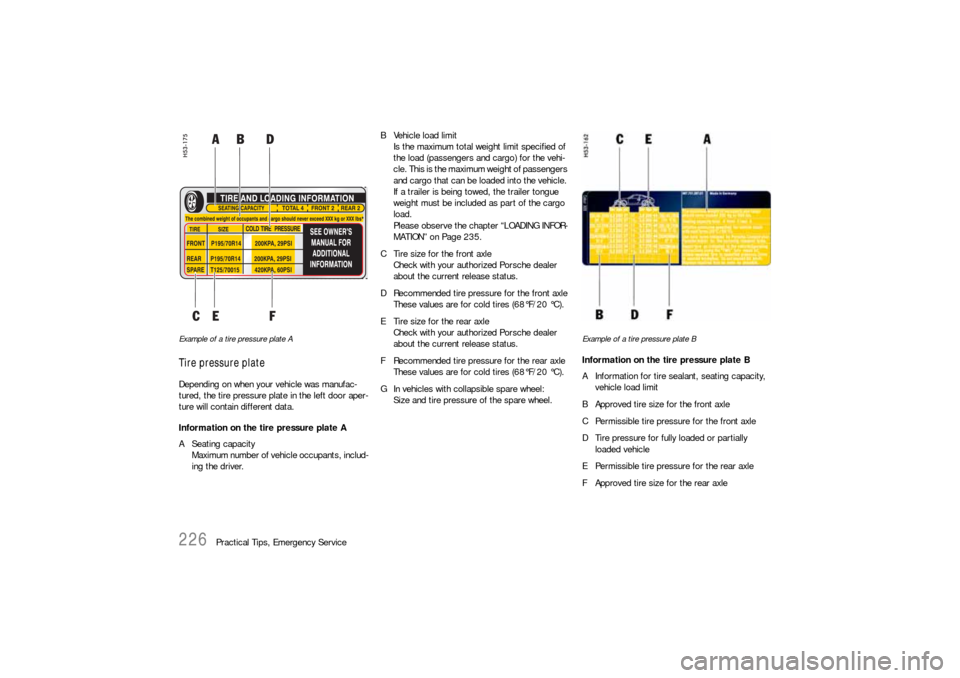
226
Practical Tips, Emergency Service
Example of a tire pressure plate ATire pressure plateDepending on when your vehicle was manufac-
tured, the tire pressure plate in the left door aper-
ture will contain different data.
Information on the tire pressure plate A
A Seating capacity
Maximum number of vehicle occupants, includ-
ing the driver.B Vehicle load limit
Is the maximum total weight limit specified of
the load (passengers and cargo) for the vehi-
cle. This is the maximum weight of passengers
and cargo that can be loaded into the vehicle.
If a trailer is being towed, the trailer tongue
weight must be included as part of the cargo
load.
Please observe the chapter “LOADING INFOR-
MATION” on Page 235.
C Tire size for the front axle
Check with your authorized Porsche dealer
about the current release status.
D Recommended tire pressure for the front axle
These values are for cold tires (68°F/20 °C).
E Tire size for the rear axle
Check with your authorized Porsche dealer
about the current release status.
F Recommended tire pressure for the rear axle
These values are for cold tires (68°F/20 °C).
G In vehicles with collapsible spare wheel:
Size and tire pressure of the spare wheel.
Example of a tire pressure plate BInformation on the tire pressure plate B
A Information for tire sealant, seating capacity,
vehicle load limit
B Approved tire size for the front axle
C Permissible tire pressure for the front axle
D Tire pressure for fully loaded or partially
loaded vehicle
E Permissible tire pressure for the rear axle
F Approved tire size for the rear axle
Page 227 of 296

Practical Tips, Emergency Service
227
Tire traction
Warning!
When driving on wet or slushy roads, a
wedge of water may build up between the
tires and the road. This phenomenon is
known as “hydroplane” and may cause par-
tial or complete loss of traction, vehicle
control or stopping ability.
fReduce speed on wet surface to prevent this. Tire life Tire life depends on various factors, i. e., road
surfaces, traffic and weather conditions, driving
habits, type of tires and tire care.
fInspect your tires for wear and damage before
driving off. If you notice uneven or substantial
wear, wheels might need alignment or tires
should be balanced or replaced.
Tire wear The original equipment tires on your Porsche have
built-in tire wear indicators. They are molded into
the bottom of the tread grooves and will appear as
approximately 1/2 in. (12 mm) bands when the
tire tread depth is down to 1/16 of an in.
(1.6 mm).
When the indicators appear in two or more adja-
cent grooves, it is time to replace the tires. We
recommend, however, that you do not let the tires
wear down to this extent.
Worn tires cannot grip the road surface properly
and are even less effective on wet roads.
In the United States, state laws may govern the
minimum tread depth permissible. Follow all such
laws.
Danger!
Driving on worn tires can result in loss of con-
trol of the vehicle and could cause serious
personal injuries or death.
fDo not drive with worn tires or tires showing
cuts or bruises as they may lead to sudden
deflation and loss of control which could cause
severe personal injury.
fSpecialized high performance tires on high
performance sports cars exhibit more wear
than those on a family sedan, or even a high
performance sedan.
Therefore, it is important to check your tire
pressure and condition at least every two weeks.
If you notice that tires are wearing unevenly, con-
sult your Porsche dealer.
Uneven wear may not always be due to improper
wheel alignment. It can be the result of individual
driving habits such as cornering at high speeds. If
the tire pressure is not checked and adjusted
regularly, abnormal tire wear can also occur.
Page 228 of 296

228
Practical Tips, Emergency Service
Tire care fAvoid damaging tires and wheel rims.
fIf you must drive over a curb or other obstacle,
drive slowly and at an obtuse angle.
fCheck tires for uneven wear and damage
before driving off.
fRemove imbedded material.
fReplace worn or damaged tires immediately.
fKeep oil, fuel, brake fluid, etc. away from tires.
fReplace missing valve stem caps.
fKeep tires inflated correctly.
fWash tires when washing the vehicle.
Also clean inner side of wheels.
fDo not use abrasive cleaners when washing
the wheels.
fCheck wheel rims for corrosion.
fRemove road salt, if driving in winter.
Tire damage, puncture fCheck tires for imbedded material, cuts, punc-
tures, cracks and bulges (side wall) before driv-
ing off.
In case of tire damage, where it is uncertain wheth-
er there is a break in the ply with all its conse-
quences or tire damage caused by thermal or me-
chanical overloading due to loss of pressure or
any other prior damage, we recommend that the
tire be replaced for safety reasons.
I f o n e f a u l t y t i re i s re p l a c e d i t s h o u l d b e n o t e d t h a t
the difference in tread depth on one axle must not
exceed 30 %.
Handling inconsistencies may result.
fPerform a visual inspection if necessary.
Danger!
Risk of serious personal injury or death.
Driving the vehicle with low tire pressure
increases risk of a tire failure and resulting
loss of control. Furthermore, low tire pres-
sure increases rate of wear of the affected
tires.
fCheck tires – including sidewalls – regularly for
foreign bodies, nicks, cuts, cracks and bulges.
fAfter driving off road, examine tires for signs
of damage such as cuts, tears, bulges or for-
eign objects stuck in the tread. Replace a dam-
aged tire if necessary.
fCross curb edges slowly and at right angles if
possible.
Avoid driving over steep or sharp curbs.
fIn cases of doubt, have the wheel (particularly
the inner side) checked by an authorized Porsche dealer.
Page 229 of 296

Practical Tips, Emergency Service
229
Tire replacements If in doubt, contact your Porsche dealer.
Use only tire makes and types approved by
Porsche.
If you do not use a Porsche recommended
replacement tire, make sure that you
purchase your new tires from a reputable tire
dealer and that the dealer complies with all
manufacturers warnings for those tires.
Only tires with the same make and with the
same specification code (e.g. “N0”, “N1”...)
can be mounted.
Before mounting new tires, check with your
Porsche dealer about the current release
status.
Use tires with “ZR” quality standards. There
are currently no standards concerning tire
strength at speeds above 150 mph (240 km/h).
Tires should be replaced no less than on one axle
at the time.
Only tires of the same make and type must be
used. Mixed tires are not permissible.
Initially, new tires do not have their full traction.
You should therefore drive at moderate speeds
during the first 60 - 120 miles (100 - 200 km). If new tires are installed only on one axle, a notice-
able change in handling occurs due to the different
tread depth of the other tires.
This happens especially if only rear tires are re-
placed. However, this condition disappears as the
new tires are broken in.
fPlease adjust your driving style accordingly.
Installation of new tires should only be done by a
qualified tire technician.
Valves
Rubber valve stems must be replaced every time
a tire is replaced.
For metal valves, the installation and replacement
instructions must be observed.
fUse only genuine Porsche metal valves.
fProtect the valve inserts against soiling with
valve caps.
Soiled valve inserts can cause a gradual loss
of air.
fUse only plastic valve caps.
Parking at the curb
Warning!
Hard impacts against curbs (or traffic
islands) are dangerous and may cause hid-
den tire damage which is not noticeable until
later. Such damage can result in accidents at
high speeds causing severe personal injury.
Depending on the force of impact, the edge
of the rim can also be damaged.
fIf you are in doubt, have the wheel checked by
an expert, particularly if you suspect damage
on the inside.
fIf you must drive over a curb or other obstacle,
drive slowly and at an obtuse angle. Exercise care when parking along curbs.