warning light PORSCHE BOXSTER 2006 2.G Repair Manual
[x] Cancel search | Manufacturer: PORSCHE, Model Year: 2006, Model line: BOXSTER, Model: PORSCHE BOXSTER 2006 2.GPages: 296, PDF Size: 4.12 MB
Page 202 of 296
202
Maintenance, Car Care
Fuel Evaporation Control Fuel tank venting The evaporation chamber and the carbon canister
prevent fuel from escaping to the atmosphere at
extreme high outside temperatures, when driving
abruptly around curves and when the car is parked
at an incline or in any other nonlevel position. Vapor control system and storage When the fuel tank is filled, vapors are collected in
the evaporation chamber by a vent line leading the
vapors to the carbon canister where they are
stored as long as the engine does not run. Purge system When the engine is running, the fuel vapors from
the canister will be mixed with fresh air from the
ambient air of the canister. This mixture will be di-
rected to the intake air housing by the tank vent
line, mixed with the intake air and burned during
normal combustion.
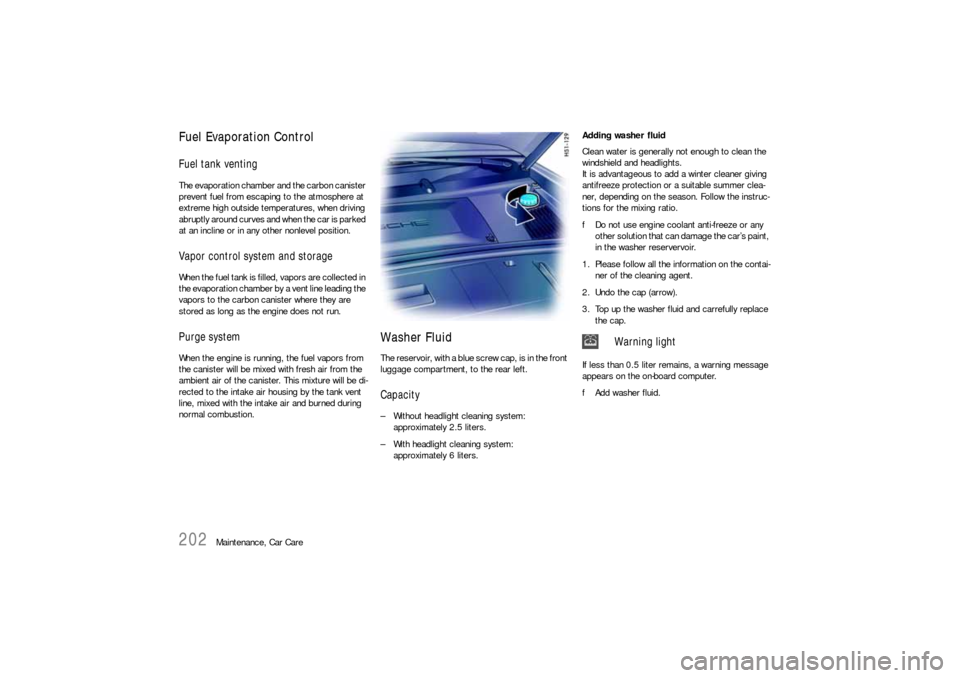
Washer Fluid The reservoir, with a blue screw cap, is in the front
luggage compartment, to the rear left. Capacity – Without headlight cleaning system:
approximately 2.5 liters.
– With headlight cleaning system:
approximately 6 liters. Adding washer fluid
Clean water is generally not enough to clean the
windshield and headlights.
It is advantageous to add a winter cleaner giving
antifreeze protection or a suitable summer clea-
ner, depending on the season. Follow the instruc-
tions for the mixing ratio.
fDo not use engine coolant anti-freeze or any
other solution that can damage the car’s paint,
in the washer reservervoir.
1. Please follow all the information on the contai-
ner of the cleaning agent.
2. Undo the cap (arrow).
3. Top up the washer fluid and carrefully replace
the cap.
If less than 0.5 liter remains, a warning message
appears on the on-board computer.
fAdd washer fluid.
Warning light
Page 210 of 296

210
Maintenance, Car Care
Washing The best method of protecting your car from the
damaging effects of the environment is frequent
washing and the application of a preservative. The
underside of your vehicle should also be tho-
roughly washed for cinders, salt or sanding at win-
ter’s end.
The longer salt, road dust and industrial dust,
dead insects, bird droppings or substances from
trees (resin, pollen) are allowed to remain on the
bodywork, the more serious is their harmful ef-
fect.
New cars should be washed carefully with plenty
of clear water to protect the new paint work. Dark
paint finishes show up the smallest of surface da-
mage (e.g., scratches) more readily than lighter
colors.
Dark colors are also more susceptible to scrat-
ching because of the composition of their pig-
ments and require particularly careful paint care.
fDo not wash your car in bright sunlight or while
the bodywork is still hot.
fWhen washing by hand, use abundant water, a
soft sponge or wash brush, and Porsche car
shampoo.
fBegin by spraying the body thoroughly with wa-
ter to rinse away loose dirt. fAfter washing, rinse the car with plenty of wa-
ter and then dry with a chamois leather.
Do not use the same chamois leather for
drying as you use for cleaning the windshield
and windows.
Warning!
Moisture which gets on to the brakes during
a car wash can reduce braking efficiency or
make the brakes pull unevenly which could
increase the danger of an accident, causing
serious personal injuries or death.
fAlways apply the brakes a few times after was-
hing the car to test braking efficiency and dry
the brake discs.
When doing this, take care not to hamper other
road users behind you (traffic conditions per-mitting).
Page 215 of 296

Maintenance, Car Care
215
Warning!
Danger of fire and serious personal injuries.
fDo not apply additional undercoating or rust-
proofing on or near the exhaust manifold, ex-
haust pipes, catalytic converters or heat
shields. During driving the substance used for undercoating could overheat and ignite.
fBefore applying fresh underseal, carefully re-
move deposits or dirt and grease. Once it has
dried, the new undercoating compound forms
a tough protective coating which provides effi-
cient rust-proofing of the floor panels and com-
ponents.
fAlways apply a fresh coating of suitable preser-
vative to unprotected areas after cleaning the
underside of the body, the transmission, the
engine or carrying out repairs to under-body,
engine or transmission components.
Effective rust-proofing is particularly important du-
ring the cold weather season. If your car is driven
frequently in areas where salt has been spread on
the roads, the whole engine compartment should
be cleaned thoroughly after the winter to prevent
salt from causing any lasting damage. A full under-
body wash should also be performed at the same
time.
Door, roof, lid and window seals fWash dirt (e.g. abrasion, dust, road salts) from
all seals regularly using warm soapy water. Do
not use any chemical cleaning agents or sol-
vents.
When there is a frost hazard, the outer door seals
and the front and rear lid seals can be protected
against freezing into place by a suitable care pro-
duct.
In order to prevent damage to the anti-fric-
tion coating, the inner door seals, the con-
vertible top seals and hardtop seals must not
be treated with care products. Stainless steel exhaust tailpipesStainless steel exhaust tailpipes can discolour due
to soiling, strong heat, and combustion residues.
The original polish can be achieved again using
commercially available metal polishing paste or
metal polish.
Headlights, lights, interior and exterior
plastic parts fUse only clean water and a little dishwashing
detergent to clean light lenses, plastic head-
light lenses, plastic parts and surfaces.
Do not clean when dry.
Use a soft sponge or a soft, lint-free cloth.
Gently wipe the surface without applying too
much pressure.
The Porsche inside window cleaner is also sui-
table for cleaning plastic surfaces. Follow the
cleaning instructions on the container.
Never use other chemical cleaners or
solvents.
fRinse cleaned surfaces with clear water.
Page 216 of 296

216
Maintenance, Car Care
Light alloy wheels fPlease observe the chapter “WASHING” on
Page 210.
Warning!
Danger of accident if cleaning agents (e.g.
wheel cleaning agents) come into contact
with the brake discs. The resulting film on the
brake discs can impair braking perfor-
mance.
fMake sure that no cleaning agent comes into
contact with the brake discs.
fIf cleaning agent has come into contact with
the brake discs, thoroughly clean the brake
discs with a strong jet of water.
fPaying attention to any road users behind you,
dry the brake discs by applying the brakes at short intervals.
Pitting may occur if metallic particles which cause
contact corrosion (e.g. brass or copper in brake
dust) are allowed to remain on the aluminum for
too long.
fIf possible, wash the wheels with a sponge or
wash brush about every two weeks. In areas
where salt is spread on winter roads or there is
a lot of airborne industrial dust, it is best to
clean the wheels weekly.
The Porsche Light Alloy Wheel Cleaner
(ph-value 9.5) can be used for this purpo-
se.If the ph-value of the detergent is incor-
rect, the protective coating on the wheels
will be destroyed.
Polishes which dissolve oxides, such as
those frequently used for other metals, or
abrasive tools or agents are unsuitable
because they break down the oxide film of
the protective coating and will cause dis-
coloration of the wheel.
fEvery three months, after cleaning, coat the
wheels with a car wax or non-corrosive grease
(vaseline).
Using a clean cloth thoroughly rub the grease
into the surface.
Leather Characteristics and special features
The natural surface markings of leather, e.g. cre-
ases, healed scars, insect sting marks, structural
differences and slight variations in shade and
grain add to the attractiveness of the natural lea-
ther product.
A special mention must be made here of natural le-
ather.
For natural leather, carefully selected hides of the
highest quality are used. It is not covered comple-
tely with dye on production.
“Nature’s signature” is therefore easily recogniz-
able.
This fine material is distinguished by an outstan-
ding seating comfort, special suppleness and a ty-
pical patina. Leather care and treatment
fClean all types of leather regularly to remove
fine dust using a soft, damp, white woollen
cloth or a commercially available microfibre
cloth.
fRemove heavy contamination with Porsche le-
ather cleaner.
Please always follow the instructions for use gi-
ven on the containers.
Caustic cleaners and hard cleaning objects
must not be used.
Perforated leather must under no circum-
stances get wet on its reverse side.
Once cleaned, leather (particularly the heavily
stressed leather seats) must be treated only with
Porsche leather care liquid.
Page 217 of 296

Maintenance, Car Care
217
Fabric, upholstery, carpets and floor-
mats fUse only a vacuum cleaner or a medium stiff
brush.
fRemove stains and spots with Porsche stain
remover.
The Porsche range of accessories includes floor-
mats to protect the carpets in summer and winter.
Warning!
Risk of an accident.
fAlways check the movement of the pedals be-
fore driving and make sure that they are not
obstructed by a floor mat or any other object.
fSecure the floor mat to prevent it from sliding
into positions that could interfere with the safe
operation of your vehicle - do not lay them loo-
sely in the vehicle.
Your Porsche dealer will be glad to offer you nonskid-floor mats of the correct size.
Alcantara Do not use a leather care product to clean
Alcantara.
For regular care it is sufficient to clean the cover
with a soft brush.
Heavy abrasion or rubbing when cleaning causes
a lasting change in the surface.
Cleaning when lightly soiled
fWet a soft cloth with water or a neutral soap
solution and wipe off the dirt.
Cleaning when heavily soiled
fWet a soft cloth with lukewarm water or thin-
ned white spirit and dab the dirt from the out-
side in.
Safety belts If it becomes necessary to clean the belts, you
can use any mild washing agent.
Allow the belts to dry prior to retracting, but avoid
direct sunlight.
fOnly use suitable cleaners.
If unsuitable cleaners are used or any attempt
is made to dye or bleach the belts, the web-
bing may be weakened and thus constitute a
safety risk.
Page 224 of 296

224
Practical Tips, Emergency Service
Tire pressures
Warning!
Incorrect tire pressure causes increased tire
wear and adversely affects road handling.
fAlways use an accurate tire pressure gauge
when checking inflation pressures.
fDo not exceed the maximum tire pressure list-
ed on the tire sidewall.
Please observe the chapter “VEHICLE IDENTI-
FICATION NUMBER” on Page 278.
fCold tire inflation pressure means: all tires
must be cold, ambient temperature maximum
(68°F, (20°C)
, when adjusting the inflation pres-
sure.
Avoid sunlight striking the tires before measur-
ing cold pressures, since the pressures would
rise from temperature influence.
fValve caps protect the valve from dust and dirt,
and thus from leakage.
Always screw caps tightly down.
Replace missing caps immediately.
fUse only plastic valve caps.
fDo not use commercially available sealant or
tire inflating bottles. Only use Porsche approved tire sealant.Each tire, including the spare (if provided), should
be checked every 2 weeks when cold (68°F/20°C)
and inflated to the inflation pressure recommend-
ed in this Owner's Manual or on the tire-pressure
plate.
If your vehicle has tires of a different size than the
size indicated in this Owner's Manual or on the tire-
pressure plate, you should determine the proper
tire inflation pressure for those tires.
As an added safety feature, your vehicle has been
equipped with a tire pressure monitoring (TPC)
that illuminates a low tire pressure message when
one or more of your tires is significantly under-in-
flated. Accordingly, when the low tire pressure
message illuminates, you should stop and check
your tires as soon as possible, and inflate them to
the proper pressure. Driving on a significantly un-
der-inflated tire causes the tire to overheat and
can lead to tire failure. Under-inflation also reduc-
es fuel efficiency and tire tread life, and may affect
the vehicle’s handling and stopping ability.
Please note that the TPC is not a substitute for
proper tire maintenance, and it is the driver’s re-
sponsibility to maintain correct tire pressure, even
if under-inflation has not reached the level to trig-
ger illumination of the TPC low tire pressure mes-
sage.
fOn vehicles with tire pressure monitoring:
Please observe the chapter “TPC TIRE
PRESSURE MONITORING” on Page 103.
When tires are warm, the tire pressure is increa-
sed.fNever let air out of hot tires.
This could cause the tire pressure to fall below
the prescribed value.
Insufficient tire filling pressure can cause tires to
overheat and thus be damaged – even invisibly.
Hidden tire damage is not eliminated by subse-
quently correcting the tire pressure.
Page 240 of 296
240
Practical Tips, Emergency Service
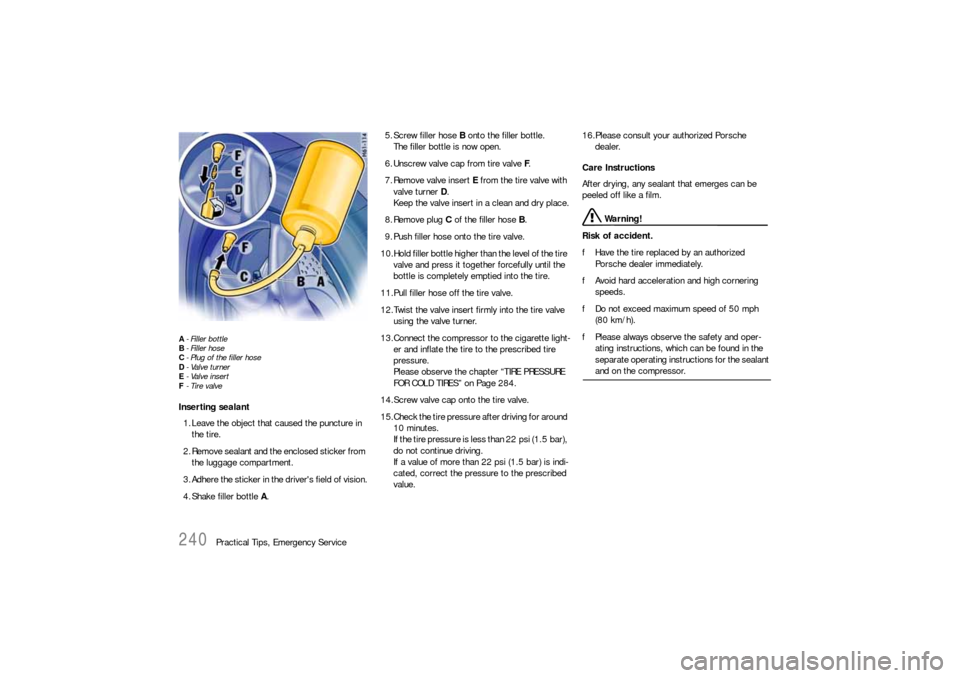
A- Filler bottle
B- Filler hose
C- Plug of the filler hose
D-Valve turner
E-Valve insert
F- Tire valveInserting sealant
1. Leave the object that caused the puncture in
the tire.
2. Remove sealant and the enclosed sticker from
the luggage compartment.
3. Adhere the sticker in the driver's field of vision.
4. Shake filler bottle A.5. Screw filler hose B onto the filler bottle.
The filler bottle is now open.
6. Unscrew valve cap from tire valve F.
7. Remove valve insert E from the tire valve with
valve turner D.
Keep the valve insert in a clean and dry place.
8. Remove plug C of the filler hose B.
9. Push filler hose onto the tire valve.
10.Hold filler bottle higher than the level of the tire
valve and press it together forcefully until the
bottle is completely emptied into the tire.
11.Pull filler hose off the tire valve.
12.Twist the valve insert firmly into the tire valve
using the valve turner.
13.Connect the compressor to the cigarette light-
er and inflate the tire to the prescribed tire
pressure.
Please observe the chapter “TIRE PRESSURE
FOR COLD TIRES” on Page 284.
14.Screw valve cap onto the tire valve.
15.Check the tire pressure after driving for around
10 minutes.
If the tire pressure is less than 22 psi (1.5 bar),
do not continue driving.
If a value of more than 22 psi (1.5 bar) is indi-
cated, correct the pressure to the prescribed
value.16.Please consult your authorized Porsche
dealer.
Care Instructions
After drying, any sealant that emerges can be
peeled off like a film.
Warning!
Risk of accident.
fHave the tire replaced by an authorized
Porsche dealer immediately.
fAvoid hard acceleration and high cornering
speeds.
fDo not exceed maximum speed of 50 mph
(80 km/h).
fPlease always observe the safety and oper-
ating instructions, which can be found in the
separate operating instructions for the sealant and on the compressor.
Page 242 of 296
242
Practical Tips, Emergency Service
Changing a wheel
Warning!
Risk of injury. The car may slip off the jack.
fMake sure that no one is in the vehicle when
jacking up and changing a wheel.
fAlways place the car on stable supports if work
has to be carried out under the car.
Risk of damage to the brake discs of the
Porsche Ceramic Composite Brake (PCCB).
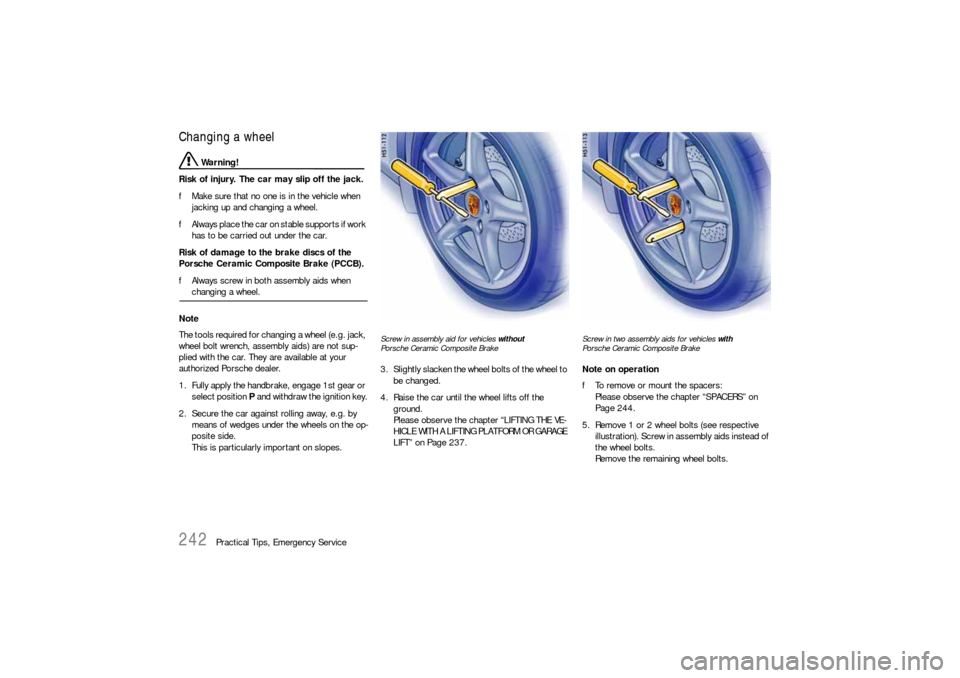
fAlways screw in both assembly aids when changing a wheel.
Note
The tools required for changing a wheel (e.g. jack,
wheel bolt wrench, assembly aids) are not sup-
plied with the car. They are available at your
authorized Porsche dealer.
1. Fully apply the handbrake, engage 1st gear or
select position P and withdraw the ignition key.
2. Secure the car against rolling away, e.g. by
means of wedges under the wheels on the op-
posite side.
This is particularly important on slopes.
Screw in assembly aid for vehicles without
Porsche Ceramic Composite Brake3. Slightly slacken the wheel bolts of the wheel to
be changed.
4. Raise the car until the wheel lifts off the
ground.
Please observe the chapter “LIFTING THE VE-
HICLE WITH A LIFTING PLATFORM OR GARAGE
LIFT” on Page 237.
Screw in two assembly aids for vehicles with
Porsche Ceramic Composite BrakeNote on operation
fTo remove or mount the spacers:
Please observe the chapter “SPACERS” on
Page 244.
5. Remove 1 or 2 wheel bolts (see respective
illustration). Screw in assembly aids instead of
the wheel bolts.
Remove the remaining wheel bolts.
Page 246 of 296

246
Practical Tips, Emergency Service
Electrical System In order to avoid damage and faults in electrical or
electronic systems, electrical accessories should
be installed at your authorized Porsche dealer.
fOnly use accessories authorized by Porsche.
Warning!
Risk of short circuit and fire.
Replacing fuses or relays with the engine
running or the ignition on could cause elec-
trical shock.
fDisconnected the battery during all work on
the electrical system.
Please observe the chapter “BATTERY” on Page 249.
Relays Defective relays should be changed only by an
authorized workshop.
Alarm system, central locking The status of the central locking and alarm system
is not changed by disconnecting the battery.
When the battery is disconnected, the alarm sys-
tem ceases to function. Overload protection If the central locking system is operated more
than ten times within a minute, further operation is
blocked for 30 seconds.
Load switch-off after 2 hours or 7 daysIf the ignition key is removed, loads which are
switched on or are in standby mode (such as the
luggage compartment light, interior light and
radio) are automatically switched off after approx.
2hours.
If the vehicle is not started or unlocked with the
remote control within 7days, the remote control
standby function is switched off (to save the
vehicle battery).
1. In this case, unlock the driver's door with the
key at the door lock.
Leave the door closed in order to prevent the
alarm system from being triggered.
2. Press button 1 on the remote control.
The remote control is now activated again.
Page 252 of 296

252
Practical Tips, Emergency Service
Putting vehicle into operationAfter the battery is connected or after an exhaus-
tively discharged battery is charged, the multi-
functional PSM light lights up on the instrument
panel and a message appears on the on-board
computer to indicate a fault.
This fault can be remedied with a few simple
steps:
1. Start the engine.
2. With the vehicle stationary, perform a few
steering movements to the left and right and
then drive a short distance in a straight line
until the multifunctinal PSM light goes out and
the message on the on-board computer
disappears.
3. If the warnings do not disappear, then:
Drive carefully to the nearest qualified
specialist workshop.
Have the fault remedied.
4. After the warnings disappear, stop the vehicle
in a suitable place.
5. Perform adaptation of the power windows:
Please observe the chapter “STORING END
POSITION OF THE WINDOWS” on Page 29.Ignition key/ignition lock
fDo not insert the ignition key into the ignition
lock if the vehicle battery is discharged.
The ignition key can no longer be removed.
The key cannot be removed until the vehicle elec-
trical system is supplied with power again.
fPlease observe the chapter “EMERGENCY UN-
LOCKING OF THE FRONT LUGGAGE COMPART-
MENT LID” on Page 248.
6. Please observe the chapter “JUMP LEAD
STARTING” on Page 256.