Lug PORSCHE BOXSTER 2006 2.G Owners Manual
[x] Cancel search | Manufacturer: PORSCHE, Model Year: 2006, Model line: BOXSTER, Model: PORSCHE BOXSTER 2006 2.GPages: 296, PDF Size: 4.12 MB
Page 11 of 296
Controls, Instruments
11 Controls, Instruments
Before driving off... ...................................... 12
Break in hints for the first
2,000 miles/3,000 kilometers ...................... 14
Keys ........................................................... 17
Security Wheel Bolts.................................... 17
Central Locking in Cars without Alarm System 19
Doors ......................................................... 25
Alarm System,
Passenger Compartment Monitoring ............. 26
Power Windows ........................................... 28
Inside mirror ................................................ 30
Automatic Anti-Glare Interior Mirror
and Door Mirrors ......................................... 30
Door Mirrors................................................ 31
Seat Adjustment .......................................... 34
Seat Memory ............................................... 36
Heated Seats .............................................. 38
Steering Wheel Adjustment ........................... 39
Multi-functional steering wheel....................... 40
Sun Visors................................................... 41
Safety Belts.................................................. 42
Child Restraint Systems................................ 45
LATCH System
Child seat bracket on the passenger’s seat .... 49
Airbag Systems ........................................... 50
Clutch Pedal ................................................ 56
Parking Brake .............................................. 57
Brakes ........................................................ 58
ABS Brake System
(Antilock Brake System) ................................ 61
Sport Mode ................................................. 63
Porsche Stability Management (PSM)............. 64Porsche Active Suspension Management
(PASM) ........................................................ 67
Retractable Spoiler ...................................... 68
Parking Aids ................................................ 70
Operation, Instruments ................................. 72
Ignition/Starter Switch with anti-theft
Steering Lock .............................................. 74
Starting Procedures ..................................... 76
Stopping engine........................................... 77
Instrument Panel USA Models ....................... 79
Automatic Speed Control Indicator light ......... 82
Instrument Illumination.................................. 82
Trip Odometer ............................................. 83
Speedometer .............................................. 84
Changing over between
Miles / Kilometers........................................ 84
Tachometer ................................................. 85
Turn Signal Indicator Light ............................ 85
High Beam .................................................. 85
Cooling System ........................................... 86
Tiptronic...................................................... 87
Fuel ............................................................ 88
Clock .......................................................... 89
Outside temperature .................................... 89
Check Engine Warning Light.......................... 90
Central warning light .................................... 91
Brake warning light USA ............................... 91
Brake warning light Canada .......................... 91
On-Board Computer (BC) .............................. 92
Light Switch .............................................. 124
Welcome Home Lighting ............................. 124
Automatic Headlight Beam Adjustment ........ 125Turn Signal/ Headlight Dimmer/Parking light /
Flasher Lever............................................. 125
Windshield Wiper / Washer Lever ................ 126
Automatic Speed Control ............................ 128
Air conditioning .......................................... 130
Automatic air conditioning system ............... 133
Central and side vents................................ 136
Fresh-air intake .......................................... 136
Emergency Flasher Switch .......................... 137
Ashtray ..................................................... 138
Cigarette Lighter ........................................ 139
Sockets .................................................... 140
Interior lights ............................................. 141
Storage in the passenger compartment ....... 142
Cupholder
(holder for drinks cans and cups) ................ 144
Luggage Storage on
Engine Compartment Lid ............................ 146
Fire extinguisher ........................................ 147
Trunk Entrapment ...................................... 148
Luggage compartment lids ......................... 150
Luggage Compartment.............................. 152
Rear luggage compartment ........................ 153
Porsche Communication Management (PCM) 154
Car Audio Operation/Tips ........................... 155
HomeLink .................................................. 158
Manual Transmission, Clutch ....................... 162
Tiptronic S................................................. 163
Convertible Top.......................................... 170
Windstop ................................................... 177
Hardtop..................................................... 178
Page 12 of 296
12
Controls, Instruments
Dear Porsche Owner A lot has gone into the manufacture of your
Porsche, including advanced engineering, rigid
quality control and demanding inspections.
These engineering and safety features will be
enhanced by you... the safe driver... – who knows his car and all controls,
– who maintains the vehicle properly,
– who uses driving skills wisely, and always
drives within her/his own capabilities and the
level of familiarity with the vehicle.
You will find helpful hints in this manual on how to
perform most of the checks listed on the following
pages.
If in doubt, have these checks performed by your
authorized Porsche dealer.
Before driving off... Check the following items first fTurn the engine off before you attempt any
checks or repairs on the vehicle.
fBe sure the tires are inflated correctly.
Check tires for damage and tire wear.
fSee that wheel bolts are properly tightened
and not loose or missing.
fCheck engine oil level, add if necessary.
Make it a habit to have engine oil checked with
every fuel filling.
fCheck all fluid levels such as windshield was-
her and brake fluid levels.
fBe sure the vehicle battery is well charged and
cranks the engine properly.
fCheck all doors and lids for proper operation
and latch them properly.
fCheck and if necessary replace worn or cra-
cked wiper blades.
fSee that all windows are clear and unobstruc-
ted.
fCheck air intake slots and area between front
lid and windshield are free of snow and ice, so
the heater and the windshield wipers work pro-
perly. fIf a child will be riding in the vehicle, check
child seat/child seat restraint system to ensure
that restraints are properly adjusted.
fCheck all exterior and interior lights for opera-
tion and that the lenses are clean.
fCheck the headlights for proper aim, and if ne-
cessary, have them adjusted.
fCheck under the vehicle for leaks.
fBe sure all luggage is stowed securely.
Emergency equipment It is good practice to carry emergency equipment
in your vehicle.
Some of the items you should have are:
window scraper, snow brush, container or bag of
sand or salt, emergency light, small shovel, first-
aid kit, etc.
Page 14 of 296

14
Controls, Instruments
Break in hints for the first
2,000 miles/3,000 kilometers The following tips will be helpful in obtaining opti-
mum performance from your new Porsche.
Despite the most modern, high-precision manufac-
turing methods, it cannot be completely avoided
that the moving parts have to wear in with each
other. This wearing-in occurs mainly in the first
2,000 miles/3,000 km. Therefore: fPreferably take longer trips.
fAvoid frequent cold starts with short-distance
driving whenever possible.
fAvoid full throttle starts and abrupt stops.
fDo not exceed maximum engine speed of
4,200 rpm (revolutions per minute).
fDo not run a cold engine at high rpm either in
Neutral or in gear.
fDo not let the engine labor, especially when dri-
ving uphill. Shift to the next lower gear in time
(use the most favorable rpm range).
fNever lug the engine in high gear at low
speeds. This rule applies at all times, not just
during the break-in period. fDo not participate in motor racing events,
sports driving schools, etc. during the first
2,000 miles/3,000 kilometers.
There may be a slight stiffness in the steering,
gear-shifting or other controls during the break-in
period which will gradually disappear.
Break in brake pads and break discsNew brake pads and discs have to be “broken in”,
and therefore only attain optimal friction when the
car has covered several hundred miles or km.
The slightly reduced braking ability must be com-
pensated for by pressing the brake pedal harder.
This also applies whenever the brake pads and
brake discs are replaced. New tires New tires do not have maximum traction. They
tend to be slippery.
fBreak in new tires by driving at moderate
speeds during the first 60 to 120 miles/100 to
200 km. Longer braking distances must be an-
ticipated.
Engine oil and fuel consumption During the break-in period oil and fuel consumpti-
on may be higher than normal.
As always, the rate of oil consumption depends on
the quality and viscosity of oil, the speed at which
the engine is operated, the climate and road con-
ditions, as well as the amount of dilution and oxi-
dation of the lubricant.
fMake a habit of checking engine oil with every
fuel filling, add if necessary.
Page 18 of 296
18
Controls, Instruments
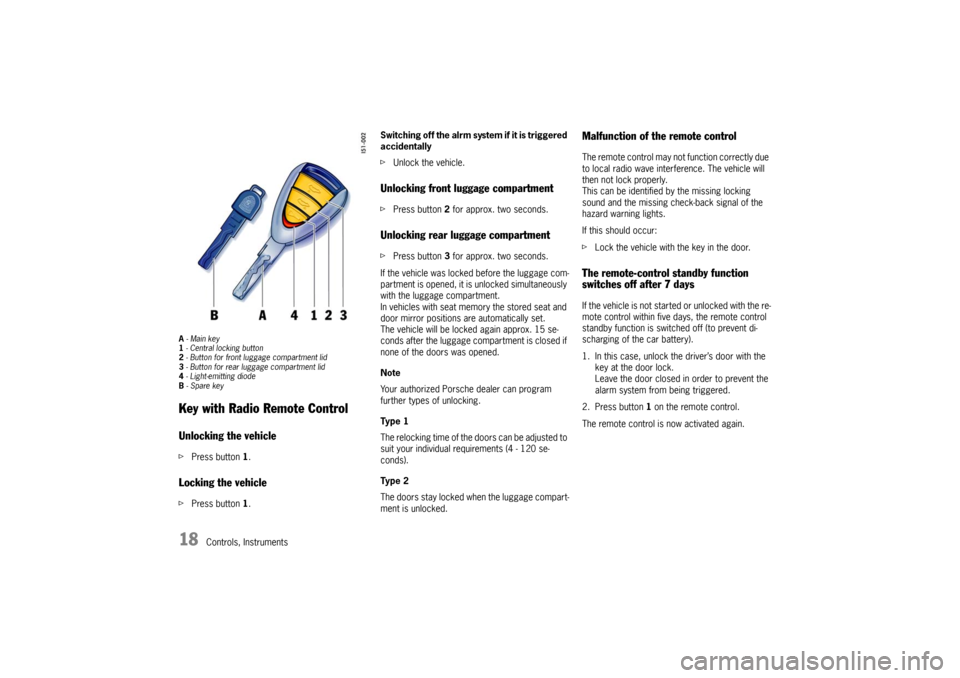
A - Main key
1 - Central locking button
2 - Button for front luggage compartment lid
3 - Button for rear luggage compartment lid
4 - Light-emitting diode
B - Spare key Key with Radio Remote ControlUnlocking the vehiclefPress button 1.Locking the vehiclefPress button 1.Switching off the alrm system if it is triggered
accidentally
fUnlock the vehicle.
Unlocking front luggage compartment fPress button 2 for approx. two seconds. Unlocking rear luggage compartment fPress button 3 for approx. two seconds.
If the vehicle was locked before the luggage com-
partment is opened, it is unlocked simultaneously
with the luggage compartment.
In vehicles with seat memory the stored seat and
door mirror positions are automatically set.
The vehicle will be locked again approx. 15 se-
conds after the luggage compartment is closed if
none of the doors was opened.
Note
Your authorized Porsche dealer can program
further types of unlocking.
Ty p e 1
The relocking time of the doors can be adjusted to
suit your individual requirements (4 - 120 se-
conds).
Ty p e 2
The doors stay locked when the luggage compart-
ment is unlocked.
Malfunction of the remote controlThe remote control may not function correctly due
to local radio wave interference. The vehicle will
then not lock properly.
This can be identified by the missing locking
sound and the missing check-back signal of the
hazard warning lights.
If this should occur:
fLock the vehicle with the key in the door.The remote-control standby function
switches off after 7 days If the vehicle is not started or unlocked with the re-
mote control within five days, the remote control
standby function is switched off (to prevent di-
scharging of the car battery).
1. In this case, unlock the driver’s door with the
key at the door lock.
Leave the door closed in order to prevent the
alarm system from being triggered.
2. Press button 1 on the remote control.
The remote control is now activated again.
Page 21 of 296
Controls, Instruments
21
Central Locking in Cars with Alarm
System This device complies with:
Part 15 of the FCC Rules
RSS-210 of Industry Canada.
Operation is subject to the following two condi-
tions:
1. This device may not cause harmful interfer-
ence, and
2. this device must accept any interference re-
ceived, including interference that may cause
undesired operation.
Note
The manufacturer is not responsible for any radio
or TV interference caused by unauthorized modifi-
cations to this equipment.
Such modification could void the user’s authority
to operate the equipment.
Warning!
Any changes or modifications not expressly appro-
ved by Porsche could void the user’s authority to
operate this equipment.
fPlease observe the chapter “LOAD SWITCH-
OFF AFTER 2 HOURS OR 7 DAYS” on Page
246.
fPlease observe the chapter “SEAT MEMORY”
on Page 36.fPlease observe the chapter “POWER WIN-
DOWS” on Page 28.
Both car doors and the filler flap can be centrally
unlocked or locked with the remote control.
The vehicle cannot be locked if the driver’s door is
not completely closed.
A short signal from the alarm horn will draw
your attention to the fact that the following
components are not completely closed when you
try to lock the vehicle:
– Doors
– Luggage compartment lids
– Convertible-top lock
– Glove compartment
– Passenger compartment
Unlocking the vehicle by using the key in the door
lock and opening the door may activate the alarm
system within 10 seconds.
Note
On vehicles with the Sport Chrono package plus,
the PCM can be used to activate automatic door
locking.
fPlease observe the chapter “Individual Memo-
ry” in the separate PCM operating instructions.
Automatic relocking If the car is unlocked by remote control and none
of the car doors is opened within approx. 60 se-
conds, automatic relocking takes place.
This relocking time can be adapted to your indivi-
dual requirements (4 - 120 seconds) by an autho-
rized Porsche dealer.
Page 37 of 296
Controls, Instruments
37
Operating with the remote control of the
vehicle keyEach remote control (up to six) can be assigned an
individual seat and door mirror position.
The stored seat and door mirror position is set au-
tomatically when the vehicle is unlocked using the
corresponding remote control.
Storing seat position
1. Switch the ignition on with the desired vehicle
key.
Reverse gear must not be engaged.
2. Set the desired seat and door-mirror positions.
3. Keep memory button M depressed and
additionally press key button 1.
The individual setting is now assigned to this
remote control and to the key button.Storing individual lowered position of the
passenger’s door mirror as a parking aid
Once the driver's seat setting has been stored, an
individual lowered position of the passenger's
door mirror may be stored for driving in reverse:
1. Apply the handbrake.
2. Switch the ignition on with the desired vehicle
key.
3. Engage reverse gear.
4. Select passenger side with mirror switch.
The passenger’s mirror swivels downwards.
5. Set passenger’s door mirror to desired final
position.
6. Keep memory button M depressed and
additionally press key button 1.
The individual setting is now assigned to this
remote control and to the key button.Recalling seat position
fUnlock the locked vehicle or the luggage
compartment with the remote control.
The stored seat position is automatically set.
The seat position assigned to a remote control
can also be recalled with the key button 1 if the
corresponding key was used to switch on the
ignition.
If no seat position has been assigned to a remote
control, the key button will not work.
Note on operation
Automatic seat adjustment can be interrupted
immediately:
– by switching on the ignition,
– by pressing the central locking button,
– by pressing any memory or seat adjustment
button.
Clearing the stored seat position
1. Switch the ignition on with the desired vehicle
key.
fPress memory button twice and key button 1
once consecutively.
Page 55 of 296

Controls, Instruments
55
LATCH SystemChild seat bracket on the passenger’s
seatThe key switch for switching off the passenger’s
airbag and the LATCH attachment bracket are not
installed at the factory. They can be retrofitted.
fPlease see your authorized Porsche dealer.
Porsche recommends the use of a Porsche Child
Seat with Lower Anchorage and Tether for Chil-
dren system (LATCH).
These systems have been tested and adjusted to
the interior of your Porsche and the appropriate
child age groups. Other systems have not been
tested and could entail an increased risk of injury.
You can obtain child seats that are LATCH compat-
ible at your authorized Porsche dealer.
fAlways observe the separate installation in-
structions for your child seat.
fPlease observe the chapter “CHILD
RESTRAINT SYSTEMS” on Page 51.
Installing a LATCH child seat system1. Secure the child seat to retaining lugs A as
outlined in the instruction manual for the child
seat.
2. Pull the child seat to check that both fastening
points are engaged correctly.
Note
Make sure that the key switch is switched to AUTO
once the child seat has been removed, in order to
provide protection to the adult occupants.
Page 117 of 296
Controls, Instruments
117
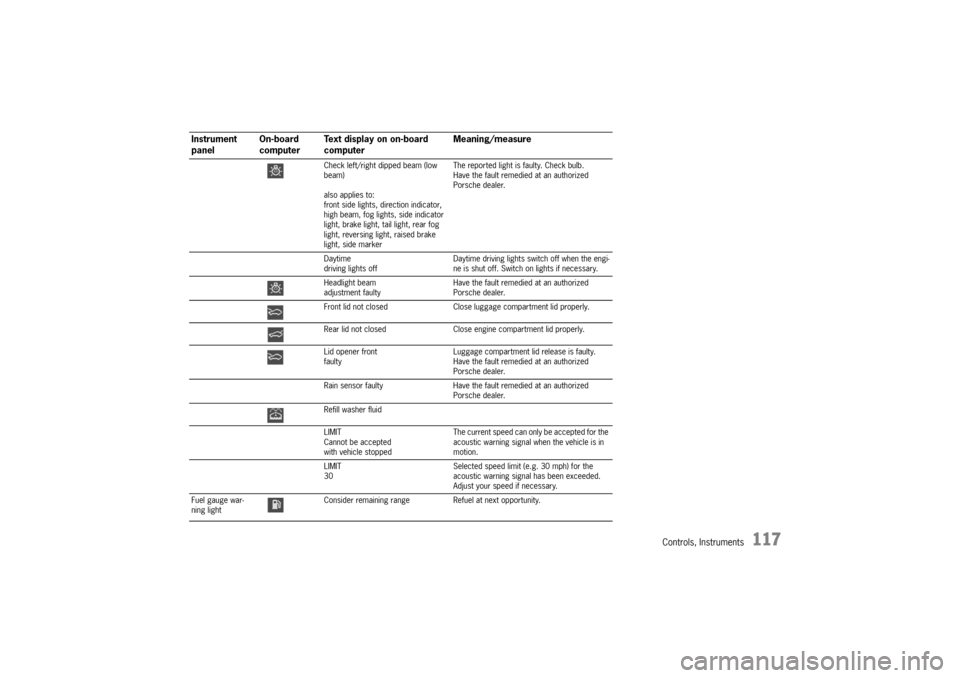
Check left/right dipped beam (low
beam)
also applies to:
front side lights, direction indicator,
high beam, fog lights, side indicator
light, brake light, tail light, rear fog
light, reversing light, raised brake
light, side markerThe reported light is faulty. Check bulb.
Have the fault remedied at an authorized
Porsche dealer.
Daytime
driving lights offDaytime driving lights switch off when the engi-
ne is shut off. Switch on lights if necessary.
Headlight beam
adjustment faultyHave the fault remedied at an authorized
Porsche dealer.
Front lid not closed Close luggage compartment lid properly.
Rear lid not closed Close engine compartment lid properly.
Lid opener front
faultyLuggage compartment lid release is faulty.
Have the fault remedied at an authorized
Porsche dealer.
Rain sensor faulty Have the fault remedied at an authorized
Porsche dealer.
Refill washer fluid
LIMIT
Cannot be accepted
with vehicle stoppedThe current speed can only be accepted for the
acoustic warning signal when the vehicle is in
motion.
LIMIT
30Selected speed limit (e.g. 30 mph) for the
acoustic warning signal has been exceeded.
Adjust your speed if necessary.
Fuel gauge war-
ning lightConsider remaining range Refuel at next opportunity.
Instrument
panelOn-board
computerText display on on-board
computerMeaning/measure
Page 136 of 296
136
Controls, Instruments
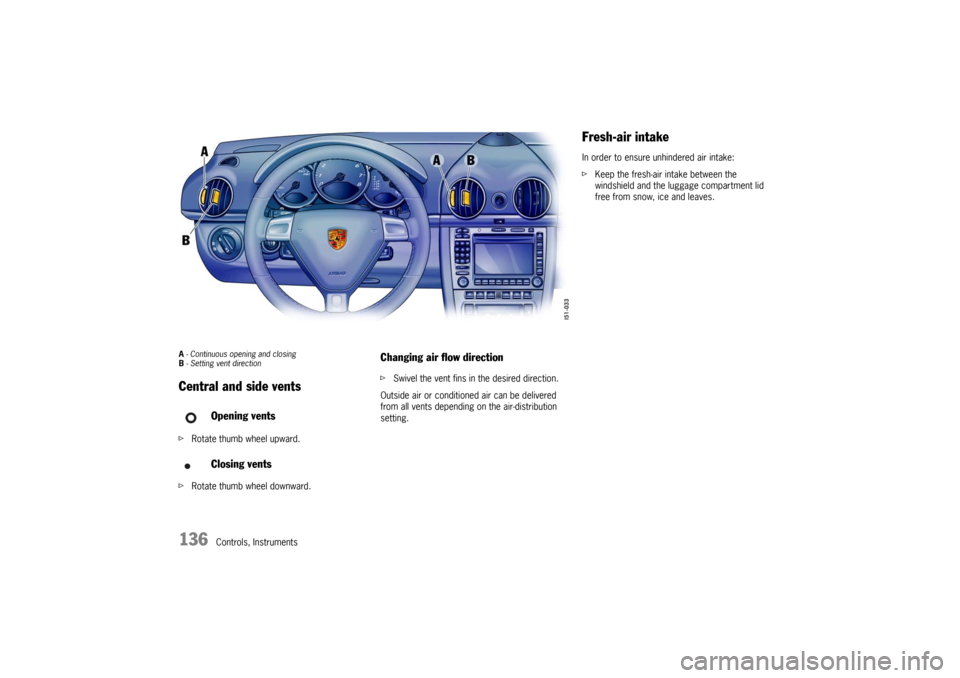
A - Continuous opening and closing
B - Setting vent direction Central and side ventsfRotate thumb wheel upward.
fRotate thumb wheel downward.
Changing air flow directionfSwivel the vent fins in the desired direction.
Outside air or conditioned air can be delivered
from all vents depending on the air-distribution
setting.
Opening vents
Closing vents
Fresh-air intakeIn order to ensure unhindered air intake:
fKeep the fresh-air intake between the
windshield and the luggage compartment lid
free from snow, ice and leaves.
Page 142 of 296
142
Controls, Instruments
Storage in the passenger
compartment
Warning!
Danger of injury during braking, rapid
direction changes or in an accident.
fDo not carry items of luggage or objects in the
passenger compartment unsecured.
fDo not transport any heavy objects in the oddments trays.
Additional storage possibilities– in the doors,
– in the door sill next to the passenger's seat,
– in the center console,
– clothes hook on back of seat backrest,
– oddments tray with coin holder between seats,
– glove compartment with CD and pen holder,
– on engine compartment lid.
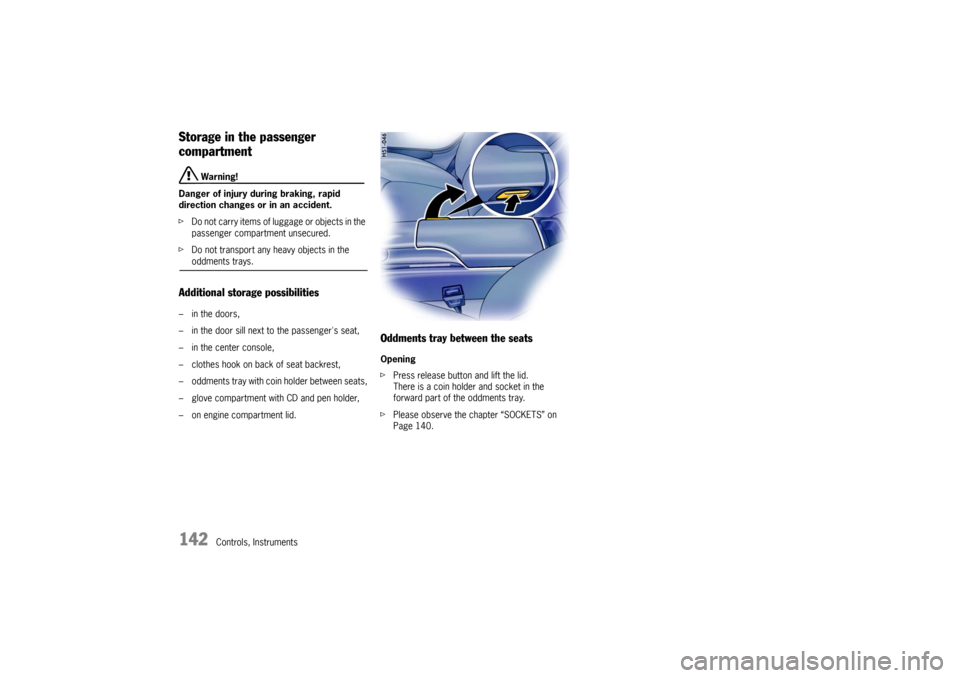
Oddments tray between the seatsOpening
fPress release button and lift the lid.
There is a coin holder and socket in the
forward part of the oddments tray.
fPlease observe the chapter “SOCKETS” on
Page 140.