belt PORSCHE BOXSTER 2006 2.G Owners Manual
[x] Cancel search | Manufacturer: PORSCHE, Model Year: 2006, Model line: BOXSTER, Model: PORSCHE BOXSTER 2006 2.GPages: 296, PDF Size: 4.12 MB
Page 2 of 296

2Dear Owner, we would like to thank you for your purchase of a
Porsche Sports car.
Judging by the car you have chosen, you are a mo-
torist of a special breed, and you are probably no
novice when it comes to automobiles.
Remember however, as with any vehicle, you
should take time to familiarize yourself with your
Porsche and its performance characteristics. Al-
ways drive within your own unique capabilities as
a driver and your level of experience with your
Porsche. Ensure that anyone else driving your
Porsche does the same. To prevent or minimize in-
jury, always use your safety belts. Never consume
alcohol or drugs before or during the operation of
your vehicle.
This Owner’s Manual contains a host of useful in-
formation. Please take the time to read this manu-
al before you drive your new Porsche. Become fa-
miliar with the operation of your Porsche car for
maximum safety and operating pleasure. The bet-
ter you know your Porsche, the more pleasure you
will experience driving your new car.
Always keep your Owner’s Manual in the car, and
give it to the new owner if you ever sell your
Porsche. A separate Maintenance Booklet explains how
you can keep your Porsche in top driving condition
by having it serviced regularly.
A separate Warranty and Customer Informa-
tion Booklet contains detailed information about
the warranties covering your Porsche.
For U.S. only:
If you believe that your vehicle has a fault which
could cause a crash, injury or death, you should
immediately inform the National Highway Traffic
Safety Administration (NHTSA) in addition to
notifying Porsche Cars North America, Inc.
(Porsche Cars N.A.).
If NHTSA receives similar complaints, it may open
an investigation, and if it finds that a safety pro-
blem exists in a group of vehicles, it may order a
recall and remedy campaign. However, NHTSA
cannot become involved in individual problems
between you and your dealer, or Porsche Cars
N.A..
To contact NHTSA, you may either call the Auto
Safety Hotline toll-free at 1(800)424-9393 (or
366-
0123 in Washington, D.C. area) or write to: NH-
TSA, U.S. Department of Transportation, Washing-
ton, D.C. 20590. You can also obtain other infor-
mation about motor vehicle safety from the Hot-
line. Your car has thousands of parts and components
which have been designed and manufactured in
accordance with Porsche’s high standards of engi-
neering quality and safety.
Any alteration of the vehicle may negate or
interfere with those safety features built into
the vehicle. Modifications may be carried out
on your vehicle only if approved by Porsche.
Your Porsche is intended to be used in a safe man-
ner obeying the local laws and in the light of dri-
ving conditions faced by you, and in accordance
with the instructions provided in this Owner’s Ma-
nual.
Do not misuse your Porsche by ignoring
those laws and driving conditions, or by
ignoring the instructions in this manual.
Any alteration or misuse of the vehicle can
lead to accidents and severe or fatal person
al injuries.
The fitting of racing tires (e.g. slicks) for sporting
events is not approved by Porsche. Very high cor-
nering speeds can be achieved with racing tires.
However, the resulting transverse acceleration va-
lues would jeopardize the adequate supply of oil to
the engine.
Porsche therefore will not accept any warranty or
accept any liability for damage occurring as a re-
sult of non-compliance with this provision.
Page 11 of 296

Controls, Instruments
11 Controls, Instruments
Before driving off... ...................................... 12
Break in hints for the first
2,000 miles/3,000 kilometers ...................... 14
Keys ........................................................... 17
Security Wheel Bolts.................................... 17
Central Locking in Cars without Alarm System 19
Doors ......................................................... 25
Alarm System,
Passenger Compartment Monitoring ............. 26
Power Windows ........................................... 28
Inside mirror ................................................ 30
Automatic Anti-Glare Interior Mirror
and Door Mirrors ......................................... 30
Door Mirrors................................................ 31
Seat Adjustment .......................................... 34
Seat Memory ............................................... 36
Heated Seats .............................................. 38
Steering Wheel Adjustment ........................... 39
Multi-functional steering wheel....................... 40
Sun Visors................................................... 41
Safety Belts.................................................. 42
Child Restraint Systems................................ 45
LATCH System
Child seat bracket on the passenger’s seat .... 49
Airbag Systems ........................................... 50
Clutch Pedal ................................................ 56
Parking Brake .............................................. 57
Brakes ........................................................ 58
ABS Brake System
(Antilock Brake System) ................................ 61
Sport Mode ................................................. 63
Porsche Stability Management (PSM)............. 64Porsche Active Suspension Management
(PASM) ........................................................ 67
Retractable Spoiler ...................................... 68
Parking Aids ................................................ 70
Operation, Instruments ................................. 72
Ignition/Starter Switch with anti-theft
Steering Lock .............................................. 74
Starting Procedures ..................................... 76
Stopping engine........................................... 77
Instrument Panel USA Models ....................... 79
Automatic Speed Control Indicator light ......... 82
Instrument Illumination.................................. 82
Trip Odometer ............................................. 83
Speedometer .............................................. 84
Changing over between
Miles / Kilometers........................................ 84
Tachometer ................................................. 85
Turn Signal Indicator Light ............................ 85
High Beam .................................................. 85
Cooling System ........................................... 86
Tiptronic...................................................... 87
Fuel ............................................................ 88
Clock .......................................................... 89
Outside temperature .................................... 89
Check Engine Warning Light.......................... 90
Central warning light .................................... 91
Brake warning light USA ............................... 91
Brake warning light Canada .......................... 91
On-Board Computer (BC) .............................. 92
Light Switch .............................................. 124
Welcome Home Lighting ............................. 124
Automatic Headlight Beam Adjustment ........ 125Turn Signal/ Headlight Dimmer/Parking light /
Flasher Lever............................................. 125
Windshield Wiper / Washer Lever ................ 126
Automatic Speed Control ............................ 128
Air conditioning .......................................... 130
Automatic air conditioning system ............... 133
Central and side vents................................ 136
Fresh-air intake .......................................... 136
Emergency Flasher Switch .......................... 137
Ashtray ..................................................... 138
Cigarette Lighter ........................................ 139
Sockets .................................................... 140
Interior lights ............................................. 141
Storage in the passenger compartment ....... 142
Cupholder
(holder for drinks cans and cups) ................ 144
Luggage Storage on
Engine Compartment Lid ............................ 146
Fire extinguisher ........................................ 147
Trunk Entrapment ...................................... 148
Luggage compartment lids ......................... 150
Luggage Compartment.............................. 152
Rear luggage compartment ........................ 153
Porsche Communication Management (PCM) 154
Car Audio Operation/Tips ........................... 155
HomeLink .................................................. 158
Manual Transmission, Clutch ....................... 162
Tiptronic S................................................. 163
Convertible Top.......................................... 170
Windstop ................................................... 177
Hardtop..................................................... 178
Page 13 of 296

Controls, Instruments
13
In the driver’s seat... fCheck operation of the horn.
fPosition seat for easy reach of foot pedals and
controls.
To reduce the possibility of injury from the air-
bag deployment, you should always sit back as
far from the steering wheel as is practical,
while still maintaining full vehicle control.
fAdjust the inside and outside rear view mirrors.
fBuckle your safety belts.
fCheck operation of the foot and parking brake.
fCheck all warning and indicator lights with
ignition on and engine not running.
fStart engine and check all warning displays for
warning symbols.
fNever leave an idling car unattended.
fLock doors from inside, especially with child-
ren in the car to prevent inadvertent opening of
doors from inside or outside.
Drive with doors locked.
On the road... fNever drive after you have consumed alcohol
or drugs.
fAlways have your safety belt fastened.
fAlways drive defensively.
Expect the unexpected.
fUse signals to indicate turns and lane changes.
fTurn on headlights at dusk or when the driving
conditions warrant it.
fAlways keep a safe distance from the vehicle in
front of you, depending on traffic, road and
weather conditions.
fReduce speed at night and during inclement
weather.
Driving in wet weather requires caution and re-
duced speeds, particularly on roads with stan-
ding water, as the handling characteristics of
the vehicle may be impaired due to hydropla-
ning of the tires.
fAlways observe speed limits and obey road
signs and traffic laws.
fWhen tired, get well off the road, stop and take
a rest. Turn the engine off. Do not sit in the ve-
hicle with engine idling.
fPlease observe the chapter “ENGINE EX-
HAUST” on Page 8.fWhen parked, always set the parking brake.
Move the Tiptronic selector lever to ”P“ or the
gearshift lever to reverse or first gear.
On hills also turn the front wheels toward the
curb.
fWhen emergency repairs become necessary,
move the vehicle well off the road. Turn on the
emergency flasher and use other warning de-
vices to alert other motorists. Do not park or
operate the vehicle in areas where the hot ex-
haust system may come in contact with dry
grass, brush, fuel spill or other flammable ma-
terial.
fMake it a habit to have the engine oil checked
with every fuel filling.
Danger!
Danger of fire in engine compartment due to
burning cigars or cigarettes.
fDo not throw any lit cigars or cigarettes out of
the vehicle.
They can be blown into the air inlets by the air
flow and cause a fire in the engine compart-
ment.
fPlease observe the chapter “ASHTRAY” on Page 138.
Page 34 of 296
34
Controls, Instruments
Seat Adjustment
Warning!
The seat may move unexpectedly if you
attempt to adjust while driving. This could
cause sudden loss of control or personal in-
jury.
fDo not adjust seats while the vehicle is in mo-
tion.
The backrest locks must be engaged at all
times while the vehicle is in motion.
Safety belts only offer protection when the
backrest is upright and the belts are properly
positioned on the body.
Improperly positioned safety belts or safety
belts worn by passengers in an excessively
reclined position can cause serious personal
injury in an accident.
fDo not operate the car with the driver or pas-
senger backrests excessively reclined (see “Seat position”).
Seat position An ergonomically correct sitting position is
important for safe and fatigue-free driving.
We recommend the following procedure for adjust-
ing the driver’s seat to suit individual
requirements:
1. Vehicles with manual transmission:
Adjust the seat until, with the clutch pedal fully
depressed, your leg remains at a slight angle.
Vehicles with Tiptronic S:
Adjust the seat until, with your left foot on the
footrest, your left leg remains at a slight angle.2. Rest your outstretched arm on the steering
wheel.
Set the backrest angle and the steering-wheel
position so that your wrist rests on the outer
rim of the steering wheel. At the same time,
the shoulders must still be in noticeable
contact with the backrest.
3. Adjust the seat height to give yourself enough
headroom and a good overview of the vehicle.
4. Electrically adjustable seat:
Adjust the seat angle until your thighs rest
lightly on the seat cushion.
Manually adjustable
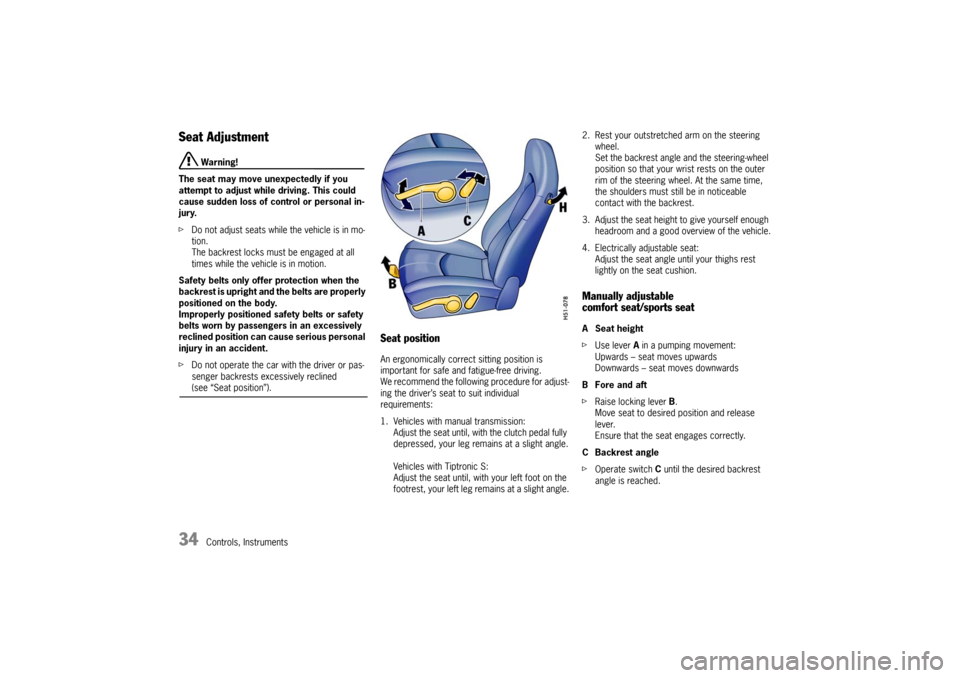
comfort seat/sports seatA Seat height
fUse lever A in a pumping movement:
Upwards – seat moves upwards
Downwards – seat moves downwards
B Fore and aft
fRaise locking lever B.
Move seat to desired position and release
lever.
Ensure that the seat engages correctly.
CBackrest angle
fOperate switch C until the desired backrest
angle is reached.
Page 35 of 296
Controls, Instruments
35
Electrically adjustable
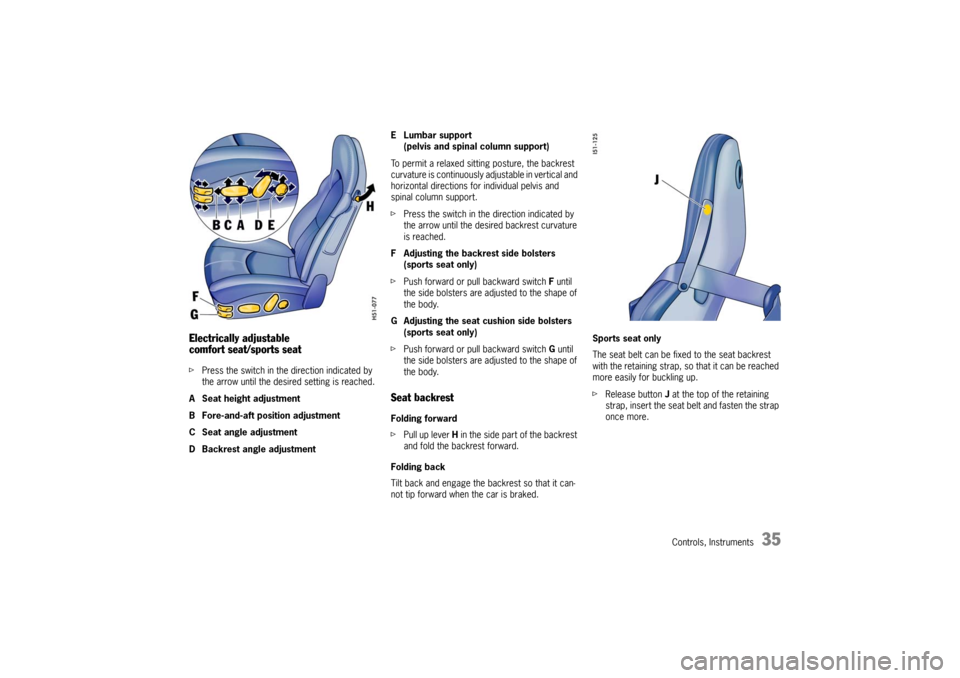
comfort seat/sports seatfPress the switch in the direction indicated by
the arrow until the desired setting is reached.
A Seat height adjustment
B Fore-and-aft position adjustment
C Seat angle adjustment
D Backrest angle adjustmentE Lumbar support
(pelvis and spinal column support)
To permit a relaxed sitting posture, the backrest
curvature is continuously adjustable in vertical and
horizontal directions for individual pelvis and
spinal column support.
fPress the switch in the direction indicated by
the arrow until the desired backrest curvature
is reached.
F Adjusting the backrest side bolsters
(sports seat only)
fPush forward or pull backward switch F until
the side bolsters are adjusted to the shape of
the body.
G Adjusting the seat cushion side bolsters
(sports seat only)
fPush forward or pull backward switch G until
the side bolsters are adjusted to the shape of
the body.
Seat backrestFolding forward
fPull up lever H in the side part of the backrest
and fold the backrest forward.
Folding back
Tilt back and engage the backrest so that it can-
not tip forward when the car is braked.Sports seat only
The seat belt can be fixed to the seat backrest
with the retaining strap, so that it can be reached
more easily for buckling up.
fRelease button J at the top of the retaining
strap, insert the seat belt and fasten the strap
once more.
Page 42 of 296

42
Controls, Instruments
Safety Belts
Warning!
Always make sure your and your passenger’s
safety belts are properly fastened while the
vehicle is in motion.
Failure to follow safety belt warnings may re-
sult in serious personal injury or death.
fFor your and your passenger’s protection, use
safety belts at all times while the vehicle is in
motion.
fUse appropriate child restraint systems for all
small children.
Proper wearing of safety belts
fS a f e t y b e l t s m u s t b e p o s i t i o n e d o n t h e b o d y a s
to restrain the upper body and lap from sliding
forward. Improperly positioned safety belts
can cause serious personal injury or death in
case of an accident.
fThe shoulder belt should always rest on your
upper body. The shoulder belt should never be
worn behind your back or under your arm.
fFor maximum effectiveness, the lap belt
should be worn low across the hips.
fPregnant women should position the belt as
low as possible across the pelvis. Make sure it
is not pressing against the abdomen. fBelts should not be worn twisted.
fDo not wear belts over rigid or breakable ob-
jects in or on your clothing, such as eye glas-
ses, pens, keys, etc. as these may cause inju-
ry.
fSeveral layers of heavy clothing may interfere
with proper positioning of belts.
fBelts must not rub against sharp objects or da-
mage may occur to the belt.
fTwo occupants should never share the same
belt at the same time.
Care and maintenance
fKeep belt buckles free of any obstruction that
may prevent a secure locking.
fBelts that have been subjected to excesssive
stretch forces in an accident must be inspec-
ted or replaced to ensure their continued effec-
tiveness in restraining you.
The same applies to belt tensioner systems
which have been triggered.
In addition, the anchor points of the belts
should be checked.
fIf safety belts do not work properly, see your
authorized Porsche dealer immediately.
fI f t h e b e l t s s h o w d a m a g e t o w e b b i n g , b i n d i n g s ,
buckles or retractors, they should be replaced
to ensure safe operation.
fDo not modify or disassemble the safety belts
in your vehicle. fThe belts must be kept clean or the retractors
may not work properly.
Please observe the chapter “CAR CARE IN-
STRUCTIONS” on Page 209.
fNever bleach or dye safety belts.
fDo not allow safety belts to retract until they
are completely dry after cleaning or this may
cause damage to the belt.
Belt tensioner Depending on the force of an impact, fastened
safety belts are tightened in an accident.
The belt tensioners are triggered by:
– Front, side and rear impacts of sufficient
severity.
– Vehicle rollover.
Note
The belt tensioner system can be triggered only
once; the system must be replaced afterward.
If there is a fault in the belt-tensioner system, the
airbag warning light lights up.
Work may be performed on the belt-tensioner sys-
tem only by an authorized Porsche dealer.
Smoke is released when the belt tensioners are
triggered. This does not indicate a fire in the
vehicle.
Page 43 of 296
Controls, Instruments
43
An audio-visual warning system is interconnec-
ted with the driver’s safety belt.
Every time the ignition is turned on, the gong will
sound for about 6 seconds to remind driver and
passenger to buckle up.
In addition, the gong will sound for approx. 90 se-
conds if the vehicle speed exceeds 15 mph
(24 km/h).
The safety belt warning light in the instrument
panel and on-board computer will go off as soon
as the driver has buckled up.
Inertia reel retractor The combination lap/shoulder belt with inertia reel
locking mechanism adjusts automatically to your
size and movements as long as the pull on the belt
is slow.
Rapid deceleration during hard braking or a collisi-
on locks the belt. The belt will also lock when you
drive up or down a steep hill or in a sharp curve,
otherwise, the shoulder belt will not inhibit your
upper body movement.
Fastening the safety beltfAssume a comfortable sitting position.
The shoulder belt should always rest on your
upper body. The shoulder belt should never be
worn behind your back or under your arm.
fGrasp belt and pull the belt in a continuous
slow motion across your chest and lap.
fInsert belt tongue into buckle on inboard side
of seat. Push down until it securely locks with
an audible click. Pull the belt to check.
fPull shoulder section to make sure belt fits
snugly across the pelvis.
fBelts should fit snugly across the pelvis and
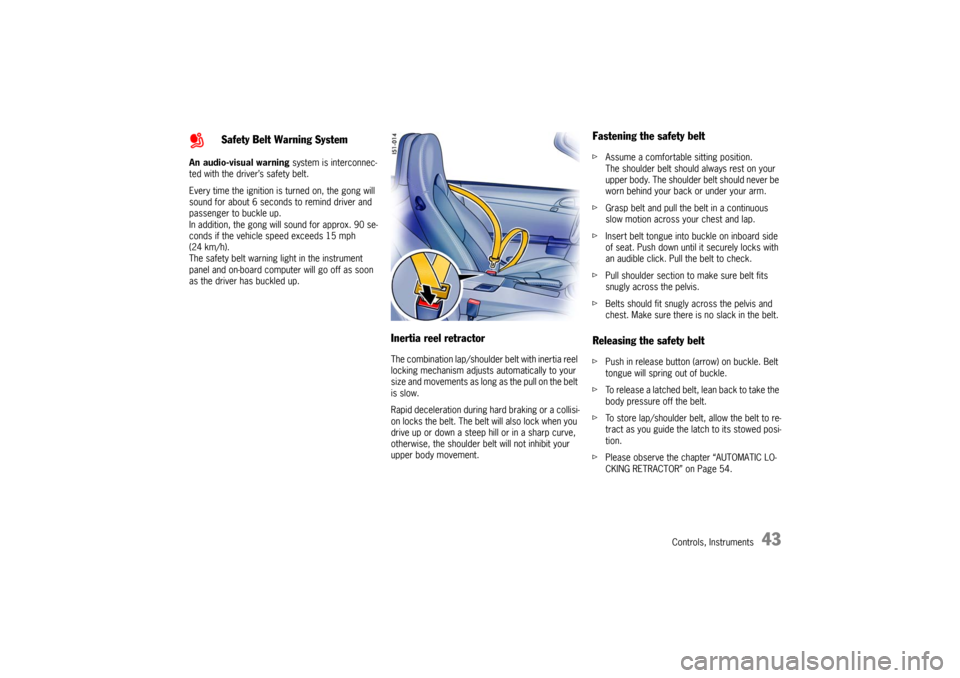
chest. Make sure there is no slack in the belt. Releasing the safety beltfPush in release button (arrow) on buckle. Belt
tongue will spring out of buckle.
fTo release a latched belt, lean back to take the
body pressure off the belt.
fTo store lap/shoulder belt, allow the belt to re-
tract as you guide the latch to its stowed posi-
tion.
fPlease observe the chapter “AUTOMATIC LO-
CKING RETRACTOR” on Page 54.
Safety Belt Warning System
Page 44 of 296

44
Controls, Instruments
Airbag SystemsThe airbags in combination with the safety belts
make up a safety system which offers the driver
and the passenger the greatest known protection
from injuries in case of accident.
Your vehicle is equipped with a weight sensing sys-
tem for the passenger's seat in accordance with
U.S. Federal/Canadian Motor Vehicle Safety Stan-
dard 208.
Even if your vehicle is equipped with airbags, the
safety belts must be worn at all times,
because the front airbag system is only deployed
by frontal collisions with an impact of sufficient se-
verity.
Below the deployment threshold of the airbag sys-
tem, and during types of collisions which do not
cause the actuation of the system, the safety belts
provide the primary protection to the occupants
when correctly worn.
Therefore, all persons within the vehicle
must wear safety belts at all times (in many
states, state law requires the use of safety belts).
fPlease observe the chapter “SAFETY BELTS”
on Page 42.The front airbags are located under the padded
steering wheel panel on the driver’s side and, on
the passenger's side, in the dashboard.
The side airbags for the front seats are installed
on the side in the seat backrests.
The head airbags are installed in the door linings.
Danger!
To provide optimal occupant protection, air-
bags must inflate at very high speed. If you
are not wearing your safety belt or are too
close to the airbag when it is deployed, inflat-
ing airbags can result in serious personal in-
jury or death.
Improper handling of the weight sensing sys-
tem can unintentionally impair switching the
passenger's airbag off and on.
fMake sure there are no people, animals or ob-
jects between the driver or passenger and the
area into which the airbag inflates.
fS i t b a c k a s f a r f ro m t h e d a s h b o a rd o r s t e e r i n g
wheel as is practical, while still maintaining full
vehicle control.
fAlways hold the steering wheel by the outer
rim. Never rest your hands on the airbag panel.
fAlways fasten seat belts because triggering
of the airbag system depends on the force and
angle of impact.
fDo not transport heavy objects on or in front of
the passenger’s seat. These could impair the
function of the airbag, the seat belts, and
weight sensing.
fDo not hang objects (e.g. jackets, coats, coat
hangers) over the backrest.
Page 46 of 296

46
Controls, Instruments
Function of the airbag systemThe front airbags are triggered during a frontal col-
lision of sufficient force and direction.
In the event of a side impact of corresponding
force, the side airbag on the impact side is
triggered.
The inflation process generates the amount of gas
required to fill the airbags at the necessary pres-
sure in fractions of a second.
Airbags protect the head and upper body, while si-
multaneously damping the motion of the driver
and passenger in the impact direction in the event
of a frontal impact or side impact.
Your vehicle is equipped with a crash sensing and
diagnostic module. This module will record the
use of the seat belt restraint system by the driver
and passenger when the airbags and/or belt ten-
sioner work.Advanced Airbag
Your vehicle is equipped with a weight sensing sys-
tem for the passenger's seat in accordance with
U.S. Federal/Canadian Motor Vehicle Safety Stan-
dard 208.
Depending on the weight acting on the passen-
ger's seat, the passenger's airbag will automati-
cally be switched on and off.
Depending on the angle and force of impact, the
passenger's airbag which is activated will be trig-
gered during a collision.
Precondition for switching the passenger's airbag
on and off, depending on weight:
– Vehicles equipped with key-operated airbag de-
activation device:
Switch position AUTO.
– Ignition key is inserted.
Page 51 of 296

Controls, Instruments
51
Child Restraint SystemsPorsche recommends that all infants and children
be restrained in child restraint systems at all times
while the vehicle is in motion in accordance with
applicable laws.
Use only child restraint systems with the LATCH-
system recommended by Porsche. These sys-
tems have been tested and adjusted to the interior
of your Porsche and the appropriate child age
groups. Other systems have not been tested and
could entail an increased risk of injury or death.
You can obtain child seats that are LATCH compa-
tible at your authorized Porsche dealer.
fAlways observe the separate installation in-
structions for your child seat.
The use of infant or child restraints is required by
law in all 50 states of the U.S. and all Canadian
provinces. The child restraint system should be
one that complies with U.S. Federal/Canadian Mo-
tor Vehicle Safety Standards and should be se-
cured by a lap belt or lap belt portion of a lap-
shoulder belt or for child seats equipped with the
LATCH sytem (Lower Anchorage and Tether for
Children, also known as ISOFIX) to the LATCH an-
chorages.
A statement by the seat manufacturer of compli-
ance with this standard can be found on the in-
struction label on the restraint and in the instruc-
tion manual provided with the restraint.
Danger!
The use of a child restraint system in the pas-
senger seat can result in serious personal in-
jury or death to the child from an airbag de-
ployment.
To reduce risk of injury from an inflating air-
bag in an accident, Porsche strongly recom-
mends:
fPlease observe the chapter “PASSENGER
AIRBAG OFF INDICATOR LAMP DOES NOT
LIGHT UP” on Page 49.
fPlease observe the chapter “CHILD RES-TRAINT SYSTEMS” on Page 51.
Note
The key switch for switching off the passenger’s
airbag and the LATCH attachment bracket are not
installed at the factory. They can be retrofitted.
fPlease see your authorized Porsche dealer. Danger!
Risk of serious personal injury or death to the
child.
fFollow all child restraint instructions and warnings in this manual.
– When using an infant or child restraint system,
be sure to follow all manufacturer's instruc-
tions on installation and use.– Infants and small children should never be held
on the lap, nor should they share a safety belt
with another occupant while the vehicle is in
motion.
– Children too big for child restraint systems
should use regular safety belts. A shoulder belt
can be used providing it does not cross the
face or the neck of the child.
– Choose a child restraint system according to
the age and size of the child.
– Child restraint systems that are damaged or
have been heavily stressed in an accident must
be replaced immediately.
– Do not affix things to child restraint systems or
cover it with other materials.
– Your authorized Porsche dealer will be glad to
advise you about the installation possibility for
a Porsche child restraint system which allows
a key-operated airbag deactivation of the pas-
senger’s airbag.
– The key-operated airbag deactivation device
installation requires special programming avail-
able only from your authorized Porsche dealer.
– Please observe the chapter “KEY-OPERATED
AIRBAG DEACTIVATION DEVICE” on Page 50.