parking brake PORSCHE BOXSTER 2006 2.G Owners Manual
[x] Cancel search | Manufacturer: PORSCHE, Model Year: 2006, Model line: BOXSTER, Model: PORSCHE BOXSTER 2006 2.GPages: 296, PDF Size: 4.12 MB
Page 8 of 296

8Porsche Ceramic Composite Brake
(PCCB)The high-performance brake system is designed
for optimal braking effect at all speeds and tempe-
ratures.
Certain speeds, braking forces and ambient
conditions (such as temperature and humidity)
therefore might cause brake noises.
Wear on the diffrent components and braking sys-
tem, such as brake pads and brake discs, de-
pends to a great extent on the individual driving
style and the conditions of use and therefore can-
not be expressed in actual miles on the road.
The values communicated by Porsche are based
on normal operation adapted to traffic. Wear incre-
ases considerably when the vehicle is driven on
race tracks or through an aggressive driving style.
fPlease consult an authorized Porsche dealer
about the current guidelines in effect before
such use of your vehicle.
Setting and operation vehicle
components when driving
Warning!
There is a danger of an accident if you ope-
rate or set the on-board computer, radio, na-
vigation system, telephone or other equip-
ment when driving.
This could distract you from the traffic and
cause you to lose control of the vehicle resul-
ting in serious personal injury or death.
fOperate the equipment while driving only if the
traffic situation allows you to do so safely.
fCarry out any complicated operating or setting procedures only with the vehicle stationary.
Portable Fuel Containers
Danger!
Portable fuel containers, full or partially em-
pty, may leak, causing an explosion, or result
in fire in case of an accident.
fNever carry additional fuel in portable contai-ners in your vehicle.
Engine Exhaust
Danger!
Engine exhaust is dangerous if inhaled.
Engine exhaust fumes have many compon-
ents which you can smell. They also contain
carbon monoxide (CO), which is a colorless
and odorless gas.
Carbon monoxide can cause unconscious-
ness and even death if inhaled.
fNever start or let the engine run in an enc-
losed, unventilated area.
It is not recommended to sit in your car for pro-
longed periods with the engine on and the car not moving.
Ground ClearancePlease bear in mind the limited clearance of your
car on uneven surfaces, when parking (curbs), on
ramps, lifting platforms, etc.
Page 11 of 296

Controls, Instruments
11 Controls, Instruments
Before driving off... ...................................... 12
Break in hints for the first
2,000 miles/3,000 kilometers ...................... 14
Keys ........................................................... 17
Security Wheel Bolts.................................... 17
Central Locking in Cars without Alarm System 19
Doors ......................................................... 25
Alarm System,
Passenger Compartment Monitoring ............. 26
Power Windows ........................................... 28
Inside mirror ................................................ 30
Automatic Anti-Glare Interior Mirror
and Door Mirrors ......................................... 30
Door Mirrors................................................ 31
Seat Adjustment .......................................... 34
Seat Memory ............................................... 36
Heated Seats .............................................. 38
Steering Wheel Adjustment ........................... 39
Multi-functional steering wheel....................... 40
Sun Visors................................................... 41
Safety Belts.................................................. 42
Child Restraint Systems................................ 45
LATCH System
Child seat bracket on the passenger’s seat .... 49
Airbag Systems ........................................... 50
Clutch Pedal ................................................ 56
Parking Brake .............................................. 57
Brakes ........................................................ 58
ABS Brake System
(Antilock Brake System) ................................ 61
Sport Mode ................................................. 63
Porsche Stability Management (PSM)............. 64Porsche Active Suspension Management
(PASM) ........................................................ 67
Retractable Spoiler ...................................... 68
Parking Aids ................................................ 70
Operation, Instruments ................................. 72
Ignition/Starter Switch with anti-theft
Steering Lock .............................................. 74
Starting Procedures ..................................... 76
Stopping engine........................................... 77
Instrument Panel USA Models ....................... 79
Automatic Speed Control Indicator light ......... 82
Instrument Illumination.................................. 82
Trip Odometer ............................................. 83
Speedometer .............................................. 84
Changing over between
Miles / Kilometers........................................ 84
Tachometer ................................................. 85
Turn Signal Indicator Light ............................ 85
High Beam .................................................. 85
Cooling System ........................................... 86
Tiptronic...................................................... 87
Fuel ............................................................ 88
Clock .......................................................... 89
Outside temperature .................................... 89
Check Engine Warning Light.......................... 90
Central warning light .................................... 91
Brake warning light USA ............................... 91
Brake warning light Canada .......................... 91
On-Board Computer (BC) .............................. 92
Light Switch .............................................. 124
Welcome Home Lighting ............................. 124
Automatic Headlight Beam Adjustment ........ 125Turn Signal/ Headlight Dimmer/Parking light /
Flasher Lever............................................. 125
Windshield Wiper / Washer Lever ................ 126
Automatic Speed Control ............................ 128
Air conditioning .......................................... 130
Automatic air conditioning system ............... 133
Central and side vents................................ 136
Fresh-air intake .......................................... 136
Emergency Flasher Switch .......................... 137
Ashtray ..................................................... 138
Cigarette Lighter ........................................ 139
Sockets .................................................... 140
Interior lights ............................................. 141
Storage in the passenger compartment ....... 142
Cupholder
(holder for drinks cans and cups) ................ 144
Luggage Storage on
Engine Compartment Lid ............................ 146
Fire extinguisher ........................................ 147
Trunk Entrapment ...................................... 148
Luggage compartment lids ......................... 150
Luggage Compartment.............................. 152
Rear luggage compartment ........................ 153
Porsche Communication Management (PCM) 154
Car Audio Operation/Tips ........................... 155
HomeLink .................................................. 158
Manual Transmission, Clutch ....................... 162
Tiptronic S................................................. 163
Convertible Top.......................................... 170
Windstop ................................................... 177
Hardtop..................................................... 178
Page 13 of 296

Controls, Instruments
13
In the driver’s seat... fCheck operation of the horn.
fPosition seat for easy reach of foot pedals and
controls.
To reduce the possibility of injury from the air-
bag deployment, you should always sit back as
far from the steering wheel as is practical,
while still maintaining full vehicle control.
fAdjust the inside and outside rear view mirrors.
fBuckle your safety belts.
fCheck operation of the foot and parking brake.
fCheck all warning and indicator lights with
ignition on and engine not running.
fStart engine and check all warning displays for
warning symbols.
fNever leave an idling car unattended.
fLock doors from inside, especially with child-
ren in the car to prevent inadvertent opening of
doors from inside or outside.
Drive with doors locked.
On the road... fNever drive after you have consumed alcohol
or drugs.
fAlways have your safety belt fastened.
fAlways drive defensively.
Expect the unexpected.
fUse signals to indicate turns and lane changes.
fTurn on headlights at dusk or when the driving
conditions warrant it.
fAlways keep a safe distance from the vehicle in
front of you, depending on traffic, road and
weather conditions.
fReduce speed at night and during inclement
weather.
Driving in wet weather requires caution and re-
duced speeds, particularly on roads with stan-
ding water, as the handling characteristics of
the vehicle may be impaired due to hydropla-
ning of the tires.
fAlways observe speed limits and obey road
signs and traffic laws.
fWhen tired, get well off the road, stop and take
a rest. Turn the engine off. Do not sit in the ve-
hicle with engine idling.
fPlease observe the chapter “ENGINE EX-
HAUST” on Page 8.fWhen parked, always set the parking brake.
Move the Tiptronic selector lever to ”P“ or the
gearshift lever to reverse or first gear.
On hills also turn the front wheels toward the
curb.
fWhen emergency repairs become necessary,
move the vehicle well off the road. Turn on the
emergency flasher and use other warning de-
vices to alert other motorists. Do not park or
operate the vehicle in areas where the hot ex-
haust system may come in contact with dry
grass, brush, fuel spill or other flammable ma-
terial.
fMake it a habit to have the engine oil checked
with every fuel filling.
Danger!
Danger of fire in engine compartment due to
burning cigars or cigarettes.
fDo not throw any lit cigars or cigarettes out of
the vehicle.
They can be blown into the air inlets by the air
flow and cause a fire in the engine compart-
ment.
fPlease observe the chapter “ASHTRAY” on Page 138.
Page 16 of 296

16
Controls, Instruments
Never invite car theft! An unlocked car with the key in the ignition lock in-
vites car theft.
A steering wheel lock and a gong alarm are stan-
dard equipment in your Porsche.
The gong alarm will sound if you open the driver’s
door while the key is still in the ignition lock. It is
your reminder to pull the key out of the ignition
lock and to lock the doors.
Warning!
Any uncontrolled movement of the vehicle
may result in serious personal injury and pro-
perty damage.
Never leave your vehicle unattended with the
key in the ignition lock, especially if children
and/or pets are left unattended in the vehic-
le. They can operate power windows and
other controls. If the engine is left running,
they may accidentally engage the shift lever.
fAlways remove the ignition key.
fAlways set the parking brake.
fLock the doors with the key or with the remote control.
Warning!
Risk of a serious accident.
The steering column will lock when you re-
move the key while you are driving or as the
car is rolling to a stop. You will not be able to
steer the car.
fNever remove the key from the steering lock while you are driving. To protect your vehicle and your possessions
from theft, you should always proceed as fol-
lows when leaving your vehicle:
fClose windows.
fClose convertible top
(with the convertible top open, the passenger
compartment monitoring system is always
switched off).
fLock glove compartment.
fRemove ignition key.
fClose storage tray between the seats.
fRemove valuables (e.g. car documents, tele-
phone, house keys) from the car.
fLock doors.
Page 37 of 296

Controls, Instruments
37
Operating with the remote control of the
vehicle keyEach remote control (up to six) can be assigned an
individual seat and door mirror position.
The stored seat and door mirror position is set au-
tomatically when the vehicle is unlocked using the
corresponding remote control.
Storing seat position
1. Switch the ignition on with the desired vehicle
key.
Reverse gear must not be engaged.
2. Set the desired seat and door-mirror positions.
3. Keep memory button M depressed and
additionally press key button 1.
The individual setting is now assigned to this
remote control and to the key button.Storing individual lowered position of the
passenger’s door mirror as a parking aid
Once the driver's seat setting has been stored, an
individual lowered position of the passenger's
door mirror may be stored for driving in reverse:
1. Apply the handbrake.
2. Switch the ignition on with the desired vehicle
key.
3. Engage reverse gear.
4. Select passenger side with mirror switch.
The passenger’s mirror swivels downwards.
5. Set passenger’s door mirror to desired final
position.
6. Keep memory button M depressed and
additionally press key button 1.
The individual setting is now assigned to this
remote control and to the key button.Recalling seat position
fUnlock the locked vehicle or the luggage
compartment with the remote control.
The stored seat position is automatically set.
The seat position assigned to a remote control
can also be recalled with the key button 1 if the
corresponding key was used to switch on the
ignition.
If no seat position has been assigned to a remote
control, the key button will not work.
Note on operation
Automatic seat adjustment can be interrupted
immediately:
– by switching on the ignition,
– by pressing the central locking button,
– by pressing any memory or seat adjustment
button.
Clearing the stored seat position
1. Switch the ignition on with the desired vehicle
key.
fPress memory button twice and key button 1
once consecutively.
Page 57 of 296
Controls, Instruments
57
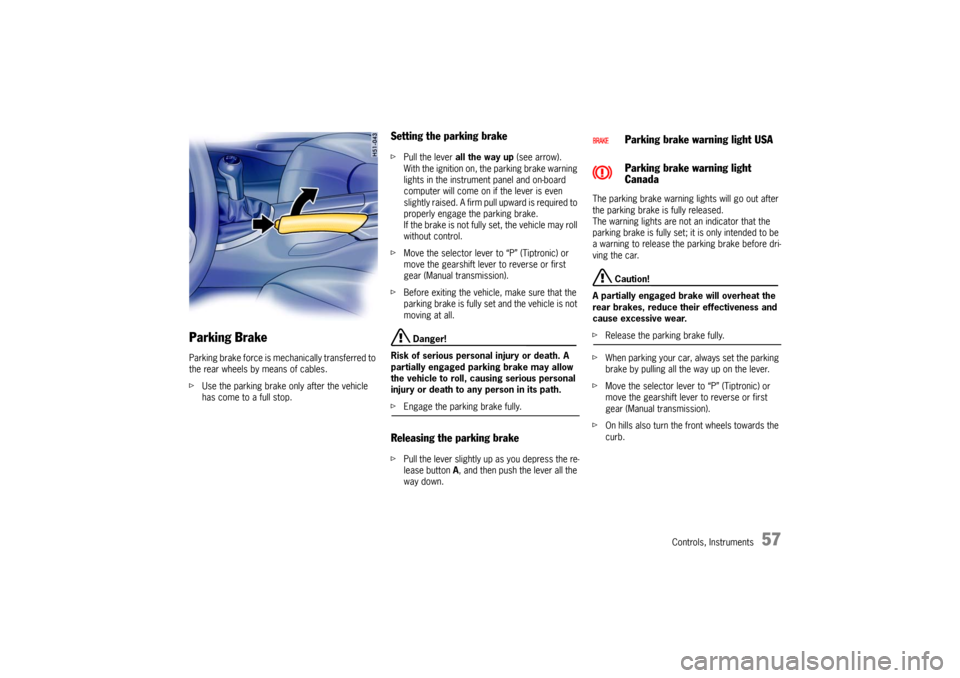
Parking Brake Parking brake force is mechanically transferred to
the rear wheels by means of cables.
fUse the parking brake only after the vehicle
has come to a full stop.
Setting the parking brake fPull the lever all the way up (see arrow).
With the ignition on, the parking brake warning
lights in the instrument panel and on-board
computer will come on if the lever is even
slightly raised. A firm pull upward is required to
properly engage the parking brake.
If the brake is not fully set, the vehicle may roll
without control.
fMove the selector lever to “P” (Tiptronic) or
move the gearshift lever to reverse or first
gear (Manual transmission).
fBefore exiting the vehicle, make sure that the
parking brake is fully set and the vehicle is not
moving at all.
Danger!
Risk of serious personal injury or death. A
partially engaged parking brake may allow
the vehicle to roll, causing serious personal
injury or death to any person in its path.
fEngage the parking brake fully.Releasing the parking brake fPull the lever slightly up as you depress the re-
lease button A, and then push the lever all the
way down. The parking brake warning lights will go out after
the parking brake is fully released.
The warning lights are not an indicator that the
parking brake is fully set; it is only intended to be
a warning to release the parking brake before dri-
ving the car.
Caution!
A partially engaged brake will overheat the
rear brakes, reduce their effectiveness and
cause excessive wear.
fRelease the parking brake fully.
fWhen parking your car, always set the parking
brake by pulling all the way up on the lever.
fMove the selector lever to “P” (Tiptronic) or
move the gearshift lever to reverse or first
gear (Manual transmission).
fOn hills also turn the front wheels towards the
curb.
Parking brake warning light USA
Parking brake warning light
Canada
Page 71 of 296
Controls, Instruments
71
Limits of ultrasonic measurement
The parking assistant system cannot detect:
– sound-absorbing obstacles (e.g. powder
snow),
– sound-reflecting obstacles (e.g. glass sur-
faces, flat painted surfaces)
– and very thin obstacles.
Other ultrasound sources (e.g. pneumatic brakes
of other vehicles, jackhammers) can interfere with
detection of obstacles.
Fault indication
The parking assistant system indicates a fault in
two ways:
– After reverse gear has been selected, the
short signal tone is followed by a continuous
tone of the same pitch:
This indicates that sensors are soiled or cove-
red with ice.
– After reverse gear has been selected, the
short signal tone is followed by a continuous
tone with a much lower pitch:
This indicates a general system fault. Please
have the fault remedied at an authorized
Porsche dealer.
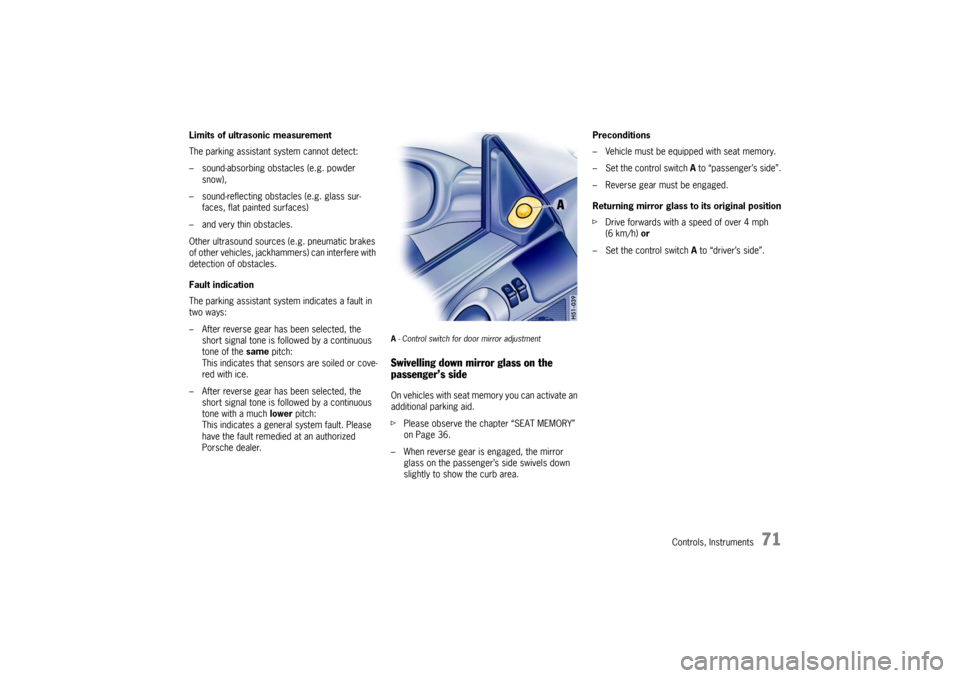
A - Control switch for door mirror adjustment Swivelling down mirror glass on the
passenger’s side On vehicles with seat memory you can activate an
additional parking aid.
fPlease observe the chapter “SEAT MEMORY”
on Page 36.
– When reverse gear is engaged, the mirror
glass on the passenger’s side swivels down
slightly to show the curb area. Preconditions
– Vehicle must be equipped with seat memory.
– Set the control switch A to “passenger’s side”.
– Reverse gear must be engaged.
Returning mirror glass to its original position
fDrive forwards with a speed of over 4 mph
(6 km/h) or
– Set the control switch A to “driver’s side”.
Page 116 of 296

116
Controls, Instruments
Warnings on the instrument panel and the on-board computerIf a warning message appears, always refer to the corresponding chapters in the Owner’s Manual.
Warning messages are issued only if all measurement preconditions are met. Therefore, check all fluid levels regularly –
in particular, always check the engine oil level after refuelling.
Instrument
panelOn-board
computerText display on on-board
computerMeaning/measure
Seat belt Driver and passengers must fasten their seat
belts.
Handbrake Handbrake is still on.
Ignition key
not removed
Replace battery
in ignition keyReplace the remote-control battery.
Ignition lock faulty,
please go to workshopHave the fault remedied at an authorized
Porsche dealer.
Ignition lock faulty,
visit workshop nowHave the fault remedied at an authorized
Porsche dealer.
Relieve steering Relieve the steering l o c k b y m o v i n g t h e s t e e r i n g
wheel to the left or right.
Steering locked The steering wheel lock remains engaged.
Have the fault remedied at an authorized
Porsche dealer.
Lights on Dipped beam/side light on.
Parking light on Left/right parking light on.
Page 165 of 296

Shifting Gear
165
Selector Lever Positions P – Parking lock fSelect only when car has been stopped.
fEngage parking lock after applying the hand-
brake and release it before releasing the hand-
brake.
The ignition key can be withdrawn only in
selector lever position P. R – Reverse fSelect only when car has been stopped and
the brake is applied. N – Neutral Selector lever position N must be selected for to-
wing or in car washes, for example.
fSelect the desired position for moving off (D,
M or R) only when the engine is idling and while
depressing the brake pedal.
D – Automatic selection mode fSelect position D for “normal” driving. The ge-
ars are shifted automatically according to the
accelerator position and speed.
Depending on the way the vehicle is driven and on
the resistance (e.g. uphill), the gear-changing
points are shifted towards higher or lower engine-
speed ranges.
The accelerator position, driving speed, engine
speed, longitudinal and lateral acceleration and
the road profile all have an influence on the gear-
changing characteristic.
Unwanted upward shifts, e.g. before bends, are
prevented by swiftly releasing the accelerator pe-
dal.
Depending on lateral acceleration, upward shifts
on bends are not made until the engine-speed limit
is reached.
Under braking, and depending on the amount of
deceleration, the Tiptronic shifts down earlier.
For subsequent cornering, the right gear is enga-
ged when pressure is applied to the brakes before
the bend.
The bend is taken in the right gear, and when you
accelerate out of the bend you do not have to shift
down. Sport mode switched on
fPlease observe the chapter “SPORT MODE” on
Page 63.
If the Sport mode programme is switched on,
Tiptronic switches to a sporty gear-changing map
and shortens the shifting periods.
Deceleration downshifts are commenced earlier.
Downshifts are already carried out in the case of
slight decelerations, even at higher engine
speeds.
Driving off
In 2nd gear, the vehicle drives off with the throttle
only slightly open.
Drive off in 1st gear with the throttle open wider
or when the engine is cold.
Page 168 of 296

168
Shifting Gear Manual mode failure
If manual mode fails, the control electronics
switch to automatic mode. In this event, the
instrument cluster will display selector lever
position D.
fHave the fault remedied.
Consult an authorized Porsche dealer.
Stopping fFor a brief stop, e.g. at a traffic light, leave the
selector lever in drive position and hold the ve-
hicle with the brake pedal.
fFor a longer stop with the engine running,
select position N (neutral).
fDo not hold the car on a slope using the
accelerator. Use the brake pedal or the hand-
brake instead.
fBefore leaving the vehicle, always apply the
handbrake and move the selector lever to
position P.
Parking fGo easy on the accelerator.
fWhen parking or maneuvring in a small space,
control the speed by careful use of the footbra-
ke. Driving in winter In wintery road conditions it is advisable to take
steep inclines in manual mode. This prevents the
occurrence of gear changes that could cause
wheelspin. Tow-starting, towing fPlease observe the chapter “TOWING” on Page
274.
Emergency program
Warning!
Reverse gear lock monitoring is disabled in
the emergency running program.
Damage to the vehicle may result as well as
loss of control, if the vehicle is moving for-
w a r d f a s t e n o u g h t o c a u s e r e a r w h e e l l o c k u p .
fDo not shift into R while the vehicle is moving forward.
A transmission fault is indicated by the following
symptoms:
–The 4th-gear display flashes.
– The warning “Tiptronic emergency run”
appears in the on-board computer.
– The transmission no longer shifts.
Regardless of selector lever position, 4th is
the only forward gear still available.
fAdapt your driving style to the changed hand-
ling.
fTo remedy the fault, please consult an authori-
zed Porsche dealer.