flat tire PORSCHE BOXSTER 2009 2.G User Guide
[x] Cancel search | Manufacturer: PORSCHE, Model Year: 2009, Model line: BOXSTER, Model: PORSCHE BOXSTER 2009 2.GPages: 294, PDF Size: 6.89 MB
Page 227 of 294
Practical Tips, Emergency Service
225
Each tire, including the spare (if provided) should
be checked monthly when cold and inflated to the
inflation pressure recommended by the vehicle
manufacturer on the vehicle placard or tire infla-
tion pressure label. (If your vehicle has tires of a
different size than the size indicated on the vehicle
placard or tire inflation pressure label, you should
determine the proper tire inflation pressure for
those tires.)
As an added safety feature, your vehicle has been
equipped with a tire pressure monitoring (TPM)
that illuminates a low tire pressure telltale when
one or more of your tires is significantly under-in-
flated. Accordingly, when the low tire pressure tell-
tale illuminates, you should stop and check your
tires as soon as possible, and inflate them to the
proper pressure. Driving on a significantly under-
inflated tire causes the tire to overheat and can
lead to tire failure. Under-inflation also reduces
fuel efficiency and tire tread life, and may affect
the vehicle’s handling and stopping ability.
Please note that the TP M is not a substitute for
proper tire maintenance, and it is the driver’s re-
sponsibility to maintain correct tire pressure, even
if under-inflation has not reached the level to trig-
ger illumination of the TP M low tire pressure tell-
tale.
f On vehicles with tire pressure monitoring:
Please see the chapter “TPM TIRE PRESSURE
MONITORING” on Page 147.
When tires are warm, the tire pressure is
increased. f
Never let air out of hot tires.
This could cause the tire pressure to fall below
the prescribed value.
Insufficient tire filling pressure can cause tires to
overheat and thus be damaged – even invisibly.
Hidden tire damage is not eliminated by subse-
quently correcting the tire pressure.
Overloading
Danger!
Risk of damage to vehicle parts, loss of con-
trol and serious personal injury or death.
f Do not overload your vehicle. Be careful about
the roof load.
f If loading the vehicle also correct the tire pres-
sure. Tire pressure for loaded vehicle can be
found on the tire pressure plate and in the
chapter technical data.
f Never exceed the specified axle load.
Overloading can shorten the service life of the
tires and car, as well as lead to dangerous ve-
hicle reactions and long braking distances.
Damage due to overloading is not covered by the vehicle warranty.
f Please see the chapter “LOADING INFORMA-
TION” on Page 234.
f Please see the chapter “TIRE PRESSURE FOR
COLD TIRES (68 °F/20 °C)” on Page 277.
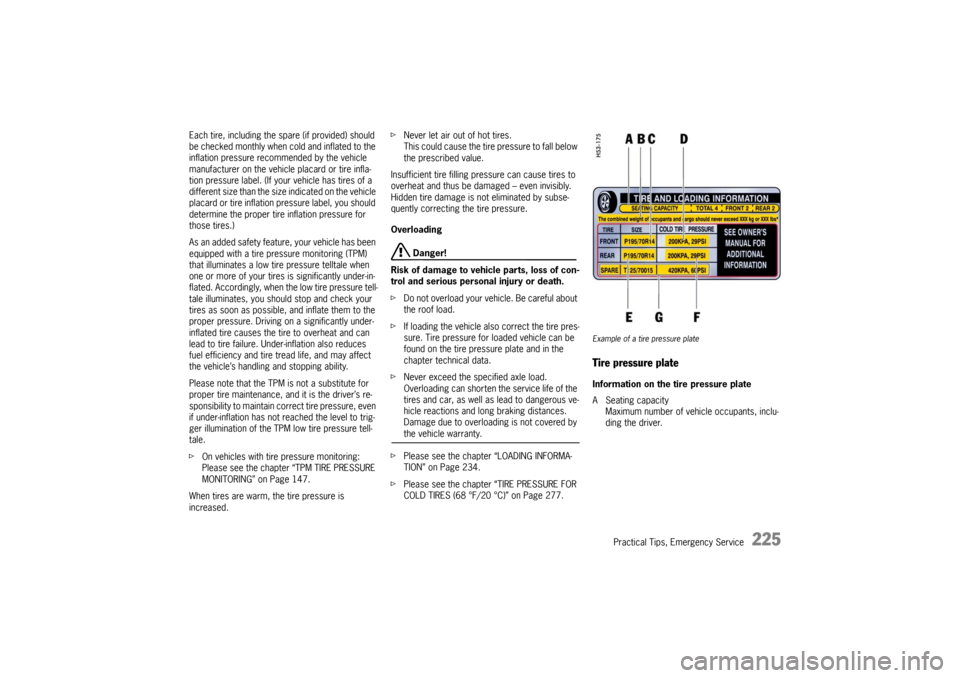
Example of a tire pressure plateTire pressure plateInformation on the tire pressure plate
A Seating capacity
Maximum number of vehicle occupants, inclu-
ding the driver.
Page 229 of 294

Practical Tips, Emergency Service
227
Danger!
Driving on worn tires can result in loss of con-
trol of the vehicle an d could cause serious
personal injuries or death.
f Do not drive with worn tires or tires showing
cuts or bruises as they may lead to sudden
deflation and loss of control which could cause
severe personal injury.
f Specialized high performance tires on high
performance sports cars exhibit more wear
than those on a family sedan, or even a high
performance sedan.
Therefore, it is important to check your tire
pressure and condition at least every two weeks.
If you notice that tires are wearing unevenly, con-
sult your Porsche dealer.
Uneven wear may not always be due to improper
wheel alignment. It can be the result of individual
driving habits such as cornering at high speeds. If
the tire pressure is not checked and adjusted
regularly, abnormal tire wear can also occur.
Tire care f Avoid damaging tires and wheel rims.
f If you must drive over a curb or other obstacle,
drive slowly and at an obtuse angle.
f Check tires for uneven wear and damage
before driving off.
f Remove imbedded material.
f Replace worn or damaged tires immediately.
f Keep oil, fuel, brake fluid, etc. away from tires.
f Replace missing valve stem caps.
f Keep tires inflated correctly.
f Wash tires when washing the vehicle. Also
clean inner side of wheels.
f Do not use abrasive cleaners when washing
the wheels.
f Check wheel rims for corrosion.
f Remove road salt, if driving in winter.
Tire damage, puncture High-pressure cleaning units can damage the
tires.
f Please see the chapter “HIGH-PRESSURE
CLEANING UNITS, STEAM CLEANERS” on
Page 213.
f Check tires for imbedded material, cuts, punc-
tures, cracks and bulges (side wall) before driv-
ing off.
In case of tire damage, where it is uncertain wheth-
er there is a break in the ply with all its conse-
quences or tire damage caused by thermal or me-
chanical overloading due to loss of pressure or
any other prior damage, we recommend that the
tire be replaced for safety reasons.
If one faulty tire is replaced it should be noted that
the difference in tread depth on one axle must not
exceed 30%.
Handling inconsistencies may result.
f Perform a visual inspection if necessary.
Page 234 of 294
232
Practical Tips, Emergency Service
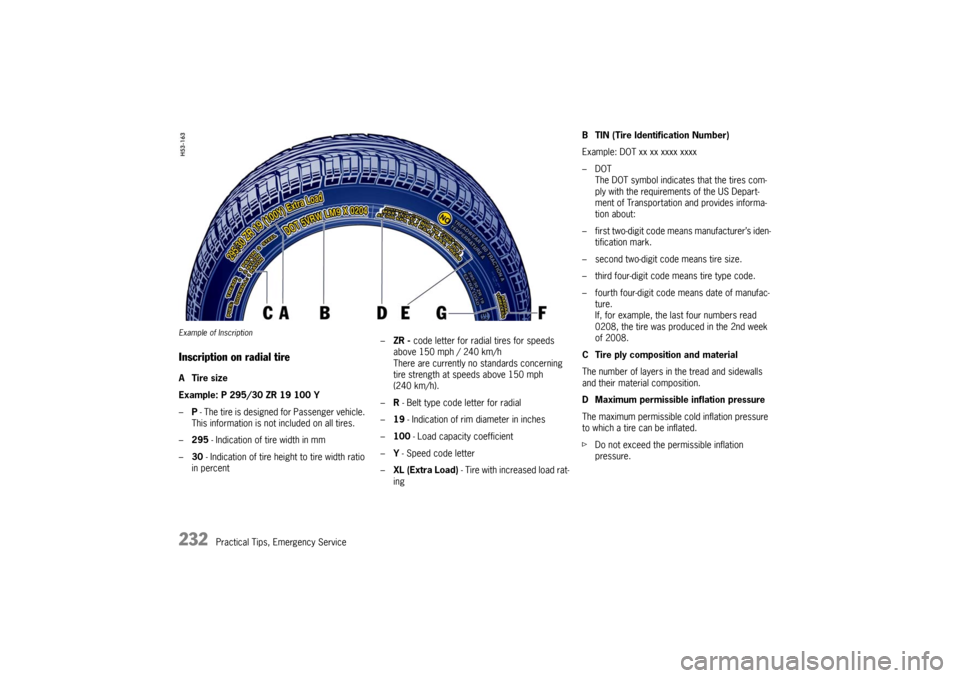
Example of InscriptionInscription on radial tireATire size
Example: P 295/30 ZR 19 100 Y
–P - The tire is designed for Passenger vehicle.
This information is not included on all tires.
– 295 - Indication of tire width in mm
– 30 - Indication of tire height to tire width ratio
in percent –
ZR - code letter for radial tires for speeds
above 150 mph / 240 km/h
There are currently no standards concerning
tire strength at speeds above 150 mph
(240 km/h).
– R - Belt type code letter for radial
– 19 - Indication of rim diameter in inches
– 100 - Load capacity coefficient
– Y - Speed code letter
– XL (Extra Load) - Tire with increased load rat-
ing
B TIN (Tire Identification Number)
Example: DOT xx xx xxxx xxxx
–DOT
The DOT symbol indicates that the tires com-
ply with the requirements of the US Depart-
ment of Transportation and provides informa-
tion about:
– first two-digit code means manufacturer’s iden- tification mark.
– second two-digit code means tire size.
– third four-digit code means tire type code.
– fourth four-digit code means date of manufac- ture.
If, for example, the last four numbers read
0208, the tire was produced in the 2nd week
of 2008.
C Tire ply composition and material
The number of layers in the tread and sidewalls
and their material composition.
D Maximum permissible inflation pressure
The maximum permissible cold inflation pressure
to which a tire can be inflated.
f Do not exceed the permissible inflation
pressure.
Page 236 of 294

234
Practical Tips, Emergency Service
Loading InformationDefinitionsThe Curb weight - actual weight of your vehicle -
vehicle weight including standard and optional
equipment, fluids and emergency tools. This
weight does not include passengers and cargo.
The Gross Vehicle Weight is sum of the curb
weight and the weight of passengers and cargo
combined.
The Gross Vehicle Weight Rating is the maxi-
mum total weight of vehicl e, passengers, luggage
and optional equipment.
The Gross Axle Weight Rating is the maximum
load limit for the front or the rear axle. This infor-
mation is located on the safety compliance sticker
located in the driver’s side door jamb.
For determining the compat ibility of the tire and
vehicle load capabilities:
f Please see the chapter “TECHNICAL DATA” on
Page 276.
The load capacity coeffici ent (e.g. “100”) is a min-
imum requirement. The Gross Combined Weight Rating is the
maximum total weight rating of vehicle, passen-
gers and cargo.
The Vehicle Capacity Weight
- Load Limit - is
the maximum total weight limit specified of the
load (passengers and cargo) for the vehicle. This
is the maximum weight of passengers and cargo
that can be loaded into the vehicle. This informa-
tion can be found on the tire pressure plate.
The maximum loaded vehicle weight is the
sum of curb weight, accessory weight, vehicle ca-
pacity weight and production options weight.
The load rating is the maximum load that a tire
is rated to carry for a given inflation pressure.
The maximum load rating is the load rating for
a tire at the maximum permissble inflation pres-
sure.
The cargo capacity is the permissible weight of
cargo, the substracted weight of passengers from
the load limit.
f Never exceed the permissible limits.
Danger!
Risk of loss of control, damage to the vehicle
and serious personal injury or death.
f Never exceed the specified axle loads.
Overloading can shorten the service life of the
tires and car, as well as lead to dangerous
vehicle reactions and long braking distances.
Damage due to overloading is not covered by the vehicle warranty.
Page 240 of 294
238
Practical Tips, Emergency Service
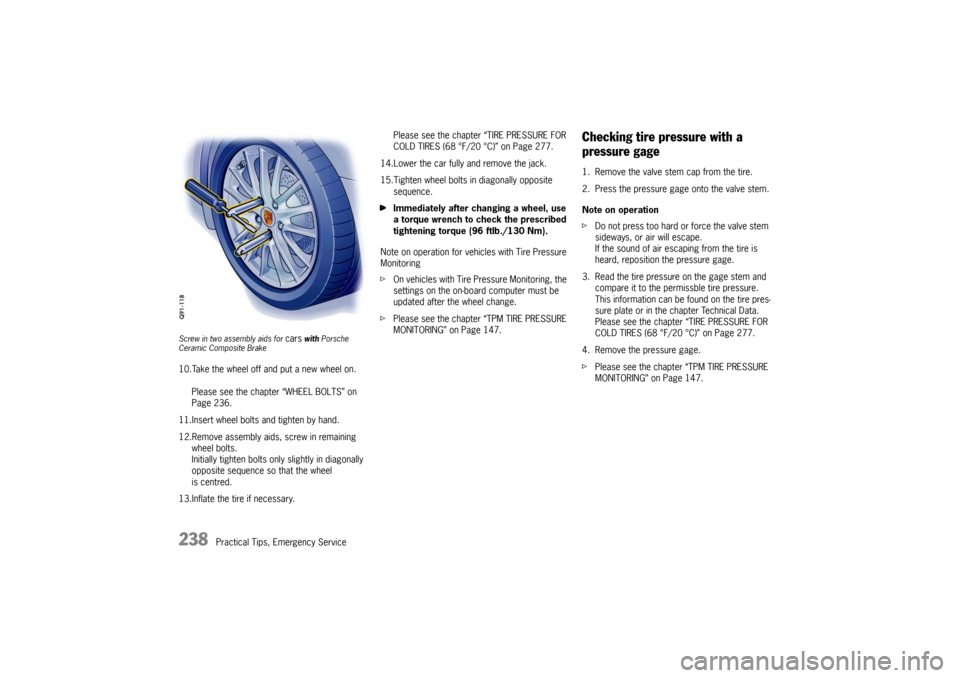
Screw in two assembly aids for
cars
with Porsche
Ceramic Composite Brake
10.Take the wheel off and put a new wheel on.
Please see the chapter “WHEEL BOLTS” on
Page 236.
11.Insert wheel bolts and tighten by hand.
12.Remove assembly aids, screw in remaining wheel bolts.
Initially tighten bolts only slightly in diagonally
opposite sequence so that the wheel
is centred.
13.Inflate the tire if necessary. Please see the chapter “TIRE PRESSURE FOR
COLD TIRES (68 °F/20 °C)” on Page 277.
14.Lower the car fully and remove the jack.
15.Tighten wheel bolts in diagonally opposite sequence.
f Immediately after changing a wheel, use
a torque wrench to check the prescribed
tightening torque (96 ftlb./130 Nm).
Note on operation for vehicles with Tire Pressure
Monitoring
f On vehicles with Tire Pressure Monitoring, the
settings on the on-board computer must be
updated after the wheel change.
f Please see the chapter “TPM TIRE PRESSURE
MONITORING” on Page 147.
Checking tire pressure with a
pressure gage1. Remove the valve stem cap from the tire.
2. Press the pressure gage onto the valve stem.
Note on operation
fDo not press too hard or force the valve stem
sideways, or air will escape.
If the sound of air escaping from the tire is
heard, reposition the pressure gage.
3. Read the tire pressure on the gage stem and compare it to the permissble tire pressure.
This information can be found on the tire pres-
sure plate or in the chapter Technical Data.
Please see the chapter “TIRE PRESSURE FOR
COLD TIRES (68 °F/20 °C)” on Page 277.
4. Remove the pressure gage.
f Please see the chapter “TPM TIRE PRESSURE
MONITORING” on Page 147.
Page 241 of 294

Practical Tips, Emergency Service
239
Flat Tire
Warning!
Failure to follow these instructions may result
in serious personal injury to you or to by-
standers.
f If you have a flat tire, move a safe distance off
the road. Turn the emergency flasher on and
use other warning devices to alert other motor-
ists. Set the parking brake.
f Do not park your vehicl e where it may contact
dry grass, brush or other flammable materials.
The hot parts of the exhaust system could set
such materials on fire, thereby causing both
property damage and serious personal injury or death.
A tire sealant and compressor with pressure
tester are located in the luggage compartment.
f Please observe the safety and operating in-
structions on the special sealant bottle with a
special Porsche part number and on the com-
pressor – these are essential. Important note
Sealing the tire with the tire repair kit is only
an emergency repair. Even with the tire air-
tight, it may be used only for short journeys
in an emergency.
The maximum permitted speed is 50 mph
(80 km/h).
f
Do not use commercially available sealant or
tire inflating bottles.
Use only the tire sealant located in the luggage
compartment.
Warning!
Risk of accident, resulting in serious
personal injury or death.
f Have tires replaced by a specialist workshop
as soon as possible.
f Avoid hard acceleration and high cornering speeds.
Page 243 of 294
Practical Tips, Emergency Service
241
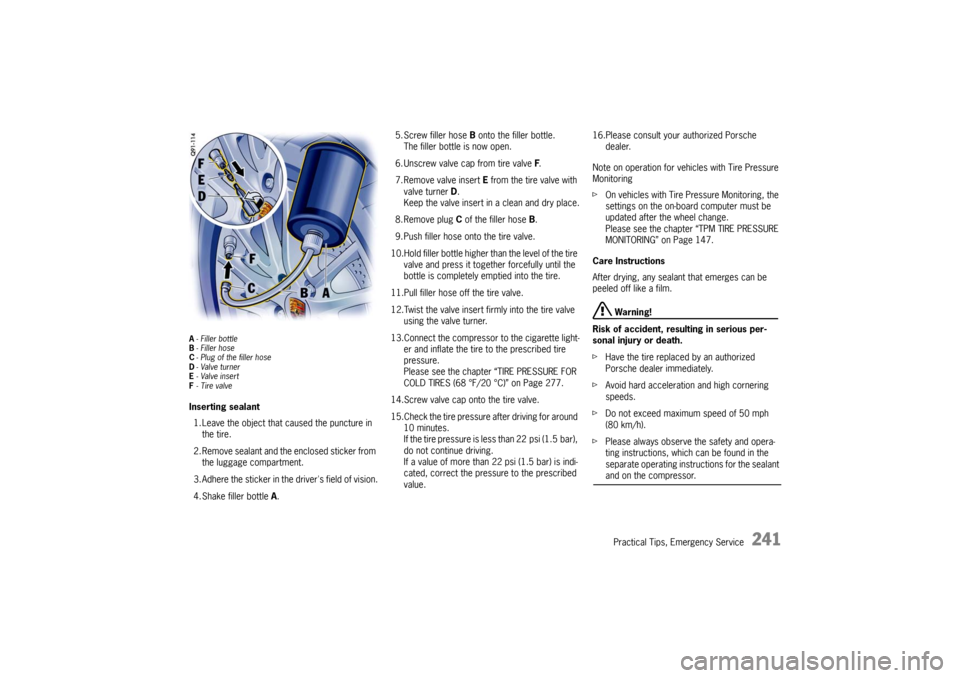
A- Filler bottle
B - Filler hose
C - Plug of the filler hose
D -Valve turner
E -Valve insert
F - Tire valveInserting sealant
1. Leave the object that caused the puncture in the tire.
2. Remove sealant and the enclosed sticker from the luggage compartment.
3. Adhere the sticker in the driver's field of vision.
4. Shake filler bottle A. 5. Screw filler hose B
onto the filler bottle.
The filler bottle is now open.
6. Unscrew valve cap from tire valve F.
7. Remove valve insert E from the tire valve with
valve turner D.
Keep the valve insert in a clean and dry place.
8. Remove plug C of the filler hose B.
9. Push filler hose onto the tire valve.
10.Hold filler bottle higher than the level of the tire valve and press it together forcefully until the
bottle is completely emptied into the tire.
11.Pull filler hose off the tire valve.
12.Twist the valve insert fi rmly into the tire valve
using the valve turner.
13.Connect the compressor to the cigarette light- er and inflate the tire to the prescribed tire
pressure.
Please see the chapter “TIRE PRESSURE FOR
COLD TIRES (68 °F/20 °C)” on Page 277.
14.Screw valve cap onto the tire valve.
15.Check the tire pressure after driving for around 10 minutes.
If the tire pressure is less than 22 psi (1.5 bar),
do not continue driving.
If a value of more than 22 psi (1.5 bar) is indi-
cated, correct the pressure to the prescribed
value. 16.Please consult your authorized Porsche
dealer.
Note on operation for vehicles with Tire Pressure
Monitoring
f On vehicles with Tire Pressure Monitoring, the
settings on the on-board computer must be
updated after the wheel change.
Please see the chapter “TPM TIRE PRESSURE
MONITORING” on Page 147.
Care Instructions
After drying, any sealan t that emerges can be
peeled off like a film.
Warning!
Risk of accident , resulting in serious per-
sonal injury or death.
f Have the tire replaced by an authorized
Porsche dealer immediately.
f Avoid hard acceleration and high cornering
speeds.
f Do not exceed maximum speed of 50 mph
(80 km/h).
f Please always observe the safety and opera-
ting instructions, which can be found in the
separate operating instructions for the sealant and on the compressor.
Page 289 of 294
Index
287
Speeds ................................................ 10
Starting .................. .............................. 75
Stopping .............................................. 76
Engine compartment Blower ....................... .................. 76, 124
Blower fan .............. ............................ 124
Care .................................................. 216
Lid ....................................................... 93
Lid warning light...... .............................. 92
Engine oil Change .............................................. 201
Consumption ............................... ......... 10
Performance class .. ............................ 201
Recommendation ........ ........................ 200
Topping off............. ............................ 200
Viscosity ................ ............................ 201
Exhaust
Pipes ......................... ............................ 5
System ................................................ 55
Tailpipes, stainless st eel ...................... 217
External antenna ......... ................................ 100
FFiller flap .................................................... 205
Fire extinguisher ......................................... 101
Flat tire ...................... ................................ 239
Floor mats.................. ................................ 219
Fluids ......................................................... 211
FM reception ................................... ............. 97
Fog light ............................................. ......... 80
Fog light, rear................. ........................ 78, 80
Fog lights Changing bulb......... ............................ 264
Footbrake ........................................... ......... 56Footwell lights...........
....................................69
Fresh air intake ......... ..................................112
Front lid ....................... ..........................92, 93
Fuel ..................... ..............................126, 205
Containers ................ ......................4, 207
Economy .................. ..........................204
Evaporation control .............................207
Fuels containing etha nol.......................207
Level gage ............... ..........................126
Level warning light ..............................126
Recommendation ........................206, 207
Recommendations .... ..........................206
Tank ..................................................206
Function keys ........... ....................................40
Fuses, replacing ....... ..................................247
GGarage
Door ....................................................76
Door opener .......................................102
Lift ............... ......................... .............242
Gear display ................. ......................116, 118
Gear shift indicator ......................................123
Glove compartment... ....................................90
Gong.................... ..............14, 73, 78, 80, 133
Ground clearance...... ......................................4HHandbrake.................... ................................55
Hardtop........................ ..............................190
Head restraints ......... ....................................32
Headlights .................... ..............................258
Adjusting .................. ..................267, 268 Beam adjustment .
................................ 79
Changing bulbs .......................... 259, 261
Cleaning system ....... ............ 82, 210, 281
Flasher ................................................ 81
Removing ................ .......................... 258
Heated rear window ..... ................ 31, 193, 194
Heated rear window/Door mirror heating ..... 113
Heater ......................... .............................. 109
Heating ........................................... .......... 106
High beam Indicator light ....... .............................. 123
Lever....................... ...................... 78, 80
High beam, additional Changing bulb ...... .............................. 261
High-pressure cleaning units........................ 213
Home mode..................... ...................... 79, 80
HomeLink .................... .............................. 102
Hoods ............................. ................ 92, 93, 95
Horn ........................................... .......... 12, 21
Hot exhaust pipes ... ....................................... 5
IIgnition key ............. ..................................... 72
Emergency operation ........................... 74
Ignition lock ............ ..................................... 72
Withdrawing ignition key,
PDK transmission ..................... .......... 176
Immobilizer ...................................... ............ 15
Indicator lights ................. .................. 116, 118
INFO Warning message s ............................. 136
Instrument Illumination........... .............................. 120
Lights ...................... ...................... 78, 80
Panel ........................... ...... 116, 118, 162