service PORSCHE BOXSTER 2009 2.G User Guide
[x] Cancel search | Manufacturer: PORSCHE, Model Year: 2009, Model line: BOXSTER, Model: PORSCHE BOXSTER 2009 2.GPages: 294, PDF Size: 6.89 MB
Page 203 of 294

Maintenance, Car Care
201
Always observe the following points:
– Use engine oils approved by Porsche only. This is a precondition for optimum and problem-free
operation of your vehicle.
– Regular oil changes are part of servicing. It is important that the service intervals,
particularly the oil change intervals, are
observed in accordance with the specifications
in the “Maintenance” booklet.
– Oils approved by Porsche can be mixed with each other.
– Porsche engines are designed so that no oil additives may be used.
– A label is located in the engine compartment, which provides you with in formation on suitable
oil for your engine.
Your Porsche partner will be pleased to
advise you.Oil changeThe engine oil has to be changed regularly at the
intervals listed in your Maintenance Schedule .
f Please see the chapter “CAPACITIES” on
Page 281.
We recommend that you have the engine oil
changed at your Porsche dealer, who has the re-
quired oils and the necessary filling equipment.
If you suspect an oil leak in the engine have your
dealer check it out immediately. All current engine oils are compatible with each
other, i.e. when making an oil change it is not nec-
essary to flush the engine if you wish to use a dif-
ferent brand or grade of oil.
Since, however, each brand of oil has a special
composition, you should, if possible, use the
same oil brand if it becomes necessary to top up
between oil changes.
Porsche engines have long intervals between oil
changes. You can make best use of these long oil
change intervals by usin
g multigrade oils since
these are largely independent of seasonal fluctua-
tions in temperature.
If your vehicle is used frequently in stop-and-go
traffic in cold weather, the engine will not always
be properly warmed up.
Condensation from products of combustion may
accumulate in the oil. In this case, it is advisable
to change the oil more fr equently so that your
engine once again has 100% efficient engine oil.
Engine oil performance class Engine oil is not only a lubricant, but also serves
to keep the engine clean, to neutralize the dirt
which penetrates into the engine through combus-
tion and to protect the engine against corrosion.
To perform these functions, the oil is provided with
additives which have been specially developed for
these functions.
The efficiency of an oil is expressed, for example,
by the API, ILSAC or ACEA classifications.
Viscosity Like all liquids, engine oil is viscous when cold,
and thin-bodied when warm. The viscosity of an oil
is expressed by its SAE class. For cold viscosity
(measured at temperatures below 32 °
F/0 °
C) the
SAE class is given as a number and the letter “W”
(as in winter), for hot viscosity (measured at
212 °
F/100 °
C) the SAE class is given only as a
number.
The viscosity of an oil is, therefore, always the
same if it has the same number of an SAE class.
Oils with two viscosities are called multigrade oils;
oils with only one viscosity are termed single-
grade oils.
Single-grade oils can not be used in your engine.
The viscosity of the engine oil for your Porsche
has to be chosen according to the ambient tem-
perature given in the engine oil recommendation
table.
Page 206 of 294

204
Maintenance, Car Care
Fuel Economy Fuel economy will vary depending on where,
when and how you drive, optional equipment
installed, and the general condition of your
car.
A car tuned to specifications and correctly
maintained, will help you to achieve optimal
fuel economy.
fHave your vehicle tuned to specifications.
Air cleaner should be dirt free to allow proper
engine “breathing”.
Battery should be fully charged.
Wheels should be properly aligned.
Tires should be inflated at correct pressure.
f Always monitor your fuel consumption.
f Drive smoothly, avoid abrupt changes in speed
as much as possible.
f Avoid jack rabbit starts and sudden stops.
f Do not drive longer than necessary in the lower
gears. Shifting into a higher gear early without
lugging the engine will help save fuel.
f Prolonged “warm up” idling wastes gas. Start
the vehicle just before you are ready to drive.
Accelerate slowly and smoothly.
f Switch off the engine if stationary for longer
periods. f
Any additional weight carried in the vehicle re-
duces fuel economy. Always keep cargo to a
minimum and remove all unnecessary items.
f Organize your trips to take in several errands
in one trip.
f All electrical accessories contribute to in-
creased fuel consumption.
f Only switch on the air conditioning when neces-
sary.
f Do not drive with the Ro of Transport System
mounted unless you need it.
The EPA estimated mpg. is to be used for
comparison purposes, actual mileage may
be different from the estimated mpg.,
depending on your driving speed, weather
conditions and trip length. Your actual
highway mileage will probably be less than
the estimated mpg.
f Please observe all local and national speed
limits.
Operating your Porsche in other
Countries Government regulations in the United States and
Canada require that automobiles meet specific
emission regulations and safety standards. There-
fore, cars built for the U.S. and Canada differ from
vehicles sold in other countries.
If you plan to take your Porsche outside the conti-
nental limits of the United States or Canada, there
is the possibility that
– unleaded fuel may not be available;
– unleaded fuel may have a considerably lower
octane rating. Excessive engine knock and se-
rious damage to both engine and catalytic con-
verters could result;
– service ma y be inadequa te due to lack of prop- er service facilities, tools or diagnostic equip-
ment;
– replacement parts may not be available or very difficult to get.
Porsche cannot be responsible for the
mechanical damage that could result
because of inadequate fuel, service or parts
availability.
If you purchased your Porsche abroad and want to
bring it back home, be sure to find out about ship-
ping and forwarding requirements, as well as cur-
rent import and customs regulations.
Page 207 of 294
Maintenance, Car Care
205
Fuel
Warning!
Fuel is highly flammable and harmful to
health.
f Fire, open flame and smoking are prohibited
when handling fuel.
f Avoid contact with skin or clothing.
f Do not inhale fuel vapors.
To prevent damage to the emission control
system and engine:
f Never drive the tank completely out of fuel.
f Avoid high cornering speeds after the warning lights have come on.
f Please see the chapter “FUEL ECONOMY” on
Page 204.
Please see the chapter “EMISSION CONTROL
SYSTEM” on Page 208.
Please see the chapter “LEVEL GAGE” on
Page 126.
Check engine warning light
If the warning lights in the instrument panel and on-
board computer come on and remain on while
driving, it suggests:
– a potential engine control problem and the need for system service or
– an improperly fastened tank cap or – refueling with engine running.
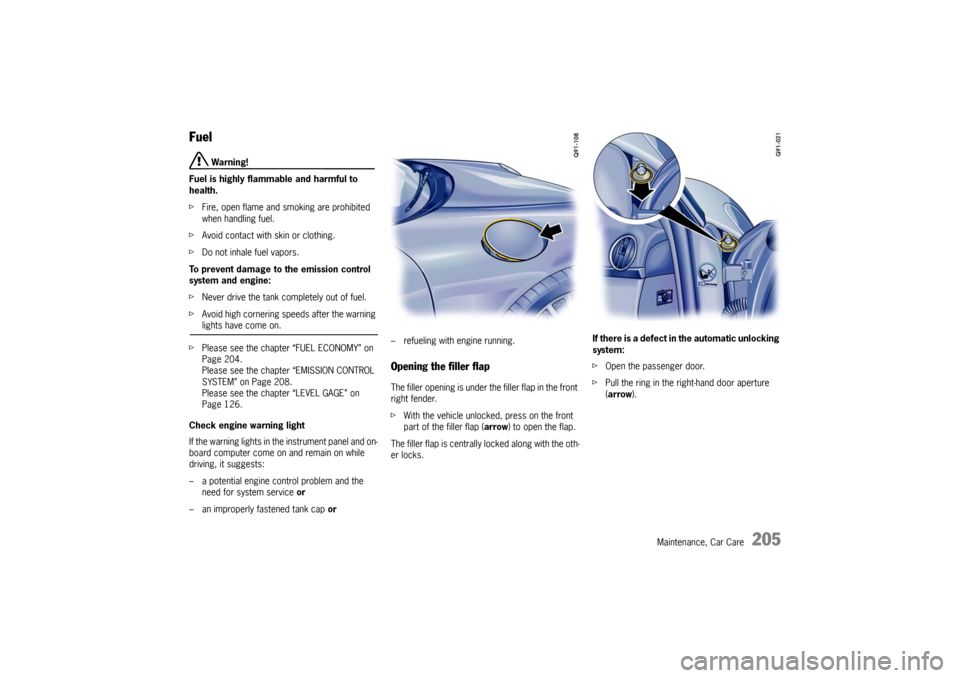
Opening the filler flapThe filler opening is under th
e filler flap in the front
right fender.
f With the vehicle unlocked, press on the front
part of the filler flap ( arrow) to open the flap.
The filler flap is centrally locked along with the oth-
er locks. If there is a defect in
the automatic unlocking
system:
f Open the passenger door.
f Pull the ring in the right-hand door aperture
(arrow ).
Page 208 of 294
206
Maintenance, Car Care
Refueling Fuel tank capacity is listed under “Capacities”.
Porsche does not recommend the use of fuel ad-
ditives.
Fuel is highly flammable and harmful to
health.
fPlease see the chapter “CAPACITIES” on
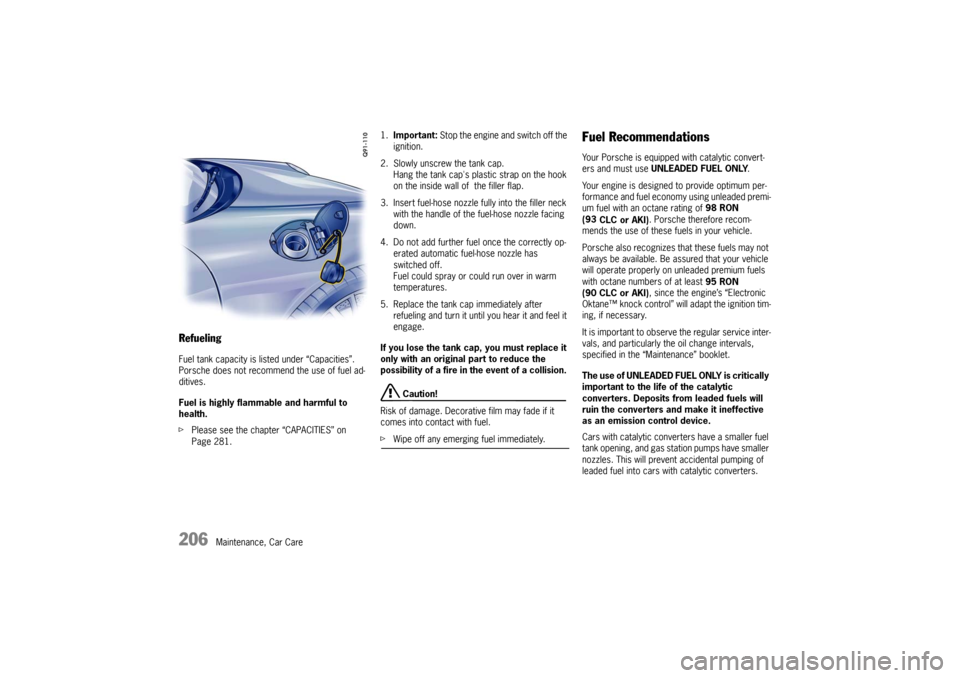
Page 281. 1.
Important: Stop the engine and switch off the
ignition.
2. Slowly unscrew the tank cap. Hang the tank cap's plastic strap on the hook
on the inside wall of the filler flap.
3. Insert fuel-hose nozzle fully into the filler neck
with the handle of the fuel-hose nozzle facing
down.
4. Do not add further fuel once the correctly op- erated automatic fuel-hose nozzle has
switched off.
Fuel could spray or could run over in warm
temperatures.
5. Replace the tank ca p immediately after
refueling and turn it until you hear it and feel it
engage.
If you lose the tank cap, you must replace it
only with an original part to reduce the
possibility of a fire in the event of a collision.
Caution!
Risk of damage. Decorative film may fade if it
comes into contact with fuel.
f Wipe off any emerging fuel immediately.
Fuel Recommendations Your Porsche is equipped with catalytic convert-
ers and must use UNLEADED FUEL ONLY .
Your engine is designed to provide optimum per-
formance and fuel economy using unleaded premi-
um fuel with an octane rating of 98 RON
(93 CLC or AKI) . Porsche therefore recom-
mends the use of these fuels in your vehicle.
Porsche also recognizes that these fuels may not
always be available. Be assured that your vehicle
will operate properly on unleaded premium fuels
with octane numbers of at least 95 RON
(90 CLC or AKI) , since the engine’s “Electronic
Oktane™ knock control” will adapt the ignition tim-
ing, if necessary.
It is important to observe the regular service inter-
vals, and particularly the oil change intervals,
specified in the “Maintenance” booklet.
The use of UNLEADED FUEL ONLY is critically
important to the life of the catalytic
converters. Deposits from leaded fuels will
ruin the converters and make it ineffective
as an emission control device.
Cars with catalytic converters have a smaller fuel
tank opening, and gas station pumps have smaller
nozzles. This will prevent accidental pumping of
leaded fuel into cars with catalytic converters.
Page 210 of 294

208
Maintenance, Car Care
Emission Control SystemIn the interest of clean air Pollution of our environment has become a prob-
lem that is of increasing concern to all of us. We
urge you to join us in ou r efforts for cleaner air in
controlling the pollutants emitted from the auto-
mobile.
Porsche has developed an emission control sys-
tem that controls or reduces those parts of the
emission that can be harmful to our environment.
Your Porsche is equipped with such a system.
Porsche warrants the Emission Control System in
your new car under the terms and conditions set
forth in the Warranty Booklet.
You, as the owner of the vehicle, have the
responsibility to provide regular maintenance serv-
ice for the vehicle and to keep a record of all main-
tenance work performed. To facilitate record
keeping, have the service performed by author-
ized Porsche dealers. They have Porsche trained
technicians and special tools to provide fast and
efficient service. To assure efficient operation of the Emission
Control System:
f
Have your vehicle maintained properly and in
accordance with the recommendations de-
scribed in your Maintenance Booklet.
Lack of proper maintenance, as well as im-
proper use of the vehicle, will impair the func-
tion of the emission control system and could
lead to damage.
f Do not alter or remove any component of the
emission control system.
f Do not alter or remove any device, such as
heat shields, switches, ignition wires, valves,
etc., which are designed to protect your vehi-
cle’s emission control system.
In addition to serious engine damage, this can
result in a fire if excess raw fuel reaches the
exhaust system.
f Do not continue to operat e your vehicle if you
detect engine misfire or other unusual operat-
ing conditions.
Parking
Warning!
Danger of fire resulting in serious personal
injury or death.
f Do not park or operate the vehicle in areas
where the hot exhaust system may come in
contact with dry grass, br ush, fuel spill or oth-
er flammable material.
f If your car catches on fire for any reason, call
the fire department.
Do not endanger your life by attempting to put out the fire.
Undercoating
Danger!
Danger of fire resulting in serious personal
injury or death.
f Do not apply additional undercoating or rust-
proofing on or near the exhaust manifold,
exhaust pipes, catalytic converters or heat
shields. During driving the substance used for undercoating could overheat and ignite.
Page 213 of 294

Maintenance, Car Care
211
Power Steering
Warning!
Risk of accident resulti ng in serious personal
injury or death.
When the engine is stopped (e.g. when being
towed) or the hydraulic system fails, there is
no assistance for steering.
Therefore, substantially more force will have
to be exerted in order to steer.
f Exercise great care when being towed.
f Have the fault remedied at your nearest autho-rized Porsche dealer.
Note
The flow noise heard at full steering lock is system
related and does not indi cate a defect in the
steering system.
Checking hydraulic fluid f Please see the chapter “EXERCISE EXTREME
CAUTION WHEN WORKING ON YOUR VEHICLE”
on Page 196.
The hydraulic fluid reservoir is located in the engi-
ne compartment.
Regular checking of hydraulic fluid is part of
servicing.
Air Filter A dirty air filter not only reduces engine perform-
ance, but can lead to premature engine wear.
Regular filter replacement is part of the routine
maintenance service.
f In dusty conditions, check the filter element
more frequently and replace if necessary.Combination Filter The fresh air passing through the combination fil-
ter into the passenger co mpartment is virtually
free of dust, pollen, and unpleasant odors.
f If the outside air is polluted by exhaust fumes,
press the circulating-air button.
A dirty filter can be the cause of reduced air flow:
f Have filter replaced by your authorized
Porsche dealer.
Regular filter replacement is part of the routine
maintenance service.
Fluids/Oils for Manual
Transmission and Porsche
Doppelkupplung (PDK)The transmission fluids/oils have to be checked
and changed at the intervals listed in your Mainte-
nance Schedule.
f Please see the chapter “CAPACITIES” on
Page 281.
Do not tow the car or run the engine without fluid/
oil in the transmission. The transmission may be
damaged by even a tiny speck of dirt, only a clean
funnel or spout must be used when adding fluid/
oil.
We recommend that you have the fluids/oils
changed at your Porsche dealer, who has the re-
quired lubricants and the necessary filling equip-
ment.
f If you suspect an oil leak in the transmission,
have your authorized Porsche dealer check it
out immediately.
Page 223 of 294
Practical Tips, Emergency Service
221
Practical Tips, Emergency Service
Exercise Extreme Caution when Working
on your Vehicle .
....................................... 222
Tires/Wheels .............. ............................. 223
Loading Information ................................... 234
Wheel Bolts .......... ................................... 236
Changing a wheel ... ................................... 237
Flat Tire ....................... ............................. 239
Lifting the Vehicle with a Lifting Platform
or Garage Lift ........ ................................... 242
Spacers ..................... .............................. 243
Electrical System ..................................... 245
Battery ................. ................................... 249
Replacing the remote-con trol battery ......... 254
Emergency Starting with Jumper Cables ..... 255
Bulb chart .............. ................................... 257
Lights, Replacing Bulb s ............................. 257
Headlights ............. ................................... 258
Number Plate Light . ................................... 266
Changing Light-Emitting Diodes and Long-Life
Bulbs ......................... .............................. 266
Adjusting Headlights .................................. 267
Towing ....................... .............................. 269
Page 224 of 294

222
Practical Tips, Emergency Service
Exercise Extreme Caution when
Working on your Vehicle
Danger!
Ignoring the following instructions may
cause serious personal injury or death.
f The engine compartment of any motor vehicle
is a potentially hazardou s area. If you are not
fully familiar with proper repair procedures, do
not attempt the adjustments described on the
following pages.
This caution also applies to the entire vehicle.
f O n l y w o r k o n y o u r v e h i c l e o u t d o o r s o r i n a w e l l
ventilated area.
f Ensure that there are no open flames in the
area of your vehicle at any time when fuel
fumes might be present. Be especially cau-
tious of such devices such as hot water heat-
ers which ignite a flame intermittently.
f Before working on any part in the engine com-
partment, turn the engine off and let it cool
down sufficiently. Hot engine compartment
components can burn skin on contact.
f Be alert and cautious around engine at all
times while the engine is running.
If work has to be performed with the engine
running, always set the parking brake, and
make sure the shift lever is in neutral position
or the PDK selector lever in position P or N. f
In particular, be very careful to ensure that
items of clothing (ties, shirt, sleeves etc.),
jewelry, long hair, hand or fingers cannot get
caught in the engine-compartment blower, fan,
belts or other moving parts.
The radiator and radiator fans are in the front
of the car.
The engine-compartment blower is mounted in
the engine-compartment.
The fans can start or continue running as a
function of temperature, even with the engine
switched off.
Carry out work in these areas only with the en-
gine off, the ignition switched off, and exercise
extreme caution.
f Your Porsche is equipped with an electronic ig-
nition system. When the ig nition is on, high volt-
age is present in all wires connected with the
ignition system; therefore, exercise extreme
caution when working on any part of the engine
while the ignition is on or the engine is running.
f Always support your car with safety stands if it
is necessary to work under the car.
Jacks are not suitable for this kind of work.
f When working under the car without safety
stands but with the wheels on the ground,
make sure the car is on level ground, the
wheels are blocked, and that the engine
cannot be started.
Remove the ignition key. f
Do not smoke or allow an open flame around
the battery or fuel.
Keep a fire extinguisher in close reach.
f Incomplete or improper servicing may cause
problems in the operation of the car. If in doubt
about any servicing, have it done by your au-
thorized Porsche dealer.
Improper maintenance during the warranty pe-
riod may affect your Porsche warranty cover-
age.
f Supplies of fluids, e.g. engine oil, brake fluid or
coolant, are hazardous to your health.
Keep these fluids out of children’s reach and
dispose of them in accordance with the appro-
priate regulations.
f Some countries require additional tools and
special spare parts to be carried.
Please make enquiries before driving abroad.
Page 225 of 294

Practical Tips, Emergency Service
223
Tires/Wheels The original equipment tires and wheel rims on
your Porsche comply with all applicable Federal
Motor Vehicle Safety Standards.
For your safety remember the following:
– Wheel rims and wheel bolts are matched to fit
your Porsche.
– If you intend to use other than original equip- ment wheels, be sure that they conform to
Porsche specifications for your model.
Only tires with the same make and with the
same specification code (e.g. “N0”, “N1”...)
can be mounted.
– The use of wheel rims and wheel bolts that do not meet specifications of the original factory
installed equipment will affect the safe opera-
tion of your vehicle.
– Before you plan on exchanging wheels, or snow tires already mounted on the wheel rims,
consult your authorized Porsche dealer. Your
dealer has the technical information necessary
to advise you which wheel rims and wheel bolts
are compatible with the original factory instal-
lations.
Danger!
Risk of loss of contro l and serious personal
injury or death.
f If while driving, your vehicle experiences a sud-
den vibration or ride disturbance, and/or you
suspect that possible damage to your tires or
vehicle has occurred, you should immediately
reduce your speed without excessive use of
the brakes.
f Stop the vehicle as soon as possible, and in-
spect the tires.
If you cannot determine the cause for the dis-
turbance, have your vehi cle towed to the near-
est Porsche or tire dealer to have your vehicle
or tire(s) inspected.
f Continuing to operate the vehicle without cor-
rection could result in a loss of control and serious personal injury.
ExampleUniform Tire Quality GradingQuality grades can be fo und where applicable on
the tire sidewall between tread shoulder and max-
imum section width.
All passenger car tires must conform to Federal
Safety Requirements in a ddition to these grades.
Tr e a d w e a r
The treadwear grade is a comparative rating
based on the wear rate of the tire when tested
under controlled conditions on a specific govern-
ment test course.
For example, a tire graded 150 would wear one
Page 226 of 294

224
Practical Tips, Emergency Service
and a half (1-1/2) times as well on the government
course as a tire graded 100.
The relative performance of tires depends upon
the actual conditions of
their use, however, and
may depart significantly fr om the norm due to var-
iations in driving habits, service practices and dif-
ferences in road characteristics and climate.
Traction AA, A, B, C
The traction grades, from highest to lowest, are
AA, A, B, and C and they represent the tire’s ability
to stop on wet pavement as measured under con-
trolled conditions on specified government test
surfaces of asphalt and concrete.
A tire marked C may have poor traction perform-
ance.
Warning!
The traction grade assigned to this is based on
braking (straight-ahead) traction tests and does
not include cornering (turned) traction, accelera-
tion, hydroplaning or peak traction characteris-
tics.
Temperature A, B, C
The temperature grades ar e A (the highest), B and
C, representing the tire’s resistance to the gener-
ation of heat and its abilit y to dissipate heat when
tested under controlled conditions on a specified
indoor laboratory test wheel.
Sustained high temperatur es can cause the mate-
rial of the tire to degenerate and reduce tire life,
and excessive temperature can lead to sudden tire failure.
The grade C corresponds to a level of perform-
ance which all passenger car tires must meet un-
der the Federal Motor Vehi
cle Safety Standard No.
109.
Grades B and A represent higher levels of per-
formance on the laboratory test wheel than the
minimum required by law.
Warning!
The temperature grade for this tire is established
for a tire that is properly inflated and not overload-
ed.
Excessive speed, underinflation, or excessive
loading, either separately or in combination, can
cause heat buildup and possible tire failure, result-
ing in serious personal injury or death. Tire pressures
Warning!
Incorrect tire pressure causes increased tire
wear and adversely affects road handling.
This could lead to tire fa ilure, resulting in loss
of control, leading to serious personal injury
or death.
f Always use an accurate tire pressure gage
when checking inflation pressures.
f Do not exceed the maximum tire pressure list-
ed on the tire sidewall.
Please see the chapter “TIRE PRESSURE PLA-
TE” on Page 275. f
Cold tire inflation pressure means: all tires
must be cold, ambient temperature maximum
(68 °F/20 °C)
, when adjusting the inflation
pressure.
Avoid sunlight striking the tires before measur-
ing cold pressures, since the pressures would
rise from temperature influence.
f Valve caps protect the valve from dust and dirt,
and thus from leakage.
Always screw caps tightly down.
Replace missing caps immediately.
f Use only plastic valve caps.
f Do not use commercially available sealant or
tire inflating bottles. Only use Porsche
approved tire sealant.
f Please see the chapter “TIRE PRESSURE FOR
COLD TIRES (68 °F/20 °C)” on Page 277.