gear PORSCHE BOXSTER 2009 2.G Owner's Manual
[x] Cancel search | Manufacturer: PORSCHE, Model Year: 2009, Model line: BOXSTER, Model: PORSCHE BOXSTER 2009 2.GPages: 294, PDF Size: 6.89 MB
Page 120 of 294

118
Instruments, On-Board Computer, Warnings
Instrument Panel Canada Models Also refer to the corresponding chapters in
the Owner’s Manual.1. Speedometer with analogue display
2. Automatic speed control indicator light
3. Tire pressure warning light
4. Turn signal indicator light, left/right
5. Tachometer
6. High beam indicator light
7. ABS warning light
8. Cooling system Temperature gage, warning light
9. Fuel Level gage, warning light
10.Adjustment button for instrument illumination and trip counter
11.Odometer and daily trip mileage display
12.Light sensor for instrument illumination
13.Airbag warning light 14.Check Engine warning light
(Emission control warning light)
15.Central warning light
16.On-board computer display
17.Porsche Stability Management PSM Multifunctional light
18.Brake warning light
19.Safety belt warning light
20.Gear display
21.PDK transmission, selector lever position
22.Clock and outside temperature display
23.Adjustment button for clock When the ignition is switched on, the warning
lights light up for a lamp check.
Note
Warnings that have been given are stored in the
appropriate control unit me
mory and can be read
out at an authorized Porsche dealer.
This information can help to warn you about situa-
tions which may be hazardous to you or your car.
Page 125 of 294
Instruments, On-Board Computer, Warnings
123
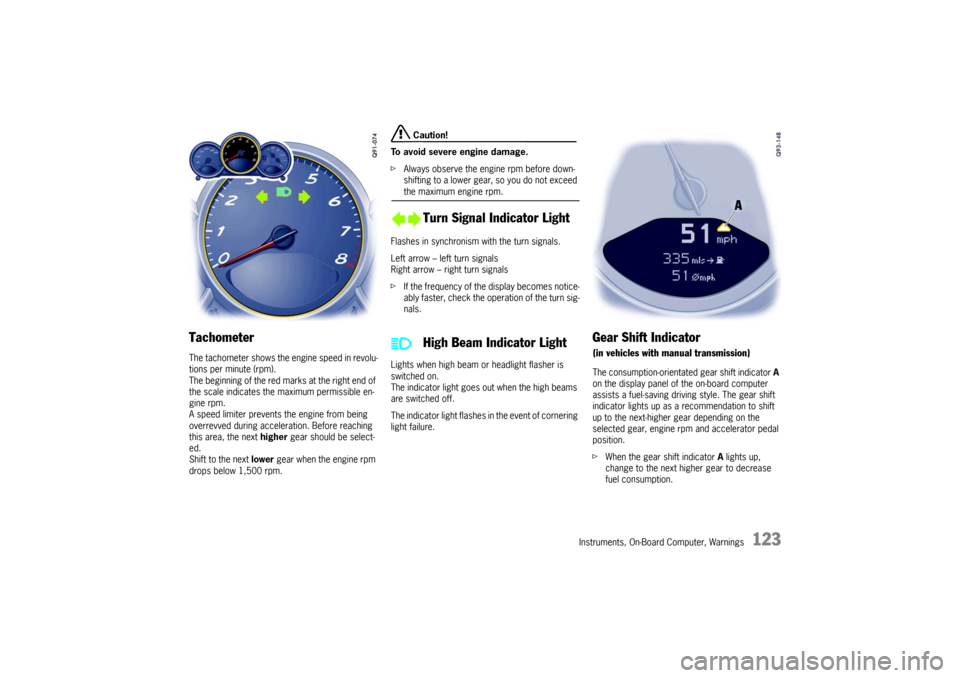
Tachometer The tachometer shows the engine speed in revolu-
tions per minute (rpm).
The beginning of the red marks at the right end of
the scale indicates the maximum permissible en-
gine rpm.
A speed limiter prevents the engine from being
overrevved during acceleration. Before reaching
this area, the next higher gear should be select-
ed.
Shift to the next lower gear when the engine rpm
drops below 1,500 rpm.
Caution!
To avoid severe engine damage.
f Always observe the engine rpm before down-
shifting to a lower gear, so you do not exceed the maximum engine rpm.
Flashes in synchronism with the turn signals.
Left arrow – left turn signals
Right arrow – right turn signals
f If the frequency of the display becomes notice-
ably faster, check the operation of the turn sig-
nals.
Lights when high beam or headlight flasher is
switched on.
The indicator light goes out when the high beams
are switched off.
The indicator light flashes in the event of cornering
light failure.
Gear Shift Indicator(in vehicles with manual transmission)The consumption-orientated gear shift indicator A
on the display panel of the on-board computer
assists a fuel-saving driving style. The gear shift
indicator lights up as a recommendation to shift
up to the next-higher gear depending on the
selected gear, engine rpm and accelerator pedal
position.
f When the gear shift indicator A lights up,
change to the next higher gear to decrease
fuel consumption.
Turn Signal Indicator Light
High Beam Indicator Light
Page 127 of 294
Instruments, On-Board Computer, Warnings
125
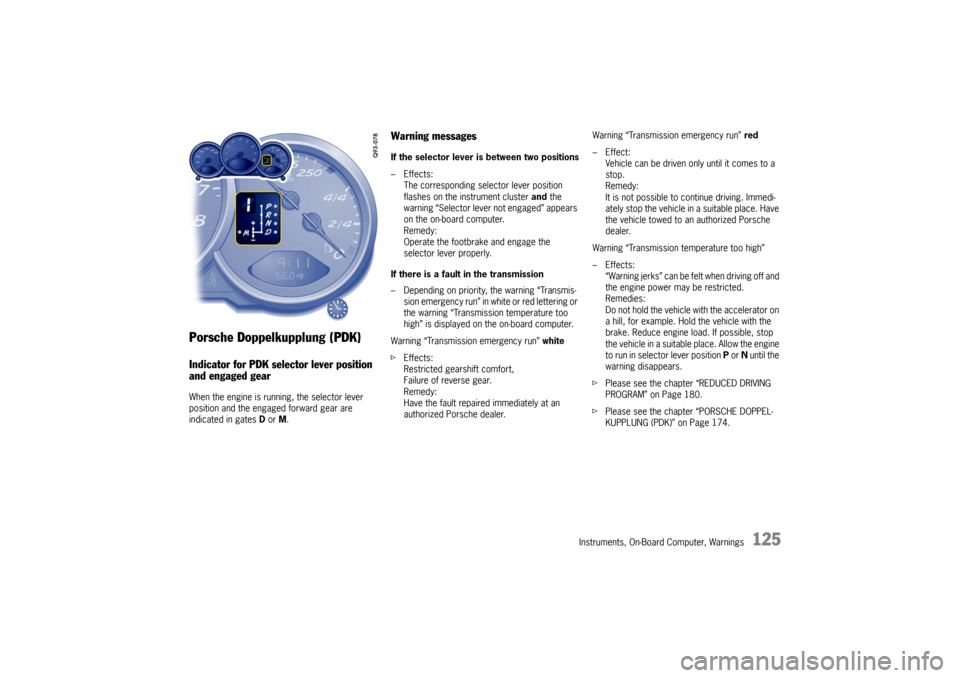
Porsche Doppelkupplung (PDK)Indicator for PDK selector lever position
and engaged gearWhen the engine is running, the selector lever
position and the engaged forward gear are
indicated in gates D or M.
Warning messagesIf the selector lever is between two positions
–Effects:
The corresponding selector lever position
flashes on the instrument cluster and the
warning “Selector lever not engaged” appears
on the on-board computer.
Remedy:
Operate the footbrake and engage the
selector lever properly.
If there is a fault in the transmission
– Depending on priority, the warning “Transmis- sion emergency run” in white or red lettering or
the warning “Transmission temperature too
high” is displayed on the on-board computer.
Warning “Transmission emergency run” white
f Effects:
Restricted gearshift comfort,
Failure of reverse gear.
Remedy:
Have the fault repaired immediately at an
authorized Porsche dealer. Warning “Transmission emergency run”
red
– Effect: Vehicle can be driven only until it comes to a
stop.
Remedy:
It is not possible to co ntinue driving. Immedi-
ately stop the vehicle in a suitable place. Have
the vehicle towed to an authorized Porsche
dealer.
Warning “Transmission temperature too high”
–Effects: “Warning jerks” can be fe lt when driving off and
the engine power may be restricted.
Remedies:
Do not hold the vehicle with the accelerator on
a hill, for example. Hold the vehicle with the
brake. Reduce engine load. If possible, stop
the vehicle in a suitable place. Allow the engine
to run in selector lever position P or N until the
warning disappears.
f Please see the chapter “REDUCED DRIVING
PROGRAM” on Page 180.
f Please see the chapter “PORSCHE DOPPEL-
KUPPLUNG (PDK)” on Page 174.
Page 169 of 294

Warnings
167
Move selector lever to PPorsche Doppelkupplung:
Move selector lever to position P before with-
drawing key from ignition lock.
Apply brake Porsche Doppelkupplung:
Apply the brake when starting.
Depress clutch pedal Manual transmission:
Depress clutch pedal when starting.
Move selector lever
to position P or N Porsche Doppelkupplung:
The vehicle can be started only in the selector
lever position P or N.
Text display in white:
Transmission
emergency run Restricted gearshift comfort,
failure of reverse gear.
Have the fault remedied
at an authorized
Porsche dealer.
Text display in red:
Transmission
emergency run No selector lever positi
on is displayed on the
instrument cluster.
Vehicle can be driven only until it comes to a
stop.
It is not possible to continue driving. Immedi-
ately stop the vehicle in a suitable place. Have
the vehicle towed to an authorized Porsche
dealer.
Transmission
temperature
too high Jerking can be felt when driving off, and the
engine power may be restricted.
Do not hold the vehicle
with the accelerator on
a hill, for example. Hold the vehicle with the
brake. Reduce engine load. If possible, stop the
vehicle in a suitable place. Allow the engine to
run in selector lever position P or N until the
warning disappears.
Instrument
panel On-board
computerText display on on-board
computer Meaning/measure
Page 173 of 294
Shifting Gears
171
Shifting Gears
Manual Transmission,
Clutch ...................... 172
Drive-Off Assistant .. ................................... 173
Porsche Doppelkupplung (PDK) .................. 174
Page 174 of 294
172
Shifting Gears
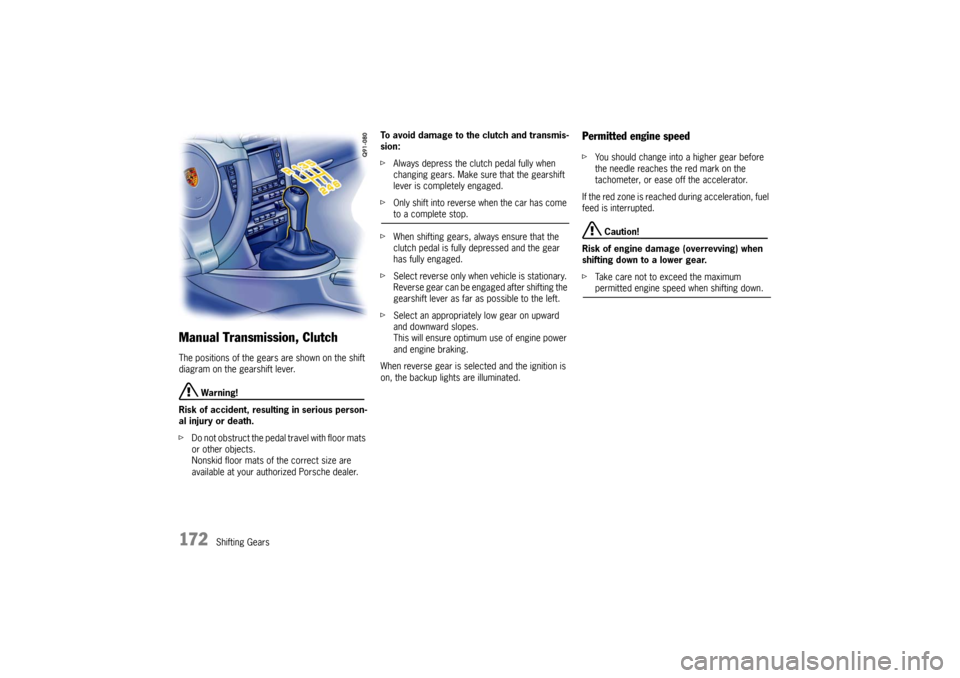
Manual Transmission, ClutchThe positions of the gears are shown on the shift
diagram on the gearshift lever.
Warning!
Risk of accident, resulting in serious person-
al injury or death.
f Do not obstruct the pedal travel with floor mats
or other objects.
Nonskid floor mats of the correct size are
available at your authorized Porsche dealer. To avoid damage to the clutch and transmis-
sion:
f
Always depress the clutch pedal fully when
changing gears. Make sure that the gearshift
lever is completely engaged.
f Only shift into reverse when the car has come
to a complete stop.
f When shifting gears, always ensure that the
clutch pedal is fully depressed and the gear
has fully engaged.
f Select reverse only when vehicle is stationary.
Reverse gear can be enga ged after shifting the
gearshift lever as far as possible to the left.
f Select an appropriately low gear on upward
and downward slopes.
This will ensure optimum use of engine power
and engine braking.
When reverse gear is sele cted and the ignition is
on, the backup lights are illuminated.
Permitted engine speedf You should change into a higher gear before
the needle reaches the red mark on the
tachometer, or ease off the accelerator.
If the red zone is reached during acceleration, fuel
feed is interrupted.
Caution!
Risk of engine damage (overrevving) when
shifting down to a lower gear.
f Take care not to exceed the maximum permitted engine speed when shifting down.
Page 175 of 294

Shifting Gears
173
Drive-Off AssistantThe Drive-Off Assistant assists the driver when
moving off on hills.
The vehicle must have sufficient road contact.
The Drive-Off Assistant is available on gradients as
from around 5%.
Danger!
Risk of accident.
Assistance by the Drive-Off Assistant is not
guaranteed when moving off on a slippery
surface (e.g. on icy or loose surfaces). In this
case, the vehicle could slip.
The limits dictated by the laws of physics
cannot be overcome, even with the Drive-Off
Assistant. The responsi bility for moving off
on upward slopes is still the driver’s, despite
the Drive-Off Assistant.
f Always adjust your driving style to the driving
conditions and vehicle load, use the brake
pedal if necessary.
Risk of accident.
If the Drive-Off Assistant is not functioning,
the driver cannot be assisted when moving
off on hills.
f Hold the vehicle with the brake pedal. Driving off with the Drive-Off Assistant
(vehicles with manual transmission)
1. Hold the vehicle secure
ly on the slope with the
brake pedal.
The engine must be running.
2. Fully depress the clutch pedal.
3. Engage a gear corresponding to the direction of travel up the slope (1st gear or reverse
gear).
4. Fully release the parking brake.
5. While keeping the clutch pedal depressed, release the brake pedal.
The vehicle is held on the slope for a short time
in order to allow driving off directly after the
brake is released.
6. Move off as usual.
Note on operation
The Drive-Off Assistant is not active:
– If the clutch is not depressed.
– If the vehicle is not stationary.
– If the engine is not running.
– On gradients of less than 5%.
– If the pressure on the brake pedal is too low. Driving off with the Drive-Off Assistant
(vehicles with PDK transmission)
1. Hold the vehicle securely on the slope with the
brake pedal.
The engine must be running.
2. Select a gear corresponding to the direction of travel up the slope (selector lever position
Dor R).
3. Fully release the parking brake.
4. Release the brake pedal. The vehicle is held on the slope for a short time
in order to allow driving off directly after the
brake is released.
5. Move off as usual.
Note on operation
The Drive-Off Assistant is not active:
– In the event of shift to neutral.
– If the vehicle is not stationary.
– If the engine is not running.
– On gradients of less than 5%.
– If the pressure on the brake pedal is too low.
Page 176 of 294
174
Shifting Gears
Porsche Doppelkupplung (PDK)The Porsche Doppelkupplung (PDK) is a seven-
speed transmission with an “automatic” and a
“manual” selection mode.
In automatic selection mode (selector lever
position D), gear changing is automatic.
You can change temporarily from automatic to
manual mode using the shift buttons on the
steering wheel.
In manual selection mode (selector lever
position M), you change gear using the shift
buttons on the steering wheel or with the PDK
selector lever.
You can change between se lector lever position D
and M as you wish while driving.
Note
f Take care not to operat e the shift buttons on
the steering wheel in advertently in either
automatic or manual mode, thereby triggering
undesired gear changes.
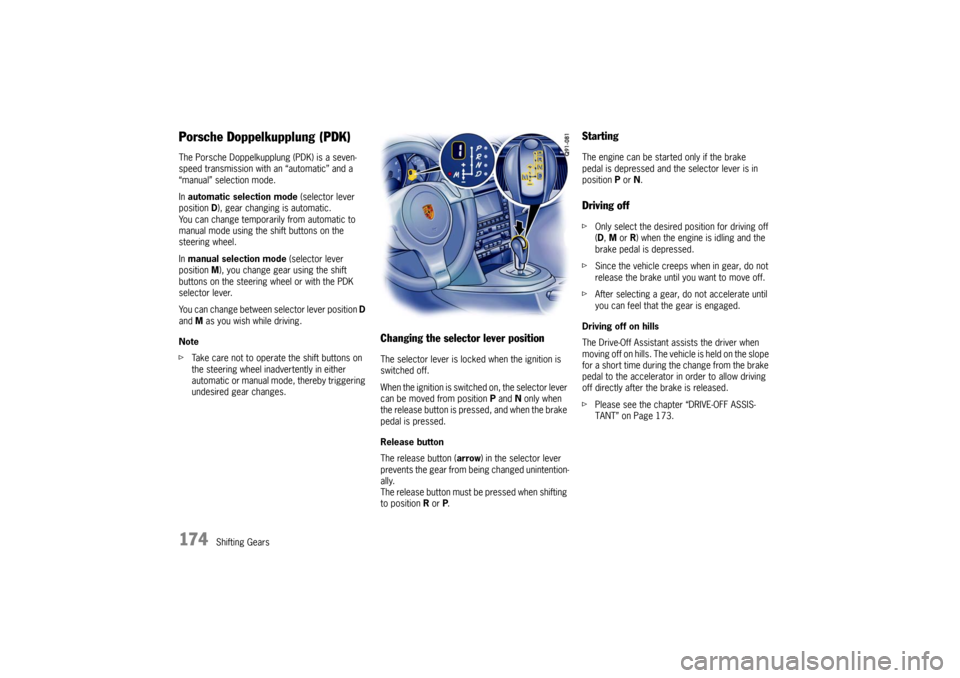
Changing the selector lever positionThe selector lever is locked when the ignition is
switched off.
When the ignition is switched on, the selector lever
can be moved from position P and N only when
the release button is pressed, and when the brake
pedal is pressed.
Release button
The release button ( arrow) in the selector lever
prevents the gear from being changed unintention-
ally.
The release button must be pressed when shifting
to position R or P.
StartingThe engine can be started only if the brake
pedal is depressed and the selector lever is in
position P or N.Driving offf Only select the desired position for driving off
( D, M or R ) when the engine is idling and the
brake pedal is depressed.
f Since the vehicle creeps when in gear, do not
release the brake until you want to move off.
f After selecting a gear, do not accelerate until
you can feel that the gear is engaged.
Driving off on hills
The Drive-Off Assistant assists the driver when
moving off on hills. The vehicle is held on the slope
for a short time during the change from the brake
pedal to the accelerator in order to allow driving
off directly after the brake is released.
f Please see the chapter “DRIVE-OFF ASSIS-
TANT” on Page 173.
Page 177 of 294
Shifting Gears
175
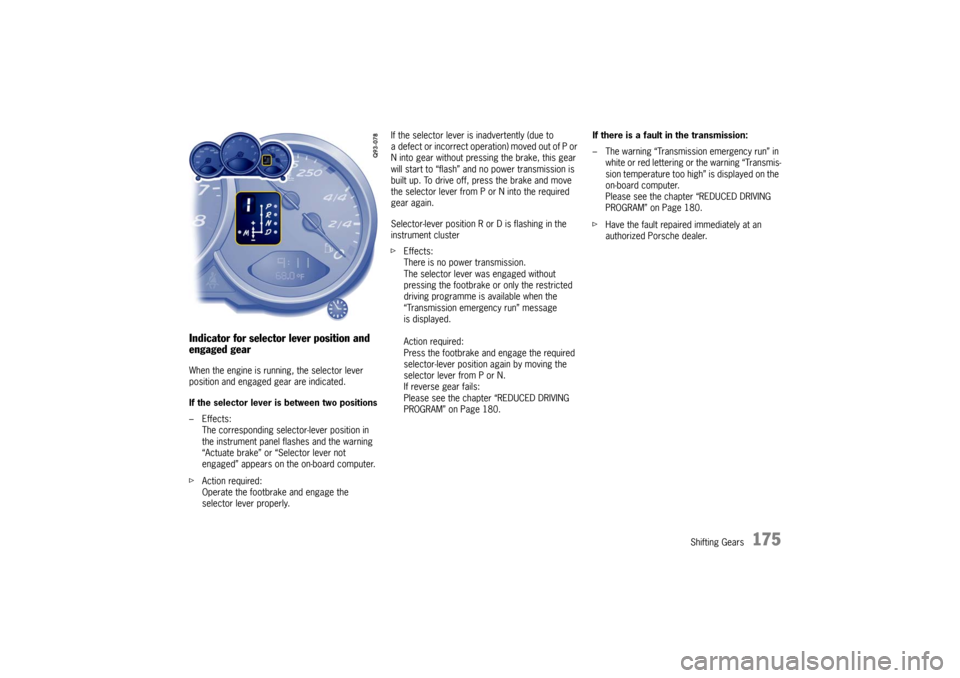
Indicator for selector lever position and
engaged gearWhen the engine is running, the selector lever
position and engaged gear are indicated.
If the selector lever is between two positions
–Effects: The corresponding selector-lever position in
the instrument panel flashes and the warning
“Actuate brake” or “Selector lever not
engaged” appears on the on-board computer.
f Action required:
Operate the footbrake and engage the
selector lever properly. If the selector lever is inadvertently (due to
a defect or incorrect operation) moved out of P or
N into gear without pressing the brake, this gear
will start to “flash” and no power transmission is
built up. To drive off, press the brake and move
the selector lever from P
or N into the required
gear again.
Selector-lever position R or D is flashing in the
instrument cluster
f Effects:
There is no power transmission.
The selector lever was engaged without
pressing the footbrake or only the restricted
driving programme is available when the
“Transmission emergency run” message
is displayed.
Action required:
Press the footbrake and engage the required
selector-lever position again by moving the
selector lever from P or N.
If reverse gear fails:
Please see the chapter “REDUCED DRIVING
PROGRAM” on Page 180. If there is a fault in the transmission:
– The warning “Transmission emergency run” in
white or red lettering or the warning “Transmis-
sion temperature too high” is displayed on the
on-board computer.
Please see the chapter “REDUCED DRIVING
PROGRAM” on Page 180.
f Have the fault repaired immediately at an
authorized Porsche dealer.
Page 178 of 294

176
Shifting Gears
Selector lever positionsP – Parking lockfEngage parking lock only when vehicle is
stationary.
If selector-lever position P is flashing in the
instrument cluster, the parking brake is not
engaged. The vehicle can roll away.
Engage selector-lever position P again by
moving the selector lever out of R.
f Engage parking lock after applying the
handbrake and release it before releasing the
handbrake.
The ignition key can be withdrawn only in
selector lever position P.R – Reverse gearf Select only if car is stationary and the brake is
applied.N – NeutralSelector lever position N must be selected for
towing or in car washes, for example.
f Only select the desired position for driving off
(D, M or R) when the engine is idling and the
brake pedal is depressed.
D - Automatic selection modeSelect position D for “normal” driving. The gears
are shifted automatically according to the acceler-
ator position and speed.
Depending on the way the vehicle is driven
(economical, comfortable or sporty driving style)
and on the resistance (e.g. uphill), the gear-
changing points are shifted towards higher or
lower engine-speed ranges.
The accelerator position, driving speed, engine
speed, longitudinal and lateral acceleration and
the road profile all have an influence on the gear-
changing characteristic.
Unwanted upward shifts, e.g. before bends, are
prevented by swiftly releasing the accelerator
pedal.
Depending on lateral acceleration, upward
changes on bends are not made until the engine-
speed limit is reached.
Under braking, and depending on the amount of
deceleration, the PDK transmission changes down
earlier.
For subsequent cornering, the right gear is
engaged when pressure is applied to the brakes
before the bend. The bend is taken in the right
gear, and when you accelera te out of the bend you
do not have to change down. With a sporty driving style, downshifts are already
initiated when the brake pedal is touched lightly.
This further enhances
a dynamic driving style.
The PDK transmission temporarily changes to the
sportiest gear-changing map, i.e. to the highest
possible gear-changing poin ts, if the accelerator
pedal is pressed quickly. The transmission accord-
ingly shifts down immediately by one or two gears
(temporary change-down).
The transmission no longer selects 7th gear at
high driving speeds.
Sport mode
(“Sport” and “Sport Plus” modes)
“Sport” mode activated:
The PDK transmission switches to a sporty gear-
changing map and shortens the gear shifting
times.
A sporty driving style is recognised more quickly
and the gear-changing speeds are adapted to
driving performance.
Deceleration downshifts are commenced earlier.
Downshifts are already carried out in the case of
slight decelerations, even at higher engine
speeds.