lights PORSCHE BOXSTER 2009 2.G Owner's Manual
[x] Cancel search | Manufacturer: PORSCHE, Model Year: 2009, Model line: BOXSTER, Model: PORSCHE BOXSTER 2009 2.GPages: 294, PDF Size: 6.89 MB
Page 69 of 294

Operation, Safety
67
Retractable Spoiler The rear spoiler improves driving stability, espe-
cially at higher speeds.
Warning!
Risk of accident, resulting in serious perso-
nal injury or death.
If the spoiler cannot be extended, driving sta-
bility will be adversel y affected by increased
rear axle lift, which could lead to loss of con-
trol.
f Adapt your driving style and speed to the
changed driving conditions.
f Have the fault remedied at an authorized
Porsche dealer.
Risk of injury during manual retraction or
extension of the spoiler with the vehicle
stationary.
f Make sure that no persons or objects are
within the range of movement of the rear
spoiler.
Risk of damage from pushing the vehicle by
the rear spoiler.
f Do not push the vehicle at the rear spoiler.
Automatic control
(automatic mode)The rear spoiler extends at approx. 75 mph
(120 km/h) and retracts again at approx. 50 mph
(80 km/h).
If the automatic control fails, the warning light
lights up.
The warning light in the on-board computer lights
up when the rear spoiler does not extend over
75 mph (120 km/h) or its end position is not
reached.
Manual control
(manual mode)When the ignition is on, the rear spoiler can be
extended and retracted manually using the button
in the center console.
Note
When the rear spoiler is extended manually, the au-
tomatic control does not operate and the rear
spoiler must be manually retracted.
Warning light
Page 70 of 294
68
Operation, Safety
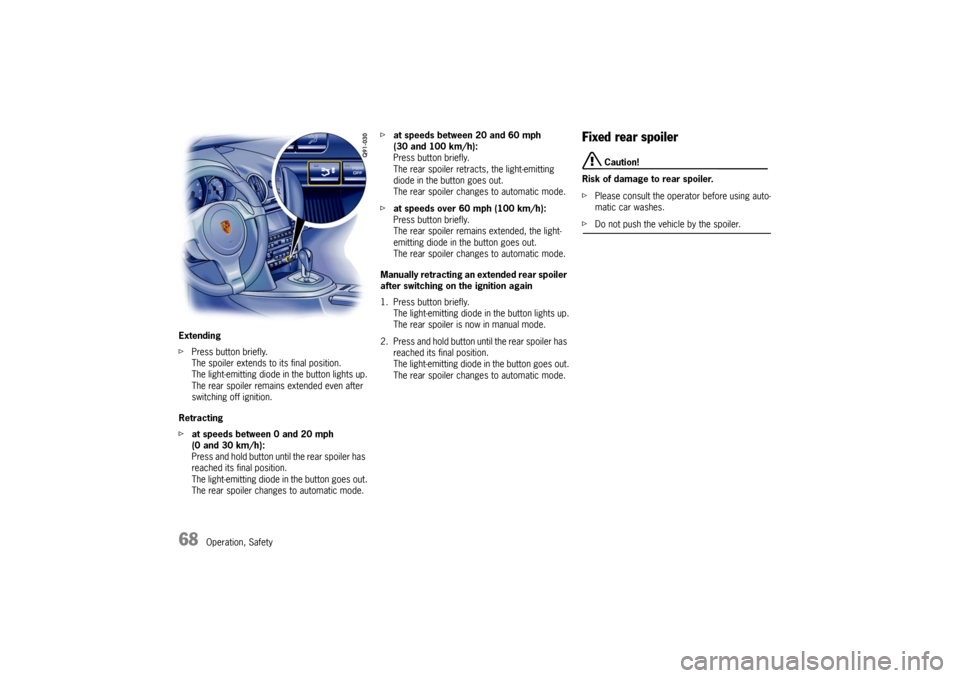
Extending
f
Press button briefly.
The spoiler extends to its final position.
The light-emitting diode in the button lights up.
The rear spoiler remains extended even after
switching off ignition.
Retracting
f at speeds between 0 and 20 mph
(0 and 30 km/h):
Press and hold button until the rear spoiler has
reached its final position.
The light-emitting diode in the button goes out.
The rear spoiler changes to automatic mode. f
at speeds between 20 and 60 mph
(30 and 100 km/h):
Press button briefly.
The rear spoiler retracts, the light-emitting
diode in the b utton goes out.
The rear spoiler changes to automatic mode.
f at speeds over 60 mph (100 km/h):
Press button briefly.
The rear spoiler remains extended, the light-
emitting diode in the button goes out.
The rear spoiler changes to automatic mode.
Manually retracting an extended rear spoiler
after switching on the ignition again
1. Press button briefly. The light-emitting diode in the button lights up.
The rear spoiler is now in manual mode.
2. Press and hold button until the rear spoiler has reached its final position.
The light-emitting diode in the button goes out.
The rear spoiler changes to automatic mode.
Fixed rear spoiler
Caution!
Risk of damage to rear spoiler.
f Please consult the operator before using auto-
matic car washes.
fDo not push the vehicle by the spoiler.
Page 71 of 294

Operation, Safety
69
A - Orientation light
B - Interior light switch, footwell lightInterior lightsf Please see the chapter “LOAD SWITCH-OFF AF-
TER 2 HOURS OR 7 DAYS” on Page 246.
Interior light, footwell lightsSwitching off
fPress left half of switch.
Switching to continuous illumination
f Press right half of switch.
Switching on and off automatically
f Move switch to center position.
The lights are switched on when a door is
unlocked or opened or when the ignition key is
withdrawn from the ignition lock.
The lights are switched off with a delay of
approx. 30 seconds after the door is closed.
The lights go out immediately as soon as the igni-
tion key is inserted in the ignition lock or the vehic-
le is locked.
Orientation lightThe light-emitting diode in the interior light impro-
ves your orientation inside the vehicle when it is
dark.
Note on operation
On vehicles with Sport Chrono Package Plus, the
brightness of the orientation light can be changed
in PCM.
f Please see the chapter ”Individual Memory“ in
the separate PCM operating instructions.
Page 77 of 294

Operation, Safety
75
Starting Procedures fPlease see the chapter “IMMOBILIZER” on
Page 15.
f Please see the chapter “EMISSION CONTROL
SYSTEM” on Page 208.
Warning!
Serious injury or death may result if you are
involved in a collision without having fas-
tened the safety belts.
f Fasten safety belts before driving away. Before starting the engine fApply the footbrake.
f Manual transmission:
Fully depress the clutch pedal and put the gear-
shift lever into neutral.
The clutch pedal must be depressed fully
before the starter will engage.
f In vehicles with PDK transmission:
Move PDK selector lever to position P or N.
Temperature sensors on the engine automatically
provide the correct fuel/air mixture required for
starting.
Therefore, it is not necessary to depress the
accelerator pedal while starting a cold or a
warm engine.
Starting the enginef Turn ignition key to ignition lock position 2.
f As soon as the engine st arts, release the igni-
tion key.
The first operation of the starter is ended automat-
ically when the engine starts.
If the engine does not start, subsequent starter
operations will not be ended automatically.
If the engine fails to start after 10 or 15 seconds
of cranking:
f Wait about 10 seconds before engaging the
starter again.
f When starting the engine, be ready to drive
immediately.
Drive vehicle at moderate speeds and avoid
engine speeds above 4,200 rpm during the
first 5 minutes.
f Do not let the engine idle to warm up.
Danger!
Engine exhaust fumes have many compo-
nents which you can smell. They also contain
carbon monoxide (CO), which is a colorless
and odorless gas.
Carbon monoxide can cause unconscious-
ness and even death if inhaled.
f Never start or let the engine run in an
enclosed, unventilated area.
It is not recommended to sit in your car for prolonged periods with the engine on and the
car not moving.
An unattended vehicle with a running engine
is potentially hazardous.
If warning lights shoul d come on to indicate
improper operation, they would go unno-
ticed.
f Never leave the engine idling unattended.
Danger of fire.
f Do not park or operate the vehicle in areas
where the hot exhaust system may come in
contact with dry grass, brush, fuel spill or oth-
er flammable material.
f If your car catches on fire for any reason, call
the fire department.
Do not endanger your life by attempting to put
out the fire.
Risk of burn injury when standing near or coming
into contact with the exhaust pipe.
The exhaust pipe is hot when the vehicle is running
and remains hot for some time after the vehicle is
turned off.
f To prevent injury, make a point of noting where
your vehicle’s exhaust pipe is, avoid placing
your legs near the exhaust pipe, and closely
supervise children around the vehicle when the
exhaust pipe could be hot.
A hot exhaust pipe can cause serious burns.
Page 80 of 294
78
Operation, SafetyWarning chime
If the ignition key is withdrawn and the door is
opened while the lights (not the Welcome Home
lighting) are on, a
chime warns of possible bat-
tery discharge.
In some countries, differences are possible
due to provisions of law.
Daytime driving lightsThe daytime driving lights are integrated in the
front auxiliary headlights. These lights are
switched on only when the engine is running and
with the light switch in the positions OFF or HOME.
Low beam headlights must be switched on when
driving through tunnels or at dusk, for example.
Operation of the daytime driving lights may vary
depending on country-specific regulations.
Canada only:
In addition to the auxiliary headlights the parking
lights are switched on.
USA only:
The daytime driving lights can be deactivated in
the on-board computer.
f Please see the chapter “ON-BOARD
COMPUTER (BC)” on Page 130.
Vehicles with the Sport Chrono Package Plus
Further individual light functions are available in ve-
hicles with the Sport Chrono Package Plus.
f Please observe the chapter “Individual Memo-
ry” in the separate PCM operating instructions.Cornering lightThe dynamic cornering light is activated above
speeds of 6 mph (10 km/h).
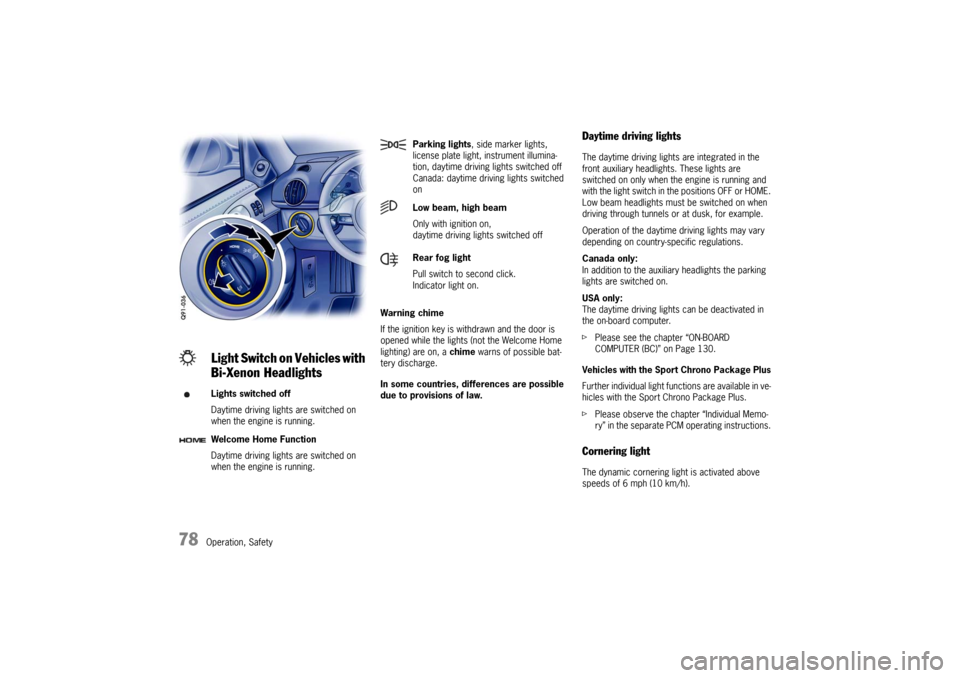
Light Switch on Vehicles with
Bi-Xenon HeadlightsLights switched off
Daytime driving lights are switched on
when the engine is running.
Welcome Home Function
Daytime driving lights are switched on
when the engine is running.
Parking lights , side marker lights,
license plate light, instrument illumina-
tion, daytime driving lights switched off
Canada: daytime driving lights switched
on
Low beam, high beam
Only with ignition on,
daytime driving lights switched off
Rear fog light
Pull switch to second click.
Indicator light on.
Page 81 of 294

Operation, Safety
79
Automatic Headlight Beam Adjustment Vehicles with Bi-Xenon headlights feature
dynamic headlight beam adjustment.
When the ignition is switched on, the level of the
headlight beam automatica lly changes in accord-
ance with the vehicle load.
The level of the headlight beam is automatically
kept constant during acceleration and braking.
Checking operation
1. Switch the low beam on.
2. Insert ignition key and switch ignition on. The light beam first dips all the way down and
is then adapted to the vehicle load.
If this test item is not met, the headlight beam
adjustment system must be checked by an author-
ized Porsche dealer.
Welcome Home LightingSwitching on
f Move light switch to the HOME position.
For improved visibility and security when you get
in and out of the car, the daytime driving lights and
the tail lights remain on for a certain period of
time:
– When you get out of the car , the lights are
turned on for approx. 30 seconds after the
door is opened. The off-delay time resumes
when the vehicle is locked.
On vehicles with the Sport Chrono Package
Plus, the PCM can be used to set the off-delay
time. This setting also changes the lighting
period for unlocking the vehicle.
Please observe the chapter “Individual
Memory” in the separate PCM operating
instructions.
– The lights are turned on for approx. 30 seconds when the vehicle is unlocked.
The lights go out if the ig nition is switched on
or when leaving the Welcome Home lighting.
Page 82 of 294
80
Operation, SafetyWarning chime
If the ignition key is withdrawn and the door is
opened while the lights (not the Welcome Home
lighting) are on, a
chime warns of possible bat-
tery discharge.
In some countries, differences are possible
due to provisions of law.
Vehicles with the Sport Chrono Package Plus
Further individual light functions are available in ve-
hicles with the Sport Chrono Package Plus.
f Please observe the chapter “Individual
Memory” in the separate PCM operating
instructions.
Daytime driving lightsUSA only:
The daytime driving lights can be activated/deacti-
vated in the on-board computer.
fPlease see the chapter “ON-BOARD
COMPUTER (BC)” on Page 130.Welcome Home LightingSwitching on
fMove light switch to the HOME position.
For improved visibility and security when you get
in and out of the car, the fog lights and the tail
lights remain on for a certain period of time:
– When you get out of the car , the lights are
turned on for approx. 30 seconds after the
door is opened. The off-delay time resumes
when the vehicle is locked.
On vehicles with the Sport Chrono Package
Plus, the PCM can be used to set the off-delay
time. This setting also changes the lighting
period for unlocking the vehicle.
Please observe the chapter “Individual
Memory” in the separate PCM operating
instructions.
– The lights are turned on for approx. 30 seconds when the vehicle is unlocked .
The lights go out if the ignition is switched on
or when leaving the Welcome Home lighting.
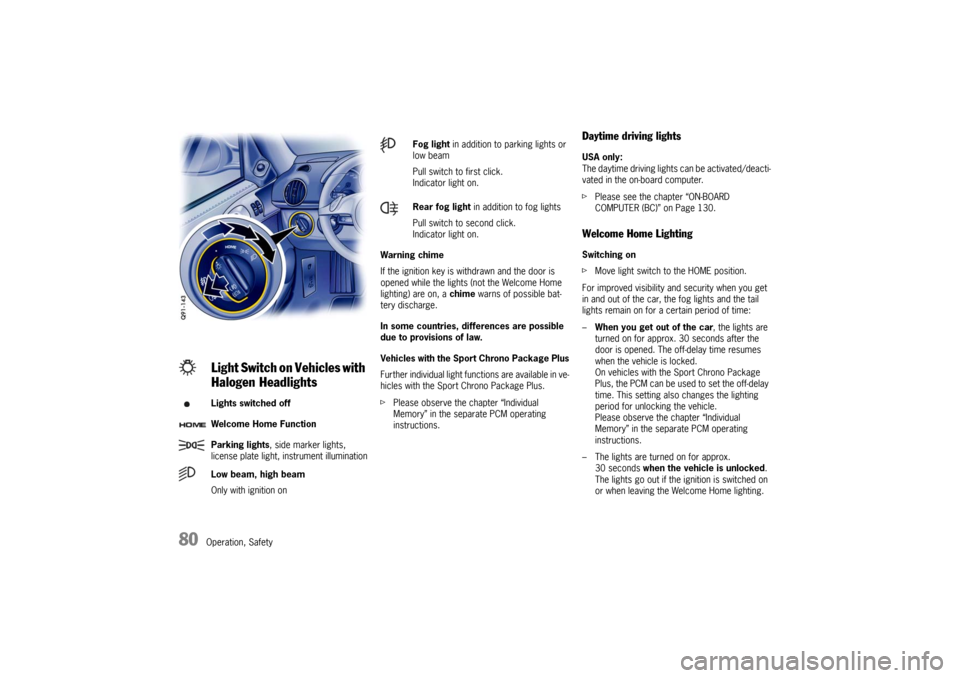
Light Switch on Vehicles with
Halogen HeadlightsLights switched off
Welcome Home Function
Parking lights , side marker lights,
license plate light, instrument illumination
Low beam, high beam
Only with ignition on
Fog light in addition to parking lights or
low beam
Pull switch to first click.
Indicator light on.
Rear fog light in addition to fog lights
Pull switch to second click.
Indicator light on.
Page 83 of 294
Operation, Safety
81
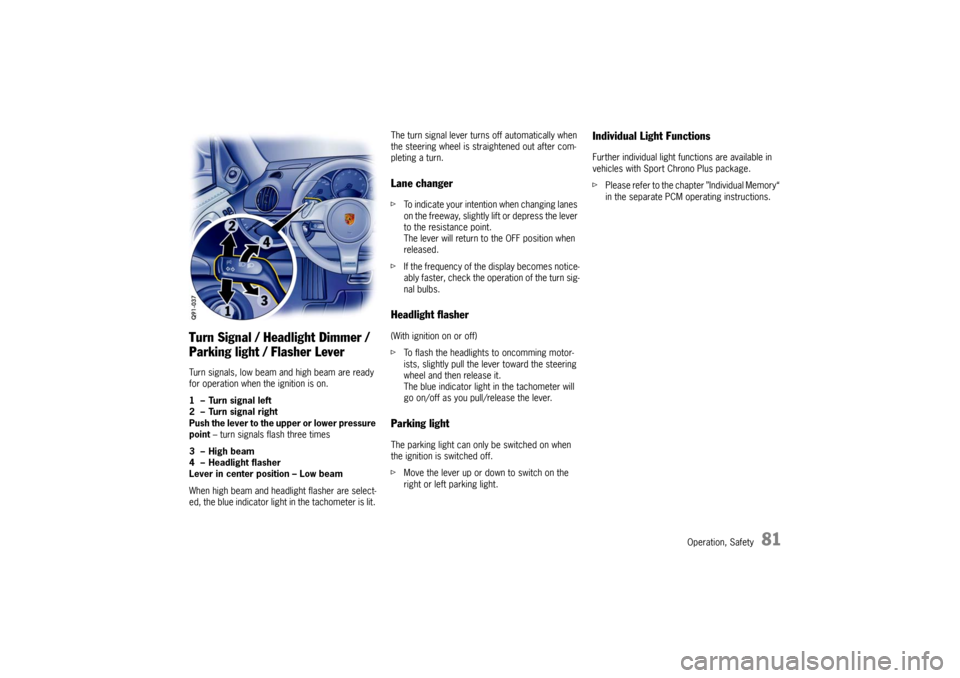
Turn Signal / Headlight Dimmer /
Parking light / Flasher Lever Turn signals, low beam and high beam are ready
for operation when the ignition is on.
1 – Turn signal left
2 – Turn signal right
Push the lever to the upper or lower pressure
point – turn signals flash three times
3 – High beam
4 – Headlight flasher
Lever in center position – Low beam
When high beam and head light flasher are select-
ed, the blue indicator light in the tachometer is lit. The turn signal lever turns off automatically when
the steering wheel is st
raightened out after com-
pleting a turn.
Lane changer f To indicate your intention when changing lanes
on the freeway, slightly lift or depress the lever
to the resistance point.
The lever will return to the OFF position when
released.
f If the frequency of the display becomes notice-
ably faster, check the operation of the turn sig-
nal bulbs. Headlight flasher (With ignition on or off)
fTo flash the headlights to oncomming motor-
ists, slightly pull the lever toward the steering
wheel and then release it.
The blue indicator light in the tachometer will
go on/off as you pull/release the lever. Parking lightThe parking light can only be switched on when
the ignition is switched off.
fMove the lever up or down to switch on the
right or left parking light.
Individual Light FunctionsFurther individual light functions are available in
vehicles with Sport Chrono Plus package.
f Please refer to the chapter ”Individual Memory“
in the separate PCM operating instructions.
Page 84 of 294
82
Operation, Safety
Windshield Wiper/ Washer Lever
Warning!
Danger of injury when the windshield wipers
operate unintentionally, e.g. in intermittent
or rain sensor operation.
Risk of damage to the windshield, wiper sys-
tem and headlight washer.
f Avoid running the wiper blades over a dry
windshield to prevent scratching the glass.
Spray washer fluid on the windshield first.
A scratched windshield will reduce visibility.
f Always loosen wiper blades from frozen glass
before operating wipers to prevent damage to
the wiper motor or blades.
f Always switch off windshield wipers in car
wash to prevent them wiping unintentionally
(intermittent or sensor operation).
f Always switch off windshield wipers before
cleaning the windshield to avoid unintentional
operation (intermittent or sensor operation).
f Do not operate the headlight washer in car
washes.
f Do not operate headlight washer when it is frozen.
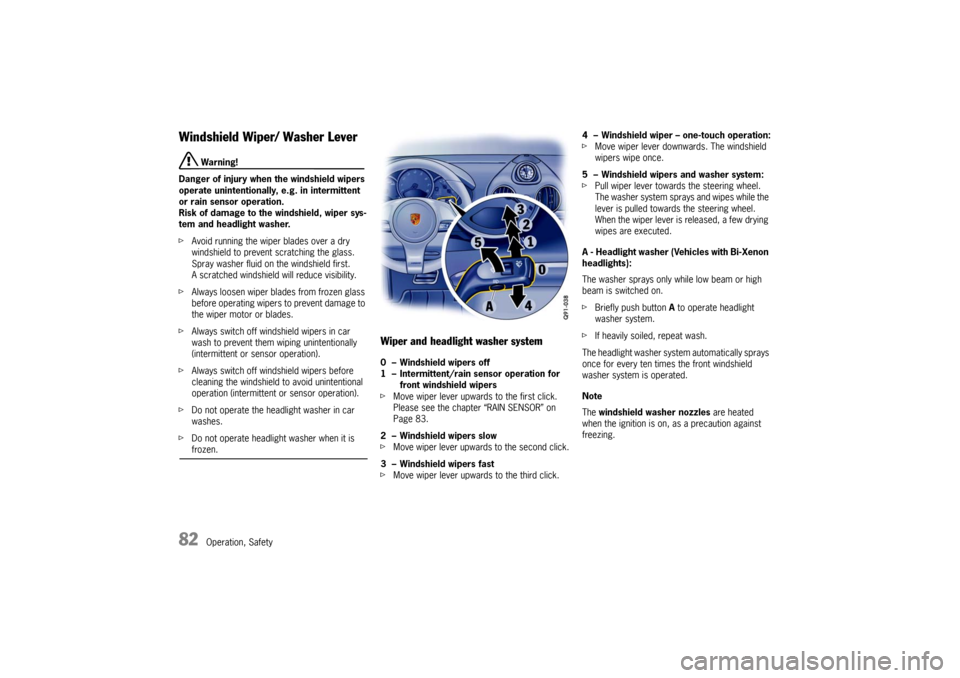
Wiper and headlight washer system0 – Windshield wipers off
1 – Intermittent/rain sensor operation for
front windshield wipers
f Move wiper lever upwards to the first click.
Please see the chapter “RAIN SENSOR” on
Page 83.
2 – Windshield wipers slow
f Move wiper lever upwards to the second click.
3 – Windshield wipers fast
f Move wiper lever upwards to the third click. 4 – Windshield wiper – one-touch operation:
f
Move wiper lever downwards. The windshield
wipers wipe once.
5 – Windshield wipers and washer system:
f Pull wiper lever towards the steering wheel.
The washer system sprays and wipes while the
lever is pulled towards the steering wheel.
When the wiper lever is released, a few drying
wipes are executed.
A - Headlight washer (Vehicles with Bi-Xenon
headlights):
The washer sprays only while low beam or high
beam is switched on.
f Briefly push button A to operate headlight
washer system.
f If heavily soiled, repeat wash.
The headlight washer system automatically sprays
once for every ten times the front windshield
washer system is operated.
Note
The windshield washer nozzles are heated
when the ignition is on, as a precaution against
freezing.
Page 97 of 294
Operation, Safety
95
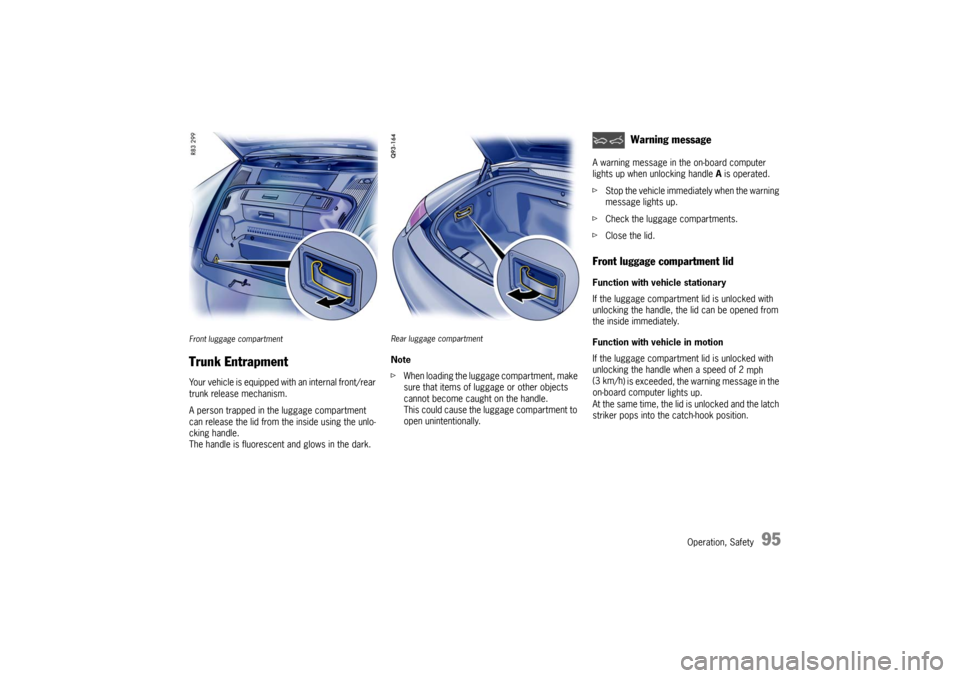
Front luggage compartment Trunk Entrapment Your vehicle is equipped with an internal front/rear
trunk release mechanism.
A person trapped in the luggage compartment
can release the lid from the inside using the unlo-
cking handle.
The handle is fluorescent and glows in the dark.
Rear luggage compartment Note
fWhen loading the luggage compartment, make
sure that items of luggage or other objects
cannot become caught on the handle.
This could cause the luggage compartment to
open unintentionally. A warning message in the on-board computer
lights up when unlocking handle
A is operated.
f Stop the vehicle immediately when the warning
message lights up.
f Check the luggage compartments.
f Close the lid.
Front luggage compartment lid Function with vehicle stationary
If the luggage compartment lid is unlocked with
unlocking the handle, the lid can be opened from
the inside immediately.
Function with vehicle in motion
If the luggage compartment lid is unlocked with
unlocking the handle when a speed of 2 mph
(3 km/h ) is exceeded, the warning message in the
on-board computer lights up.
At the same time, the lid is unlocked and the latch
striker pops into the catch-hook position.
Warning message