transmission PORSCHE BOXSTER 2009 2.G Owner's Manual
[x] Cancel search | Manufacturer: PORSCHE, Model Year: 2009, Model line: BOXSTER, Model: PORSCHE BOXSTER 2009 2.GPages: 294, PDF Size: 6.89 MB
Page 178 of 294

176
Shifting Gears
Selector lever positionsP – Parking lockfEngage parking lock only when vehicle is
stationary.
If selector-lever position P is flashing in the
instrument cluster, the parking brake is not
engaged. The vehicle can roll away.
Engage selector-lever position P again by
moving the selector lever out of R.
f Engage parking lock after applying the
handbrake and release it before releasing the
handbrake.
The ignition key can be withdrawn only in
selector lever position P.R – Reverse gearf Select only if car is stationary and the brake is
applied.N – NeutralSelector lever position N must be selected for
towing or in car washes, for example.
f Only select the desired position for driving off
(D, M or R) when the engine is idling and the
brake pedal is depressed.
D - Automatic selection modeSelect position D for “normal” driving. The gears
are shifted automatically according to the acceler-
ator position and speed.
Depending on the way the vehicle is driven
(economical, comfortable or sporty driving style)
and on the resistance (e.g. uphill), the gear-
changing points are shifted towards higher or
lower engine-speed ranges.
The accelerator position, driving speed, engine
speed, longitudinal and lateral acceleration and
the road profile all have an influence on the gear-
changing characteristic.
Unwanted upward shifts, e.g. before bends, are
prevented by swiftly releasing the accelerator
pedal.
Depending on lateral acceleration, upward
changes on bends are not made until the engine-
speed limit is reached.
Under braking, and depending on the amount of
deceleration, the PDK transmission changes down
earlier.
For subsequent cornering, the right gear is
engaged when pressure is applied to the brakes
before the bend. The bend is taken in the right
gear, and when you accelera te out of the bend you
do not have to change down. With a sporty driving style, downshifts are already
initiated when the brake pedal is touched lightly.
This further enhances
a dynamic driving style.
The PDK transmission temporarily changes to the
sportiest gear-changing map, i.e. to the highest
possible gear-changing poin ts, if the accelerator
pedal is pressed quickly. The transmission accord-
ingly shifts down immediately by one or two gears
(temporary change-down).
The transmission no longer selects 7th gear at
high driving speeds.
Sport mode
(“Sport” and “Sport Plus” modes)
“Sport” mode activated:
The PDK transmission switches to a sporty gear-
changing map and shortens the gear shifting
times.
A sporty driving style is recognised more quickly
and the gear-changing speeds are adapted to
driving performance.
Deceleration downshifts are commenced earlier.
Downshifts are already carried out in the case of
slight decelerations, even at higher engine
speeds.
Page 179 of 294

Shifting Gears
177
“Sport Plus” mode activated:
In “Sport Plus” mode, the PDK transmission
changes to a shift program designed for driving
on race circuits. 7th gear is not selected.
The gear-changing performance is enhanced
significantly again compared with “Sport” mode.
fPlease see the chapter “SPORT MODE” on
Page 61.
Driving with Launch Control
Driving with Launch Control allows you to achieve
maximum acceleration from a standing start. It is
intended to provide you with a unique enjoyment of
your vehicle under controlled circumstances and
is not intended to be used in any location where it
could be a nuisance to other persons.
Warning!
There is a risk of endangering other road
users if you use this Control in an improper
location or in a situation where other persons
might need to take evas ive action due to the
rapid acceleration that this technology
permits.
f Launch Control is designed to be used in a
controlled environment on closed circuit
driving courses where no vehicle cross traffic
or pedestrian traffic is present.
f Use Launch Control only if conditions permit it
to be applied in a safe manner. f
Do not use Launch Control if there is a possibi-
lity it could endanger other persons. Such a
possibility exists if you cannot see that you
have a clear road with no possibility of cross
traffic in your intended direction of driving. Caution!
Stress on components increases dramatically
when starting with maximum acceleration in
comparison with normal driving off. Use of
Launch Control will inevitably reduce the life
of the engaged engine and transmission
components.
Preconditions:
– Launch Control should only be used when the engine has reached operating temperature.
– “Sport Plus” mode must be switched on (light- emitting diode in button is on and “SPORT
PLUS” is displayed on the on-board computer).
1. Press the brake with your left foot.
2. Quickly press down the accelerator fully (kickdown activated) and hold.
The engine speed will flatten out at around
6500 rpm.
“Launch Control active” is displayed on the
on-board computer. 3. Release the brake within a few seconds.
Remaining stationary for a long time with
“Launch Control active” can lead to overload-
ing of the transmission.
In order to protect the transmission, the engine
power is then reduced an d the “Launch Control
active” process is cancelled.
Shifting gears on the steering wheel
With the shift buttons on the steering wheel, you
can change temporarily fr om automatic selection
mode D to manual mode M.
For example:
– Shifting down before bends and on entering built-up areas.
– Shifting down on downward slopes (engine braking).
– Shifting down for brief spurts of acceleration.
Manual selection mode remains engaged:
– for cornering (depending on the lateral acceler- ation) and overrunning,
– when the vehicle is stationary (e.g. at a junction).
The system leaves manual selection mode:
– automatically after approx. 8 seconds (unless cornering or overrunning),
– after driving off.
Page 180 of 294
178
Shifting Gears
Kickdown
The kickdown function is active in selector lever
positions
D and M.
f For optimum acceleration, e.g. when
overtaking, depress the accelerator pedal
beyond the full-throttle point (kickdown).
The transmission shifts down depending on the
speed of travel and engine speed.
Upward shifts occur at the highest possible engine
speeds.
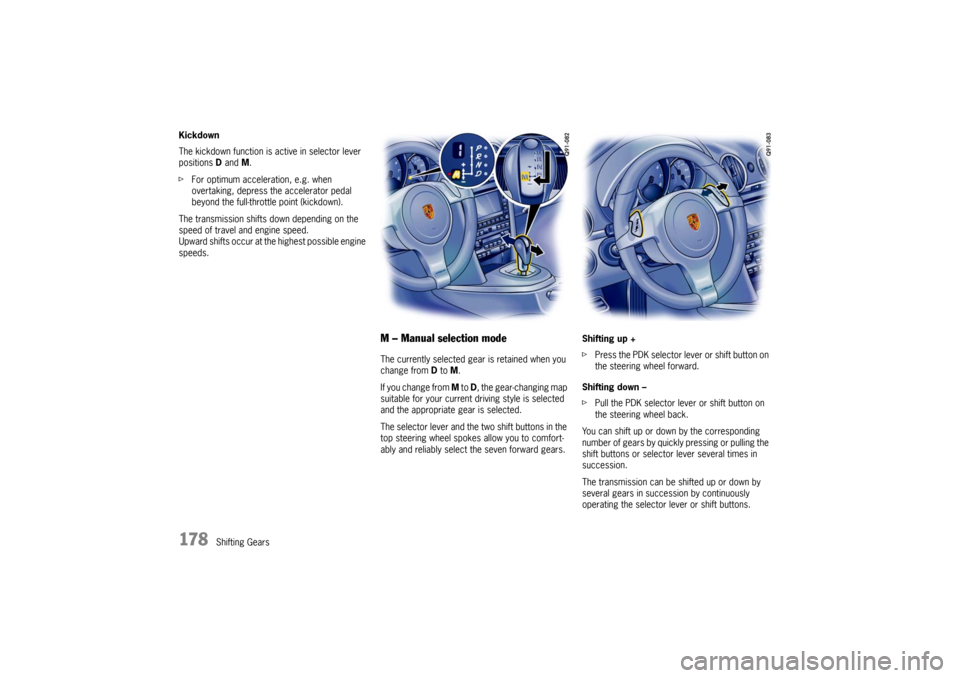
M – Manual selection modeThe currently selected gear is retained when you
change from D to M.
If you change from M to D, the gear-changing map
suitable for your current driving style is selected
and the appropriate gear is selected.
The selector lever and the two shift buttons in the
top steering wheel spokes allow you to comfort-
ably and reliably select the seven forward gears. Shifting up +
f
Press the PDK selector lever or shift button on
the steering wheel forward.
Shifting down –
f Pull the PDK selector leve r or shift button on
the steering wheel back.
You can shift up or down by the corresponding
number of gears by quickly pressing or pulling the
shift buttons or selector lever several times in
succession.
The transmission can be shifted up or down by
several gears in succe ssion by continuously
operating the selector lever or shift buttons.
Page 181 of 294

Shifting Gears
179
Depending on driving speed and engine speed,
you can shift up or down at any time.
Gear changes which would exceed the upper or
lower engine speed limit are not executed by the
controller.
There is no automatic upshift at the upper engine
speed limit in selector lever position M. Upshift
suppression can be cancelled by kickdown opera-
tion. If, for example, the engine speed limit is
reached during overtaking and the automatic
upshift does not occur, the transmission in this
case shifts up as a result of kickdown operation.
f Select an appropriately low gear on upward
and downward slopes.
This will ensure optimum use of engine power
and engine braking.
In order to shift up au tomatically at the upper
engine speed limit:
f Depress the accelerator pedal beyond the full-
throttle point (kickdown). Failure of the selector lever display on the
instrument cluster
The warning “Transmission emergency run” is
displayed in red on the on-board computer.
–Effect:
No selector lever position is displayed on the
instrument cluster.
Vehicle can be driven only until it comes to a
stop.
Remedy:
It is not possible to continue driving. Immedi-
ately stop the vehicle in a suitable place. Have
the vehicle towed to an authorized Porsche
dealer.
Please see the chapter “TOWING” on
Page 269.
Stoppingf For a brief stop (e.g. at a traffic light), leave the
selector lever in drive position and hold the
vehicle with the brake pedal.
f Do not hold the car on a slope using the
accelerator. Use the brake pedal or the
handbrake instead.
f Before leaving the vehicle, always apply the
handbrake and move the selector lever to
position P.Parkingf Go easy on the accelerator!
f When parking or manoeuvring in a small
space, control the speed by careful use of the
footbrake.Driving in winterIn wintry road conditions it is advisable to take
steep inclines in manual mo de. This prevents gear
changes occurring that could cause wheelspin.Tow-starting, towingf Please see the chapter “TOWING” on
Page 269.
Page 182 of 294

180
Shifting Gears
Reduced driving programIf there is a fault in the transmission
– Depending on priority, the warning “Transmis-sion emergency run” in white or red lettering or
the warning “Transmission temperature too
high” is displayed on the on-board computer.
Warning “Transmission emergency run” white
– Effects: Restricted gearshift comfort,
Reverse gear may not function.
Remedy:
Have the fault repaired immediately at an
authorized Porsche dealer. Warning “Transmission emergency run”
red
– Effect: Vehicle can be driven only until it comes to a
stop.
Remedy:
It is not possible to continue driving. Immedi-
ately stop the vehicle in a suitable place. Have
the vehicle towed to an authorized Porsche
dealer.
Warning “Transmission temperature too high”
–Effects: “Warning jerks” can be felt when driving off and
the engine power may be restricted.
Remedy:
Do not hold the vehicle with the accelerator on
a hill, for example. Hold the vehicle with the
brake. Reduce engine load. If possible, stop
the vehicle in a suitable place. Allow the engine
to run in selector lever position P or N until the
warning disappears.
Page 197 of 294
Maintenance, Car Care
195
Maintenance, Car Care
Exercise Extreme Caution when Working
on your Vehicle ......
................................... 196
Coolant Level ......... ................................... 197
Engine Oil ............. ................................... 199
Engine Oil Level .... ................................... 199
Engine Oil Recommenda tion ....................... 200
Brake Fluid Level .... ................................... 202
Fuel Economy ............. .............................. 204
Operating your Porsche in other Countries .. 204
Fuel Recommendation s .............................. 206
Portable Fuel Containe rs ........................... 207
Fuel Evaporation Control ........................... 207
Emission Control Syst em ........................... 208
How Emission Control Works ..................... 209
Washer Fluid .......... ................................... 210
Power Steering ...... ................................... 211
Air Filter ................ ................................... 211
Combination Filter .. ................................... 211
Fluids/Oils for Manual Transmission
and Porsche Doppelkupplung (PDK) ............ 211
Wiper Blades ........ ................................... 212
Car Care Instructions ................................ 213
Page 213 of 294

Maintenance, Car Care
211
Power Steering
Warning!
Risk of accident resulti ng in serious personal
injury or death.
When the engine is stopped (e.g. when being
towed) or the hydraulic system fails, there is
no assistance for steering.
Therefore, substantially more force will have
to be exerted in order to steer.
f Exercise great care when being towed.
f Have the fault remedied at your nearest autho-rized Porsche dealer.
Note
The flow noise heard at full steering lock is system
related and does not indi cate a defect in the
steering system.
Checking hydraulic fluid f Please see the chapter “EXERCISE EXTREME
CAUTION WHEN WORKING ON YOUR VEHICLE”
on Page 196.
The hydraulic fluid reservoir is located in the engi-
ne compartment.
Regular checking of hydraulic fluid is part of
servicing.
Air Filter A dirty air filter not only reduces engine perform-
ance, but can lead to premature engine wear.
Regular filter replacement is part of the routine
maintenance service.
f In dusty conditions, check the filter element
more frequently and replace if necessary.Combination Filter The fresh air passing through the combination fil-
ter into the passenger co mpartment is virtually
free of dust, pollen, and unpleasant odors.
f If the outside air is polluted by exhaust fumes,
press the circulating-air button.
A dirty filter can be the cause of reduced air flow:
f Have filter replaced by your authorized
Porsche dealer.
Regular filter replacement is part of the routine
maintenance service.
Fluids/Oils for Manual
Transmission and Porsche
Doppelkupplung (PDK)The transmission fluids/oils have to be checked
and changed at the intervals listed in your Mainte-
nance Schedule.
f Please see the chapter “CAPACITIES” on
Page 281.
Do not tow the car or run the engine without fluid/
oil in the transmission. The transmission may be
damaged by even a tiny speck of dirt, only a clean
funnel or spout must be used when adding fluid/
oil.
We recommend that you have the fluids/oils
changed at your Porsche dealer, who has the re-
quired lubricants and the necessary filling equip-
ment.
f If you suspect an oil leak in the transmission,
have your authorized Porsche dealer check it
out immediately.
Page 219 of 294

Maintenance, Car Care
217
Note
Door windows feature a water-repellent (hydro-
phobic) coating which prevents soiling of the
windows.
This coating is subject to natural wear and can be
renewed.
fConsult an authorized Porsche dealer.Wiper blades Wiper blades that are in perfect condition are vital
for a clear view.
fPlease see the chapter “WIPER BLADES” on
Page 212.
f Replace the wiper blades twice per year (be-
fore and after the cold season) or whenever
wiper performance deteriorates or the blades
are damaged.
f Periodically clean the wiper blades with
Porsche window cleaner, especially after the
vehicle has been washed in a car wash.
If they are very dirty (e.g. with insect remains),
they can be cleaned with a sponge or cloth.
If the wiper blades rub or squeak, this can be as a
result of the following:
– If the vehicle is washed in an automatic car wash, residues may adhere to the windshield.
These wax residues can be removed only by
using window cleaner concentrate.
– The wiper blades may be damaged or worn. – Replace damaged or worn wiper blades imme-
diately.
f Please see the chapter “WASHER FLUID” on
Page 210.
f Please contact your authorized Porsche dealer
for further information.
Undercoating As it is not possible to ex clude the risk of damage
to this protective coating in day to day driving, it
is advisable to have the underside of the car in-
spected at certain interv als – preferably before
the start of winter and again in spring – and the un-
dercoating restored as necessary.
Your authorized Porsche dealer is familiar with the
bodyseal treatment procedures and has the nec-
essary equipment for applying factory approved
materials. We recommend that you entrust them
with such work and inspections.
Unlike conventional spray oils, undercoating and
rust-proofing compounds based on bitumen or
wax do not attack the so und-proofing materials ap-
plied at the factory.
Warning!
Danger of fire resulting in serious personal
injury or death.
f Do not apply additional undercoating or rust-
proofing on or near the exhaust manifold, ex-
haust pipes, catalytic converters or heat shields. During driving the substance used for
undercoating could overheat and ignite.
f Before applying fresh underseal, carefully
remove any deposits of dirt and grease. Once
it has dried, the new undercoating compound
forms a tough protective coating which
provides efficient rust-proofing of the floor
panels and components.
f Always apply a fresh coating of suitable pre-
servative to unprotected areas after cleaning
the underside of the body, the transmission,
the engine or carrying out repairs to under-
body, engine or transmission components.
Effective rust-proofing is particularly important
during the cold weather seas on. If your car is driv-
en frequently in areas where salt has been spread
on the roads, the whole engine compartment
should be cleaned thoroughly after the winter to
prevent salt from causing any lasting damage. A
full under-body wash should also be performed at
the same time.
Stainless steel exhaust tailpipesStainless steel exhaust tailpipes can discolor due
to soiling, strong heat, and combustion residues.
The original polish can be achieved again using
commercially available metal polishing paste or
metal polish.
Page 276 of 294
274
Vehicle Identification, Technical Data
Vehicle IdentificationWhen ordering spare parts or making inquiries,
please always quote the vehicle identification
number. Vehicle data bankThe vehicle data bank is attached to the inside of
the “Maintenance” booklet.
It contains all important data about your vehicle.
Note
This data bank cannot be re -ordered if it is lost or
damaged.
This label contains the following information:
1. Vehicle Identification No.
2. Type/Type description
3. Engine code/Transmission code
4. Paint No./Interior
5. Optional equipment
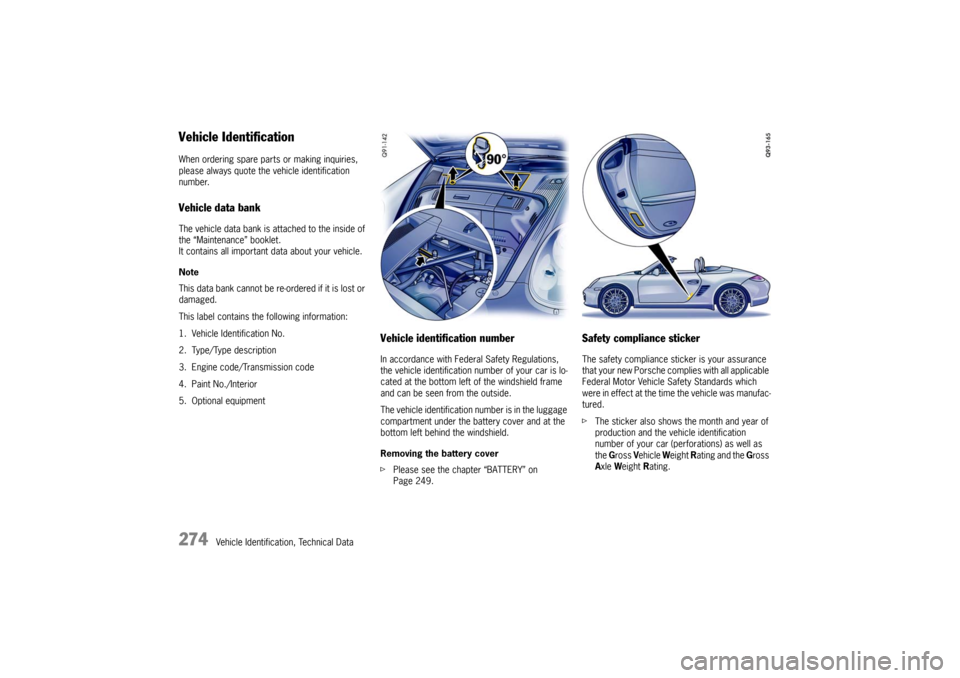
Vehicle identification number In accordance with Federal Safety Regulations,
the vehicle identification number of your car is lo-
cated at the bottom left of the windshield frame
and can be seen from the outside.
The vehicle identification number is in the luggage
compartment under the battery cover and at the
bottom left behind the windshield.
Removing the battery cover
f Please see the chapter “BATTERY” on
Page 249.
Safety compliance stickerThe safety compliance sticker is your assurance
that your new Porsche complies with all applicable
Federal Motor Vehicle Safety Standards which
were in effect at the time the vehicle was manufac-
tured.
fThe sticker also shows the month and year of
production and the vehicle identification
number of your car (perforations) as well as
the Gross Vehicle Weight Rating and the G ross
A xle Weight Rating.
Page 282 of 294

280
Technical Data
Driving Performance* * At DIN empty weight and half load, without performance-inhibiting extra equipment.
Boxster Manual transmission Porsche Doppelkupplung
Top track speed
6-speed transmission 164 mph/263 km/h 162 mph/261 km/h
Acceleration 0 – 60 mph 5.6 seconds
5.5 seconds
Acceleration 0 – 60 mph with Sport+ 5.3 seconds
Acceleration 0 – 100 km/h (6 2 mph) 5.9 seconds5.8 seconds
Acceleration 0 – 100 km/h (62 mph) with Sport+ 5.6 seconds
Boxster S Manual transmission Porsche Doppelkupplung
Top track speed 170 mph/274 km/h 169 mph/272 km/h
Acceleration 0 – 60 mph 5.0 seconds4.9 seconds
Acceleration 0 – 60 mph with Sport+ 4.7 seconds
Acceleration 0 – 100 km/h (6 2 mph) 5.3 seconds5.2 seconds
Acceleration 0 – 100 km/h (62 mph) with Sport+ 5.0 seconds