warning light PORSCHE BOXSTER 2009 2.G Manual PDF
[x] Cancel search | Manufacturer: PORSCHE, Model Year: 2009, Model line: BOXSTER, Model: PORSCHE BOXSTER 2009 2.GPages: 294, PDF Size: 6.89 MB
Page 220 of 294

218
Maintenance, Car Care
Light alloy wheels fPlease see the chapter “WASHING” on
Page 214.
Warning!
Danger of accident re sulting in serious per-
sonal injury or death if cleaning agents (e.g.
wheel cleaning agents) come into contact
with the brake discs.
The resulting film on the brake discs can im-
pair braking performance.
f Make sure that no cleaning agent comes into
contact with the brake discs.
f If cleaning agent has come into contact with
the brake discs, thoroughly clean the brake
discs with a strong jet of water.
f Paying attention to any road users behind you,
dry the brake discs by applying the brakes at short intervals.
Metal particles (such as brass or copper in brake
dust) must not remain too long on alloy wheels.
Contact corrosion can cause pitting.
Cleaners with an oxide-removing effect or the
wrong pH value, as are commonly used for other
metals, as well as mechanical tools and products,
will damage the oxide layer and are therefore
unsuitable.
f Use only cleaners for alloy wheels (pH value
9.5). Products with the wrong pH value can destroy the protective layer on the wheels.
We recommend Porsche cleaner for alloy rims.
f If possible, wash the wheels every two weeks
with a sponge or washing brush. If the wheels
are exposed to road salt, grit or industrial dust,
weekly cleaning is necessary.
Door, roof, lid and window seals
Caution!
The lubricant coating on the inner door seals,
convertible top and hardtop seals may be
damaged by unsuitable cleaning and care agents.
f Do not use any chemic al cleaning agents
or solvents.
f Do not use any preservative agents.
f Wash dirt (e.g. abrasion, dust, road salt and
grit) from all seals regularly using warm
soapy water.
f If there is a risk of frost, protect the outer door
seals and lid seals against freezing into place
with a suitable care product.
Headlights, lights, interior and exterior
plastic parts, adhesive filmsfUse only clean water and a little dishwashing
detergent to clean light lenses, plastic head-
light lenses, plastic parts, adhesive films and
surfaces.
Do not clean when dry.
Use a soft sponge or a so ft, lint-free cloth. Gen-
tly wipe the surface without applying too much
pressure.
An interior window cleaner can also be used to
clean plastic surfaces (always read the cleaning
instructions on the container). We recommend
Porsche interior window cleaner.
f Gently wipe the surfac e without applying too
much pressure.
f Do not clean when dry.
f Never use other chemical cleaners or
solvents.
f Rinse cleaned surfaces with clear water.Leather Characteristics and special features
The natural surface markings of leather, e.g.
creases, healed scars, in sect sting marks, struc-
tural differences and slight variations in shade and
grain add to the attractiveness of the natural leath-
er product.
Page 221 of 294

Maintenance, Car Care
219
Observe the following care instructions:
Caution!
The leather will be da maged by the use of
unsuitable cleaning and care agents and by
incorrect treatment.
f Do not use caustic cleaners or hard
cleaning aids.
f Perforated leather must under no circumstances get wet on its reverse side.
f Clean all types of leather regularly to remove
fine dust using a soft, damp, white woollen
cloth or a commercially available
microfibre cloth.
f Remove heavy contamination with a leather
cleaner.
Always read the instructions for use given on
the containers.
We recommend Porsche leather cleaner.
f Treat cleaned leather only with a leather
care product.
We recommend the Porsche leather
care product.
Cleaning airbags covers
Danger!
There is a danger of serious personal injury
or death if the airbag system is impaired by
improper cleaning work.
f Do not make any modifications whatsoever on
individual components such as the padded
covers of the steering wheel, passenger side
instrument panel, the front seats and the door
linings.
f Let your authorized Porsche dealer clean these components.
Carpets and floor-mats fUse only a vacuum clea ner or a medium stiff
brush.
f Remove stains and spots with Porsche stain
remover.
To protect carpets, the Porsche range of accesso-
ries includes mats of th e correct size and with the
appropriate fastening.
Warning!
Risk of an accident re sulting in serious per-
sonal injury or death.
f Always check the movement of the pedals be-
fore driving and make sure that they are not ob-
structed by a floor-ma t or any other object. f
Secure the floor-mat to prevent it from sliding
into positions that could interfere with the safe
operation of your vehicl e - do not install them
loosely in the vehicle.
Your Porsche dealer will be glad to offer you
nonskid floor-mats of the correct size.
Cleaning fabric linings
f Fabric linings on pillars, convertible top liner
and sun blinds, etc. must be cleaned only
using suitable cleaning agents or a suitable dry
foam and a soft brush.
Alcantara fDo not use a leather care product to clean
Alcantara.
For regular care it is su fficient to clean the cover
with a soft brush.
Heavy abrasion or rubbing when cleaning causes
a lasting change in the surface.
Cleaning when lightly soiled
f Wet a soft cloth with water or a neutral soap
solution and wipe off the dirt.
Cleaning when heavily soiled
f Wet a soft cloth with lukewarm water or
thinned white spirit and dab the dirt from the
outside in.
Cleaning safety belts
Page 226 of 294

224
Practical Tips, Emergency Service
and a half (1-1/2) times as well on the government
course as a tire graded 100.
The relative performance of tires depends upon
the actual conditions of
their use, however, and
may depart significantly fr om the norm due to var-
iations in driving habits, service practices and dif-
ferences in road characteristics and climate.
Traction AA, A, B, C
The traction grades, from highest to lowest, are
AA, A, B, and C and they represent the tire’s ability
to stop on wet pavement as measured under con-
trolled conditions on specified government test
surfaces of asphalt and concrete.
A tire marked C may have poor traction perform-
ance.
Warning!
The traction grade assigned to this is based on
braking (straight-ahead) traction tests and does
not include cornering (turned) traction, accelera-
tion, hydroplaning or peak traction characteris-
tics.
Temperature A, B, C
The temperature grades ar e A (the highest), B and
C, representing the tire’s resistance to the gener-
ation of heat and its abilit y to dissipate heat when
tested under controlled conditions on a specified
indoor laboratory test wheel.
Sustained high temperatur es can cause the mate-
rial of the tire to degenerate and reduce tire life,
and excessive temperature can lead to sudden tire failure.
The grade C corresponds to a level of perform-
ance which all passenger car tires must meet un-
der the Federal Motor Vehi
cle Safety Standard No.
109.
Grades B and A represent higher levels of per-
formance on the laboratory test wheel than the
minimum required by law.
Warning!
The temperature grade for this tire is established
for a tire that is properly inflated and not overload-
ed.
Excessive speed, underinflation, or excessive
loading, either separately or in combination, can
cause heat buildup and possible tire failure, result-
ing in serious personal injury or death. Tire pressures
Warning!
Incorrect tire pressure causes increased tire
wear and adversely affects road handling.
This could lead to tire fa ilure, resulting in loss
of control, leading to serious personal injury
or death.
f Always use an accurate tire pressure gage
when checking inflation pressures.
f Do not exceed the maximum tire pressure list-
ed on the tire sidewall.
Please see the chapter “TIRE PRESSURE PLA-
TE” on Page 275. f
Cold tire inflation pressure means: all tires
must be cold, ambient temperature maximum
(68 °F/20 °C)
, when adjusting the inflation
pressure.
Avoid sunlight striking the tires before measur-
ing cold pressures, since the pressures would
rise from temperature influence.
f Valve caps protect the valve from dust and dirt,
and thus from leakage.
Always screw caps tightly down.
Replace missing caps immediately.
f Use only plastic valve caps.
f Do not use commercially available sealant or
tire inflating bottles. Only use Porsche
approved tire sealant.
f Please see the chapter “TIRE PRESSURE FOR
COLD TIRES (68 °F/20 °C)” on Page 277.
Page 239 of 294
Practical Tips, Emergency Service
237
Changing a wheel
Warning!
Risk of serious personal injury or death. The
car may slip off the jack.
f Make sure that no one is in the vehicle when
jacking up and changing a wheel.
f Always place the car on stable supports if work
has to be carried out under the car.
Risk of damage to the brake discs of the
Porsche Ceramic Composite Brake (PCCB).
f Always screw in both assembly aids when changing a wheel.
Note
The tools required for changing a wheel (e.g. jack,
wheel bolt wrench, assembly aids) are not sup-
plied with the car.
Your authorized Porsche dealer will be pleased to
advise you.
1. Apply the handbrake fully and engage 1st gear or PDK selector-lever position P and remove
the ignition key.
2. Switch on the hazard warning lights if neces- sary.
3. Secure the car against rolling away, e.g. by
means of wedges under the wheels on the op-
posite side.
This is particularly important on slopes. 4. Slightly slacken the whee
l bolts of the wheel to
be changed.
5. Lift the car only at the specified jacking points.
6. Raise the car until the wheel lifts off the ground.
Please see the chapter “LIFTING THE VEHICLE
WITH A LIFTING PLATFORM OR GARAGE LIFT”
on Page 242.
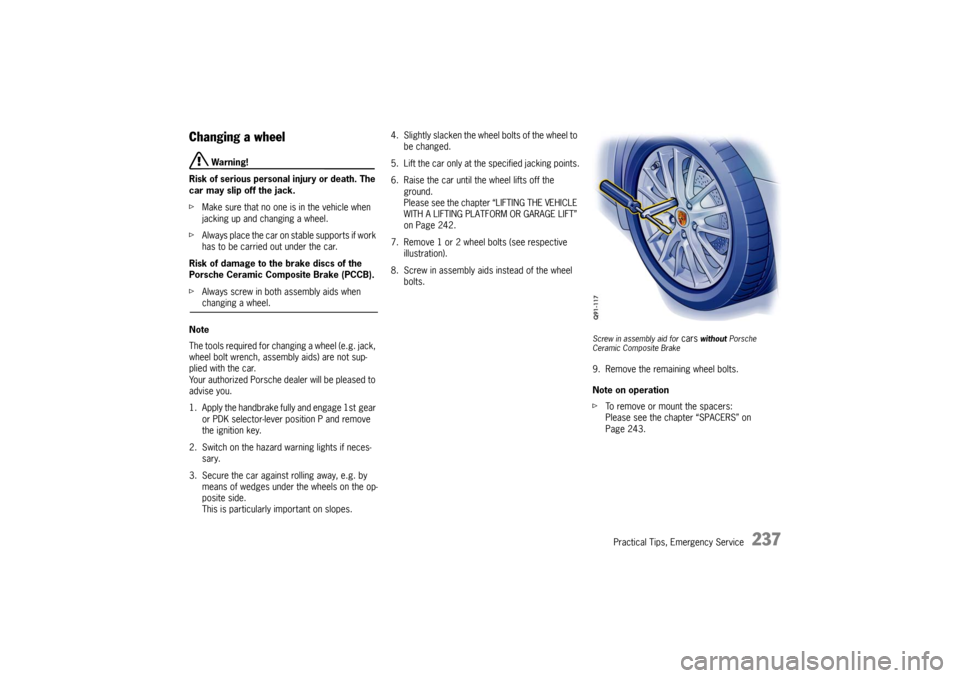
7. Remove 1 or 2 wheel bolts (see respective illustration).
8. Screw in assembly aids instead of the wheel bolts.
Screw in assembly aid for
cars
without Porsche
Ceramic Composite Brake
9. Remove the remaining wheel bolts.
Note on operation
f To remove or mount the spacers:
Please see the chapter “SPACERS” on
Page 243.
Page 243 of 294
Practical Tips, Emergency Service
241
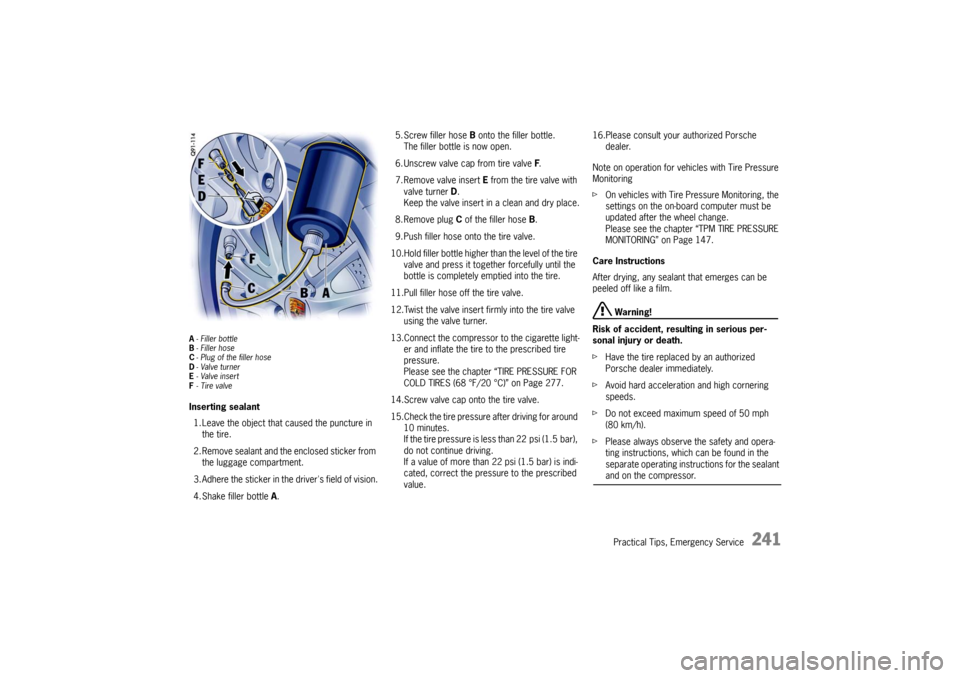
A- Filler bottle
B - Filler hose
C - Plug of the filler hose
D -Valve turner
E -Valve insert
F - Tire valveInserting sealant
1. Leave the object that caused the puncture in the tire.
2. Remove sealant and the enclosed sticker from the luggage compartment.
3. Adhere the sticker in the driver's field of vision.
4. Shake filler bottle A. 5. Screw filler hose B
onto the filler bottle.
The filler bottle is now open.
6. Unscrew valve cap from tire valve F.
7. Remove valve insert E from the tire valve with
valve turner D.
Keep the valve insert in a clean and dry place.
8. Remove plug C of the filler hose B.
9. Push filler hose onto the tire valve.
10.Hold filler bottle higher than the level of the tire valve and press it together forcefully until the
bottle is completely emptied into the tire.
11.Pull filler hose off the tire valve.
12.Twist the valve insert fi rmly into the tire valve
using the valve turner.
13.Connect the compressor to the cigarette light- er and inflate the tire to the prescribed tire
pressure.
Please see the chapter “TIRE PRESSURE FOR
COLD TIRES (68 °F/20 °C)” on Page 277.
14.Screw valve cap onto the tire valve.
15.Check the tire pressure after driving for around 10 minutes.
If the tire pressure is less than 22 psi (1.5 bar),
do not continue driving.
If a value of more than 22 psi (1.5 bar) is indi-
cated, correct the pressure to the prescribed
value. 16.Please consult your authorized Porsche
dealer.
Note on operation for vehicles with Tire Pressure
Monitoring
f On vehicles with Tire Pressure Monitoring, the
settings on the on-board computer must be
updated after the wheel change.
Please see the chapter “TPM TIRE PRESSURE
MONITORING” on Page 147.
Care Instructions
After drying, any sealan t that emerges can be
peeled off like a film.
Warning!
Risk of accident , resulting in serious per-
sonal injury or death.
f Have the tire replaced by an authorized
Porsche dealer immediately.
f Avoid hard acceleration and high cornering
speeds.
f Do not exceed maximum speed of 50 mph
(80 km/h).
f Please always observe the safety and opera-
ting instructions, which can be found in the
separate operating instructions for the sealant and on the compressor.
Page 247 of 294
Practical Tips, Emergency Service
245
Electrical System In order to avoid damage and faults in electrical or
electronic systems, electrical accessories should
be installed at your authorized Porsche dealer.
fOnly use accessories authorized by Porsche.
Warning!
Risk of short circuit and fire, resulting in
serious personal injury or death.
Replacing fuses or relays with the engine
running or the ignition on could cause elec-
trical shock.
f Disconnect the negative terminal on the
battery during all work on the electrical
system.
Please see the chapter “BATTERY” on Page 249.
RelaysDefective relays should be changed only by an
authorized workshop.
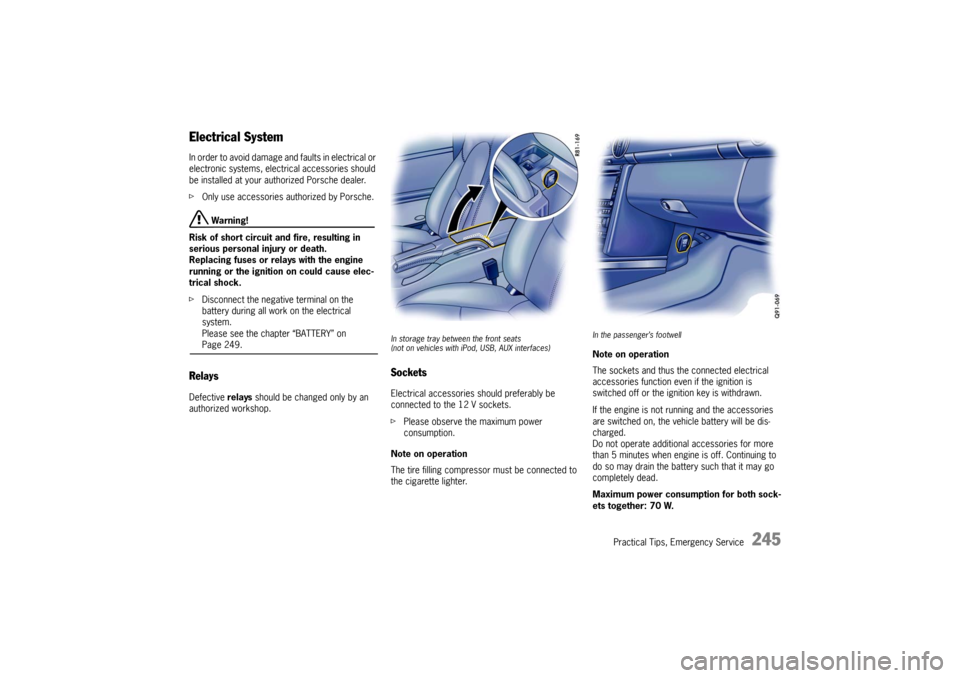
In storage tray between the front seats
(not on vehicles with iPod, USB, AUX interfaces)SocketsElectrical accessories should preferably be
connected to the 12 V sockets.
f Please observe the maximum power
consumption.
Note on operation
The tire filling compressor must be connected to
the cigarette lighter.
In the passenger’s footwellNote on operation
The sockets and thus the connected electrical
accessories function even if the ignition is
switched off or the igni tion key is withdrawn.
If the engine is not running and the accessories
are switched on, the vehicle battery will be dis-
charged.
Do not operate additional accessories for more
than 5 minutes when engine is off. Continuing to
do so may drain the batte ry such that it may go
completely dead.
Maximum power consumpti on for both sock-
ets together: 70 W.
Page 253 of 294

Practical Tips, Emergency Service
251
Winter operation The capacity and ability of the battery to store
power decreases at low outside temperatures.
Moreover, the battery is more heavily loaded in
winter months, e.g. by the heated rear window,
more frequent use of additional lights, the fans
and the windshield wipers, etc.
f Have the battery checked before the start
of winter.
Maintenance note
Keep the battery well charged to prevent it
from freezing.
A discharged battery can freeze at 23 °F (--5 °C),
but a fully charged battery only freezes at -- 40 °F
(--40 °C).
A frozen battery must always be thawed before
connecting jump leads.
Replacing battery The service life of the batt ery is subject to normal
wear; it depends greatly on care, climatic conditi-
ons, and driving conditions (distances, loads).
f Only use an original Porsche battery, with the
correct part number, as a replacement.
f Please observe the disposal instructions for
batteries.
Putting vehicle into operationAfter the battery is co nnected or after an exhaus-
tively discharged battery is charged, the multi-
functional PSM light lights up on the instrument
panel and a message appears on the on-board
computer to indicate a fault.
This fault can be remedied with a few simple
steps:
1. Start the engine.
2. With the vehicle stationary, perform a few steering movements to the left and right and
then drive a short distance in a straight line
until the multifunctinal PSM light goes out and
the message on the on-board computer
disappears.
3. If the warnings do not disappear, then:
Drive carefully to the nearest authorized
Porsche dealer.
Have the fault remedied.
4. After the warnings disappear: Stop the vehicle in a suitable place.
f Perform adaptation of the power windows:
Please see the chapter “STORING END
POSITION OF THE WINDOWS” on Page 28.
Page 259 of 294

Practical Tips, Emergency Service
257
Bulb chart
Ty p e , r a t i n g
Halogen low beam H7, 55W
Halogen high beam H9, 65W
Low beam/high beam with Bi-Xen on headlights Philips, D2S 35W
Additional high beam with Bi-Xenon headlights H7, 55 W
Turn signal light, front Philips HY21W
Turn signal light, side WY5W
Fog light H8, 35W
License plate light C5W
Lights, Replacing Bulbs
Warning!
Risk of short circuit.
f Always switch off the relevant consumer when
changing bulbs.
Risk of serious personal injury or death.
The Bi-Xenon headlights are under high
voltage when installed.
f Be careful during all work in the area of the Bi-
Xenon headlights.
Risk of damage. Bulbs of a higher wattage
can damage the lamp housing.
f Only the bulbs shown in the chart may be used.
f New bulbs must be clean and free from oil,
grease and fingerprints. Therefore, never
touch bulbs with your bare hands.
Use a cloth or soft paper while replacing bulbs.
Page 287 of 294
Index
285
AABS (antilock brake system) .......................... 59
Warning light .......... .............................. 60
Adaptive sports seat ..................................... 33
Adjusting Headlights.... ................................ 267
Advanced Airbag......... .................................. 45
Air conditioning ........... ................................ 106
Air conditioning compressor ................ 109, 111
Air conditioning system .................... ........... 109
Air distribution ................ ............ 106, 109, 111
Air filter ...................... ................................ 211
Air intake.................... ................................ 112
Airbag ............................ .............................. 44
Cleaning covers ...... ............................ 219
Function ..................... .......................... 45
Warning light .......... .............................. 48
Air-conditioning compressor ........................ 108
Alarm system ................. ........................ 25, 99
Deactivating passenger compartment
monitoring .............. .............................. 26
Fault indication........ .............................. 26
Function indication ................................ 25
Not active .............. ............................ 246
Alcantara, cleaning . .................................... 219
Antenna ................. ...................... 99, 100, 214
Antifreeze .................................................. 197
Antilock brake system (ABS) .......................... 59
Warning light .......... .............................. 60
Ashtray .......................... .............................. 87
Assembly aids for wheel changes................. 237
Audio operation ...................................... 97, 98
Auto-button, air conditioning ........................ 109
Automatic Air conditioning system ....................... 109 Anti-glare mirrors .......................
...........30
Car washes .............. ..........................214
Door locking ............. ......................18, 24
Garage door ......... ................................76
Headlight adjustment .............................79
Speed control .........................84, 85, 120
Transmission ............ ..........................174
Automatic speed contro l..............................120
Indicator light ........ ..............................120
Average consumption .... ......................131, 161
Average speed ............. ......................131, 161
BBackrest
Adjustment ............... ............................32
Release .................... ............................32
Battery ......................... ..............................249
Care......................... ..........................250
Charge state......... ..............................249
Charging .................. ..........................250
Putting vehicle into operation ...............251
Remote control ..... ..............................254
Removing ................. ..........................252
Replacing ................. ..........................251
Warning light......... ..............................128
Winter operation.... ..............................251
Before driving off ...... ..................................8, 9
Belts ................ ............................................42
Cleaning ................... ..........................219
Tensioner ................. ............................42
Warning light......... ................................43
Blower adjustment ........ ......................106, 112
Blower speed adjustme nt ............................110
Brake Break in ...................
............................ 10
Pads ....................... ............................ 58
Pedal....................... ............................ 57
Wear ....................... ............................ 58
Brake fluid
Changing ................. .......................... 203
Checking level ...... .............................. 202
Level ....................... .......................... 202
Warning light ............ .......................... 203
Brake light .............. ................................... 266
Brake light, addition al ................................. 266
Brakes ........................ .............................. 202
Brake circuit division warning light ....... 203
Brake warning light ............................. 128
Fluid ............................ .............. 202, 281
Fluid warning light. .............................. 203
Function .................. ............................ 56
New brake pads or linings ..................... 58
Pads ....................... ............................ 10
Parking brake....... ................................ 55
Porsche Ceramic Composite Brake
(PCCB) .................................... .............. 4
Test stand ........... ................................ 65
Break in brakes ....... ..................................... 10
Break in hints .......... ..................................... 10
Bulbs
Chart ....................... .......................... 257
Replacing ................ ..........................2
57
Page 288 of 294
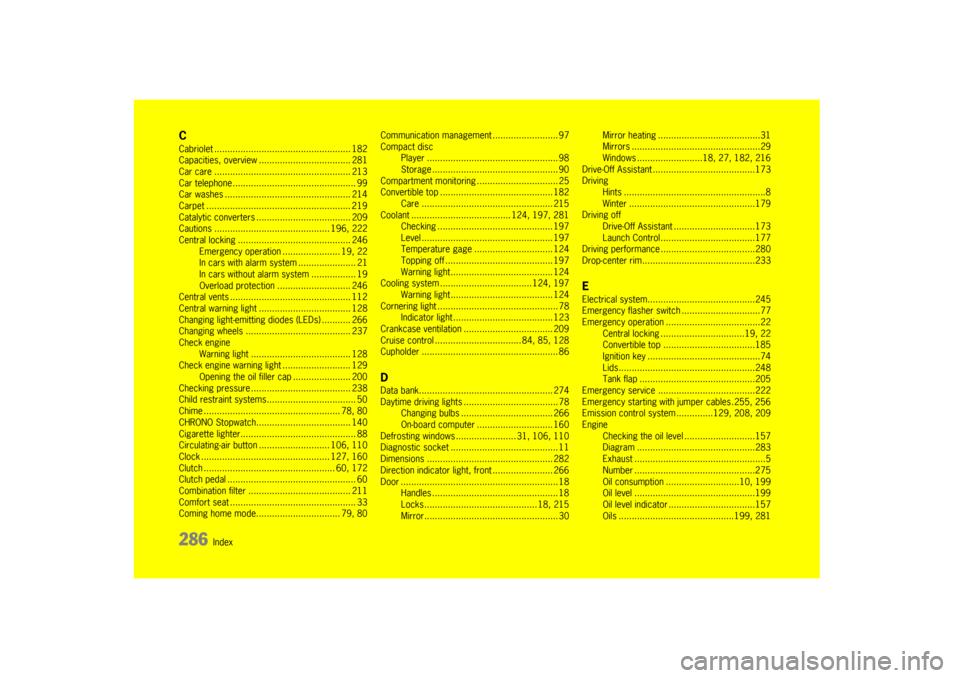
286
Index
CCabriolet .................................................... 182
Capacities, overview ... ................................ 281
Car care ........................ ............................ 213
Car telephone ............. .................................. 99
Car washes .................... ............................ 214
Carpet ....................................................... 219
Catalytic converters .... ................................ 209
Cautions ........................ .................... 196, 222
Central locking ........... ................................ 246
Emergency operation ...................... 19, 22
In cars with alarm system ...................... 21
In cars without alar m system ................. 19
Overload protection ............................ 246
Central vents .............. ................................ 112
Central warning light ................................... 128
Changing light-emitting diodes (LEDs) ........... 266
Changing wheels ........ ................................ 237
Check engine Warning light .......... ............................ 128
Check engine warning li ght .......................... 129
Opening the oil filler cap ...................... 200
Checking pressure ...... ................................ 238
Child restraint system s.................................. 50
Chime ............... ......................... ............ 78, 80
CHRONO Stopwatch.... ................................ 140
Cigarette lighter.......... .................................. 88
Circulating-air button ... ........................ 106, 110
Clock ............................................. .... 127, 160
Clutch ............... ............................. ...... 60, 172
Clutch pedal ............... .................................. 60
Combination filter ....... ................................ 211
Comfort seat .............. .................................. 33
Coming home mode.... ............................ 79, 80 Communication manage
ment ......................... 97
Compact disc Player ...................... ............................ 98
Storage .................... ............................ 90
Compartment monitoring ................ ............... 25
Convertible top ......... .................................. 182
Care ........................ .......................... 215
Coolant ........... ........................... 124, 197, 281
Checking ............................................ 197
Level .................................................. 1
97
Temperature gage .... .......................... 124
Topping off ........... .............................. 197
Warning light......... .............................. 124
Cooling system ............. ...................... 124, 197
Warning light......... .............................. 124
Cornering light .......... .................................... 78
Indicator light ........ .............................. 123
Crankcase ventilation .................................. 209
Cruise control ................................. 84, 85, 128
Cupholder ......................................... ........... 86
DData bank................................................... 274
Daytime driving lights .................................... 78
Changing bulbs ..... .............................. 266
On-board computer ............................. 160
Defrosting windows ....... ................ 31, 106, 110
Diagnostic socket ..... .................................... 11
Dimensions ....................................... ......... 282
Direction indicator lig ht, front ....................... 266
Door ............................ ................................ 18
Handles ................................................ 18
Locks....................... .................... 18, 215
Mirror....................... ............................ 30 Mirror heating ..........
.............................31
Mirrors .................... .............................29
Windows ......................... 18, 27, 182, 216
Drive-Off Assistant ....... ................................173
Driving
Hints .............. ........................................8
Winter ......................... .......................179
Driving off
Drive-Off Assistant .... ...........................173
Launch Control......... ...........................177
Driving performance .... ................................280
Drop-center rim........... ................................233
EElectrical system..... ....................................245
Emergency flasher swit ch ..............................77
Emergency operation . ...................................22
Central locking ......... .......................19, 22
Convertible top ........ ...........................185
Ignition key ......... ..................................74
Lids................ ......................... ...........248
Tank flap ................. ...........................205
Emergency service ..... ................................222
Emergency starting with jumper cables.255, 256
Emission control system ..............129, 208, 209
Engine Checking the oil leve l ...........................157
Diagram ...................... .......................283
Exhaust ................... ...............................5
Number ..............................................275
Oil consumption ....... .....................10, 199
Oil level ................... ...........................199
Oil level indicator ...................... ...........157
Oils ............................................199, 281