tire size PORSCHE BOXSTER 2009 2.G Owners Manual
[x] Cancel search | Manufacturer: PORSCHE, Model Year: 2009, Model line: BOXSTER, Model: PORSCHE BOXSTER 2009 2.GPages: 294, PDF Size: 6.89 MB
Page 62 of 294

60
Operation, Safety
When the ignition is switched on the ABS warning
light will light up while the system is electronically
interrogated and goes o
ut when the engine is
started if the check is not yet complete.
If the ABS warning lamp fails to go out, this indi-
cates that ABS has been deactivated due to a
fault. If the warning lights in the instrument panel
and on-board computer light up while you are driv-
ing, this indicates that a fault has occurred. In both
cases, normal braking, as in vehicles without ABS,
is still retained.
The ABS system should, however, be examined at
an authorized Porsche dealer immediately to pre-
vent the occurrence of further faults.
f If the ABS system becomes inoperative, take
your vehicle to your authorized Porsche dealer
immediately.
Warning!
Risk of an accident, resulting in serious per-
sonal injury or death.
The control unit of the ABS brake system is
set for standard tire size. If non-standard
tires are installed, the control unit may mis-
interpret the speed of th e vehicle, because of
the variant data it rece ives from the sensors
on the axles.
f Use only tire makes and types tested by Porsche.
Clutch Pedal The clutch pedal must be depressed fully
before the starter will engage.
Warning!
Risk of an accident, resulting in serious per-
sonal injury or death.
f Always check the movement of the clutch ped-
al before driving and make sure that it is not
obstructed by a floor mat or any other object.
f Secure the floor mat to prevent it from sliding
into positions that could interfere with the safe
operation of your vehicle.
Your Porsche dealer will be glad to offer you
nonskid floor mats of the correct size.
To avoid damage to the clutch and transmis-
sion:
f Always depress the clutch pedal fully when
changing gears.
f Do not hold the car on a steep grade with the clutch pedal partially depressed.
Should the free travel of the clutch pedal suddenly
become larger, it could me an a malfunction of the
clutch.
f See your Porsche dealer for correction.
Warning light USA
Warning light Canada
Page 149 of 294
Instruments, On-Board Computer, Warnings
147
TPM
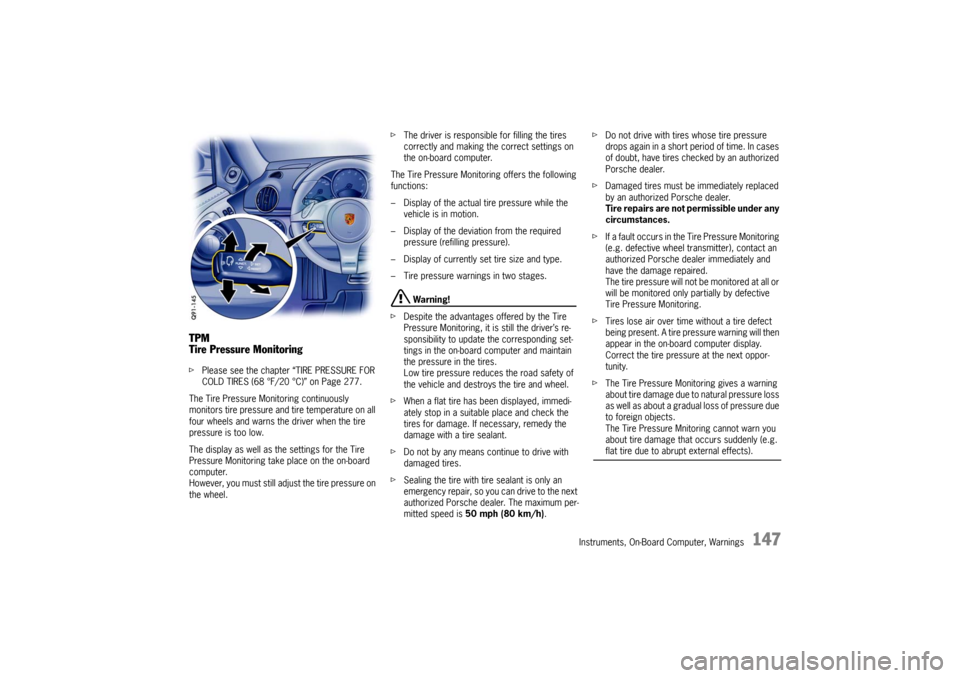
Tire Pressure MonitoringfPlease see the chapter “TIRE PRESSURE FOR
COLD TIRES (68 °F/20 °C)” on Page 277.
The Tire Pressure Monitoring continuously
monitors tire pressure and tire temperature on all
four wheels and warns the driver when the tire
pressure is too low.
The display as well as the settings for the Tire
Pressure Monitoring take place on the on-board
computer.
However, you must still adjust the tire pressure on
the wheel. f
The driver is responsible for filling the tires
correctly and making the correct settings on
the on-board computer.
The Tire Pressure Monitoring offers the following
functions:
– Display of the actual ti re pressure while the
vehicle is in motion.
– Display of the deviation from the required pressure (refilling pressure).
– Display of currently set tire size and type.
– Tire pressure warnings in two stages.
Warning!
f Despite the advantages offered by the Tire
Pressure Monitoring, it is still the driver’s re-
sponsibility to update the corresponding set-
tings in the on-board computer and maintain
the pressure in the tires.
Low tire pressure reduces the road safety of
the vehicle and destroys the tire and wheel.
f When a flat tire has been displayed, immedi-
ately stop in a suitable place and check the
tires for damage. If necessary, remedy the
damage with a tire sealant.
f Do not by any means continue to drive with
damaged tires.
f Sealing the tire with tire sealant is only an
emergency repair, so you can drive to the next
authorized Porsche dealer. The maximum per-
mitted speed is 50 mph (80 km/h). f
Do not drive with tires whose tire pressure
drops again in a short period of time. In cases
of doubt, have tires checked by an authorized
Porsche dealer.
f Damaged tires must be immediately replaced
by an authorized Porsche dealer.
Tire repairs are not permissible under any
circumstances.
f If a fault occurs in the Tire Pressure Monitoring
(e.g. defective wheel tr ansmitter), contact an
authorized Porsche dealer immediately and
have the damage repaired.
The tire pressure will not be monitored at all or
will be monitored only partially by defective
Tire Pressure Monitoring.
f Tires lose air over time without a tire defect
being present. A tire pressure warning will then
appear in the on-board computer display.
Correct the tire pressure at the next oppor-
tunity.
f The Tire Pressure Monitoring gives a warning
about tire damage due to natural pressure loss
as well as about a gradual loss of pressure due
to foreign objects.
The Tire Pressure Mnitoring cannot warn you
about tire damage that occurs suddenly (e.g.
flat tire due to abrupt external effects).
Page 151 of 294
Instruments, On-Board Computer, Warnings
149
The tire pressure to be corrected (refill pressure)
is indicated on the displayed wheel.
Example: If “ –1.5 psi (–0.1 bar)” is displayed,
1.5 psi (0.1 bar) must be added to this tire.
Note
The tire pressure menu can only be called up when
the vehicle is stationary.
Calling up the “Info pressure” display
fPush operating lever forward in order to switch
on the selection field.
f Select “TPM” with the operating lever.
f Push operating lever forward.
The display changes to the tire pressure menu.
f Select “Info pressure” with the operating lever.
f Push operating lever forward.
Note
After the ignition is switch ed on, it can take up to
approx. 1 minute before all tire pressures are
displayed. Dashes (“-.-”) appear instead of the tire
pressures. Tire type info in Tire pressure menu
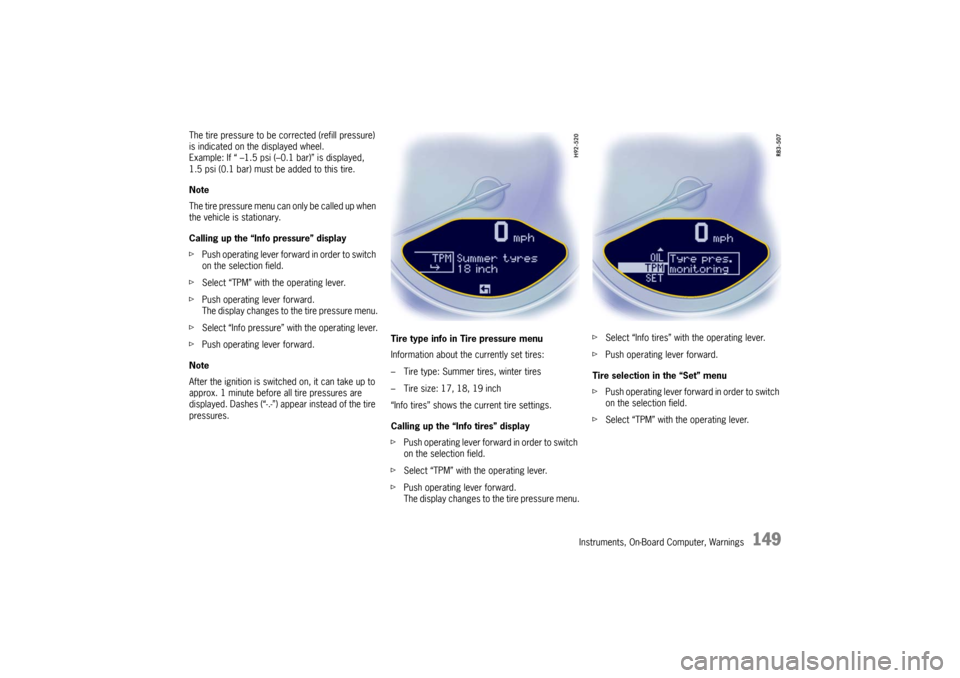
Information about the currently set tires:
– Tire type: Summer tires, winter tires
– Tire size: 17, 18, 19 inch
“Info tires” shows the current tire settings.
Calling up the “Info tires” display
f
Push operating lever forward in order to switch
on the selection field.
f Select “TPM” with the operating lever.
f Push operating lever forward.
The display changes to the tire pressure menu. f
Select “Info tires” with the operating lever.
f Push operating lever forward.
Tire selection in the “Set” menu
f Push operating lever forward in order to switch
on the selection field.
f Select “TPM” with the operating lever.
Page 153 of 294
Instruments, On-Board Computer, Warnings
151
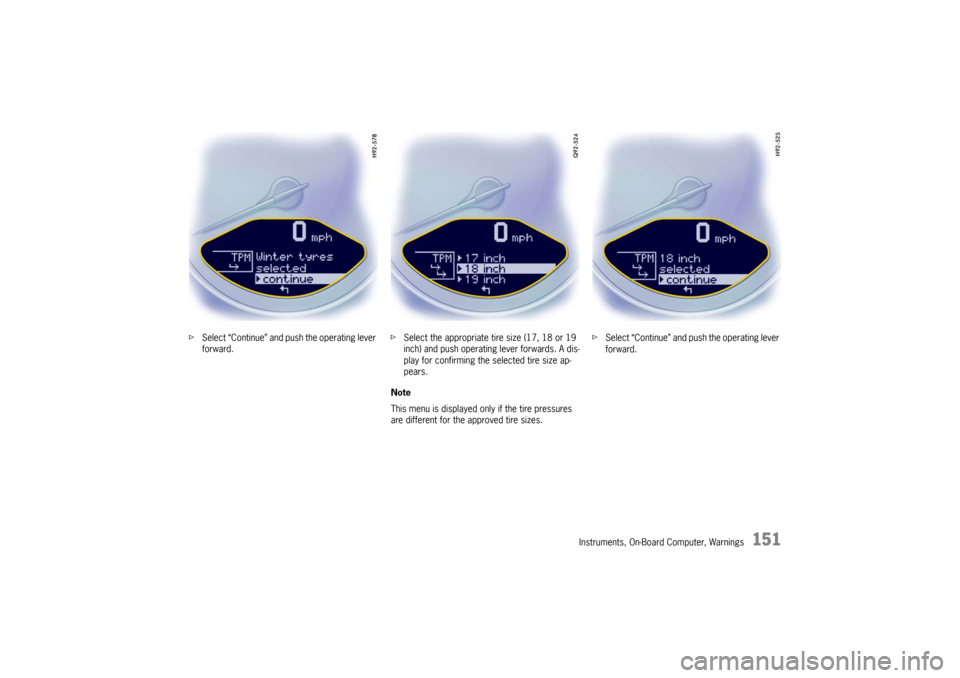
fSelect “Continue” and push the operating lever
forward. f
Select the appropriate tire size (17, 18 or 19
inch) and push operating lever forwards. A dis-
play for confirming the selected tire size ap-
pears.
Note
This menu is displayed only if the tire pressures
are different for the approved tire sizes. f
Select “Continue” and push the operating lever
forward.
Page 154 of 294
152
Instruments, On-Board Computer, Warnings
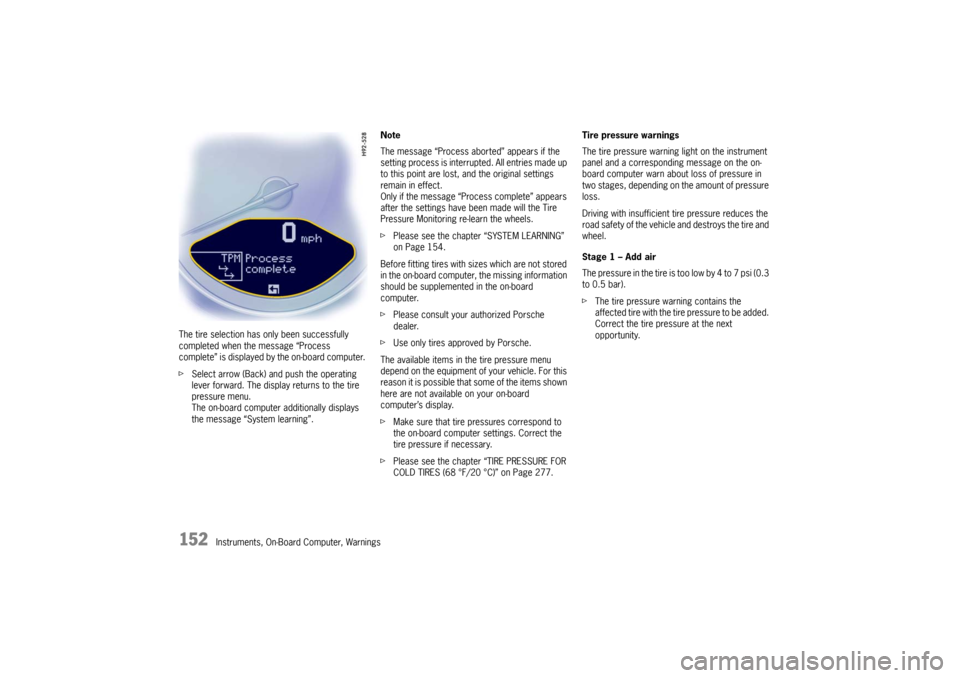
The tire selection has only been successfully
completed when the message “Process
complete” is displayed by the on-board computer.
f
Select arrow (Back) and push the operating
lever forward. The display returns to the tire
pressure menu.
The on-board computer additionally displays
the message “System learning”. Note
The message “Process aborted” appears if the
setting process is interrupted. All entries made up
to this point are lost, and the original settings
remain in effect.
Only if the message “Process complete” appears
after the settings have been made will the Tire
Pressure Monitoring re-learn the wheels.
f
Please see the chapter “SYSTEM LEARNING”
on Page 154.
Before fitting tires with sizes which are not stored
in the on-board computer, the missing information
should be supplemented in the on-board
computer.
f Please consult your authorized Porsche
dealer.
f Use only tires approved by Porsche.
The available items in the tire pressure menu
depend on the equipment of your vehicle. For this
reason it is possible that some of the items shown
here are not available on your on-board
computer’s display.
f Make sure that tire pressures correspond to
the on-board computer settings. Correct the
tire pressure if necessary.
f Please see the chapter “TIRE PRESSURE FOR
COLD TIRES (68 °F/20 °C)” on Page 277. Tire pressure warnings
The tire pressure warning light on the instrument
panel and a corresponding message on the on-
board computer warn about loss of pressure in
two stages, depending on the amount of pressure
loss.
Driving with insufficient tire pressure reduces the
road safety of the vehicle
and destroys the tire and
wheel.
Stage 1 – Add air
The pressure in the tire is too low by 4 to 7 psi (0.3
to 0.5 bar).
f The tire pressure warning contains the
affected tire with the tire pressure to be added.
Correct the tire pressure at the next
opportunity.
Page 227 of 294
Practical Tips, Emergency Service
225
Each tire, including the spare (if provided) should
be checked monthly when cold and inflated to the
inflation pressure recommended by the vehicle
manufacturer on the vehicle placard or tire infla-
tion pressure label. (If your vehicle has tires of a
different size than the size indicated on the vehicle
placard or tire inflation pressure label, you should
determine the proper tire inflation pressure for
those tires.)
As an added safety feature, your vehicle has been
equipped with a tire pressure monitoring (TPM)
that illuminates a low tire pressure telltale when
one or more of your tires is significantly under-in-
flated. Accordingly, when the low tire pressure tell-
tale illuminates, you should stop and check your
tires as soon as possible, and inflate them to the
proper pressure. Driving on a significantly under-
inflated tire causes the tire to overheat and can
lead to tire failure. Under-inflation also reduces
fuel efficiency and tire tread life, and may affect
the vehicle’s handling and stopping ability.
Please note that the TP M is not a substitute for
proper tire maintenance, and it is the driver’s re-
sponsibility to maintain correct tire pressure, even
if under-inflation has not reached the level to trig-
ger illumination of the TP M low tire pressure tell-
tale.
f On vehicles with tire pressure monitoring:
Please see the chapter “TPM TIRE PRESSURE
MONITORING” on Page 147.
When tires are warm, the tire pressure is
increased. f
Never let air out of hot tires.
This could cause the tire pressure to fall below
the prescribed value.
Insufficient tire filling pressure can cause tires to
overheat and thus be damaged – even invisibly.
Hidden tire damage is not eliminated by subse-
quently correcting the tire pressure.
Overloading
Danger!
Risk of damage to vehicle parts, loss of con-
trol and serious personal injury or death.
f Do not overload your vehicle. Be careful about
the roof load.
f If loading the vehicle also correct the tire pres-
sure. Tire pressure for loaded vehicle can be
found on the tire pressure plate and in the
chapter technical data.
f Never exceed the specified axle load.
Overloading can shorten the service life of the
tires and car, as well as lead to dangerous ve-
hicle reactions and long braking distances.
Damage due to overloading is not covered by the vehicle warranty.
f Please see the chapter “LOADING INFORMA-
TION” on Page 234.
f Please see the chapter “TIRE PRESSURE FOR
COLD TIRES (68 °F/20 °C)” on Page 277.
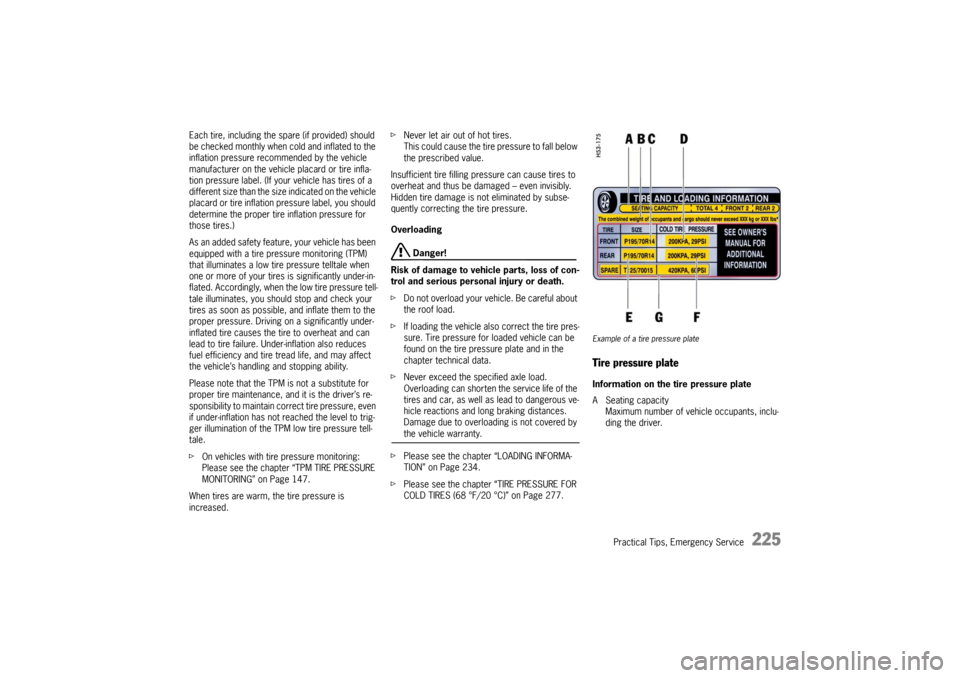
Example of a tire pressure plateTire pressure plateInformation on the tire pressure plate
A Seating capacity
Maximum number of vehicle occupants, inclu-
ding the driver.
Page 228 of 294

226
Practical Tips, Emergency Service
B Vehicle load limit
Is the maximum total weight limit specified of
the load (passengers and cargo) for the vehi-
cle. This is the maximum weight of passengers
and cargo that can be loaded into the vehicle.
Please see the chapter “LOADING INFORMA-
TION” on Page 234.
C Tire size for the front axle Check with your authorized Porsche dealer
about the current release status.
D Recommended tire pre ssure for the front axle
These values are for cold tires (68 °F/20 °C).
E Tire size for the rear axle Check with your authorized Porsche dealer
about the current release status.
F Recommended tire pressure for the rear axle. These values are for cold tires (68 °F/20 °C).
G In vehicles with collapsible spare wheel: Size and tire pressure of the spare wheel.
Tire traction
Warning!
When driving on wet or slushy roads, a
wedge of water may build up between the
tires and the road. This phenomenon is
known as “hydroplane” and may cause par-
tial or complete loss of traction, vehicle
control or stopping ability.
f Reduce speed on wet surface to prevent this. Tire life Tire life depends on vari ous factors, i. e., road
surfaces, traffic and wea ther conditions, driving
habits, type of tires and tire care.
f Inspect your tires for wear and damage before
driving off. If you notice uneven or substantial
wear, wheels might need alignment or tires
should be balanced or replaced.
Tire wear The original equipment tires on your Porsche have
built-in tire wear indicato rs. They are molded into
the bottom of the tread grooves and will appear as
approximately 1/2 in. (12 mm) bands when the
tire tread depth is down to 1/16 of an in.
(1.6 mm).
When the indicators appear in two or more adja-
cent grooves, it is time to replace the tires. We
recommend, however, that you do not let the tires
wear down to this extent.
Worn tires cannot grip the road surface properly
and are even less effective on wet roads.
Snow tires lose their traction capability when their
tread depth falls below 5/32 in. (4 mm).
In the United States, state laws may govern the
minimum tread depth permissible. Follow all such
laws.
Page 234 of 294
232
Practical Tips, Emergency Service
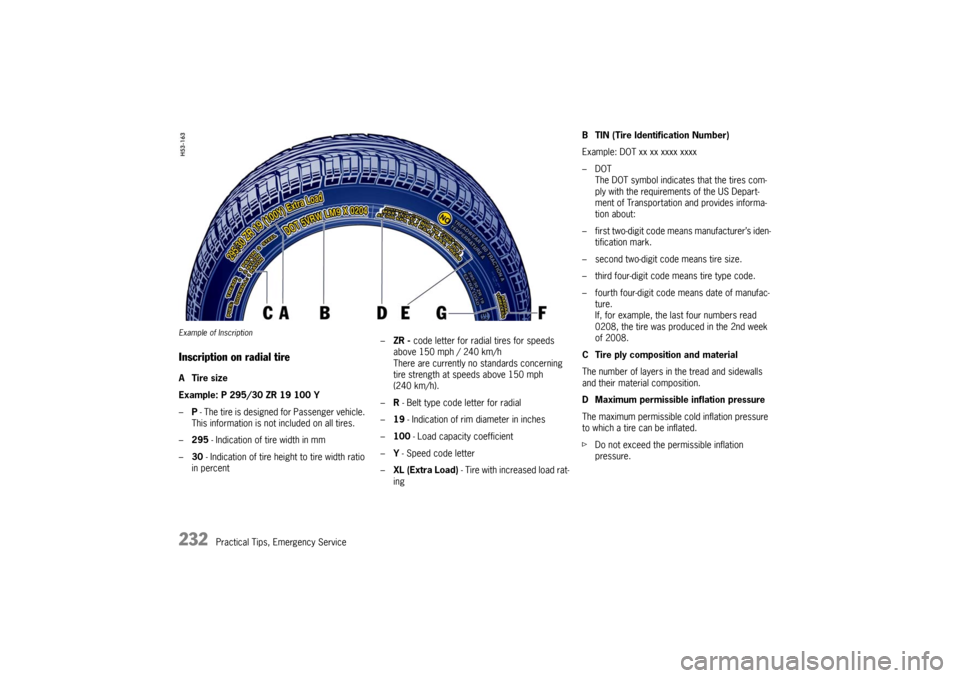
Example of InscriptionInscription on radial tireATire size
Example: P 295/30 ZR 19 100 Y
–P - The tire is designed for Passenger vehicle.
This information is not included on all tires.
– 295 - Indication of tire width in mm
– 30 - Indication of tire height to tire width ratio
in percent –
ZR - code letter for radial tires for speeds
above 150 mph / 240 km/h
There are currently no standards concerning
tire strength at speeds above 150 mph
(240 km/h).
– R - Belt type code letter for radial
– 19 - Indication of rim diameter in inches
– 100 - Load capacity coefficient
– Y - Speed code letter
– XL (Extra Load) - Tire with increased load rat-
ing
B TIN (Tire Identification Number)
Example: DOT xx xx xxxx xxxx
–DOT
The DOT symbol indicates that the tires com-
ply with the requirements of the US Depart-
ment of Transportation and provides informa-
tion about:
– first two-digit code means manufacturer’s iden- tification mark.
– second two-digit code means tire size.
– third four-digit code means tire type code.
– fourth four-digit code means date of manufac- ture.
If, for example, the last four numbers read
0208, the tire was produced in the 2nd week
of 2008.
C Tire ply composition and material
The number of layers in the tread and sidewalls
and their material composition.
D Maximum permissible inflation pressure
The maximum permissible cold inflation pressure
to which a tire can be inflated.
f Do not exceed the permissible inflation
pressure.
Page 281 of 294

Technical Data
279
fWhen changing tires or fitting new ones: Please see the chapter “WHEEL BOLTS” on Page 236.
Danger!
Installation of sizes not authorized by
Porsche may have a dangerous effect on
the driving stability and could result in
serious personal injury or death.
f Before mounting new tires, check with yourPorsche dealer about the current release status.
Boxster S Tires Rim Rim offset Track
Summer tires
front 235/40 ZR 18 91Y 8 J x 18 H2 57 mm 58.5 in./1486 mm
rear 265/40 ZR 18 101Y XL 9 J x 18 H2 43 mm 60.2 in./1528 mm
or front 235/35 ZR 19 87Y 8 J x 19 H2 57 mm 58.5 in./1486 mm
rear 265/35 ZR 19 94Y 9.5 J x 19 H2 46 mm 59.9 in./1522 mm
or front 235/35 ZR 19 87Y 8.5 J x 19 H2 55 mm 58.7 in./1490 mm
rear 265/35 ZR 19 94Y 10 J x 19 H2 42 mm 60.2 in./1530 mm
Snow tires front235/40 R 18 91V M+S 8 J x 18 H2 57 mm 58.5 in./1486 mm
rear * 255/40 R 18 95V M+S 9 J x 18 H2 43 mm 60.2 in./1528 mm
The load capacity coefficient (e.g. ”91“) and maximum sp eed code letter (e.g. ”Y“) are minimum requirements.
Tire and rim sizes Extensive tests are performed before specific tires and wheels are approved by Porsche. Your Porsche dealer has information
about approved tires and wheels and is happy to assist you. If aftermarket tires and/or wheels are installed which are not
approved by Porsche, the vehicle’s roadability and handling characteristics might be impaired. Since Porsche has no data on
such combinations, Porsche cannot st and behind the safety or durability of these aftermarket combinations.
Snow chains Can be mounted only on the rear wheels; maximum speed 30 mph/50 km/h. Use only Porsche authorized fine-link
cross-type or edge chains. Snow chain clearance can be guaranteed only with the tire + rim combination marked*
without spacers. Please see the chapter “SPACERS” on Page 243.
Page 293 of 294
Index
291
Pressure plate .................................... 275
Removing and storing.......................... 229
Sealant ...................... ................ 239, 240
Sidewall ..................... ........................ 232
Size ................................................... 232
Snow tires .............. ............................ 230
Tools ................ ........................................... 94
Towing ........................... .................... 269, 271
Towing hook............... ................................ 269
TPM Tire pressure moni toring ...................... 147
Track ............................. ............................ 278
Transmission Drive-Off Assistant... ............................ 172
Fluid........................... ................ 211, 281
Manual transmission ............................ 172
Porsche Doppelkupplung (PDK) .... 172, 174
Trip Odometer ............ ................................ 121
Trunk entrapment ....... .................................. 95
Turn signal Indicator light.......... ............................ 123
Turn signal light, front Changing bulb......... ............................ 263
Turn signals ......................................... 81, 123
UUndercoating ................ ......................208, 217VValves ........................................................228
Vanity mirror............. ....................................41
Vehicle Care......................... ..........................213
Engine number....................................275
Identification ......... ..............................274
Identification labe l ...............................274
Identification numbe r ...........................274
Lifting................... ..............................242
Load capacity ....... ..............................235
Putting into operat ion ..........................251
Safety compliance st icker ....................274
Washing ................... ..........................214
Vehicle identification number ........................274
Ventilation .................... ..............................109
Vents ................... ......................106, 109, 112
Viscosity, engine oil .....................................201
Voice control, button . ..................................130
Voice control, PCM ... ..................................130
WWarning lights and me ssages ...................... 162
Washer
Fluid ........................ .......................... 210
Fluid warning light. .............................. 210
Washer fluid ................................. .............. 281
Washer lever................................ ................ 82
Washing ...................... .............................. 214
Weights ........................................... .......... 282
Welcome Home Function ........................ 79, 80
Wheel ................. ................. 10, 223, 278, 279
Alignment ................ .......................... 229
Balancing........................................... 229
Bolts ....................... .......................... 236
Care ........................ .......................... 223
Changing ................. .......................... 239
Checking pressure ............................. 238
Inscription ............ .............................. 232
Loading information . ........................... 234
Securing bolts...... .............................. 236
Security wheel bolts ............................. 15
Sidewall ................... .......................... 232
Size .................................................. 232
Tire pressure ....... .............................. 224
Tire pressure plate ............... .............. 275
Tire sealant .............. .................. 239, 240
Wheels
Assembly aids for wheel changes ........ 237
Care ........................ .......................... 218
TPM sensors............ .......................... 229
Windows.......................... .................. 182, 216
Anti-crushing protection ........................ 28
Care ........................ .......................... 216
Opening/Closing ...................... ............ 27