roof PORSCHE BOXSTER S 2010 2.G User Guide
[x] Cancel search | Manufacturer: PORSCHE, Model Year: 2010, Model line: BOXSTER S, Model: PORSCHE BOXSTER S 2010 2.GPages: 294, PDF Size: 6.89 MB
Page 193 of 294
Mobile Roofs
191
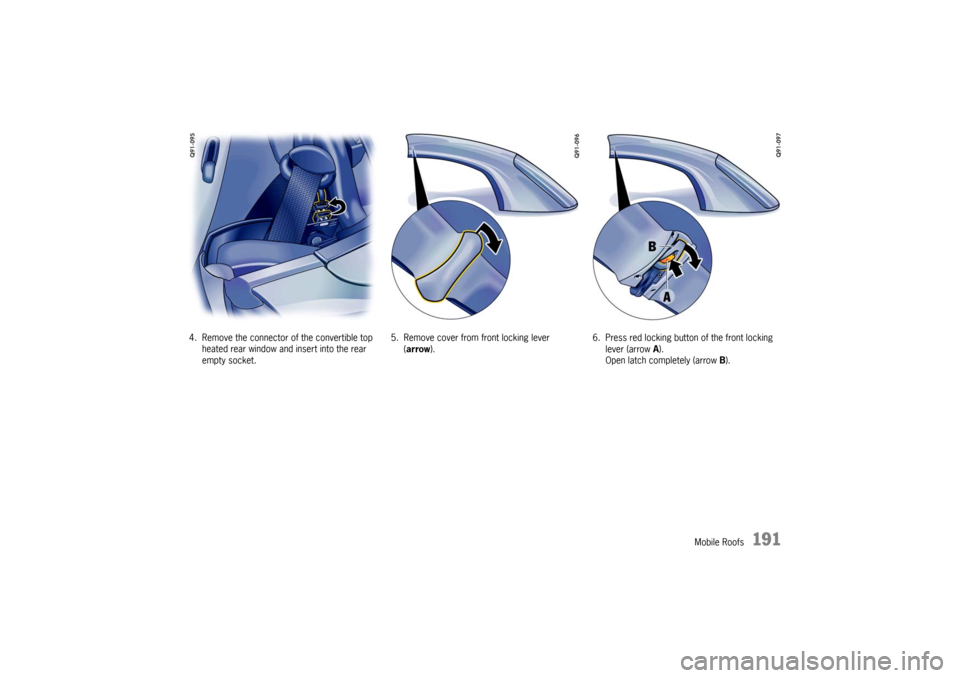
4. Remove the connector of the convertible top heated rear window and insert into the rear
empty socket. 5. Remove cover from front locking lever
(arrow ). 6. Press red locking button of the front locking
lever (arrow A ).
Open latch completely (arrow B).
Page 194 of 294
192
Mobile Roofs
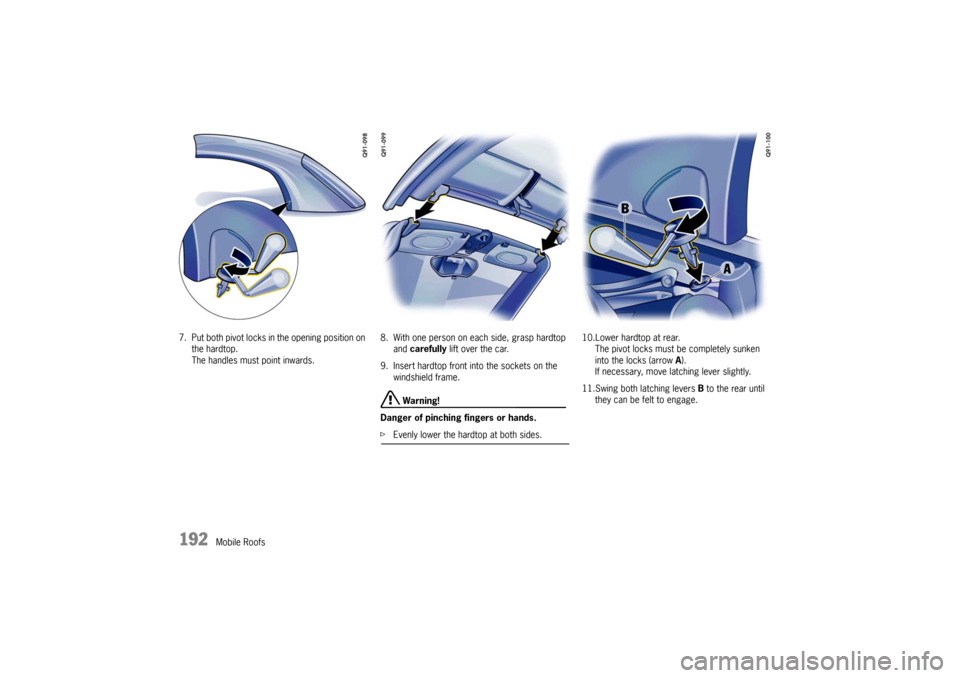
7. Put both pivot locks in the opening position on
the hardtop.
The handles must point inwards. 8. With one person on each side, grasp hardtop
and carefully lift over the car.
9. Insert hardtop front i nto the sockets on the
windshield frame.
Warning!
Danger of pinching fingers or hands.
f Evenly lower the hardtop at both sides. 10.Lower hardtop at rear.
The pivot locks must be completely sunken
into the locks (arrow A).
If necessary, move latching lever slightly.
11.Swing both latching levers B to the rear until
they can be felt to engage.
Page 195 of 294
Mobile Roofs
193
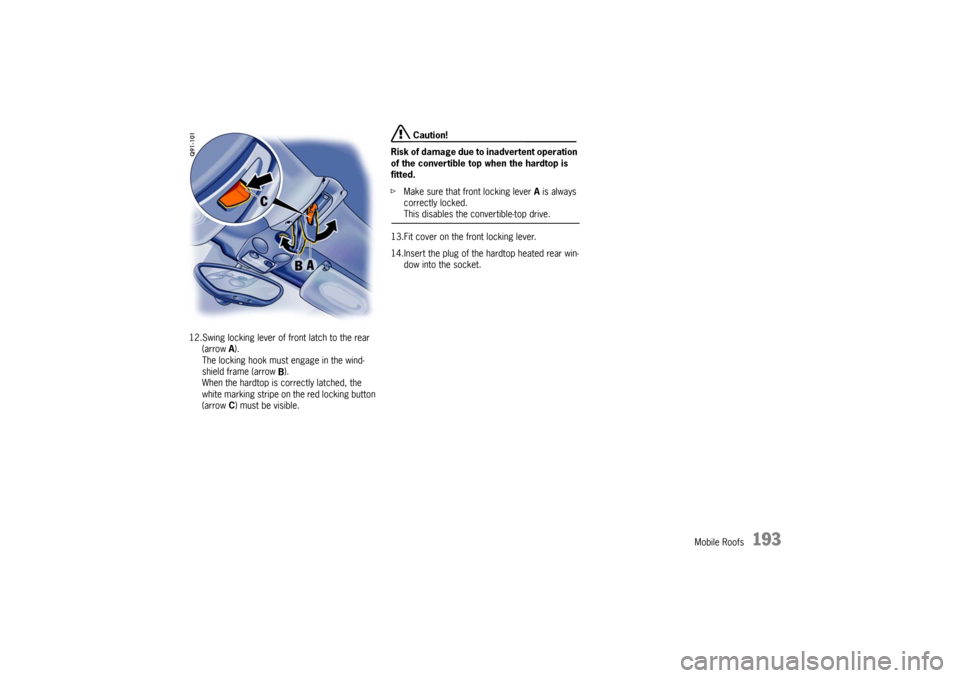
12.Swing locking lever of front latch to the rear (arrow A).
The locking hook must engage in the wind-
shield frame (arrow B).
When the hardtop is correctly latched, the
white marking stripe on the red locking button
(arrow C) must be visible.
Caution!
Risk of damage due to inadvertent operation
of the convertible top when the hardtop is
fitted.
f Make sure that front locking lever A is always
correctly locked.This disables the convertible-top drive.
13.Fit cover on the front locking lever.
14.Insert the plug of the hardtop heated rear win- dow into the socket.
Page 196 of 294
194
Mobile Roofs
Removing the hardtop1. Make sure that the hardtop is placed on a clean, soft surface.
2. Open doors.
3. Remove cover from the front locking lever.
4. Open front latch.
5. Open rear pivot locks (swivel inwards). Unplug plug of the hardtop heated rear win-
dow.
6. With one person on each side, grasp the hard- top.
Lift hardtop at rear and pull out of the sockets
on the windshield frame at front.
Warning!
Danger of pinching fingers or hands.
f Evenly lift the hardtop at both sides.
7. Carefully lift the hardto p up and off the vehicle
to the rear.
8. Close front hardtop latch. Fit cover on the front latch.
9. Close pivot locks on the vehicle with the plastic covers.
10.Remove the connector of the convertible top
heated rear window from the empty socket
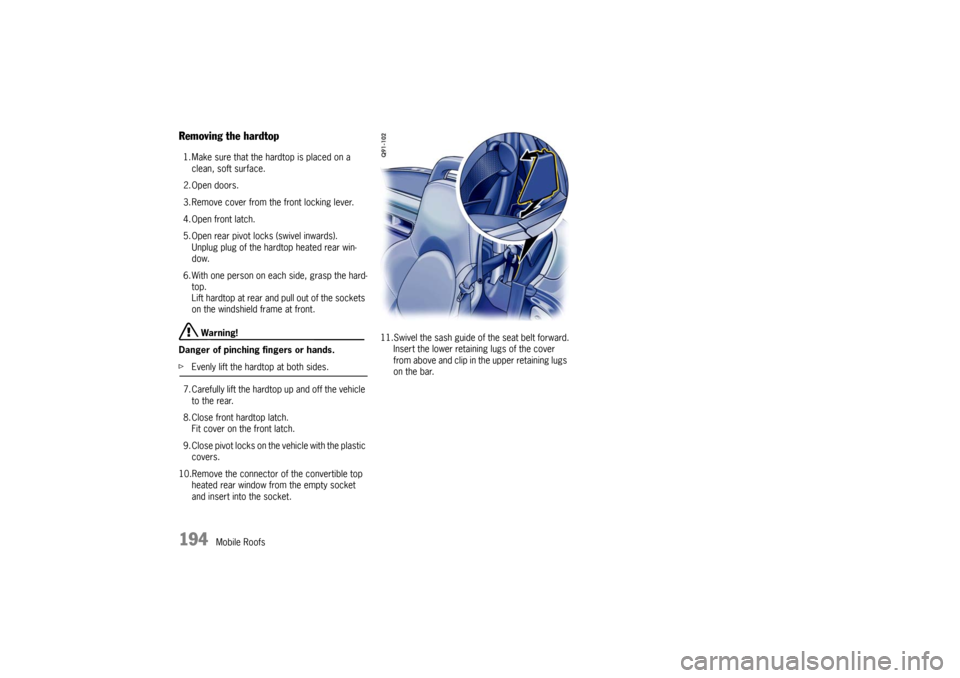
and insert into the socket. 11.Swivel the sash guide of
the seat belt forward.
Insert the lower retaining lugs of the cover
from above and clip in the upper retaining lugs
on the bar.
Page 210 of 294

208
Maintenance, Car Care
Emission Control SystemIn the interest of clean air Pollution of our environment has become a prob-
lem that is of increasing concern to all of us. We
urge you to join us in ou r efforts for cleaner air in
controlling the pollutants emitted from the auto-
mobile.
Porsche has developed an emission control sys-
tem that controls or reduces those parts of the
emission that can be harmful to our environment.
Your Porsche is equipped with such a system.
Porsche warrants the Emission Control System in
your new car under the terms and conditions set
forth in the Warranty Booklet.
You, as the owner of the vehicle, have the
responsibility to provide regular maintenance serv-
ice for the vehicle and to keep a record of all main-
tenance work performed. To facilitate record
keeping, have the service performed by author-
ized Porsche dealers. They have Porsche trained
technicians and special tools to provide fast and
efficient service. To assure efficient operation of the Emission
Control System:
f
Have your vehicle maintained properly and in
accordance with the recommendations de-
scribed in your Maintenance Booklet.
Lack of proper maintenance, as well as im-
proper use of the vehicle, will impair the func-
tion of the emission control system and could
lead to damage.
f Do not alter or remove any component of the
emission control system.
f Do not alter or remove any device, such as
heat shields, switches, ignition wires, valves,
etc., which are designed to protect your vehi-
cle’s emission control system.
In addition to serious engine damage, this can
result in a fire if excess raw fuel reaches the
exhaust system.
f Do not continue to operat e your vehicle if you
detect engine misfire or other unusual operat-
ing conditions.
Parking
Warning!
Danger of fire resulting in serious personal
injury or death.
f Do not park or operate the vehicle in areas
where the hot exhaust system may come in
contact with dry grass, br ush, fuel spill or oth-
er flammable material.
f If your car catches on fire for any reason, call
the fire department.
Do not endanger your life by attempting to put out the fire.
Undercoating
Danger!
Danger of fire resulting in serious personal
injury or death.
f Do not apply additional undercoating or rust-
proofing on or near the exhaust manifold,
exhaust pipes, catalytic converters or heat
shields. During driving the substance used for undercoating could overheat and ignite.
Page 217 of 294

Maintenance, Car Care
215
Convertible top
fNever remove snow and ice using a sharp
edged object.
Incorrect care and treatment can damage the con-
vertible top and cause leaks. Any repair work can
be done by your authorized Porsche dealer.
Important note
No folding top is 100% leak proof.
Due to the constant changi ng of loads and strains
to which a car is subject to when driving on roads,
minor wind noise and seepage at joints between
the top, body and doors on convertible tops can-
not be completely sealed in certain areas. There-
fore small leaks are considered normal for these
models. In addition, your convertible top should
not be washed in a car wash. The top may experi-
ence damage by the brushes or may experience
leaks due to the high pressure water streams di-
rected in areas which wo uld not encounter water
in normal driving conditions.
Cleaning
Caution!
Risk of damage due to the cleaning jet of the
high-pressure cleaning equipment or hot wax
treatment.
f Do not clean the convertible top with high-
pressure cleaning equipment.
fDo not use the hot wax treatment. Do not wash the convertibl
e top each time the car
is washed.
It is usually sufficient to spray or wash it with clean
water.
f Brush dust off the convertible top in the direc-
tion of the weave using a soft brush.
f Only if there is heavy dirt, wet the convertible
top with lukewarm water and the Porsche
Wash-Shampoo & convertible-top cleaner, us-
ing a sponge or soft brush, and rub gently.
Rinse Wash-Shampoo & convertible-top clean-
er thoroughly off the convertible top with clean
water.
f After washing it, treat the convertible-top cover
at least once a year with the special Porsche
convertible-top care product.
Do not allow the convertible-top care product
to come into contact with paint or windows. If
it does, remove immediately.
f If there is leakage in the convertible-top cover
or at its seams or folds, the special Porsche
convertible-top care product can be used.
f Please note the information on the container.
f Remove bird droppings immediately since the
acid in them will make the rubber swell and the
convertible top will become leaky.
f Open convertible top only when it is completely
dry, otherwise damp stains and scrub marks
may occur which cannot be removed. f
Try to remove spots from the convertible-top
cover by rubbing carefu lly with a soft rubber
sponge.
Door lock f To prevent the door lock from freezing during
the cold season, the lock cylinder should be
covered during a wash.
f Should the lock freeze, use an ordinary de-icer.
In many cases, a well warmed key can help.
Never use excessive force.PaintTo protect the paint on yo ur vehicle in the best
possible way against mechanical and chemical
damage, you should
– preserve it regularly,
– polish it if necessary,
– remove spots and stains, and
– repair damaged paintwork.
f Do not apply care products containing silicone
to the convertible top and windows.
General information
f Never rub a dusty vehicle with a dry cloth,
because the grains of dirt will damage the
paintwork.
Page 218 of 294

216
Maintenance, Car Care
f
Do not treat matt-painted components with
preservatives or polishes, otherwise the matt
effect will be lost.
Preservation
The paint surface becomes dull over time due
to weathering.
f Preserve paint regularly.
f Apply paint preservative after washing the
vehicle and polish it smooth to preserve the
paintwork.
This keeps the paint shiny and elastic. Dirt is
prevented from adhering to the paint surface and
industrial dust is prevented from penetrating
the paint.
Polishing
Do not resort to using Porsche polish until it be-
comes evident that the normal preservatives no
longer produce the desired finish.
Spots and stains
f Remove tar stains, grease, oil spots and dead
insects as soon as possible with Insect Remov-
er. They can cause discoloration if allowed to
remain on the paintwork.
f Wash the affected area immediately after treat-
ing it. Minor paint damage
f
Have minor paint damage, such as scratches,
scores or chips caused by flying stones, re-
paired immediately by your authorized
Porsche dealer before corrosion sets in.
However, if there are already traces of corrosion,
they must first be removed carefully and thorough-
ly. Coat the area with a rust-proofing primer and
finish off with a top coa t. The paint code and color
number are found on the da ta bank in the Mainte-
nance booklet.
f Please see the chapter “VEHICLE DATA BANK”
on Page 274.
Engine compartment The engine compartment and the surface of the
engine are treated with a corrosion-inhibitor at the
factory.
If degreasing solvents are used to clean the en-
gine compartment or the engine is washed down,
the process almost invariably removes the corro-
sion-inhibiting coating. It is then absolutely neces-
sary to have a durable pr eservative applied to all
surfaces, body seams, joints and assemblies in
the engine compartment. This also applies when
corrosion-inhibitor parts are replaced.
Caution!
Risk of damage to the alternator.
f Do not point the cleaning jet directly at the al-ternator, or cover the alternator.
Effective rust-proofing is particularly important
during the cold weather se ason. If the vehicle is
driven frequently in areas where salt has been
spread on the roads, the engine compartment
should be cleaned thoroughly and subsequently
sealed after the cold weather season to prevent
salt from causing any lasting damage.
Windows The road dust which settles on the windshield and
windows contains particles of tire rubber and oil
residue. The interior trim and upholstery release
particles, particularly in strong sunlight, which col-
lect on the insides of the windows. These deposits
are augmented by impurities in the air which en-
ters the car through the fresh air vents.
f Clean all windows regularly, inside and outside,
with Porsche window cleaner.
f If you use a chamois le ather for the windows,
do not use it for paintwork as it will otherwise
pick up a certain amount of preservative or
polish and could smear the windows and thus
impair vision.
f Remove dead insects with Porsche insect re-
mover.
Page 219 of 294

Maintenance, Car Care
217
Note
Door windows feature a water-repellent (hydro-
phobic) coating which prevents soiling of the
windows.
This coating is subject to natural wear and can be
renewed.
fConsult an authorized Porsche dealer.Wiper blades Wiper blades that are in perfect condition are vital
for a clear view.
fPlease see the chapter “WIPER BLADES” on
Page 212.
f Replace the wiper blades twice per year (be-
fore and after the cold season) or whenever
wiper performance deteriorates or the blades
are damaged.
f Periodically clean the wiper blades with
Porsche window cleaner, especially after the
vehicle has been washed in a car wash.
If they are very dirty (e.g. with insect remains),
they can be cleaned with a sponge or cloth.
If the wiper blades rub or squeak, this can be as a
result of the following:
– If the vehicle is washed in an automatic car wash, residues may adhere to the windshield.
These wax residues can be removed only by
using window cleaner concentrate.
– The wiper blades may be damaged or worn. – Replace damaged or worn wiper blades imme-
diately.
f Please see the chapter “WASHER FLUID” on
Page 210.
f Please contact your authorized Porsche dealer
for further information.
Undercoating As it is not possible to ex clude the risk of damage
to this protective coating in day to day driving, it
is advisable to have the underside of the car in-
spected at certain interv als – preferably before
the start of winter and again in spring – and the un-
dercoating restored as necessary.
Your authorized Porsche dealer is familiar with the
bodyseal treatment procedures and has the nec-
essary equipment for applying factory approved
materials. We recommend that you entrust them
with such work and inspections.
Unlike conventional spray oils, undercoating and
rust-proofing compounds based on bitumen or
wax do not attack the so und-proofing materials ap-
plied at the factory.
Warning!
Danger of fire resulting in serious personal
injury or death.
f Do not apply additional undercoating or rust-
proofing on or near the exhaust manifold, ex-
haust pipes, catalytic converters or heat shields. During driving the substance used for
undercoating could overheat and ignite.
f Before applying fresh underseal, carefully
remove any deposits of dirt and grease. Once
it has dried, the new undercoating compound
forms a tough protective coating which
provides efficient rust-proofing of the floor
panels and components.
f Always apply a fresh coating of suitable pre-
servative to unprotected areas after cleaning
the underside of the body, the transmission,
the engine or carrying out repairs to under-
body, engine or transmission components.
Effective rust-proofing is particularly important
during the cold weather seas on. If your car is driv-
en frequently in areas where salt has been spread
on the roads, the whole engine compartment
should be cleaned thoroughly after the winter to
prevent salt from causing any lasting damage. A
full under-body wash should also be performed at
the same time.
Stainless steel exhaust tailpipesStainless steel exhaust tailpipes can discolor due
to soiling, strong heat, and combustion residues.
The original polish can be achieved again using
commercially available metal polishing paste or
metal polish.
Page 220 of 294

218
Maintenance, Car Care
Light alloy wheels fPlease see the chapter “WASHING” on
Page 214.
Warning!
Danger of accident re sulting in serious per-
sonal injury or death if cleaning agents (e.g.
wheel cleaning agents) come into contact
with the brake discs.
The resulting film on the brake discs can im-
pair braking performance.
f Make sure that no cleaning agent comes into
contact with the brake discs.
f If cleaning agent has come into contact with
the brake discs, thoroughly clean the brake
discs with a strong jet of water.
f Paying attention to any road users behind you,
dry the brake discs by applying the brakes at short intervals.
Metal particles (such as brass or copper in brake
dust) must not remain too long on alloy wheels.
Contact corrosion can cause pitting.
Cleaners with an oxide-removing effect or the
wrong pH value, as are commonly used for other
metals, as well as mechanical tools and products,
will damage the oxide layer and are therefore
unsuitable.
f Use only cleaners for alloy wheels (pH value
9.5). Products with the wrong pH value can destroy the protective layer on the wheels.
We recommend Porsche cleaner for alloy rims.
f If possible, wash the wheels every two weeks
with a sponge or washing brush. If the wheels
are exposed to road salt, grit or industrial dust,
weekly cleaning is necessary.
Door, roof, lid and window seals
Caution!
The lubricant coating on the inner door seals,
convertible top and hardtop seals may be
damaged by unsuitable cleaning and care agents.
f Do not use any chemic al cleaning agents
or solvents.
f Do not use any preservative agents.
f Wash dirt (e.g. abrasion, dust, road salt and
grit) from all seals regularly using warm
soapy water.
f If there is a risk of frost, protect the outer door
seals and lid seals against freezing into place
with a suitable care product.
Headlights, lights, interior and exterior
plastic parts, adhesive filmsfUse only clean water and a little dishwashing
detergent to clean light lenses, plastic head-
light lenses, plastic parts, adhesive films and
surfaces.
Do not clean when dry.
Use a soft sponge or a so ft, lint-free cloth. Gen-
tly wipe the surface without applying too much
pressure.
An interior window cleaner can also be used to
clean plastic surfaces (always read the cleaning
instructions on the container). We recommend
Porsche interior window cleaner.
f Gently wipe the surfac e without applying too
much pressure.
f Do not clean when dry.
f Never use other chemical cleaners or
solvents.
f Rinse cleaned surfaces with clear water.Leather Characteristics and special features
The natural surface markings of leather, e.g.
creases, healed scars, in sect sting marks, struc-
tural differences and slight variations in shade and
grain add to the attractiveness of the natural leath-
er product.
Page 227 of 294
Practical Tips, Emergency Service
225
Each tire, including the spare (if provided) should
be checked monthly when cold and inflated to the
inflation pressure recommended by the vehicle
manufacturer on the vehicle placard or tire infla-
tion pressure label. (If your vehicle has tires of a
different size than the size indicated on the vehicle
placard or tire inflation pressure label, you should
determine the proper tire inflation pressure for
those tires.)
As an added safety feature, your vehicle has been
equipped with a tire pressure monitoring (TPM)
that illuminates a low tire pressure telltale when
one or more of your tires is significantly under-in-
flated. Accordingly, when the low tire pressure tell-
tale illuminates, you should stop and check your
tires as soon as possible, and inflate them to the
proper pressure. Driving on a significantly under-
inflated tire causes the tire to overheat and can
lead to tire failure. Under-inflation also reduces
fuel efficiency and tire tread life, and may affect
the vehicle’s handling and stopping ability.
Please note that the TP M is not a substitute for
proper tire maintenance, and it is the driver’s re-
sponsibility to maintain correct tire pressure, even
if under-inflation has not reached the level to trig-
ger illumination of the TP M low tire pressure tell-
tale.
f On vehicles with tire pressure monitoring:
Please see the chapter “TPM TIRE PRESSURE
MONITORING” on Page 147.
When tires are warm, the tire pressure is
increased. f
Never let air out of hot tires.
This could cause the tire pressure to fall below
the prescribed value.
Insufficient tire filling pressure can cause tires to
overheat and thus be damaged – even invisibly.
Hidden tire damage is not eliminated by subse-
quently correcting the tire pressure.
Overloading
Danger!
Risk of damage to vehicle parts, loss of con-
trol and serious personal injury or death.
f Do not overload your vehicle. Be careful about
the roof load.
f If loading the vehicle also correct the tire pres-
sure. Tire pressure for loaded vehicle can be
found on the tire pressure plate and in the
chapter technical data.
f Never exceed the specified axle load.
Overloading can shorten the service life of the
tires and car, as well as lead to dangerous ve-
hicle reactions and long braking distances.
Damage due to overloading is not covered by the vehicle warranty.
f Please see the chapter “LOADING INFORMA-
TION” on Page 234.
f Please see the chapter “TIRE PRESSURE FOR
COLD TIRES (68 °F/20 °C)” on Page 277.
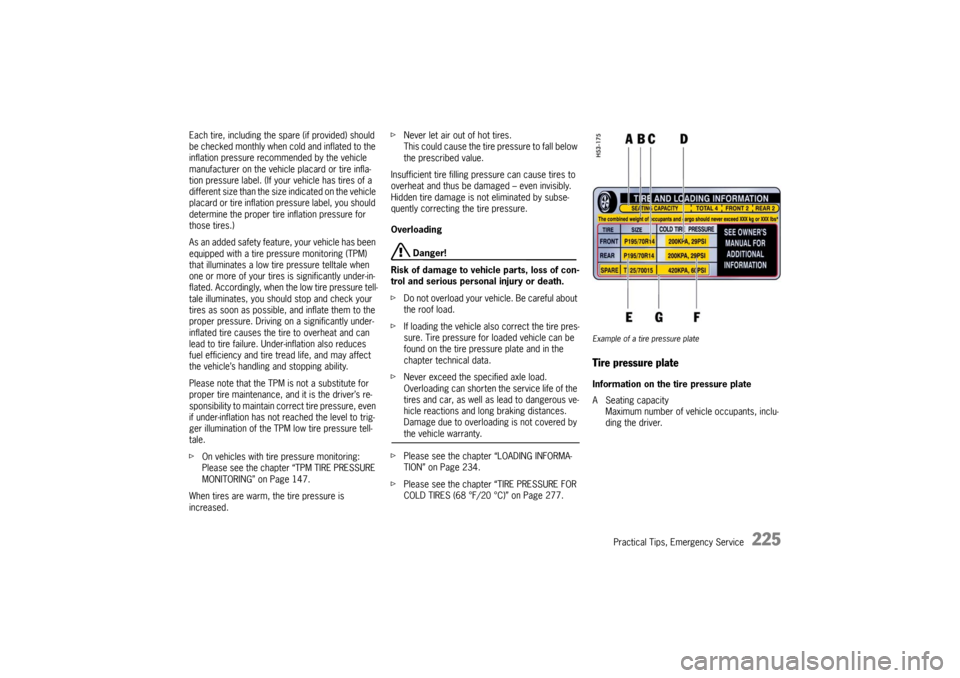
Example of a tire pressure plateTire pressure plateInformation on the tire pressure plate
A Seating capacity
Maximum number of vehicle occupants, inclu-
ding the driver.