Wheel PORSCHE BOXSTER S 2010 2.G Service Manual
[x] Cancel search | Manufacturer: PORSCHE, Model Year: 2010, Model line: BOXSTER S, Model: PORSCHE BOXSTER S 2010 2.GPages: 294, PDF Size: 6.89 MB
Page 163 of 294

Instruments, On-Board Computer, Warnings
161
Average consumption and average speed
The values displayed are based on the distance
travelled since the last reset to “zero”.
You can set the starting time for a measurement
before or during the trip.
Switching the ignition off does not reset the meas-
urements. It is therefore possible to collect values
over long periods.
Disconnecting the car ba ttery will cause these
memories to be erased.
Tire pressure
The Tire pressure function of the on-board
computer displays the ti re pressures dependent
on temperature in the four wheels. You can watch
the tire pressure rise and fall while driving.
The display is only for information.
f To correct the tire pressures, always use the
displayed values from the “Info pressure”
display in the tire pressure menu.
Page 164 of 294

162
Warnings
Warnings on the instrument panel and the on-board computerIf a warning message appears, always refer to the corresponding chapters in the Owner’s Manual.
Warning messages are issued only if all measurement preconditi ons are met. Therefore, check all fluid levels regularly –
in particular, always check the en gine oil level before refuelling.
Instrument
panel On-board
computerText display on on-board
computer Meaning/measure
Seat belt
Driver and passengers must fasten their seat
belts.
Handbrake Handbrake is still on.
Ignition key
not removed
Replace battery
in ignition key Replace the remote-control battery.
Ignition lock faulty,
please go to workshop Have the fault remedied at an authorized
Porsche dealer.
Ignition lock faulty,
visit workshop now Have the fault remedied at an authorized
Porsche dealer.
Relieve steering Relieve the steering l o c k b y m o v i n g t h e s t e e r i n g
wheel to the left or right.
Steering locked The steering wheel lock remains engaged.
Have the fault remedied at an authorized
Porsche dealer.
Lights on Low beam/side marker lamps on
Parking light on Left/right parking light on
Page 165 of 294

Warnings
163
Check left/right dipped beam (low
beam)
also applies to:
direction indicator, high beam, side in-
dicator light, reversing lightThe reported light is faulty. Check bulb.
Have the fault remedied
at an authorized
Porsche dealer.
Daytime
driving lights off Daytime driving lights switch off when the en-
gine is shut off. Switch
on lights if necessary.
Headlight beam
adjustment faulty Have the fault remedied
at an authorized
Porsche dealer.
Front lid not closed Close front lu ggage compartment lid properly.
Rear lid not closed Close rear luggage compartment lid properly.
Rain sensor faulty Have the faul t remedied at an authorized
Porsche dealer.
Steering wheel heating
ON Steering wheel heating was switched on.
Steering wheel heating
OFF Steering wheel heating was switched off.
Launch
control
active
Drive Off Assistant
failure Have the fault remedied
at an authorized
Porsche dealer.
Refill washer fluid
LIMIT
Cannot be accepted
with vehicle stopped The current speed can only
be accepted for the
acoustic warning signal when the vehicle is in
motion.
Instrument
panel On-board
computerText display on on-board
computer Meaning/measure
Page 171 of 294

Warnings
169
Add airThe Tire Pressure Monitoring has detected a
gradual pressure loss. Correct tire pressure at
the next opportunity.
TPM is learning
monitoring
not act. The Tire Pressure Monitoring is learning the
wheels on the vehicle. The Tire Pressure Moni-
toring is searching for the tires and their posi-
tion. During this period the current pressure
specifications are not av
ailable on the on-board
computer.
TPM inactive The Tire Pressure Monitoring is faulty.
Consult an authorized Porsche dealer.
TPM partial monitoring 1 or 2 wheel transmitters are faulty. The tyre
pressures of these wheels are not monitored.
The other wheels are still monitored.
Consult an authorized Porsche dealer.
TPM inactive
Brief disturbance
TPM inactive
Too many wheel transmitters The Tire Pressure Monitoring is temporarily de-
activated by excessive tire temperatures (ap-
prox. 248 °F (120 °C)) or external interference
(e.g. from other wheel transmitters inside the
car). Once the source of
the interference is re-
moved, the system is automatically reactivated.
Wheel change?
Input new
TPM settings! Update the settings in the TPM menu of the
on-board computer at the next opportunity.
Wrong entries will affect
the correct pressure in-
formation in the menu. The safety of your vehi-
cle is at risk.
TPM
Indicator faulty The display of the Tire Pressure Monitoring is
faulty.
Consult an authorized Porsche dealer.
Instrument
panelOn-board
computerText display on on-board
computer Meaning/measure
Page 176 of 294
174
Shifting Gears
Porsche Doppelkupplung (PDK)The Porsche Doppelkupplung (PDK) is a seven-
speed transmission with an “automatic” and a
“manual” selection mode.
In automatic selection mode (selector lever
position D), gear changing is automatic.
You can change temporarily from automatic to
manual mode using the shift buttons on the
steering wheel.
In manual selection mode (selector lever
position M), you change gear using the shift
buttons on the steering wheel or with the PDK
selector lever.
You can change between se lector lever position D
and M as you wish while driving.
Note
f Take care not to operat e the shift buttons on
the steering wheel in advertently in either
automatic or manual mode, thereby triggering
undesired gear changes.
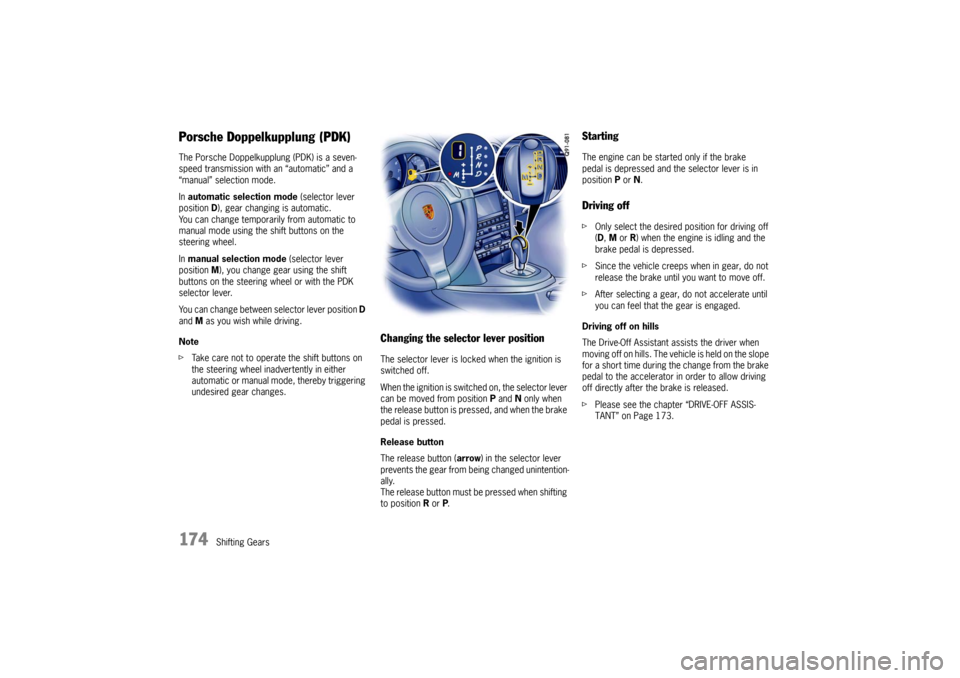
Changing the selector lever positionThe selector lever is locked when the ignition is
switched off.
When the ignition is switched on, the selector lever
can be moved from position P and N only when
the release button is pressed, and when the brake
pedal is pressed.
Release button
The release button ( arrow) in the selector lever
prevents the gear from being changed unintention-
ally.
The release button must be pressed when shifting
to position R or P.
StartingThe engine can be started only if the brake
pedal is depressed and the selector lever is in
position P or N.Driving offf Only select the desired position for driving off
( D, M or R ) when the engine is idling and the
brake pedal is depressed.
f Since the vehicle creeps when in gear, do not
release the brake until you want to move off.
f After selecting a gear, do not accelerate until
you can feel that the gear is engaged.
Driving off on hills
The Drive-Off Assistant assists the driver when
moving off on hills. The vehicle is held on the slope
for a short time during the change from the brake
pedal to the accelerator in order to allow driving
off directly after the brake is released.
f Please see the chapter “DRIVE-OFF ASSIS-
TANT” on Page 173.
Page 179 of 294

Shifting Gears
177
“Sport Plus” mode activated:
In “Sport Plus” mode, the PDK transmission
changes to a shift program designed for driving
on race circuits. 7th gear is not selected.
The gear-changing performance is enhanced
significantly again compared with “Sport” mode.
fPlease see the chapter “SPORT MODE” on
Page 61.
Driving with Launch Control
Driving with Launch Control allows you to achieve
maximum acceleration from a standing start. It is
intended to provide you with a unique enjoyment of
your vehicle under controlled circumstances and
is not intended to be used in any location where it
could be a nuisance to other persons.
Warning!
There is a risk of endangering other road
users if you use this Control in an improper
location or in a situation where other persons
might need to take evas ive action due to the
rapid acceleration that this technology
permits.
f Launch Control is designed to be used in a
controlled environment on closed circuit
driving courses where no vehicle cross traffic
or pedestrian traffic is present.
f Use Launch Control only if conditions permit it
to be applied in a safe manner. f
Do not use Launch Control if there is a possibi-
lity it could endanger other persons. Such a
possibility exists if you cannot see that you
have a clear road with no possibility of cross
traffic in your intended direction of driving. Caution!
Stress on components increases dramatically
when starting with maximum acceleration in
comparison with normal driving off. Use of
Launch Control will inevitably reduce the life
of the engaged engine and transmission
components.
Preconditions:
– Launch Control should only be used when the engine has reached operating temperature.
– “Sport Plus” mode must be switched on (light- emitting diode in button is on and “SPORT
PLUS” is displayed on the on-board computer).
1. Press the brake with your left foot.
2. Quickly press down the accelerator fully (kickdown activated) and hold.
The engine speed will flatten out at around
6500 rpm.
“Launch Control active” is displayed on the
on-board computer. 3. Release the brake within a few seconds.
Remaining stationary for a long time with
“Launch Control active” can lead to overload-
ing of the transmission.
In order to protect the transmission, the engine
power is then reduced an d the “Launch Control
active” process is cancelled.
Shifting gears on the steering wheel
With the shift buttons on the steering wheel, you
can change temporarily fr om automatic selection
mode D to manual mode M.
For example:
– Shifting down before bends and on entering built-up areas.
– Shifting down on downward slopes (engine braking).
– Shifting down for brief spurts of acceleration.
Manual selection mode remains engaged:
– for cornering (depending on the lateral acceler- ation) and overrunning,
– when the vehicle is stationary (e.g. at a junction).
The system leaves manual selection mode:
– automatically after approx. 8 seconds (unless cornering or overrunning),
– after driving off.
Page 180 of 294
178
Shifting Gears
Kickdown
The kickdown function is active in selector lever
positions
D and M.
f For optimum acceleration, e.g. when
overtaking, depress the accelerator pedal
beyond the full-throttle point (kickdown).
The transmission shifts down depending on the
speed of travel and engine speed.
Upward shifts occur at the highest possible engine
speeds.
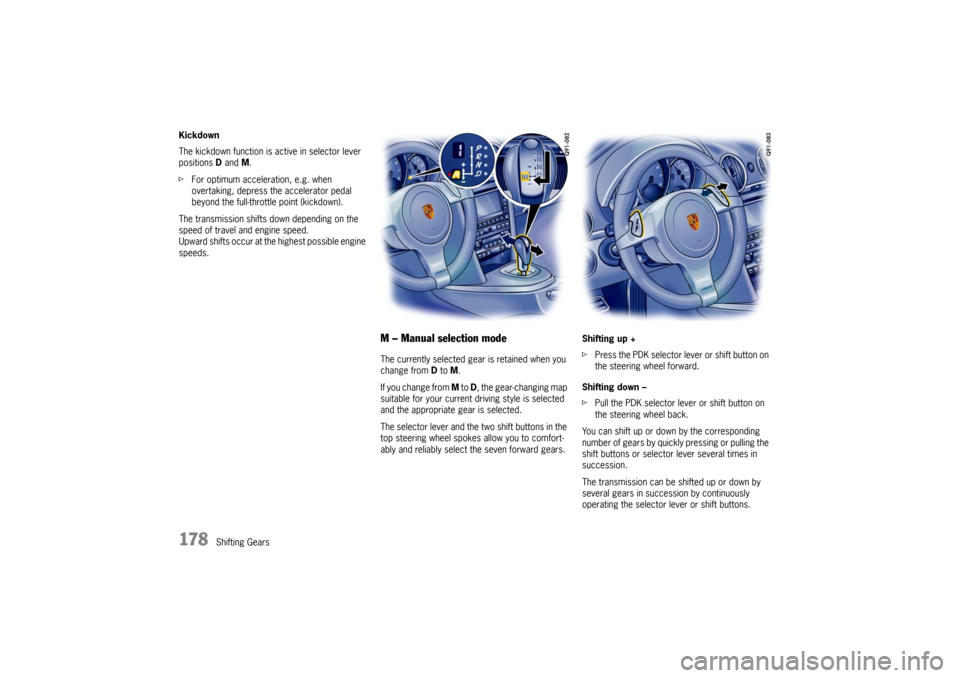
M – Manual selection modeThe currently selected gear is retained when you
change from D to M.
If you change from M to D, the gear-changing map
suitable for your current driving style is selected
and the appropriate gear is selected.
The selector lever and the two shift buttons in the
top steering wheel spokes allow you to comfort-
ably and reliably select the seven forward gears. Shifting up +
f
Press the PDK selector lever or shift button on
the steering wheel forward.
Shifting down –
f Pull the PDK selector leve r or shift button on
the steering wheel back.
You can shift up or down by the corresponding
number of gears by quickly pressing or pulling the
shift buttons or selector lever several times in
succession.
The transmission can be shifted up or down by
several gears in succe ssion by continuously
operating the selector lever or shift buttons.
Page 181 of 294

Shifting Gears
179
Depending on driving speed and engine speed,
you can shift up or down at any time.
Gear changes which would exceed the upper or
lower engine speed limit are not executed by the
controller.
There is no automatic upshift at the upper engine
speed limit in selector lever position M. Upshift
suppression can be cancelled by kickdown opera-
tion. If, for example, the engine speed limit is
reached during overtaking and the automatic
upshift does not occur, the transmission in this
case shifts up as a result of kickdown operation.
f Select an appropriately low gear on upward
and downward slopes.
This will ensure optimum use of engine power
and engine braking.
In order to shift up au tomatically at the upper
engine speed limit:
f Depress the accelerator pedal beyond the full-
throttle point (kickdown). Failure of the selector lever display on the
instrument cluster
The warning “Transmission emergency run” is
displayed in red on the on-board computer.
–Effect:
No selector lever position is displayed on the
instrument cluster.
Vehicle can be driven only until it comes to a
stop.
Remedy:
It is not possible to continue driving. Immedi-
ately stop the vehicle in a suitable place. Have
the vehicle towed to an authorized Porsche
dealer.
Please see the chapter “TOWING” on
Page 269.
Stoppingf For a brief stop (e.g. at a traffic light), leave the
selector lever in drive position and hold the
vehicle with the brake pedal.
f Do not hold the car on a slope using the
accelerator. Use the brake pedal or the
handbrake instead.
f Before leaving the vehicle, always apply the
handbrake and move the selector lever to
position P.Parkingf Go easy on the accelerator!
f When parking or manoeuvring in a small
space, control the speed by careful use of the
footbrake.Driving in winterIn wintry road conditions it is advisable to take
steep inclines in manual mo de. This prevents gear
changes occurring that could cause wheelspin.Tow-starting, towingf Please see the chapter “TOWING” on
Page 269.
Page 198 of 294

196
Maintenance, Car Care
Exercise Extreme Caution when
Working on your Vehicle
Danger!
Ignoring the following instructions may
cause serious personal injury or death.
f The engine compartment of any motor vehicle
is a potentially hazardou s area. If you are not
fully familiar with proper repair procedures, do
not attempt the adjustments described on the
following pages.
This caution also applies to the entire vehicle.
f O n l y w o r k o n y o u r v e h i c l e o u t d o o r s o r i n a w e l l
ventilated area.
f Ensure that there are no open flames in the
area of your vehicle at any time when fuel
fumes might be present. Be especially cau-
tious of such devices such as hot water heat-
ers which ignite a flame intermittently.
f Before working on any part in the engine com-
partment, turn the engine off and let it cool
down sufficiently. Hot engine compartment
components can burn skin on contact.
f Be alert and cautious around engine at all
times while the engine is running.
If work has to be performed with the engine
running, always set the parking brake, and
make sure the shift lever is in neutral position
or the PDK selector lever in position P or N . f
In particular, be very careful to ensure that
items of clothing (ties, shirt, sleeves etc.),
jewelry, long hair, hand or fingers cannot get
caught in the engine-compartment blower, fan,
belts or other moving parts.
The radiator and radiator fans are in the front
of the car.
The engine-compartment blower is mounted in
the engine-compartment.
The fans can start or continue running as a
function of temperature, even with the engine
switched off.
Carry out work in these areas only with the en-
gine off, the ignition switched off, and exercise
extreme caution.
f Your Porsche is equipped with an electronic ig-
nition system. When the ignition is on, high
voltage is present in all wires connected with
the ignition system; therefore, exercise ex-
treme caution when working on any part of the
engine while the ignition is on or the engine is
running.
f Always support your car with safety stands if it
is necessary to work under the car.
f When working under the car without safety
stands but with the wheels on the ground,
make sure the car is on level ground, the
wheels are blocked, and that the engine
cannot be started.
Remove the ignition key. f
Do not smoke or allow an open flame around
the battery or fuel.
Keep a fire extinguisher in close reach.
f Incomplete or improper servicing may cause
problems in the operation of the car. If in doubt
about any servicing, have it done by your
authorized Porsche dealer.
Improper maintenance during the warranty
period may affect your Porsche warranty cov-
erage.
f Supplies of fluids, e.g. engine oil, brake fluid or
coolant, are hazardous to your health.
Keep these fluids out of children’s reach and
dispose of them in accordance with the appro-
priate regulations.
f Some countries require additional tools and
special spare parts to be carried in your vehi-
cle.
Please make enquiries before driving abroad.
Page 206 of 294

204
Maintenance, Car Care
Fuel Economy Fuel economy will vary depending on where,
when and how you drive, optional equipment
installed, and the general condition of your
car.
A car tuned to specifications and correctly
maintained, will help you to achieve optimal
fuel economy.
fHave your vehicle tuned to specifications.
Air cleaner should be dirt free to allow proper
engine “breathing”.
Battery should be fully charged.
Wheels should be properly aligned.
Tires should be inflated at correct pressure.
f Always monitor your fuel consumption.
f Drive smoothly, avoid abrupt changes in speed
as much as possible.
f Avoid jack rabbit starts and sudden stops.
f Do not drive longer than necessary in the lower
gears. Shifting into a higher gear early without
lugging the engine will help save fuel.
f Prolonged “warm up” idling wastes gas. Start
the vehicle just before you are ready to drive.
Accelerate slowly and smoothly.
f Switch off the engine if stationary for longer
periods. f
Any additional weight carried in the vehicle re-
duces fuel economy. Always keep cargo to a
minimum and remove all unnecessary items.
f Organize your trips to take in several errands
in one trip.
f All electrical accessories contribute to in-
creased fuel consumption.
f Only switch on the air conditioning when neces-
sary.
f Do not drive with the Ro of Transport System
mounted unless you need it.
The EPA estimated mpg. is to be used for
comparison purposes, actual mileage may
be different from the estimated mpg.,
depending on your driving speed, weather
conditions and trip length. Your actual
highway mileage will probably be less than
the estimated mpg.
f Please observe all local and national speed
limits.
Operating your Porsche in other
Countries Government regulations in the United States and
Canada require that automobiles meet specific
emission regulations and safety standards. There-
fore, cars built for the U.S. and Canada differ from
vehicles sold in other countries.
If you plan to take your Porsche outside the conti-
nental limits of the United States or Canada, there
is the possibility that
– unleaded fuel may not be available;
– unleaded fuel may have a considerably lower
octane rating. Excessive engine knock and se-
rious damage to both engine and catalytic con-
verters could result;
– service ma y be inadequa te due to lack of prop- er service facilities, tools or diagnostic equip-
ment;
– replacement parts may not be available or very difficult to get.
Porsche cannot be responsible for the
mechanical damage that could result
because of inadequate fuel, service or parts
availability.
If you purchased your Porsche abroad and want to
bring it back home, be sure to find out about ship-
ping and forwarding requirements, as well as cur-
rent import and customs regulations.