warning light PORSCHE BOXSTER S 2010 2.G Repair Manual
[x] Cancel search | Manufacturer: PORSCHE, Model Year: 2010, Model line: BOXSTER S, Model: PORSCHE BOXSTER S 2010 2.GPages: 294, PDF Size: 6.89 MB
Page 181 of 294

Shifting Gears
179
Depending on driving speed and engine speed,
you can shift up or down at any time.
Gear changes which would exceed the upper or
lower engine speed limit are not executed by the
controller.
There is no automatic upshift at the upper engine
speed limit in selector lever position M. Upshift
suppression can be cancelled by kickdown opera-
tion. If, for example, the engine speed limit is
reached during overtaking and the automatic
upshift does not occur, the transmission in this
case shifts up as a result of kickdown operation.
f Select an appropriately low gear on upward
and downward slopes.
This will ensure optimum use of engine power
and engine braking.
In order to shift up au tomatically at the upper
engine speed limit:
f Depress the accelerator pedal beyond the full-
throttle point (kickdown). Failure of the selector lever display on the
instrument cluster
The warning “Transmission emergency run” is
displayed in red on the on-board computer.
–Effect:
No selector lever position is displayed on the
instrument cluster.
Vehicle can be driven only until it comes to a
stop.
Remedy:
It is not possible to continue driving. Immedi-
ately stop the vehicle in a suitable place. Have
the vehicle towed to an authorized Porsche
dealer.
Please see the chapter “TOWING” on
Page 269.
Stoppingf For a brief stop (e.g. at a traffic light), leave the
selector lever in drive position and hold the
vehicle with the brake pedal.
f Do not hold the car on a slope using the
accelerator. Use the brake pedal or the
handbrake instead.
f Before leaving the vehicle, always apply the
handbrake and move the selector lever to
position P.Parkingf Go easy on the accelerator!
f When parking or manoeuvring in a small
space, control the speed by careful use of the
footbrake.Driving in winterIn wintry road conditions it is advisable to take
steep inclines in manual mo de. This prevents gear
changes occurring that could cause wheelspin.Tow-starting, towingf Please see the chapter “TOWING” on
Page 269.
Page 184 of 294

182
Mobile Roofs
Convertible TopBrief operating instructions can be found on the
back side of the driver’s sun visor.
fPlease see the chapter “CAR CARE INSTRUC-
TIONS” on Page 213.
Warning!
When opening or closing the convertible top,
serious personal injury may occur if a per-
son’s body parts are near or in the way of the
convertible top mechanism’s moving parts.
f Make absolutely sure that nobody can be
injured by the convertible-top mechanism or the convertible-top compartment lid.
Do not operate convertible top:
– At temperatures below 32 °F/0 °C.
– When one side of the ca r is on a curb, a hoist
or a jack.
– When items of luggage or other objects hinder the convertible top movement.
f Drive only with the convertible top fully open or
closed (end positions). f
Items of luggage or objects on the luggage
tray above the engine compartment lid must
be put in the storage box or be secured to
prevent their sliding out. These items must not
be in abrasive contact with the convertible top
or rear window. Keep s hutters of the storage
box closed while driving.
f Avoid frequent operation of the convertible top
with the engine off; the vehicle battery would
be unintentionally discharged rapidly.
f When opening or closing the convertible top,
ensure there is sufficient clearance above the
convertible top (e.g. in the garage).
f To prevent damp stains and abrasions, only
open the convertible top in a dry, clean state.
f Park your car in the shade whenever possible,
as the fabric, rubber ma terial and color can be
harmed by long exposure to sunlight.
f The convertible top may only be actuated
during driving on even surfaces.
f The convertible top must not be used with
strong counter wind (over approx. 50 mph/
80 km/h).
Conditions for operating the convertible
top – The ignition must be switched on
(engine running or off).
– Maximum speed 30 mph (50 km/h) The opening/closing process of the convertib-
le top will be interrupted if the maximum speed
is exceeded.
f Reduce speed.
Press button again.
The opening/closing process is ended.
Page 194 of 294
192
Mobile Roofs
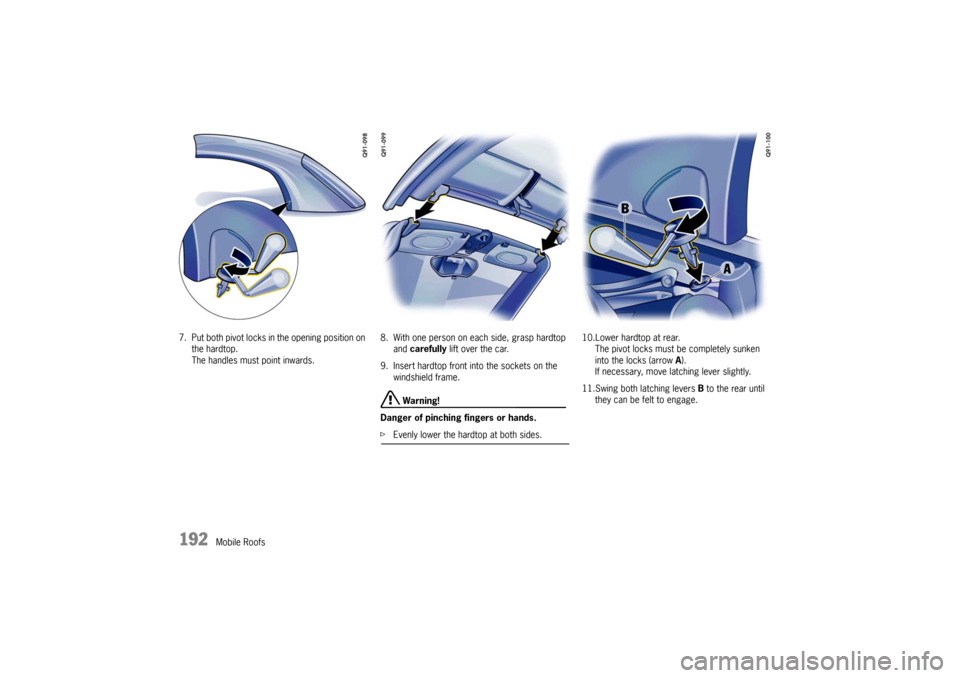
7. Put both pivot locks in the opening position on
the hardtop.
The handles must point inwards. 8. With one person on each side, grasp hardtop
and carefully lift over the car.
9. Insert hardtop front i nto the sockets on the
windshield frame.
Warning!
Danger of pinching fingers or hands.
f Evenly lower the hardtop at both sides. 10.Lower hardtop at rear.
The pivot locks must be completely sunken
into the locks (arrow A).
If necessary, move latching lever slightly.
11.Swing both latching levers B to the rear until
they can be felt to engage.
Page 201 of 294

Maintenance, Car Care
199
Engine Oil It is important to perform oil changes regularly in
accordance with the intervals specified in the
“Maintenance” booklet.
Engine oil consumption
It is normal for your engine to consume oil.
The rate of oil consumption depends on the quality
and viscosity of oil, the speed at which the engine
is operated, the climate, road conditions as well
as the amount of dilution and oxidation of the
lubricant.
If the vehicle is used for repeated short trips, and
consumes a normal amount of oil, the engine oil
measurement may not show any drop in the oil
level at all, even after 600 miles (1,000 km) or
more. This is because the oil is gradually becom-
ing diluted with fuel or mo isture, making it appear
that the oil level has not changed.
The diluting ingredients evaporate out when the
vehicle is driven at high speeds, as on an express-
way, making it then appear that oil is excessively
consumed after driving at high speeds.
If the conditions you drive your vehicle in are
dusty, humid, or hot, the frequency of the oil
change intervals should be greater. If the vehicle is driven at a high rate of speed,
climatic conditions are warm, and the load is high,
the oil should be checked more frequently, as
driving conditions will determine the rate of oil
consumption.
– The engine in your vehicle depends on oil to
lubricate and cool all of its moving parts.
Therefore, the engine oil should be checked
regularly and kept at the required level.
– Make it a habit to have the engine oil level checked at every fuel filling.
– The oil pressure warning light is not an oil level indicator.
The oil pressure warning light indicates serious
engine damage may be occuring when lit, if en-
gine rpm is above idle speed.
Engine Oil Level f Please see the chapter “EXERCISE EXTREME
CAUTION WHEN WORKING ON YOUR VEHICLE”
on Page 196.
f Regularly check the oil level using the on-board
computer after the vehicle is refuelled.
Please see the chapter “OIL DISPLAY AND
MEASUREMENT OF THE ENGINE OIL LEVEL”
on Page 157.
The difference between the minimum and maxi-
mum marks on the segment display is approx.
1.3 quarts (1.25 liters).
Each segment of the display corresponds to ap-
prox. 0.42 quart (0.4 liter).
Page 202 of 294
200
Maintenance, Car Care
Topping off engine oil
Warning!
Engine oil is hazardous to your health and
may be fatal if swallowed.
f Keep engine oil out of children’s reach.
Used engine oil contains chemicals that have
caused cancer in laboratory animals.
f Always protect your skin by washing thorough-ly with soap and water. Caution!
Risk of damage from overflowing engine oil.
f Take care while checking and topping up
engine oil not to soil the luggage compartment or items of luggage.
Note
The Check Engine warning light may light up if the
cap of the oil filler open ing is opened while the
engine is running.
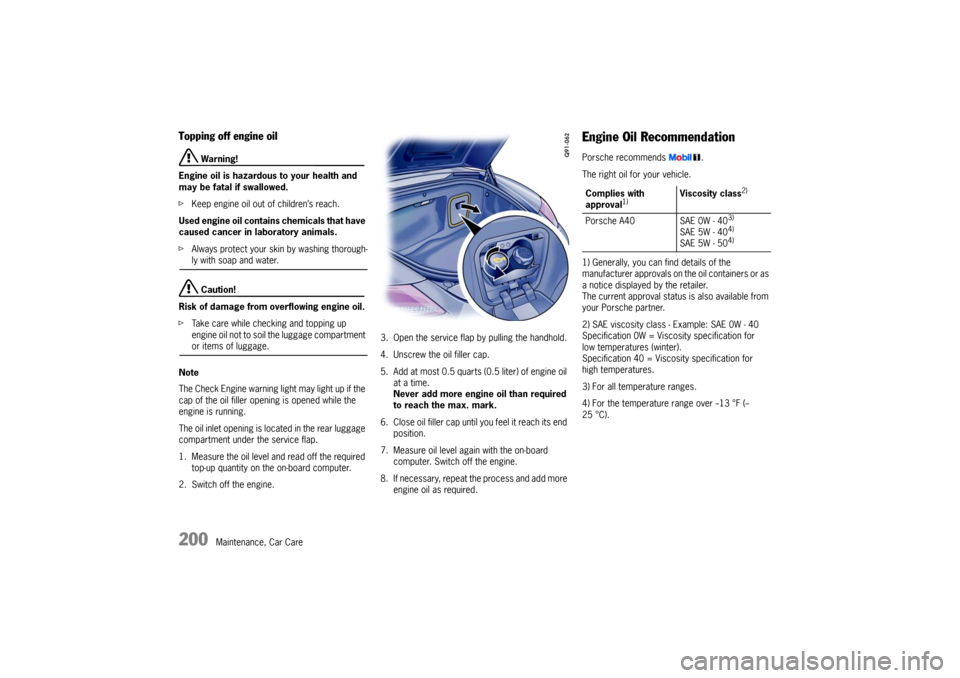
The oil inlet opening is lo cated in the rear luggage
compartment under the service flap.
1. Measure the oil level and read off the required top-up quantity on the on-board computer.
2. Switch off the engine. 3. Open the service flap by pulling the handhold.
4. Unscrew the oil filler cap.
5. Add at most 0.5 quar ts (0.5 liter) of engine oil
at a time.
Never add more engine oil than required
to reach the max. mark.
6. Close oil filler cap until you feel it reach its end
position.
7. Measure oil level again with the on-board computer. Switch off the engine.
8. If necessary, repeat the process and add more engine oil as required.
Engine Oil RecommendationPorsche recommends .
The right oil for your vehicle.
1) Generally, you can find details of the
manufacturer approvals on the oil containers or as
a notice displayed by the retailer.
The current approval status is also available from
your Porsche partner.
2) SAE viscosity class - Example: SAE 0W - 40
Specification 0W = Viscosity specification for
low temperatures (winter).
Specification 40 = Viscosity specification for
high temperatures.
3) For all temperature ranges.
4) For the temperature range over --13 °F (--
25 °C).Complies with
approval
1)
Viscosity class
2)
Porsche A40 SAE 0W - 40
3)
SAE 5W - 40
4)
SAE 5W - 50
4)
Page 204 of 294
202
Maintenance, Car Care
Brake Fluid LevelfPlease see the chapter “EXERCISE EXTREME
CAUTION WHEN WORKING ON YOUR VEHICLE”
on Page 196.
f Use only new (unused) Original Porsche
brake fluid.
Warning!
Brake fluid is hazardous to your health, and
may be fatal if swallowed.
Brake fluid also attacks paintwork.
f Keep brake fluid out of children’s reach.
f Take care while topping off brake fluid not to
soil the luggage compartment or items of lug-gage.
Checking the brake fluid levelThe reservoir for the hydraulic braking and clutch
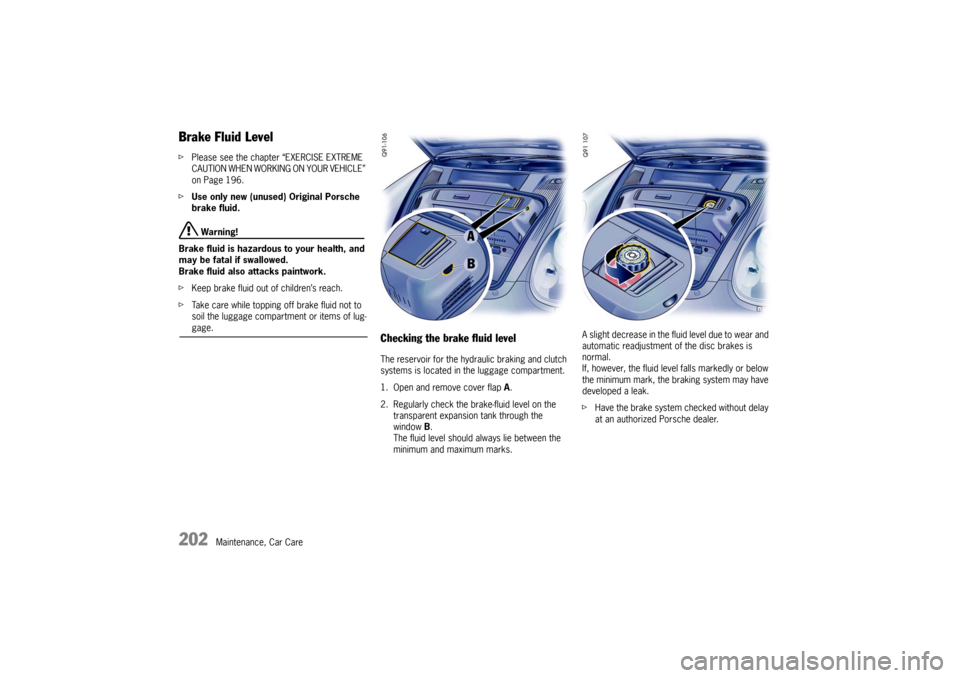
systems is located in the luggage compartment.
1. Open and remove cover flap A.
2. Regularly check the brake-fluid level on the transparent expansion tank through the
window B.
The fluid level should always lie between the
minimum and maximum marks. A slight decrease in the fluid level due to wear and
automatic readjustment of
the disc brakes is
normal.
If, however, the fluid level falls markedly or below
the minimum mark, the br aking system may have
developed a leak.
f Have the brake system checked without delay
at an authorized Porsche dealer.
Page 205 of 294

Maintenance, Car Care
203
Changing the brake fluid Brake fluid absorbs moisture from the air over
time. This accumulation of water lowers the boil-
ing point and, under certain operating conditions,
can affect the braking performance.
Therefore have the brake fluid changed in accord-
ance with the change intervals stated in the
brochure “Maintenance”. – The warning lights on the instrument panel and
on the on-board computer indicate an insuffi-
cient brake fluid level.
– If the warning light lights up on the instrument
panel and the warning message appears on
the on-board computer in combination with a
larger pedal travel, a brake circuit may have
failed.
If the warning lights should light up when
driving:
f Stop immediately in a suitable place.
f Do not continue driving.
Consult an authorized Porsche dealer.
Warning light USA
Warning light Canada
Page 207 of 294
Maintenance, Car Care
205
Fuel
Warning!
Fuel is highly flammable and harmful to
health.
f Fire, open flame and smoking are prohibited
when handling fuel.
f Avoid contact with skin or clothing.
f Do not inhale fuel vapors.
To prevent damage to the emission control
system and engine:
f Never drive the tank completely out of fuel.
f Avoid high cornering speeds after the warning lights have come on.
f Please see the chapter “FUEL ECONOMY” on
Page 204.
Please see the chapter “EMISSION CONTROL
SYSTEM” on Page 208.
Please see the chapter “LEVEL GAGE” on
Page 126.
Check engine warning light
If the warning lights in the instrument panel and on-
board computer come on and remain on while
driving, it suggests:
– a potential engine control problem and the need for system service or
– an improperly fastened tank cap or – refueling with engine running.
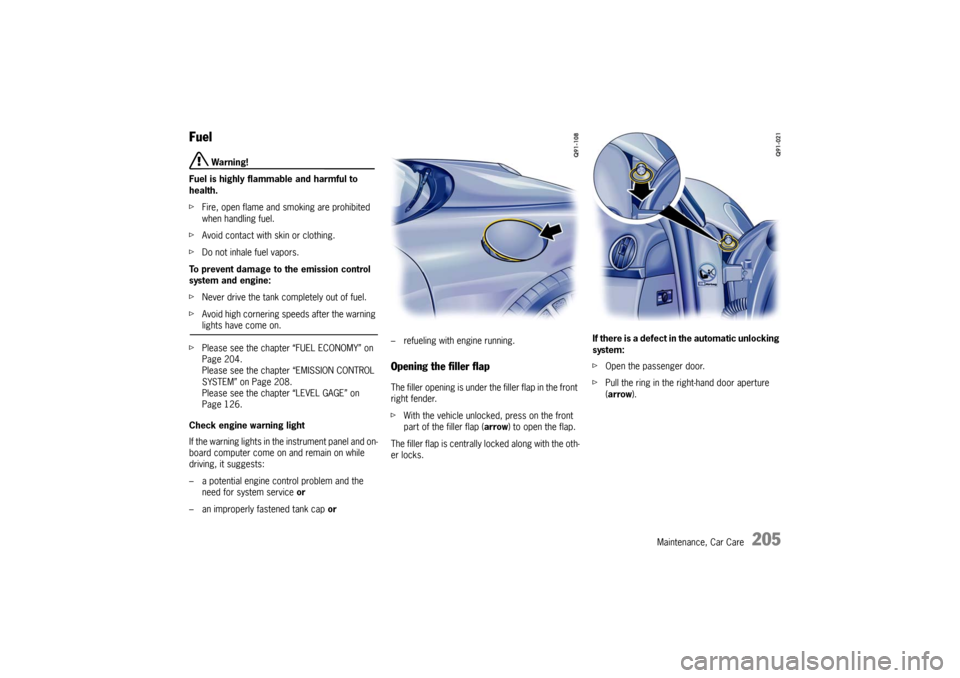
Opening the filler flapThe filler opening is under th
e filler flap in the front
right fender.
f With the vehicle unlocked, press on the front
part of the filler flap ( arrow) to open the flap.
The filler flap is centrally locked along with the oth-
er locks. If there is a defect in
the automatic unlocking
system:
f Open the passenger door.
f Pull the ring in the right-hand door aperture
(arrow ).
Page 212 of 294
210
Maintenance, Car Care
Washer FluidCapacity – Without headlight cleaning system:approximately 2.6 quarts (2.5 liters).
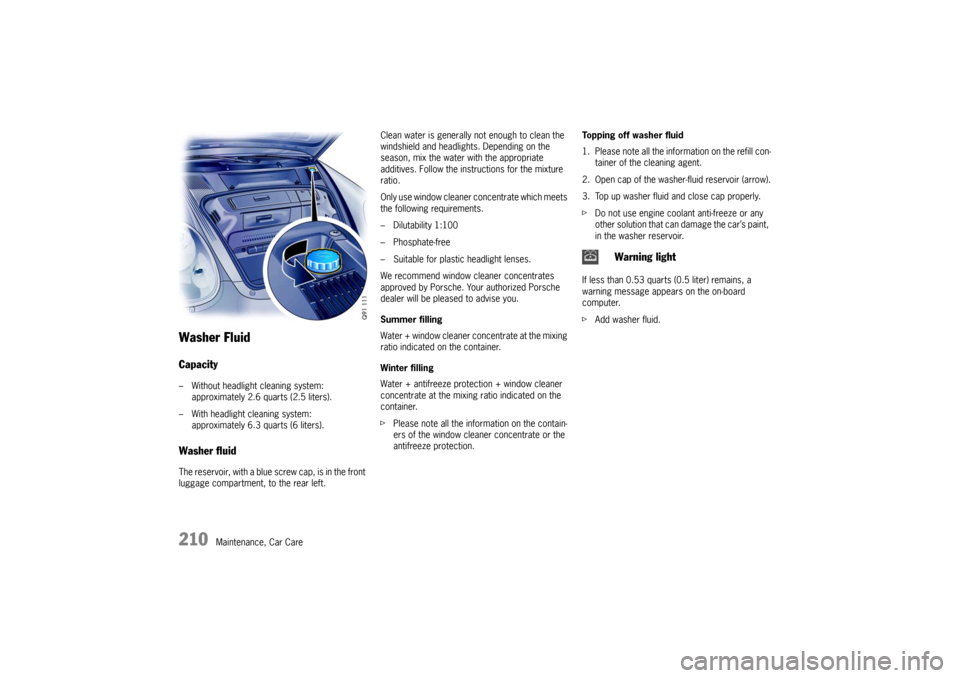
– With headlight cleaning system: approximately 6.3 quarts (6 liters). Washer fluidThe reservoir, with a blue screw cap, is in the front
luggage compartment, to the rear left. Clean water is generally
not enough to clean the
windshield and headlights. Depending on the
season, mix the water with the appropriate
additives. Follow the instructions for the mixture
ratio.
Only use window cleaner concentrate which meets
the following requirements.
– Dilutability 1:100
– Phosphate-free
– Suitable for plastic headlight lenses.
We recommend window cleaner concentrates
approved by Porsche. Your authorized Porsche
dealer will be pleased to advise you.
Summer filling
Water + window cleaner concentrate at the mixing
ratio indicated on the container.
Winter filling
Water + antifreeze protection + window cleaner
concentrate at the mixing ratio indicated on the
container.
f Please note all the info rmation on the contain-
ers of the window cleaner concentrate or the
antifreeze protection. Topping off washer fluid
1. Please note all the info
rmation on the refill con-
tainer of the cleaning agent.
2. Open cap of the washer-fluid reservoir (arrow).
3. Top up washer fluid and close cap properly.
f Do not use engine coolant anti-freeze or any
other solution that can damage the car’s paint,
in the washer reservoir.
If less than 0.53 quarts (0.5 liter) remains, a
warning message appears on the on-board
computer.
f Add washer fluid.
Warning light
Page 216 of 294

214
Maintenance, Car Care
Washing The best method of protecting your car from the
damaging effects of the environment is frequent
washing and the application of a preservative. The
underside of your vehicle should also be thorough-
ly washed for cinders, salt or sanding at winter’s
end.
The longer salt, road du st and industrial dust,
dead insects, bird droppi ngs or substances from
trees (resin, pollen) are allowed to remain on the
bodywork, the more serious is their harmful ef-
fect.
New cars should be washed carefully with plenty
of clear water to protect the new paint work. Dark
paint finishes show up the smallest of surface
damage (e.g., scratches) more readily than lighter
colors.
Dark colors are also more susceptible to scratch-
ing because of the compos ition of their pigments
and require particularly careful paint care.
f Do not wash your car in bright sunlight or while
the bodywork is still hot.
f When washing by hand, use abundant water, a
soft sponge or wash brush, and Porsche car
shampoo.
f Begin by spraying the body thoroughly with wa-
ter to rinse away loose dirt. f
After washing, rinse the car with plenty of wa-
ter and then dry with a chamois leather.
Do not use the same chamois leather for dry-
ing as you use for cleaning the windshield and
windows.
Warning!
Moisture which gets on to the brakes during
a car wash can reduce braking efficiency or
make the brakes pull unevenly which could
increase the danger of an accident, causing
serious personal injuries or death.
f After washing the car, test the brakes and
steering and briefly brake the discs dry.
When doing this, take care not to hamper other
road users behind you (traffic conditions permitting).
Automatic car washes
f Please see the chapter “WIPER BLADES” on
Page 212.
Optional add-on parts or parts which project
beyond the contours of the vehicle may be
damaged by design features (e.g. brushes) of au-
tomatic car washes. The following parts are particularly
susceptible to damage:
– Convertible top (hot wax treatment cannot be
used, as the wax attacks the convertible top
material)
– Windshield wipers (alw ays switch them off to
prevent them wiping unintentionally in intermit-
tent or sensor operation)
– External antennas (always unscrew)
– Rear spoiler
– Wheels (the wider the rim and the lower the tire height, the greater the risk of damage)
– High-gloss wheels (to prevent these from get- ting scratched, do not clean with the wheel-
cleaning brushes of the car wash).
f Please consult the operator before using auto-
matic car washes.
f Wash and dry by hand all points not reached by
a car wash, such as door and lid seams or
door sills.
Note
Automatic car washes spray water at odd angles
and high pressures, which are not seen in normal
driving. Therefore, water can sometimes find its
way into the passengers compartment during or
shortly after the car wash.