fuel consumption PORSCHE BOXSTER S 2013 3.G Information Manual
[x] Cancel search | Manufacturer: PORSCHE, Model Year: 2013, Model line: BOXSTER S, Model: PORSCHE BOXSTER S 2013 3.GPages: 69, PDF Size: 13.64 MB
Page 21 of 69
2 1
4041For fuel consumption, CO2 emissions and efficiency class please refer to page 131.
Fo r w ar d t h r u s t |
Engine
adaptive cruise control will decelerate
your vehicle accordingly – even down to
a halt.
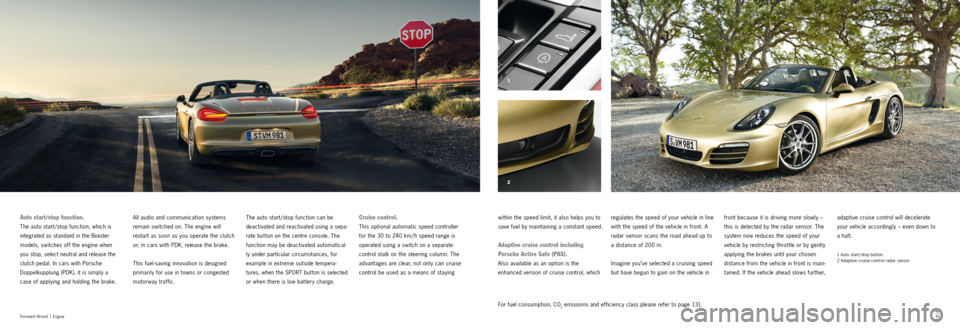
1 Auto start /stop but ton
2 Adaptive cruise control radar sensor
front because it is driving more slowly –
this is detected by the radar sensor. The
system now reduces the speed of your
vehicle by restricting throt tle or by gently
applying the brakes until your chosen
distance from the vehicle in front is main -
tained. If the vehicle ahead slows further,
regulates the speed of your vehicle in line
with the speed of the vehicle in front. A
radar sensor scans the road ahead up to
a distance of 200 m.
Imagine you’ve selected a cruising speed
but have begun to gain on the vehicle in
within the speed limit, it also helps you to
save fuel by maintain
ing a constant speed.
Adaptive cruise control including
Porsche Active Safe (PAS).
Also available as an option is the
enhanced version of cruise control, which
Cruise control.
This optional automatic speed controller
for the 30 to 240 km/ h speed range is
operated using a switch
on a separate
control stalk on the steering
column. The
advantages are clear, not
only can cruise
control be used as a
means of staying
The auto start /stop function can be
deactivated and reactivated using a sepa-
rate but ton on the centre console. The
function may be deactivated automatical-
ly under particular circumstances, for
example in extreme outside tempera
-
tures, when the SPORT but ton is selected
or when there is low bat tery charge.
All audio and commu nication systems
remain switched on. The engine will
restart as soon as you operate the clutch
or, in cars with PDK, release the brake.
This fuel-saving innovation is designed
primarily for use in towns or congested
motorway traffic.
Auto start/stop function.
The auto start/stop function, which is
integrated as standard in the Boxster
models, switches off the engine when
you stop, select neutral and release the
clutch pedal.
In cars with Porsche
Doppelkupplung (PDK), it is simply a
case of applying and holding the brake.
Page 22 of 69
42
4342
43Fo r w ar d t h r u s t |
Engine
For fuel consumption, CO2 emissions and efficiency class please refer to page 131.
Servicing.
In the Boxster models, the generator and
air conditioning system are driven by a
single self-adjusting belt. The drive chains
on the camshafts do not normally require
servicing. With the sole exception of the
spark plugs, the ignition system is also
maintenance-free in normal servicing. In
short, longer service intervals mean long er-
lasting driving pleasure.
initiation of targeted braking. During this
process, any braking by the driver is
boosted to achieve the maximum braking
force that the system is able to provide.
Electrical system recuperation.
For enhanced ef ficiency the Boxster
models are equipped with intelligent elec -
trical system recuperation. The vehicle
bat tery is recharged by the generator
predominantly under braking. Thanks to
this selective recharging, when you
request full driving power the maximum
possible output can be directed straight to
the road.
For increased safet y, the system also
readies the brakes whenever it detects
that the distance from the vehicle is
decreasing. However, the driver should
be prepared to intervene manually if
heavier braking is required. As soon as
the road ahead clears, your vehicle will
accelerate back up to the cruising speed
originally set.
Porsche Active Safe (PAS) issues an audi -
ble and a visual warning if the system
detects that your vehicle is approaching
the vehicle in front too quickly. This is
accompanied by a brief application of
brake force and, where necessary, the
Page 23 of 69
7654321R
4
3 2 1
4445
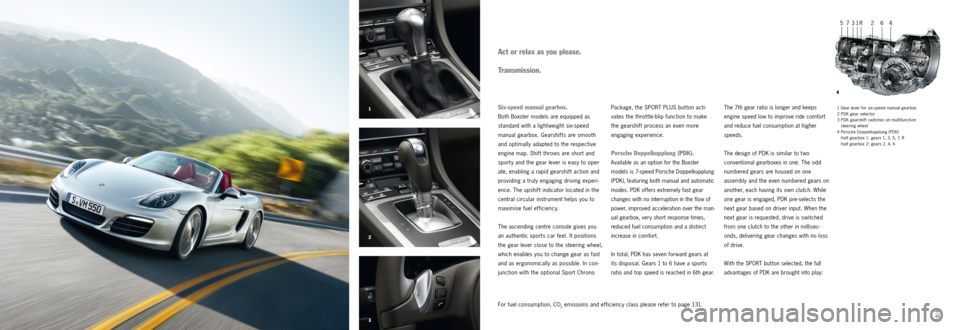
1 Gear lever for six-speed manual gearbox
2 PDK gear selector
3 PDK gearshift switches on multifunction
steering wheel
4 Porsche Doppelkupplung (PDK) H a l f ge a r b ox 1: ge a rs 1, 3, 5, 7, R
Half gearbox 2: gears 2, 4, 6The 7th gear ratio is longer and keeps
engine speed low to improve ride comfort
and
reduce fuel consumption at higher
speeds.
The design of PDK is similar to t wo
conventional gearboxes in one. The odd
numbered gears are housed on one
assembly and the even numbered gears on
another, each having its own clutch. While
one gear is engaged, PDK pre-selects the
next gear based on driver input. When the
next gear is requested, drive is switched
from one clutch to the other in millisec-
onds, delivering gear changes with no loss
of drive.
With the SPORT but ton selected, the full
advantages of PDK are brought into play:
Act or relax as you please.
Transmission.
Package, the SPORT PLUS but ton acti-
vates the throt tle-blip function to make
the gearshift process an even more
engaging experience.
Porsche Doppelkupplung (PDK).
Available as an option for the Boxster
models is 7-speed Porsche Doppelkupplung
(PDK), featuring both manual and automatic
modes. PDK offers extremely fast gear
changes with no interruption in the flow of
power, improved acceleration over the man-
ual gearbox, very short response times,
reduced fuel consumption and a distinct
increase in comfort.
In total, PDK has seven forward gears at
its disposal. Gears 1 to 6 have a sports
ratio and top speed is reached in 6th gear.
For fuel consumption, CO2 emissions and efficiency class please refer to page 131.
Six-speed manual gearbox.
Both Boxster models are equipped as
standard with a light weight six-speed
manual gearbox. Gearshifts are smooth
and optimally adapted to the respective
engine map. Shift throws are short and
sport y and the gear lever is easy to oper-
ate, enabling a rapid gearshift action and
providing a truly engaging driving experi-
ence. The upshift indicator located in the
central circular instrument helps you to
maximise fuel efficiency.
The ascending centre console gives you
an authentic sports car feel. It positions
the gear lever close to the steering wheel,
which enables you to change gear as fast
and as ergonomically as possible. In con-
junction with the optional Sport Chrono
Page 24 of 69
4647
Fo r w ar d t h r u s t |
Transmission
accelerator or brake pedal, PDK re-en -
gages the appropriate gear within frac -
tions of a second. The process is smooth
and seamless thanks to the extremely
fast clutch.
Another way to reduce fuel consumption
is to utilise the coasting function on
downhill gradients that are gentle enough
for you to maintain a constant speed.
Efficient on long journeys, such as on the
motorway, PDK remains ready to respond
as swiftly and precisely as you would
expect.
In short, driving in coasting mode makes
a real impact on fuel consumption with -
out any need for compromise on comfort
or sporty performance.Coasting.
The coasting function available with
Porsche Doppelkupplung (PDK) enables
you to save even more fuel where the
situation allows. The engine is decoupled
from the transmission to prevent
deceleration caused by engine braking.
In this way, optimum use is made of
the vehicle’s momentum, allowing it to
coast for longer distances.
For example, you may want to slow
down 100 km/ h to 80 km/ h in anticipa -
tion of the change of speed limit ahead.
As you ease off the accelerator pedal,
PDK deselects the current gear automa -
tically and you begin
to coast in neutral
until you have reached
your desired
speed. As soon as you
operate the
For fuel consumption, CO2 emissions and efficiency class please refer to page 131.
a more immediate response to throt tle
inputs, even shorter shift times and swift,
throttle-blip downshifts on overrun and
when braking – always accompanied by
an emotive engine sound.
With the optional Sport Chrono Package,
PDK is enhanced by the ‘Launch Control’
and ‘motorsport- derived gearshif t strat-
egy’ functions (p. 65) for even faster and
firmer gear changes and the best possible
performance thanks to a boost in torque
during upshift phases. Overrun downshifts
provide extremely sport y braking and
acceleration for added excitement.
Page 26 of 69
5051
Fo r w ar d t h r u s t |
Chassis
and more comfortable than the standard
chassis. The PASM control unit evaluates
the driving conditions and modifies the
damping force on each of the wheels in
accordance with the selected mode.
Sensors record the body movements that
accompany powerful acceleration, brak
-
ing or uneven road surfaces. This enables
intelligent adaptation of damper stif fness
for the selected mode, optimising contact
bet ween each individual t yre and the road
and reducing pitch.
Porsche Active Suspension
Management (PASM).
Optional PASM, the electronic damping
control system, suits the Boxster models
down to the ground. PASM
actively and
continuously regulates the damping force
for each wheel according to the
road con-
ditions and driving st yle. In addition, the
suspension is lowered by 10 mm.
The driver can select bet ween t wo
dif ferent modes: ‘Normal’ which is a
blend of performance and comfort,
and ‘Sport ’ where the setup is much
firmer. Depending on the mode selected,
therefore, PASM can be both sportier
of the previous model. The independent
suspension features lightweight spring-strut
axles with longitudinal and transverse
links and, at the front, cross members
that have been refined for optimum control.
As a result, each wheel moves precisely
to ensure excellent directional stability
and superior handling in all situations.
What does this mean for the driver? The
sophisticated engineering of the chassis,
combined with the mid-engined layout,
achieves impressive dynamic performance.
Body roll and pitch have been practically
eliminated to offer a level of agilit y that
turns each corner into an incomparable
experience.
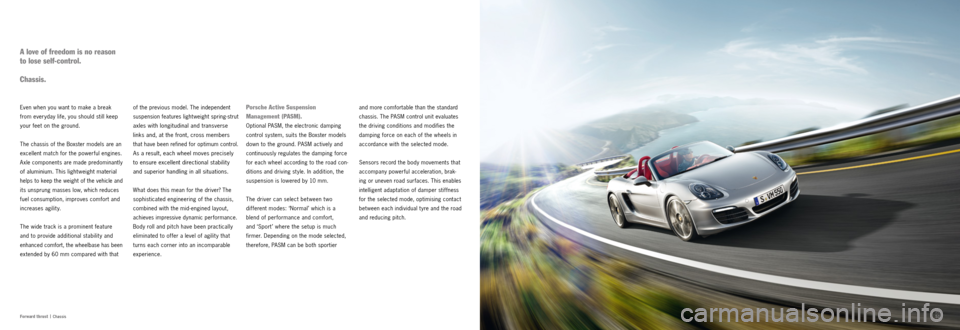
Even when you want to make a break
from everyday life, you should still keep
your feet on the ground.
The chassis of the Boxster models are an
excellent match for the powerful engines.
Axle components are made predominantly
of aluminium. This lightweight material
helps to keep the weight of the vehicle and
its unsprung masses low, which reduces
fuel consumption, improves comfort and
increases agilit y.
The wide track is a prominent feature
and to provide additional stability and
enhanced comfort, the wheelbase has been
extended by 60 mm compared with
that
A love of freedom is no reason
to lose self-control.
Chassis.
Page 27 of 69
2 1
52
53
Fo r w ar d t h r u s t |
Chassis
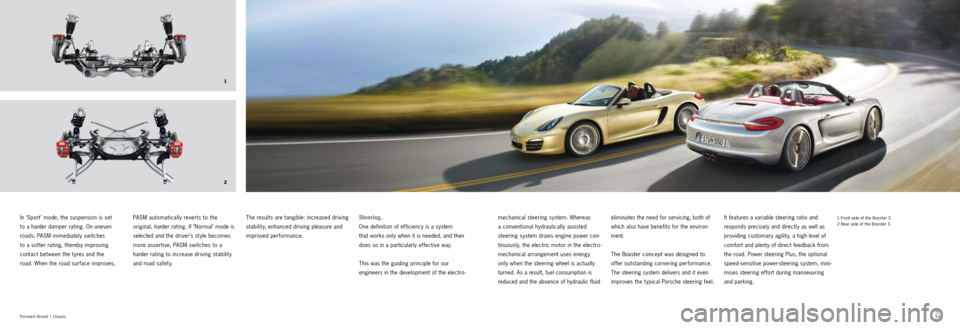
1 Front axle of the Boxster S
2 Rear axle of the Boxster SIt features a variable steering ratio and
responds precisely and directly as well as
providing customary agility, a high level of
comfort and plent y of direct feedback from
the road. Power steering Plus, the optional
speed -sensitive power-steering system, mini -
mises steering ef fort during manoeuvring
and parking.
eliminates the need for servicing, both of
which also have benefits for the environ-
ment.
The Boxster concept was designed to
offer outstanding cornering performance.
The steering system delivers and it even
improves the typical Porsche steering feel.
mechanical steering system. Whereas
a conventional hydraulically assisted
steering system draws engine
power con-
tinuously, the electric motor
in the electro-
mechanical arrangement uses energy
only when the steering
wheel is actually
turned. As a result, fuel consumption is
reduced and the absence of hydraulic fluid
Steering.
One definition of efficiency is a system
that works only when it is needed, and then
does so in a particularly effective way.
This was the guiding principle for our
engineers in the development of the electro-
The results are tangible: increased driving
stability, enhanced driving pleasure and
improved performance. PASM automatically reverts to the
original, harder rating. If ‘Normal’ mode is
selected and the driver’s st yle becomes
more assertive, PASM switches to a
harder rating to increase driving stability
and road safet y.
In ‘Sport ’ mode, the suspension is set
to a harder damper rating. On uneven
roads, PASM immediately switches
to a softer rating, thereby improving
contact bet ween the t yres and the
road. When the road surface improves,
Page 39 of 69
76
77For fuel consumption, CO2 emissions and efficiency class please refer to page 131. injection, VarioCam Plus and, in conjunc
-
tion with optional PDK, coasting mode.
On the other hand, newly developed
cataly tic converters provide ef ficient
emission control. While the stereo
Lambda control circuitr y controls and
monitors each cylinder bank separately.
For each exhaust tract, oxygen sensors,
together with the engine electronics
and injectors, regulate the composition
of the exhaust gas, while another
Lambda sensor on each cylinder bank
monitors pollutant conversion in the
respective cataly tic converter.
The goal is to enhance performance –
but, where possible, not at the expense
of the environment.
Exhaust emission control.
Vehicles manufactured by Porsche
demonstrate that even high-performance
sports cars can achieve moderate fuel
consumption and exhaust emission values
in their respective category.
This is achieved, on the one hand, through
the use of fuel - ef ficient technologies such
as auto start /stop, thermal management,
electrical system recuperation, direct fuel
compared with the respective previous
model, even though performance has
been increased in every generation. This
is made possible by an efficient drive
concept (e.g. direct fuel injection (DFI) and
VarioCam Plus), lightweight construction,
optimised aerodynamics and low rolling
resistance.
The environmental management team
at the Porsche Development Centre in
Weissach aims to demonstrate a high
level of environmental responsibility. Here,
technological developments are carried
out with environmental protection in mind.
If we are to continue to enjoy driving
pleasure, we need to look after our
environment. In other words, we need to
take responsibilit y. In an era of intensify -
ing debate about global climate change
and CO
2 emissions, every automotive
manufacturer is asking itself what it
has to offer in terms of environmental
protection. Our answer has long been
the same: a combination of high power
output and high efficiency.
In recent years Porsche has managed to
reduce fuel consumption across all model
ranges by a double - digit percentage
You can live for the moment
and still care about tomorrow.
Environment.
Page 40 of 69
7879For fuel consumption, CO2 emissions and efficiency class please refer to page 131.
The wider view |
Environment
Servicing.
Long service intervals offer clear advan -
tages. For you, they reduce costs and
save time. For the environment, they
assist in the sparing use of consumables
and replacement parts. For full details
of service intervals, please refer to the
separate price list.
the fuel system has been minimised
thanks to the active carbon filter and the
multilayered material from which the fuel
tank is made. All fuel lines are made from
multilayered plastic, steel or aluminium.
Fuel.
Both
Boxster models are designed to
operate on fuels with an ethanol content
of up to 10 %. Ethanol has a positive
impact on the CO
2 balance since the
plants grown for the production of this
biofuel also absorb CO
2 from the atmos -
phere. The release of hydrocarbons from
technical requirements. In short, the
Boxster is around 95 % recoverable.
In addition, Porsche uses a high propor -
tion of environmentally friendly water-
based paints. For us, environmental
protection does not begin at the end of
a vehicle’s life. It starts at the planning
and development stage.
On the ecological side, all materials used
are meticulously selected. We use only
innovative and environmentally friendly
components. All synthetic components
are easily recyclable and each material
is labelled to facilitate its separation for
recycling. The reduction in the number
of plastic variants helps to ensure more
ef ficient recycling. Recycled plastics are
used where they meet our exacting
On the technical side, various compo
-
nents are made with a high proportion of
aluminium, magnesium, plastics and
super high-strength sheet steel. The
materials used have been selected for
their abilit y to withstand load, yet they
are considerably lighter than conventional
steel. As a result, the bodyshell of the
Boxster models has a light alloy content
of approximately 46 %.
Fuel economy and recycling.
Intelligent lightweight construction has
been fundamental to the Porsche identit y
since 1948 for both technical and ecolog -
ical reasons. This forms the basis for
achieving low fuel consumption values in
conjunction with outstanding perfor -
mance.
Page 66 of 69
130131Technical data
Boxster Boxster S
Weights
Manual/PDK Manual/PDK
Unladen weight (DIN) 1,310 kg / 1,340 kg 1,320 kg / 1,350 kg
Unladen weight (EC)
1)1,385 kg / 1,415 kg 1,395 kg / 1,425 kg
Pe r m issi b le gross we igh t 1,645 kg / 1,675 kg 1,655 kg / 1,685 kg
PerformanceManual/PDK Manual/PDK
Top speed 264 km/ h / 262 km/ h 279 km/ h / 277 km/ h
0–100 km/h 5.8 secs / 5.7 secs 5.1 secs / 5.0 secs
with Sport Chrono Package (in conjunction with PDK) – / 5.5 secs – / 4.8 secs
0 –16 0 k m / h 13.1 secs / 13.0 secs 11.0 secs / 10.9 secs
with Sport Chrono Package (in conjunction with PDK) – / 12.7 secs – / 10.7 secs
Flexibilit y (80 –120 km/ h) in 5th gear 8.2 secs / – 6.7 secs / –
Overtaking acceleration (80 –120 km/ h) – / 3.7 secs – / 3.1 secs
Fuel consumption/emissions 2)Manual/PDK Manual/PDK
Urban in l/100 km 11.4 / 10.6 12.2 / 11.2
Extra urban in l/100 km 6.3 / 5.9 6.9 / 6.2
Combined in l/100 km 8.2 / 7.7 8.8 / 8.0
CO
2 emissions g/km 192 / 180 206 / 188
Efficiency classManual/PDKManual/PDK
Efficiency class (Germany) G / F G / F
Efficiency class (Switzerland) G / F G / F
Dimensions/aerodynamics
Length4 , 374 m m 4 , 374 m m
Width (including exterior mirrors) 1,8 01 m m (1,978 m m) 1,8 01 m m (1,978 m m)
Height 1, 282 m m 1, 281 m m
Wheelbase 2,475 mm 2,475 mm
Luggage compartment volume
(German Car Manufacturers’ Assoc.) front/rear 150 litres / 130 litres 150 litres / 130 litres
Tank capacity (refill volume) approx. 64 litres approx. 64 litres
Drag coef ficient c
w = 0.30 cw = 0.31
1)
Weight is calculated in accordance with the relevant EC Directives and is valid for vehicles with standard specification only. Optional equipment increases this figure. The figure given includes 68 kg for the driver and 7 kg for luggage.2) Data determined in the NEDC (New European Driving Cycle) in accordance with the Euro 5 (715/2007/ EG, 692/2008/ EG, 566/2011/ EG and ECE- R 101) measurement method. The figures do not refer to an individual vehicle nor do they constitute part
of the of fer. They are intended solely as a means of comparing dif ferent t ypes of vehicle. You can obtain further information about individual vehicles from your Porsche Centre. Fuel consumption calculated for vehicles with standard specification only.
A vehicle‘s fuel consumption and CO
2 emissions depend not only on its ef ficient use of fuel, but also on driving st yle and other non -technical factors. Actual consumption and per formance may var y with items of optional equipment.
Boxster Boxster S
Engine
C y linders 6 6
Displacement 2,70 6 c m
33,436 cm3
Max. power (DIN)
at rpm 195 kW (265 hp)
6,70 0 232 kW (315 hp)
6,70 0
Max. torque
at rpm 280 Nm
4,500 – 6,500 360 Nm
4,500–5,800
Compression ratio 12 . 5:1 12 . 5:1
Transmission
LayoutRear-wheel drive Rear-wheel drive
Manual gearbox 6-speed 6-speed
PDK (optional) 7-speed 7-speed
Chassis
Front axleLightweight spring-strut suspension Lightweight spring-strut suspension
Rear axle Lightweight spring-strut suspension Lightweight spring-strut suspension
Steering Variable steering ratio, power-assisted (electromechanical) Variable steering ratio, power-assisted (electromechanical)
Turning circle 10.9 8 m 10.9 8 m
Brakes Four-piston aluminium monobloc fixed calipers front and rear,
discs internally vented and cross-drilled Four-piston aluminium monobloc fixed calipers front and rear,
discs internally vented and cross-drilled
Vehicle stabilit y system Enhanced Porsche Stabilit y Management (PSM)
with ASR, ABD MSR and ABS 9.0 Enhanced
Porsche Stabilit y Management (PSM)
with ASR, ABD MSR and ABS 9.0
Anti - lock braking system A BS 9.0 A BS 9.0
Standard wheels Front: 8 J x 18 ET 57, Rear: 9 J x 18 ET 47 Front: 8 J x 19 ET 57, Rear: 9.5 J x 19 ET 45
Standard tyres Front: 235/45 ZR 18, Rear: 265/45 ZR 18 Front: 235/40 ZR 19, Rear: 265/40 ZR 19
Technical data
Page 67 of 69

132133
Index
C
CD/ DV D au tochanger 101
CDR audio system 96
CDR Plus audio system 96
Chassis 50
Child seats 88
Coasting 46
Colours 110
Exterior 110
Interior 112
Comfort 82
Cruise control 40
D
Design 12
Digital radio 101
Direct fuel injection (DFI) 33
Dr y-sump lubrication, integrated 34
Dynamic gearbox mounts 66
E
Electric parking brake 59
Electrical system recuperation 42
Engine management 38
Engineered body design 70Engines
28
2.7-litre engine 30
3.4 - litre engine 30
Environment 77
Exhaust emission control 77
Exhaust system 36
Exterior 12 , 110
Exterior mirrors and rear-view mirror 92
F
Factory collection 12 5
Floor mats 11 8
Fuel 79
Fuel consumption 78
G
Gearbox mounts, dynamic 66
H
Handset for telephone module,
cordless 99
HomeLink
® (programmable
garage door opener) 92
Hood, fully electric 94I
Instruments
84
Integrated dr y-sump lubrication 34
I nte r i o r 16 , 8 2, 112
ISOFIX child seat preparation 88
L
Leather package 8 4 , 112
Light design package 92
Lights 74
Logbook, electronic 98
Luggage compartments 91
M
Manual gearbox, 6-speed 45
Materials 78
Mobile phone preparation 101
N
Navigation module 96
O
Online services 101P
Panorama
12 6
Pa r k A ssist 92
Parking brake, electric 59
Personalisation 10 8
Porsche Active Suspension
Management (PASM) 50
Porsche Car Configurator 12 3
Porsche Ceramic Composite
Brake (PCCB) 57
Porsche Communication
Management (PCM) 96
Porsche Doppelkupplung (PDK) 45
Porsche Driving Experience 124
Porsche Dynamic Light System
(PDLS) 74
Porsche Exclusive 12 2
Porsche Side Impact Protection
System (POSIP) 73
Porsche Stabilit y Management (PSM) 60
Porsche Torque Vectoring (PTV) 62
Porsche Vehicle Tracking
System (PV TS) 93
Power steering 53Power steering Plus
53
Principle 12 8
R
Recycling 78
Resonance intake manifold 33
Roll - over protection 72
S
Safety 70
Seat heating 88
Seat ventilation 88
Seats 88
Adaptive Sports seats Plus 88
Child seats 88
Fully electric Sports seats 88
Sports bucket seats 88
Sports seats 88
Sports seats Plus 88
Servicing 42, 79
Smoking package 11 8
Sound Package Plus 102
SPORT button 38
Sport Chrono Package 65Sports exhaust system
36
Steering 52
Steering wheel heating 87
Steering wheels 87
Multifunction steering wheel 87
SportDesign steering wheel 87
Sports steering wheel 87
Storage options 90
T
Technical data 13 0
Telephone module 99
TF T screen 85
Thermal management 36
Tra n s m i ssi o n 45
T V tuner 98
Tyre Pressure Monitoring (TPM) 55
U
Universal audio interface 9 6 , 101
V
VarioCam Plus 34
Voice control system 98W
Water- repellent side windows
94
‘Welcome Home’ lighting 92
Wheels 54
Wind deflector 95
Index
A
Adaptive cruise control including
Porsche Active Safe (PAS) 41
Air conditioning system 92
Airbags 72
Alarm system 93
Anti-theft protection 93
Audio and communication 96
Audio interface, universal 96
Auto start/stop function 39
Automatic climate control, two-zone 92
Automatic headlight activation 75
B
Bi-Xenon headlights 74
BOSE
® Surround Sound System 102
Boxer engines 28
Boxster 22
Boxster concept 9
Boxster S 24
Brakes 57
Burmester
® High - End
Surround Sound System 10 4