lights PORSCHE CAYMAN 2006 1.G Service Manual
[x] Cancel search | Manufacturer: PORSCHE, Model Year: 2006, Model line: CAYMAN, Model: PORSCHE CAYMAN 2006 1.GPages: 280, PDF Size: 4.89 MB
Page 135 of 280

Controls, Instruments
135
Switching circulating-air mode on or off
fPress button C.
The outside-air supply is interrupted and only
the inside air is circulated.
The light-emitting diode in the button lights up.
Over approx. 37°F/3°C
If the air-conditioning compressor was off, it
switches on automatically. The duration of
circulating-air mode is not limited.
Below approx. 37°F/3°C
The air-conditioning compressor is switched off.
Circulating-air mode is automatically ended after
approx. 3 minutes.Air distributionThe individual air distributions can be combined as
desired.
Recommended setting in Summer –
Air distribution to central and side vents
Recommended setting in Winter –
Air distribution to footwell and windshield
Air distribution to footwell
fPress button J.
The air flows to the footwell.
The selection appears on the display panel.Air distribution to center and side vents
fPress button K.
The air flows from the central and side vents.
Vents must be open.
The selection appears on the display panel.
Air distribution to windshield
fPress button L.
The air flows to the windshield.
The selection appears on the display panel.
Note on operation
fOn vehicles with the Sport Chrono package
Plus, individual air conditioning settings can be
stored on your vehicle key.
Please observe the chapter “Individual
Memory” in the separate PCM operating
instructions.
Information on air-conditioning
compressor– May switch off briefly to ensure sufficient
engine cooling if the engine is operating under
extreme load.
– Operates most effectively with the windows
closed.
If the vehicle has been in the sun for a long
time, it is a good idea to ventilate the interior
briefly with the windows open.
– Depending on the outside temperature and
humidity, condensation can drip from the
evaporator and form a pool under the car.
This is normal and not a sign of leakage.
– If uncooled air flows out when the lowest
temperature has been set, switch off the air
conditioning compressor and have the fault
remedied.
Please contact your authorized Porsche dealer
for further information.
Page 146 of 280

146
Controls, Instruments
Front luggage compartment Trunk Entrapment Your vehicle is equipped with an internal front trunk
release mechanism.
A person trapped in the front luggage compart-
ment can release the lid from the inside using un-
locking handle A.
The handle A is fluorescent and glows in the dark.Note
When loading the luggage compartment, make
sure that items of luggage or other objects cannot
become caught on handle A.
This could cause the luggage compartment to
open unintentionally.
A warning message in the on-board computer
lights up when unlocking handle A is operated.
fStop the vehicle immediately when the warning
message lights up.
fCheck the luggage compartment.
fClose the lid.
Function with vehicle stationary
If the luggage compartment lid is unlocked with
unlocking handle A, the lid can be opened from the
inside immediately.
Function with vehicle in motion
If the luggage compartment lid is unlocked with
unlocking handle A when a speed of 2
mph
(3 km/h
) is exceeded, the warning message in
the on-board computer
lights up.
At the same time, the lid is unlocked and the latch
striker pops into the catch-hook position.
Danger!
Risk of accident.
If the warning message in the on-board com-
puter lights up when the vehicle is in motion,
the lid may impact in front of the windshield
and can tear off.
You can lose control of the vehicle, and
serious personal injury or death may result.
fStop the vehicle immediately when the warning
message lights up.
fCheck the luggage compartment.
fClose the lid.
Note
The front lid cannot be opened from the inside if
the battery is disconnected or empty.
Safety reasons therefore require that you un-
screw the latch striker of the front lid lock if
you plan to put the vehicle out of operation
for an extended period.
Please consult your authorized Porsche dealer.
They will advise you about the necessary measu-
res.
Warning message
Page 158 of 280

158
Controls, Instruments It is essential to observe the instructions of
the telephone manufacturer before putting
the telephone into operation.
Any portable telephone or radio transmitter which
is used in a Porsche must be properly installed in
accordance with the technical requirements of
Porsche.
The transmission power must not exceed
10 W.
The devices must possess a type approval for
your vehicle and have an “e” symbol.
If you should require equipment with transmission
power values greater than 10 W, please consult
your authorized Porsche dealer for this purpose.
He is familiar with the technical requirements for
installing devices of this kind.
The antennas for all radios and telephones with a
transmitting antenna must be externally mounted.
The improper installation of radios or telephones
or use of a radio or telephone with a transmitting
antenna inside the car may cause the warning
lights to come on.
Improper installation of such equipment can crea-
te a discharged battery or excessive current draw
from added equipment. If aftermarket systems are installed by non-dealer-
ship technicians or outside the selling dealer, pro-
blems may result. Installation of aftermarket
equipment is not covered under the New Car War-
ranty.
fConsult your authorized Porsche dealer about
the installation of non Porsche approved equip-
ment.
Reception quality
The reception quality of your car telephone will
change constantly when you are driving. Interfe-
rence caused by buildings, landscape and
weather is unavoidable. It may become particular-
ly difficult to hear when using the hands-free func-
tion due to external noise such as engine and wind
noise.
Antenna
Always unscrew the external antenna before using
an automatic car-wash.
Page 159 of 280

Controls, Instruments
159
1, 2, 3 - Programmable buttons
A- Light-emitting diode for status identificationHomeLinkThe programmable HomeLink replaces up to three
original hand-held transmitters used to operate
various devices (e.g. garage door, gate to the
property, alarm system).
You can program buttons 1 to 3 with a frequency
of an original handheld transmitter.
Warning!
Risk of accident when using the HomeLink if
persons, animals or objects are within the
range of movement of the equipment that is
being operated.
fWhen using the HomeLink, ensure that no
persons, animals or objects are within the
range of movement of the equipment that is
being operated.
fObserve the safety notes for the original hand-held transmitter.
Preconditions for operating and
programming the HomeLink:
– Ignition is switched on.
– Fog lights are switched off.
To operate the respective device:
fPress the appropriate button (1, 2 or 3).
Light-emitting diode A lights up during signal
transfer.Note on operation
fAlways use the HomeLink opener in the
direction of travel.
Otherwise, range restrictions cannot be ruled
out.
fBefore selling the vehicle, delete the
programmed signals of the HomeLink.
fPlease read the instructions for the original
hand-held transmitter to find out whether the
original transmitter is equipped with fixed or
changeable code.
Page 160 of 280

160
Controls, Instruments
Allocating signals to the buttonsfPlease follow the operating instructions for the
original hand-held transmitter.
Prior to programming the HomeLink for the
first time
The following process deletes the standard codes
set at the factory. Do not repeat the process if you
program further buttons.
fKeep the two outer buttons 1 and 3
depressed for approx. 20 seconds until light-
emitting diode A begins to flash quickly.
All programmed signals of buttons 1 to 3 are
deleted.HomeLink with fixed code system
1. Press the desired button until the light-emitting
diode begins to flash slowly.
You then have approx. 5 minutes to perform
steps 2 and 3.
2. Hold the original hand-held transmitter approx.
0 to 12 in. (0 to 30 cm) in front of the marked
position (figure) on the vehicle.
3. Press the transmit button on the original hand-
held transmitter until the fog lights flash three
times (up to approx. 45 seconds).
4. Repeat steps 1 to 3 to allocate other buttons.
Note
Several attempts with different distances between
the vehicle and the original hand-held transmitter
might be necessary.
The fog lights will flash once the 5 minutes have
been exceeded. Programming must be repeated
from the beginning.HomeLink with changeable code system
1. Allocate the required keys as for the systems
with fixed code (steps 1 to 3).
2. To synchronize the system:
Press the programming button on the receiver
for the garage door actuator.
Afterwards, you usually have approx.
30 seconds to initiate step 3.
3. Press the allocated HomeLink button twice.
(With some devices, the button to be allocated
must be pressed a third time in order to
complete the setting process.)
4. Repeat the programming steps to allocate
other buttons.
Note
fPlease consult an authorized Porsche dealer if
you have not been able to successfully allocate
signals for the garage door opener to the
buttons even though you have carefully
followed the instructions in this chapter and
the operating instructions for the original hand-
held transmitter.
Page 161 of 280

Controls, Instruments
161
To reprogram a single button:
1. Press the desired button until the
light-emitting diode begins to flash slowly
(approx. 20 seconds).
You then have approx. 5 minutes to perform
steps 2 and 3.
2. Hold the original hand-held transmitter approx.
0 to 30 cm in front of the marked position
(figure) on the vehicle.
3. Press the transmit button on the original
hand-held transmitter until the fog lights flash
three times (up to approx. 45 seconds).
4. Repeat steps 1 to 3 to allocate other buttons.
Note
Several attempts with different distances between
the vehicle and the hand-held transmitter might be
necessary.
The fog lights will flash once the 5 minutes have
been exceeded. Programming must be repeated
from the beginning in this case.Deleting programmed signals of the
HomeLink
(e.g., when selling the vehicle)
Keep the two outer buttons 1 and 3 depressed
for approx. 20 seconds until light-emitting diode A
begins to flash quickly.
All programmed signals of buttons 1 to 3 are
deleted.
Page 164 of 280

164
Shifting Gear
Manual Transmission, ClutchThe positions of the gears are shown on the shift
diagram on the gearshift lever.
Warning!
Risk of accident.
fDo not obstruct the pedal travel with floor mats
or other objects.
Nonskid floor mats of the correct size are
available at your authorized Porsche dealer.
To avoid damage to the clutch and transmis-
sion:
fAlways depress the clutch pedal fully when
changing gears. Make sure that the gearshift
lever is completely engaged.
fOnly shift into reverse when the car has come to a complete stop.fWhen shifting gears, always ensure that the
clutch pedal is fully depressed and the gear
has fully engaged.
fSelect reverse only when vehicle is stationary.
fSelect an appropriately low gear on upward
and downward slopes.
This will ensure optimum use of engine power
and engine braking.
When reverse gear is selected and the ignition is
on, the backup lights are illuminated.
Permitted engine speedfYou should change into a higher gear before
the needle reaches the red mark on the ta-
chometer, or ease off the accelerator.
If the red zone is reached during acceleration, fuel
feed is interrupted.
Caution!
Risk of engine damage (overrevving) when
shifting down to a lower gear.
fTake care not to exceed the maximum permit-ted engine speed when shifting down.
Page 183 of 280

Maintenance, Car Care
183
Changing the brake fluid Brake fluid absorbs moisture from the air over
time. This accumulation of water lowers the boil-
ing point and, under certain operating con ditions,
can affect braking performance.
Therefore have the brake fluid changed in accord-
ance with the change intervals stated in the bro-
chure “Maintenance”. The brake-fluid warning lights in the instrument
panel and on-board computer indicate:
– brake-fluid level too low,
– in conjunction with large pedal travel, braking-
circuit failure.
If the warning lights should light up while
driving:
fStop immediately in a suitable place.
fDo not continue driving.
Please have the fault remedied at your nearest
authorized Porsche dealer.
Warning light USA
Warning light Canada
Page 184 of 280

184
Maintenance, Car Care
Fuel Economy Fuel economy will vary depending on where,
when and how you drive, optional equipment
installed, and the general condition of your
car.
A car tuned to specifications and correctly
maintained, will help you to achieve optimal
fuel economy.
fHave your vehicle tuned to specifications.
Air cleaner should be dirt free to allow proper
engine “breathing”.
Battery should be fully charged.
Wheels should be properly aligned.
Tires should be inflated to the correct pres-
sure.
fAlways monitor your fuel consumption.
fDrive smoothly, avoid abrupt changes in speed
as much as possible.
fAvoid jack rabbit starts and sudden stops.
fDo not drive longer than necessary in the lower
gears. Shifting into a higher gear early without
lugging the engine will help save fuel.
fProlonged “warm up” idling wastes gas. Start
the vehicle just before you are ready to drive.
Accelerate slowly and smoothly.
fSwitch off the engine if stationary for longer
periods (traffic lights, jams, level crossings). fAny additional weight carried in the vehicle re-
duces fuel economy. Always keep cargo to a
minimum and remove all unnecessary items.
fOrganize your trips to take in several errands
in one trip.
fAll electrical accessories contribute to in-
creased fuel consumption.
fOnly switch on the air conditioning when neces-
sary.
The EPA estimated m.p.g. is to be used for
comparison purposes, actual mileage may
be different from the estimated m.p.g., de-
pending on your driving speed, weather con-
ditions and trip length. Your actual highway
mileage will probably be less than the esti-
mated m.p.g.
fPlease observe all local and national speed lim-
its.
Page 186 of 280
186
Maintenance, Car Care
Fuel
Warning!
Fuel is highly flammable and harmful to
health.
fFire, open flame and smoking are prohibited
when handling fuel.
fAvoid contact with skin or clothing.
fDo not inhale fuel vapors.
To prevent damage to the emission control
system and engine:
fNever drive the tank completely out of fuel.
fAvoid high cornering speeds after the warning lights have come on.
fPlease observe the chapter “FUEL ECONOMY”
on Page 184.
fPlease observe the chapter “EMISSION CONT-
ROL SYSTEM” on Page 190.
fPlease observe the chapter “FUEL” on Page
88.
Check engine warning light
If the warning lights in the instrument panel and on-
board computer come on and remain on while
driving, it suggests:
– an improperly fastened tank cap or
– refueling with engine running.
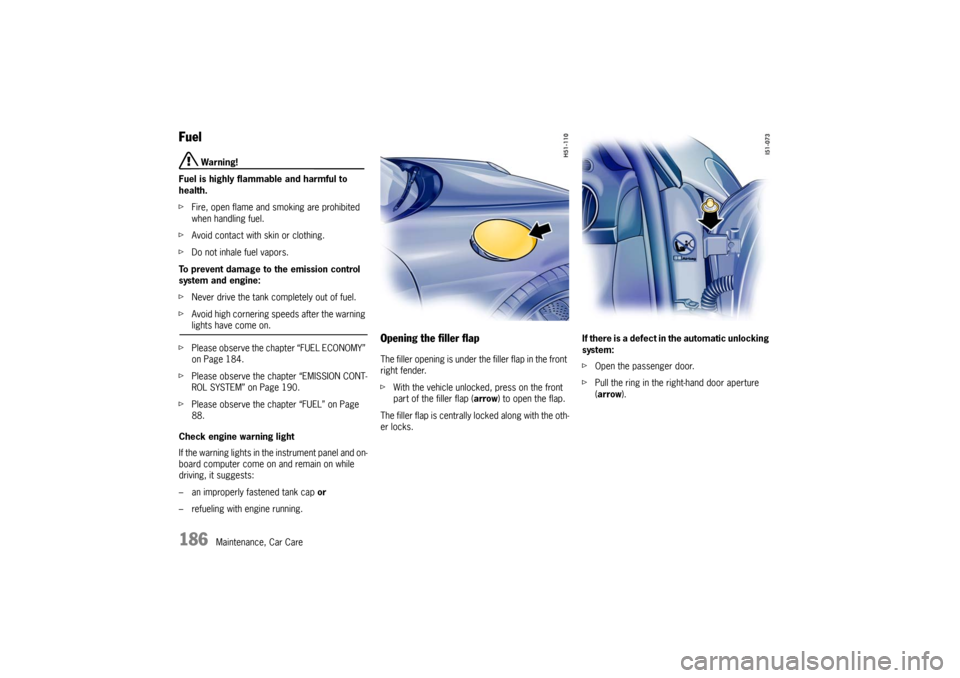
Opening the filler flap The filler opening is under the filler flap in the front
right fender.
fWith the vehicle unlocked, press on the front
part of the filler flap (arrow) to open the flap.
The filler flap is centrally locked along with the oth-
er locks. If there is a defect in the automatic unlocking
system:
fOpen the passenger door.
fPull the ring in the right-hand door aperture
(arrow).