interior lights PORSCHE CAYMAN 2006 1.G Owners Manual
[x] Cancel search | Manufacturer: PORSCHE, Model Year: 2006, Model line: CAYMAN, Model: PORSCHE CAYMAN 2006 1.GPages: 280, PDF Size: 4.89 MB
Page 11 of 280

Controls, Instruments
11 Controls, Instruments
Before driving off... ...................................... 12
Break in hints for the first
2,000 miles/3,000 kilometers ...................... 14
Keys ........................................................... 17
Security Wheel Bolts .................................... 17
Doors ......................................................... 23
Alarm System,
Passenger Compartment Monitoring ............. 24
Power Windows ........................................... 26
Inside mirror ................................................ 28
Automatic Anti-Glare
Interior Mirror and Door Mirrors .................... 28
Door Mirrors ................................................ 29
Seat Adjustment .......................................... 32
Seat Memory ............................................... 34
Heated Seats .............................................. 36
Steering Wheel Adjustment ........................... 37
Multi-functional steering wheel ....................... 38
Sun Visors ................................................... 39
Safety Belts ................................................. 40
Airbag Systems ........................................... 42
Child Restraint Systems ................................ 49
LATCH System
Child seat bracket on the passenger’s seat .... 53
Child Restraint Anchorage ............................ 54
Clutch Pedal ................................................ 55
Parking Brake .............................................. 55
Brakes ........................................................ 56
ABS Brake System
(Antilock Brake System) ................................ 59
Sport Mode ................................................. 61
Porsche Stability Management (PSM) ............. 62Porsche Active Suspension Management
(PASM) ........................................................ 65
Retractable Rear Spoiler ............................... 66
Parking Aids ................................................ 68
Interior Lights .............................................. 70
Operation, Instruments ................................. 72
Ignition/Starter Switch with anti-theft Steering
Lock ........................................................... 74
Starting Procedures ..................................... 76
Stopping engine ........................................... 77
Instrument Panel USA Models ....................... 79
Automatic Speed Control Indicator light ......... 82
Instrument Illumination .................................. 82
Trip Odometer ............................................. 83
Speedometer .............................................. 84
Changing over between Miles / Kilometers .... 84
Tachometer ................................................. 85
Turn Signal Indicator Light ............................. 85
High Beam .................................................. 85
Cooling System ........................................... 86
Tiptronic ...................................................... 87
Fuel ............................................................ 88
Clock .......................................................... 89
Outside temperature .................................... 89
Check Engine Warning Light .......................... 90
Central warning light .................................... 91
Brake warning light USA ............................... 91
Brake warning light Canada .......................... 91
On-Board Computer (BC) .............................. 92
Light Switch .............................................. 122
Welcome Home Lighting ............................. 123
Automatic Headlight Beam Adjustment ........ 123Turn Signal/ Headlight Dimmer/Parking light /
Flasher Lever ............................................. 124
Windshield Wiper / Washer Lever ................ 125
Automatic Speed Control ............................ 128
Air conditioning .......................................... 130
Automatic air conditioning system ...............133
Central and side vents ................................ 136
Fresh-air intake .......................................... 136
Emergency Flasher Switch .......................... 137
Ashtray ..................................................... 138
Cigarette Lighter ........................................139
Sockets .................................................... 140
Storage in the passenger compartment ....... 141
Cupholder
(holder for drinks cans and cups) ...............143
Fire extinguisher ........................................145
Trunk Entrapment ....................................... 146
Front Luggage Compartment lid .................. 147
Front Luggage Compartment ...................... 149
Rear Lid .................................................... 150
Rear Luggage Compartment ....................... 151
Porsche Communication Management
(PCM) ........................................................ 155
Car Audio Operation/Tips ........................... 156
HomeLink .................................................. 159
Roof Transport System ............................... 162
Page 12 of 280

12
Controls, Instruments
Dear Porsche Owner A lot has gone into the manufacture of your
Porsche, including advanced engineering, rigid
quality control and demanding inspections.
These engineering and safety features will be
enhanced by you... the safe driver... – who knows his car and all controls,
– who maintains the vehicle properly,
– who uses driving skills wisely, and always
drives within her/his own capabilities and the
level of familiarity with the vehicle.
You will find helpful hints in this manual on how to
perform most of the checks listed on the following
pages.
If in doubt, have these checks performed by your
authorized Porsche dealer.
Before driving off... Check the following items first fTurn the engine off before you attempt any
checks or repairs on the vehicle.
fBe sure the tires are inflated correctly.
Check tires for damage and tire wear.
fSee that wheel bolts are properly tightened
and not loose or missing.
fCheck engine oil level, add if necessary.
Make it a habit to have engine oil checked with
every fuel filling.
fCheck all fluid levels such as windshield wash-
er and brake fluid levels.
fBe sure the vehicle battery is well charged and
cranks the engine properly.
fCheck all doors and lids for proper operation
and latch them properly.
fCheck and if necessary replace worn or
cracked wiper blades.
fSee that all windows are clear and unobstruct-
ed.
fCheck air intake slots and area between front
lid and windshield are free of snow and ice, so
the heater and the windshield wipers work
properly. fIf a child will be riding in the vehicle, check
child seat/child seat restraint system to ensure
that restraints are properly adjusted.
fCheck all exterior and interior lights for opera-
tion and that the lenses are clean.
fCheck the headlights for proper aim, and if
necessary, have them adjusted.
fCheck under the vehicle for leaks.
fBe sure all luggage is stowed securely.
Emergency equipment It is good practice to carry emergency equipment
in your vehicle.
Some of the items you should have are:
window scraper, snow brush, container or bag of
sand or salt, emergency light, small shovel, first-
aid kit, etc.
Page 28 of 280
28
Controls, Instruments
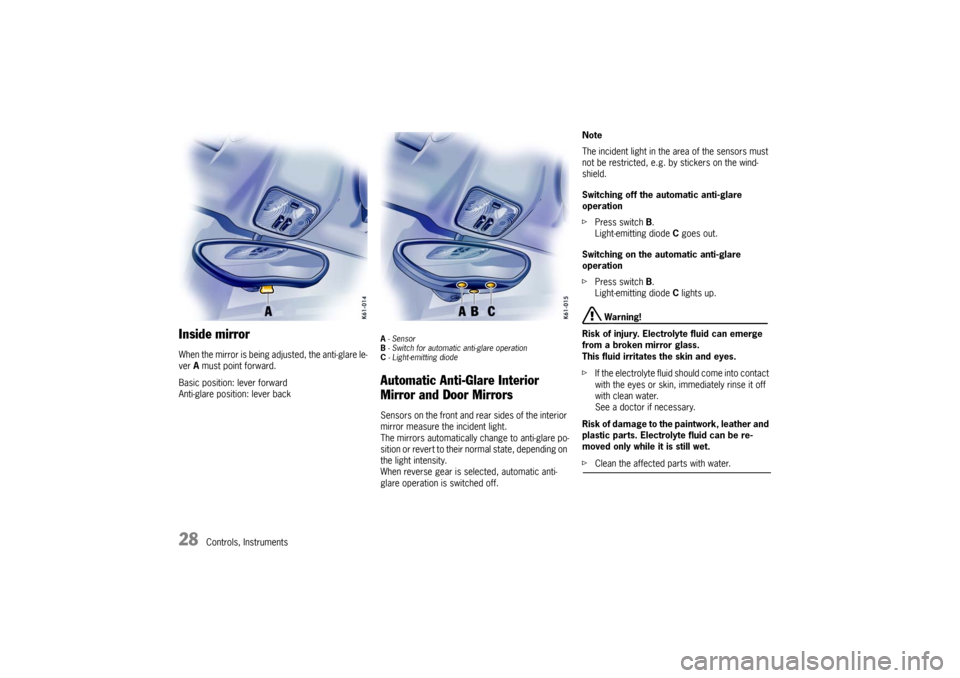
Inside mirror When the mirror is being adjusted, the anti-glare le-
ver A must point forward.
Basic position: lever forward
Anti-glare position: lever back
A - Sensor
B - Switch for automatic anti-glare operation
C - Light-emitting diode Automatic Anti-Glare Interior
Mirror and Door Mirrors Sensors on the front and rear sides of the interior
mirror measure the incident light.
The mirrors automatically change to anti-glare po-
sition or revert to their normal state, depending on
the light intensity.
When reverse gear is selected, automatic anti-
glare operation is switched off. Note
The incident light in the area of the sensors must
not be restricted, e.g. by stickers on the wind-
shield.
Switching off the automatic anti-glare
operation
fPress switch B.
Light-emitting diode C goes out.
Switching on the automatic anti-glare
operation
fPress switch B.
Light-emitting diode C lights up.
Warning!
Risk of injury. Electrolyte fluid can emerge
from a broken mirror glass.
This fluid irritates the skin and eyes.
fIf the electrolyte fluid should come into contact
with the eyes or skin, immediately rinse it off
with clean water.
See a doctor if necessary.
Risk of damage to the paintwork, leather and
plastic parts. Electrolyte fluid can be re-
moved only while it is still wet.
fClean the affected parts with water.
Page 70 of 280
70
Controls, Instruments
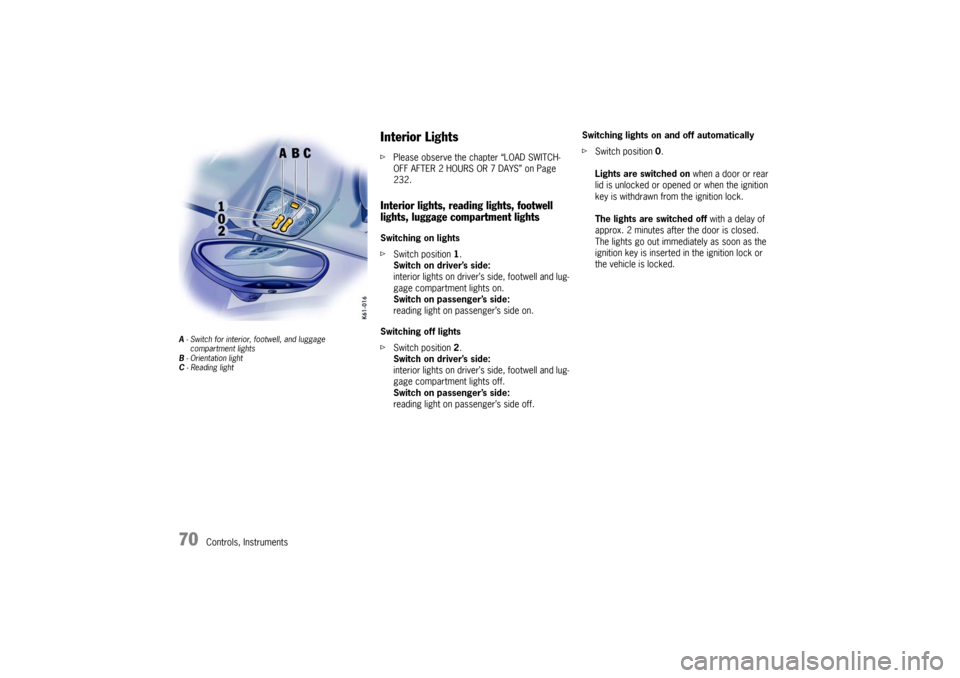
A - Switch for interior, footwell, and luggage
compartment lights
B - Orientation light
C - Reading light
Interior LightsfPlease observe the chapter “LOAD SWITCH-
OFF AFTER 2 HOURS OR 7 DAYS” on Page
232.Interior lights, reading lights, footwell
lights, luggage compartment lightsSwitching on lights
fSwitch position 1.
Switch on driver’s side:
interior lights on driver’s side, footwell and lug-
gage compartment lights on.
Switch on passenger’s side:
reading light on passenger’s side on.
Switching off lights
fSwitch position 2.
Switch on driver’s side:
interior lights on driver’s side, footwell and lug-
gage compartment lights off.
Switch on passenger’s side:
reading light on passenger’s side off.Switching lights on and off automatically
fSwitch position 0.
Lights are switched on when a door or rear
lid is unlocked or opened or when the ignition
key is withdrawn from the ignition lock.
The lights are switched off with a delay of
approx. 2 minutes after the door is closed.
The lights go out immediately as soon as the
ignition key is inserted in the ignition lock or
the vehicle is locked.
Page 131 of 280

Controls, Instruments
131
Defrost windshieldfPress button B (switch on or off).
The light-emitting diode in the button lights up.
The windshield is demisted or defrosted as
quickly as possible.
Air flows to the windshield only.Circulating-air mode
Warning!
Risk of accident due to hampered vision.
In circulating-air mode, the windows may
mist with.
fOnly select circulating-air mode for short
periods.
fIf the windows mist with, switch air-circulation
mode off immediately by pressing the
air-circulation button again and selecting the “Defrost windshield” function.
Switching circulating-air mode on or off
fPress circulating-air button C.
The light-emitting diode in the button lights up.
The outside-air supply is interrupted and only
the inside air is circulated.
ECO – switching the air-conditioning
compressor on and offThe air conditioning compressor switches off
automatically at temperatures below approx.
37°F/3°C and cannot be switched on, even
manually.
Whenever outside temperatures exceed approx.
37°F/3°C, the air-conditioning compressor can be
switched on or off manually.
The compressor can be switched off manual to
save fuel.
fPress ECO button E.
The light-emitting diode in the button lights up.
The compressor is switched off.
fIf the interior temperature is too high, switch
on the compressor again.
To dry incoming air in damp weather, do not
switch off the air-conditioning compressor.
This prevents misting of windows.AC max operationIn AC max operation, the interior of your vehicle is
cooled as quickly as possible.
fPress AC max button H.
The light-emitting diode in the button lights up.
Air distributionThe individual air distributions can be combined as
desired.
If an air distribution is not selected, no symbol
appears in the display panel. Air flows then from
all vents as well as to the windshield.
Recommended setting in Summer –
Air distribution to central and side vents
Recommended setting in Winter –
Air distribution to footwell and windshield
Air distribution to footwell
fPress button I.
The selection appears on the display panel.
The air flows to the footwell.
Air distribution to center and side vents
fPress button J.
The selection appears on the display panel.
The air flows from the central and side vents.
Vents must be open.
Air distribution to windshield
fPress button K.
The selection appears on the display panel.
The air flows to the windshield.
Page 134 of 280

134
Controls, Instruments
Setting temperaturefPress button H upwards or downwards
respectively.
To suit personal comfort, the interior temperature
can be adjusted between 61°F and 85°F/16°C
and 29.5°C.
Recommendation: 72°F/22 °C.
If “LO” or “HI” appears on the display, the system
is operating at maximum cooling or heating
power.
Automatic control is no longer active.
Note
If the preselected temperature is changed, the
blower speed can increase automatically in
automatic mode.
The desired temperature is reached more quickly
this way.
Sensors
To avoid affecting the performance of the air-
conditioning system:
fDo not cover the sun sensor on the instrument
panel or the temperature sensor D.
Defrost windshieldfPress button B (switch on or off).
The windshield is demisted or defrosted as
quickly as possible.
Air flows to the windshield only.
The light-emitting diode in the button lights up.ECO – switching the air-conditioning
compressor on and offThe air conditioning compressor switches off
automatically at temperatures below approx.
37°F/3°C and cannot be switched on, even
manually.
Whenever outside temperatures exceed approx.
37°F/3°C, the air-conditioning compressor is
always switched on in automatic mode.
The compressor can be switched off manually to
save fuel, but control comfort is then limited:
fPress ECO button E.
The compressor is switched off.
The light-emitting diode in the button lights up.
fIf the interior temperature is too high, switch
compressor back on or press AUTO button.
To dry incoming air in damp weather, do not
switch off the air-conditioning compressor.
This prevents misting of windows.
Adjusting blower speedfPress button M upwards or downwards
respectively.
The preset blower speed is increased or
decreased.
The speeds are indicated by a bar display.
The compressor is switched off at low blower
speeds.
If the button is pressed downwards at the lowest
blower stage, the blower and automatic control
are switched off. “OFF” will appear on the display
field.
Pressing the button upwards or pressing the
AUTO button switches the blower and automatic
control back on again.Circulating-air mode
Warning!
Risk of accident due to hampered vision.
In circulating-air mode, the windows may
mist up.
fOnly select circulating-air mode for short
periods.
fIf the windows mist up, switch air-circulation
mode by pressing the air-circulation button
again and selecting the “Defrost windshield” function.
Page 135 of 280

Controls, Instruments
135
Switching circulating-air mode on or off
fPress button C.
The outside-air supply is interrupted and only
the inside air is circulated.
The light-emitting diode in the button lights up.
Over approx. 37°F/3°C
If the air-conditioning compressor was off, it
switches on automatically. The duration of
circulating-air mode is not limited.
Below approx. 37°F/3°C
The air-conditioning compressor is switched off.
Circulating-air mode is automatically ended after
approx. 3 minutes.Air distributionThe individual air distributions can be combined as
desired.
Recommended setting in Summer –
Air distribution to central and side vents
Recommended setting in Winter –
Air distribution to footwell and windshield
Air distribution to footwell
fPress button J.
The air flows to the footwell.
The selection appears on the display panel.Air distribution to center and side vents
fPress button K.
The air flows from the central and side vents.
Vents must be open.
The selection appears on the display panel.
Air distribution to windshield
fPress button L.
The air flows to the windshield.
The selection appears on the display panel.
Note on operation
fOn vehicles with the Sport Chrono package
Plus, individual air conditioning settings can be
stored on your vehicle key.
Please observe the chapter “Individual
Memory” in the separate PCM operating
instructions.
Information on air-conditioning
compressor– May switch off briefly to ensure sufficient
engine cooling if the engine is operating under
extreme load.
– Operates most effectively with the windows
closed.
If the vehicle has been in the sun for a long
time, it is a good idea to ventilate the interior
briefly with the windows open.
– Depending on the outside temperature and
humidity, condensation can drip from the
evaporator and form a pool under the car.
This is normal and not a sign of leakage.
– If uncooled air flows out when the lowest
temperature has been set, switch off the air
conditioning compressor and have the fault
remedied.
Please contact your authorized Porsche dealer
for further information.
Page 200 of 280

200
Maintenance, Car Care
Warning!
Danger of fire and serious personal injuries.
fDo not apply additional undercoating or rust-
proofing on or near the exhaust manifold, ex-
haust pipes, catalytic converters or heat
shields. During driving the substance used for undercoating could overheat and ignite.
fBefore applying fresh underseal, carefully re-
move deposits or dirt and grease. Once it has
dried, the new undercoating compound forms
a tough protective coating which provides effi-
cient rust-proofing of the floor panels and com-
ponents.
fAlways apply a fresh coating of suitable pre-
servative to unprotected areas after cleaning
the underside of the body, the transmission,
the engine or carrying out repairs to under-
body, engine or transmission components.
Effective rust-proofing is particularly important
during the cold weather season. If your car is driv-
en frequently in areas where salt has been spread
on the roads, the whole engine compartment
should be cleaned thoroughly after the winter to
prevent salt from causing any lasting damage. A
full under-body wash should also be performed at
the same time.
Door, lid and window seals fWash dirt (e.g. abrasion, dust, road salts) from
all seals regularly using warm soapy water. Do
not use any chemical cleaning agents or sol-
vents.
When there is a frost hazard, the outer door seals
and the front and rear lid seals can be protected
against freezing into place by a suitable care prod-
uct.
In order to prevent damage to the anti-fric-
tion coating, the inner door seals must not be
treated with care products. Stainless steel exhaust tailpipesStainless steel exhaust tailpipes can discolor due
to soiling, strong heat, and combustion residues.
The original polish can be achieved again using
commercially available metal polishing paste or
metal polish.
Headlights, lights, interior and exterior
plastic parts fUse only clean water and a little dishwashing
detergent to clean light lenses, plastic head-
light lenses, plastic parts and surfaces.
Do not clean when dry.
Use a soft sponge or a soft, lint-free cloth. Gen-
tly wipe the surface without applying too much
pressure.
The Porsche inside window cleaner is also suit-
able for cleaning plastic surfaces. Follow the
cleaning instructions on the container.
Never use other chemical cleaners or
solvents.
fRinse cleaned surfaces with clear water.
Page 278 of 280

278Ignition lock............................. 74
, 76, 77, 165
Immobilizer .................................................. 17
Instrument
Illumination ........................................... 82
Lights ................................................ 122
Panel ................................................... 79
Interior lights .............................................. 257
Interior mirror ............................................... 28
JJump lead starting ...................................... 242KKeylock...................................................... 165
Keys ............................................................ 17
with remote control ............................... 18LLATCH System.............................................. 53
Leather care............................................... 201
License plate light....................................... 122
Lids .......................................... 146
, 148
, 150
Emergency unlocking.......................... 234
Light
Flasher................................ 85
, 122
, 124
Low beam ..................................122, 124
Switch................................................ 124
Light alloy wheels ....................................... 201
Inscription .......................................... 220
Load switch-off ........................................... 232
Loading information .................................... 221
Locking........................................................ 21Luggage compartment ................................ 257
Cover ................................................. 154
Lids ................................................... 147
Net .................................................... 151
MMaintenance ............................................... 172
Make-up mirror ............................................. 39
Maximum permitted engine speeds ....... 14
, 164
Mirrors ......................................................... 29
Anti-glare .............................................. 28
Multi-Functional steering wheel
Function keys........................................ 38
NNavigation .................................................. 155
Notes on
Car care ............................................. 195
Maintenance ....................................... 172
Number plate light ............................. 122
, 254
OOctane rating..................................... 188
, 189
Off delay .................................................... 123
Oil ............................................................. 271
Checking level .................................... 110
Consumption ........................................ 14
Level checks ...................................... 179
Level indicator .................................... 110
On-board computer .................................. 8, 92
Basic settings ..................................... 112
Language versions.............................. 112On-board literature ..........................................2
Outside temperatur indicator..........................89
PPaint
Care...................................................195
Data ...................................................265
ParkAssistant................................................68
Parking
Aids .....................................................68
Assistant ..............................................69
Brake ...................................................55
Light ..................................................122
Particle filter ...............................................194
Plastic parts ...............................................200
Platform lift.................................................223
Porsche Active Suspension Management (PASM) .
65
Porsche Ceramic Composite Brake (PCCB) ..... 8
,
228
Porsche Communication Management ..... 8
, 155
Porsche Stability Management (PSM) ..............62
Information light ....................................64
Power measurements ..................................172
Power steering fluid level .................... 193, 271
Power windows ...................................... 23, 26
Practical tips ..............................................206
RRadiator fans ..............................................177
Radio reception...........................................156
Rain sensor ................................................125
Range on remaining fuel ....................... 93
, 113