time PORSCHE CAYMAN 2006 1.G Owners Manual
[x] Cancel search | Manufacturer: PORSCHE, Model Year: 2006, Model line: CAYMAN, Model: PORSCHE CAYMAN 2006 1.GPages: 280, PDF Size: 4.89 MB
Page 2 of 280

2Dear Owner, we would like to thank you for your purchase of a
Porsche Sports car.
Judging by the car you have chosen, you are a mo-
torist of a special breed, and you are probably no
novice when it comes to automobiles.
Remember however, as with any vehicle, you
should take time to familiarize yourself with your
Porsche and its performance characteristics. Al-
ways drive within your own unique capabilities as
a driver and your level of experience with your
Porsche. Ensure that anyone else driving your
Porsche does the same. To prevent or minimize in-
jury, always use your safety belts. Never consume
alcohol or drugs before or during the operation of
your vehicle.
This Owner’s Manual contains a host of useful in-
formation. Please take the time to read this manu-
al before you drive your new Porsche. Become fa-
miliar with the operation of your Porsche car for
maximum safety and operating pleasure. The bet-
ter you know your Porsche, the more pleasure you
will experience driving your new car.
Always keep your Owner’s Manual in the car, and
give it to the new owner if you ever sell your
Porsche. A separate Maintenance Booklet explains how
you can keep your Porsche in top driving condition
by having it serviced regularly.
A separate Warranty and Customer Informa-
tion Booklet contains detailed information about
the warranties covering your Porsche.
For U.S. only:
If you believe that your vehicle has a fault which
could cause a crash, injury or death, you should
immediately inform the National Highway Traffic
Safety Administration (NHTSA) in addition to
notifying Porsche Cars North America, Inc.
(Porsche Cars N.A.).
If NHTSA receives similar complaints, it may open
an investigation, and if it finds that a safety prob-
lem exists in a group of vehicles, it may order a re-
call and remedy campaign. However, NHTSA can-
not become involved in individual problems be-
tween you and your dealer, or Porsche Cars N.A..
To contact NHTSA, you may either call the Auto
Safety Hotline toll-free at 1(800)424-9393 (or
366-
0123 in Washington, D.C. area) or write to: NHT-
SA, U.S. Department of Transportation, Washing-
ton, D.C. 20590. You can also obtain other infor-
mation about motor vehicle safety from the Hot-
line. Your car has thousands of parts and components
which have been designed and manufactured in
accordance with Porsche’s high standards of engi-
neering quality and safety.
Any alteration of the vehicle may negate or
interfere with those safety features built into
the vehicle. Modifications may be carried out
on your vehicle only if approved by Porsche.
Your Porsche is intended to be used in a safe man-
ner obeying the local laws and in the light of driv-
ing conditions faced by you, and in accordance
with the instructions provided in this Owner’s Man-
ual.
Do not misuse your Porsche by ignoring
those laws and driving conditions, or by
ignoring the instructions in this manual.
Any alteration or misuse of the vehicle can
lead to accidents and severe or fatal person
al injuries.
The fitting of racing tires (e.g. slicks) for sporting
events is not approved by Porsche. Very high cor-
nering speeds can be achieved with racing tires.
However, the resulting transverse acceleration
values would jeopardize the adequate supply of oil
to the engine.
Porsche therefore will not accept any warranty or
accept any liability for damage occurring as a re-
sult of non-compliance with this provision.
Page 3 of 280

3
Regularly check your vehicle for signs of
damage.
Damaged or missing aerodynamic compo-
nents such as spoilers or underside panels
affect the driving behavior and therefore
must be replaced immediately.
Your car may have all or some of the components
described in this manual.
Should you have difficulty understanding any of
the explanations of features or equipment installed
in your vehicle, contact your authorized Porsche
dealer. He/She will be glad to assist you. Also
check with your dealer on other available options
or equipment.
Throughout this booklet, left is designated as the
driver’s side of the vehicle, and right as the pas-
senger’s side of the vehicle.
Text, illustrations and specifications in this manual
are based on the information available at the time
of printing.
It has always been Porsche’s policy to continuous-
ly improve its products. Porsche, therefore, re-
serves the right to make changes in design and
specification, and to make additions or
improvements in its product without incurring any
obligation to install them on products previously
manufactured.
We wish you many miles of safe and pleasurable
driving in your Porsche.
Important
For your own protection and longer service life of
your car, please follow all operating instructions
and special warnings. These special warnings use
the safety alert symbol, followed by the words
Danger, Warning and Caution. These special
warnings contain important messages regarding
your safety and/or the potential for damage to
your Porsche. Ignoring them could result in seri-
ous mechanical failure or even physical injury.
fDo not alter your Porsche. Any alteration could
create dangerous conditions or defeat safety
engineering features built into your car.
fDo not misuse your Porsche. Use it safely, and
consistently with the law, according to the driv-
ing conditions, and the instructions in this man-
ual.
Alteration or misuse of your Porsche could
cause accidents and severe or fatal personal
injuries.
Note to owners In Canada, this manual is also available in French.
To obtain a copy contact your dealer or write to: Note aux proprietaires Au Canada, ce manuel est également disponible
en francais. Pour en obtenir un exemplaire, adres-
sez-vous à votre concessionnaire ou écrivez à
l’adresse ci-dessous.
Porsche Cars Canada, Ltd.
Automobiles Porsche Canada, LTEE
5045 Orbitor Drive
Building #8, Suite 200
Mississauga, Ontario
Canada L4W 4Y4
Telephone number for customer assistance:
1-800-PORSCHE / Option 3
Page 14 of 280

14
Controls, Instruments
Break in hints for the first
2,000 miles/3,000 kilometers The following tips will be helpful in obtaining opti-
mum performance from your new Porsche.
Despite the most modern, high-precision manufac-
turing methods, it cannot be completely avoided
that the moving parts have to wear in with each
other. This wearing-in occurs mainly in the first
2,000 miles/3,000 km. Therefore: fPreferably take longer trips.
fAvoid frequent cold starts with short-distance
driving whenever possible.
fAvoid full throttle starts and abrupt stops.
fDo not exceed maximum engine speed of
4,200 rpm (revolutions per minute).
fDo not run a cold engine at high rpm either in
Neutral or in gear.
fDo not let the engine labor, especially when
driving uphill. Shift to the next lower gear in
time (use the most favorable rpm range).
fNever lug the engine in high gear at low
speeds. This rule applies at all times, not just
during the break-in period. fDo not participate in motor racing events,
sports driving schools, etc. during the first
2,000 miles/3,000 kilometers.
There may be a slight stiffness in the steering,
gear-shifting or other controls during the break-in
period which will gradually disappear.
Break in brake pads and break discsNew brake pads and discs have to be “broken in”,
and therefore only attain optimal friction when the
car has covered several hundred miles or km.
The slightly reduced braking ability must be com-
pensated for by pressing the brake pedal harder.
This also applies whenever the brake pads and
brake discs are replaced. New tires New tires do not have maximum traction. They
tend to be slippery.
fBreak in new tires by driving at moderate
speeds during the first 60 to 120 miles/100 to
200 km. Longer braking distances must be an-
ticipated.
Engine oil and fuel consumption During the break-in period oil and fuel consump-
tion may be higher than normal.
As always, the rate of oil consumption depends on
the quality and viscosity of oil, the speed at which
the engine is operated, the climate and road con-
ditions, as well as the amount of dilution and oxi-
dation of the lubricant.
fMake a habit of checking engine oil with every
fuel filling, add if necessary.
Page 17 of 280

Controls, Instruments
17
Keys fPlease observe the chapter “CENTRAL LO-
CKING” on Page 19.
Two main keys and one spare key are supplied
with your Porsche.
These keys operate all the locks on your vehicle.
fBe careful with your car keys: do not part with
them except under exceptional circumstances.
fTo avoid battery run-down, always remove the
ignition key from the ignition lock.
Replacement keys Replacement car keys can be obtained only from
your authorized Porsche dealer, and this can
sometimes be very time-consuming.
You should therefore always keep the spare key on
your person.
Keep it in a safe place (e.g. wallet), but under no
circumstances in or on the vehicle.
The key codes of new keys have to be “reported”
to the car control unit by your authorized Porsche
dealer.
A total of 6 car keys can be taught.
Disabling key codes
If a key is lost, the key codes can be disabled by
an authorized Porsche dealer.
All the remaining car keys are required for this pur-
pose.
Disabling the code ensures that the car can be
started only using authorized keys.
Note
fPlease note that the other locks can still be
opened with the disabled key.
Immobilizer There is a transponder (an electronic component)
in the key grip, containing a stored code.
When the ignition is switched on, the ignition lock
checks the code.
The immobilizer can be deactivated and the en-
gine started only using an authorized ignition key.
Switching off the immobilizer
fInsert the ignition key into the ignition lock.
If the ignition is left on for more than 2 minutes
without starting the engine, the immobilizer is re-
activated.
fIf this happens, turn the ignition key back to the
3 position before starting the engine.
Please observe the chapter “0 - INITIAL POSITI-
ON 1 - IGNITION ON 2 - START ENGINE 3 - IG-
NITION OFF” on Page 74.
Switching on the immobilizer
fRemove ignition key.Security Wheel Bolts fIf wheels have to be removed during a repair-
shop visit, do not forget to hand over the sock-
et for the security wheel bolts along with the
car key.
Page 18 of 280
18
Controls, Instruments
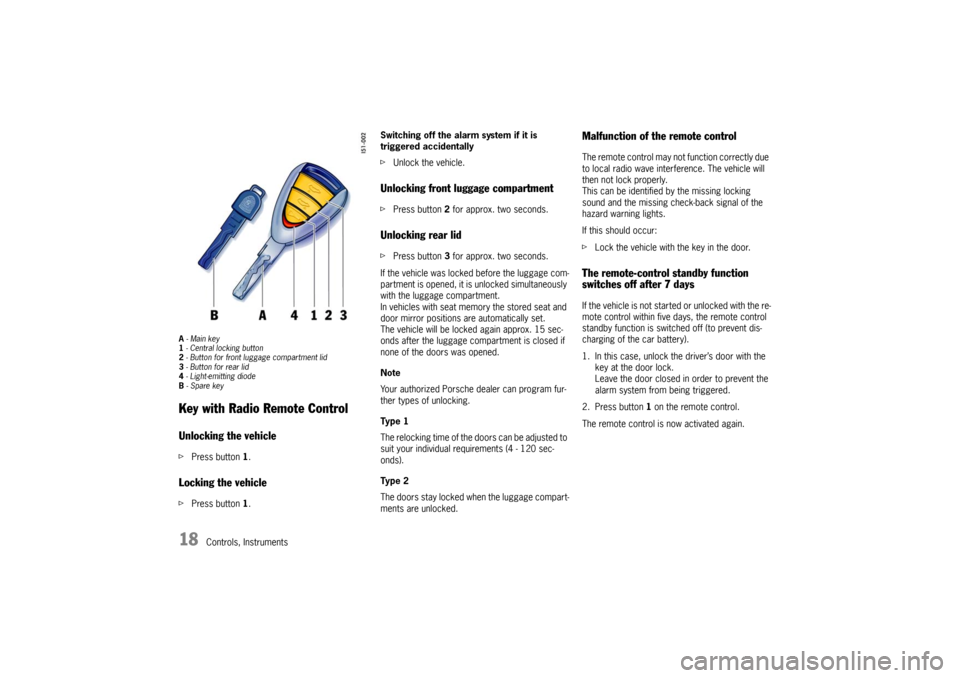
A - Main key
1 - Central locking button
2 - Button for front luggage compartment lid
3 - Button for rear lid
4 - Light-emitting diode
B - Spare key Key with Radio Remote ControlUnlocking the vehiclefPress button 1.Locking the vehiclefPress button 1.Switching off the alarm system if it is
triggered accidentally
fUnlock the vehicle.
Unlocking front luggage compartment fPress button 2 for approx. two seconds. Unlocking rear lid fPress button 3 for approx. two seconds.
If the vehicle was locked before the luggage com-
partment is opened, it is unlocked simultaneously
with the luggage compartment.
In vehicles with seat memory the stored seat and
door mirror positions are automatically set.
The vehicle will be locked again approx. 15 sec-
onds after the luggage compartment is closed if
none of the doors was opened.
Note
Your authorized Porsche dealer can program fur-
ther types of unlocking.
Ty p e 1
The relocking time of the doors can be adjusted to
suit your individual requirements (4 - 120 sec-
onds).
Ty p e 2
The doors stay locked when the luggage compart-
ments are unlocked.
Malfunction of the remote controlThe remote control may not function correctly due
to local radio wave interference. The vehicle will
then not lock properly.
This can be identified by the missing locking
sound and the missing check-back signal of the
hazard warning lights.
If this should occur:
fLock the vehicle with the key in the door.The remote-control standby function
switches off after 7 days If the vehicle is not started or unlocked with the re-
mote control within five days, the remote control
standby function is switched off (to prevent dis-
charging of the car battery).
1. In this case, unlock the driver’s door with the
key at the door lock.
Leave the door closed in order to prevent the
alarm system from being triggered.
2. Press button 1 on the remote control.
The remote control is now activated again.
Page 19 of 280

Controls, Instruments
19
Central Locking This device complies with:
Part 15 of the FCC Rules
RSS-210 of Industry Canada.
Operation is subject to the following two condi-
tions:
1. This device may not cause harmful interfer-
ence, and
2. this device must accept any interference re-
ceived, including interference that may cause
undesired operation.
Note
The manufacturer is not responsible for any radio
or TV interference caused by unauthorized modifi-
cations to this equipment.
Such modification could void the user’s authority
to operate the equipment.
Warning!
Any changes or modifications not expressly ap-
proved by Porsche could void the user’s authority
to operate this equipment.
fPlease observe the chapter “LOAD SWITCH-
OFF AFTER 2 HOURS OR 7 DAYS” on Page
232.
fPlease observe the chapter “SEAT MEMORY”
on Page 34.fPlease observe the chapter “POWER WIN-
DOWS” on Page 26.
Both car doors and the filler flap can be centrally
unlocked or locked with the remote control.
The vehicle cannot be locked if the driver’s door is
not completely closed.
A short signal from the alarm horn will draw
your attention to the fact that the following
components are not completely closed when you
try to lock the vehicle:
– Doors
– Luggage compartment lids
– Glove compartment
– Passenger compartment
Unlocking the vehicle by using the key in the door
lock and opening the door may activate the alarm
system within 10 seconds.
Note
On vehicles with the Sport Chrono package plus,
the PCM can be used to activate automatic door
locking.
fPlease observe the chapter “Individual Mem-
ory” in the separate PCM operating instruc-
tions.
Automatic relocking If the car is unlocked by remote control and none
of the car doors is opened within approx. 60 sec-
onds, automatic relocking takes place.
This relocking time can be adapted to your individ-
ual requirements (4 - 120 seconds) by an author-
ized Porsche dealer.
Page 22 of 280

22
Controls, Instruments
Automatic door locking Your authorized Porsche dealer can program di-
verse types of automatic door locking in the con-
trol unit of the central locking system.
Ty p e 1
Doors lock automatically when the ignition is
switched on.
Ty p e 2
Doors lock automatically when a speed of
3 - 6 mph (5 - 10 km/h) is exceeded.
Ty p e 3
Doors lock automatically when the ignition is
switched on. If doors are opened with the engine
running, they lock again automatically when a
speed of 3 - 6 mph (5 - 10 km/h) is exceeded.
Ty p e 4
The doors do not lock automatically. Note
Automatically locked doors can be unlocked with
the central locking button or opened by pulling on
the inside door handle twice.
On vehicles with the Sport Chrono package Plus,
the PCM can be used to activate automatic door
locking.
fPlease observe the chapter “Individual Memo-
ry” in the separate PCM operating instructions.
Warning!
In an emergency situation where you need to
exit the car through an automatically locked
door, remember the following procedure to
open the door.
fUnlock the doors by pressing the central lock-
ing button or
fpull the inside door handle twice to open the door.
Fault indication A double horn signal during locking indicates a
defect in the central locking or alarm system.
Have the defect remedied at an authorized
Porsche dealer. Overload protection If the central locking system is operated more
than ten times within a minute, further operation is
blocked for 15 seconds.
Page 32 of 280
32
Controls, Instruments
Seat Adjustment
Warning!
The seat may move unexpectedly if you
attempt to adjust while driving. This could
cause sudden loss of control or personal in-
jury.
fDo not adjust seats while the vehicle is in mo-
tion.
The backrest locks must be engaged at all
times while the vehicle is in motion.
Safety belts only offer protection when the
backrest is upright and the belts are properly
positioned on the body.
Improperly positioned safety belts or safety
belts worn by passengers in an excessively
reclined position can cause serious personal
injury in an accident.
fDo not operate the car with the driver or pas-
senger backrests excessively reclined (see “Seat position”).
Seat position An ergonomically correct sitting position is
important for safe and fatigue-free driving.
We recommend the following procedure for adjust-
ing the driver’s seat to suit individual
requirements:
1. Vehicles with manual transmission:
Adjust the seat until, with the clutch pedal fully
depressed, your leg remains at a slight angle.
Vehicles with Tiptronic S:
Adjust the seat until, with your left foot on the
footrest, your left leg remains at a slight angle.2. Rest your outstretched arm on the steering
wheel.
Set the backrest angle and the steering-wheel
position so that your wrist rests on the outer
rim of the steering wheel. At the same time,
the shoulders must still be in noticeable
contact with the backrest.
3. Adjust the seat height to give yourself enough
headroom and a good overview of the vehicle.
4. Electrically adjustable seat:
Adjust the seat angle until your thighs rest
lightly on the seat cushion.
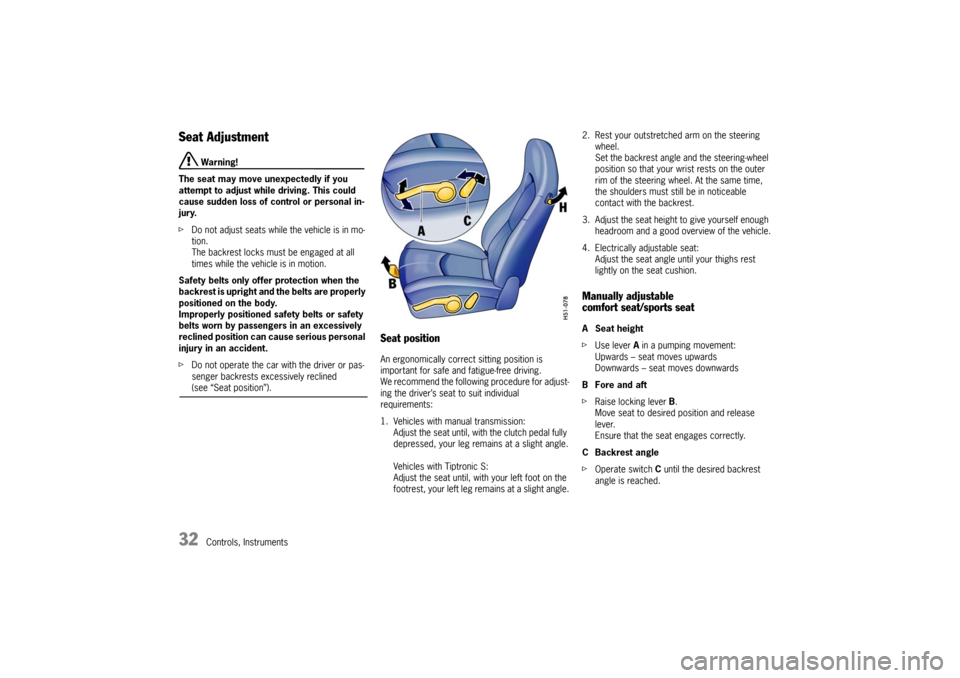
Manually adjustable
comfort seat/sports seatA Seat height
fUse lever A in a pumping movement:
Upwards – seat moves upwards
Downwards – seat moves downwards
B Fore and aft
fRaise locking lever B.
Move seat to desired position and release
lever.
Ensure that the seat engages correctly.
CBackrest angle
fOperate switch C until the desired backrest
angle is reached.
Page 40 of 280

40
Controls, Instruments
Safety Belts
Warning!
Always make sure your and your passenger’s
safety belts are properly fastened while the
vehicle is in motion.
Failure to follow safety belt warnings may re-
sult in serious personal injury or death.
fFor your and your passenger’s protection, use
safety belts at all times while the vehicle is in
motion.
fUse appropriate child restraint systems for all
small children.
Proper wearing of safety belts
fS a f e t y b e l t s m u s t b e p o s i t i o n e d o n t h e b o d y a s
to restrain the upper body and lap from sliding
forward. Improperly positioned safety belts
can cause serious personal injury or death in
case of an accident.
fThe shoulder belt should always rest on your
upper body. The shoulder belt should never be
worn behind your back or under your arm.
fFor maximum effectiveness, the lap belt
should be worn low across the hips.
fPregnant women should position the belt as
low as possible across the pelvis. Make sure it
is not pressing against the abdomen. fBelts should not be worn twisted.
fDo not wear belts over rigid or breakable ob-
jects in or on your clothing, such as eye glass-
es, pens, keys, etc. as these may cause injury.
fSeveral layers of heavy clothing may interfere
with proper positioning of belts.
fBelts must not rub against sharp objects or
damage may occur to the belt.
fTwo occupants should never share the same
belt at the same time.
Care and maintenance
fKeep belt buckles free of any obstruction that
may prevent a secure locking.
fBelts that have been subjected to excessive
stretch forces in an accident must be inspect-
ed or replaced to ensure their continued effec-
tiveness in restraining you.
The same applies to belt tensioner systems
which have been triggered.
In addition, the anchor points of the belts
should be checked.
fIf safety belts do not work properly, see your
authorized Porsche dealer immediately.
fI f t h e b e l t s s h o w d a m a g e t o w e b b i n g , b i n d i n g s ,
buckles or retractors, they should be replaced
to ensure safe operation.
fDo not modify or disassemble the safety belts
in your vehicle.
fThe belts must be kept clean or the retractors may not work properly.
Please observe the chapter “CAR CARE IN-
STRUCTIONS” on Page 195.
fNever bleach or dye safety belts.
fDo not allow safety belts to retract until they
are completely dry after cleaning or this may
cause damage to the belt.
Belt tensioner Depending on the force of an impact, fastened
safety belts are tightened in an accident.
The belt tensioners are triggered by:
– Front, side and rear impacts of sufficient
severity.
Note
The belt tensioner system can be triggered only
once; the system must be replaced afterward.
If there is a fault in the belt-tensioner system, the
airbag warning light lights up.
Work may be performed on the belt-tensioner sys-
tem only by an authorized Porsche dealer.
Smoke is released when the belt tensioners are
triggered. This does not indicate a fire in the
vehicle.
Page 41 of 280
Controls, Instruments
41
An audio-visual warning system is interconnect-
ed with the driver’s safety belt.
Every time the ignition is turned on, the gong will
sound for about 6 seconds to remind driver and
passenger to buckle up.
In addition, the gong will sound for approx. 90 sec-
onds if the vehicle speed exceeds 15 mph
(24 km/h).
The safety belt warning light in the instrument
panel and on-board computer will go off as soon
as the driver has buckled up.
Inertia reel retractor The combination lap/shoulder belt with inertia reel
locking mechanism adjusts automatically to your
size and movements as long as the pull on the belt
is slow.
Rapid deceleration during hard braking or a colli-
sion locks the belt. The belt will also lock when you
drive up or down a steep hill or in a sharp curve,
otherwise, the shoulder belt will not inhibit your
upper body movement.
Fastening the safety beltfAssume a comfortable sitting position.
The shoulder belt should always rest on your
upper body. The shoulder belt should never be
worn behind your back or under your arm.
fGrasp belt and pull the belt in a continuous
slow motion across your chest and lap.
fInsert belt tongue into buckle on inboard side
of seat. Push down until it securely locks with
an audible click. Pull the belt to check.
fPull shoulder section to make sure belt fits
snugly across the pelvis.
fBelts should fit snugly across the pelvis and
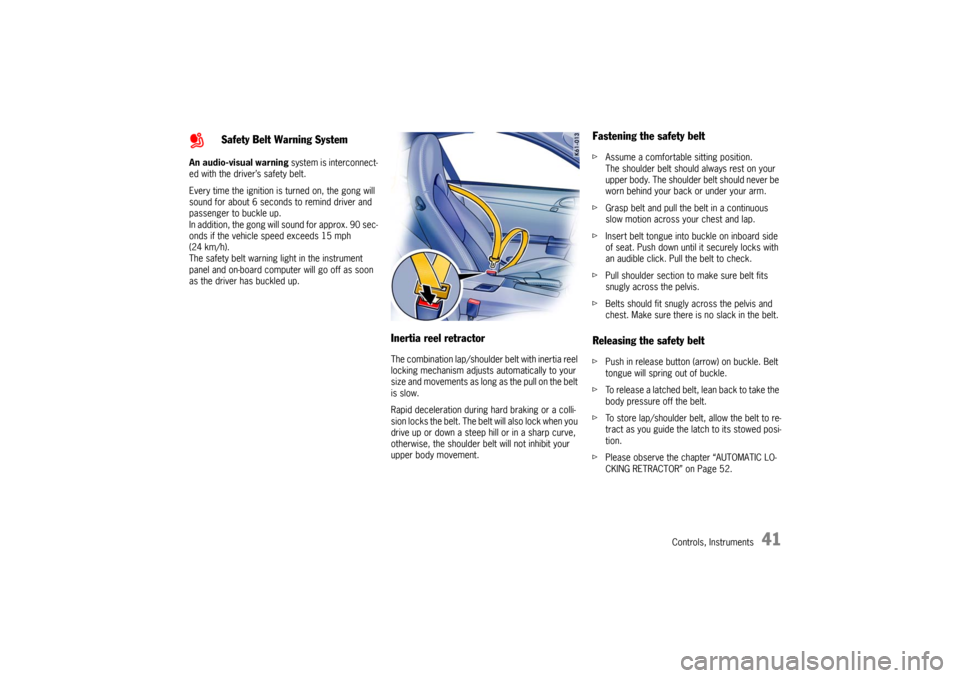
chest. Make sure there is no slack in the belt. Releasing the safety beltfPush in release button (arrow) on buckle. Belt
tongue will spring out of buckle.
fTo release a latched belt, lean back to take the
body pressure off the belt.
fTo store lap/shoulder belt, allow the belt to re-
tract as you guide the latch to its stowed posi-
tion.
fPlease observe the chapter “AUTOMATIC LO-
CKING RETRACTOR” on Page 52.
Safety Belt Warning System