tires PORSCHE CAYMAN 2009 1.G User Guide
[x] Cancel search | Manufacturer: PORSCHE, Model Year: 2009, Model line: CAYMAN, Model: PORSCHE CAYMAN 2009 1.GPages: 284, PDF Size: 5.94 MB
Page 160 of 284

158
Instruments, On-Board Computer, Warnings
System learningThe Tire Pressure Monitoring begins to “learn” the
wheels after a wheel change, wheel transmitter
replacement or update of the tire settings. During
this process, the Tire Pressure Monitoring recog-
nizes the tires and their locations.
The on-board computer displayes the message
“TPM is learning, monitoring not act.” .The Tire Pressure Monitoring requires a certain
amount of time to learn the wheels. During this
time, the current tire pressures are not available
on the on-board-computer:
– The tire pressure warning light remains lit until
all wheels have been learned.
– The display of the tire pressure function of the on-board computer shows lines.
– The required pressures for cold tires at 68 °F (20 °C) are indicated in the Info pressure
display in the tire pressure menu.
Position and pressure information is displayed as
soon as the Tire Pressure Monitoring has as-
signed the wheels identified as belonging to the
vehicle to the correct wheel positions.
The wheel learning process takes place
exclusively when the vehicle is being driven
(vehicle speed above 25 km/h (16 mph)).
f Check the tire pressure for all wheels on the
“Info pressure” display.
f Correct the tire pressure to the required
pressure if necessary.
Changing a wheel and replacing tiresfNew wheels must be fitt ed with radio transmit-
ters for the Tire Pressure Monitoring.
Before tires are changed, the battery charge
state of the wheel transmitters should be
checked at an authorized Porsche dealer.
f Switch the ignition off when changing a wheel.
The tire settings on the on-board computer must
be updated after changing a wheel.
If the tire settings are not updated, the message
“Wheel change? Input new TPM settings!” is
displayed on the on-board computer.
f Update the on-board computer settings when
the vehicle is stationary the next time.
Page 161 of 284

Instruments, On-Board Computer, Warnings
159
Warning!
Your vehicle has also be en equipped with a TPM
malfunction indicator to indicate when the system
is not operating properly.
The TPM malfunction indicator is combined with
the low tire pressure telltale.
When the system detects a malfunction, the tellta-
le will flash for approximately one minute and then
remain continuously illuminated. This sequence
will continue upon subsequent vehicle start-ups as
long as the malfunction exists.
When the malfunction indi cator is illuminated, the
system may not be able to detect or signal low tire
pressure as intended.
TPM malfuntions may occur for a variety of
reasons, including the installation of replacement
or alternate tires or wheels on the vehicle that
prevent the TPM from functioning properly.
Always check the TPM malfunction telltale after
replacing one or more tires or wheels on your
vehicle to ensure that the replacement or alter-
nate tires and wheels allow the TPM to continue to
function properly.
The warning light in the speedometer lights up:
– When a loss in pressure has been detected.
– When learning newly mounted wheels/wheel sensors, as long as the vehicle’s own wheels
have not yet been recognized. In the event of a defect in Tire Pressure Monitoring
or a temporary fault, the warning light in the
speedometer flashes for approx. one minute and
then remains continuously illuminated.
The tire pressure warning light in the instrument
panel goes out only when
the cause of the fault
has been rectified.
Partial monitoringMonitoring of the other wheels is continued if there
is a fault in one or two wheel transmitters.
– The tire pressure warning light lights up.
– The message “TPM partial monitoring” is displayed on the on-board computer.
– No tire pressures are displayed on the on- board computer for wheels with faulty wheel
transmitters.
No monitoringIn the event of faults the Tire Pressure Monitoring
cannot monitor the tire pressure.
The warning light in the speedometer flashes for
approx. one minute and then remains continuously
illuminated and a corresponding message
appears on the on-board computer.
Monitoring is not active when:
– the Tire Pressure Monitoring is faulty,
– wheel transmitters for the Tire Pressure Monitoring are missing,
– during the learning phase after the tire settings have been updated,
– after a wheel change without updating the tire settings,
– more than four wheel transmitters are detected,
– there is external interference by other radio sources, e.g. wireless headphones,
– tire temperatures are too high.
f Please see the chapter “WARNINGS ON THE
INSTRUMENT PANEL AND THE ON-BOARD
COMPUTER” on Page 166.
Warning light
Page 162 of 284

160
Instruments, On-Board Computer, Warnings
Pressure increase as the result of
temperature increaseIn accordance with physical principles, the air
pressure changes as the temperature changes.
The tire pressure increases or decreases by
around 1.5 psi (0.1 bar) for every 18 °F (10 °C)
change in temperature.
The Tire Pressure Monitoring takes this relation-
ship between tire pressure and temperature into
account.
Tire pressure specificationsInformation on tire pressure for public roads can
be found in this Owner's Manual in the Technical
Data chapter or on the tire-pressure plate in the
left door aperture.
These values apply to cold tires at 68 °F (20 °C)
ambient temperature.
Page 174 of 284

172
Warnings
System fault
Go to workshopSeveral systems may have
failed. Adjust your
driving style. Reduce speed.
Have the fault remedied at an authorized
Porsche dealer.
Failure of fuel level indicator
Workshop Have the fault remedied at an authorized
Porsche dealer.
Service in mls/days Service indicator
Bring the vehicle in for service no later than af-
ter the distance/time shown has elapsed.
Please observe the additional information in the
“Maintenance” booklet.
Service now Service indicator
Have your vehicle serviced at an authorized
Porsche dealer.
Flat tyre! Tire Pressure Monitoring has detected a serious
pressure loss.
Stop at a suitable plac e and check tires for dam-
age. Fill in tire sealant if necessary.
Add air The Tire Pressure Monitoring has detected a
gradual pressure loss. Correct tire pressure at
the next opportunity.
TPM is learning
monitoring
not act. The Tire Pressure Monitoring is learning the
wheels on the vehicle. The Tire Pressure Moni-
toring is searching for the tires and their posi-
tion. During this period
the current pressure
specifications are not av ailable on the on-board
computer.
TPM inactive The Tire Pressure Monitoring is faulty.
Consult an authorized Porsche dealer.
Instrument
panel On-board
computerText display on on-board
computer Meaning/measure
Page 196 of 284

194
Maintenance, Car Care
Fuel Economy Fuel economy will vary depending on where,
when and how you drive, optional equipment
installed, and the general condition of your
car.
A car tuned to specifications and correctly
maintained, will help you to achieve optimal
fuel economy.
fHave your vehicle tuned to specifications.
Air cleaner should be dirt free to allow proper
engine “breathing”.
Battery should be fully charged.
Wheels should be properly aligned.
Tires should be inflated at correct pressure.
f Always monitor your fuel consumption.
f Drive smoothly, avoid abrupt changes in speed
as much as possible.
f Avoid jack rabbit starts and sudden stops.
f Do not drive longer than necessary in the lower
gears. Shifting into a higher gear early without
lugging the engine will help save fuel.
f Prolonged “warm up” idling wastes gas. Start
the vehicle just before you are ready to drive.
Accelerate slowly and smoothly.
f Switch off the engine if stationary for longer
periods. f
Any additional weight carried in the vehicle re-
duces fuel economy. Always keep cargo to a
minimum and remove all unnecessary items.
f Organize your trips to take in several errands
in one trip.
f All electrical accessories contribute to in-
creased fuel consumption.
f Only switch on the air conditioning when neces-
sary.
f Do not drive with the Ro of Transport System
mounted unless you need it.
The EPA estimated mpg. is to be used for
comparison purposes, actual mileage may
be different from the estimated mpg.,
depending on your driving speed, weather
conditions and trip length. Your actual
highway mileage will probably be less than
the estimated mpg.
f Please observe all local and national speed
limits.
Operating your Porsche in other
Countries Government regulations in the United States and
Canada require that automobiles meet specific
emission regulations and safety standards. There-
fore, cars built for the U.S. and Canada differ from
vehicles sold in other countries.
If you plan to take your Porsche outside the conti-
nental limits of the United States or Canada, there
is the possibility that
– unleaded fuel may not be available;
– unleaded fuel may have a considerably lower
octane rating. Excessive engine knock and se-
rious damage to both engine and catalytic con-
verters could result;
– service ma y be inadequa te due to lack of prop- er service facilities, tools or diagnostic equip-
ment;
– replacement parts may not be available or very difficult to get.
Porsche cannot be responsible for the
mechanical damage that could result
because of inadequate fuel, service or parts
availability.
If you purchased your Porsche abroad and want to
bring it back home, be sure to find out about ship-
ping and forwarding requirements, as well as cur-
rent import and customs regulations.
Page 205 of 284

Maintenance, Car Care
203
Car Care Instructions fPlease see the chapter “EXERCISE EXTREME
CAUTION WHEN WORKING ON YOUR VEHICLE”
on Page 186.
Regular and correct care helps to maintain
the value of your car and is also a
precondition for the New Vehicle Warranty
and the Anti Corrosion Warranty.
Your authorized Porsche dealer has specially
developed car-care products from the
Porsche program available either singly or
as complete car-care sets. They will be
pleased to help you select suitable products.
Whether you use Porsche products or other
commercially available cleaning agents first
make sure of their correct application.
A Porsche that is well-cared for can look like new
for years. It all depends on the amount of care the
owner is willing to give the car.
Warning!
Risk of serious personal injury or damage to
the vehicle or property.
Cleaning agents may be hazardous to your
health.
Most chemical cleaners are concentrates
which require dilution. High concentrations
might cause problems ranging from irritation
to serious injury as we ll as damage to your
vehicle. f
Keep cleaning agents out of reach from chil-
dren.
f Observe all caution labels.
f Always read directions on the container before
using any product. These directions may con-
tain information necessary to avoid personal
injury.
f Do not use fuel, kerosene, naphtha, nail polish
remover or other volatile cleaning fluids. They
may be toxic, flammable or hazardous in other
ways. Only use spot removing fluids in a well
vented area.
f Do not clean the underside of chassis, fend-
ers, wheel covers, etc., without protecting
your hands and arms as you may cut yourself
on sharp-edged metal parts.
Moisture and road salt on brakes may affect brak-
ing efficiency.
f Test the brakes after each vehicle washing.
Decorative film
Caution!
Risk of damage due to separation of the
decorative film when cleaning your vehicle
with high-pressure cleaning equipment or
steam cleaners.
f Do not use high-pressure cleaning equipment or steam cleaners for cl eaning decorative film.
High-pressure cleaning units, steam
cleaners
Warning!
High-pressure cleaning units or steam clean-
ers can damage the following components:
–tires,
– logos, emblems,
– painted surfaces,
– alternator,
– ParkAssist sensors.
f Please observe the operating instructions from
the unit manufacturer.
f When cleaning with a flat-jet nozzle or the like,
maintain a minimum distance of 20 inches (50
cm).
f Never use high-pressure cleaning units or
steam cleaners with a ro und-jet nozzle. A high-
pressure cleaning unit or steam cleaners with
round nozzle will damage your vehicle.
f The tires are particularly susceptible to dam-
age.
f Do not point the cleaning jet directly at any of the aforementioned components.
Page 212 of 284

210
Maintenance, Car Care
Storing your Porsche If you intend to store your Porsche for a prolonged
period, please consult your authorized Porsche
dealer. The staff will be glad to advise you on the
most suitable and necessary methods.
fClean your vehicle thoroughly inside and out-
side.
Clean the engine compartment.
The under carriage and chassis components
should be free of dirt and salt deposits.
f Fill up the fuel tank.
f Change the oil and oil filter, and run the engine
for several minutes.
f Increase the tire pressure to 50 psi (3.5 bar).
It is not recommended to lift the vehicle, due to
the possibility of corrosion on shock absorber
piston shafts.
The vehicle should be moved slightly, approxi-
mately every four weeks, to prevent flat spot
on the tires. Climate control
The air conditioning system should be in good
working condition and fully charged.
Windshield/Headlight washer
f
Check and correct antifr eeze/cleaning solution
level as necessary.
Electrical system
f Remove the battery from the vehicle and store
it in a cool dry place, not on a cement floor.
When the battery is disconnected, the
alarm system is deactivated.
f Recharge the battery every 3 months. If the
battery remains in the vehicle with the cables
connected, it is necessary to check, remove
and recharge the battery every 2-3 weeks.
Do not fast charge the battery.
f Please see the chapter “BATTERY” on
Page 239.
Vehicle interior
The interior must be dry, especially in the area of
the floor carpets. The use of drying agents (Silica-
Gel) is recommended in vehicles with leather inte-
rior and in areas with high humidity. The recom-
mended amount is 3 fabric bags of 1.1 lbs.
(500 grams) each placed on the floor carpets.
Windows, doors and lids must be closed. The air
vents should be opened.
Page 213 of 284
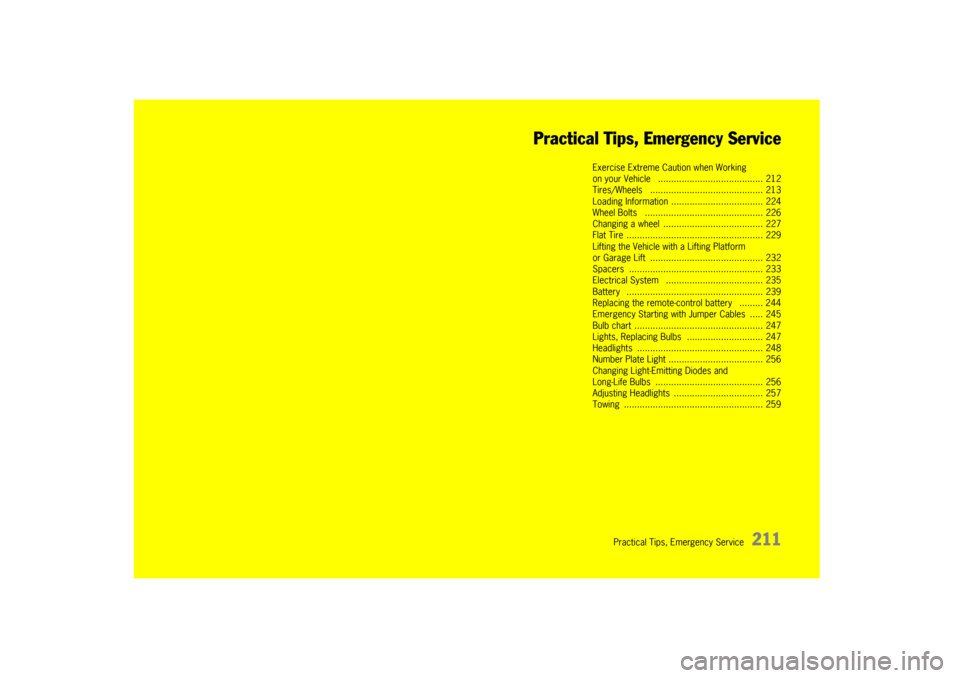
Practical Tips, Emergency Service
211
Practical Tips, Emergency Service
Exercise Extreme Caution when Working
on your Vehicle .
....................................... 212
Tires/Wheels ............................. .............. 213
Loading Information ................................... 224
Wheel Bolts .......... ................................... 226
Changing a wheel ... ................................... 227
Flat Tire ................. ................................... 229
Lifting the Vehicle with a Lifting Platform
or Garage Lift ........ ................................... 232
Spacers ..................... .............................. 233
Electrical System ..................................... 235
Battery ................. ................................... 239
Replacing the remote-con trol battery ......... 244
Emergency Starting with Jumper Cables ..... 245
Bulb chart .............. ................................... 247
Lights, Replacing Bulb s ............................. 247
Headlights ............. ................................... 248
Number Plate Light . ................................... 256
Changing Light-Emitting Diodes and
Long-Life Bulbs ........................... .............. 256
Adjusting Headlights .................................. 257
Towing ....................... .............................. 259
Page 215 of 284

Practical Tips, Emergency Service
213
Tires/Wheels The original equipment tires and wheel rims on
your Porsche comply with all applicable Federal
Motor Vehicle Safety Standards.
For your safety remember the following:
– Wheel rims and wheel bolts are matched to fit
your Porsche.
– If you intend to use other than original equip- ment wheels, be sure that they conform to
Porsche specifications for your model.
Only tires with the same make and with the
same specification code (e.g. “N0”, “N1”...)
can be mounted.
– The use of wheel rims and wheel bolts that do not meet specifications of the original factory
installed equipment will affect the safe opera-
tion of your vehicle.
– Before you plan on exchanging wheels, or snow tires already mounted on the wheel rims,
consult your authorized Porsche dealer. Your
dealer has the technical information necessary
to advise you which wheel rims and wheel bolts
are compatible with the original factory instal-
lations.
Danger!
Risk of loss of contro l and serious personal
injury or death.
f If while driving, your vehicle experiences a sud-
den vibration or ride disturbance, and/or you
suspect that possible damage to your tires or
vehicle has occurred, you should immediately
reduce your speed without excessive use of
the brakes.
f Stop the vehicle as soon as possible, and in-
spect the tires.
If you cannot determine the cause for the dis-
turbance, have your vehi cle towed to the near-
est Porsche or tire dealer to have your vehicle
or tire(s) inspected.
f Continuing to operate the vehicle without cor-
rection could result in a loss of control and serious personal injury.
ExampleUniform Tire Quality GradingQuality grades can be fo und where applicable on
the tire sidewall between tread shoulder and max-
imum section width.
All passenger car tires must conform to Federal
Safety Requirements in a ddition to these grades.
Tr e a d w e a r
The treadwear grade is a comparative rating
based on the wear rate of the tire when tested
under controlled conditions on a specific govern-
ment test course.
For example, a tire graded 150 would wear one
Page 216 of 284

214
Practical Tips, Emergency Service
and a half (1-1/2) times as well on the government
course as a tire graded 100.
The relative performance of tires depends upon
the actual conditions of
their use, however, and
may depart significantly fr om the norm due to var-
iations in driving habits, service practices and dif-
ferences in road characteristics and climate.
Traction AA, A, B, C
The traction grades, from highest to lowest, are
AA, A, B, and C and they represent the tire’s ability
to stop on wet pavement as measured under con-
trolled conditions on specified government test
surfaces of asphalt and concrete.
A tire marked C may have poor traction perform-
ance.
Warning!
The traction grade assigned to this is based on
braking (straight-ahead) traction tests and does
not include cornering (turned) traction, accelera-
tion, hydroplaning or peak traction characteris-
tics.
Temperature A, B, C
The temperature grades ar e A (the highest), B and
C, representing the tire’s resistance to the gener-
ation of heat and its abilit y to dissipate heat when
tested under controlled conditions on a specified
indoor laboratory test wheel.
Sustained high temperatur es can cause the mate-
rial of the tire to degenerate and reduce tire life,
and excessive temperature can lead to sudden tire failure.
The grade C corresponds to a level of perform-
ance which all passenger car tires must meet un-
der the Federal Motor Vehi
cle Safety Standard No.
109.
Grades B and A represent higher levels of per-
formance on the laboratory test wheel than the
minimum required by law.
Warning!
The temperature grade for this tire is established
for a tire that is properly inflated and not overload-
ed.
Excessive speed, underinflation, or excessive
loading, either separately or in combination, can
cause heat buildup and possible tire failure, result-
ing in serious personal injury or death. Tire pressures
Warning!
Incorrect tire pressure causes increased tire
wear and adversely affects road handling.
This could lead to tire fa ilure, resulting in loss
of control, leading to serious personal injury
or death.
f Always use an accurate tire pressure gage
when checking inflation pressures.
f Do not exceed the maximum tire pressure list-
ed on the tire sidewall.
Please see the chapter “TIRE PRESSURE PLA-
TE” on Page 265. f
Cold tire inflation pressure means: all tires
must be cold, ambient temperature maximum
(68 °F/20 °C)
, when adjusting the inflation
pressure.
Avoid sunlight striking the tires before measur-
ing cold pressures, since the pressures would
rise from temperature influence.
f Valve caps protect the valve from dust and dirt,
and thus from leakage.
Always screw caps tightly down.
Replace missing caps immediately.
f Use only plastic valve caps.
f Do not use commercially available sealant or
tire inflating bottles. Only use Porsche
approved tire sealant.
f Please see the chapter “TIRE PRESSURE FOR
COLD TIRES (68 °F/ 20 °C)” on Page 267.