ECU PORSCHE CAYMAN 2009 1.G Owner's Manual
[x] Cancel search | Manufacturer: PORSCHE, Model Year: 2009, Model line: CAYMAN, Model: PORSCHE CAYMAN 2009 1.GPages: 284, PDF Size: 5.94 MB
Page 107 of 284

Operation, Safety
105
Roof Transport SystemfPlease follow the separate instructions for fit-
ting the Roof Transport System.
f Only use Roof Transport Systems from the
Porsche Tequipment product range or Roof
Transport Systems which have been tested
and approved for your car by Porsche. Fitting
normal commercially available luggage racks
is not possible.
The Porsche Roof Transport System allows you
to carry various sports and hobby equipment.
Your Porsche partner will be pleased to tell you
about the various different uses of the Roof Trans-
port System.
Caution!
f Risk of damage to the paint on the rear lid.
Only open the rear lid if this cannot touch the
load.
f Completely remove the Roof Transport System
b e f o re u s i n g a n a u t o m a t i c c a r w a s h - r i s k o f d a -
mage to the vehicle!
f Do not exceed the maximum permitted pay-
load of 132 lbs. (60 kg), the maximum permit-
ted gross weight and the maximum permitted
axle loads.
f Please see the chapter “WEIGHTS” on
Page 272. f
Distribute load evenly, storing heavy items as
low as possible. Items of luggage must not
project beyond the side of the load area.
f Fix and secure every item to the basic carrier
with a rope or lashing strap (do not use elastic
rubber tensioners).
f Before every trip, and at regular intervals
during long trips, check that Roof Transport
System and load are secu re. Re-tighten if ne-
cessary and secure additionally by locking.
f When the Roof Transport System is loaded, the
maximum speed depends on the nature, size
and weight of the load being carried. But never
drive faster than 90 mph (140 km/h).
f With the basic carrier fitted and no load, do not
exceed a maximum speed of 110 mph
(180 km/h).
f Driving, braking and steering behavior change
due to the higher center of gravity and the gre-
ater wind-resistant area. You should adapt your
driving style appropriately.
f Since fuel consumption and noise are incre-
ased with the Roof Transport System fitted, it
should not remain on the vehicle if not in use.
Page 135 of 284

Instruments, On-Board Computer, Warnings
133
Check Engine
(Emission Control)The emission control system detects malfunctions
early that could, for example, cause increased
pollutant emissions or consequential damage.
Faults are indicated by a continuously lit or
flashing instrument panel warning light.
The faults are recorded in the control unit's fault
memory.
The warning light in the instrument panel lights up
when the ignition is switched on as a bulb check
and goes out approx. 4 seconds after the engine
starts. If the warning light does not light up, have
the bulb replaced promptly.
The warning light in the instrument panel flashes to
indicate operating states (e.g. engine misfiring)
which might cause damage to certain parts of the
emission control system.
fIn this case, immediately reduce the engine
load by easing off the accelerator.
f In order to avoid consequential damage to the
engine or emission control system (e.g. cata-
lytic converter), have the fault diagnosed and
rectified immediately at the nearest authorized
Porsche dealer. If the warning light in the
instrument panel lights up
permanently without flashing before and remains
on while driving, it suggests:
– a potential engine control problem and the need for system service or
– an improperly fastened tank cap or
– the vehicle was refueled while the engine was running.
f Stop immediately at a suitable and secure
place and check tank cap for proper fastening.
If tank cap was fastened correctly, see your au-
thorized Porsche dealer for service as soon as
possible.
Caution!
If the check engine warning light in the in-
strument panel is flashing, serious catalytic
converter damage and power loss will soon
occur.
Prolonged driving with the check engine war-
ning light on could cause damage to the
emission control system. It also could affect
fuel economy and driveability.
f Have the fault remedied at the nearest authorized Porsche dealer immediately.
Warning Light
Page 179 of 284

Shifting Gears
177
Drive-Off AssistantThe Drive-Off Assistant assists the driver when
moving off on hills.
The vehicle must have sufficient road contact.
The Drive-Off Assistant is available on gradients as
from around 5%.
Danger!
Risk of accident.
Assistance by the Drive-Off Assistant is not
guaranteed when moving off on a slippery
surface (e.g. on icy or loose surfaces). In this
case, the vehicle could slip.
The limits dictated by the laws of physics
cannot be overcome, even with the Drive-Off
Assistant. The responsi bility for moving off
on upward slopes is still the driver’s, despite
the Drive-Off Assistant.
f Always adjust your driving style to the driving
conditions and vehicle load, use the brake
pedal if necessary.
Risk of accident.
If the Drive-Off Assistant is not functioning,
the driver cannot be assisted when moving
off on hills.
f Hold the vehicle with the brake pedal. Driving off with the Drive-Off Assistant
(vehicles with manual transmission)
1. Hold the vehicle secure
ly on the slope with the
brake pedal.
The engine must be running.
2. Fully depress the clutch pedal.
3. Engage a gear corresponding to the direction of travel up the slope (1st gear or reverse
gear).
4. Fully release the parking brake.
5. While keeping the clutch pedal depressed, release the brake pedal.
The vehicle is held on the slope for a short time
in order to allow driving off directly after the
brake is released.
6. Move off as usual.
Note on operation
The Drive-Off Assistant is not active:
– If the clutch is not depressed.
– If the vehicle is not stationary.
– If the engine is not running.
– On gradients of less than 5%.
– If the pressure on the brake pedal is too low. Driving off with the Drive-Off Assistant
(vehicles with PDK transmission)
1. Hold the vehicle securely on the slope with the
brake pedal.
The engine must be running.
2. Select a gear corresponding to the direction of travel up the slope (selector lever position
Dor R).
3. Fully release the parking brake.
4. Release the brake pedal. The vehicle is held on the slope for a short time
in order to allow driving off directly after the
brake is released.
5. Move off as usual.
Note on operation
The Drive-Off Assistant is not active:
– In the event of shift to neutral.
– If the vehicle is not stationary.
– If the engine is not running.
– On gradients of less than 5%.
– If the pressure on the brake pedal is too low.
Page 185 of 284

Shifting Gears
183
Depending on driving speed and engine speed,
you can shift up or down at any time.
Gear changes which would exceed the upper or
lower engine speed limit are not executed by the
controller.
There is no automatic upshift at the upper engine
speed limit in selector lever position M. Upshift
suppression can be cancelled by kickdown opera-
tion. If, for example, the engine speed limit is
reached during overtaking and the automatic
upshift does not occur, the transmission in this
case shifts up as a result of kickdown operation.
f Select an appropriately low gear on upward
and downward slopes.
This will ensure optimum use of engine power
and engine braking.
In order to shift up au tomatically at the upper
engine speed limit:
f Depress the accelerator pedal beyond the full-
throttle point (kickdown). Failure of the selector lever display on the
instrument cluster
The warning “Transmission emergency run” is
displayed in red on the on-board computer.
–Effect:
No selector lever position is displayed on the
instrument cluster.
Vehicle can be driven only until it comes to a
stop.
Remedy:
It is not possible to continue driving. Immedi-
ately stop the vehicle in a suitable place. Have
the vehicle towed to an authorized Porsche
dealer.
Please see the chapter “TOWING” on
Page 259.
Stoppingf For a brief stop (e.g. at a traffic light), leave the
selector lever in drive position and hold the
vehicle with the brake pedal.
f Do not hold the car on a slope using the
accelerator. Use the brake pedal or the
handbrake instead.
f Before leaving the vehicle, always apply the
handbrake and move the selector lever to
position P.Parkingf Go easy on the accelerator!
f When parking or manoeuvring in a small
space, control the speed by careful use of the
footbrake.Driving in winterIn wintry road conditions it is advisable to take
steep inclines in manual mo de. This prevents gear
changes occurring that could cause wheelspin.Tow-starting, towingf Please see the chapter “TOWING” on
Page 259.
Page 204 of 284

202
Maintenance, Car Care
Wiper Blades Wiper blades that are in perfect condition are vital
for a clear view.
fReplace the wiper blades twice per year (be-
fore and after the cold season) or whenever
wiper performance deteriorates.
Caution!
Risk of damage if the wiper arm accidentally
falls back on to the window.
f Always hold the wiper arm securely when re-
placing the wiper blade.
Risk of damage if wiper blades that are fro-
zen in place are loosened improperly.
f Thaw the wiper blades before loosening them.
Maintenance note
f Periodically clean the wiper blades with win-
dow cleaner, especially after the vehicle has
been washed in a car wash.
We recommend the Porsche window cleaner. If
they are very dirty (e.g. with insect remains),
they can be cleaned with a sponge or cloth. If the wiper blades rub or squeak, this can be as a
result of the following:
– If the vehicle is washed in an automatic car
wash, wax residues may adhere to the wind-
shield. These wax residues can be removed
only by using window cleaner concentrate.
– The wiper blades may be damaged or worn.
– Replace damaged or worn wiper blades as soon as possible.
– Please see the chapter “WASHER FLUID” on Page 200.
f Please contact your authorized Porsche dealer
for further information.
Changing wiper bladesfPlease read the separate instructions for fitting
wiper blades as supplied by the manufacturer.
f We recommend that you get your authorized
Porsche dealer to replace the wiper blades.
Caution!
Risk of damage.
If the wiper blades are not changed properly,
they can come loose when the car is moving.
f Check that the wiper blades are seated
securely. The wiper blades must engage properly in the wiper arm.
Page 211 of 284

Maintenance, Car Care
209
Fabric, upholstery, carpets and
floor-mats fUse only a vacuum clea ner or a medium stiff
brush.
f Remove stains and spots with Porsche stain
remover.
To protect carpets, the Porsche range of accesso-
ries includes mats of the correct size and with the
appropriate fastening.
Warning!
Risk of an accident resulting in serious per-
sonal injury or death.
f Always check the movement of the pedals be-
fore driving and make sure that they are not ob-
structed by a floor-mat or any other object.
f Secure the floor-mat to prevent it from sliding
into positions that could interfere with the safe
operation of your vehicle - do not install them
loosely in the vehicle.
Your Porsche dealer will be glad to offer you nonskid floor-mats of the correct size.
Cleaning fabric liningsfFabric linings on pillar s, convertible top liner
and sun blinds, etc. must be cleaned only
using suitable cleaning agents or a suitable dry
foam and a soft brush.Alcantara f Do not use a leather care product to clean
Alcantara.
For regular care it is sufficient to clean the cover
with a soft brush.
Heavy abrasion or rubbing when cleaning causes
a lasting change in the surface.
Cleaning when lightly soiled
f Wet a soft cloth with water or a neutral soap
solution and wipe off the dirt.
Cleaning when heavily soiled
f Wet a soft cloth with lukewarm water or
thinned white spirit and dab the dirt from the
outside in.
Cleaning safety belts f Use mild detergent to clean soiled belts.
f When drying, avoid direct sunlight.
f Only use suitable cleaning agents.
f Do not tint or bleach the belts.
The belt fabric could be weakened, thus affec-
ting safety.
Page 228 of 284
226
Practical Tips, Emergency Service
Wheel Bolts
Danger!
Risk of wheel bolt breakage and wheel sepa-
ration, resulting in serious personal injury or
death.
f Follow all instructions concerning wheel bolts. f
Always clean the wheel bolts before fitting.
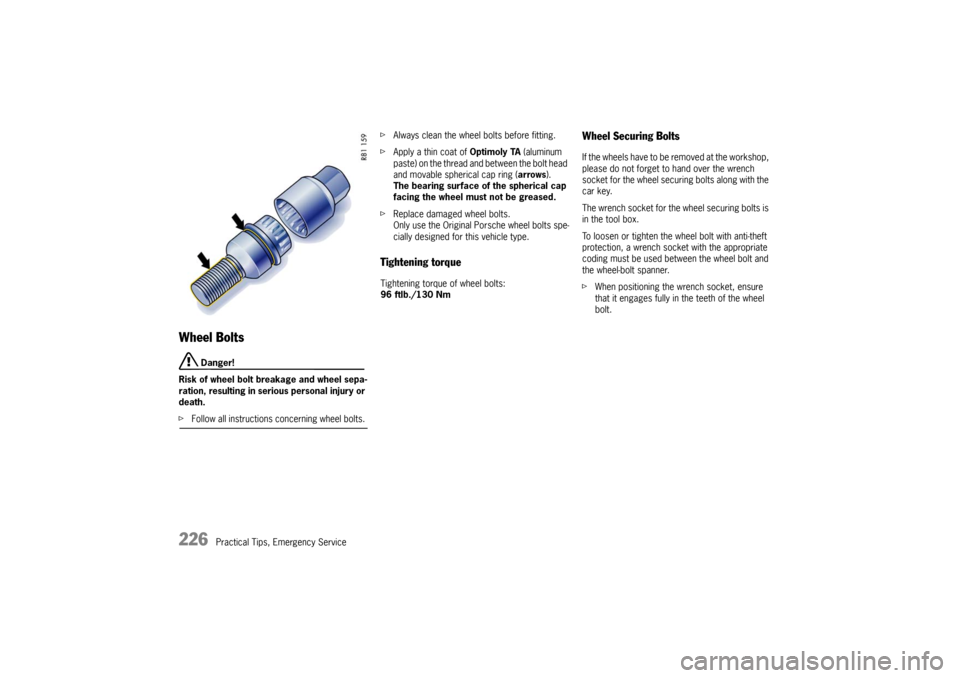
f Apply a thin coat of Optimoly TA (aluminum
paste) on the thread and between the bolt head
and movable spherical cap ring ( arrows).
The bearing surface of the spherical cap
facing the wheel must not be greased.
f Replace damaged wheel bolts.
Only use the Original Porsche wheel bolts spe-
cially designed for this vehicle type.
Tightening torque Tightening torque of wheel bolts:
96 ftlb./130 Nm
Wheel Securing Bolts If the wheels have to be removed at the workshop,
please do not forget to hand over the wrench
socket for the wheel securing bolts along with the
car key.
The wrench socket for the wheel securing bolts is
in the tool box.
To loosen or tighten the wheel bolt with anti-theft
protection, a wrench sock et with the appropriate
coding must be used be tween the wheel bolt and
the wheel-bolt spanner.
f When positioning the wr ench socket, ensure
that it engages fully in the teeth of the wheel
bolt.
Page 229 of 284

Practical Tips, Emergency Service
227
Changing a wheel
Warning!
Risk of serious personal injury or death. The
car may slip off the jack.
f Make sure that no one is in the vehicle when
jacking up and changing a wheel.
f Always place the car on stable supports if work
has to be carried out under the car.
Risk of damage to the brake discs of the
Porsche Ceramic Composite Brake (PCCB).
f Always screw in both assembly aids when changing a wheel.
Note
The tools required for changing a wheel (e.g. jack,
wheel bolt wrench, assembly aids) are not sup-
plied with the car.
Your authorized Porsche dealer will be pleased to
advise you.
1. Apply the handbrake fully and engage 1st gear or PDK selector-lever position P and remove
the ignition key.
2. Switch on the hazard warning lights if neces- sary.
3. Secure the car against rolling away, e.g. by
means of wedges under the wheels on the op-
posite side.
This is particularly important on slopes. 4. Slightly slacken the whee
l bolts of the wheel to
be changed.
5. Lift the car only at the specified jacking points.
6. Raise the car until the wheel lifts off the ground.
Please see the chapter “LIFTING THE VEHICLE
WITH A LIFTING PLATFORM OR GARAGE LIFT”
on Page 232.
7. Remove 1 or 2 wheel bolts (see respective illustration).
8. Screw in assembly aids instead of the wheel bolts.
Screw in assembly aid for cars without Porsche Ceramic
Composite Brake9. Remove the remaining wheel bolts.
Note on operation
f To remove or mount the spacers:
Please see the chapter “SPACERS” on
Page 233.
Page 242 of 284

240
Practical Tips, Emergency Service
Battery care fEnsure that battery is securely mounted.
f Keep terminals and connections clean and
properly tightened.
Corrosion can be prevented by coating the ter-
minals and connections with petroleum jelly or
silicone spray.
f Ensure that vent caps ar e securely tightened to
prevent spillage.
Checking the electrolyte fluid level
f The acid level should be checked more fre-
quently by a qualified specialist workshop dur-
ing the summer months and in predominantly
warm countries. Battery charging
Automotive batteries loose their efficiency when
not in use.
The charge available in your battery can be meas-
ured with a battery hydrometer.
We recommend that the battery voltage be tested
by your authorized Porsche dealer who has the ap-
propriate equipment.
If the car is not driven for prolonged periods, the
battery must be charged at least every 6 weeks.
A discharged battery allows
rapid formation of sul-
fates, leading to premature deterioration of the
plates.
Warning!
Hydrogen gas generated by the battery
could cause an explosion, resulting in
serious personal injury or death.
f Charge battery in a well ventilated area.
f Never charge a frozen battery. It may explode
because of gas trapped in the ice. Allow a fro-
zen battery to thaw out first.
f If you get electrolyte, wh ich is an acid, in your
eyes or on your skin, immediately rinse with
cold water for several minutes and call a doc-tor. Slow battery charging
Your authorized Porsche dealer will be pleased to
advise you about a suitable charger.
1. Always observe the instructions of the charger
manufacturer.
Depending on the type of charger, the battery
may have to be disconnected.
In this case, always disconnect the negative
lead first, and then the positive lead – risk of
short circuit!.
Reconnect the leads in reverse order.
2. Before charging, cold batteries must be warmed up indoors.
3. Frozen batteries must be thawed out first before being charged.
4. When charging, ensure that there is adequate ventilation.
5. Connect the charger to the battery. Only plug into the mains and switch the
charger on when it is connected up correctly.
6. Switch on the charger.
7. After charging, switch off the charger first and then disconnect it.
8. Please see the chapter “PUTTING VEHICLE INTO OPERATION” on Page 241.
Page 251 of 284
Practical Tips, Emergency Service
249
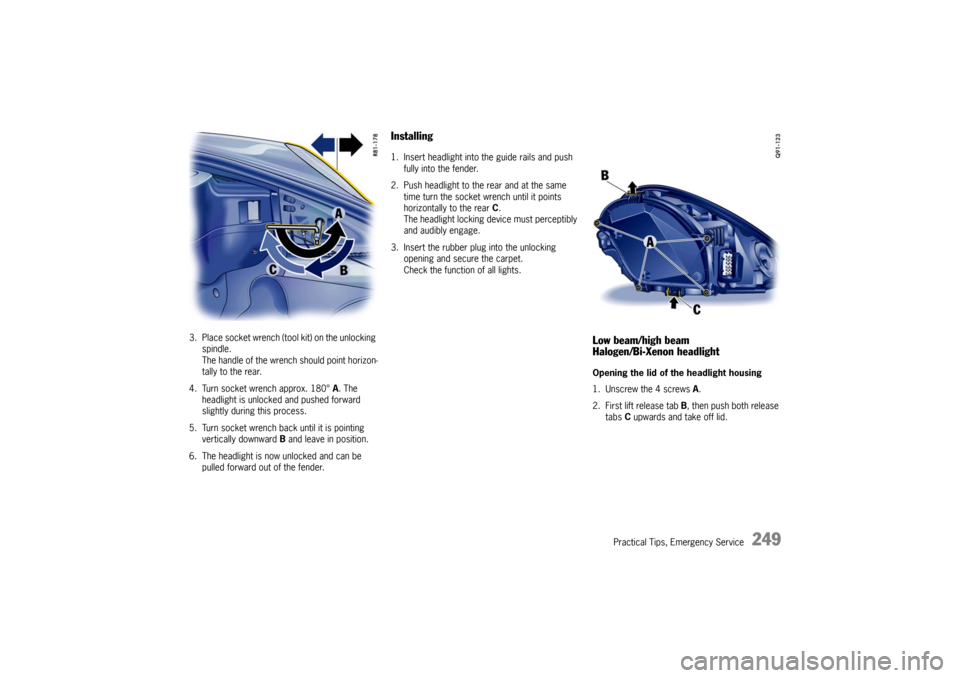
3. Place socket wrench (tool kit) on the unlocking spindle.
The handle of the wrench should point horizon-
tally to the rear.
4. Turn socket wrench approx. 180° A. The
headlight is unlocked and pushed forward
slightly during this process.
5. Turn socket wrench ba ck until it is pointing
vertically downward B and leave in position.
6. The headlight is now unlocked and can be pulled forward out of the fender.
Installing1. Insert headlight into the guide rails and push
fully into the fender.
2. Push headlight to the rear and at the same time turn the socket wrench until it points
horizontally to the rear C.
The headlight locking device must perceptibly
and audibly engage.
3. Insert the rubber plug into the unlocking opening and secure the carpet.
Check the function of all lights.
Low beam/high beam
Halogen/Bi-Xenon headlightOpening the lid of the headlight housing
1. Unscrew the 4 screws A .
2. First lift release tab B, then push both release
tabs C upwards and take off lid.