ignition PORSCHE CAYMAN 2009 1.G Owner's Guide
[x] Cancel search | Manufacturer: PORSCHE, Model Year: 2009, Model line: CAYMAN, Model: PORSCHE CAYMAN 2009 1.GPages: 284, PDF Size: 5.94 MB
Page 67 of 284

Operation, Safety
65
Sport modeA sportier car set-up is obtained when Sport or
Sport Plus mode is switched on.
PSM interventions are later than in Normal mode;
the vehicle can be maneuverd with greater agility
at its performance limits, without dispensing with
the assistance of PSM in emergency situations.
This helps to achieve optimal lap times, particu-
larly on race circuits and a dry road surface.
– The multifunctional light on the instrument panel lights up for a lamp check when the
ignition is switched on.
– The light indicates a control operation by flashing, including when PSM is switched off
(brake control in the ev ent of one-sided wheel
spin).
– In conjunction with a message on the on-board computer, the light indicates that PSM is
switched off.
An acoustic signal also sounds.
– The light indicates a faul t in conjunction with a
message on the on-board computer.
PSM is out of order. f
Please have the fault remedied at an author-
ized Porsche dealer.
f Please see the chapter “PUTTING VEHICLE
INTO OPERATION” on Page 241.
Towingf Please see the chapter “TOWING” on
Page 259.Checks on test standsBrake tests
Brake tests must be performed only on plate-type
test stands or roller test stands.
The ignition must be switched off.
The following limit values must not be exceeded
on roller test stands:
– Testing speed 5 mph (8 km/h)
– Test duration 20 seconds
Handbrake tests
Handbrake tests on the roller test stand must be
performed only with the ignition switched off .
PSM multifunctional light
Page 68 of 284

66
Operation, Safety
PASM makes two running-gea
r setups available to
the driver: “Normal” and “Sport”.
The selection is made vi a a button on the center
console.
In Normal mode the runnin g gear is in a comfort-
able setup.
Sport mode offers very sporty shock absorber
tuning.
The variable suspension system selects the appro-
priate damping level for each wheel according to
the situation and driving conditions.
Example:
If the vehicle is driven in a very sporty manner in
Normal mode, PASM automatically adapts the
shock-absorber behavior to the driving situation
accordingly.
Switching on PASM Sport modef Press PASM button in the center console.
When PASM Sport mode is switched on, the
light-emitting diode in the button is lit up and a
message is shown on the on-board computer.Switching off PASM Sport modefPress PASM button in the center console.
The light-emitting diode in the button goes out
and the on-board computer displays a
message.
After the ignition is switched off, PASM is
automatically reset to Normal mode.
Porsche Active Suspension
Management (PASM)
Page 69 of 284

Operation, Safety
67
Rear Spoiler The rear spoiler improves driving stability, espe-
cially at higher speeds.
Warning!
Risk of accident, resulting in serious perso-
nal injury or death.
If the spoiler cannot be extended, driving sta-
bility will be adversel y affected by increased
rear axle lift, which could lead to loss of con-
trol.
f Adapt your driving style and speed to the
changed driving conditions.
f Have the fault remedied at an authorized
Porsche dealer.
Risk of injury during manual retraction or
extension of the spoiler with the vehicle
stationary.
f Make sure that no persons or objects are
within the range of movement of the rear
spoiler.
Risk of damage from pushing the vehicle by
the rear spoiler.
f Do not push the vehicle at the rear spoiler.
Automatic control
(automatic mode)The rear spoiler extends at approx. 75 mph
(120 km/h) and retracts again at approx. 50 mph
(80 km/h).
If the automatic control fails, the warning light
lights up.
The warning light in the on-board computer lights
up when the rear spoiler does not extend over
75 mph (120 km/h) or its end position is not
reached.
Manual control
(manual mode)When the ignition is on, the rear spoiler can be
extended and retracted manually using the button
in the center console.
Note
When the rear spoiler is extended manually, the au-
tomatic control does not operate and the rear
spoiler must be manually retracted.
Warning light
Page 70 of 284

68
Operation, Safety
Extending
f
Press button briefly.
The spoiler extends to its final position.
The light-emitting diode in the button lights up.
The rear spoiler remains extended even after
switching off ignition.
Retracting
f at speeds between 0 and 20 mph
(0 and 30 km/h):
Press and hold button until the rear spoiler has
reached its final position.
The light-emitting diode in the button goes out.
The rear spoiler changes to automatic mode. f
at speeds between 20 and 60 mph
(30 and 100 km/h):
Press button briefly.
The rear spoiler retracts, the light-emitting
diode in the b utton goes out.
The rear spoiler changes to automatic mode.
f at speeds over 60 mph (100 km/h):
Press button briefly.
The rear spoiler remains extended, the light-
emitting diode in the button goes out.
The rear spoiler changes to automatic mode.
Manually retracting an extended rear spoiler
after switching on the ignition again
1. Press button briefly. The light-emitting diode in the button lights up.
The rear spoiler is now in manual mode.
2. Press and hold button until the rear spoiler has reached its final position.
The light-emitting diode in the button goes out.
The rear spoiler changes to automatic mode.
Fixed rear spoiler
Caution!
Risk of damage to rear spoiler.
f Please consult the operator before using auto-
matic car washes.
fDo not push the vehicle by the spoiler.
Page 71 of 284
Operation, Safety
69
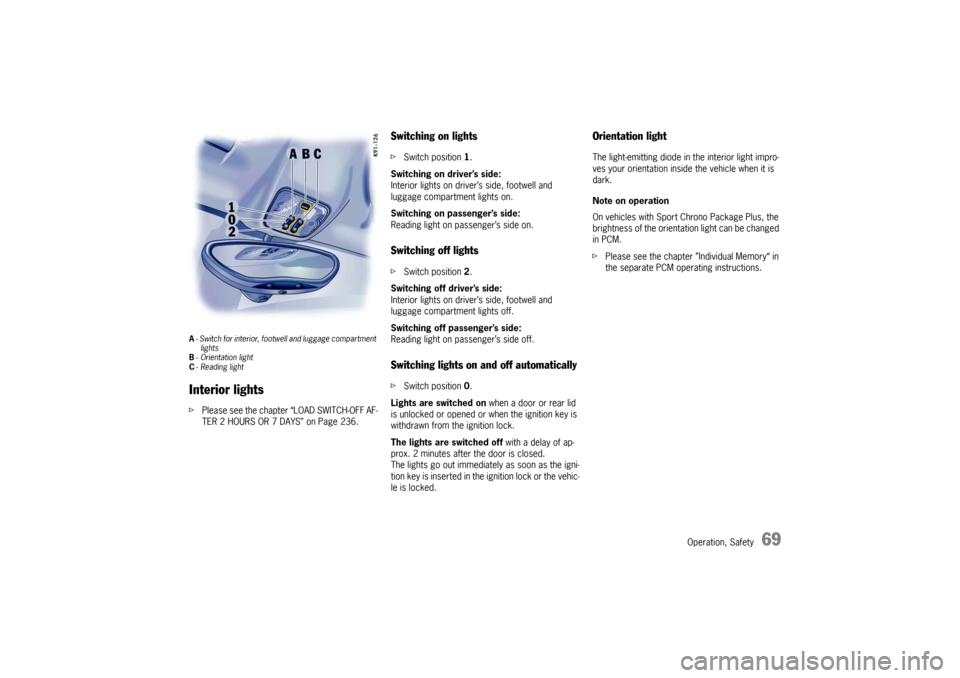
A - Switch for interior, foot well and luggage compartment
lights
B -Orientation light
C -Reading lightInterior lightsf Please see the chapter “LOAD SWITCH-OFF AF-
TER 2 HOURS OR 7 DAYS” on Page 236.
Switching on lightsfSwitch position 1.
Switching on driver’s side:
Interior lights on driver’s side, footwell and
luggage compartment lights on.
Switching on passenger’s side:
Reading light on passenger’s side on.Switching off lightsf Switch position 2.
Switching off driver’s side:
Interior lights on driver’s side, footwell and
luggage compartment lights off.
Switching off passenger’s side:
Reading light on passenger’s side off.Switching lights on and off automaticallyf Switch position 0.
Lights are switched on when a door or rear lid
is unlocked or opened or when the ignition key is
withdrawn from the ignition lock.
The lights are switched off with a delay of ap-
prox. 2 minutes after the door is closed.
The lights go out immediately as soon as the igni-
tion key is inserted in the ignition lock or the vehic-
le is locked.
Orientation lightThe light-emitting diode in the interior light impro-
ves your orientation inside the vehicle when it is
dark.
Note on operation
On vehicles with Sport Chrono Package Plus, the
brightness of the orientation light can be changed
in PCM.
f Please see the chapter ”Individual Memory“ in
the separate PCM operating instructions.
Page 74 of 284
72
Operation, Safety
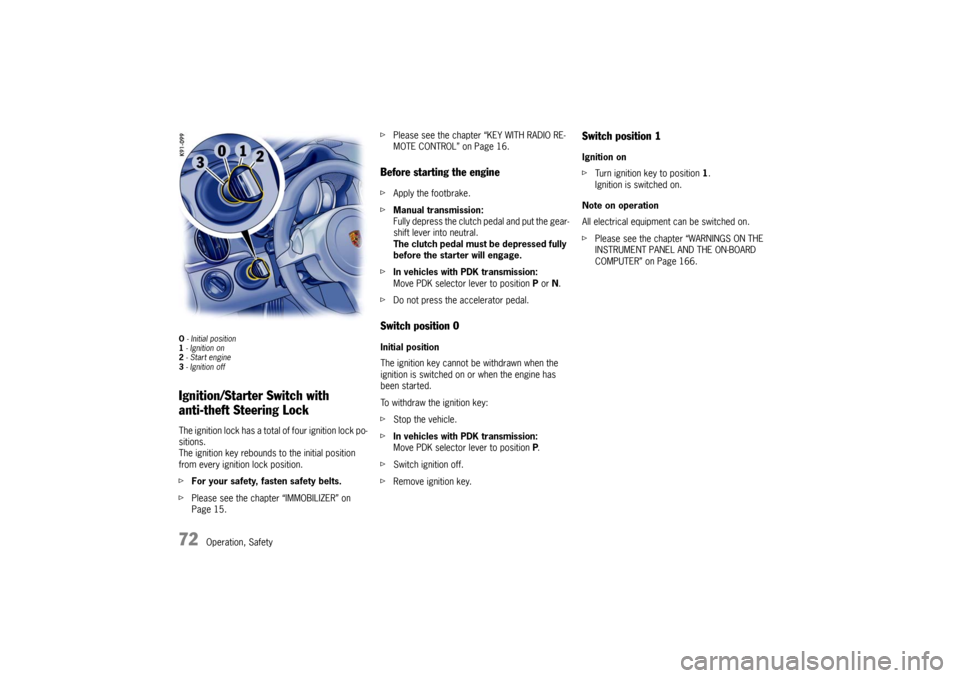
O - Initial position
1 - Ignition on
2 - Start engine
3 - Ignition offIgnition/Starter Switch with
anti-theft Steering LockThe ignition lock has a total of four ignition lock po-
sitions.
The ignition key rebounds to the initial position
from every ignition lock position.
f For your safety, fasten safety belts.
f Please see the chapter “IMMOBILIZER” on
Page 15. f
Please see the chapter “KEY WITH RADIO RE-
MOTE CONTROL” on Page 16.
Before starting the enginefApply the footbrake.
f Manual transmission:
Fully depress the clutch pedal and put the gear-
shift lever into neutral.
The clutch pedal must be depressed fully
before the starte r will engage.
f In vehicles with PDK transmission:
Move PDK selector lever to position P or N.
f Do not press the accelerator pedal.Switch position 0 Initial position
The ignition key cannot be withdrawn when the
ignition is switched on or when the engine has
been started.
To withdraw the ignition key:
f Stop the vehicle.
f In vehicles with PDK transmission:
Move PDK selector lever to position P.
f Switch ignition off.
f Remove ignition key.
Switch position 1 Ignition on
fTurn ignition key to position 1.
Ignition is switched on.
Note on operation
All electrical equipme nt can be switched on.
f Please see the chapter “WARNINGS ON THE
INSTRUMENT PANEL AND THE ON-BOARD
COMPUTER” on Page 166.
Page 75 of 284

Operation, Safety
73
Switch position 2Start engine
fTurn ignition key to ignition lock position 2 .
f Please see the chapter “STARTING PROCEDU-
RES” on Page 75.Switch position 3Ignition off
fTurn ignition key to ignition lock position 3 .
Note on operation
The vehicle battery discharges if the ignition key is
left inserted.
If the vehicle battery is dead, the key can only be
pulled out of the ignition lock if the emergency
operation is performed:
f Please see the chapter “EMERGENCY OPERA-
TION – PULLING OUT THE IGNITION KEY” on
Page 74.
Locking the steering columnAutomatic locking
The steering column is automatically locked when
the ignition key is withdrawn from the ignition lock.
Warning!
Risk of an accident, re sulting in serious per-
sonal injury or death.
The steering wheel will lock and will cause
loss of steering.
f Never remove key from the ignition lock or turn
the key off while the vehicle is moving.
f Always withdraw the ignition key when leaving the vehicle. Automatic unlocking
The steering column is unlocked when the vehicle
is unlocked with the radio remote control.
Note
f
To avoid discharging the battery, always re-
move the ignition key from the ignition lock.
Please see the chapter “BATTERY” on
Page 239.
Gong If you leave the key in the ignition/steering lock, a
gong will sound when the driver’s door is opened.
This is a reminder to remove the key.
Page 76 of 284
74
Operation, Safety
Emergency operation – pulling out the
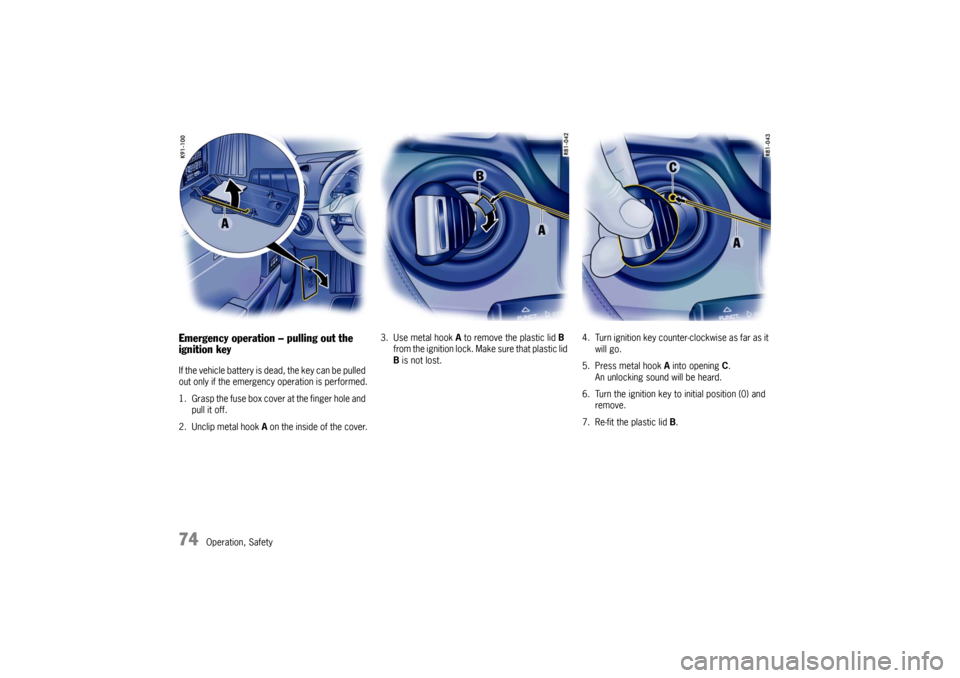
ignition keyIf the vehicle battery is dead, the key can be pulled
out only if the emergency operation is performed.
1. Grasp the fuse box cover at the finger hole and pull it off.
2. Unclip metal hook A on the inside of the cover. 3. Use metal hook A
to remove the plastic lid B
from the ignition lock. Make sure that plastic lid
B is not lost. 4. Turn ignition key counter-
clockwise as far as it
will go.
5. Press metal hook A into opening C.
An unlocking sound will be heard.
6. Turn the ignition key to initial position (0) and
remove.
7. Re-fit the plastic lid B.
Page 77 of 284

Operation, Safety
75
Starting Procedures fPlease see the chapter “IMMOBILIZER” on
Page 15.
f Please see the chapter “EMISSION CONTROL
SYSTEM” on Page 198.
Warning!
Serious injury or death may result if you are
involved in a collision without having fas-
tened the safety belts.
f Fasten safety belts before driving away. Before starting the engine fApply the footbrake.
f Manual transmission:
Fully depress the clutch pedal and put the gear-
shift lever into neutral.
The clutch pedal must be depressed fully
before the starter will engage.
f In vehicles with PDK transmission:
Move PDK selector lever to position P or N.
Temperature sensors on the engine automatically
provide the correct fuel/air mixture required for
starting.
Therefore, it is not necessary to depress the
accelerator pedal while starting a cold or a
warm engine.
Starting the enginef Turn ignition key to ignition lock position 2.
f As soon as the engine st arts, release the igni-
tion key.
The first operation of the starter is ended automat-
ically when the engine starts.
If the engine does not start, subsequent starter
operations will not be ended automatically.
If the engine fails to start after 10 or 15 seconds
of cranking:
f Wait about 10 seconds before engaging the
starter again.
f When starting the engine, be ready to drive
immediately.
Drive vehicle at moderate speeds and avoid
engine speeds above 4,200 rpm during the
first 5 minutes.
f Do not let the engine idle to warm up.
Danger!
Engine exhaust fumes have many compo-
nents which you can smell. They also contain
carbon monoxide (CO), which is a colorless
and odorless gas.
Carbon monoxide can cause unconscious-
ness and even death if inhaled.
f Never start or let the engine run in an
enclosed, unventilated area.
It is not recommended to sit in your car for prolonged periods with the engine on and the
car not moving.
An unattended vehicle with a running engine
is potentially hazardous.
If warning lights shoul d come on to indicate
improper operation, they would go unno-
ticed.
f Never leave the engine idling unattended.
Danger of fire.
f Do not park or operate the vehicle in areas
where the hot exhaust system may come in
contact with dry grass, brush, fuel spill or oth-
er flammable material.
f If your car catches on fire for any reason, call
the fire department.
Do not endanger your life by attempting to put
out the fire.
Risk of burn injury when standing near or
coming into contact with the exhaust pipe.
The exhaust pipe is hot when the vehicle is running
and remains hot for some time after the vehicle is
turned off.
f To prevent injury, make a point of noting where
your vehicle’s exhaust pipe is, avoid placing
your legs near the exhaust pipe, and closely
supervise children around the vehicle when the
exhaust pipe could be hot.
A hot exhaust pipe can cause serious burns.
Page 78 of 284

76
Operation, Safety
Stopping Engine fTurn key back to position 3.
f Do not stop engine immediately after hard or
extended driving.
Keep engine running at increased idle for
about two minutes to prevent excessive heat
build-up before turning off engine.
f To avoid discharging the battery, always re-
move the ignition key from the ignition lock.
f When leaving the car, always remove the igni-
tion key, apply the parking brake and engage
1st gear or reverse gear on vehicles with man-
ual transmission or move the selector lever to
position P on vehicles with PDK transmission.
f Engage the steering lock by moving the steer-
ing wheel to the left or right.
Turn the steering wheel to the locking position
before you switch off the engine so that you
don’t have to exert your self when locking or
unlocking the steering.
Warning!
Danger of injury. Hot engine compartment
components can burn skin on contact.
f Before working on any part in the engine
compartment, turn the engine off and let it cool
down sufficiently. Risk of burn injury when standing near or
coming into contact with the exhaust pipe.
The exhaust pipe is hot wh
en the vehicle is running
and remains hot for some time after the vehicle is
turned off.
f To prevent injury, make a point of noting where
your vehicle’s exhaust pipe is, avoid placing
your legs near the exhaust pipe, and closely
supervise children around the vehicle when the
exhaust pipe could be hot.
A hot exhaust pipe can cause serious burns.
Engine-compartment blower,
radiator fan The radiator and radiator fans are in the front of
the car.
The engine-compartment bl ower is mounted in the
engine compartment.
Warning!
Risk of injury.
After the engine is switched off, the engine-
compartment temperature is monitored for
approx. 30 minutes.
During this period, and depending on tem-
perature, the engine-compartment blower
may continue to run or start to run.
f Carry out work in these areas only with the en-
gine off, the ignition off, and exercise extreme
caution. Risk of injury. The radiator fans in the front
end of the car may be operating or
unexpectedly start operating when the
engine is switched on.
f
Carry out work in these areas only with the en-
gine switched off.
Automatic garage door The ignition system in your Porsche may interfere
with your electronically operated garage door.
fTo check this, drive your Porsche close to the
garage door. Make sure not to interfere with
the operating range of the door.
f Run the engine at different speeds.
f If the garage door opens or closes without you
operating the garage door unit in your car,
contact the dealer who installed the automatic
garage door to have the frequency and/or
coding of the garage door signal changed or
modified.