warning PORSCHE CAYMAN 2010 1.G Owners Manual
[x] Cancel search | Manufacturer: PORSCHE, Model Year: 2010, Model line: CAYMAN, Model: PORSCHE CAYMAN 2010 1.GPages: 284, PDF Size: 5.94 MB
Page 216 of 284

214
Practical Tips, Emergency Service
and a half (1-1/2) times as well on the government
course as a tire graded 100.
The relative performance of tires depends upon
the actual conditions of
their use, however, and
may depart significantly fr om the norm due to var-
iations in driving habits, service practices and dif-
ferences in road characteristics and climate.
Traction AA, A, B, C
The traction grades, from highest to lowest, are
AA, A, B, and C and they represent the tire’s ability
to stop on wet pavement as measured under con-
trolled conditions on specified government test
surfaces of asphalt and concrete.
A tire marked C may have poor traction perform-
ance.
Warning!
The traction grade assigned to this is based on
braking (straight-ahead) traction tests and does
not include cornering (turned) traction, accelera-
tion, hydroplaning or peak traction characteris-
tics.
Temperature A, B, C
The temperature grades ar e A (the highest), B and
C, representing the tire’s resistance to the gener-
ation of heat and its abilit y to dissipate heat when
tested under controlled conditions on a specified
indoor laboratory test wheel.
Sustained high temperatur es can cause the mate-
rial of the tire to degenerate and reduce tire life,
and excessive temperature can lead to sudden tire failure.
The grade C corresponds to a level of perform-
ance which all passenger car tires must meet un-
der the Federal Motor Vehi
cle Safety Standard No.
109.
Grades B and A represent higher levels of per-
formance on the laboratory test wheel than the
minimum required by law.
Warning!
The temperature grade for this tire is established
for a tire that is properly inflated and not overload-
ed.
Excessive speed, underinflation, or excessive
loading, either separately or in combination, can
cause heat buildup and possible tire failure, result-
ing in serious personal injury or death. Tire pressures
Warning!
Incorrect tire pressure causes increased tire
wear and adversely affects road handling.
This could lead to tire fa ilure, resulting in loss
of control, leading to serious personal injury
or death.
f Always use an accurate tire pressure gage
when checking inflation pressures.
f Do not exceed the maximum tire pressure list-
ed on the tire sidewall.
Please see the chapter “TIRE PRESSURE PLA-
TE” on Page 265. f
Cold tire inflation pressure means: all tires
must be cold, ambient temperature maximum
(68 °F/20 °C)
, when adjusting the inflation
pressure.
Avoid sunlight striking the tires before measur-
ing cold pressures, since the pressures would
rise from temperature influence.
f Valve caps protect the valve from dust and dirt,
and thus from leakage.
Always screw caps tightly down.
Replace missing caps immediately.
f Use only plastic valve caps.
f Do not use commercially available sealant or
tire inflating bottles. Only use Porsche
approved tire sealant.
f Please see the chapter “TIRE PRESSURE FOR
COLD TIRES (68 °F/ 20 °C)” on Page 267.
Page 218 of 284

216
Practical Tips, Emergency Service
B Vehicle load limit
Is the maximum total weight limit specified of
the load (passengers and cargo) for the vehi-
cle. This is the maximum weight of passengers
and cargo that can be loaded into the vehicle.
Please see the chapter “LOADING INFORMA-
TION” on Page 224.
C Tire size for the front axle Check with your authorized Porsche dealer
about the current release status.
D Recommended tire pre ssure for the front axle
These values are for cold tires (68 °F/20 °C).
E Tire size for the rear axle Check with your authorized Porsche dealer
about the current release status.
F Recommended tire pressure for the rear axle. These values are for cold tires (68 °F/20 °C).
G In vehicles with collapsible spare wheel: Size and tire pressure of the spare wheel.
Tire traction
Warning!
When driving on wet or slushy roads, a
wedge of water may build up between the
tires and the road. This phenomenon is
known as “hydroplane” and may cause par-
tial or complete loss of traction, vehicle
control or stopping ability.
f Reduce speed on wet surface to prevent this. Tire life Tire life depends on vari ous factors, i. e., road
surfaces, traffic and wea ther conditions, driving
habits, type of tires and tire care.
f Inspect your tires for wear and damage before
driving off. If you notice uneven or substantial
wear, wheels might need alignment or tires
should be balanced or replaced.
Tire wear The original equipment tires on your Porsche have
built-in tire wear indicato rs. They are molded into
the bottom of the tread grooves and will appear as
approximately 1/2 in. (12 mm) bands when the
tire tread depth is down to 1/16 of an in.
(1.6 mm).
When the indicators appear in two or more adja-
cent grooves, it is time to replace the tires. We
recommend, however, that you do not let the tires
wear down to this extent.
Worn tires cannot grip the road surface properly
and are even less effective on wet roads.
Snow tires lose their traction capability when their
tread depth falls below 5/32 in. (4 mm).
In the United States, state laws may govern the
minimum tread depth permissible. Follow all such
laws.
Page 220 of 284

218
Practical Tips, Emergency Service
Danger!
Risk of serious personal injury or death.
Driving the vehicle with low tire pressure
increases risk of a tire failure and resulting
loss of control. Furthermore, low tire pres-
sure increases rate of wear of the affected
tires.
f Check tires – including sidewalls – regularly for
foreign bodies, nicks, cuts, cracks and bulges.
f After driving off road, examine tires for signs
of damage such as cuts, tears, bulges or for-
eign objects stuck in the tread. Replace a dam-
aged tire if necessary.
f Cross curb edges slowly and at right angles if
possible.
Avoid driving over steep or sharp curbs.
f In cases of doubt, have the wheel (particularly
the inner side) checked by an authorized Porsche dealer.
Tire replacements If in doubt, contact your Porsche dealer.
Use only tire makes and types approved by
Porsche.
If you do not use a Porsche recommended
replacement tire, make sure that you
purchase your new tires from a reputable tire
dealer and that the dealer complies with all
manufacturers warnings for those tires.
Only tires with the same make and with the
same specification code (e.g. “N0”, “N1”...)
can be mounted.
Before mounting new tires, check with your
Porsche dealer about the current release
status.
Use tires with “ZR” quality standards. There
are currently no standards concerning tire
strength at speeds above 150 mph (240 km/h).
Tires should be replaced no less than on one axle
at the time.
Only tires of the same make and type must be
used. Mixed tires are not permissible.
Initially, new tires do not have their full traction.
You should therefore drive at moderate speeds
during the first 60 - 120 miles (100 - 200 km). If new tires are installed only on one axle, a notice-
able change in handling occurs due to the different
tread depth of the other tires.
This happens especially if only rear tires are re-
placed. However, this condition disappears as the
new tires are broken in.
f
Please adjust your driving style accordingly.
Installation of new tires sh ould only be done by a
qualified tire technician.
Valves
Rubber valve stems must be replaced every time
a tire is replaced.
For metal valves, the installation and replacement
instructions must be observed.
f Use only genuine Porsche metal valves.
f Protect the valve inserts against soiling with
valve caps.
Soiled valve inserts can cause a gradual loss
of air.
f Use only plastic valve caps.
Page 221 of 284

Practical Tips, Emergency Service
219
Parking at the curb
Warning!
Hard impacts against curbs (or traffic
islands) are dangerous and may cause hid-
den tire damage which is not noticeable until
later. Such damage can result in accidents at
high speeds causing serious personal injury
or death.
Depending on the force of impact, the edge
of the rim can also be damaged.
f If you are in doubt, have the wheel checked by
an expert, particularly if you suspect damage
on the inside.
f If you must drive over a curb or other obstacle,
drive slowly and at an obtuse angle. Exercise care when parking along curbs.
Wheel alignment, wheel balancing As a precaution, have wheels with summer tires
balanced in the spring, and those with mud and
snow tires before winter.
Unbalanced wheels may affect car handling and
tire life.
Only the specified weight s may be used for wheel
balancing.
Self-adhesive weights must not come into contact
with cleaning agents, since they could drop off.
Uneven tread wear indicates wheel imbalance. In
this event, the vehicle should be checked at an au-
thorized Porsche dealer.
Warning!
If, during a trip, uneven running or vibrations
occur that could be caused by damage to
tires or the car, the speed must be reduced
immediately, but without braking sharply.
If you continue your trip without having the
cause of the fault reme died, you might lose
control of your vehicle which could cause se-
rious personal injury or death.
f Stop the vehicle and check the tires.
f If no cause for the fault can be found, drive
carefully to the nearest authorized Porsche dealer.
Wheels with Tire Pressure Monitoring
(TPM) sensorsBefore changing wheels, make sure that the
wheels are compatible with your vehicle's TPM.
f Check this with your authorized Porsche
dealer.Removing and storing tires fAfter changing, adjust tire pressure and torque
wheel bolts diagonally to 94 ftlb (130 Nm).
Tires must always remain on the same side of
the vehicle.
When wheels are removed, the direction of
rotation and position of each wheel should be
marked.
Example
FR (front right), FL, RR and RL.
Wheels must always be fitted in accordance with
their marking.
The perception that tire durability and perform-
ance are immune to the effects of storage and
age is unfounded.
Chemical additives, whic h make the rubber elas-
tic, lose their effectivene ss in the course of time
and the rubber becomes brittle and cracks.
Therefore, the tires should be inspected from
time to time.
Page 229 of 284

Practical Tips, Emergency Service
227
Changing a wheel
Warning!
Risk of serious personal injury or death. The
car may slip off the jack.
f Make sure that no one is in the vehicle when
jacking up and changing a wheel.
f Always place the car on stable supports if work
has to be carried out under the car.
Risk of damage to the brake discs of the
Porsche Ceramic Composite Brake (PCCB).
f Always screw in both assembly aids when changing a wheel.
Note
The tools required for changing a wheel (e.g. jack,
wheel bolt wrench, assembly aids) are not sup-
plied with the car.
Your authorized Porsche dealer will be pleased to
advise you.
1. Apply the handbrake fully and engage 1st gear or PDK selector-lever position P and remove
the ignition key.
2. Switch on the hazard warning lights if neces- sary.
3. Secure the car against rolling away, e.g. by
means of wedges under the wheels on the op-
posite side.
This is particularly important on slopes. 4. Slightly slacken the whee
l bolts of the wheel to
be changed.
5. Lift the car only at the specified jacking points.
6. Raise the car until the wheel lifts off the ground.
Please see the chapter “LIFTING THE VEHICLE
WITH A LIFTING PLATFORM OR GARAGE LIFT”
on Page 232.
7. Remove 1 or 2 wheel bolts (see respective illustration).
8. Screw in assembly aids instead of the wheel bolts.
Screw in assembly aid for cars without Porsche Ceramic
Composite Brake9. Remove the remaining wheel bolts.
Note on operation
f To remove or mount the spacers:
Please see the chapter “SPACERS” on
Page 233.
Page 231 of 284

Practical Tips, Emergency Service
229
Flat Tire
Warning!
Failure to follow these instructions may result
in serious personal injury to you or to by-
standers.
f If you have a flat tire, move a safe distance off
the road. Turn the emergency flasher on and
use other warning devices to alert other motor-
ists. Set the parking brake.
f Do not park your vehicl e where it may contact
dry grass, brush or other flammable materials.
The hot parts of the exhaust system could set
such materials on fire, thereby causing both
property damage and serious personal injury or death.
A tire sealant and compressor with pressure
tester are located in the luggage compartment.
f Please observe the safety and operating in-
structions on the special sealant bottle with a
special Porsche part number and on the com-
pressor – these are essential. Important note
Sealing the tire with the tire repair kit is only
an emergency repair. Even with the tire air-
tight, it may be used only for short journeys
in an emergency.
The maximum permitted speed is 50 mph
(80 km/h).
f
Do not use commercially available sealant or
tire inflating bottles.
Use only the tire sealant located in the luggage
compartment.
Warning!
Risk of accident, resulting in serious
personal injury or death.
f Have tires replaced by a specialist workshop
as soon as possible.
f Avoid hard acceleration and high cornering speeds.
Page 232 of 284
230
Practical Tips, Emergency Service
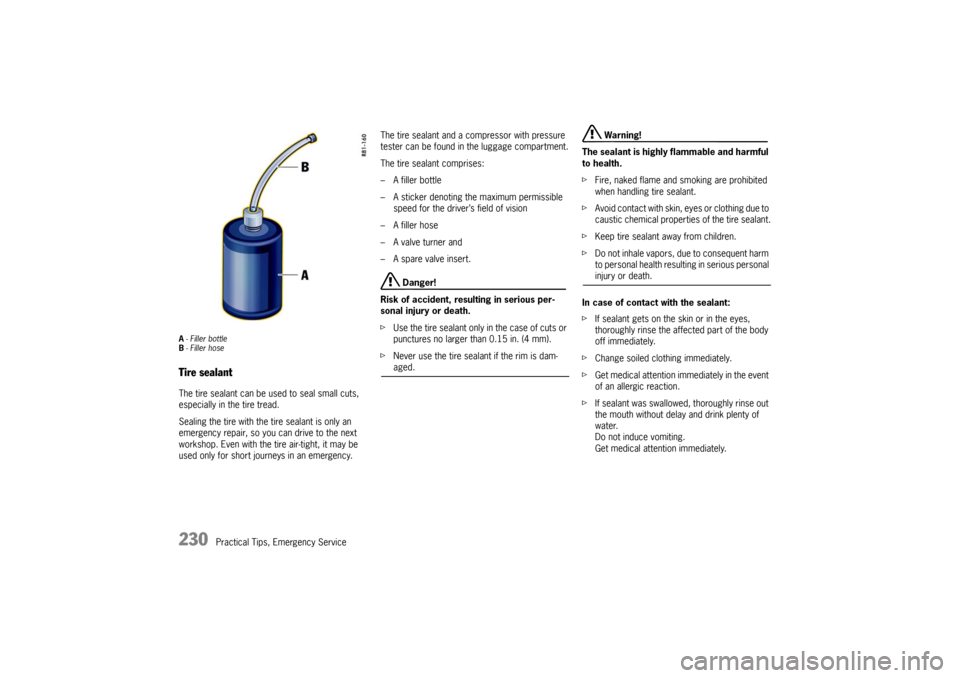
A- Filler bottle
B - Filler hoseTire sealantThe tire sealant can be used to seal small cuts,
especially in the tire tread.
Sealing the tire with the tire sealant is only an
emergency repair, so you can drive to the next
workshop. Even with the tire air-tight, it may be
used only for short journeys in an emergency. The tire sealant and a compressor with pressure
tester can be found in the luggage compartment.
The tire sealant comprises:
– A filler bottle
– A sticker denoting the maximum permissible
speed for the driver’s field of vision
– A filler hose
– A valve turner and
– A spare valve insert.
Danger!
Risk of accident , resulting in serious per-
sonal injury or death.
f Use the tire sealant only in the case of cuts or
punctures no larger than 0.15 in. (4 mm).
f Never use the tire sealant if the rim is dam-aged.
Warning!
The sealant is highly flammable and harmful
to health.
f Fire, naked flame and smoking are prohibited
when handling tire sealant.
f Avoid contact with skin, ey es or clothing due to
caustic chemical properties of the tire sealant.
f Keep tire sealant away from children.
f Do not inhale vapors, due to consequent harm
to personal health resulting in serious personal injury or death.
In case of contact with the sealant:
f If sealant gets on the skin or in the eyes,
thoroughly rinse the affect ed part of the body
off immediately.
f Change soiled clothing immediately.
f Get medical attention immediately in the event
of an allergic reaction.
f If sealant was swallowed, thoroughly rinse out
the mouth without delay an d drink plenty of
water.
Do not induce vomiting.
Get medical attention immediately.
Page 233 of 284
Practical Tips, Emergency Service
231
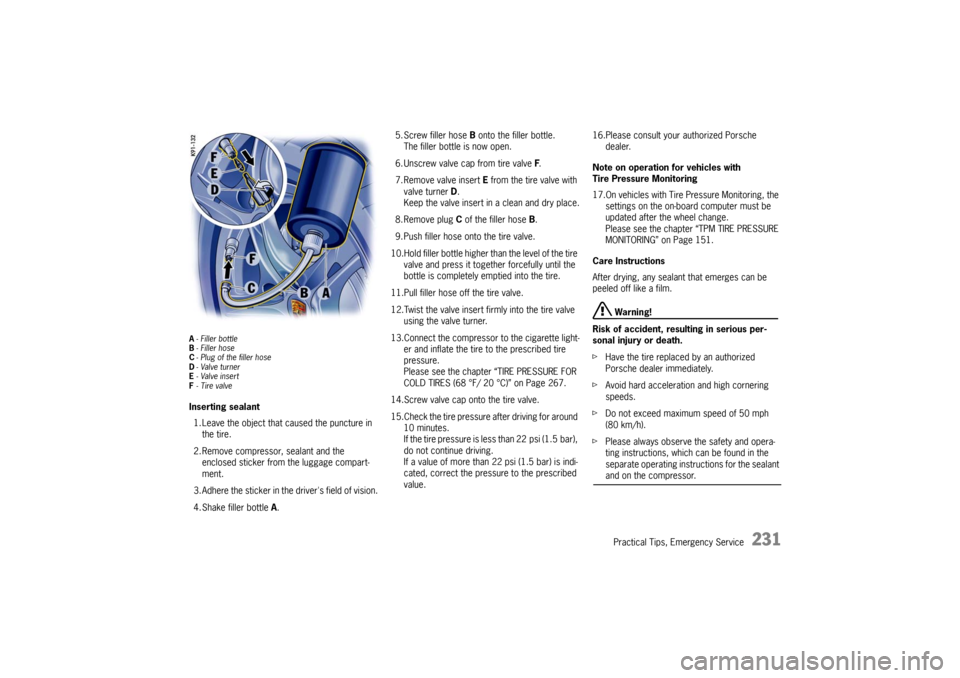
A- Filler bottle
B - Filler hose
C - Plug of the filler hose
D -Valve turner
E -Valve insert
F - Tire valveInserting sealant
1. Leave the object that caused the puncture in the tire.
2. Remove compressor, sealant and the enclosed sticker from the luggage compart-
ment.
3. Adhere the sticker in the driver's field of vision.
4. Shake filler bottle A. 5. Screw filler hose B
onto the filler bottle.
The filler bottle is now open.
6. Unscrew valve cap from tire valve F.
7. Remove valve insert E from the tire valve with
valve turner D.
Keep the valve insert in a clean and dry place.
8. Remove plug C of the filler hose B.
9. Push filler hose onto the tire valve.
10.Hold filler bottle higher than the level of the tire valve and press it together forcefully until the
bottle is completely emptied into the tire.
11.Pull filler hose off the tire valve.
12.Twist the valve insert fi rmly into the tire valve
using the valve turner.
13.Connect the compressor to the cigarette light- er and inflate the tire to the prescribed tire
pressure.
Please see the chapter “TIRE PRESSURE FOR
COLD TIRES (68 °F/ 20 °C)” on Page 267.
14.Screw valve cap onto the tire valve.
15.Check the tire pressure after driving for around 10 minutes.
If the tire pressure is less than 22 psi (1.5 bar),
do not continue driving.
If a value of more than 22 psi (1.5 bar) is indi-
cated, correct the pressure to the prescribed
value. 16.Please consult your authorized Porsche
dealer.
Note on operation for vehicles with
Tire Pressure Monitoring
17.On vehicles with Tire Pressure Monitoring, the settings on the on-board computer must be
updated after the wheel change.
Please see the chapter “TPM TIRE PRESSURE
MONITORING” on Page 151.
Care Instructions
After drying, any sealan t that emerges can be
peeled off like a film.
Warning!
Risk of accident , resulting in serious per-
sonal injury or death.
f Have the tire replaced by an authorized
Porsche dealer immediately.
f Avoid hard acceleration and high cornering
speeds.
f Do not exceed maximum speed of 50 mph
(80 km/h).
f Please always observe the safety and opera-
ting instructions, which can be found in the
separate operating instructions for the sealant and on the compressor.
Page 237 of 284
Practical Tips, Emergency Service
235
Electrical System In order to avoid damage and faults in electrical or
electronic systems, electrical accessories should
be installed at your authorized Porsche dealer.
fOnly use accessories authorized by Porsche.
Warning!
Risk of short circuit and fire, resulting in
serious personal injury or death.
Replacing fuses or relays with the engine
running or the ignition on could cause elec-
trical shock.
f Disconnect the negative terminal on the
battery during all work on the electrical
system.
Please see the chapter “BATTERY” on Page 239.
RelaysDefective relays should be changed only by an
authorized workshop.
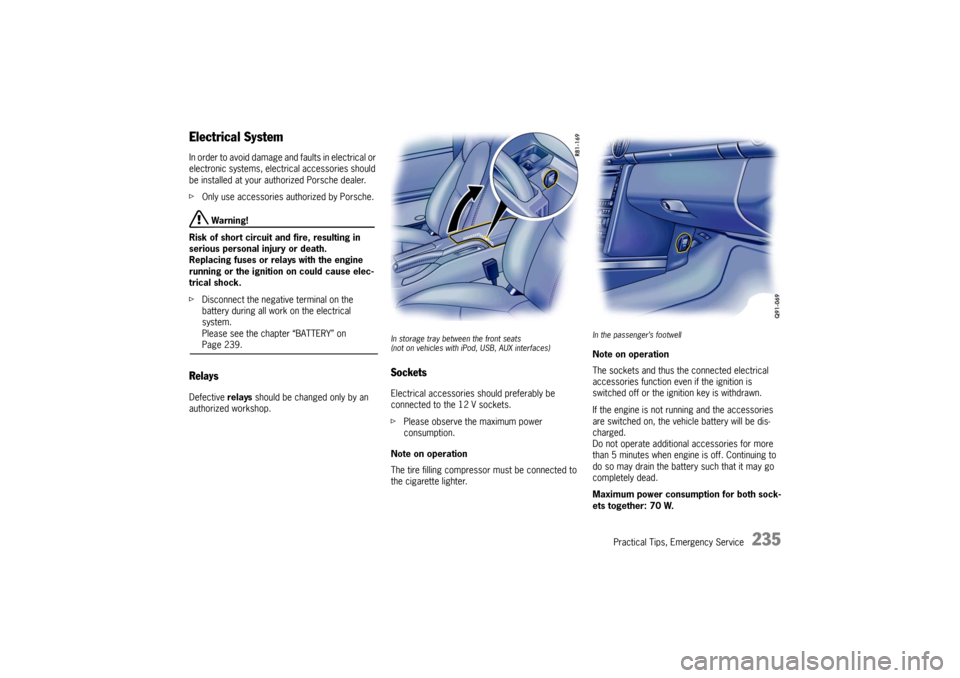
In storage tray between the front seats
(not on vehicles with iPod, USB, AUX interfaces)SocketsElectrical accessories should preferably be
connected to the 12 V sockets.
f Please observe the maximum power
consumption.
Note on operation
The tire filling compressor must be connected to
the cigarette lighter.
In the passenger’s footwellNote on operation
The sockets and thus the connected electrical
accessories function even if the ignition is
switched off or the igni tion key is withdrawn.
If the engine is not running and the accessories
are switched on, the vehicle battery will be dis-
charged.
Do not operate additional accessories for more
than 5 minutes when engine is off. Continuing to
do so may drain the batte ry such that it may go
completely dead.
Maximum power consumpti on for both sock-
ets together: 70 W.
Page 241 of 284

Practical Tips, Emergency Service
239
Battery The battery is located in the front luggage
compartment under a black plastic cover.
f Please see the chapter “EMERGENCY OPERA-
TION – PULLING OUT THE IGNITION KEY” on
Page 74.
f Please see the chapter “EMERGENCY UNLO-
CKING OF THE FRONT LUGGAGE COMPART-
MENT LID” on Page 238.
Warning!
Risk of short circuit, fire and damage to al-
ternator and electronic control units, result-
ing in serious personal injury or death.
f Observe all warning notes on the battery.
f Disconnect the negative terminal on the bat-
tery during all work on the electrical system.
f Do not lay tools or other metal objects on the
battery as they could cause a short circuit
across the battery terminal.
Hydrogen gas generated by the battery
could cause an explosion, resulting in
serious personal injury or death.
f Do not expose the battery to an open flame,
electrical spark or a lit cigarette.
f Do not wipe battery with a dry cloth.
Risk of serious personal injury or death and
damage to the fabric, metal or paint. f
Wear eye protection.
f Do not allow battery acid to come in contact
with your skin, eyes, fabric or painted
surfaces.
f If you get electrolyte, which is an acid, in your
eyes or on your skin, immediately rinse with
cold water for several minutes and call a doc-
tor.
f Spilled electrolyte must be rinsed off at once
with a solution of baki ng soda and water to
neutralize the acid.
Battery posts, terminals and related acces-
sories contain lead and lead compounds,
chemicals known to the State of California to
cause cancer and reproductive harm.
f Always protect your skin by washing thorough-
ly with soap and water.
Risk of explosion as a result of static charge,
resulting in serious personal injury or death.
f Do not wipe the battery with a dry cloth.
f Eliminate potential electrostatic charge by
touching the vehicle before touching the bat-
tery.
Charge state A well-charged battery prevents starting problems
and has a longer service life.
Traffic density, requirements regarding noise, ex-
haust gas and fuel consumption reduce the engine
speed and, hence, the alternator output.
However, the large number of electrical loads has
markedly increased the demand for electrical
power.
In order to avoid discharging the battery
unintentionally:
f Switch off unnecessary electrical loads in city
traffic, on short trips or in a line or traffic.
f Always remove the ignition key from the igni-
tion switch when leaving the car.
f Avoid frequent operation of the Porsche Com-
munication Management system and audio
system when the engine is not running.
f In the cold season in particular or if the vehicle
is used primarily for short journeys, it may be
necessary to recharge the battery from time to
time.