service PORSCHE CAYMAN 2010 1.G Owners Manual
[x] Cancel search | Manufacturer: PORSCHE, Model Year: 2010, Model line: CAYMAN, Model: PORSCHE CAYMAN 2010 1.GPages: 284, PDF Size: 5.94 MB
Page 4 of 284

2Dear Owner, We would like to thank you for your purchase of a
Porsche Sports car.
Judging by the car you have chosen, you are a mo-
torist of a special breed, and you are probably no
novice when it comes to automobiles.
Remember however, as with any vehicle, you
should take time to familiarize yourself with your
Porsche and its performance characteristics. Al-
ways drive within your own unique capabilities as
a driver and your level of experience with your
Porsche. Ensure that anyone else driving your
Porsche does the same. To prevent or minimize in-
jury, always use your safety belts. Never consume
alcohol or drugs before or during the operation of
your vehicle.
This Owner’s Manual contains a host of useful in-
formation. Please take the time to read this manu-
al before you drive your new Porsche. Become fa-
miliar with the operation of your Porsche car for
maximum safety and operating pleasure. The bet-
ter you know your Porsche, the more pleasure you
will experience driving your new car.
Always keep your Owner’s Manual in the car, and
give it to the new owner if you ever sell your
Porsche. A separate Maintenance Booklet
explains how
you can keep your Porsche in top driving condition
by having it serviced regularly.
A separate Warranty and Customer Informa-
tion Booklet contains detailed information about
the warranties covering your Porsche.
For U.S. only:
If you believe that your vehicle has a fault which
could cause a crash, injury or death, you should
immediately inform the National Highway Traffic
Safety Administration (NHTSA) in addition to noti-
fying Porsche Cars North America, Inc. (Porsche
Cars N.A.).
If NHTSA receives similar complaints, it may open
an investigation, and if it finds that a safety prob-
lem exists in a group of vehicles, it may order a re-
call and remedy campaign. However, NHTSA can-
not become involved in individual problems be-
tween you and your dealer, or Porsche Cars N.A..
To contact NHTSA, you may call the Vehicle Safety
Hotline toll-free at 1-88 8-327-4236 (TTY: 1-800-
424-9153); go to http://www.safercar.gov; or
write to: Administrator, NHTSA, 400 Seventh
Street, SW., Washington, DC 20590.
You can also obtain other information about motor
vehicle safety from http://www.savercar.gov.
Your car has thousands of parts and components
which have been designed and manufactured in
accordance with Porsche’s high standards of
engineering quality and safety.
Warning!
Any alteration or misuse of the vehicle can
lead to accidents and severe or fatal
personal injuries.
Any alteration of the vehicle may negate or
interfere with those safety features built into
the vehicle. Modifications may be carried out
on your vehicle only if approved by Porsche.
Your Porsche is intended to be used in a safe
manner obeying the local laws and in the
light of driving conditions faced by you, and
in accordance with the instructions provided
in this Owner’s Manual.
f Do not misuse your Porsche by ignoring those
laws and driving conditions, or by ignoring the instructions in this manual. Caution!
The fitting of racing tires (e.g. slicks) for
sporting events is not approved by Porsche.
Very high cornering speeds can be achieved
with racing tires. However, the resulting
transverse acceleration values would jeopar-
dize the adequate supply of oil to the engine.
Porsche therefore will not accept any
warranty or accept any liability for damage
occurring as a result of non-compliance with
this provision.
f Do not fit racing tires (e .g. slicks) for sporting events on your vehicle.
Page 5 of 284

3
Regularly check your vehicle for signs of
damage.
Damaged or missing aerodynamic compo-
nents such as spoilers or underside panels
affect the driving behavior and therefore
must be replaced immediately.
Your car may have all or some of the components
described in this manual.
Should you have difficulty understanding any of
the explanations of features or equipment installed
in your vehicle, contact your authorized Porsche
dealer. He/She will be glad to assist you. Also
check with your dealer on other available options
or equipment.
Throughout this booklet, left is designated as the
driver’s side of the vehicle, and right as the pas-
senger’s side of the vehicle.
Text, illustrations and specifications in this manual
are based on the informatio n available at the time
of printing.
It has always been Porsche’s policy to continuous-
ly improve its products. Porsche, therefore, re-
serves the right to make changes in design and
specification, and to make additions or improve-
ments in its product without incurring any obliga-
tion to install them on products previously manu-
factured.
We wish you many miles of safe and pleasurable
driving in your Porsche.
Warning!
For your own protection and longer service life of
your car, please follow all operating instructions
and special warnings. These special warnings use
the safety alert symbol, followed by the words
Danger, Warning and Caution . These special
warnings contain important messages regarding
your safety and/or the potential for damage to
your Porsche. Ignoring them could result in seri-
ous mechanical failure, serious personal injury or
death.
f Do not alter your Porsche. Any alteration could
create dangerous conditions or defeat safety
engineering features built into your car.
f Do not misuse your Porsche. Use it safely, and
consistently with the law, according to the driv-
ing conditions, and the instructions in this man-
ual.
Alteration or misuse of your Porsche could
cause accidents and serious personal injury
or death.
Note to owners In Canada, this manual is also available in French.
To obtain a copy contact your dealer or write to: Note aux proprietaires Au Canada on peut se procurer un exemplaire de
ce Manuel en français auprès du concessionaire
ou du:
Porsche Cars Canada, Ltd.
Automobiles Porsche Canada, LTEE
5925 Airport Road
Suite 420
Mississauga, Ontario
Canada L4V 1W1
Telephone number for customer assistance:
1-800-PORSCHE / Option 3
Page 9 of 284
Table of Contents
7
Instrument Panel Canada Models ................. 122
Automatic Speed Control Indicator light ....... 124
Instrument Illumination ................................ 124
Trip Odometer ........... ................................ 125
Speedometer ................ ............................ 126
Changing over between Miles / Kilometers .. 126
Tachometer ............... ................................ 127
Turn Signal Indicator Light .......................... 127
High Beam Indicator Li ght ........................... 127
Gear Shift Indicator
(in vehicles with manual transmission) .......... 127
Cooling System ......... ................................ 128
Porsche Doppelkupplung (PDK) ................... 129
Fuel .......................... ................................ 130
Clock ............................ ............................ 131
Outside Temperature ................................. 131
Check Engine (Emission Control) ................. 133
On-Board Computer (B C) ............................ 134
Warnings on the instrument panel and
the on-board computer ............................... 166Shifting Gears........ .......................... 175Manual Transmission, Cl utch....................... 176
Drive-Off Assistant ...... ............................... 177
Porsche Doppelkupplung (PDK) ................... 178
Maintenance, Car Care .................... 185Exercise Extreme Caution when Working
on your Vehicle ........ ..................................186
Coolant Level ........... ..................................187
Engine Oil ............... ..................................188
Engine Oil Level .. ......................................189
Engine Oil Recommendat ion ........................190
Brake Fluid Level ...... ..................................192
Fuel Economy .......... ..................................194
Operating your Porsche in other Countries ...194
Fuel Recommendation s ..............................196
Portable Fuel Containers ............................197
Fuel Evaporation Control ............................ 197
Emission Control Syst em ............................198
How Emission Control Works ......................199
Washer Fluid ............ ..................................200
Power Steering ......... ..................................201
Air Filter .................. ..................................201
Combination Filter .... ..................................201
Fluids/Oils for Manual Transmission
and Porsche Doppelkuppl ung (PDK) .............201
Wiper Blades .......... ..................................202
Car Care Instructions ................................203Practical Tips, Emergency Service .... 211Exercise Extreme Caution when Working
on your Vehicle ............................ .............212
Tires/Wheels .......... ..................................213
Loading Information ...................... .............224
Wheel Bolts ................................. .............226
Changing a wheel .......................... .............227
Flat Tire ................... ..................................229 Lifting the Vehicle with a Lifting Platform
or Garage Lift ........
................................... 232
Spacers ..................... .............................. 233
Electrical System ..................................... 235
Battery ................. ................................... 239
Replacing the remote-con trol battery ......... 244
Emergency Starting with Jumper Cables ..... 245
Bulb chart .............. ................................... 247
Lights, Replacing Bulb s ............................. 247
Headlights ............. ................................... 248
Number Plate Light . ................................... 256
Changing Light-Emitting Diodes and
Long-Life Bulbs ........................... .............. 256
Adjusting Headlights .................................. 257
Towing ....................... .............................. 259
Vehicle Identification,
Technical Data ......... ....................... 263Vehicle Identification .................................. 264
Technical Data ....... ................................... 266
Tire Pressure for Cold Tires ...................... 267
Tires, Rims, Tracks .................................. 268
Driving Performance .................................. 270
Capacities ............. ................................... 271
Weights ..................... .............................. 272
Dimensions ........... ................................... 272
Diagrams ................... .............................. 273
Page 98 of 284

96
Operation, Safety
A-Topping up engine oil
B -Checking coolant level or topping upRear luggage compartmentService flapf Press catch button on the service flap and
open flap.
Luggage net, tie-down rings
Warning!
Unsecured luggage and heavy objects may
come loose during brak ing, rapid directional
changes or in an accident and cause serious
personal injury or death.
f Do not carry items of luggage or objects in the
passenger compartment unsecured. Secure
load against sliding.
f Do not transport heavy objects under the lug-gage net. f
Hang the luggage net on the 4 tie-down rings
around the engine cover or in the rear luggage
compartment.
Page 104 of 284

102
Operation, Safety
Fading and drifting
FM range is limited to
about 25 miles (40 km),
except for some high power stations.
If a vehicle is moving aw ay from the desired sta-
tion’s transmitter, the signal will tend to fade and/
or drift. This condition is more prevalent with FM
than AM, and is often ac companied by distortion.
Fading and drifting can be minimized to a certain
degree by careful attention to fine tuning or selec-
tion of a stronger signal.
Static and fluttering
When the line-of-sight link between a transmitter
and vehicle is blocked by large buildings or moun-
tains, the radio sound may be accompanied with
static or fluttering because of the characteristic of
FM.
In a similar effect, a fluttering noise is sometimes
heard when driving along a tree-lined road.
This static and fluttering can be reduced by adjust-
ing the tone control for greater bass response un-
til the disturbance has passed.
Multipath
Because of the reflecting characteristics of FM,
direct and reflected signals may reach the antenna
at the same time (multipath) and cancel each other
out.
As a vehicle moves through these electronic dead
spots, the listener may hear a momentary flutter
or loss of reception. Station swapping
When two FM stations are close to each other, and
an electronic dead spot, such as static or multi-
path area, interrupts the original signal, some-
times the stronger second signal will be selected
automatically until the original one returns.
This swapping can also occur as you drive away
from the selected station and approach another
station of a stronger signal.
Compact disc player
Caution!
To avoid damage to compact disc player and
discs.
f Use only compact discs labeled as shown, hav-
ing no dirt, damage or warpage.
f Never attempt to disassemble or oil any part
of the player unit.
Do not insert any object other than a disc into
the slot.
Remember there are no user-serviceable parts
inside the compact disc player.
f Do not allow the disc to sustain any finger-
prints, scrapes or stickers on the surfaces.
This may cause poor sound quality.
Hold the disc only on the edge or center hole. f
When not in use, take th e disc out of the player,
put the disc back into its case and store it
away from dust, heat, damp and direct
sunlight.
Leaving the disc on the dashboard in the sun
can damage the disc.
f If the disc gets dirty, clean the disc by wiping
the surfaces from the center to the outside in
a radial direction with a soft cloth.
Do not use a conventional record cleaner or
anti-static record preservative.
Disc cleaners are available in audio stores.
Page 135 of 284

Instruments, On-Board Computer, Warnings
133
Check Engine
(Emission Control)The emission control system detects malfunctions
early that could, for example, cause increased
pollutant emissions or consequential damage.
Faults are indicated by a continuously lit or
flashing instrument panel warning light.
The faults are recorded in the control unit's fault
memory.
The warning light in the instrument panel lights up
when the ignition is switched on as a bulb check
and goes out approx. 4 seconds after the engine
starts. If the warning light does not light up, have
the bulb replaced promptly.
The warning light in the instrument panel flashes to
indicate operating states (e.g. engine misfiring)
which might cause damage to certain parts of the
emission control system.
fIn this case, immediately reduce the engine
load by easing off the accelerator.
f In order to avoid consequential damage to the
engine or emission control system (e.g. cata-
lytic converter), have the fault diagnosed and
rectified immediately at the nearest authorized
Porsche dealer. If the warning light in the
instrument panel lights up
permanently without flashing before and remains
on while driving, it suggests:
– a potential engine control problem and the need for system service or
– an improperly fastened tank cap or
– the vehicle was refueled while the engine was running.
f Stop immediately at a suitable and secure
place and check tank cap for proper fastening.
If tank cap was fastened correctly, see your au-
thorized Porsche dealer for service as soon as
possible.
Caution!
If the check engine warning light in the in-
strument panel is flashing, serious catalytic
converter damage and power loss will soon
occur.
Prolonged driving with the check engine war-
ning light on could cause damage to the
emission control system. It also could affect
fuel economy and driveability.
f Have the fault remedied at the nearest authorized Porsche dealer immediately.
Warning Light
Page 143 of 284
Instruments, On-Board Computer, Warnings
141
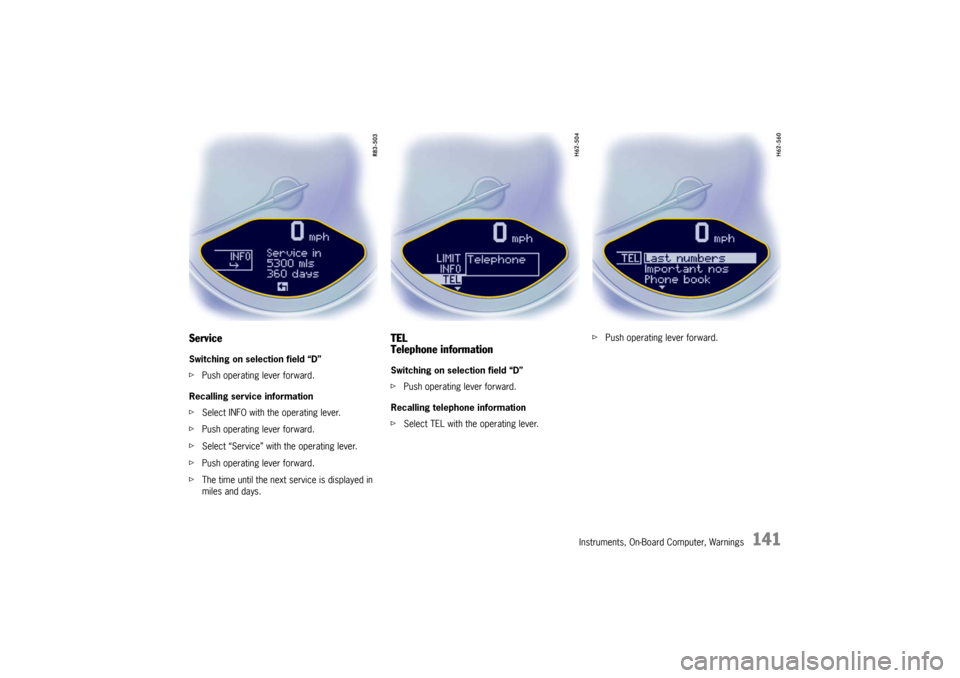
ServiceSwitching on selection field “D”
fPush operating lever forward.
Recalling service information
f Select INFO with the operating lever.
f Push operating lever forward.
f Select “Service” with the operating lever.
f Push operating lever forward.
f The time until the next service is displayed in
miles and days.
TEL
Telephone informationSwitching on selection field “D”
fPush operating lever forward.
Recalling telephone information
f Select TEL with the operating lever. f
Push operating lever forward.
Page 174 of 284

172
Warnings
System fault
Go to workshopSeveral systems may have
failed. Adjust your
driving style. Reduce speed.
Have the fault remedied at an authorized
Porsche dealer.
Failure of fuel level indicator
Workshop Have the fault remedied at an authorized
Porsche dealer.
Service in mls/days Service indicator
Bring the vehicle in for service no later than af-
ter the distance/time shown has elapsed.
Please observe the additional information in the
“Maintenance” booklet.
Service now Service indicator
Have your vehicle serviced at an authorized
Porsche dealer.
Flat tyre! Tire Pressure Monitoring has detected a serious
pressure loss.
Stop at a suitable plac e and check tires for dam-
age. Fill in tire sealant if necessary.
Add air The Tire Pressure Monitoring has detected a
gradual pressure loss. Correct tire pressure at
the next opportunity.
TPM is learning
monitoring
not act. The Tire Pressure Monitoring is learning the
wheels on the vehicle. The Tire Pressure Moni-
toring is searching for the tires and their posi-
tion. During this period
the current pressure
specifications are not av ailable on the on-board
computer.
TPM inactive The Tire Pressure Monitoring is faulty.
Consult an authorized Porsche dealer.
Instrument
panel On-board
computerText display on on-board
computer Meaning/measure
Page 189 of 284

Maintenance, Car Care
187
Coolant LevelfPlease see the chapter “EXERCISE EXTREME
CAUTION WHEN WORKING ON YOUR VEHICLE”
on Page 186.
The cooling system is filled at the factory with a
permanent coolant.
It provides year-round protection from corrosion
and freezing down to –31 °F/–35 °C .
f Only use antifreeze authorized by Porsche. Checking coolant level The expansion tank with its filler orifice is located
in the rear luggage comp artment under the serv-
ice flap.
f Check the coolant level regularly.
When the engine is cold and the car is level the
fluid level must lie between the “MIN” and “MAX”
markings.
Topping off coolant
Warning!
Danger of serious personal injury or death
from scalding. Coolant is hazardous to your
health, and may be fatal if swallowed.
f Do not open the cap of the expansion tank
while the engine is hot.
f Allow the engine to cool down before opening
the cap and protect your hands, arms and face
from any possible escape of hot coolant.
f Keep coolant out of children’s reach.
f Also, keep coolant away from your pets.
They can be attracted to it should there be a
spill, or to used coolant left in an open contai-
ner. Coolant can be deadly to pets if consu-
med.
Risk of damage from overflowing coolant.
f Take care while topping off coolant not to soil the luggage compartment or items of luggage.
1. Switch engine off and let it cool. Please see the chapter “COOLING SYSTEM” on
Page 88. 2. Press catch button on the service flap and
open flap.
3. Cover the expansion tank cap with a thick rag. Open cap slowly and ca refully and allow over-
pressure to escape.
Then unscrew cap completely.
4. Only add a mixture of antifreeze and water in
equal parts, and do not exceed the ”Max.“
mark.
Antifreeze in coolant:
50% gives protection down to –31 °F/–35 °C
60% gives protection down to –58 °F/–50 °C
5. Screw cap firmly on.
6. Close service flap.
Page 191 of 284

Maintenance, Car Care
189
If the vehicle is driven at a high rate of speed,
climatic conditions are warm, and the load is high,
the oil should be checked more frequently, as
driving conditions will determine the rate of oil
consumption.
– The engine in your vehicle depends on oil to lubricate and cool all of its moving parts.
Therefore, the engine oil should be checked
regularly and kept at the required level.
– Make it a habit to have the engine oil level checked at every fuel filling.
– The oil pressure warning light is not an oil level
indicator.
The oil pressure warning light indicates serious
engine damage may be occuring when lit, if en-
gine rpm is above idle speed.Engine Oil Level f Please see the chapter “EXERCISE EXTREME
CAUTION WHEN WORKING ON YOUR VEHICLE”
on Page 186.
f Regularly check the oil level using the on-board
computer after the vehicle is refuelled.
Please see the chapter “OIL DISPLAY AND
MEASUREMENT OF THE ENGINE OIL LEVEL”
on Page 161.
The difference between the minimum and maxi-
mum marks on the segment display is approx.
1.3 quarts (1.25 liters).
Each segment of the display corresponds to ap-
prox. 0.42 quart (0.4 liter).
Topping off engine oil
Warning!
Engine oil is hazardous to your health and
may be fatal if swallowed.
f Keep engine oil out of children’s reach.
Used engine oil contains chemicals that have
caused cancer in laboratory animals.
f Always protect your skin by washing thorough-ly with soap and water. Caution!
Risk of damage from overflowing engine oil.
f Take care while checking and topping up
engine oil not to soil the luggage compartment or items of luggage.
Note
The Check Engine warning light may light up if the
cap of the oil filler opening is opened while the
engine is running.
The oil inlet opening is located in the rear luggage
compartment under the service flap.
1. Measure the oil level and read off the required top-up quantity on the on-board computer.
2. Switch off the engine. 3. Press catch button on the service flap and
open flap.
4. Unscrew the oil filler cap.
5. Add at most 0.5 quarts (0.5 liter) of engine oil at a time.
Never add more engine oil than required
to reach the max. mark.
6. Close oil filler cap until you feel it reach its end position.
7. Measure oil level again with the on-board computer. Switch off the engine.
8. If necessary, repeat the process and add more engine oil as required.