torque PORSCHE CAYMAN S 2010 1.G Information Manual
[x] Cancel search | Manufacturer: PORSCHE, Model Year: 2010, Model line: CAYMAN S, Model: PORSCHE CAYMAN S 2010 1.GPages: 66, PDF Size: 4.89 MB
Page 4 of 66
Porsche Doppelkupplung (PDK,
p. 48) is available as an option.
The key elements of PDK are its
seven gears, t wo half gearboxes
and t wo clutches. It features both
manual and automatic modes.
Gears are changed using the gear
selector for PDK, the switches
on the three-spoke sports steering
wheel or the new optional three-
spoke sports steering wheel with
gearshif t paddles with race track
control logic. The gear change
takes place in a mat ter of millisec -
onds without any interruption in
the flow of power. The advantage
over a fully manual transmission
is the considerably faster rate of
acceleration for the same rate of
fuel consumption. The advantage
over a fully automatic transmission
is the perceptible increase in
driving dynamics – with a similar
level of comfort, and a distinct
reduction in fuel consumption.
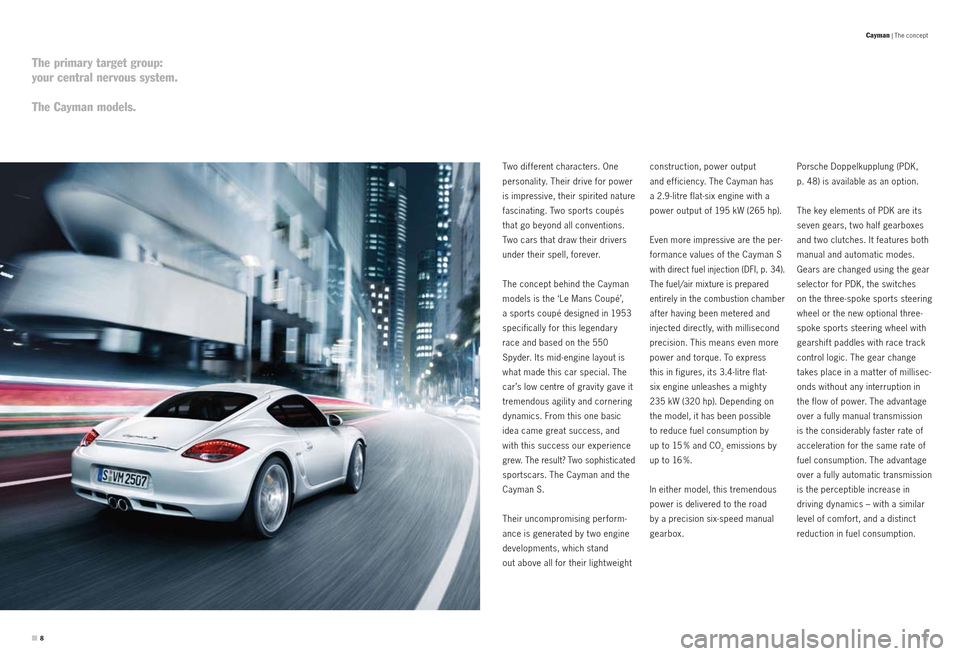
Two dif ferent characters. One
personalit y. Their drive for power
is impressive, their spirited nature
fascinating. Two sports coupés
that go beyond all conventions.
Two cars that draw their drivers
under their spell, forever.
The concept behind the Cayman
models is the ‘Le Mans Coupé’,
a sports coupé designed in 1953
specifically for this legendary
race and based on the 550
Spyder. Its mid- engine layout is
what made this car special. The
car’s low centre of gravit y gave it
tremendous agilit y and cornering
dynamics. From this one basic
idea came great success, and
with this success our experience
grew. The result? Two sophisticated
sportscars. The Cayman and the
Cayman S.
Their uncompromising perform -
ance is generated by t wo engine
developments, which stand
out above all for their light weight construction, power output
and ef ficiency. The Cayman has
a 2.9 -litre flat-six engine with a
power output of 195 kW (265 hp).
Even more impressive are the per -
formance values of the Cayman S
with direct fuel injection (DFI, p. 34).
The fuel/air mixture is prepared
entirely in the combustion chamber
af ter having been metered and
injected directly, with millisecond
precision. This means even more
power and torque. To express
this in figures, its 3.4-litre flat-
six engine unleashes a might y
235 kW (320 hp). Depending on
the model, it has been possible
to reduce fuel consumption by
up to 15 % and CO
2 emissions by
up to 16 %.
In either model, this tremendous
power is delivered to the road
by a precision six-speed manual
gearbox.
The primary target group:
your central nervous system.
The Cayman models.
Cayman | The concept
89
Page 11 of 66
6,000 rpm. From a standing start,
the Cayman accelerates to
62 mph (100 km/ h) in 5.8 seconds.
With the optional Porsche
Doppelkupplung (PDK), this sprint
takes just 5.7 seconds. Top
speed is 165 mph (265 km/ h)
in conjunction with the manual
gearbox. Equally impressive, with the CDR-30 audio system
with 5-inch display. An integrated
six- disc CD autochanger is
available as an option.
The Cayman has found its way.
Its own? Without doubt.
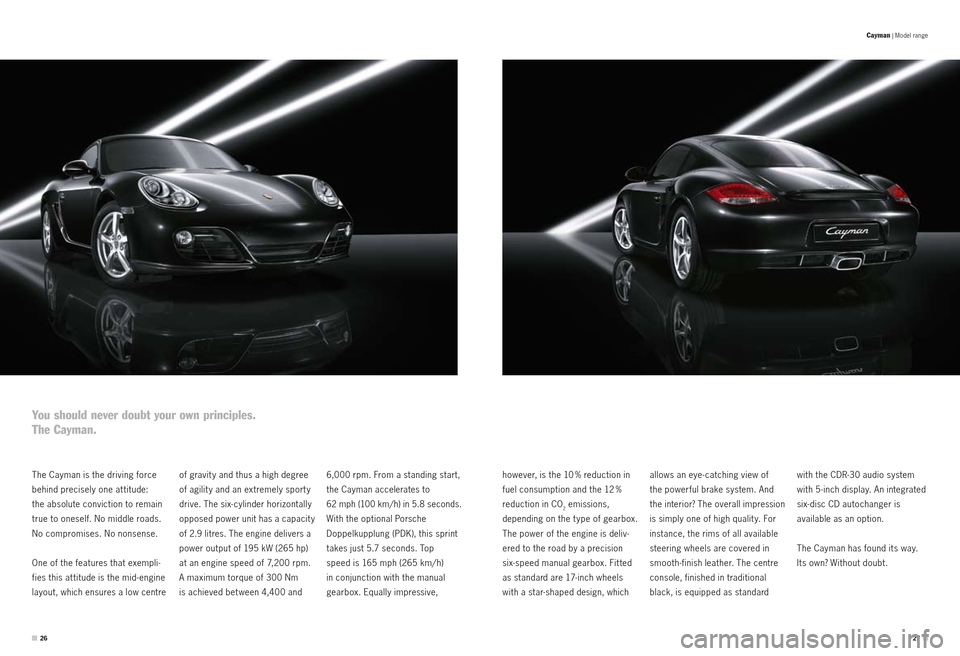
The Cayman is the driving force
behind precisely one at titude:
the absolute conviction to remain
true to oneself. No middle roads.
No compromises. No nonsense.
One of the features that exempli -
fies this at titude is the mid- engine
layout, which ensures a low centre however, is the 10
% reduction in
fuel consumption and the 12 %
reduction in CO2 em issio ns,
depending on the t ype of gearbox.
The power of the engine is deliv -
ered to the road by a precision
six-speed manual gearbox. Fit ted
as standard are 17-inch wheels
with a star-shaped design, which
of gravit y and thus a high degree
of agilit y and an extremely sport y
drive. The six-cylinder horizontally
opposed power unit has a capacit y
of 2.9 litres. The engine delivers a
power output of 195 kW
(265 hp)
at an engine speed of 7,200 rpm.
A maximum torque of 300 Nm
is achieved bet ween 4,400 and allows an eye-catching view of
the powerful brake system. And
the interior? The overall impression
is simply one of high qualit y. For
instance, the rims of all available
steering wheels are covered in
smooth -finish leather. The centre
console, finished in traditional
black, is equipped as standard
You should never doubt your own principles.
The Cayman.
Cayman | Model range
2627
Page 12 of 66
is achieved at 4,750 rpm.
This means, it has been possible
to reduce fuel consumption by
up to 15 % and CO
2 emissions
by up to 16 %, depending on the
t ype of gearbox.
To accept no compromises,
to make conscious decisions, to
be governed by nothing other
than one’s own free will, and to
have a clear point of view. A
highly promising way to build a
sportscar. For us, it ’s the only
w ay. The Cayman S reaches 62 mph
(100 km/ h) in just 5.2 seconds.
Top speed isn’t reached until
172 mph (277 km/ h). Porsche
Doppelkupplung (PDK, p. 48)
is available as an option.
The fastest rate of acceleration
of 4.9 seconds is achieved
in conjunction with the optional
Sport Chrono Package.
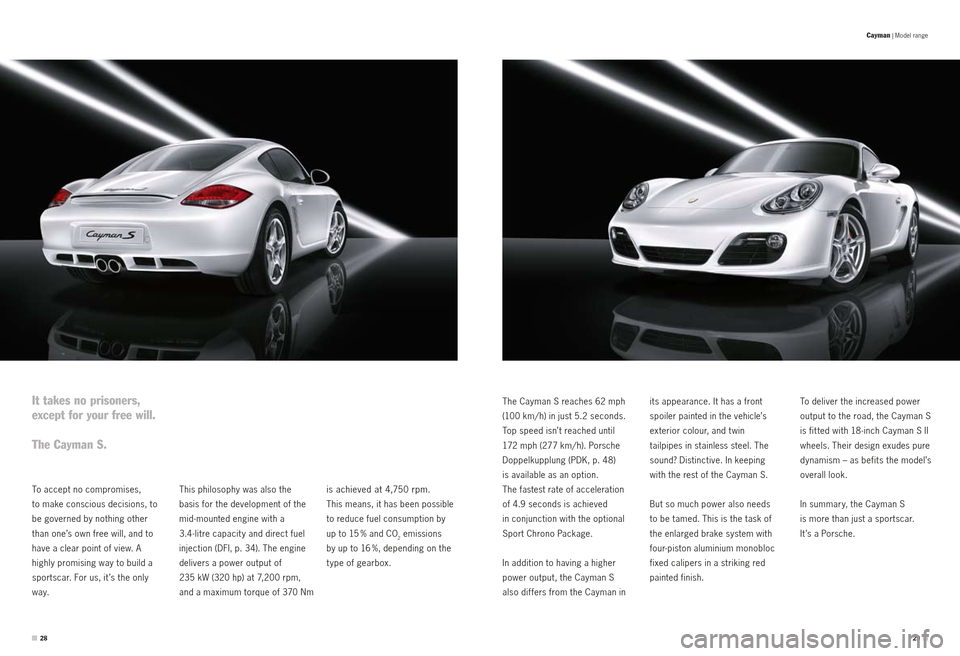
In addition to having a higher
power output, the Cayman S
also dif fers from the Cayman in
This philosophy was also the
basis for the development of the
mid-mounted engine with a
3.4-litre capacit y and direct fuel
injection (DFI, p. 34). The engine
delivers a power output of
235 kW (320 hp) at 7,200 rpm,
and a maximum torque of 370 Nm its appearance. It has a front
spoiler painted in the vehicle’s
exterior colour, and t win
tailpipes in stainless steel. The
sound? Distinctive. In keeping
with the rest of the Cayman S.
But so much power also needs
to be tamed. This is the task of
the enlarged brake system with
four-piston aluminium monobloc
fixed calipers in a striking red
painted finish. To deliver the increased power
output to the road, the Cayman S
is fit ted with 18-inch Cayman S II
wheels. Their design exudes pure
dynamism – as befits the model’s
overall look.
In summary, the Cayman S
is more than just a sportscar.
It ’s a Porsche.
It takes no prisoners,
except for your free will.
The Cayman S.
Cayman | Model range
2829
Page 14 of 66
Two examples of the uncompromising efforts of our engineers.
Going forward.
The engines of the Cayman models.
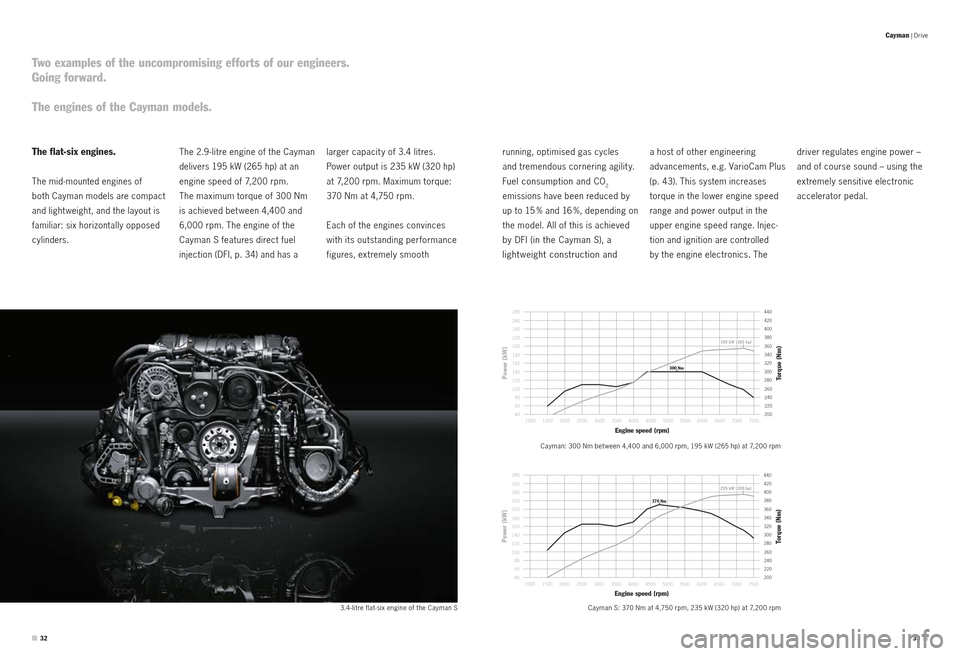
3.4 - litre flat-six engine of the Cayman SCayman S: 370 Nm at 4,750 rpm, 235 kW (320 hp) at 7,200 rpm
Cayman: 300 Nm bet ween 4,400 and 6,000 rpm, 195 kW (265 hp) at 7,200 rpm
larger capacit y of 3.4 litres.
Power output is 235 kW (320 hp)
at 7,200 rpm. Maximum torque:
370 Nm at 4,750 rpm.
Each of the engines convinces
with its outstanding performance
figures, extremely smooth driver regulates engine power –
and of course sound – using the
extremely sensitive electronic
accelerator pedal.The flat-six engines.
The mid-mounted engines of
both Cayman models are compact
and light weight, and the layout is
familiar: six horizontally opposed
cylinders.
running, optimised gas cycles
and tremendous cornering agilit y.
Fuel consumption and CO2
emissions have been reduced by
up to 15 % and 16 %, depending on
the model. All of this is achieved
by DFI (in the Cayman S), a
lightweight construction and
The 2.9 -litre engine of the Cayman
delivers 195 kW (265 hp) at an
engine speed of 7,200 rpm.
The maximum torque of 300 Nm
is achieved bet ween 4,400 and
6,000 rpm. The engine of the
Cayman S features direct fuel
injection (DFI, p. 34) and has a a host of other engineering
advancements, e.g. VarioCam Plus
(p. 43). This system increases
torque in the lower engine speed
range and power output in the
upper engine speed range. Injec
-
tion and ignition are controlled
by the engine electronics. The
Cayman | Drive
Power (kW)
T orque (Nm)
Engine speed (rpm)
200
280 300 320 340 360 380 400 420
40 60 80
100 120 140 160 180 200 220 240 260
1500 7500
2000 2500 300035004000 4500 500055006000 6500 7000 220 240 260
1000
235 kW (320 hp)
370 Nm
280
440
40 60 80
100 120 140 160 180 200 220 240 260
1500 7500
2000 2500 3000 3500 4000 4500 5000 5500 6000 6500 7000 1000
195 kW (265 hp)
300 Nm
280 Power (kW)
T orque (Nm)
Engine speed (rpm)
200
280 300 320 340 360 380 400
420
220 240 260
440
3233
Page 15 of 66
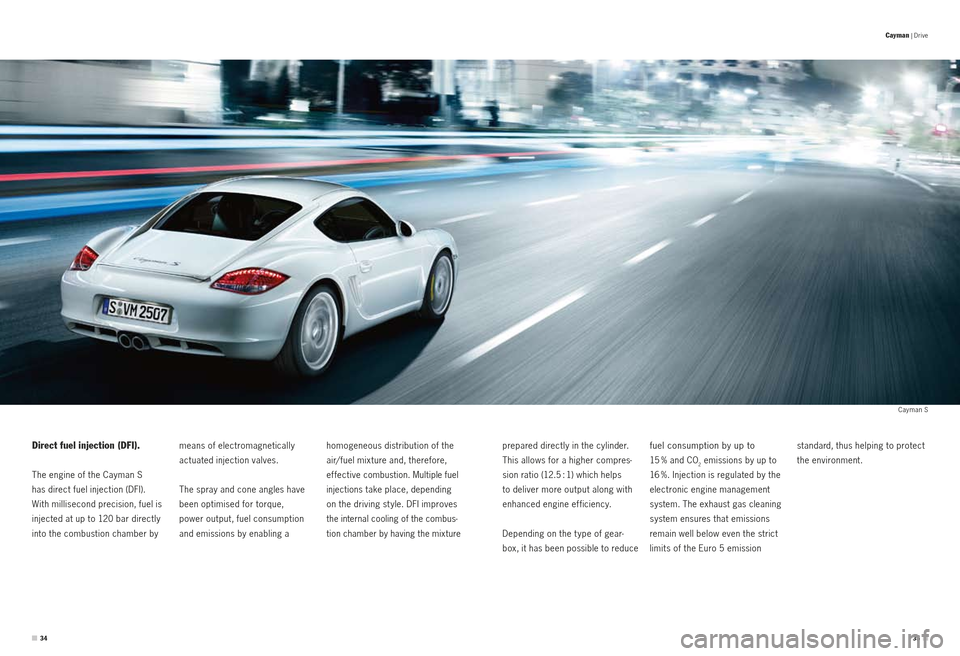
Cayman S
homogeneous distribution of the
air/fuel mixture and, therefore,
effective
combustion. Multiple fuel
injections
take place, depending
on the driving st yle. DFI improves
the internal cooling of the combus -
tion chamber by having the mixture
standard, thus helping to protect
the environment.
Direct fuel injection (DFI).
The engine of the Cayman S
has direct fuel injection (DFI).
With millisecond precision, fuel is
injected at up to 120 bar directly
into the combustion chamber by prepared directly in the cylinder.
This allows for a higher compres
-
sion ratio (12.5 : 1) which helps
to deliver more output along with
enhanced engine ef ficiency.
Depending on the t ype of gear -
box, it has been possible to reduce
means of electromagnetically
actuated injection valves.
The spray and cone angles have
been optimised for torque,
power output, fuel consumption
and emissions by enabling a
fuel consumption by up to
15 % and CO
2 emissions by up to
16 %. Injection is regulated by the
electronic engine management
system. The exhaust gas cleaning
system ensures that emissions
remain well below even the strict
limits of the Euro 5 emission
Cayman | Drive
3435
Page 18 of 66
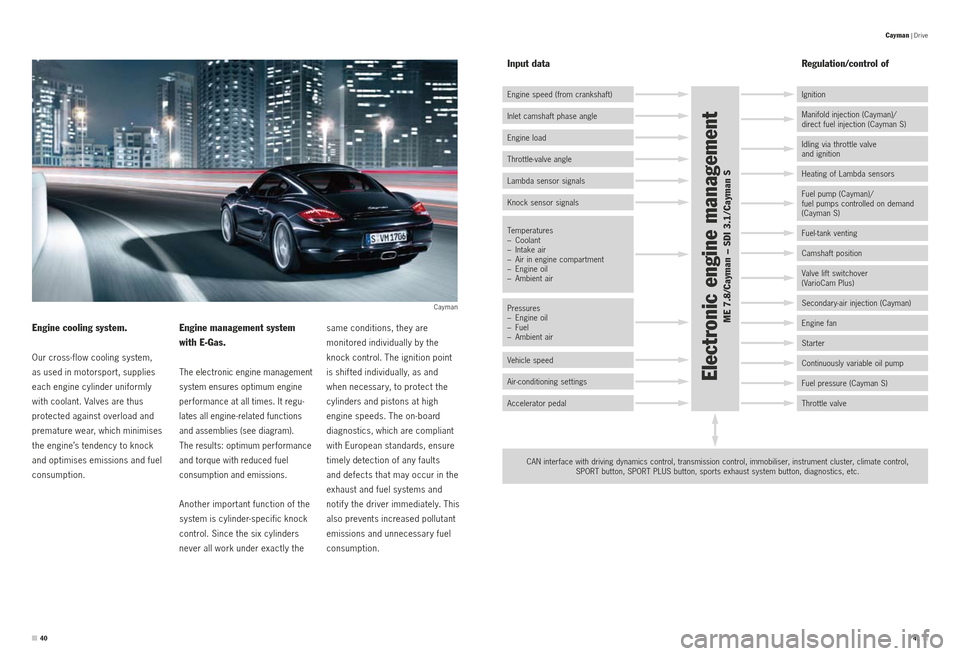
Input dataRegulation/control of
Electronic engine management
ME 7.8/Cayman – SDI 3.1/ Cayman S
Engine load
Lambda sensor signals
Engine speed (from crankshaft)
Inlet camshaft phase angle
Knock sensor signals
Vehicle speed
Air-conditioning settings
Accelerator pedal
Temperatures
– Coolant
– Intake air
– Air in engine compartment
– Engine oil
– Ambient air
Pressures
– Engine oil
– Fuel
– Ambient air
Ignition
Manifold injection (Cayman)/
direct fuel injection (Cayman S)
Heating of Lambda sensors
Fuel pump (Cayman)/
fuel pumps controlled on demand
(Cayman S)
Fuel-tank venting
CAN interface with driving dynamics control, transmission control, immobiliser, instrument cluster, climate control,
SPORT button, SPORT PLUS button, sports exhaust system button, diagnostics, etc.
Valve lift switchover
(VarioCam Plus)
Secondary-air injection (Cayman)
Starter
Throttle-valve angle
Idling via throttle valve
and ignition
Fuel pressure (Cayman S)
Throttle valve
Camshaft position
Engine fan
Continuously variable oil pump
Cayman
same conditions, they are
monitored individually by the
knock control. The ignition point
is shifted individually, as and
when necessary, to protect the
cylinders and pistons at high
engine speeds. The on -board
diagnostics, which are compliant
with European standards, ensure
timely detection of any faults
and defects that may occur in the
exhaust and fuel systems and
notif y the driver immediately. This
also prevents increased pollutant
emissions and unnecessary fuel
consumption.Engine cooling system.
Our cross-flow cooling system,
as used in motorsport, supplies
each engine cylinder uniformly
with coolant. Valves are thus
protected against overload and
premature wear, which minimises
the engine’s tendency to knock
and optimises emissions and fuel
consumption.
Engine management system
with E-Gas.
The electronic engine management
system ensures optimum engine
performance at all times. It regu -
lates all engine-related functions
and assemblies (see diagram).
The results: optimum performance
and torque with reduced fuel
consumption and emissions.
Another important function of the
system is cylinder-specific knock
control. Since the six cylinders
never all work under exactly the
Cayman | Drive
4041
Page 19 of 66
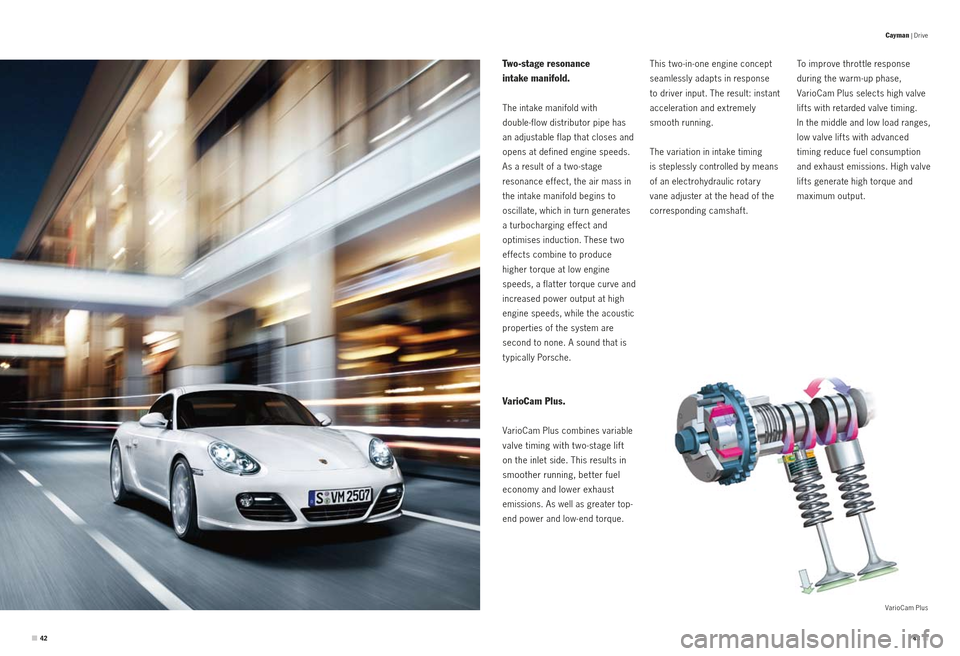
Cayman | Drive
VarioCam Plus
To improve throt tle response
during the warm -up phase,
VarioCam Plus selects high valve
lif ts with retarded valve timing.
In the middle and low load ranges,
low valve lif ts with advanced
timing reduce fuel consumption
and exhaust emissions. High valve
lif ts generate high torque and
maximum output.Two-stage resonance
intake manifold.
The intake manifold with
double-flow distributor pipe has
an adjustable flap that closes and
opens at defined engine speeds.
As a result of a t wo -stage
resonance ef fect, the air mass in
the intake manifold begins to
oscillate, which in turn generates
a turbocharging ef fect and
optimises induction. These t wo
ef fects combine to produce
higher torque at low engine
speeds, a flat ter torque curve and
increased power output at high
engine speeds, while the acoustic
properties of the system are
second to none. A sound that is
typically Porsche.
VarioCam Plus.
VarioCam Plus combines variable
valve timing with t wo -stage lift
on the inlet side. This results in
smoother running, bet ter fuel
economy and lower exhaust
emissions. As well as greater top-
end power and low- end torque. This two-in-one engine concept
seamlessly adapts in response
to driver input. The result: instant
acceleration and extremely
smooth running.
The variation in intake timing
is steplessly controlled by means
of an electrohydraulic rotary
vane adjuster at the head of the
corresponding camshaf t.
4243
Page 20 of 66
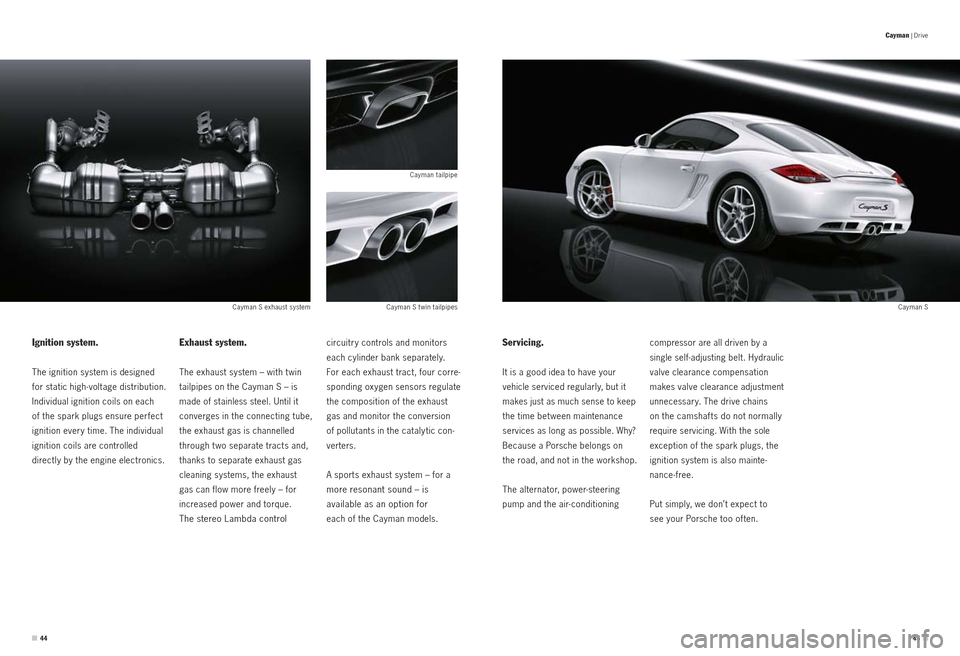
Cayman S exhaust systemCayman S t win tailpipes Cayman S
Cayman tailpipe
circuitry controls and monitors
each cylinder bank separately.
For each exhaust tract, four corre -
sponding oxygen sensors regulate
the composition of the exhaust
gas and monitor the conversion
of pollutants in the cataly tic con -
verters.
A sports exhaust system – for a
more resonant sound – is
available as an option for
each of the Cayman models.
Ignition system.
The ignition system is designed
for static high -voltage distribution.
Individual ignition coils on each
of the spark plugs ensure perfect
ignition every time. The individual
ignition coils are controlled
directly by the engine electronics.
Servicing.
It is a good idea to have your
vehicle serviced regularly, but it
makes just as much sense to keep
the time bet ween maintenance
services as long as possible. Why?
Because a Porsche belongs on
the road, and not in the workshop.
The alternator, power-steering
pump and the air- conditioning
Exhaust system.
The exhaust system – with t win
tailpipes on the Cayman S – is
made of stainless steel. Until it
converges in the connecting tube,
the exhaust gas is channelled
through t wo separate tracts and,
thanks to separate exhaust gas
cleaning systems, the exhaust
gas can flow more freely – for
increased power and torque.
The stereo Lambda control
compressor are all driven by a
single self-adjusting belt. Hydraulic
valve clearance compensation
makes valve clearance adjustment
unnecessary. The drive chains
on the camshaf ts do not normally
require servicing. With the sole
exception of the spark plugs, the
ignition system is also mainte -
nance -free.
Put simply, we don’t expect to
see your Porsche too often.
Cayman | Drive
4445
Page 23 of 66
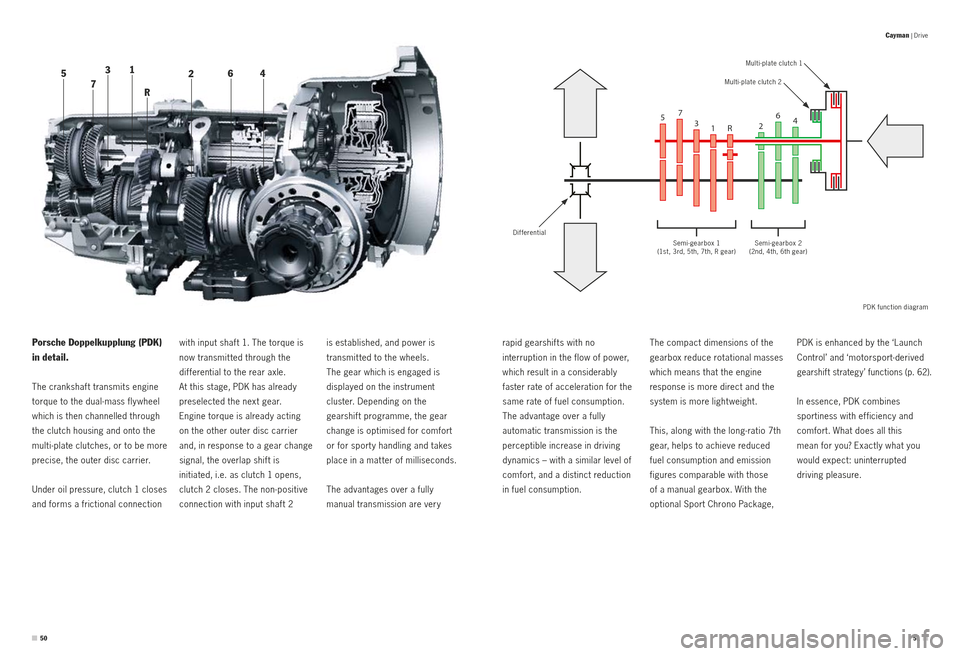
Multi - plate clutch 1
Multi - plate clutch 2
Semi -gearbox 2
(2nd, 4th, 6th gear)
Semi -gearbox 1
(1st, 3rd, 5th, 7th, R gear)
Differential
P DK function diagram
is established, and power is
transmit ted to the wheels.
The gear which is engaged is
displayed on the instrument
cluster. Depending on the
gearshif t programme, the gear
change is optimised for comfort
or for sport y handling and takes
place in a mat ter of milliseconds.
The advantages over a fully
manual transmission are very PDK is enhanced by the ‘Launch
Control’ and ‘motorsport- derived
gearshift strategy’ functions (p. 62).
In essence, PDK combines
sportiness with ef ficiency and
comfort. What does all this
mean for you? Exactly what you
would expect: uninterrupted
driving pleasure.
Porsche Doppelkupplung (PDK)
in detail.
The crankshaf t transmits engine
torque to the dual-mass fly wheel
which is then channelled through
the clutch housing and onto the
multi-plate clutches, or to be more
precise, the outer disc carrier.
Under oil pressure, clutch 1 closes
and forms a frictional connection rapid gearshif ts with no
interruption in the flow of power,
which result in a considerably
faster rate of acceleration for the
same rate of fuel consumption.
The advantage over a fully
automatic transmission is the
perceptible increase in driving
dynamics – with a similar level of
comfort, and a distinct reduction
in fuel consumption.
with input shaft 1. The torque is
now transmit ted through the
dif ferential to the rear axle.
At this stage, PDK has already
preselected the next gear.
Engine torque is already acting
on the other outer disc carrier
and, in response to a gear change
signal, the overlap shift is
initiated, i.e. as clutch 1 opens,
clutch 2 closes. The non-positive
connection with input shaf t 2 The compact dimensions of the
gearbox reduce rotational masses
which means that the engine
response is more direct and the
system is more light weight.
This, along with the long-ratio 7th
gear, helps to achieve reduced
fuel consumption and emission
figures comparable with those
of a manual gearbox. With the
optional Sport Chrono Package,
Cayman | Drive
50
46
2
1
R
7 3
5
51
4
6
2
R1
3
7
5
Page 29 of 66
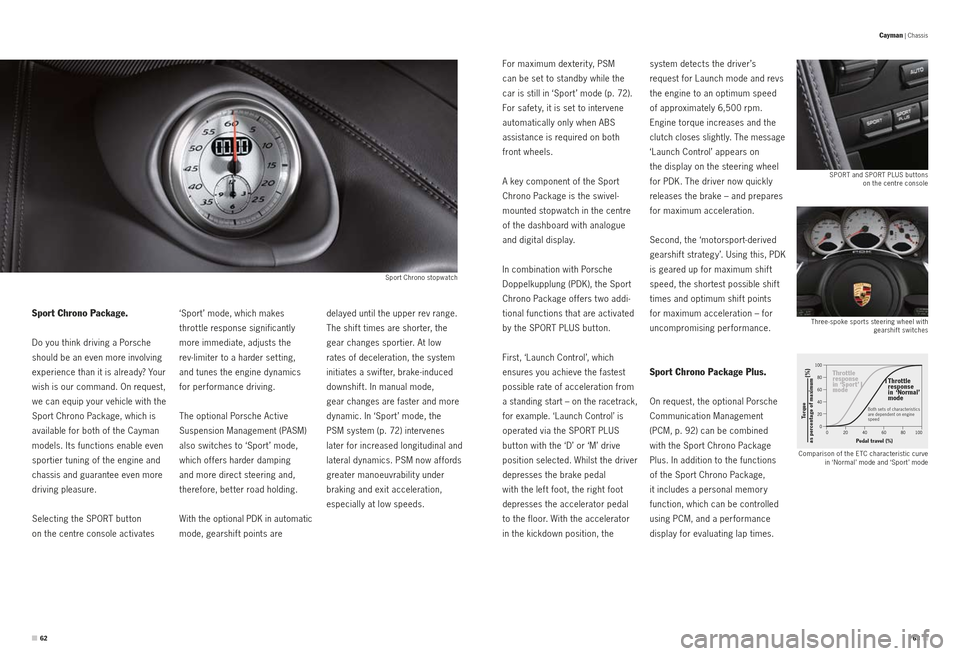
Sport Chrono stopwatchSPORT and SPORT PLUS but tons
on the centre console
Three -spoke sports steering wheel with gearshif t switches
For maximum dexterit y, PSM
can be set to standby while the
car is still in ‘Sport ’ mode (p. 72).
For safet y, it is set to intervene
automatically only when ABS
assistance is required on both
front wheels.
A key component of the Sport
Chrono Package is the swivel-
mounted stopwatch in the centre
of the dashboard with analogue
and digital display.
In combination with Porsche
Doppelkupplung (PDK), the Sport
Chrono Package offers t wo addi -
tional functions that are activated
by the SPORT PLUS but ton.
First, ‘Launch Control’, which
ensures you achieve the fastest
possible rate of acceleration from
a standing start – on the racetrack,
for example. ‘Launch Control’ is
operated via the SPORT PLUS
but ton with the ‘D’ or ‘M’ drive
position selected. Whilst the driver
depresses the brake pedal
with the lef t foot, the right foot
depresses the accelerator pedal
to the floor. With the accelerator
in the kickdown position, the
delayed until the upper rev range.
The shif t times are shorter, the
gear changes sportier. At low
rates of deceleration, the system
initiates a swif ter, brake-induced
downshift. In manual mode,
gear changes are faster and more
dynamic. In ‘Sport ’ mode, the
PSM system (p. 72) intervenes
later for increased longitudinal and
lateral dynamics. PSM now af fords
greater manoeuvrabilit y under
braking and exit acceleration,
especially at low speeds.
Sport Chrono Package.
Do you think driving a Porsche
should be an even more involving
experience than it is already? Your
wish is our command. On request,
we can equip your vehicle with the
Sport Chrono Package, which is
available for both of the Cayman
models. Its functions enable even
sportier tuning of the engine and
chassis and guarantee even more
driving pleasure.
Selecting the SPORT but ton
on the centre console activates ‘Sport ’ mode, which makes
throt tle response significantly
more immediate, adjusts the
rev-limiter to a harder set ting,
and tunes the engine dynamics
for performance driving.
The optional Porsche Active
Suspension Management (PASM)
also switches to ‘Sport ’ mode,
which of fers harder damping
and more direct steering and,
therefore, bet ter road holding.
With the optional PDK in automatic
mode, gearshif t points are system detects the driver’s
request for Launch mode and revs
the engine to an optimum speed
of approximately 6,500 rpm.
Engine torque increases and the
clutch closes slightly. The message
‘Launch Control’ appears on
the display on the steering wheel
for PDK. The driver now quickly
releases the brake – and prepares
for maximum acceleration.
Second, the ‘motorsport- derived
gearshif t strategy’. Using this, PDK
is geared up for maximum shif t
speed, the shortest possible shif t
times and optimum shif t points
for maximum acceleration – for
uncompromising performance.
Sport Chrono Package Plus.
On request, the optional Porsche
Communication Management
(PCM, p. 92) can be combined
with the Sport Chrono Package
Plus. In addition to the functions
of the Sport Chrono Package,
it includes a personal memory
function, which can be controlled
using PCM, and a performance
display for evaluating lap times.
Throttle
response
in ‘Sport’
mode Throttle
response
in ‘Normal’
mode
Both sets of characteristics
are dependent on engine
speed
Pedal travel (%)
(%)
Torque
as percentage of maximum
Comparison of the ETC characteristic curve in ‘Normal’ mode and ‘Sport ’ mode
Cayman | Chassis
6263