fuel PORSCHE CAYMAN S 2012 2.G Information Manual
[x] Cancel search | Manufacturer: PORSCHE, Model Year: 2012, Model line: CAYMAN S, Model: PORSCHE CAYMAN S 2012 2.GPages: 69, PDF Size: 19.31 MB
Page 22 of 69
123
43
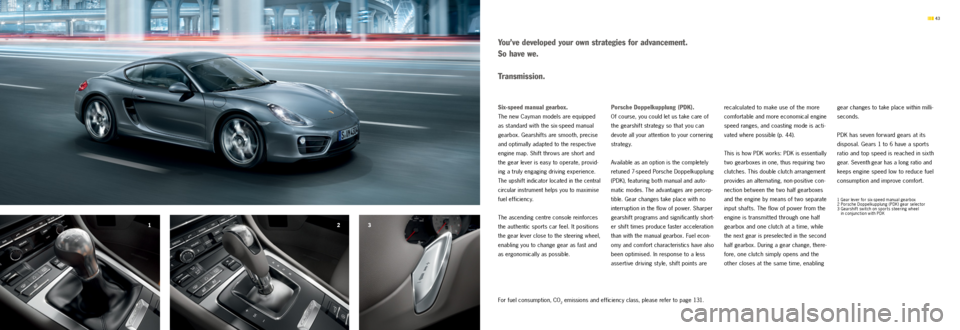
Six-speed manual gearbox.
The new Cayman models are equipped
as standard with the six-speed manual
gearbox. Gearshifts are smooth, precise
and optimally adapted to the respective
engine map. Shift throws are short and
the gear lever is easy to operate, provid -
ing a truly engaging driving experience.
The upshift indicator located in the central
circular instrument helps you to maximise
fuel efficiency.
The ascending centre console reinforces
the authentic sports car feel. It positions
the gear lever close to the steering wheel,
enabling you to change gear as fast and
as ergonomically as possible.
Porsche Doppelkupplung (PDK).
Of course, you could let us take care of
the gearshift strategy so that you can
devote all your at tention to your cornering
strategy.
Available as an option is the completely
retuned 7-speed Porsche Doppelkupplung
(PDK), featuring both manual and auto -
matic modes. The advantages are percep -
tible. Gear changes take place with no
interruption in the flow of power. Sharper
gearshift programs and significantly short -
er shift times produce faster acceleration
than with the manual gearbox. Fuel econ-
omy and comfort characteristics have also
been optimised. In response to a less
assertive driving st yle, shif t points are
recalculated to make use of the more
comfortable and more economical engine
speed ranges, and coasting mode is acti -
vated where possible (p. 44).
This is how PDK works: PDK is essentially
t wo gearboxes in one, thus requiring t wo
clutches. This double clutch arrangement
provides an alternating, non-positive con -
nection between the two half gearboxes
and the engine by means of t wo separate
input shafts. The flow of power from the
engine is transmit ted through one half
gearbox and one clutch at a time, while
the next gear is preselected in the second
half gearbox. During a gear change, there -
fore, one clutch simply opens and the
other closes at the same time, enabling
gear changes to take place within milli
-
seconds.
PDK has seven forward gears at its
disposal. Gears 1 to 6 have a sports
ratio and top speed is reached in sixth
gear. Seventh gear has a long ratio and
keeps
engine speed low to reduce fuel
con
sumption and improve comfort.
1 Gear lever for six-speed manual gearbox
2 Porsche Doppelkupplung (PDK) gear selector
3 Gearshif t switch on spor ts steering wheel
in conjunction with PDK
y ou’ve developed your own strategies for advancement.
So have we.
Transmission.
For fuel consumption, CO2 emissions and efficiency class, please refer to page 131.
Page 23 of 69

44
With the SPORT but ton selected, the full
advantages of the new version of PDK
are brought into play: a more immediate
response to throt tle inputs, relatively
short shift times and swift throt tle-blip
downshifts on overrun, such as during
braking into a corner, and always accom -
panied by an emotive engine sound.
With the optional Sport Chrono Package,
PDK is enhanced by ‘Launch Control’
and the ‘motorsport-derived gearshift
strategy’ for even faster and firmer gear
changes and best possible per formance,
thanks to a boost in torque during up -
shift phases. Overrun downshifts provide
extremely sport y braking and accelera -
tion for added excitement.
Coasting.
Efficiency is another area in which the
performance of the new Cayman models
has been further improved. The coasting
function available with Porsche Doppel-
kupplung (PDK) enables you to save even
more fuel where the situation allows.
The engine is decoupled from the trans -
mission to prevent deceleration caused
by engine braking. In this way, optimum
use is made of the vehicle’s momentum,
allowing it to coast for longer distances.
For example, you may want to slow down
from 100 to 80 km/ h (70 to 50 mph) in
anticipation
of the change of speed limit
ahead. As you ease off the accelerator
pedal, PDK deselects the current gear
automatically and you begin to coast in
neutral with minimal input required on
your part until
you have reached your desired speed.
As soon as you operate
the accelerator
or brake pedal, PDK
re-engages the appropriate gear within
fractions of a second. The process
is smooth and seamless, thanks to the
extremely fast
clutch.
Another way to reduce fuel consumption
is to utilise the coasting function on down -
hill gradients that are gentle enough for
you to maintain a constant speed. Efficient
on long journeys, such as on the motor -
way, PDK remains ready to respond as
swiftly and precisely as you would expect.
In short, driving in coasting mode makes
a real impact on fuel consumption without
the need to compromise on comfort or
sporty performance.
Drive |
Tra n s m i ssi o n
For fuel consumption, CO2 emissions and efficiency class, please refer to page 131.
Page 25 of 69
1212
49
Strong relationships need sincerity,
common goals and the abilit y to over-
come difficult situations in unison.
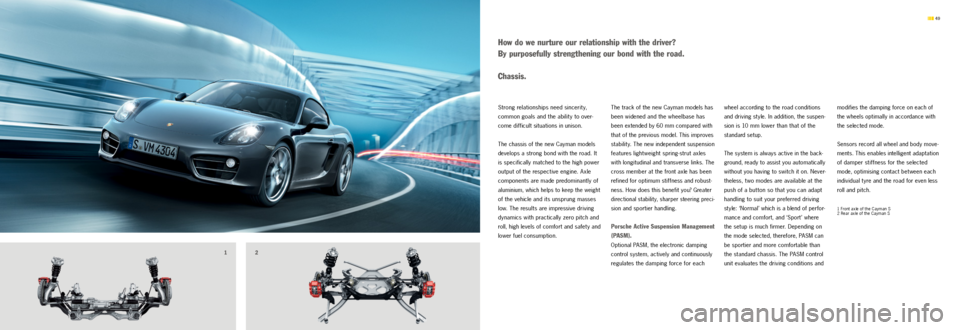
The chassis of the new Cayman models
develops a strong bond with the road. It
is specifically matched to the high power
output of the respective engine. A xle
components are made predominantly of
aluminium, which helps to keep the weight
of the vehicle and its unsprung masses
low. The results are impressive driving
dynamics with practically zero pitch and
roll, high levels of comfort and safet y and
lower fuel consumption. The track of the new Cayman models has
been widened and the wheelbase has
been extended by 60 mm compared with
that of the previous model. This improves
stabilit y. The new independent suspension
features light weight spring-strut axles
with longitudinal and transverse links. The
cross member at the front axle has been
refined for optimum stiffness and robust -
ness. How does this benefit you? Greater
directional stability, sharper steering preci -
sion and sportier handling.
Porsche active Suspension management
(PaSm ).
Optional PASM, the electronic damping
control system, actively and continuously
regulates the damping force for each
wheel according to the road conditions
and driving st yle. In addition, the suspen -
sion is 10 mm lower than that of the
st a n d a rd s e t u p .
The system is always active in the back-
ground, ready to assist you automatically
without you having to switch it on. Never -
theless, t wo modes are available at the
push of a but ton so that you can adapt
handling to suit your preferred driving
st yle: ‘Normal’ which is a blend of perfor-
mance and comfort, and ‘Sport ’ where
the setup is much firmer. Depending on
the mode selected, therefore, PASM can
be sportier and more comfortable than
the standard chassis. The PASM control
unit evaluates the driving conditions and modifies the damping force on each of
the wheels optimally in accordance with
the selected mode.
Sensors record all wheel and body move
-
ments. This enables intelligent adaptation
of damper stiffness for the selected
mode, optimising contact between each
individual t yre and the road for even less
roll and pitch.
h ow do we nurture our relationship with the driver?
By purposefully strengthening our bond with the road.
Chassis.
1 Front axle of the Cayman S
2 Rear axle of the Cayman S
Page 26 of 69
51
50
In ‘Sport ’ mode, for example, the suspen -
sion is set to a harder damper rating. On
uneven roads, PASM immediately switch -
es to a softer rating, thereby improving
contact bet ween the t yres and the road.
When the road surface improves, PASM
automatically reverts to the original,
harder rating. If ‘Normal’ mode is select -
ed and the driver’s st yle becomes more
assertive, PASM switches to a harder
rating to increase driving stabilit y and
road safety.
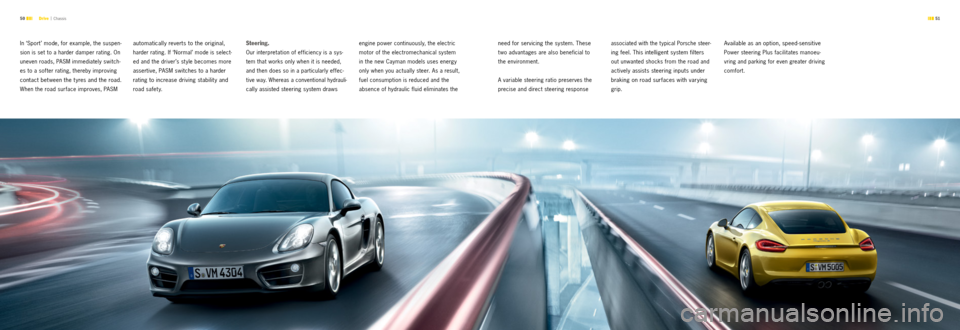
Steering.
Our interpretation of efficiency is a sys -
tem that works only when it is needed,
and then does so in a particularly effec -
tive way. Whereas a conventional hydrauli -
cally assisted steering system draws
engine power continuously, the electric
motor of the electromechanical system
in the new Cayman models uses energy
only when you actually steer. As a result,
fuel consumption is reduced and the
absence of hydraulic fluid eliminates the need for servicing the system. These
t wo advantages are also beneficial to
the environment.
A variable steering ratio preserves the
precise and direct steering response
associated with the t ypical Porsche steer-
ing feel. This intelligent system filters
out unwanted shocks from the road and
actively assists steering inputs under
braking on road surfaces with varying
grip.
Available as an option, speed-sensitive
Power steering Plus facilitates manoeu -
vring and parking for even greater driving
comfort.
Drive |
Chassis
Page 27 of 69
1
21
2
53
52
w heels.
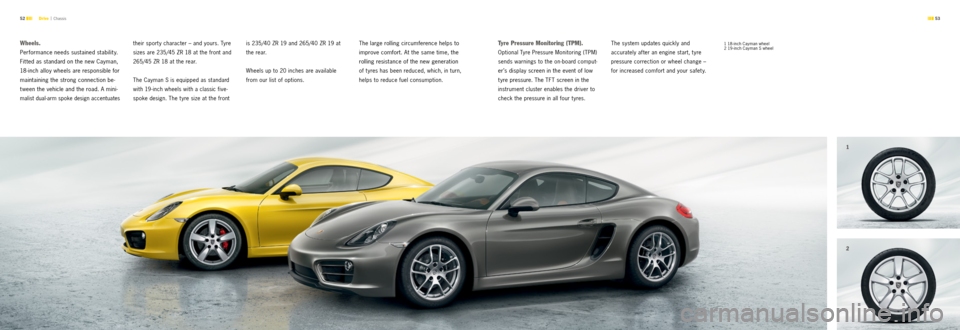
Performance needs sustained stability.
Fit ted as standard on the new Cayman,
18-inch alloy wheels are responsible for
maintaining the strong connection be -
t ween the vehicle and the road. A mini -
malist dual -arm spoke design accentuates
their sport y character – and yours. Tyre
sizes are 235/45 ZR 18 at the front and
265/45 ZR 18 at the rear.
The Cayman S is equipped as standard
with 19-inch wheels with a classic five-
spoke design. The t yre size at the front is 235/40 ZR 19 and 265/40 ZR 19 at
the rear.
Wheels up to 20 inches are available
from our list of options. The large rolling circumference helps to
improve comfort. At the same time, the
rolling resistance of the new generation
of t yres has been reduced, which, in turn,
helps to reduce fuel consumption.
1 18-inch Cayman wheel
2 19 - inch Cayman S wheel
Drive |
Chassis
Tyre Pressure m onitoring (TPm).
Optional Tyre Pressure Monitoring (TPM)
sends warnings to the on-board comput -
er’s display screen in the event of low
t yre pressure. The TFT screen in the
instrument cluster enables the driver to
check the pressure in all four t yres. The system updates quickly and
accurately af ter an engine start, t yre
pressure correction or wheel change –
for increased comfort and your safet y.
Page 29 of 69
57
56
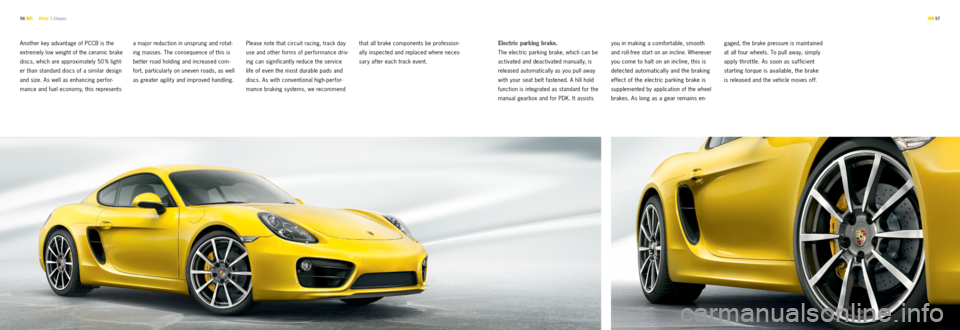
Another key advantage of PCCB is the
extremely low weight of the ceramic brake
discs, which are approximately 50 % light-
er than standard discs of a similar design
and size. As well as enhancing perfor -
mance and fuel economy, this represents a major reduction in unsprung and rotat
-
ing masses. The consequence of this is
bet ter road holding and increased com -
fort, particularly on uneven roads, as well
as greater agility and improved handling. Please note that circuit racing, track day
use and other forms of performance driv
-
ing can significantly reduce the service
life of even the most durable pads and
discs. As with conventional high-perfor -
mance braking systems, we recommend that all brake components be profession
-
ally inspected and replaced where neces -
sary after each track event.
e lectric parking brake.
The electric parking brake, which can be
activated and deactivated manually, is
released automatically as you pull away
with your seat belt fastened. A hill hold
function is integrated as standard for the
manual gearbox and for PDK. It assists
you in making a comfortable, smooth
and roll-free start on an incline. Whenever
you come to halt on an incline, this is
detected automatically and the braking
effect of the electric parking brake is
supplemented by application of the wheel
brakes. As long as a gear remains en -
gaged, the brake pressure is maintained
at all four wheels. To pull away, simply
apply throt tle. As soon as sufficient
starting torque is available, the brake
is
released and the vehicle moves off.
Drive |
Chassis
Page 38 of 69
75
For fuel consumption, CO2 emissions and efficiency class, please refer to page 131.
You aren’t the only one looking for ways
to improve your performance. In an era of
intensif ying debate about global climate
change and CO
2 em issio ns, au to m ot i ve
manufacturers are among those asking
themselves how they can contribute to
environmental protection. Our answer
has long been the same: Intelligent Per -
formance – a combination of high power
output and high efficiency.
In recent years, Porsche has managed to
reduce fuel consumption across all model
ranges by a double-digit percentage com -
pared with the respective previous model,
even though performance has been in -
creased in every generation. This is made
possible by an ef ficient drive concept,
including direct fuel injection (DFI) and
VarioCam Plus, a lightweight construc -
tion, optimised aerodynamics and low
rolling resistance.
The environmental management team
at the Porsche Development Centre in
Weissach demonstrates a high level of
environmental responsibility. Here, tech -
nological developments are carried out
with environmental protection in mind.
The goal is to enhance performance –
but preferably not at the expense of the
environment. We achieve this goal with
Intelligent Performance, as epitomised
by the new Cayman.
w hen it comes to sports cars, every gram counts.
e specially every gram of C o
2.
environment.
e mission control.
Vehicles manufactured by Porsche dem-
onstrate that even high-performance
sports cars can achieve moderate fuel
consumption and exhaust emission
val
ues in their respective category.
This is accomplished by the use of fuel-
ef ficient technologies such as auto start /
stop, thermal management, electrical
system recuperation, direct fuel injection,
VarioCam Plus and, in conjunction with
optional PDK, coasting mode.
The newly developed cataly tic converters
also provide ef ficient emission control,
while the stereo Lambda control circuitr y
manages and monitors each cylinder
bank separately. For each exhaust tract,
oxygen sensors, together with the engine
electronics and injectors, regulate the
composition of the exhaust gas, while
another Lambda sensor on each cylinder
bank monitors pollutant conversion in
the respective cataly tic converter.
Page 39 of 69
76 Safety and environment |
Environment
Fuel economy and recycling.
Intelligent lightweight construction is, and
always has been, a fundamental aspect of
the Porsche philosophy – for both techni -
cal and ecological reasons. This combina -
tion forms the basis for achieving low fuel
consumption values in conjunction with
high performance. On the technical side,
various components are made with a high
proportion of alu minium, magnesium, plas -
tics and super- high -strength sheet steel.
The materials used have been selected
for their abilit y to withstand load, yet they
are considerably lighter than conventional
steel. As a result, the bodyshell of the new
Cayman models has a light alloy content
of approximately 44 %.
On the ecological side, all materials used
are meticulously selected. We use only state-of-the-art components, with priority
given to products manufactured in a sus
-
tainable manner where possible. All syn -
thetic components are easily recyclable
and each material is labelled to facilitate
its separation for recycling. The reduction
in the number of plastic variants helps to
ensure more efficient recycling. Recycled
plastics are used where they meet our
exacting technical requirements.
In short, the new Cayman is around 95 %
recoverable.
In addition, Porsche uses a high proportion
of environmentally friendly water-based
paints. For us, environmental protection
does not begin with the vehicle manufac -
turing process. It starts at the planning
and development stage.
Fuel.
The new Cayman models are designed to
operate on fuels with an ethanol content of
up to 10 %. Ethanol has a positive impact
on the CO2 balance since the plants grown
for the production of this biofuel also
absorb CO
2 from the atmosphere. The
release of hydrocarbons from the fuel
system has been minimised thanks to the
active carbon filter and the multilayered
material from which the fuel tank is made.
Servicing.
Long service intervals offer clear advan -
tages. For you, they reduce costs and
save time. For the environment, they assist
in the sparing use of consumables and
replacement parts. For full details of ser -
vice intervals, please refer to the separate
price list.
For fuel consumption, CO
2 emissions and efficiency class, please refer to page 131.
Page 47 of 69
92 Interior | Interior and comfort
Cruise control.
Cruise control is available as an option for
the new Cayman models. This automatic
speed controller for the 30 to 240 km/ h
(18–149 mph) speed range is operated
by a switch on a separate control stalk on
the steering
column. The advantages
are clear. Not only can cruise control be
used as a
means of staying within the
speed limit, it also helps you to save fuel
by maintaining
a constant speed.
adaptive cruise control including
Porsche a ctive Safe (P aS).
Also available as an option is the en -
hanced version of cruise control, which
regulates the speed of your vehicle in
line with the speed of the vehicle in
front. A radar sensor inside the front
centre air intake scans the road ahead
up to a distance of 200 m. Imagine
you’ve selected a cruising speed but
have begun to gain on the vehicle in
front because it is driving more slowly –
this is detected by the radar sensor.
The system now reduces the speed of
your vehicle by restricting throt tle or by
gently applying the brakes until your
chosen distance from the vehicle in front
is maintained. If the vehicle ahead slows
further, adaptive cruise control will decel-
erate your vehicle accordingly – even
down to a halt.
For increased safet y, the system also
readies the brakes whenever it detects
that the distance from the vehicle is
decreasing. However, the driver should
be prepared to intervene manually if
heavier braking is required.
As soon as the road ahead clears, your
vehicle will accelerate back up to the
cruising speed originally set. Porsche
Active Safe (PAS) issues an audible and a
visual warning if the system detects that
your vehicle is approaching the vehicle in
front too quickly. This is accompanied by
a brief application of brake force and,
where necessary, the initiation of targeted
braking. During this process, any braking
by the driver is boosted to achieve the
maximum braking force that the system
is able to provide.
Park assist.
Optional Park Assist is activated the mo -
ment you select reverse gear. An audible
signal gives a warning if you reverse too
close to an obstacle.
An enhanced version of Park Assist pro -
vides monitoring of the area to the front
of the vehicle. Ultrasonic sensors are
neatly integrated in the front and rear
aprons. The audible alert is supplemented
by a visual warning in the central display
screen of the CDR audio system or op -
tional PCM showing a graphical represen -
tation of the vehicle from overhead.
‘ w elcome h ome’ lighting.
The ‘Welcome Home’ lighting function
automatically switches on the LED day -
time running lights for a user-defined
period whenever the vehicle is opened
or closed using the key remote.
a nti-theft protection.
The new Cayman models are equipped as
standard with an immobiliser with in-key
transponder. In addition, the Cayman S has
an alarm system with contact-sensitive
exterior protection. A radar-based interior
surveillance system is available on request.
For the Cayman, a combined alarm and
radar-based interior surveillance system is
available as an option.
Porsche Vehicle Tracking System
(PV TS).
This optional preparation enables future
installation of the Porsche Vehicle Tracking
System (PV TS) from Porsche Tequipment.
PV TS makes it possible to locate a stolen
vehicle across most European countries.
The preparation package includes a spe -
cial wiring loom and a tilt sensor for the
alarm system.
Page 65 of 69
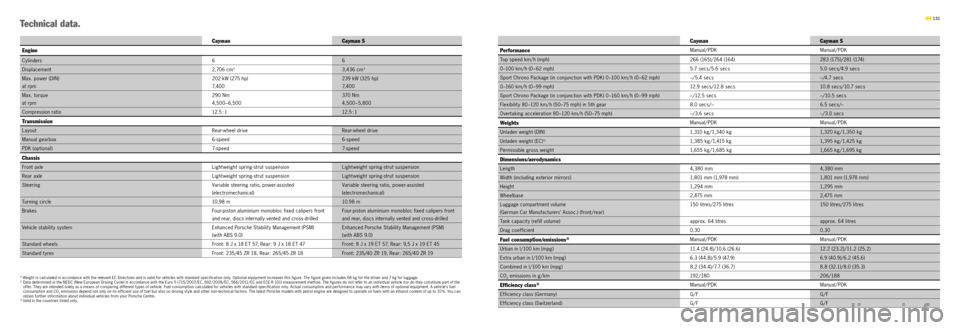
131 Technical data.
CaymanCayman S
e ngine
C y linders 66
Displacement 2,70 6 c m
33,436 cm3
Max. power (DIN)
at rpm 202 kW (275 hp)
7, 4 0 0239 kW (325 hp)
7, 4 0 0
Max. torque
at rpm 290 Nm
4,500 – 6,500370
Nm
4,500–5,800
Compression ratio 12.5 : 112.5 : 1
Transmission
Layout Rear-wheel driveRear-wheel drive
Manual gearbox 6-speed6-speed
PDK (optional) 7-speed7-speed
Chassis
Front axle Lightweight spring-strut suspensionLightweight spring-strut suspension
Rear axle Lightweight spring-strut suspensionLightweight spring-strut suspension
Steering Variable steering ratio, power-assisted
(electromechanical) Variable steering ratio, power-assisted
(electromechanical)
Turning circle 10.9 8 m 10.9 8 m
Brakes Four-piston aluminium monobloc fixed calipers front
and rear, discs internally vented and cross-drilledFour-piston aluminium monobloc fixed calipers front
and rear, discs internally vented and cross-drilled
Vehicle stabilit y system Enhanced Porsche Stabilit y Management (PSM)
(with ABS 9.0) Enhanced
Porsche Stabilit y Management (PSM)
(with ABS 9.0)
Standard wheels Front: 8 J x 18 ET 57, Rear: 9 J x 18 ET 47Front: 8 J x 19 ET 57, Rear: 9,5 J x 19 ET 45
Standard tyres Front: 235/45 ZR 18, Rear: 265/45 ZR 18Front: 235/40 ZR 19, Rear: 265/40 ZR 19
CaymanCayman S
Performance
Manual/PDK Manual/PDK
Top speed km/ h (mph) 2 6 6 (16 5) / 2 6 4 (16 4)2 8 3 ( 17 5 ) / 2 81 ( 174 )
0 –100 km/ h (0 – 62 mph) 5.7 secs/5.6 secs 5.0 secs/4.9 secs
Sport Chrono Package (in conjunction with PDK) 0 –100 km/ h (0 – 62 mph) –/5.4 secs –/4.7 secs
0 –160 km/ h (0 –99 mph) 12.9 secs/12.8 secs 10.8 secs/10.7 secs
Sport Chrono Package (in conjunction with PDK) 0 –160 km/ h (0 –99 mph) –/12.5 secs–/10.5 secs
Flexibilit y 80 –120 km/ h (50 –75 mph) in 5th gear 8.0 secs/– 6.5 secs/–
Overtaking acceleration 80 –120 km/ h (50 –75 mph) –/3.6 secs –/3.0 secs
weightsManual/PDK Manual/PDK
Unladen weight (DIN) 1, 310 k g / 1, 3 4 0 k g 1, 32 0 k g / 1, 3 5 0 k g
Unladen weight (EC)
1)1, 3 8 5 k g / 1,415 k g 1, 3 9 5 k g / 1,425 k g
Pe r m issi b le gross we igh t 1,6 55 k g / 1,6 8 5 k g 1,6 6 5 k g / 1,69 5 k g
Dimensions/aerodynamics
Length 4,380 mm 4,380 mm
Width (including exterior mirrors) 1,8 01 m m (1,978 m m) 1,8 01 m m (1,978 m m)
Height 1, 2 9 4 m m 1, 2 95 m m
Wheelbase 2,475 mm 2,475 mm
Luggage compartment volume
(German Car Manufacturers’ Assoc.) (front/rear) 150
litres/275 litres 150 litres/275 litres
Tank capacity (refill volume) approx. 64 litres approx. 64 litres
Drag coef ficient 0.300.30
Fuel consumption/emissions 2)Manual/PDK Manual/PDK
Urban in l/100 km (mpg) 11.4 (24.8)/10.6 (26.6)12.2 (23.2)/11.2 (25.2)
Extra urban in l/100 km (mpg) 6.3 (44.8)/5.9 (47.9)6.9 (40.9)/6.2 (45.6)
Combined in l/100 km (mpg) 8.2 (34.4)/ 7.7 (36.7)8.8 (32.1)/8.0 (35.3)
CO
2 emissions in g / km 192 / 18 020 6/ 18 8
efficiency class 3)Manual/PDK Manual/PDK
Efficiency class (Germany) G/FG/F
Ef ficiency class (Switzerland) G/FG/F
1) Weight is calculated in accordance with the relevant EC Directives and is valid for vehicles with standard specification only. Optional equipment increases this figure. The figure given includes 68 kg for the driver and 7 kg for luggage.2) Data determined in the NEDC (New European Driving Cycle) in accordance with the Euro 5 (715/2007/ EC, 692/2008/ EC, 566/2011/ EC and ECE- R 101) measurement method. The figures do not refer to an individual vehicle nor do they constitute part of the
of fer. They are intended solely as a means of comparing dif ferent t ypes of vehicle. Fuel consumption calculated for vehicles with standard specification only. Actual consumption and per formance may var y with items of optional equipment. A vehicle’s fuel
consumption and CO
2 emissions depend not only on its ef ficient use of fuel but also on driving st yle and other non -technical factors. The latest Porsche models with petrol engine are designed to operate on fuels with an ethanol content of up to 10 %. You can
obtain further information about individual vehicles from your Porsche Centre.
3) Valid in the countries listed only.