suspension PORSCHE CAYNNE 2004 1.G User Guide
[x] Cancel search | Manufacturer: PORSCHE, Model Year: 2004, Model line: CAYENNE, Model: PORSCHE CAYENNE 2004 1.GPages: 379, PDF Size: 13.91 MB
Page 193 of 379
Driving and Driving Safety
193
Porsche Active Suspension
Management (PASM)Various messages are shown on the multi-purpose
display of the instrument panel.
fFor further information on warning messages
on the multi-purpose display:
Please see the chapter “OVERVIEW OF
WARNING MESSAGES” on Page 149.
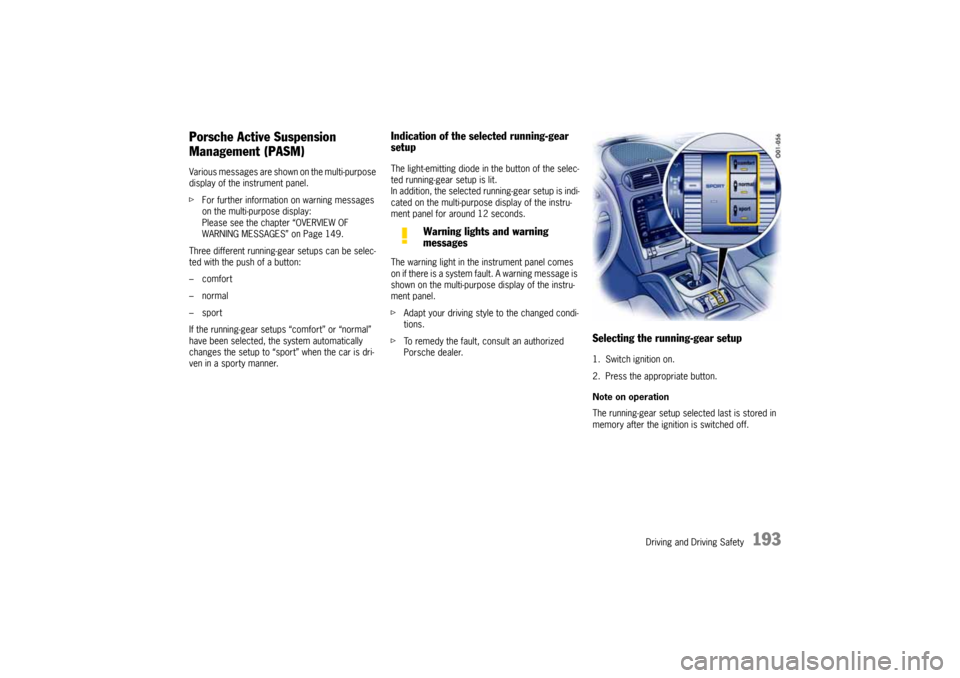
Three different running-gear setups can be selec-
ted with the push of a button:
–comfort
–normal
–sport
If the running-gear setups “comfort” or “normal”
have been selected, the system automatically
changes the setup to “sport” when the car is dri-
ven in a sporty manner.
Indication of the selected running-gear
setupThe light-emitting diode in the button of the selec-
ted running-gear setup is lit.
In addition, the selected running-gear setup is indi-
cated on the multi-purpose display of the instru-
ment panel for around 12 seconds.
The warning light in the instrument panel comes
on if there is a system fault. A warning message is
shown on the multi-purpose display of the instru-
ment panel.
fAdapt your driving style to the changed condi-
tions.
fTo remedy the fault, consult an authorized
Porsche dealer.
Selecting the running-gear setup1. Switch ignition on.
2. Press the appropriate button.
Note on operation
The running-gear setup selected last is stored in
memory after the ignition is switched off.
Warning lights and warning
messages
10_Cayenne_21_KW17.book Seite 193 Donnerstag, 9. April 2009 3:33 15
Page 194 of 379
194
Driving and Driving Safety
Porsche Dynamic
Chassis Control (PDCC)FunctionPorsche Dynamic Chassis Control (PDCC) is a sys-
tem for roll stabilization of the vehicle body when
driving. Driving comfort and driving safety are im-
proved by active intervention of the anti-roll bars
on the front and rear axles.
No separate controls are available for the PDCC
system.
After selection of a running-gear setup in Porsche
Active Suspension Management (PASM):
–comfort
–normal
–sport
PDCC automatically activates the corresponding
on-road driving program.
fFor information on selecting a running-gear
setup:
Please see the chapter “PORSCHE ACTIVE
SUSPENSION MANAGEMENT (PASM)” on
Page 193.
PDCC automatically activates the off-road driving
program if Low Range reduction is switched on.fFor information on switching Low Range
reduction on and off:
Please see the chapter “DRIVING PROGRAMS
FOR ON-ROAD AND OFF-ROAD DRIVING” on
Page 177.
Warning messageA warning message appears on the multi-purpose
display of the instrument panel if there is a system
fault.
fFor further information on warning messages
on the multi-purpose display:
Please see the chapter “OVERVIEW OF
WARNING MESSAGES” on Page 149.
fAdapt your driving style to the changed
conditions.
fConsult an authorized Porsche dealer in order
to remedy the fault.
Checking hydraulic fluidRegular checking and changing of the hydraulic
fluid takes place as part of servicing.
Further important information on “Maintenance”
can be found in a separate chapter.
fPlease see the chapter “CAR CARE
INSTRUCTIONS” on Page 270.
10_Cayenne_21_KW17.book Seite 194 Donnerstag, 9. April 2009 3:33 15
Page 225 of 379
Luggage Compartment, Loadspace and Storage
225
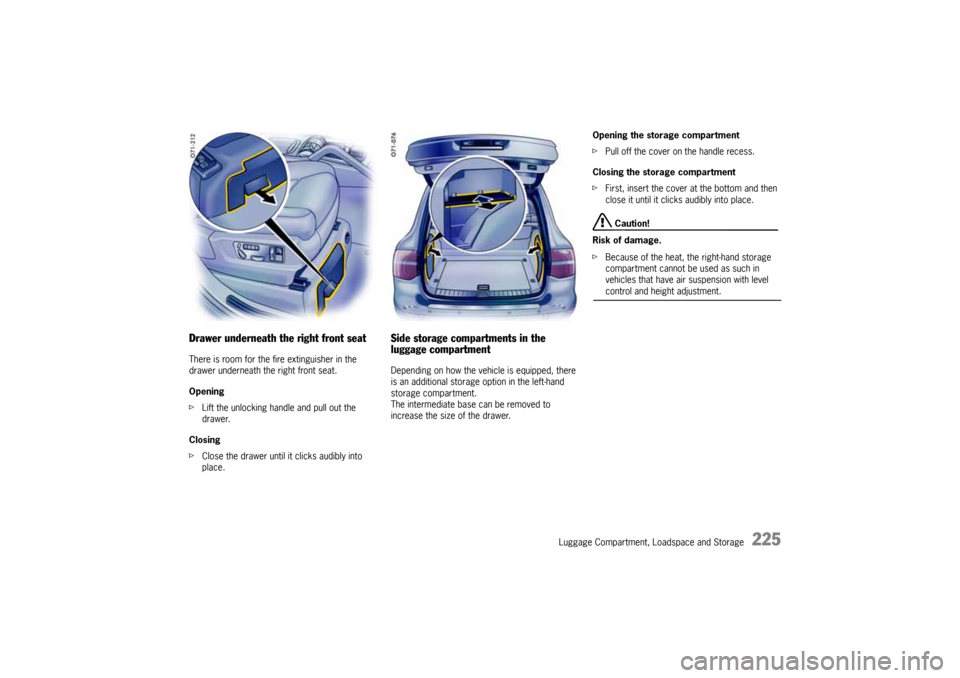
Drawer underneath the right front seatThere is room for the fire extinguisher in the
drawer underneath the right front seat.
Opening
fLift the unlocking handle and pull out the
drawer.
Closing
fClose the drawer until it clicks audibly into
place.
Side storage compartments in the
luggage compartmentDepending on how the vehicle is equipped, there
is an additional storage option in the left-hand
storage compartment.
The intermediate base can be removed to
increase the size of the drawer.Opening the storage compartment
fPull off the cover on the handle recess.
Closing the storage compartment
fFirst, insert the cover at the bottom and then
close it until it clicks audibly into place.
Caution!
Risk of damage.
fBecause of the heat, the right-hand storage
compartment cannot be used as such in
vehicles that have air suspension with level control and height adjustment.
10_Cayenne_21_KW17.book Seite 225 Donnerstag, 9. April 2009 3:33 15
Page 238 of 379
238
Parking
Front ultrasound sensorsSensors
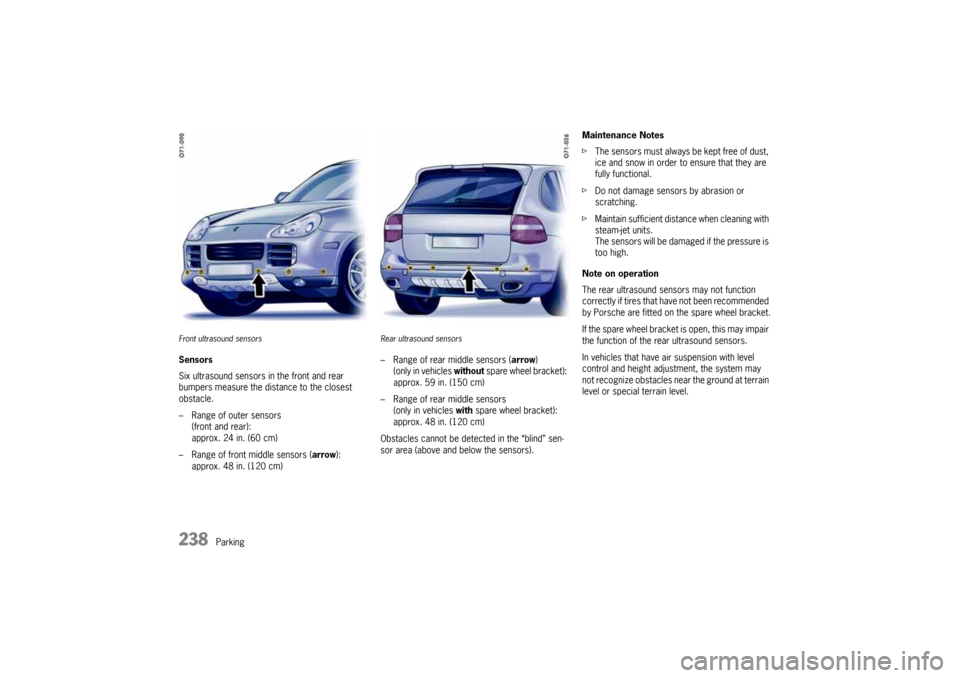
Six ultrasound sensors in the front and rear
bumpers measure the distance to the closest
obstacle.
– Range of outer sensors
(front and rear):
approx. 24 in. (60 cm)
– Range of front middle sensors (arrow):
approx. 48 in. (120 cm)
Rear ultrasound sensors– Range of rear middle sensors (arrow)
(only in vehicles without spare wheel bracket):
approx. 59 in. (150 cm)
– Range of rear middle sensors
(only in vehicles with spare wheel bracket):
approx. 48 in. (120 cm)
Obstacles cannot be detected in the “blind” sen-
sor area (above and below the sensors).Maintenance Notes
fThe sensors must always be kept free of dust,
ice and snow in order to ensure that they are
fully functional.
fDo not damage sensors by abrasion or
scratching.
fMaintain sufficient distance when cleaning with
steam-jet units.
The sensors will be damaged if the pressure is
too high.
Note on operation
The rear ultrasound sensors may not function
correctly if tires that have not been recommended
by Porsche are fitted on the spare wheel bracket.
If the spare wheel bracket is open, this may impair
the function of the rear ultrasound sensors.
In vehicles that have air suspension with level
control and height adjustment, the system may
not recognize obstacles near the ground at terrain
level or special terrain level.
10_Cayenne_21_KW17.book Seite 238 Donnerstag, 9. April 2009 3:33 15
Page 250 of 379
250
Maintenance and Car Care
Exercise Extreme Caution when
Working on your Vehicle
Danger!
Ignoring the following instructions may cau-
se serious personal injury or death.
fThe engine compartment of any motor vehicle
is a potentially hazardous area. If you are not
fully familiar with proper repair procedures, do
not attempt the adjustments described on the
following pages.
This caution applies to the entire vehicle.
fO n l y w o r k o n y o u r v e h i c l e o u t d o o r s o r i n a w e l l
ventilated area.
fEnsure that there are no open flames in the
area of your vehicle at any time when fuel
fumes might be present. Be especially
cautious of such devices such as hot water
heaters which ignite a flame intermittently.
fBefore working on any part in the engine
compartment, turn the engine off and let it cool
down sufficiently. Hot engine compartment
components can burn skin on contact.
fBe alert and cautious around engine at all
times while the engine is running.
If you have to work on the engine while it is
running, always put the parking brake on and
put the gearshift lever in neutral or the
Tiptronic selector lever in position P or N.fIn particular, be very careful to ensure that
items of clothing (ties, shirt, sleeves etc.),
jewelry, long hair, hand or fingers cannot get
caught in the fan, belts or other moving parts.
The radiator and radiator fans are in the front
of the car.
The fans can start or continue running as a
function of temperature, even with the engine
switched off.
Carry out work in these areas only with the
engine off and exercise extreme caution.
fYour Porsche is equipped with an electronic
ignition system. When the ignition is on, high
voltage is present in all wires connected with
the ignition system; therefore, exercise
extreme caution when working on any part of
the engine while the ignition is on or the engine
is running.
fAlways support your car with safety stands if it
is necessary to work under the car. The jack
supplied with the car is not adequate for this
purpose.
For vehicles with air suspension with level
control and height adjustment switch off level
control.
Please see the chapter “RAISING VEHICLE
WITH THE JACK” on Page 192.fWhen working under the car without safety
stands but with the wheels on the ground,
make sure the car is on level ground, the
wheels are blocked, and that the engine can-
not be started.
Withdraw ignition keys (switch ignition off in
vehicles that have Porsche Entry & Drive).
fDo not smoke or allow an open flame around
the battery or fuel.
Keep a fire extinguisher close at hand.
fIncomplete or improper servicing may cause
problems in the operation of the car. If in doubt
about any servicing, have it done by your
authorized Porsche dealer.
Improper maintenance during the warranty
period may affect your Porsche warranty
coverage.
fSupplies of fluids, e.g. engine oil, washer fluid,
brake fluid or coolant, are hazardous to your
health.
Keep these fluids out of children's reach and
dispose of them in accordance with the appro-
priate regulations.
fSome countries require additional tools and
special spare parts to be carried in your
vehicle. Please make enquiries before driving
abroad.
10_Cayenne_21_KW17.book Seite 250 Donnerstag, 9. April 2009 3:33 15
Page 280 of 379

280
Minor Repairs
Exercise Extreme Caution when
Working on your Vehicle
Danger!
Ignoring the following instructions may cau-
se serious personal injury or death.
fThe engine compartment of any motor vehicle
is a potentially hazardous area. If you are not
fully familiar with proper repair procedures, do
not attempt the adjustments described on the
following pages.
This caution applies to the entire vehicle.
fO n l y w o r k o n y o u r v e h i c l e o u t d o o r s o r i n a w e l l
ventilated area.
fEnsure that there are no open flames in the
area of your vehicle at any time when fuel
fumes might be present. Be especially
cautious of such devices such as hot water
heaters which ignite a flame intermittently.
fBefore working on any part in the engine com-
partment, turn the engine off and let it cool
down sufficiently. Hot engine compartment
components can burn skin on contact.
fBe alert and cautious around engine at all
times while the engine is running.
If you have to work on the engine while it is run-
ning, always put the parking brake on and put
the gearshift lever in neutral or the Tiptronic
selector lever in position P or N.fIn particular, be very careful to ensure that
items of clothing (ties, shirt, sleeves etc.),
jewelry, long hair, hand or fingers cannot get
caught in the engine-compartment blower, fan,
belts or other moving parts.
The radiator and radiator fans are in the front
of the car.
The fans can start or continue running as a
function of temperature, even with the engine
switched off.
Carry out work in these areas only with the
engine off and exercise extreme caution.
fYour Porsche is equipped with an electronic
ignition system. When the ignition is on, high
voltage is present in all wires connected with
the ignition system; therefore, exercise
extreme caution when working on any part of
the engine while the ignition is on or the engine
is running.
fAlways support your car with safety stands if it
is necessary to work under the car. The jack
supplied with the car is not adequate for this
purpose.
For vehicles with air suspension with level
control and height adjustment:
Please see the chapter “RAISING VEHICLE
WITH THE JACK” on Page 192.fWhen working under the car without safety
stands but with the wheels on the ground,
make sure the car is on level ground, the
wheels are blocked, and that the engine can-
not be started.
Remove the ignition key.
fDo not smoke or allow an open flame around
the battery or fuel.
Keep a fire extinguisher close at hand.
fIncomplete or improper servicing may cause
problems in the operation of the car. If in doubt
about any servicing, have it done by your
authorized Porsche dealer.
Improper maintenance during the warranty
period may affect your Porsche warranty
coverage.
fSupplies of fluids, e.g. engine oil, brake fluid or
coolant, are hazardous to your health. Keep
these fluids out of children's reach and dispose
of them in accordance with the appropriate
regulations.
fSome countries require additional tools and
special spare parts to be carried in your vehi-
cle.
Please make enquiries before driving abroad.
10_Cayenne_21_KW17.book Seite 280 Donnerstag, 9. April 2009 3:33 15
Page 292 of 379
292
Minor Repairs
Warning!
The jack must be used only to raise the car
for wheel changing.
The jack must never be used as a support to
work underneath the vehicle. If the jack is
accidentally dislodged, you or bystanders
could suffer severe personal injury.
fNever jack up other vehicle or other loads with
the jack.
fAlways place the car on stable supports if you
have to work under the car.
When working under the vehicle, always use
safety stands specifically designed for this pur-pose.
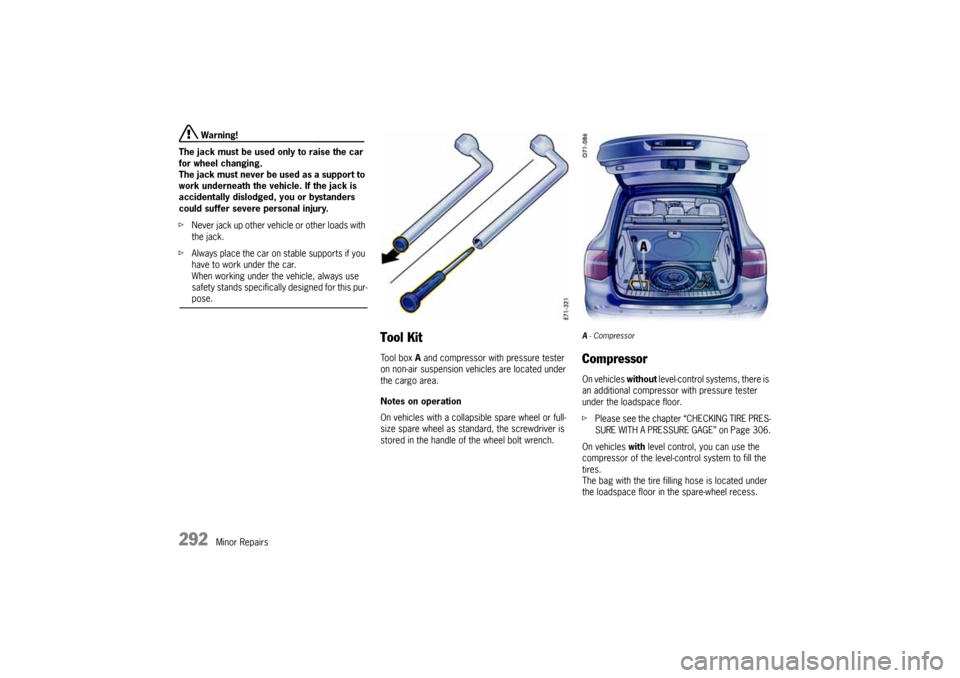
Tool KitTo o l b o x A and compressor with pressure tester
on non-air suspension vehicles are located under
the cargo area.
Notes on operation
On vehicles with a collapsible spare wheel or full-
size spare wheel as standard, the screwdriver is
stored in the handle of the wheel bolt wrench.
A-CompressorCompressorOn vehicles without level-control systems, there is
an additional compressor with pressure tester
under the loadspace floor.
fPlease see the chapter “CHECKING TIRE PRES-
SURE WITH A PRESSURE GAGE” on Page 306.
On vehicles with level control, you can use the
compressor of the level-control system to fill the
tires.
The bag with the tire filling hose is located under
the loadspace floor in the spare-wheel recess.
10_Cayenne_21_KW17.book Seite 292 Donnerstag, 9. April 2009 3:33 15
Page 306 of 379
306
Minor Repairs
Warning!
Risk of accident.
fThe collapsible spare wheel must be used only
over short distances in cases of emergency.
For safety reasons, replace the tires before
the wear indicators appear (webs in the tire
grooves, 1/16 in. (1.6 mm) high).
fNever deactivate the Porsche Stability
Management (PSM) system.
fAvoid hard acceleration and high cornering
speeds.
The maximum permitted speed is 50 mph
(80 km/h) and must not be exceeded
because of altered driving characteristics and
for reasons of wear.
The tread depth of the spare wheel is subject
to the same laws as the original tires.
fDo not use a collapsible spare wheel from a
different vehicle type.
fDo not mount the collapsible spare wheel from
your car on a different vehicle.
fOnly fit one collapsible spare wheel on the
vehicle at a time.
fOn vehicles with air suspension, use the tire fil-
ling connection A only to inflate the collapsible
spare wheel.
fTo avoid damage, do not use automatic car washes when the spare wheel is installed.After using the collapsible spare wheel
fRelease air by unscrewing the valve insert.
Notes on operation
The tire will revert to its original shape only after
several hours. Only then can it be stowed in the
spare wheel recess in the luggage compartment.
There is a plastic sheet in the tool box to store the
damaged wheel.
Maintenance Note
The collapsible spare wheel must be repaired only
by the manufacturer.
fPlease consult your authorized Porsche dealer
if the collapsible spare wheel is defective.
Checking tire pressure with a pressure
gage1. Remove the valve stem cap from the tire.
2. Press the pressure gage onto the valve stem.
Note on operation
fDo not press too hard or force the valve stem
sideways, or air will escape.
If the sound of air escaping from the tire is
heard, reposition the pressure gage.
3. Read the tire pressure on the gage stem and
compare it to the permissible tire pressure.
This information can be found on the tire pres-
sure plate in the left door aperture.
Please see the chapter “TIRE PRESSURES,
COLD (68 °F/20 °C)” on Page 354.
4. Remove the pressure gage.
10_Cayenne_21_KW17.book Seite 306 Donnerstag, 9. April 2009 3:33 15
Page 307 of 379
Minor Repairs
307
Inflating tires on vehicles without air
suspension1. Please follow the operating instructions on the
compressor.
2. Screw filler hose of the compressor onto the
tire valve.
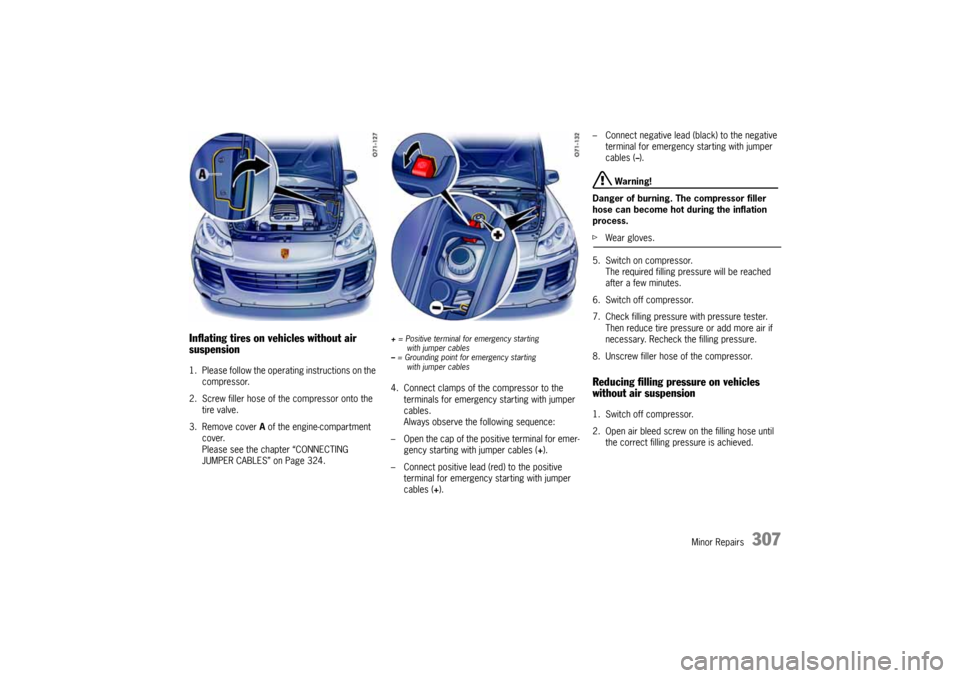
3. Remove cover A of the engine-compartment
cover.
Please see the chapter “CONNECTING
JUMPER CABLES” on Page 324.
+ = Positive terminal for emergency starting
with jumper cables
– = Grounding point for emergency starting
with jumper cables4. Connect clamps of the compressor to the
terminals for emergency starting with jumper
cables.
Always observe the following sequence:
– Open the cap of the positive terminal for emer-
gency starting with jumper cables (+).
– Connect positive lead (red) to the positive
terminal for emergency starting with jumper
cables (+).– Connect negative lead (black) to the negative
terminal for emergency starting with jumper
cables (
–).
Warning!
Danger of burning. The compressor filler
hose can become hot during the inflation
process.
fWear gloves.
5. Switch on compressor.
The required filling pressure will be reached
after a few minutes.
6. Switch off compressor.
7. Check filling pressure with pressure tester.
Then reduce tire pressure or add more air if
necessary. Recheck the filling pressure.
8. Unscrew filler hose of the compressor.Reducing filling pressure on vehicles
without air suspension1. Switch off compressor.
2. Open air bleed screw on the filling hose until
the correct filling pressure is achieved.
10_Cayenne_21_KW17.book Seite 307 Donnerstag, 9. April 2009 3:33 15
Page 308 of 379
308
Minor Repairs
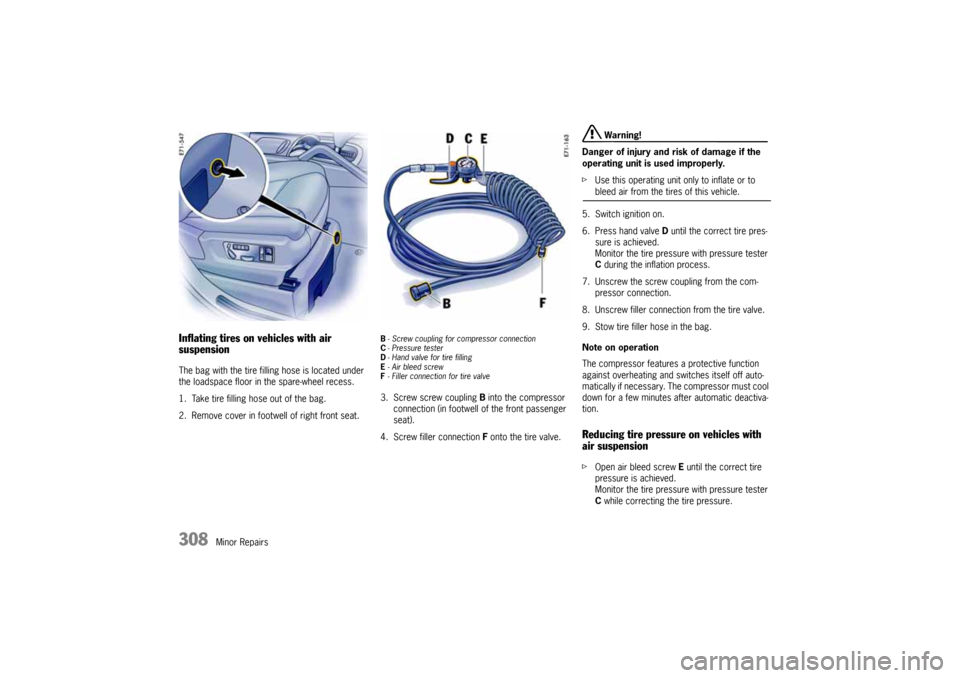
Inflating tires on vehicles with air
suspensionThe bag with the tire filling hose is located under
the loadspace floor in the spare-wheel recess.
1. Take tire filling hose out of the bag.
2. Remove cover in footwell of right front seat.
B- Screw coupling for compressor connection
C-Pressure tester
D- Hand valve for tire filling
E-Air bleed screw
F- Filler connection for tire valve3. Screw screw coupling B into the compressor
connection (in footwell of the front passenger
seat).
4. Screw filler connection F onto the tire valve.
Warning!
Danger of injury and risk of damage if the
operating unit is used improperly.
fUse this operating unit only to inflate or to bleed air from the tires of this vehicle.
5. Switch ignition on.
6. Press hand valve D until the correct tire pres-
sure is achieved.
Monitor the tire pressure with pressure tester
C during the inflation process.
7. Unscrew the screw coupling from the com-
pressor connection.
8. Unscrew filler connection from the tire valve.
9. Stow tire filler hose in the bag.
Note on operation
The compressor features a protective function
against overheating and switches itself off auto-
matically if necessary. The compressor must cool
down for a few minutes after automatic deactiva-
tion.
Reducing tire pressure on vehicles with
air suspensionfOpen air bleed screw E until the correct tire
pressure is achieved.
Monitor the tire pressure with pressure tester
C while correcting the tire pressure.
10_Cayenne_21_KW17.book Seite 308 Donnerstag, 9. April 2009 3:33 15