tire type PORSCHE CAYNNE 2004 1.G User Guide
[x] Cancel search | Manufacturer: PORSCHE, Model Year: 2004, Model line: CAYENNE, Model: PORSCHE CAYENNE 2004 1.GPages: 379, PDF Size: 13.91 MB
Page 286 of 379

286
Minor Repairs
Tire damage, puncturefPlease see the chapter “HIGH-PRESSURE
CLEANING EQUIPMENT, STEAM CLEANERS”
on Page 271.
Danger!
Risk of serious personal injury or death.
Driving the vehicle with low tire pressure
increases risk of a tire failure and resulting
loss of control. Furthermore, low tire pres-
sure increases rate of wear of the affected
tires.
fCheck tires – including sidewalls – regularly for
foreign bodies, nicks, cuts, cracks and bulges.
fAfter driving off road, examine tires for signs
of damage such as cuts, tears, bulges or
foreign objects stuck in the tread. Replace a
damaged tire if necessary.
fCross curb edges slowly and at right angles if
possible.
Avoid driving over steep or sharp curbs.
fIn cases of doubt, have the wheel (particularly
the inner side) checked by an authorized Porsche dealer.In case of tire damage, where it is uncertain
whether there is a break in the ply with all its con-
sequences or tire damage caused by thermal or
mechanical overloading due to loss of pressure or
any other prior damage, we recommend that the
tire be replaced for safety reasons.
I f o n e f a u l t y t i re i s re p l a c e d i t s h o u l d b e n o t e d t h a t
the difference in tread depth on one axle must not
exceed 30%. Handling inconsistencies may result.
fPerform a visual inspection if necessary.
Tire replacementsfUse only tire makes and types tested by
Porsche.
If you do not use a Porsche recommended
replacement tire, make sure that you
purchase your new tires from a reputable tire
dealer and that the dealer complies with all
manufacturers warnings for those tires.
Only tires with the same manufacturer and
with the same specification code (e.g. “N0”,
“N1”...) should be mounted on the vehicle.
Before mounting new tires, check with your
Porsche dealer about the current release
status.
Tires should be replaced no less than on one axle
at the time. Only tires of the same make and type
must be used. Mixed tires are not permissible and
will affect vehicle performance, safety, and can
affect vehicle warranty.Porsche dealers can recommend the most current
replacement tire options for your vehicle.
Initially, new tires do not have their full traction.
You should therefore drive at moderate speeds
during the first 60 - 120 miles (100 - 200 km).
Tires must always remain on the same side of
the vehicle.
When wheels are removed, the direction of rota-
tion and position of each wheel should be marked.
If new tires are installed only on one axle, a notice-
able change in handling occurs due to the different
tread depth of the other tires. This happens espe-
cially if only rear tires are replaced. However, this
condition disappears as the new tires are broken
in.
fPlease adjust your driving style accordingly.
Installation of new tires should only be done by a
qualified tire technician.
Valves
fUse only plastic valve caps.
fThe rubber valves must be replaced whenever
the tires are changed.
fThe fitting and replacement specifications
must be observed for metal valves.
fOnly use Original Porsche metal valves.
fProtect the valve inserts against soiling with
valve caps.
Soiled valve inserts can cause a gradual loss
of air.
10_Cayenne_21_KW17.book Seite 286 Donnerstag, 9. April 2009 3:33 15
Page 290 of 379
290
Minor Repairs
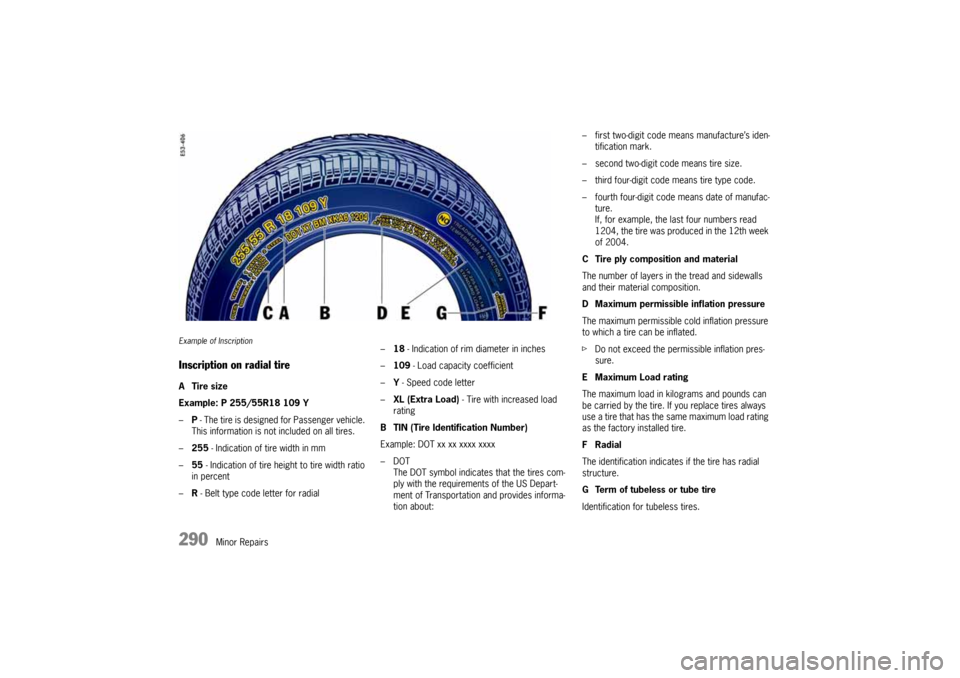
Example of InscriptionInscription on radial tireATire size
Example: P 255/55R18 109 Y
–P - The tire is designed for Passenger vehicle.
This information is not included on all tires.
–255 - Indication of tire width in mm
–55 - Indication of tire height to tire width ratio
in percent
–R - Belt type code letter for radial–18 - Indication of rim diameter in inches
–109 - Load capacity coefficient
–Y - Speed code letter
–XL (Extra Load) - Tire with increased load
rating
B TIN (Tire Identification Number)
Example: DOT xx xx xxxx xxxx
–DOT
The DOT symbol indicates that the tires com-
ply with the requirements of the US Depart-
ment of Transportation and provides informa-
tion about:
– first two-digit code means manufacture’s iden-
tification mark.
– second two-digit code means tire size.
– third four-digit code means tire type code.
– fourth four-digit code means date of manufac-
ture.
If, for example, the last four numbers read
1204, the tire was produced in the 12th week
of 2004.
C Tire ply composition and material
The number of layers in the tread and sidewalls
and their material composition.
D Maximum permissible inflation pressure
The maximum permissible cold inflation pressure
to which a tire can be inflated.
fDo not exceed the permissible inflation pres-
sure.
E Maximum Load rating
The maximum load in kilograms and pounds can
be carried by the tire. If you replace tires always
use a tire that has the same maximum load rating
as the factory installed tire.
FRadial
The identification indicates if the tire has radial
structure.
G Term of tubeless or tube tire
Identification for tubeless tires.
10_Cayenne_21_KW17.book Seite 290 Donnerstag, 9. April 2009 3:33 15
Page 293 of 379
Minor Repairs
293
SpacersfUse the spacers only together with wheels
approved by Porsche.
Before having spacers fitted, find out about the
current approval status.
fRemove spacers if 18 inch tires, snow chains
or a collapsible spare wheel are mounted.
Danger!
Risk of accident if the spacers are not
removed before mounting 18 inch tires or
collapsible spare wheel.
f17 mm spacers are always to be removed
before mounting 18 inch tires or a collapsible
spare wheel, because the wheel cannot be fit-ted correctly. Caution!
Risk of damage to wheel housings if the
spacers on the rear axle are not removed
before fitting the snow chains.
f17 mm spacers must always be removed from the rear axle when snow chains are to be fitted.Note on operation
fTo remove or mount the spacers:
Please see the chapter “CHANGING A WHEEL
WITH REMOVAL OF 17 MM SPACER” on
Page 303.
Please see the chapter “FITTING THE 17 MM
SPACER” on Page 305.
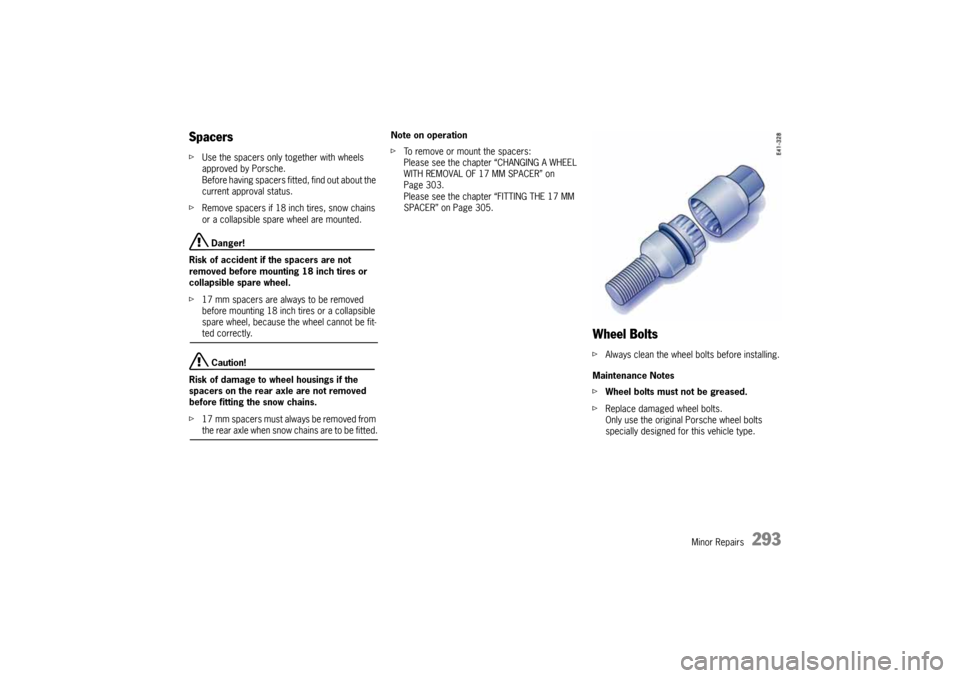
Wheel BoltsfAlways clean the wheel bolts before installing.
Maintenance Notes
fWheel bolts must not be greased.
fReplace damaged wheel bolts.
Only use the original Porsche wheel bolts
specially designed for this vehicle type.
10_Cayenne_21_KW17.book Seite 293 Donnerstag, 9. April 2009 3:33 15
Page 303 of 379
Minor Repairs
303
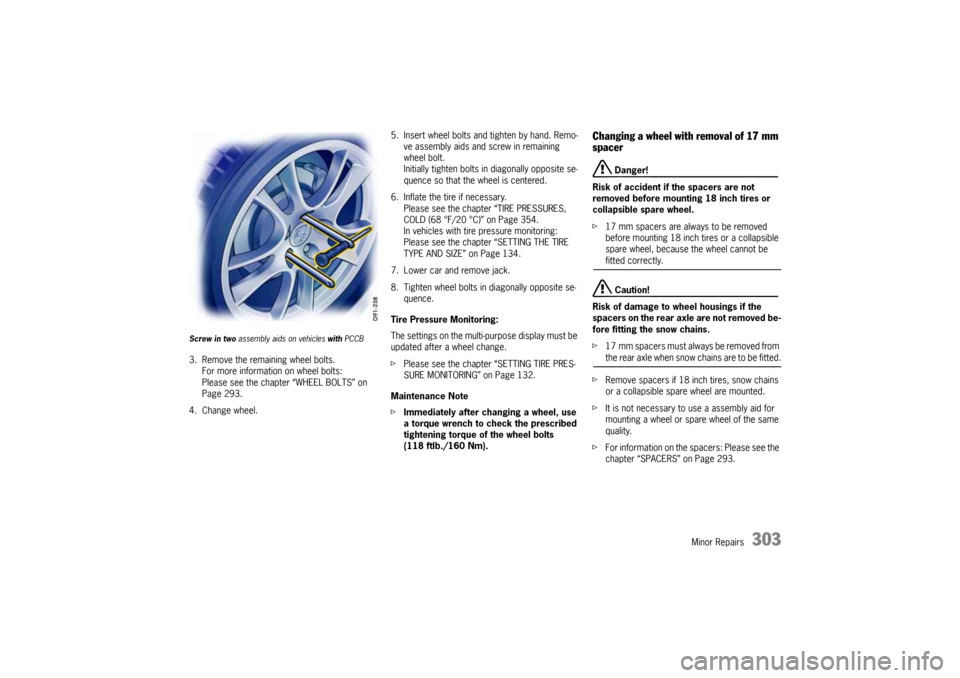
Screw in two assembly aids on vehicles with PCCB3. Remove the remaining wheel bolts.
For more information on wheel bolts:
Please see the chapter “WHEEL BOLTS” on
Page 293.
4. Change wheel.5. Insert wheel bolts and tighten by hand. Remo-
ve assembly aids and screw in remaining
wheel bolt.
Initially tighten bolts in diagonally opposite se-
quence so that the wheel is centered.
6. Inflate the tire if necessary.
Please see the chapter “TIRE PRESSURES,
COLD (68 °F/20 °C)” on Page 354.
In vehicles with tire pressure monitoring:
Please see the chapter “SETTING THE TIRE
TYPE AND SIZE” on Page 134.
7. Lower car and remove jack.
8. Tighten wheel bolts in diagonally opposite se-
quence.
Tire Pressure Monitoring:
The settings on the multi-purpose display must be
updated after a wheel change.
fPlease see the chapter “SETTING TIRE PRES-
SURE MONITORING” on Page 132.
Maintenance Note
fImmediately after changing a wheel, use
a torque wrench to check the prescribed
tightening torque of the wheel bolts
(118 ftlb./160 Nm).
Changing a wheel with removal of 17 mm
spacer
Danger!
Risk of accident if the spacers are not
removed before mounting 18 inch tires or
collapsible spare wheel.
f17 mm spacers are always to be removed
before mounting 18 inch tires or a collapsible
spare wheel, because the wheel cannot be fitted correctly. Caution!
Risk of damage to wheel housings if the
spacers on the rear axle are not removed be-
fore fitting the snow chains.
f17 mm spacers must always be removed from the rear axle when snow chains are to be fitted.
fRemove spacers if 18 inch tires, snow chains
or a collapsible spare wheel are mounted.
fIt is not necessary to use a assembly aid for
mounting a wheel or spare wheel of the same
quality.
fFor information on the spacers: Please see the
chapter “SPACERS” on Page 293.
10_Cayenne_21_KW17.book Seite 303 Donnerstag, 9. April 2009 3:33 15
Page 305 of 379
Minor Repairs
305
8. Inflate the tire if necessary.
Please see the chapter “TIRE PRESSURES,
COLD (68 °F/20 °C)” on Page 354.
On vehicles with Tire Pressure Monitoring:
Please see the chapter “SETTING THE TIRE
TYPE AND SIZE” on Page 134.
9. Lower the car and remove the jack.
10.Tighten wheel bolts in diagonally opposite
sequence.
Maintenance Note
fImmediately after changing a wheel, use
a torque wrench to check the prescribed
tightening torque of the wheel bolts
(160 Nm/118 ftlb.).
fSpacer, steel nuts, and plastic covers should
be stored together.
Fitting the 17 mm spacer1. Remove wheel.
2. Fit the spacer with the wheel bolts A used to
fasten the wheel.
Tightening torque: 160 Nm (118 ftlb.)
3. Fit wheel.
To d o t h i s use the original wheel nuts for
fastening the wheels.
Tightening torque: 160 Nm (118 ftlb.)
Place plastic covers onto the steel nuts.
Note
There is no anti-theft protection for the wheel nuts.Collapsible spare wheelThe collapsible spare wheel is fastened under the
floor in the luggage compartment.
On vehicles with 17 mm spacers:
fBefore fitting a collapsible spare wheel on the
rear axle always remove the corresponding
spacer.
For information on the spacers:
Please see the chapter “SPACERS” on
Page 293.
For information about removing the spacers:
Please see the chapter “CHANGING A WHEEL
WITH REMOVAL OF 17 MM SPACER” on
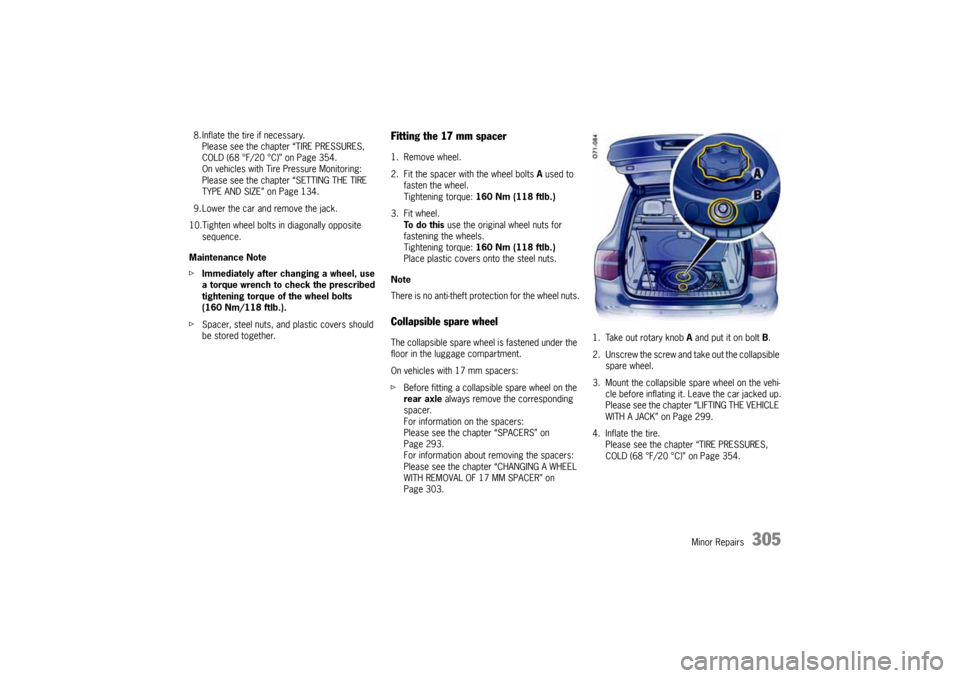
Page 303.1. Take out rotary knob A and put it on bolt B.
2. Unscrew the screw and take out the collapsible
spare wheel.
3. Mount the collapsible spare wheel on the vehi-
cle before inflating it. Leave the car jacked up.
Please see the chapter “LIFTING THE VEHICLE
WITH A JACK” on Page 299.
4. Inflate the tire.
Please see the chapter “TIRE PRESSURES,
COLD (68 °F/20 °C)” on Page 354.
10_Cayenne_21_KW17.book Seite 305 Donnerstag, 9. April 2009 3:33 15
Page 306 of 379

306
Minor Repairs
Warning!
Risk of accident.
fThe collapsible spare wheel must be used only
over short distances in cases of emergency.
For safety reasons, replace the tires before
the wear indicators appear (webs in the tire
grooves, 1/16 in. (1.6 mm) high).
fNever deactivate the Porsche Stability
Management (PSM) system.
fAvoid hard acceleration and high cornering
speeds.
The maximum permitted speed is 50 mph
(80 km/h) and must not be exceeded
because of altered driving characteristics and
for reasons of wear.
The tread depth of the spare wheel is subject
to the same laws as the original tires.
fDo not use a collapsible spare wheel from a
different vehicle type.
fDo not mount the collapsible spare wheel from
your car on a different vehicle.
fOnly fit one collapsible spare wheel on the
vehicle at a time.
fOn vehicles with air suspension, use the tire fil-
ling connection A only to inflate the collapsible
spare wheel.
fTo avoid damage, do not use automatic car washes when the spare wheel is installed.After using the collapsible spare wheel
fRelease air by unscrewing the valve insert.
Notes on operation
The tire will revert to its original shape only after
several hours. Only then can it be stowed in the
spare wheel recess in the luggage compartment.
There is a plastic sheet in the tool box to store the
damaged wheel.
Maintenance Note
The collapsible spare wheel must be repaired only
by the manufacturer.
fPlease consult your authorized Porsche dealer
if the collapsible spare wheel is defective.
Checking tire pressure with a pressure
gage1. Remove the valve stem cap from the tire.
2. Press the pressure gage onto the valve stem.
Note on operation
fDo not press too hard or force the valve stem
sideways, or air will escape.
If the sound of air escaping from the tire is
heard, reposition the pressure gage.
3. Read the tire pressure on the gage stem and
compare it to the permissible tire pressure.
This information can be found on the tire pres-
sure plate in the left door aperture.
Please see the chapter “TIRE PRESSURES,
COLD (68 °F/20 °C)” on Page 354.
4. Remove the pressure gage.
10_Cayenne_21_KW17.book Seite 306 Donnerstag, 9. April 2009 3:33 15
Page 309 of 379
Minor Repairs
309
Spare wheel
Warning!
Risk of accident. The wheel and tire size and
the tire quality of the spare wheel and normal
wheel may differ.
If a spare wheel that differs from the normal
tires is used, this may impair the driving
behavior.
fThe spare wheel must be used only over short
distances in cases of emergency.
For safety reasons, replace the tires before
the wear indicators appear (webs in the tire
grooves, 1/16 in. (1.6 mm) high).
fNever deactivate the Porsche Stability
Management (PSM) system.
fIf the tire on the spare wheel is older than
4 years, the spare wheel should be used only
in the event of a flat.
fAvoid hard acceleration and high cornering
speeds.
The maximum permitted speed is 50 mph
(80 km/h) if the mounted spare wheel differs
from the other three wheels on the car. This
maximum speed must not be exceeded
because of altered driving characteristics and
for reasons of wear.
fDo not use a spare wheel from a different
vehicle type.
fDo not mount the spare wheel from your car on a different vehicle.Removing spare wheel from bracket
Warning!
Danger of injury if the spare wheel is
removed improperly.
fRemove the spare wheel only when the spare
wheel bracket is locked.
fRemove the spare wheel from the spare wheel
bracket with care. The wheel is very heavy [approx. 77 lbs. (35 kg)].
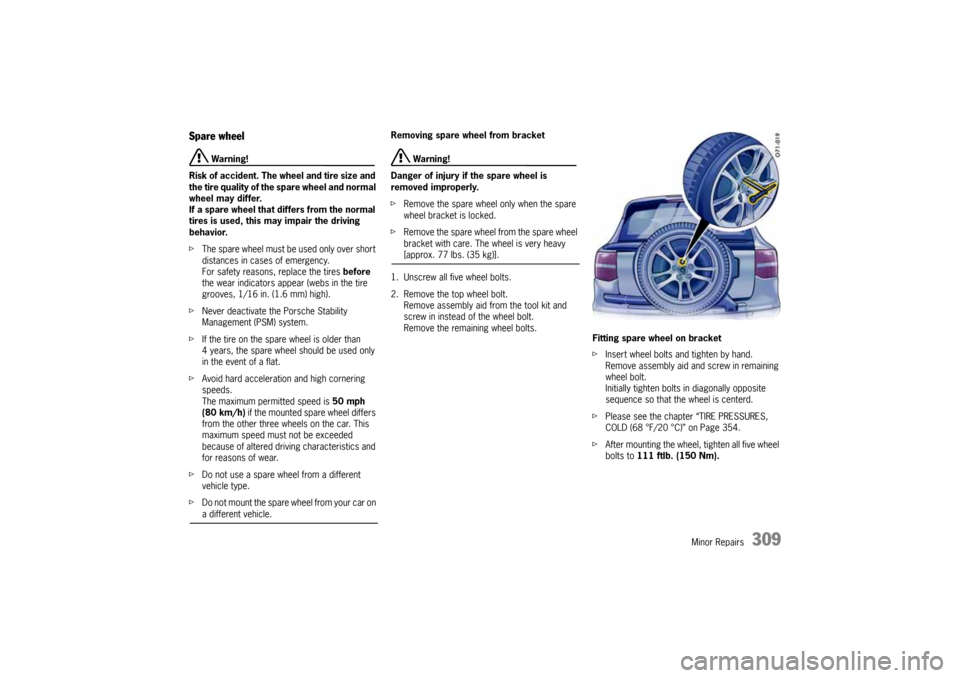
1. Unscrew all five wheel bolts.
2. Remove the top wheel bolt.
Remove assembly aid from the tool kit and
screw in instead of the wheel bolt.
Remove the remaining wheel bolts.
Fitting spare wheel on bracket
fInsert wheel bolts and tighten by hand.
Remove assembly aid and screw in remaining
wheel bolt.
Initially tighten bolts in diagonally opposite
sequence so that the wheel is centerd.
fPlease see the chapter “TIRE PRESSURES,
COLD (68 °F/20 °C)” on Page 354.
fAfter mounting the wheel, tighten all five wheel
bolts to 111 ftlb. (150 Nm).
10_Cayenne_21_KW17.book Seite 309 Donnerstag, 9. April 2009 3:33 15
Page 322 of 379
322
Minor Repairs
Putting vehicle into operationAfter the battery is connected or after a
completely discharged batterie is charged, the
PSM warning light lights up on the instrument
panel and a message appears on the multi-
purpose display of the instrument panel to indicate
a fault.
This fault can be remedied with a few simple
steps:
1. Start the engine.
To do this, turn the ignition key or the control
unit (on vehicles that have Porsche Entry &
Drive) to ignition lock position 2 twice.
2. Perform a few steering movements and drive
a short distance in a straight line until the PSM
warning light goes out and the message is
erased from the memory of the multi-purpose
display of the instrument panel.
3. If the warnings does not go out, then:
Drive carefully to the nearest authorized
Porsche dealer.
Have the fault remedied by an authorized
Porsche dealer.
4. After the warnings disappear:
Stop the vehicle in a suitable place.
5. Perform adaptation of the power windows:
Please see the chapter “STORING FINAL POSI-
TION OF THE DOOR WINDOWS” on Page 90.6. On vehicles with tire pressure monitoring:
Please see the chapter “SETTING THE TIRE
TYPE AND SIZE” on Page 134.
7. On vehicles with Panorama roof system:
Please see the chapter “SAVE FINAL POSITION
OF THE PANORAMA ROOF SYSTEM” on
Page 99.
Replacing the remote control
batteryNote
fPlease dispose of batteries in compliance with
any and all government regulations.Car keyIf the battery in the remote control becomes too
weak, a warning will appear on the multi-purpose
display in the instrument panel. The battery should
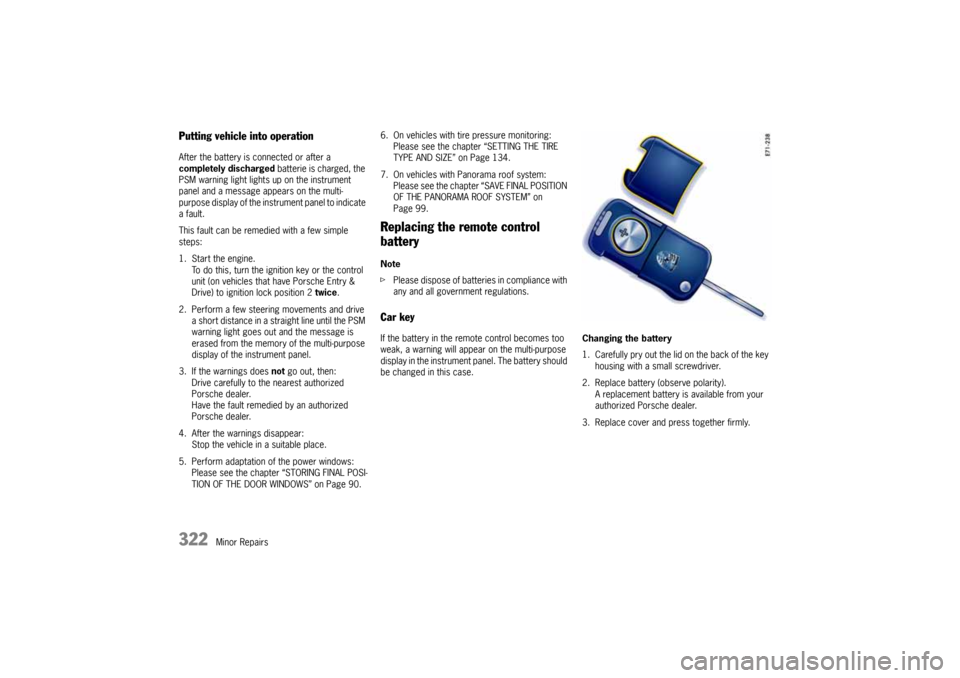
be changed in this case.Changing the battery
1. Carefully pry out the lid on the back of the key
housing with a small screwdriver.
2. Replace battery (observe polarity).
A replacement battery is available from your
authorized Porsche dealer.
3. Replace cover and press together firmly.
10_Cayenne_21_KW17.book Seite 322 Donnerstag, 9. April 2009 3:33 15
Page 326 of 379

326
Minor Repairs 4. After the warnings disappear:
Stop the vehicle in a suitable place.
5. Perform adaptation of the power windows:
Please see the chapter “STORING FINAL POSI-
TION OF THE DOOR WINDOWS” on Page 90.
6. On vehicles with tire pressure monitoring:
Please see the chapter “SETTING THE TIRE
TYPE AND SIZE” on Page 134.
7. On vehicles with Panorama roof system:
Please see the chapter “SAVE FINAL POSITION
OF THE PANORAMA ROOF SYSTEM” on
Page 99.
Replacing Bulbs
Warning!
Danger of short circuit.
fAlways switch off the relevant consumer when
changing bulbs.
Risk of serious personal injury or death. The
headlights are under high voltage when
installed.
fExercise extreme caution when working in the
area of the headlights.
Risk of damage. Bulbs of a higher wattage
can damage the light housing.
fOnly use the bulbs specified in the bulb chart.
fBulbs must be clean and free from oil, grease
or fingerprints.
fNever touch bulbs with your bare hands.
Use a cloth or soft paper when replacing bulbs.
fAlways carry spare bulbs with you.
In certain countries, the carrying of spare
bulbs is mandatory.
Caution!
Risk of damage to headlights due to exces-
sive temperatures and abrasion.
fAttach no coverings (e.g. films, “stone
guards”) in the area of the headlights.
fUse soapy water only to clean light lenses and
plastic headlight lenses. In no case may chemi-
cal cleaners or other volatile cleaning fluids be
used.
fTo prevent scratches, do not rub with a dry or merely moist cloth, tissue or insect sponges.
10_Cayenne_21_KW17.book Seite 326 Donnerstag, 9. April 2009 3:33 15
Page 347 of 379
Tire Pressure and Technical Data
347
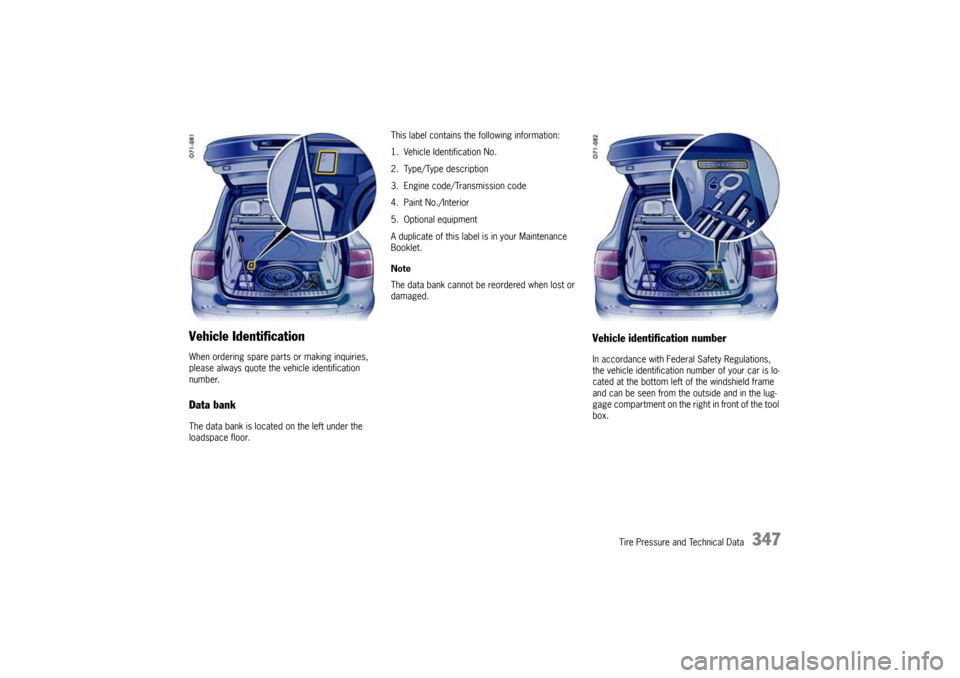
Vehicle IdentificationWhen ordering spare parts or making inquiries,
please always quote the vehicle identification
number.Data bankThe data bank is located on the left under the
loadspace floor.This label contains the following information:
1. Vehicle Identification No.
2. Type/Type description
3. Engine code/Transmission code
4. Paint No./Interior
5. Optional equipment
A duplicate of this label is in your Maintenance
Booklet.
Note
The data bank cannot be reordered when lost or
damaged.
Vehicle identification numberIn accordance with Federal Safety Regulations,
the vehicle identification number of your car is lo-
cated at the bottom left of the windshield frame
and can be seen from the outside and in the lug-
gage compartment on the right in front of the tool
box.
10_Cayenne_21_KW17.book Seite 347 Donnerstag, 9. April 2009 3:33 15