trailer PORSCHE CAYNNE 2004 1.G User Guide
[x] Cancel search | Manufacturer: PORSCHE, Model Year: 2004, Model line: CAYENNE, Model: PORSCHE CAYENNE 2004 1.GPages: 379, PDF Size: 13.91 MB
Page 233 of 379

Trailer Hitch
233
Stowing load in the vehicle
Warning!
Danger of injury.
An unsecured or incorrectly positioned cargo
can slip out of place or endanger the vehicle
occupants during braking, direction changes
or in accidents.
Never transport objects which are not
secured.
fAlways transport cargo in the cargo area,
never in the passenger compartment (e.g. on
or in front of the seats).
fSupport the cargo on the seat backrests
whenever possible. Always lock the backrests
into place.
fPlace the cargo behind unoccupied seats
whenever possible.
fStow heavy objects as close to the front of the
cargo area as possible, with lightweight ob-
jects behind them.
fThe cargo must never project over the top
edge of the seat backrest.
fAlways protect the passenger compartment
with a luggage safety net and a luggage
compartment cover.
Do not drive with objects on top of the luggage
compartment cover.fIf the rear seats are not occupied, the back-
rests can be additionally secured with the safe-
ty belts. Simply cross the outer safety belts
and insert each into the opposite buckle.
fMake sure that the cargo cannot damage the
heating filaments of the rear window and the
TV antenna of the side window.
Luggage net
fLuggage must be stowed completely covered
by the luggage net.
The luggage net can prevent only lightweight
objects from slipping.
Tie-down belts
fDo not use elastic belts or straps to tie down
cargo.
fDo not place belts and straps over sharp
edges.
fObserve the directions for use and information
for the tie-down equipment.
fUse only belts with a tear strength of at least
1543 lbs. (700 kg) and a maximum width of
1in. (25mm).
fCross the belts over the load.Driving
fThe car's handling changes depending on the
vehicle loading. Adapt your driving style to the
changed driving behavior.
fDo not exceed the maximum gross weight and
the axle load.
fPlease see the chapter “WEIGHTS” on
Page 356.
fNever drive with the rear window or rear lid
open.
Exhaust gases can enter the passenger
compartment.
fAdapt the tire pressure to the load.
fPlease see the chapter “SETTING VEHICLE
LOADING AND ADJUSTING TIRE PRESSURE”
on Page 135.
fPlease see the chapter “TIRE PRESSURES,
COLD (68 °F/20 °C)” on Page 354.
10_Cayenne_21_KW17.book Seite 233 Donnerstag, 9. April 2009 3:33 15
Page 234 of 379

234
Tr a i l e r H i t c h
Towing a trailer
Warning!
Driving with a trailer
fAlways see the permissible towing capacity,
vertical coupling load and rear-axle load.
Please see the chapter “WEIGHTS” on
Page 356.
fWhen connected, the trailer must always be
horizontal behind the towing vehicle. If neces-
sary, use a trailer with an adjustable drawbar.
fWhen the vehicle is driven in the mountains, the
engine output decreases as altitude increases.
The maximum weights stated are the values at
sea level. The total permissable weight of the
car-trailer combination must therefore be re-
duced by 10% for each increment of 3,280 ft.
(1,000 meters) altitude. A fractional increment
counts as the full 3,280 ft. (1,000 meters).
Please take this into consideration when plan-
ning your route.Distributing the load
fDistribute the load in the trailer so that heavy
objects are as close to the axle as possible.
Always safeguard all objects against slipping
and tie them down securely.
fYou should make the best possible use of the
trailer coupling's rated vertical coupling load
when loading the trailer, but never exceed it.
Tire pressure
fSelect the vehicle tire pressure for full load
when towing a trailer.
fPlease see the chapter “TIRE PRESSURES,
COLD (68 °F/20 °C)” on Page 354.
fCheck the tire pressure of the trailer's wheels
according to the manufacturer's instructions.Door mirrors
fIf the width of the trailer obstructs your view of
the traffic behind the trailer, you must have
additional door mirrors fitted.
Headlights, lights
fAlways check the headlight adjustment before
driving with a trailer.
If necessary, correct with the headlight beam
adjustment function.
fCheck whether the plug of the trailer is
plugged into the towing vehicle and whether all
lights function.
10_Cayenne_21_KW17.book Seite 234 Donnerstag, 9. April 2009 3:33 15
Page 235 of 379

Trailer Hitch
235
Driving with a trailer
When towing a trailer you must under all circum-
stances adapt your speed to prevailing road and
driving conditions. Towing at excessive speed can
result in loss of control. Observe country-specific
laws for driving with trailers.
fCarefully and gradually familiarize yourself with
the handling and braking behavior of the car-
trailer combination.
fDo not drive with the towing vehicle empty and
the trailer loaded.
If this unfavorable combination is unavoidable,
please drive especially slowly.
fBear in mind the different vehicle handling and
size in situations such as braking, parking,
cornering and overtaking, etc.
fThe driving stability of the car-trailer combina-
tion worsens as the speed increases. There-
fore, drive especially slowly on downhill
stretches and in the case of unfavorable road
and weather conditions (such as wind).
fDrive in an appropriately low gear on downhill
stretches in order to make use of the engine
braking effect.fSlow down immediately if the trailer starts to
sway. Do not countersteer; brake if necessary.
Never attempt to straighten out the car-trailer
combination by accelerating.
fActivate Low Range when moving off on steep
slopes.
fUnder no circumstances may people, animals
or objects be in the space between the trailer
and the towing vehicle when the vehicle is
moving.
fWhen reversing, bear in mind that ParkAssist is
not active.
fAlways see the permissible towing capacity,
vertical coupling load and rear-axle load.
Please see the chapter “WEIGHTS” on
Page 356.
Maintenance Note
fPlease take into consideration that driving with
a trailer places markedly greater stress on all
vehicle components. Expert inspection and
maintenance after every use are indispensable
prerequisites for proper functioning and safety.
10_Cayenne_21_KW17.book Seite 235 Donnerstag, 9. April 2009 3:33 15
Page 239 of 379
Parking
239
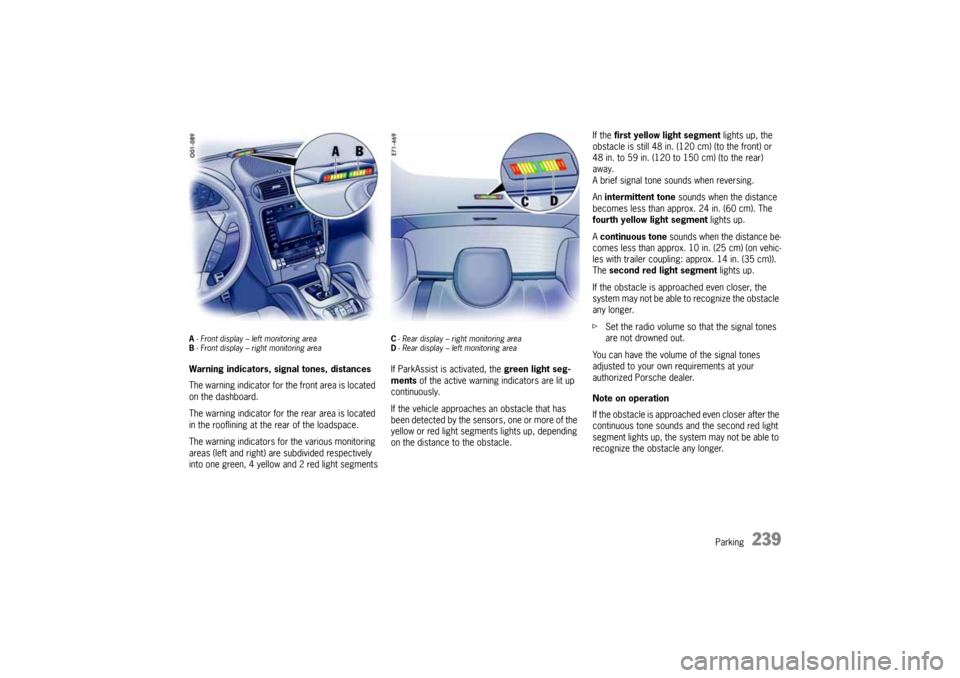
A- Front display – left monitoring area
B- Front display – right monitoring areaWarning indicators, signal tones, distances
The warning indicator for the front area is located
on the dashboard.
The warning indicator for the rear area is located
in the rooflining at the rear of the loadspace.
The warning indicators for the various monitoring
areas (left and right) are subdivided respectively
into one green, 4 yellow and 2 red light segments
C- Rear display – right monitoring area
D- Rear display – left monitoring areaIf ParkAssist is activated, the green light seg-
ments of the active warning indicators are lit up
continuously.
If the vehicle approaches an obstacle that has
been detected by the sensors, one or more of the
yellow or red light segments lights up, depending
on the distance to the obstacle.If the first yellow light segment lights up, the
obstacle is still 48 in. (120 cm) (to the front) or
48 in. to 59 in. (120 to 150 cm) (to the rear)
away.
A brief signal tone sounds when reversing.
An intermittent tone sounds when the distance
becomes less than approx. 24 in. (60 cm). The
fourth yellow light segment lights up.
A continuous tone sounds when the distance be-
comes less than approx. 10 in. (25 cm) (on vehic-
les with trailer coupling: approx. 14 in. (35 cm)).
The second red light segment lights up.
If the obstacle is approached even closer, the
system may not be able to recognize the obstacle
any longer.
fSet the radio volume so that the signal tones
are not drowned out.
You can have the volume of the signal tones
adjusted to your own requirements at your
authorized Porsche dealer.
Note on operation
If the obstacle is approached even closer after the
continuous tone sounds and the second red light
segment lights up, the system may not be able to
recognize the obstacle any longer.
10_Cayenne_21_KW17.book Seite 239 Donnerstag, 9. April 2009 3:33 15
Page 240 of 379

240
Parking Limits of ultrasonic measurement
– ParkAssist cannot detect sound-absorbing
obstacles (e.g. winter operation, powder
snow),
– Sound-reflecting obstacles (e.g. glass sur-
faces, flat painted surfaces),
– And very thin obstacles.
Other ultrasound sources (e.g. pneumatic brakes
of other vehicles, jackhammers) can interfere with
detection of obstacles.
Fault indication without warning tone
All red light segments of the active warning indica-
tors light up when there is a temporary fault in
ParkAssist.
Note
Correct operation is no longer ensured if there is
a temporary fault (e.g. caused by ice formation or
heavy soiling on the sensors).
The system detects the temporary fault.
All light segments light up until a speed of
9mph (14km/h) is reached.
ParkAssist is ready for operation again when the
interference has been eliminated.Fault indication with warning tone
In the event of a long-lasting fault in ParkAssist,
the red light segments of the active warning indi-
cators light up and a continuous tone sounds for
three seconds after a transmission range has
been selected.
Possible causes
– Defect or system fault.
fSwitch ParkAssist off.
When ParkAssist is switched off, the indicator
light in the button lights up.
Please see the chapter “SWITCHING
PARKASSIST ON AND OFF” on Page 237.
fPlease have the fault remedied at an
authorized Porsche dealer.Driving with a trailer
The ParkAssist rear monitoring area is switched
off when the trailer’s power supply is plugged in.
10_Cayenne_21_KW17.book Seite 240 Donnerstag, 9. April 2009 3:33 15
Page 245 of 379

Alarm System and Theft Protection
245
Alarm System and Passenger
Compartment MonitoringThis device complies with:
Part 15 of the FCC Rules
RSS-210 of Industry Canada.
Operation of this device is subject to the following
two conditions:
– It may not cause harmful interference, and
– it must accept any interference received inclu-
ding interference that may cause undesired
operation.
Note
fThe manufacturer is not responsible for any
radio or TV interference caused by
unauthorized modifications to this equipment.
Such modification could void the user's
authority to operate the equipment.
Warning!
Any changes or modifications not expressly ap-
proved by Porsche could void the user’s authority
to operate this equipment.Avoiding false alarmsfIf people or animals are remaining in the locked
vehicle or the vehicle is being transported on a
train or ship, for example, the passenger
compartment monitoring system must
temporarily be switched off.
fAlways close the sliding/lifting roof or the
Panorama roof system, and all door windows.
fDo not leave a mobile phone switched on in the
glasses case of the roof console.
fAlways turn off the alarm system before you
attach or uncouple a trailer. The alarm system
could trigger an alarm unintentionally.Switching off the alarm system if it is
triggeredfUnlock vehicle doors with the remote control
or
fSwitch ignition on.
The following alarm contacts are
monitored– Doors
– Engine compartment lid
– Rear lid
–Rear window
– Passenger compartment
fIf one of these alarm contacts is interrupted,
the alarm horn sounds for approx. 30 seconds
and the emergency flashers flash.
After 5 seconds of interruption the alarm is
triggered again. This cycle is repeated ten
times. USA: KR55WK45032
Canada: CAN 267 104 187
10_Cayenne_21_KW17.book Seite 245 Donnerstag, 9. April 2009 3:33 15
Page 284 of 379
284
Minor Repairs Overloading
Danger!
Risk of damage to vehicle parts, loss of con-
trol and serious personal injury or death.
fDo not overload your vehicle. Be careful about
the roof load.
fIf loading the vehicle also correct the tire pres-
sure. Tire pressure for loaded vehicle can be
found on the tire pressure plate and in the
chapter technical data.
fNever exceed the specified axle load.
Overloading can shorten the service life of the
tires and car, as well as lead to dangerous
vehicle reactions and long braking distances.
Damage due to overloading is not covered by the vehicle warranty.
fPlease see the chapter “LOADING
INFORMATION” on Page 231.
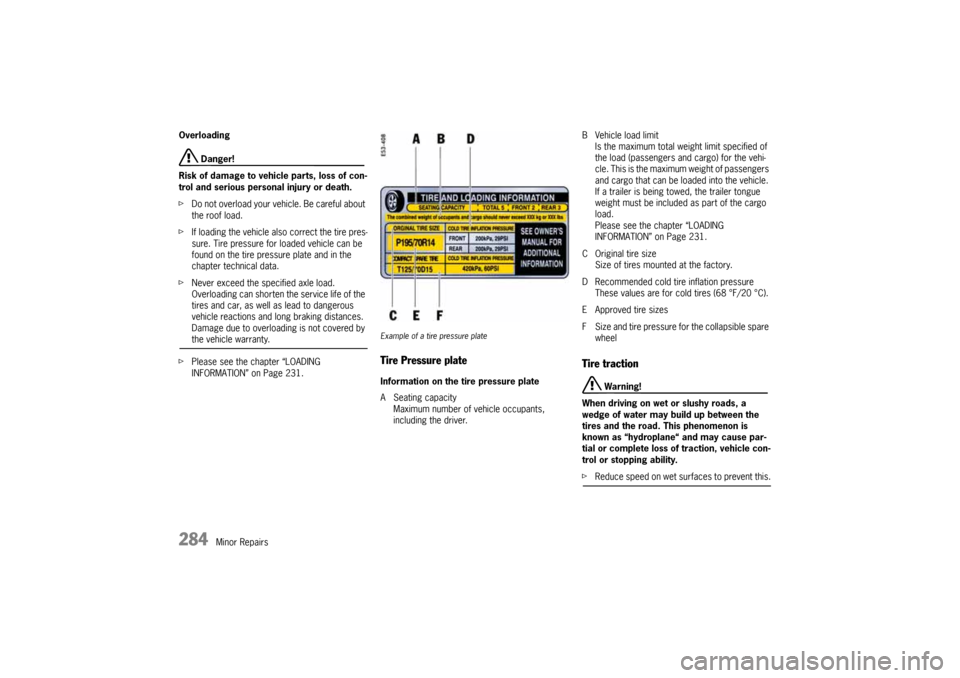
Example of a tire pressure plateTire Pressure plateInformation on the tire pressure plate
A Seating capacity
Maximum number of vehicle occupants,
including the driver.B Vehicle load limit
Is the maximum total weight limit specified of
the load (passengers and cargo) for the vehi-
cle. This is the maximum weight of passengers
and cargo that can be loaded into the vehicle.
If a trailer is being towed, the trailer tongue
weight must be included as part of the cargo
load.
Please see the chapter “LOADING
INFORMATION” on Page 231.
C Original tire size
Size of tires mounted at the factory.
D Recommended cold tire inflation pressure
These values are for cold tires (68 °F/20 °C).
E Approved tire sizes
F Size and tire pressure for the collapsible spare
wheel
Tire traction
Warning!
When driving on wet or slushy roads, a
wedge of water may build up between the
tires and the road. This phenomenon is
known as “hydroplane“ and may cause par-
tial or complete loss of traction, vehicle con-
trol or stopping ability.
fReduce speed on wet surfaces to prevent this.
10_Cayenne_21_KW17.book Seite 284 Donnerstag, 9. April 2009 3:33 15
Page 317 of 379
Minor Repairs
317
Fuse assignment – fuse box in right side of dashboardNo. Designation Rating in A No. Designation Rating in A1
Trailer coupling
15
25
Air conditioner 2+2, rear
5
2 ParkAssist 5 27Level control,
Porsche Dynamic Chassis Control (PDCC)15
3
Trailer coupling
15
29
Transmission control unit, Tiptronic selector lever
switch
5
5 Trailer coupling 15 30Rear lid power closing mechanism relay (control and
load)20
6
Porsche Stability Management (PSM)
30
31
Filler flap actuator, rear end control unit (motors)
15
7Transfer box (center-differential lock), telephone prepa-
ration5 34 Power window and central locking, front right door 30
8
Vehicle electrical system control unit (left side marker
light, right turn signal, right low beam
30
35
Power seat controls, right
30
10 TV tuner, Rear Seat Entertainment 10 36 Roof console, electrical compass 5
11
Radio or Porsche Communication System (PCM)
10
38
Porsche Stability Management (PSM)
10
12 Amplifier for sound package and Bose 30 39 Diagnosis 5
14
Tail light, left
15
40
Transfer box (center-differential lock)
10
15 Power window and central locking, rear right door 30 41 Trailer coupling control unit 10
18
Heated rear window relay (load)
30
42
Roof module
5
19 Trailer coupling, trailer socket connection point 25 43 Reversing light 5
21
Spare wheel release relay (load), horn for alarm system
10
44
Heatable washer nozzles, chassis switch, seat heating
potentiometer, Porsche Dynamic Chassis Control
(PDCC)
5
22
Seat heating, front25 46 Rear Seat Entertainment 5
23
Air conditioner 2+2
10
48
Level control
10
24
Power seat controls and seat memory, front right30 49 Anti-dazzle interior mirror 5
10_Cayenne_21_KW17.book Seite 317 Donnerstag, 9. April 2009 3:33 15
Page 356 of 379
356
Tire Pressure and Technical Data
Weights1)Empty weight includes 165 lbs. (75 kg) driver and baggage share.2)The maximum gross weight must not be exceeded.
Note: If additional equipment is installed, the useful load will be correspondingly less.3)Use only Original Porsche Roof Transport System. Cayenne
manual transmissionCayenne
Tiptronic SCayenne GTS,
Cayenne S Transsyberia
manual transmissionCayenne S,
Cayenne GTS,
Cayenne S Transsyberia
Tiptronic SEmpty weightEmpty weight (depending on equipment)per DIN 70020
4762 - 5556 lbs.
(2160 - 2520 Kg)
4784 -5578 lbs.
(2170 - 2530 kg)
4905 - 5732 lbs.
(2225 - 2600 kg)
4949 - 5776 lbs.
(2245 - 2620 kg)
per 70/156/EEC
1)
4927 - 5720 lbs.
(2235 - 2595 kg)4949 - 5743 lbs.
(2245 - 2605 kg)5071 - 5897 lbs.
(2300 - 2675 kg)5115 - 5941 lbs.
(2320 - 2695 kg)
Maximum axle load, front
2)
3053 lbs. (1385 kg)
3053 lbs. (1385 kg)
3208 lbs. (1455 kg)
3208 lbs. (1455 kg)
Maximum axle load, rear
2)
3638 lbs. (1650 kg) 3638 lbs. (1650 kg) 3704 lbs. (1680 kg) 3704 lbs. (1680 kg)
Maximum gross weight 6493 lbs. (2945 kg) 6493 lbs. (2945 kg) 6790 lbs. (3080 kg) 6790 lbs. (3080 kg)
Trailer operation Canada/USAMaximum gross weight 6493 lbs. (2945 kg) 6493 lbs. (2945 kg) 6790 lbs. (3080 kg) 6790 lbs. (3080 kg)Maximum axle load, front/rear axle
3053/3803 lbs.
(1385/1725 kg)
3053/3803 lbs.
(1385/1725 kg)
3208/3803 lbs.
(1455/1725 kg)
3208/3803 lbs.
(1455/1725 kg)
Roof load
Maximum roof load
3)
when roof rail is fitted
3)
221 lbs. (100 kg)
165 lbs. (75kg)
221 lbs. (100 kg)
165lbs. (75kg)
221 lbs. (100 kg)
165 lbs. (75 kg)
221 lbs. (100 kg)
165lbs. (75kg)
Towing capacity/vehicle + trailer weight
Maximum towing capacity, braked
(up to a max. 12% slope)
7716 lbs. (3500 kg)
7716 lbs. (3500 kg)
7716 lbs. (3500 kg)
7716 lbs. (3500 kg)
Maximum towing capacity, unbraked 1654 lbs. (750 kg) 1654 lbs. (750 kg) 1654 lbs. (750 kg) 1654 lbs. (750 kg)
Maximum vehicle + trailer weight
14209 lbs. (6445 kg)
14209 lbs. (6445 kg)
14506 lbs. (6580 kg)
14506 lbs. (6580 kg)
Maximum trailer hitch load 617 lbs. (280 kg) 617lbs. (280 kg) 617 lbs. (280 kg) 617 lbs. (280 kg)
10_Cayenne_21_KW17.book Seite 356 Donnerstag, 9. April 2009 3:33 15
Page 361 of 379
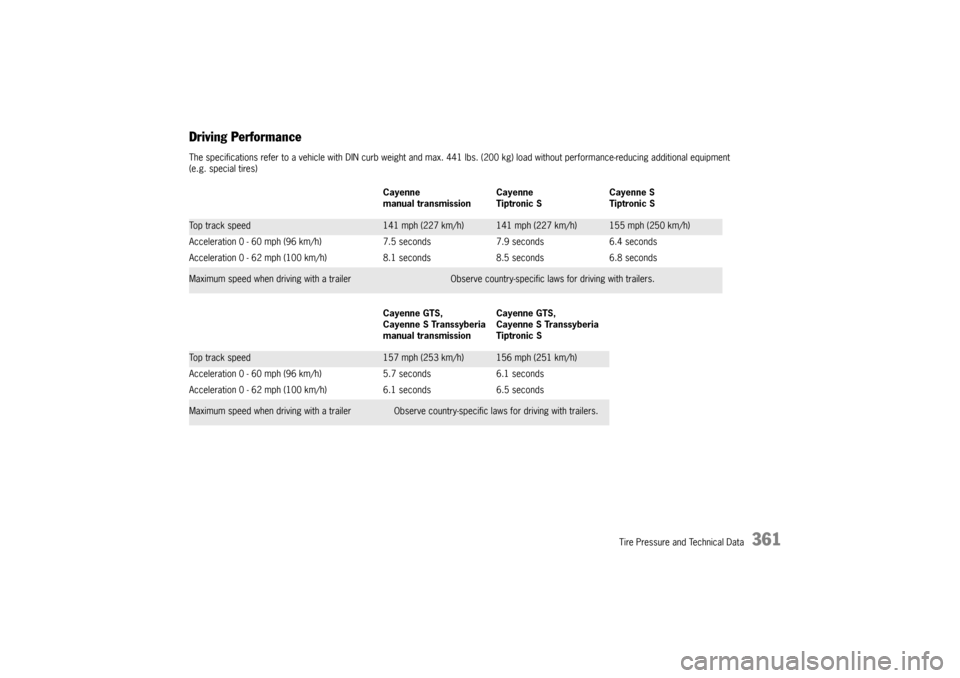
Tire Pressure and Technical Data
361
Driving PerformanceThe specifications refer to a vehicle with DIN curb weight and max. 441 lbs. (200 kg) load without performance-reducing additional equipment
(e.g. special tires)
Cayenne
manual transmissionCayenne
Tiptronic SCayenne S
Tiptronic STo p t r a c k s p e e d
141 mph (227 km/h)
141 mph (227 km/h)
155 mph (250 km/h)
Acceleration 0 - 60 mph (96 km/h) 7.5 seconds 7.9 seconds 6.4 seconds
Acceleration 0 - 62 mph (100 km/h) 8.1 seconds 8.5 seconds 6.8 seconds
Maximum speed when driving with a trailer
Observe country-specific laws for driving with trailers.
Cayenne GTS,
Cayenne S Transsyberia
manual transmissionCayenne GTS,
Cayenne S Transsyberia
Tiptronic S
To p t r a c k s p e e d
157 mph (253 km/h)
156 mph (251 km/h)
Acceleration 0 - 60 mph (96 km/h) 5.7 seconds 6.1 seconds
Acceleration 0 - 62 mph (100 km/h) 6.1 seconds 6.5 seconds
Maximum speed when driving with a trailer
Observe country-specific laws for driving with trailers.
10_Cayenne_21_KW17.book Seite 361 Donnerstag, 9. April 2009 3:33 15