belt PORSCHE CAYNNE 2004 1.G Owner's Manual
[x] Cancel search | Manufacturer: PORSCHE, Model Year: 2004, Model line: CAYENNE, Model: PORSCHE CAYENNE 2004 1.GPages: 379, PDF Size: 13.91 MB
Page 119 of 379
Multi-Purpose Display and Instruments
119
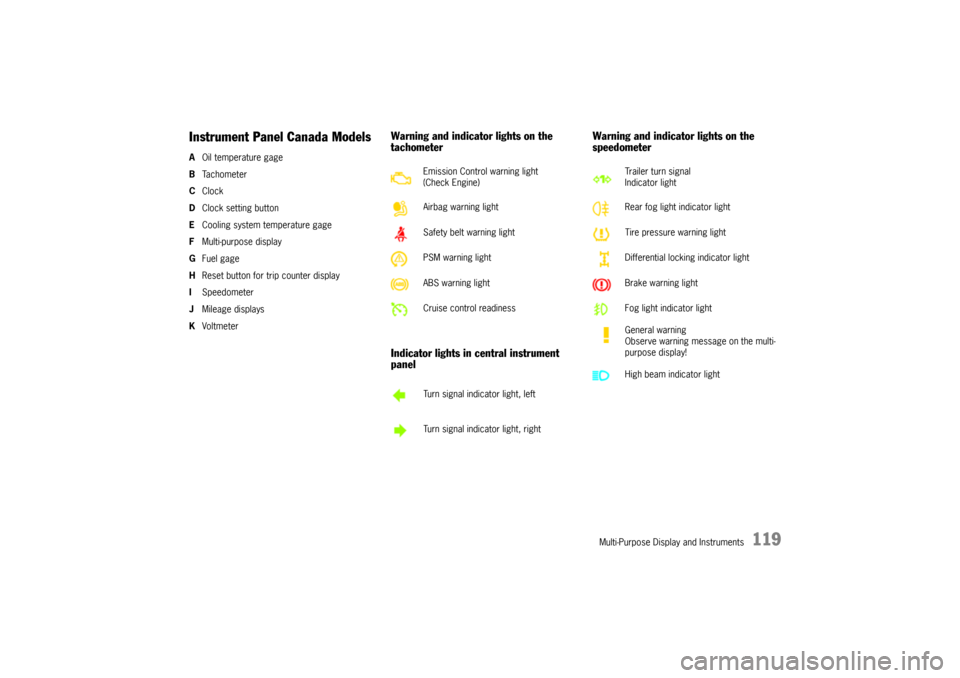
Instrument Panel Canada ModelsAOil temperature gage
BTa c h o m e t e r
CClock
DClock setting button
ECooling system temperature gage
FMulti-purpose display
GFuel gage
HReset button for trip counter display
ISpeedometer
JMileage displays
KVoltmeter
Warning and indicator lights on the
tachometer
Indicator lights in central instrument
panelWarning and indicator lights on the
speedometer
Emission Control warning light
(Check Engine)
Airbag warning light
Safety belt warning light
PSM warning light
ABS warning light
Cruise control readiness
Turn signal indicator light, left
Turn signal indicator light, right
Trailer turn signal
Indicator light
Rear fog light indicator light
Tire pressure warning light
Differential locking indicator light
Brake warning light
Fog light indicator light
General warning
Observe warning message on the multi-
purpose display!
High beam indicator light
10_Cayenne_21_KW17.book Seite 119 Donnerstag, 9. April 2009 3:33 15
Page 121 of 379
Multi-Purpose Display and Instruments
121
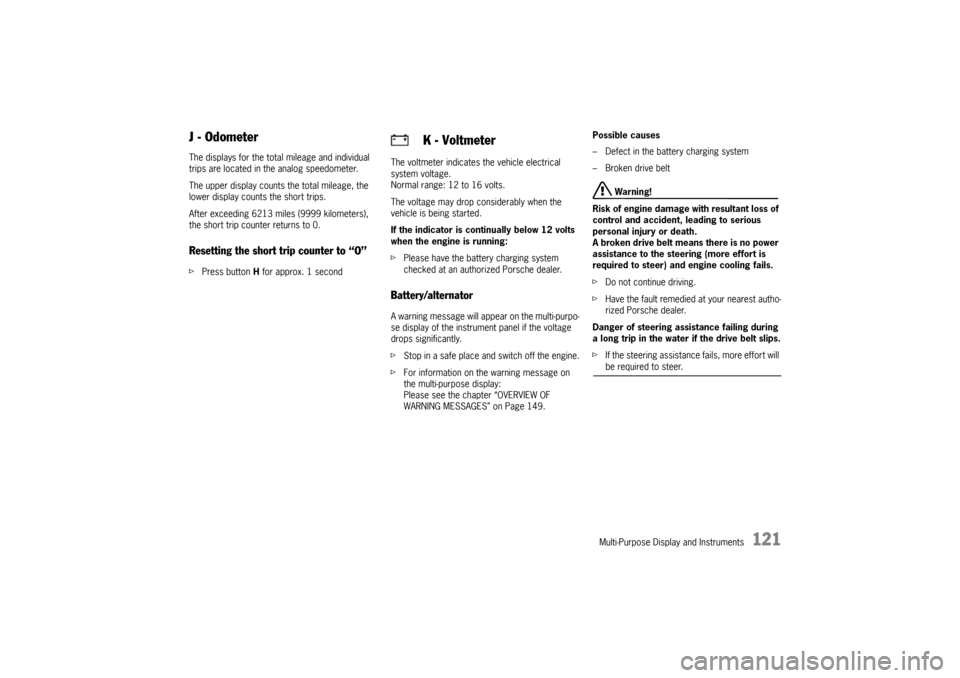
J - OdometerThe displays for the total mileage and individual
trips are located in the analog speedometer.
The upper display counts the total mileage, the
lower display counts the short trips.
After exceeding 6213 miles (9999 kilometers),
the short trip counter returns to 0.Resetting the short trip counter to “O”fPress button H for approx. 1 secondThe voltmeter indicates the vehicle electrical
system voltage.
Normal range: 12 to 16 volts.
The voltage may drop considerably when the
vehicle is being started.
If the indicator is continually below 12 volts
when the engine is running:
fPlease have the battery charging system
checked at an authorized Porsche dealer.
Battery/alternatorA warning message will appear on the multi-purpo-
se display of the instrument panel if the voltage
drops significantly.
fStop in a safe place and switch off the engine.
fFor information on the warning message on
the multi-purpose display:
Please see the chapter “OVERVIEW OF
WARNING MESSAGES” on Page 149.Possible causes
– Defect in the battery charging system
– Broken drive belt
Warning!
Risk of engine damage with resultant loss of
control and accident, leading to serious
personal injury or death.
A broken drive belt means there is no power
assistance to the steering (more effort is
required to steer) and engine cooling fails.
fDo not continue driving.
fHave the fault remedied at your nearest autho-
rized Porsche dealer.
Danger of steering assistance failing during
a long trip in the water if the drive belt slips.
fIf the steering assistance fails, more effort will be required to steer.
K - Voltmeter
10_Cayenne_21_KW17.book Seite 121 Donnerstag, 9. April 2009 3:33 15
Page 151 of 379
Multi-Purpose Display and Instruments
151
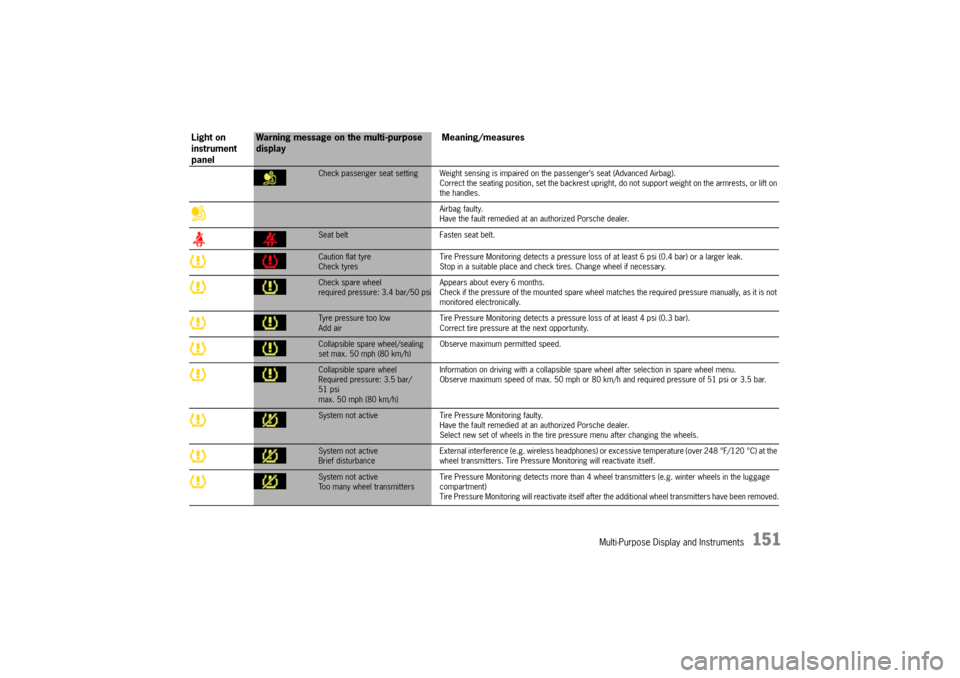
Check passenger seat setting Weight sensing is impaired on the passenger’s seat (Advanced Airbag).
Correct the seating position, set the backrest upright, do not support weight on the armrests, or lift on
the handles.
Airbag faulty.
Have the fault remedied at an authorized Porsche dealer.
Seat belt Fasten seat belt.Caution flat tyre
Check tyresTire Pressure Monitoring detects a pressure loss of at least 6 psi (0.4 bar) or a larger leak.
Stop in a suitable place and check tires. Change wheel if necessary.Check spare wheel
required pressure: 3.4 bar/50 psiAppears about every 6 months.
Check if the pressure of the mounted spare wheel matches the required pressure manually, as it is not
monitored electronically.Tyre pressure too low
Add airTire Pressure Monitoring detects a pressure loss of at least 4 psi (0.3 bar).
Correct tire pressure at the next opportunity.Collapsible spare wheel/sealing
set max. 50 mph (80 km/h)Observe maximum permitted speed.Collapsible spare wheel
Required pressure: 3.5 bar/
51 psi
max. 50 mph (80 km/h)Information on driving with a collapsible spare wheel after selection in spare wheel menu.
Observe maximum speed of max. 50 mph or 80 km/h and required pressure of 51 psi or 3.5 bar.System not active Tire Pressure Monitoring faulty.
Have the fault remedied at an authorized Porsche dealer.
Select new set of wheels in the tire pressure menu after changing the wheels.System not active
Brief disturbanceExternal interference (e.g. wireless headphones) or excessive temperature (over 248 °F/120 °C) at the
wheel transmitters. Tire Pressure Monitoring will reactivate itself.System not active
Too many wheel transmittersTire Pressure Monitoring detects more than 4 wheel transmitters (e.g. winter wheels in the luggage
compartment)
Tire Pressure Monitoring will reactivate itself after the additional wheel transmitters have been removed.
Light on
instrument
panel
Warning message on the multi-purpose
displayMeaning/measures
10_Cayenne_21_KW17.book Seite 151 Donnerstag, 9. April 2009 3:33 15
Page 200 of 379

200
Driving and Driving Safety Soiling can impair the braking action.
fCheck and clean the brakes if they have been
soiled.
Danger of steering assistance failing during
a long journey in the water if the drive belt
slips.
fIf the steering assistance fails, more effort will
be required to steer.
Danger of damaging electrical systems
fAvoid driving through salt water.
Notes on operation
fActivate the Low Range program.
fSwitch the air conditioner off.
fSwitch the headlights off.Tips on driving
fAvoid high engine speeds (max. 2,500 rpm).
fDo not perform manual gear changes when
driving, and try to avoid stopping.
Moving off in the water can be difficult due to
the high resistance and the loose surface
involved.
fStart the water crossing at a shallow place at
walking speed.
fAfter checking the body of water, take the
shortest path through it.
fNever drive into the water at high speed. The
resulting “bow wave” could damage the engine
and its accessories.
fAdjust your driving style to the unfamiliar sur-
roundings.
fCross the body of water slowly and at a con-
stant speed.
fNever turn around when crossing a body of
water.
fIf it is not possible to cross the body of water,
the car must be backed out of it in reverse
gear.
The servo pump and alternator can fail if the car is
driven through water for an extended period.
fIf the servo pump fails, substantially more
force will have to be exerted in order to steer. Maintenance Note
The car requires a special check after the water
crossing.
fRemove mud from the tire tread.
fBriefly apply the brakes in order to dry them
after driving through the water.10_Cayenne_21_KW17.book Seite 200 Donnerstag, 9. April 2009 3:33 15
Page 204 of 379
204
Luggage Compartment, Loadspace and Storage
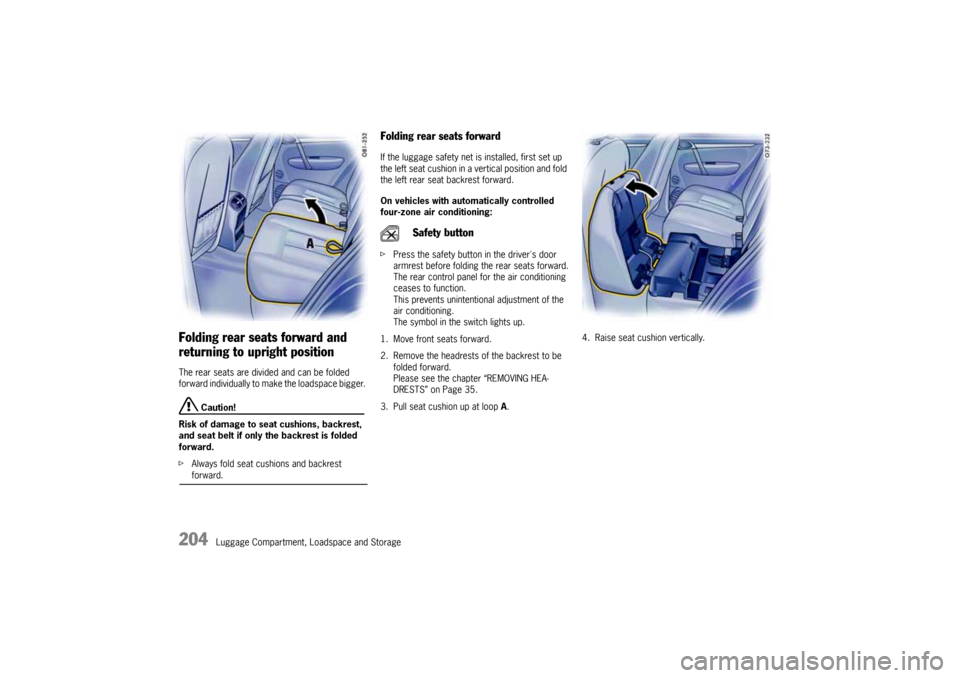
Folding rear seats forward and
returning to upright positionThe rear seats are divided and can be folded
forward individually to make the loadspace bigger.
Caution!
Risk of damage to seat cushions, backrest,
and seat belt if only the backrest is folded
forward.
fAlways fold seat cushions and backrest forward.
Folding rear seats forwardIf the luggage safety net is installed, first set up
the left seat cushion in a vertical position and fold
the left rear seat backrest forward.
On vehicles with automatically controlled
four-zone air conditioning:
fPress the safety button in the driver's door
armrest before folding the rear seats forward.
The rear control panel for the air conditioning
ceases to function.
This prevents unintentional adjustment of the
air conditioning.
The symbol in the switch lights up.
1. Move front seats forward.
2. Remove the headrests of the backrest to be
folded forward.
Please see the chapter “REMOVING HEA-
DRESTS” on Page 35.
3. Pull seat cushion up at loop A.4. Raise seat cushion vertically.
Safety button
10_Cayenne_21_KW17.book Seite 204 Donnerstag, 9. April 2009 3:33 15
Page 206 of 379
206
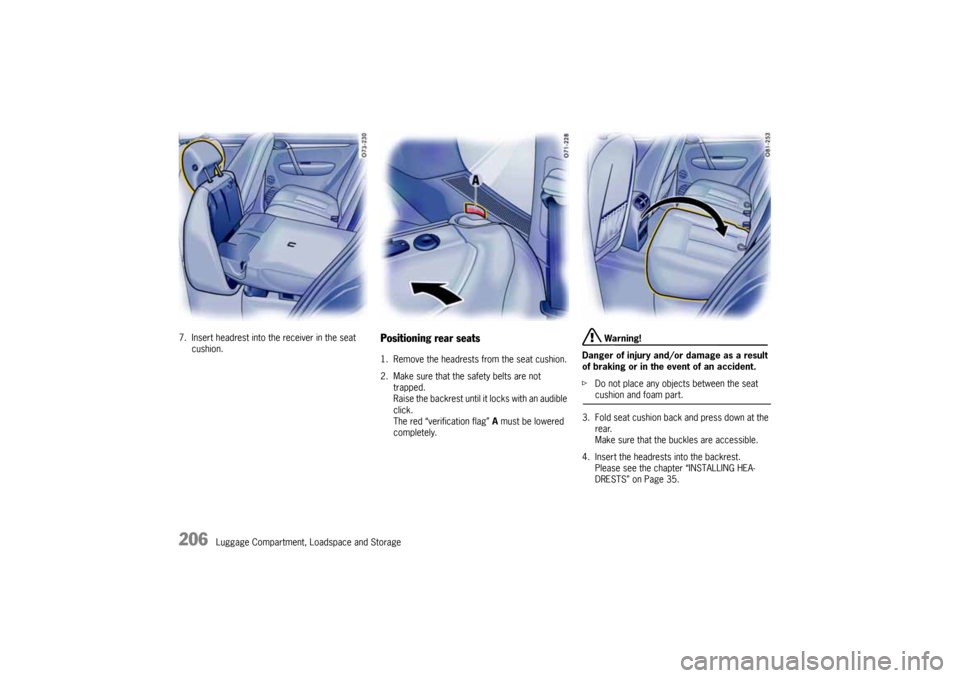
Luggage Compartment, Loadspace and Storage 7. Insert headrest into the receiver in the seat
cushion.
Positioning rear seats1. Remove the headrests from the seat cushion.
2. Make sure that the safety belts are not
trapped.
Raise the backrest until it locks with an audible
click.
The red “verification flag” A must be lowered
completely.
Warning!
Danger of injury and/or damage as a result
of braking or in the event of an accident.
fDo not place any objects between the seat cushion and foam part.
3. Fold seat cushion back and press down at the
rear.
Make sure that the buckles are accessible.
4. Insert the headrests into the backrest.
Please see the chapter “INSTALLING HEA-
DRESTS” on Page 35.
10_Cayenne_21_KW17.book Seite 206 Donnerstag, 9. April 2009 3:33 15
Page 209 of 379
Luggage Compartment, Loadspace and Storage
209
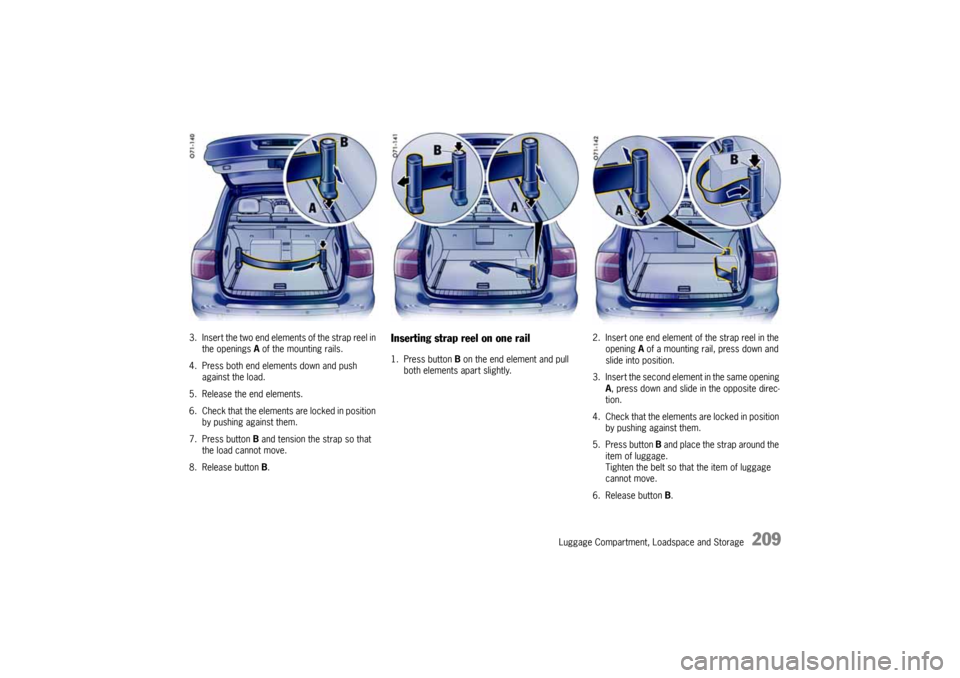
3. Insert the two end elements of the strap reel in
the openings A of the mounting rails.
4. Press both end elements down and push
against the load.
5. Release the end elements.
6. Check that the elements are locked in position
by pushing against them.
7. Press button B and tension the strap so that
the load cannot move.
8. Release button B.
Inserting strap reel on one rail1. Press button B on the end element and pull
both elements apart slightly.2. Insert one end element of the strap reel in the
opening A of a mounting rail, press down and
slide into position.
3. Insert the second element in the same opening
A, press down and slide in the opposite direc-
tion.
4. Check that the elements are locked in position
by pushing against them.
5. Press button B and place the strap around the
item of luggage.
Tighten the belt so that the item of luggage
cannot move.
6. Release button B.
10_Cayenne_21_KW17.book Seite 209 Donnerstag, 9. April 2009 3:33 15
Page 215 of 379
Luggage Compartment, Loadspace and Storage
215
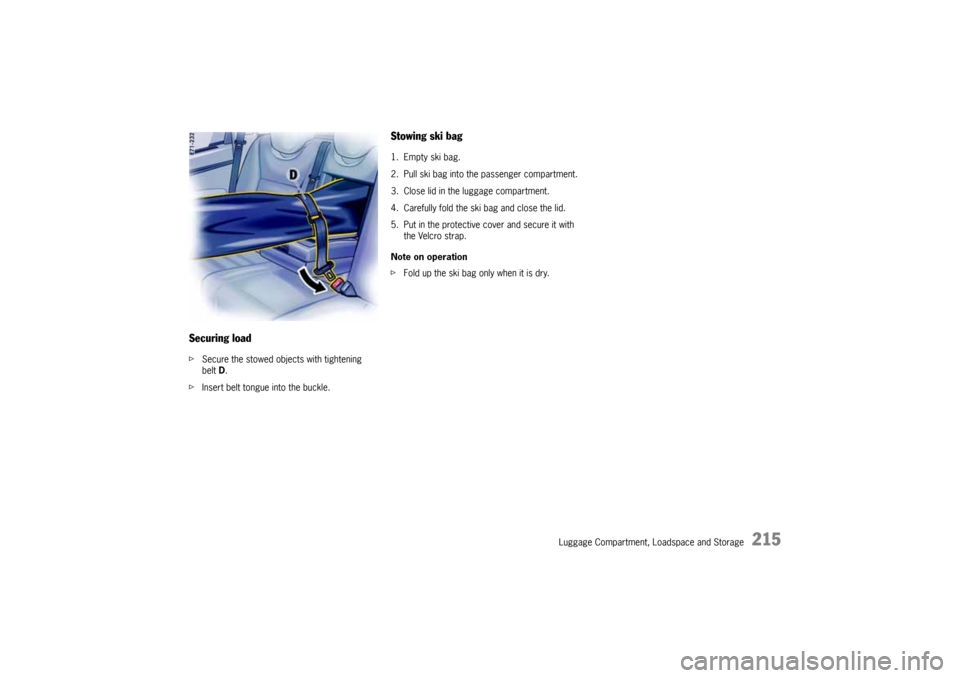
Securing loadfSecure the stowed objects with tightening
beltD.
fInsert belt tongue into the buckle.
Stowing ski bag1. Empty ski bag.
2. Pull ski bag into the passenger compartment.
3. Close lid in the luggage compartment.
4. Carefully fold the ski bag and close the lid.
5. Put in the protective cover and secure it with
the Velcro strap.
Note on operation
fFold up the ski bag only when it is dry.
10_Cayenne_21_KW17.book Seite 215 Donnerstag, 9. April 2009 3:33 15
Page 231 of 379

Trailer Hitch
231
Loading InformationDefinitionsThe towing capacity (gross weight of the trailer)
is the sum of the trailer's empty weight and the
weight of the load.
The vertical coupling load is the weight that the
trailer drawbar exerts on the trailer coupling of the
vehicle.
The rear-axle load is the vehicle weight on the
rear axle plus the weight of the transported load
and the vertical coupling load of the trailer.
The gross weight of the vehicle and trailer is
the sum of the weight of the towing vehicle and the
weight of the trailer.
The Curb weight - actual weight of your vehicle -
vehicle weight including standard and optional
equipment, fluids, emergency tools, and spare tire
assembly. This weight does not include passen-
gers and cargo.
The Gross Vehicle Weight is sum of the curb
weight and the weight of passengers and cargo
combined.
The Gross Vehicle Weight Rating is the
maximum total weight of vehicle, passengers,
luggage, hitch, trailer tongue load and optional
equipment.The Gross Axle Weight Rating is the maximum
load limit for the front or the rear axle. This infor-
mation is located on the safety comliance sticker
located in the driver’s side door jamb.
For determining the compatibility of the tire and
vehicle load capabilities:
fPlease see the chapter “TIRES, RIMS, TRACKS”
on Page 350.
The load capacity coefficient (e.g. “106”) is a
minimum requirement. For more information:
fPlease see the chapter “INSCRIPTION ON
RADIAL TIRE” on Page 290.
The Gross Combined Weight Rating is the
maximum total weight rating of vehicle, passen-
gers, cargo and trailer.
The Vehicle Capacity Weight - Load Limit - is
the maximum total weight limit specified of the
load (passengers and cargo) for the vehicle. This
is the maximum weight of passengers and cargo
that can be loaded into the vehicle. This informa-
tion can be found on the tire pressure plate.
If a trailer is being towed, the trailer tongue weight
must be included as part of the cargo load.
The maximum loaded vehicle weight is the
sum of curb weight, accessory weight, vehicle
capacity weight and production options weight.
The load rating is the maximum load that a tire
is rated to carry for a given inflation pressure.The maximum load rating is the load rating for
a tire at the maximum permissible inflation pres-
sure.
The cargo capacity is the permissible weight of
cargo, the subtracted weight of passengers from
the load limit.
fNever exceed the permissible limits.
Danger!
Risk of personal injury or death.
Injuries are much more likely in an accident
if persons ride in the cargo area.
fPersons must ride only on the seats provided
for this purpose.
fMake sure that everybody fastens their safety
belts.
Risk of loss of control, damage to the vehicle
and serious personal injury or death.
fNever exceed the specified axle loads. Over-
loading can shorten the service life of the tires
and car, as well as lead to dangerous vehicle
reactions and long braking distances. Damage
due to overloading is not covered by the vehicle warranty.
10_Cayenne_21_KW17.book Seite 231 Donnerstag, 9. April 2009 3:33 15
Page 233 of 379

Trailer Hitch
233
Stowing load in the vehicle
Warning!
Danger of injury.
An unsecured or incorrectly positioned cargo
can slip out of place or endanger the vehicle
occupants during braking, direction changes
or in accidents.
Never transport objects which are not
secured.
fAlways transport cargo in the cargo area,
never in the passenger compartment (e.g. on
or in front of the seats).
fSupport the cargo on the seat backrests
whenever possible. Always lock the backrests
into place.
fPlace the cargo behind unoccupied seats
whenever possible.
fStow heavy objects as close to the front of the
cargo area as possible, with lightweight ob-
jects behind them.
fThe cargo must never project over the top
edge of the seat backrest.
fAlways protect the passenger compartment
with a luggage safety net and a luggage
compartment cover.
Do not drive with objects on top of the luggage
compartment cover.fIf the rear seats are not occupied, the back-
rests can be additionally secured with the safe-
ty belts. Simply cross the outer safety belts
and insert each into the opposite buckle.
fMake sure that the cargo cannot damage the
heating filaments of the rear window and the
TV antenna of the side window.
Luggage net
fLuggage must be stowed completely covered
by the luggage net.
The luggage net can prevent only lightweight
objects from slipping.
Tie-down belts
fDo not use elastic belts or straps to tie down
cargo.
fDo not place belts and straps over sharp
edges.
fObserve the directions for use and information
for the tie-down equipment.
fUse only belts with a tear strength of at least
1543 lbs. (700 kg) and a maximum width of
1in. (25mm).
fCross the belts over the load.Driving
fThe car's handling changes depending on the
vehicle loading. Adapt your driving style to the
changed driving behavior.
fDo not exceed the maximum gross weight and
the axle load.
fPlease see the chapter “WEIGHTS” on
Page 356.
fNever drive with the rear window or rear lid
open.
Exhaust gases can enter the passenger
compartment.
fAdapt the tire pressure to the load.
fPlease see the chapter “SETTING VEHICLE
LOADING AND ADJUSTING TIRE PRESSURE”
on Page 135.
fPlease see the chapter “TIRE PRESSURES,
COLD (68 °F/20 °C)” on Page 354.
10_Cayenne_21_KW17.book Seite 233 Donnerstag, 9. April 2009 3:33 15