roof PORSCHE CAYNNE 2004 1.G Owner's Guide
[x] Cancel search | Manufacturer: PORSCHE, Model Year: 2004, Model line: CAYENNE, Model: PORSCHE CAYENNE 2004 1.GPages: 379, PDF Size: 13.91 MB
Page 245 of 379

Alarm System and Theft Protection
245
Alarm System and Passenger
Compartment MonitoringThis device complies with:
Part 15 of the FCC Rules
RSS-210 of Industry Canada.
Operation of this device is subject to the following
two conditions:
– It may not cause harmful interference, and
– it must accept any interference received inclu-
ding interference that may cause undesired
operation.
Note
fThe manufacturer is not responsible for any
radio or TV interference caused by
unauthorized modifications to this equipment.
Such modification could void the user's
authority to operate the equipment.
Warning!
Any changes or modifications not expressly ap-
proved by Porsche could void the user’s authority
to operate this equipment.Avoiding false alarmsfIf people or animals are remaining in the locked
vehicle or the vehicle is being transported on a
train or ship, for example, the passenger
compartment monitoring system must
temporarily be switched off.
fAlways close the sliding/lifting roof or the
Panorama roof system, and all door windows.
fDo not leave a mobile phone switched on in the
glasses case of the roof console.
fAlways turn off the alarm system before you
attach or uncouple a trailer. The alarm system
could trigger an alarm unintentionally.Switching off the alarm system if it is
triggeredfUnlock vehicle doors with the remote control
or
fSwitch ignition on.
The following alarm contacts are
monitored– Doors
– Engine compartment lid
– Rear lid
–Rear window
– Passenger compartment
fIf one of these alarm contacts is interrupted,
the alarm horn sounds for approx. 30 seconds
and the emergency flashers flash.
After 5 seconds of interruption the alarm is
triggered again. This cycle is repeated ten
times. USA: KR55WK45032
Canada: CAN 267 104 187
10_Cayenne_21_KW17.book Seite 245 Donnerstag, 9. April 2009 3:33 15
Page 264 of 379

264
Maintenance and Car Care
Parking
Danger!
Danger of fire resulting in serious personal
injury or death.
fDo not park or operate the vehicle in areas
where the hot exhaust system may come in
contact with dry grass, brush, fuel spill or
other flammable material.
fIf your car catches on fire for any reason, call
the fire department. Do not endanger your life by attempting to put out the fire.
Undercoating
Danger!
Danger of fire resulting in serious personal
injury or death.
fDo not apply additional undercoating or rust-
proofing on or near the exhaust manifold,
exhaust pipes, catalytic converters or heat
shields. During driving the substance used for undercoating could overheat and ignite.
How Emission Control WorksWhen an automobile engine is running, it uses
energy generated through the combustion of a
mixture of air and fuel. Depending on whether a
car is driven fast or slowly or whether the engine
is cold or hot, some of the fuel (hydrocarbons)
may not be burned completely, but may be
discharged into the engine crankcase or exhaust
system. Additonal hydrocarbons may enter the
atmosphere through evaporation of fuel from the
fuel tank. These hydrocarbons (HC), when
released into the air, contribute to undesirable
pollution.
In addition, carbon monoxide (CO) and oxides of
nitrogen (NOx) contribute to engine emissions.
They, too, are formed during the combustion
process and discharged into the exhaust system.
To reduce these pollutants, your Porsche is
equipped with a precisely calibrated fuel injection
system to assure a finely balanced air/fuel mixture
under all operating conditions.
Oxygen sensorThe oxygen sensor, installed in the exhaust pipe
continuously senses the oxygen content of the ex-
haust and signals the information to an electronic
control unit. The control unit corrects the air/fuel
ratio, so the engine always receives an accurately
metered air/fuel mixture.Crankcase ventilationThrough crankcase ventilation, undesirable
emissions from the engine crankcase are not per-
mitted to reach the outside atmosphere. These
emissions are recirculated from the crankcase to
the air intake system. From here the emissions
mix with the intake air and are later burned in the
engine.Catalytic convertersThe catalytic converters are efficient “clean-up”
devices built into the exhaust system of the
vehicle. The catalytic converters burn the
undesirable pollutants in the exhaust gas before it
is released into the atmosphere.
The exclusive use of unleaded fuel is critical-
ly important for the life of the catalytic con-
verters. Therefore, only unleaded fuel must
be used.
10_Cayenne_21_KW17.book Seite 264 Donnerstag, 9. April 2009 3:33 15
Page 265 of 379

Maintenance and Car Care
265
The catalytic converters will be damaged by:
– push or tow starting the vehicle
– misfiring of the engine
– turning off the ignition while the vehicle is
moving or
– driving until the fuel tank is completely empty
– by other unusual operating conditions.
fDo not continue to operate your vehicle under
these conditions, since raw fuel might reach
the catalytic converters. This could result in
overheating of the converters. Federal law
prohibits use of leaded fuel in this car.
Fuel EconomyFuel economy will vary depending on where,
when and how you drive, optional equipment
installed, and the general condition of your
car.
A car tuned to specifications and correctly
maintained, will help you to achieve optimal
fuel economy.
fHave your vehicle tuned to specifications. Air
cleaner should be dirt free to allow proper
engine “breathing”.
Battery should be fully charged.
Wheels should be properly aligned.
Tires should be inflated to the correct
pressure.
fAlways monitor your fuel consumption.
fDrive smoothly, avoid abrupt changes in speed
as much as possible.
fAvoid jack rabbit starts and sudden stops.
fDo not drive longer than necessary in the lower
gears. Shifting into a higher gear early without
lugging the engine will help save fuel.
fProlonged “warm up” idling wastes gas. Start
the vehicle just before you are ready to drive.
Accelerate slowly and smoothly.fSwitch off the engine if stationary for longer
periods.
fAny additional weight carried in the vehicle
re d u c e s f u e l e c o n o m y. A l w a ys k e e p c a rg o t o a
minimum and remove all unnecessary items.
fOrganize your trips to take in several errands
in one trip.
fAll electrical accessories contribute to
increased fuel consumption.
fOnly switch on the air conditioning when neces-
sary.
fDo not drive with the Roof Transport System
mounted unless you need it.
The EPA estimated miles per gallon (mpg) is
to be used for comparison purposes, actual
mileage may be different from the estimated
mpg, depending on your driving speed,
weather conditions and trip length. Your
actual highway mileage will probably be less
than the estimated mpg.
fPlease see all local and national speed limits.
10_Cayenne_21_KW17.book Seite 265 Donnerstag, 9. April 2009 3:33 15
Page 272 of 379

272
Maintenance and Car Care
Warning!
Moisture which gets on the brakes during a
car wash can reduce braking efficiency or
make the brake pull unevenly which could
increase the danger of an accident, causing
serious personal injuries or death.
fAfter washing the vehicle, test the brakes and
steering and briefly brake the discs dry.
When doing so, make sure that vehicles travel-ling behind you are not affected.
Automatic car washes
fPlease see the chapter “WIPER BLADES” on
Page 261.
Optional add-on parts or parts which project be-
yond the contours of the vehicle may be damaged
by design features (e.g. brushes) of automatic car
washes.The following parts are particularly
susceptible to damage:
– Windshield wipers and rear wiper (always
switch them off – wiper stalk in position0 – to
prevent them wiping unintentionally in intermit-
tent or sensor operation).
– Door mirrors (always fold in).
– External antennas (always unscrew).
– Roof Transport System (always remove com-
pletely).
– Off-road roof-mounted headlights (always
remove completely).
– Spoiler.
– Wheels (the wider the rim and the lower the tire
height, the greater the risk of damage).
fPlease consult the operator before using
automatic car washes.
fWash and dry by hand all points not reached by
a car wash, such as door and lid seams or
door sills.
Note
Automatic car washes spray water at odd angles
and high pressures, which are not seen in normal
driving. Therefore, water can sometimes find its
way into the passengers compartment during or
shortly after the car wash.
10_Cayenne_21_KW17.book Seite 272 Donnerstag, 9. April 2009 3:33 15
Page 273 of 379

Maintenance and Car Care
273
PaintfNever rub a dusty car with a dry cloth since
dust particles are abrasive and could dull and
damage the surface finish.
The paintwork of your car is exposed to all types
of mechanical and chemical conditions, particular-
ly climatic ones such as bright sunlight, rain, frost
and snow. Ultraviolet light, rapid changes in tem-
perature, rain, snow, industrial dust and chemical
deposits constantly attack the paint which is only
able to withstand such exposure in the long term
if it is given regular care and attention.
fDo not apply silicone polishes to the windshield
or window.
fDo not treat matt-painted components with
preservatives or polishes, otherwise the matt
effect will be lost.
Preservation
The paint surface becomes dull over time due to
weathering. It is therefore necessary to preserve
the paint regularly.
This keeps the paint shiny and elastic. Dirt is
prevented from adhering to the paint surface and
industrial dust is prevented from penetrating the
paint.
Provided it is washed and treated with preserva-
tive regularly, the brand new finish of your car will
be retained for years to come.
fSimply apply paint preservative after washing
the car and polish it smooth.Polishing
Do not resort to using Porsche polish until it
becomes evident that the normal preservatives no
longer produce the desired finish.
Removing spots and stains
fRemove tar stains, grease, oil spots and dead
insects etc. as soon as possible with Insect Re-
mover. They can cause discoloration if allowed
to remain on the paintwork.
fWash the affected area immediately after
treating it.
Minor paint damage
fHave minor paint damage, such as scratches,
scores or chips caused by flying stones,
repaired immediately by your authorized
Porsche dealer before corrosion begins.
However, if there are already traces of corrosion,
they must first be removed carefully and
thoroughly. Coat the area with a rust-proofing
primer and finish off with a top coat. The paint
code and color number are found on the data bank
in the Maintenance booklet and on the vehicle’s
data bank.
fPlease see the chapter “DATA BANK” on
Page 347.
Cleaning the engine compartment
Caution!
Risk of damage, e.g. to the alternator,
painted surfaces, and the valve covers.
fNever use high-pressure cleaning equipment
with a round-jet nozzle.
fAlways maintain a minimum distance of 21 in.
(50 cm).
fAlways cover the lid over the brake fluid reser-
voir prior to cleaning with a high-pressure
cleaner. Never point the cleaning jet directly at
the lid.
fDo not point the cleaning jet directly at any of the aforementioned components.
Note on operation
If the car is driven off-road frequently and after
driving on salted or gritted roads:
fClean the engine compartment regularly.
10_Cayenne_21_KW17.book Seite 273 Donnerstag, 9. April 2009 3:33 15
Page 275 of 379

Maintenance and Car Care
275
UndercoatingThe underside of your car is durably protected
against chemical and mechanical influences.
As it is not possible to exclude the risk of damage
to this protective coating in day to day driving, it
is advisable to have the underside of the car
inspected at certain intervals - preferably before
the start of winter and again in spring - and the
undercoating restored as necessary.
Your authorized Porsche dealer is familiar with the
bodyseal treatment procedures and has the ne-
cessary equipment for applying factory approved
materials. We recommend that you entrust them
with such work and inspections.
Unlike conventional spray oils, undercoating and
rust-proofing compounds based on bitumen or
wax do not attack the sound-proofing materials
applied at the factory.
Warning!
Danger of fire resulting in serious personal
injury or death.
fDo not apply additional undercoating or rust-
proofing on or near the exhaust manifold,
exhaust pipes, catalytic converters or heat
shields. During driving the substance used for undercoating could overheat and ignite.fBefore applying fresh underseal, carefully re-
move deposits or dirt and grease. Once it has
dried, the new undercoating compound forms
a tough protective coating which provides effi-
cient rust-proofing of the floor panels and com-
ponents.
fAlways apply a fresh coating of suitable pre-
servative to unprotect areas after cleaning the
underside of the body, the transmission, the
engine or carrying out repairs to underbody,
engine or transmission components.
Effective rust-proofing is particularly important
during the cold weather season. If your car is
driven frequently in areas where salt has been
spread on the roads, the whole engine compart-
ment should be cleaned thoroughly after the
winter to prevent salt from causing any lasting
damage. A full under-body wash should also be
performed at the same time.
Cleaning headlights, lights, interior and
exterior plastic parts, adhesive filmsObserve the following points:
fUse only clean water and a little dishwashing
detergent or interior window cleaner to clean
headlights, lights, plastic parts, adhesive films
and surfaces.
Use a soft sponge or a soft, lint-free cloth.
Note
An interior window cleaner can also be used to
clean plastic surfaces (observe cleaning instruc-
tions on the container!).
We recommend the Porsche interior window
cleaner.
fGently wipe the surface without applying too
much pressure.
fDo not clean when dry.
fNever use other chemical cleaners or
solvents.
Rinse cleaned surfaces with clear water.
10_Cayenne_21_KW17.book Seite 275 Donnerstag, 9. April 2009 3:33 15
Page 276 of 379

276
Maintenance and Car Care
Light alloy wheelsfPlease see the chapter “AUTOMATIC CAR
WASHES” on Page 272.
Danger!
Danger of accident resulting in serious
personal injury or death if cleaning agents
(e.g. wheel cleaning agents) come into
contact with the brake discs. The resulting
film on the brake discs can impair braking
performance.
fMake sure that no cleaning agent comes into
contact with the brake discs.
fIf cleaning agent has come into contact with
the brake discs, thoroughly clean the brake
discs with a strong jet of water.
fPaying attention to any road users behind you, dry the brake discs by applying the brakes.
Pitting may occur if metallic particles which cause
contact corrosion (e.g. brass or copper in brake
dust) are allowed to remain on the aluminum too
long.
fIf possible, wash the wheels with a sponge or
wash brush about every two weeks. In areas
where road salt or grit is spread on winter
roads or there is a lot of airborne industrial
dust, it is best to clean the wheels weekly.
The Porsche Light Alloy Wheel Cleaner
(ph-value 9.5) can be used for this
purpose.If the ph-value of the detergent is
incorrect, the protective coating on the
wheels will be destroyed.
Polishes which dissolve oxides, such as those
frequently used for other metals, or abrasive
tools or agents are unsuitable because they
break down the oxide film of the protective
coating and will cause discoloration of the
wheel.
fEvery three months, after cleaning, coat the
wheels with a car wax or non-corrosive grease
(e.g. vaseline).
Using a clean cloth thoroughly rub the grease
into the surface.
Stainless steel exhaust tailpipesStainless steel exhaust tailpipes can discolor due
to soiling, strong heat, and combustion residues.
The original polish can be achieved again using
commercially available metal polishing paste or
metal polish.
Cleaning door, roof, lid and window seals
Caution!
The lubricant coating on the inner door seals
may be damaged by unsuitable cleaning and
care agents.
fDo not use any chemical cleaning agents or
solvents.
fDo not use any care agents.
fWash dirt (e.g. abrasion, dust, road salt or grit)
from all seals regularly using warm soapy
water. Do not use any chemical cleaning
agents or solvents.
fWhen there is a frost hazard, the outer door
seals and the lid seals can be protected
against freezing into place by a suitable care
product.
10_Cayenne_21_KW17.book Seite 276 Donnerstag, 9. April 2009 3:33 15
Page 277 of 379

Maintenance and Car Care
277
Leather careThe natural surface markings of leather,
e.g. creases, healed scars, insect sting marks,
structural differences and slight variations in
shade and grain add to the attractiveness of the
high-quality natural leather product.
Observe the following care instructions:
Caution!
The leather will be damaged by the use of
unsuitable cleaning and care agents and by
inappropriate treatment.
fDo not use caustic cleaners or hard cleaning
objects!
fPerforated leather must under no circum-stances get wet on its reverse side.
fAll types of leather should be cleaned regularly
to remove fine dust using a soft, damp, white
woollen cloth or a commercially available
microfibre cloth.
fRemove heavy contamination with a leather
cleaner.
Please always follow the instructions for use
given on the containers.
We recommend the Porsche leather care
product.
fOnce cleaned, leather (particularly the heavily
stressed leather seats) must be treated only
with Porsche leather care product.
Carpets and matsfUse only a vacuum cleaner or a medium stiff
brush.
fRemove stains and spots with Porsche stain
remover.
The Porsche range of accessories includes floor-
mats to protect the carpets in summer and winter.
Warning!
Risk of an accident resulting in serious
personal injury or death.
fAlways check the movement of the pedals
before driving and make sure that they are not
obstructed by a floor mat or any other object.
fSecure the floor mat to prevent it from sliding
into positions that could interfere with the safe
operation of your vehicle – do not lay them
loosely in the vehicle.
Your Porsche dealer will be glad to offer you
floor mats of correct size including a securing possibility.
Cleaning airbags covers
Danger!
There is a danger of serious personal injury
or death if the airbag system is impaired by
improper cleaning work.
fDo not make any modifications whatsoever on
individual components such as the padded
covers of the steering wheel, the passenger
side of the dashboard, the front seats, the roof
pillars and the rooflinings.
fLet your authorized Porsche dealer clean these components.
Cleaning fabric liningsFabric linings on pillars, headliner and sun visors,
etc., must be treated only using suitable cleaning
agents or a suitable dry foam and a soft brush.
10_Cayenne_21_KW17.book Seite 277 Donnerstag, 9. April 2009 3:33 15
Page 278 of 379

278
Maintenance and Car Care
Cleaning AlcantarafDo not use a leather care product to clean
Alcantara.
For regular care it is sufficient to clean the cover
with a soft brush. Heavy abrasion or rubbing when
cleaning causes a permanent change in the
surface.
Cleaning when lightly soiled
fWet a soft cloth with water or a neutral soap
solution and wipe off the dirt.
Cleaning when heavily soiled
fWet a soft cloth with lukewarm water or
thinned white spirit and dab the dirt from the
outside in.Cleaning safety beltsfUse mild detergent to clean soiled belts.
fWhen drying, avoid direct sunlight.
fOnly use suitable cleaning agents.
fDo not tint or bleach the belts.
The belt fabric could be weakened, thus affec-
ting safety.
Storing your PorscheIf you intend to store your Porsche for a prolonged
period, please consult your authorized Porsche
dealer. The staff will be glad to advise you on the
most suitable and necessary methods.
fClean your vehicle thoroughly inside and out-
side. Clean the engine compartment. The
under carriage and chassis components
should be free of dirt and salt deposits.
fFill up the fuel tank.
fChange the oil and oil filter, and run the engine
for several minutes.
fIncrease the tire pressure to 58 psi (4 bar). It
is not recommended to lift the vehicle, due to
the possibility of corrosion on shock absorber
piston shafts.The vehicle should be moved
slightly, approximately every four weeks, to
prevent flat spot on the tires.
Climate control
The air conditioning system should be in good
working condition and fully charged.
Windshield/Headlight washer
fCheck and correct antifreeze/cleaning solution
level as necessary.Electrical system
fRemove the battery from the vehicle and store
it in a cool dry place, not on a cement floor.
When the battery is disconnected, the alarm
system is deactivated.
fRecharge the battery every 3 months. If the
battery remains in the vehicle with the cables
connected, it is necessary to check, remove
and recharge the battery every 2-3 weeks.
Do not fast charge the battery.
fPlease see the chapter “CHARGE STATE” on
Page 320.
Vehicle interior
The interior must be dry, especially in the area of
the floor carpets. The use of drying agents (Silica-
Gel) is recommended in vehicles with leather inte-
rior and in areas with high humidity. The recom-
mended amount is 3 fabric bags of 1.1 lbs.
(500 grams) each placed on the floor carpets.
fWindows, doors, lids and roof must be closed.
The air vents should be opened.
10_Cayenne_21_KW17.book Seite 278 Donnerstag, 9. April 2009 3:33 15
Page 284 of 379
284
Minor Repairs Overloading
Danger!
Risk of damage to vehicle parts, loss of con-
trol and serious personal injury or death.
fDo not overload your vehicle. Be careful about
the roof load.
fIf loading the vehicle also correct the tire pres-
sure. Tire pressure for loaded vehicle can be
found on the tire pressure plate and in the
chapter technical data.
fNever exceed the specified axle load.
Overloading can shorten the service life of the
tires and car, as well as lead to dangerous
vehicle reactions and long braking distances.
Damage due to overloading is not covered by the vehicle warranty.
fPlease see the chapter “LOADING
INFORMATION” on Page 231.
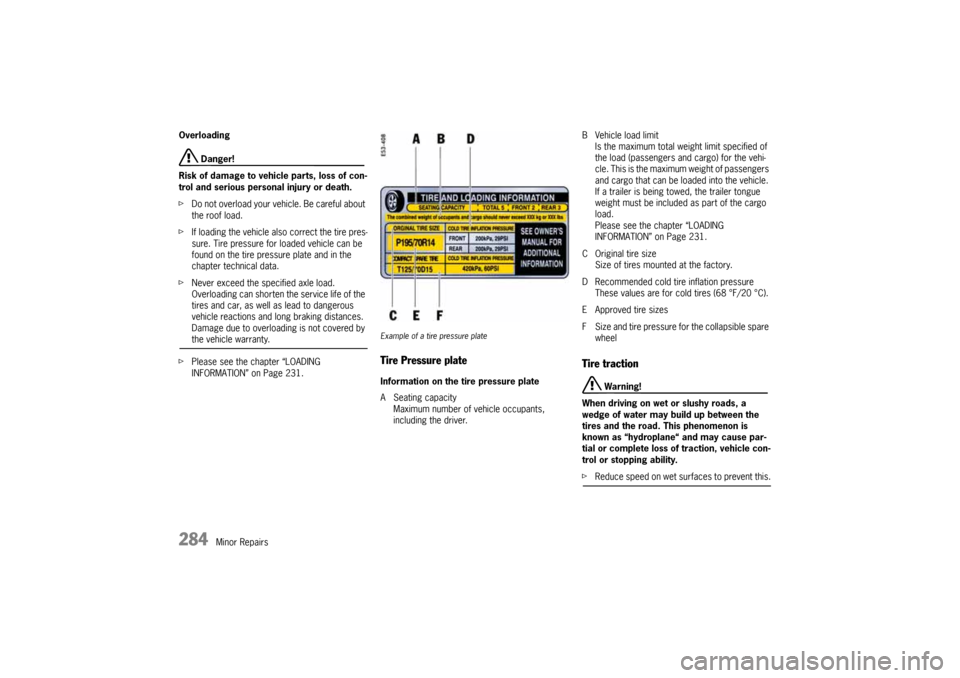
Example of a tire pressure plateTire Pressure plateInformation on the tire pressure plate
A Seating capacity
Maximum number of vehicle occupants,
including the driver.B Vehicle load limit
Is the maximum total weight limit specified of
the load (passengers and cargo) for the vehi-
cle. This is the maximum weight of passengers
and cargo that can be loaded into the vehicle.
If a trailer is being towed, the trailer tongue
weight must be included as part of the cargo
load.
Please see the chapter “LOADING
INFORMATION” on Page 231.
C Original tire size
Size of tires mounted at the factory.
D Recommended cold tire inflation pressure
These values are for cold tires (68 °F/20 °C).
E Approved tire sizes
F Size and tire pressure for the collapsible spare
wheel
Tire traction
Warning!
When driving on wet or slushy roads, a
wedge of water may build up between the
tires and the road. This phenomenon is
known as “hydroplane“ and may cause par-
tial or complete loss of traction, vehicle con-
trol or stopping ability.
fReduce speed on wet surfaces to prevent this.
10_Cayenne_21_KW17.book Seite 284 Donnerstag, 9. April 2009 3:33 15